

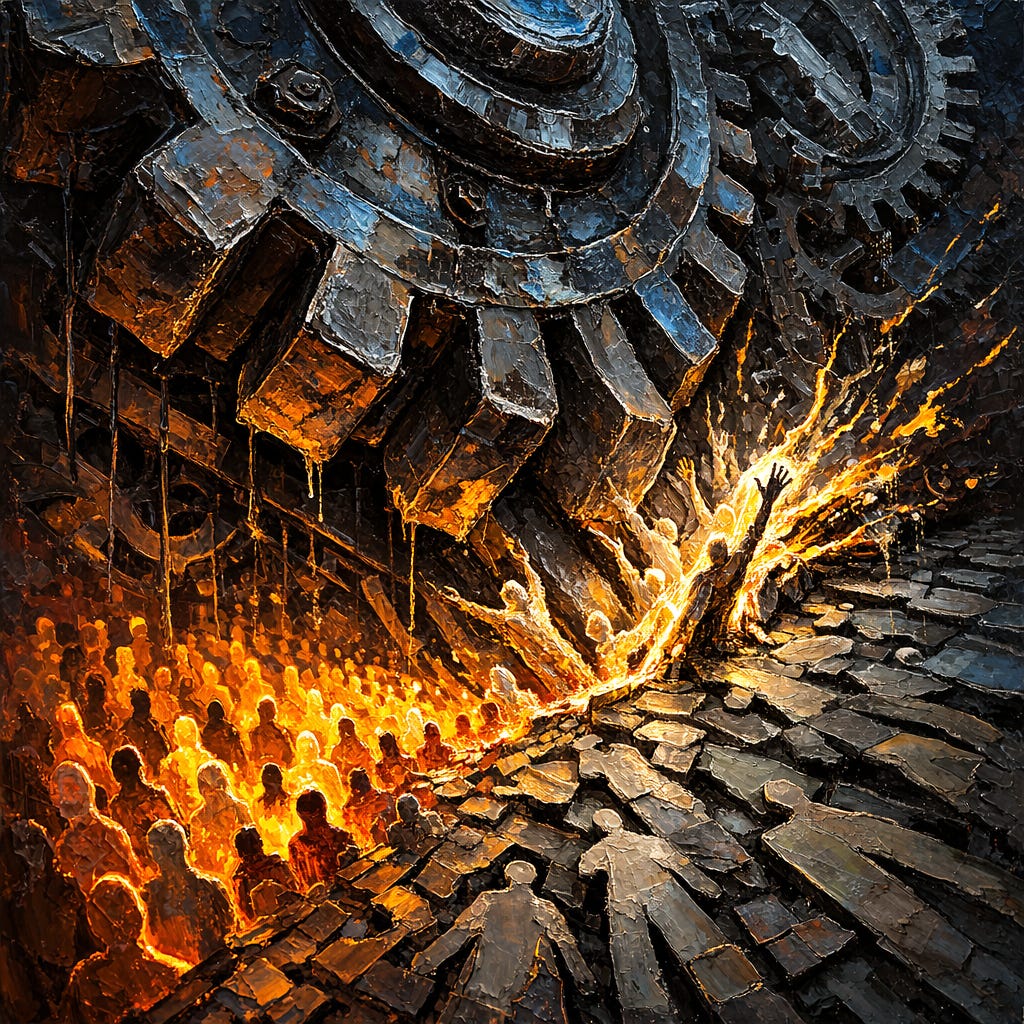
In 1936, at the University of Salamanca, the philosopher Miguel de Unamuno rose to answer a general who had just shouted his favourite motto: Viva la muerte! — Long live death. Unamuno called the cry “necrophilous and senseless.” He told the general he could win but never convince, because convincing requires what he lacked: reason and right. The general’s soldiers controlled the room. Unamuno was placed under house arrest and dead within months.¹
The scene contains the essential architecture of large-scale evil. A man who loves death and has the force to impose that love. A man who recognises what he is looking at and names it. And between them — the audience. The witnesses who will decide, through action or inaction, which world prevails.
Every serious account of evil contains these three elements. The debate that has fractured serious thinkers for decades is which one matters most. Is evil driven by the pathological few who design the machinery? Or by the ordinary majority who operate it? The answer — which the evidence compels and which no single author in the literature fully articulates — is that the question is wrongly framed. The pathological and the ordinary do not compete as explanations. They are two stages in a single process, operating at different scales, and neither produces evil without the other.
Support This Work
This work remains free because paid subscribers make it possible. If you find value here, consider joining them.
Paid subscribers get access to all books — including The DMSO Book, The Kitchen Remedies Guide, Chlorine Dioxide, The PSA Trap, Breast Cancer, and more — with 1-2 new books added each month. Plus the Deep Dive Audio Library: 180+ in-depth audio book summaries and discussions.
Pricing Update: The annual subscription moves from $50 AUD to $50 USD on May 7 (now extended from May 1) — the first change in five years. Current paid subscribers keep their existing rate. Free subscribers can lock in the current price by upgrading before May 7.
Everyone Got Arendt Wrong
Hannah Arendt watched Adolf Eichmann stand trial in Jerusalem and saw a man who could not utter a single sentence that was not a cliché. His “inability to speak was closely connected with an inability to think, namely, to think from the standpoint of somebody else.”² Standing beneath the gallows, he reached for stock phrases of funeral oratory — at his own funeral. She called this “the fearsome, word-and-thought-defying banality of evil.”
The phrase detonated across intellectual life, and almost everyone misread it. One camp took it as proof that any ordinary person becomes a killer under the right conditions. The other read it as trivialising genocide. Both missed the point. Arendt was not saying evil is common. She was saying that this particular evil arose from something common — from thoughtlessness — and that this was more terrifying than demonic intention, not less.³
The popular version hardened into a formula: ordinary people do terrible things when authority tells them to. Milgram’s obedience experiments appeared to confirm it. Zimbardo’s prison experiment appeared to seal it. The lesson entered the culture as settled knowledge.
It is half true. And a half-truth about evil is more dangerous than ignorance, because it closes the door on the question that still needs asking.
The Distribution That Won’t Go Away
In July 1942, Reserve Police Battalion 101 — roughly five hundred middle-aged Hamburg policemen, most of them working-class, few of them committed Nazis — received orders to shoot the Jewish population of the Polish village of Józefów. Their commander, Major Trapp, wept as he relayed the orders. He offered to excuse any man not “up to it.”⁴
What happened next is the single most important empirical finding in the study of perpetrator behaviour. The battalion split into three groups. Ten to twenty percent refused — stepped out, found ways to evade, accepted reassignment. The vast majority complied, reluctantly at first, with increasing numbness over time. Many vomited. Many drank themselves into a stupor. Many, when unsupervised, quietly refrained from shooting.
And a small nucleus volunteered for firing squads, sought out opportunities to kill, and appeared to discover a vocation in the massacre.⁵
This three-part distribution — a small eager core, a large reluctant middle, a small group of refusers — recurs everywhere researchers have looked. Zimbardo found roughly the same proportions among his randomly selected prison guards: a third cruel and inventive, a third compliant, less than twenty percent humane.⁶ Milgram’s data, read carefully, shows the same fracture. The majority who administered shocks did so with visible anguish. A small number did not.
The situational account cannot explain this. If evil were purely a function of pressure and circumstance, the response should be roughly uniform across the population. Instead it fractures along identical lines every time. The situation is necessary. It is not sufficient. Something else is selecting for that eager core, and something else is protecting the resistant minority.
The Spectrum
The psychoanalyst Erich Fromm, writing in 1964, proposed a framework that makes sense of this distribution without forcing a choice between pathology and situation. The deepest divide in human character, Fromm argued, is between what he called biophilia — the love of life — and necrophilia — the love of death.⁷
Not a sexual perversion. A total orientation. The necrophilous person is drawn to the mechanical over the organic, to control over spontaneity, to possession over experience. “The necrophilous person is driven by the desire to transform the organic into the inorganic, to approach life mechanically, as if all living persons were things.” The biophilous person prefers to construct rather than retain, sees wholes rather than parts, wants to influence “by love, reason, by his example — not by force, by cutting things apart, by the bureaucratic manner of administering people as if they were things.”⁸
The key insight is that this operates as a gradient. Pure necrophilia is psychopathology. Pure biophilia is sainthood. Most people are a blend, and what matters is which tendency dominates — and which conditions strengthen which tendency. Fromm identified the conditions with precision. Necrophilia is fostered by “lack of stimulation; fright; conditions which make life routinized and uninteresting; mechanical order instead of one determined by direct and human relations among people.” Biophilia requires “warm, affectionate contact with others during infancy; freedom, and absence of threats; teaching — by example rather than by preaching — of the principles conducive to inner harmony and strength.”⁹
Apply this to Browning’s battalion and the data resolves. The eager nucleus — the volunteers for firing squads — sit at the necrophilous end of the gradient. Not necessarily clinical psychopaths, but people in whom the orientation toward control, force, and the mechanical treatment of others was already dominant before the situation activated it. The reluctant majority sit in the middle of the gradient — biophilous enough to vomit, necrophilous enough to comply, pushed further along the spectrum by sustained exposure to conditions that reward obedience and punish independent feeling. The refusers are those in whom biophilia was strong enough to resist the pressure.
The situation didn’t create three types of people. It revealed a pre-existing distribution and then shifted the entire population toward death.
Who Designs the Machinery
Fromm’s gradient explains the majority. It does not explain where the machinery comes from.
Andrew Lobaczewski, a clinical psychologist who spent his career under communist rule in Poland, spent decades studying what he and a clandestine network of colleagues called “political ponerology” — the science of evil as it operates in political systems. Their central finding was that the variable missing from every mainstream account of totalitarianism was clinical psychopathology — not as a metaphor, but as a diagnosis.¹⁰
A small fraction of any population, Lobaczewski argued — he estimated around six percent when various personality disorders are included — are biologically incapable of the normal human responses of empathy, guilt, and conscience. The most significant subgroup, which he called “essential psychopaths,” perceive the moral and social world of normal people the way a colour-blind person perceives colour: as an incomprehensible convention with no grounding in their own experience. They learn, from childhood, to mimic normal emotional responses. They develop an expert practical knowledge of normal people’s weaknesses. And they recognise each other, forming what Lobaczewski described as “a ponerogenically active network of common collusions, partially estranged from the community of normal people.”¹¹
These individuals are not simply damaged or antisocial. They are, in Lobaczewski’s analysis, operating from a qualitatively different psychological world — one in which other people’s suffering produces no internal signal, in which conscience is an alien concept to be studied and exploited rather than experienced. Because they are unconstrained by guilt and skilled at impression management, they are disproportionately drawn to positions where power over others is available.
Under normal social conditions, this tendency is contained. Functional institutions, moral traditions, and the sheer numerical dominance of psychologically normal people keep the pathological minority at the margins. But under conditions of social stress — economic crisis, war, institutional decay, moral exhaustion — the constraints weaken. Lobaczewski described a process he called “ponerization”: the progressive capture of organisations by pathological individuals, beginning with character-disordered agitators who exploit legitimate grievances, and culminating with essential psychopaths who displace the early agitators and assume control. The ideology that attracted genuine believers is hollowed out. Its words remain. Their meanings invert.¹²
The editor of Political Ponerology asks the question the situational literature never confronts: in Milgram’s experiment, most subjects reluctantly obeyed an authority figure’s instructions to administer shocks. “Who is most likely to take the role played by the experimenter, the ones deciding the policy and giving the orders? Do they tend to be ‘ordinary people,’ too?”¹³
The answer, in Browning’s data, is visible if you know where to look. The rank and file of Battalion 101 were ordinary men by every measurable criterion — middle-aged, working-class, unremarkable. But the system that placed them in a Polish forest with orders to kill was not designed by ordinary men. The orders came from the highest levels of a regime that had been systematically captured, over a decade, by individuals whose relationship to human suffering was fundamentally different from that of the men pulling the triggers.
Turning People into Things
Simone Weil, writing in 1940 as France collapsed, identified the operation that connects these levels. Force, she wrote, is “that x that turns anybody who is subjected to it into a thing.” It kills — that is its most literal function. But its subtler work is more terrible: it turns a person into a thing while they are still alive. “He is alive; he has a soul; and yet — he is a thing. An extraordinary entity this — a thing that has a soul.”¹⁴
Weil saw that force degrades both sides. The victim is made into a thing by subjection. The wielder is made into a thing by the intoxication of power — by the disappearance of what she called the “tiny interval that is reflection” between impulse and act. Where that interval vanishes, so does justice, prudence, and the capacity to recognise the humanity of others.¹⁵
Arendt arrived at the same insight through political analysis. The concentration camps, she wrote in The Origins of Totalitarianism, existed to eliminate spontaneity itself — “man’s power to begin something new out of his own resources, something that cannot be explained on the basis of reactions to environment and events.” The endpoint was not death but something worse than death: the human being reduced to “a bundle of reactions,” a creature from whom all unpredictability had been extracted. “Totalitarianism strives not toward despotic rule over men, but toward a system in which men are superfluous.”¹⁶
This is what the convergence of pathological leadership and mass compliance produces. The psychopathic nucleus designs a system whose organising principle is the conversion of persons into things — into administrative categories, into numbers on transport lists, into labour units, into corpses. The ordinary majority operates the system, and in doing so is itself converted — not into psychopaths, but into something Arendt found more disturbing: people who have lost the capacity to think from the standpoint of another, who perform their functions within the machinery without confronting what the machinery does. Not evil in any classical sense. Something new: the human being as interchangeable component, as reliable as a reflex and as empty.
Fromm called this the triumph of necrophilia. Weil called it the empire of force. Lobaczewski called it pathocracy. Arendt refused to give it a name that would make it comprehensible through existing categories, because she believed its essence was precisely that it broke those categories. They were all describing the same thing: a system in which the logic of death — the treatment of living beings as raw material — becomes the organising principle of an entire society.
What the Refusers Know
The ten to twenty percent who refused are the most important and least examined data in the literature. Their existence is fatal to a pure situational account, because it proves the pressure is resistible. Their small number is fatal to a pure pathological account, because if only the pathological comply, refusal should be the norm, not the exception.
Lobaczewski observed that people who have had direct personal experience with psychopathic individuals — who have learned through painful encounter to recognise the mask of sanity — develop a psychological immunity. They become harder to manipulate, harder to spellbind. Knowledge of the pathological factor is itself protective: “mere proper knowledge alone can begin healing individual humans and helping their minds regain harmony.”¹⁷
Fromm said something parallel about biophilia: it is contagious, just as necrophilia is. The love of life “communicates itself without words, explanations, and certainly without any preaching that one ought to love life.”¹⁸
The refusers are not heroes in any conventional sense. Browning records no grand moral declarations from the men who stepped out at Józefów. They could not articulate ethical principles. They simply could not do it — the word they used most often was “weak,” as though the inability to shoot unarmed civilians were a failing rather than the last functioning reflex of a moral sense under siege.¹⁹ What they retained was something prior to articulation: Weil’s tiny interval of reflection, the capacity to perceive another person as a person rather than a thing. That interval is what the entire apparatus of totalitarianism — from the ideology down through the bureaucracy to the individual trigger-pull — is designed to destroy.
The defence against evil, then, is not primarily institutional, though institutions matter. It is not primarily ideological, though ideas matter. It is the preservation of that interval — the capacity to think, to perceive the person in front of you as a person, to refuse the conversion of the living into the dead. Lobaczewski staked his life’s work on the conviction that understanding the pathological factor protects against it. Fromm argued that the social conditions which foster biophilia — freedom, stimulation, direct human contact, the absence of mechanical routine — are the conditions under which evil has the hardest time taking root.
Both are right, and the implication is uncomfortable. The conditions of modern life — bureaucratic, screen-mediated, increasingly abstracted from direct human consequence — are conditions that narrow the interval. They do not produce psychopaths. They produce something almost as useful to psychopaths: a population in which the reflexes of empathy and independent judgement have been dulled just enough that, when the machinery starts, most people will operate it.
Unamuno saw all of this compressed into a single moment in a lecture hall in Salamanca. He named what he was looking at. The naming did not save him. But the general’s regime is gone, and the words survive: You will win, because you have more than enough brute force. But you will not convince.
The capacity to see what is in front of you, and to say what you see — this is where resistance begins, and where the machinery of death meets the only force it cannot convert into a thing.
References
The Unamuno incident occurred on October 12, 1936. Fromm recounts it in The Heart of Man (1964), Chapter 3, as an introduction to necrophilia.
Hannah Arendt, Eichmann in Jerusalem: A Report on the Banality of Evil (1963), Postscript.
Arendt, Eichmann in Jerusalem, Postscript: “It was sheer thoughtlessness — something by no means identical with stupidity — that predisposed him to become one of the greatest criminals of that period.”
Christopher R. Browning, Ordinary Men: Reserve Police Battalion 101 and the Final Solution in Poland (1992), Chapter 7.
Browning, Ordinary Men, Chapters 7–8 and 18.
Browning, Ordinary Men, Chapter 18, citing Zimbardo’s findings on guard behaviour in the Stanford prison experiment.
Erich Fromm, The Heart of Man: Its Genius for Good and Evil (1964), Chapter 3.
Fromm, The Heart of Man, Chapter 3.
Fromm, The Heart of Man, Chapter 3.
Andrew M. Lobaczewski, Political Ponerology: The Science of Evil, Psychopathy, and the Origins of Totalitarianism (1984/2022), Chapters IV–V.
Lobaczewski, Political Ponerology, Chapter IV, section on essential psychopathy.
Lobaczewski, Political Ponerology, Chapters IV–V. The ponerization process and the role of ideology are treated in the Editor’s Introduction and throughout.
Lobaczewski, Political Ponerology, Editor’s Introduction.
Simone Weil, “The Iliad, or The Poem of Force” (1940), trans. Mary McCarthy.
Weil, “The Iliad, or The Poem of Force.”
Hannah Arendt, The Origins of Totalitarianism (1951), Chapter 12, “Total Domination.”
Lobaczewski, Political Ponerology, Chapter I.
Fromm, The Heart of Man, Chapter 3.
Browning, Ordinary Men, Chapter 8. Many refusers described themselves as “too weak” or “cowardly” — unable to articulate their refusal as a moral act.
I think all those that love death should commit suicide before aiming their love on others. That would also solve the eugenicist's love of getting rid of 'superfluent' people. The thing is, they seem to love death for others, but they themselves want to live.
It is sad, really sad, to think that only 20 % of what look like humans, are human indeed.
Does the mechanism really work the way this article claims it does? There is something different about those who resist: the strength to recognize what they see and believe what they see. Most people see what everyone else sees, but refuse to believe what their own senses are telling them. This strength is internal, a belief in themselves, and especially their intuition-their connection with the Divine within them.
Everything about the Western system is designed to sever that connection so we become robots and subject to mind control. I am not talking about MK-Ultra although such extreme forms of mind control exist, the ordinary mind control most people experience is done by language. The ability to sense BS is dismissed as irrelevant by education which glorifies rational thought.
Consider the word democracy. Our education system distorted the word democracy to mean something good, when it is nothing more than mob rule. It is a system where in a numerically evenly divided population, convincing just one person means the other group's desires, wishes or concerns becomes a non-issue. We see that today. Twisting that word to mean our system of government (done through education) blinds the followers to the real effect of a true democracy and that those who want this can become the 50-1 minority at the blink of an eye, the whims of just one charismatic person with a pathological personality.
So when the left says Trump is destroying democracy, this is a true statement, but those that can't think for themselves will believe that is bad, whereas those who can ask why this is a bad thing, in other words their internal BS meter detects something fishy about that statement. Just because you detect something fishy does not mean you will like what he wants instead, but the ability to question something because it doesn't feel right is on the path towards discovering what is true and what is a manufactured fact.