

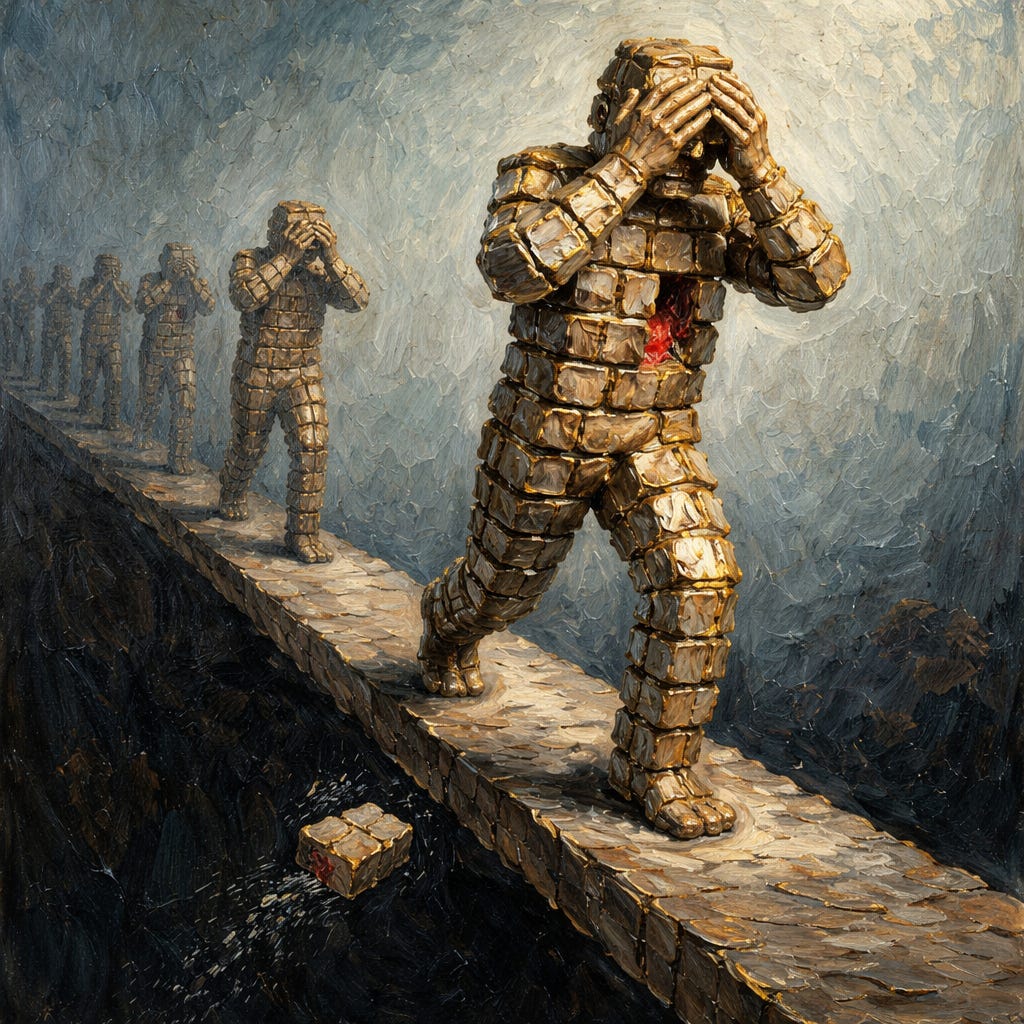
The academic does not question his university’s funding structure. The journalist does not challenge her outlet’s editorial line. The regulator does not push back against the industry he oversees. None of these people are consciously suppressing doubts. None of them wake up and decide to look the other way. They are, by every available measure, sincere. They believe what they need to believe, because the cost of believing otherwise is the mortgage payment, the school fees, the retirement fund, the spouse who married a certain kind of life — the entire architecture of an existence built on the assumption that the institution they serve is legitimate.
This is not a story about corruption. Corruption is easy to understand and easy to name. This is something more durable and more difficult to see: the process by which financial obligation generates genuine conviction. Not as a metaphor. As a mechanism.
The conventional understanding runs in one direction: people form beliefs, and those beliefs guide their financial decisions. They become doctors because they believe in medicine. They become journalists because they believe in the press. They become regulators because they believe in the system they oversee. The mortgage follows the belief.
The argument here is that the arrow runs the other way. The mortgage, and everything it represents (the career, the credential, the social identity, the monthly obligation that cannot be missed), creates the belief. Not in a single moment of compromise, but through a slow accumulation of commitments, each one narrowing the range of what a person can afford to think.
Support Independent Research
This work remains free because paid subscribers make it possible. If you find value here, consider joining them.
What paid subscribers get: Access to the Deep Dive Audio Library — 180+ in-depth discussions (30-50 min each) exploring the books behind these essays. New discussions added weekly. That’s 100+ hours of content for less than the price of a single audiobook.
[Upgrade to Paid – $5/month or $50/year]
Get in touch Essay ideas, stories, or expertise to share: unbekoming@outlook.com
The Production Line
The process begins long before anyone signs a loan agreement. It begins in school.
Samuel Bowles and Herbert Gintis, in Schooling in Capitalist America, identified what they called the correspondence principle: the structure of education mirrors the structure of the workplace. The relationships between administrators and teachers, teachers and students, students and their work, replicate the hierarchical division of labour. Students don’t primarily learn skills. They learn dispositions. Obedience. Deference to authority. Tolerance of boredom. Acceptance of external reward systems — grades — as substitutes for intrinsic motivation. The hidden curriculum, as Bowles and Gintis documented it, is not hidden at all once you look for it. It is the curriculum.
Their data showed the mechanism in action. When they analysed personality traits and academic performance, the only traits significantly penalised by the grading system were creativity, independence, and aggressiveness — the traits incompatible with conformity to hierarchical authority. The traits rewarded were perseverance, consistency, dependability, and identification with the school’s social order. Students rated high on “citizenship” and “drive to achieve” by their teachers were, by statistical measurement, below average on cognitive flexibility, complexity of thought, originality, and independence of judgement. The system didn’t fail to develop independent thinkers. It actively selected against them.
The school committees of the nineteenth century were candid about this. The Springfield School Committee wrote in 1854 that “the object of education is by no means accomplished by mere intellectual instruction. It has other aims of equal if not higher importance. The character and habits are to be formed for life.” They then named the habits: “attention, self-reliance, habits of order and neatness, politeness and courtesy... habits of punctuality.” A writer in the Massachusetts Teacher connected these directly to industrial requirements: “The habit of prompt action in the performance of the duty required of the boy, by the teacher at school, becomes in the man of business confirmed; thus system and order characterize the employment of the day laborer.”
The mill owners funding these schools knew what they were buying. Literacy rates in Massachusetts already exceeded what the economy required. Only a small fraction of jobs demanded it. What employers needed was not cognitive skill but behavioural compliance — and the schools delivered. As Bowles and Gintis observed, the employers’ support for public education “apparently related to the noncognitive effects of schooling — in more modern terms, to the hidden curriculum.”
C. Wright Mills, writing in White Collar, traced what happens next. The graduate school is organised as a feudal system: “the student trades his loyalty to one professor for protection against other professors.” The young scholar learns that the path upward runs through conformity, not originality. “The personable young man, willing to learn quickly the thought-ways of others, may succeed as readily or even more readily than the truly original mind.” The specialisation required for professional success is, as Mills put it, “often deadening to the mind that would grasp for higher culture.” The professor is “a member of a petty hierarchy, almost completely closed in by its middle-class environment.” In that hierarchy, “mediocrity makes its own rules and sets its own image of success.”
The pipeline doesn’t just sort people into jobs. It sorts them into selves. Different levels of the educational system produce different kinds of compliance for different levels of the hierarchy. Bowles and Gintis found that “lower levels (junior and senior high school) tend to severely limit and channel the activities of students. Somewhat higher up the educational ladder, teacher and community colleges allow for more independent activity and less overall supervision. At the top, the elite four-year colleges emphasize social relationships conformable with the higher levels in the production hierarchy.” The worker learns to follow rules. The manager learns to internalise norms. The executive learns to identify with the institution itself. Each track produces the dispositions required for the corresponding rung, and the system either allows students to progress to the next level of behavioural regulation or channels them into the corresponding level in the hierarchy of production.
By the time a person emerges from this pipeline — twelve years of primary and secondary education selecting for compliance, four years of undergraduate training reinforcing it, three to eight years of graduate or professional school deepening the groove — they have spent the majority of their conscious life being shaped by institutions whose primary function, whatever their stated purpose, is the production of people who will operate without complaint within hierarchical structures. They have been selected, sorted, and rewarded for their willingness to defer. They have absorbed, as genuine personal conviction, the values of the institutions that trained them.
Mills saw where this leads. The professor, once established, operates within “a petty hierarchy, almost completely closed in by its middle-class environment and its segregation of intellectual from social life.” Research becomes dependent on foundation funding, and foundations are “notably averse to scholars who develop unpopular, ‘unconstructive,’ theses.” The young academic who studies Latin America or Asia, and who “does not deviate from acceptable facts and policies,” hopes for “opportunities of research, travel, and foundation subsidies.” By his silence — or explicitly in his work — “the academic intellectual often sanctions illusions that uphold authority, rather than speak out against them. In his teaching, he may censor himself by carefully selecting safe problems in the name of pure science.” Mills was describing the early stage of the process — the point where the academic still knows he is selecting safe problems. What happens next is more complete: the safe problems become the only problems he can see. The selection becomes invisible. The self-censorship becomes the self.
This is the product of the pipeline: a person whose beliefs are institutionally shaped, professionally reinforced, and experienced as entirely their own. They have not yet signed a mortgage. But the beliefs are already forming.
The Lock
What the mortgage does is make those beliefs load-bearing.
David Graeber, in Debt: The First 5,000 Years, demonstrated that debt is never merely an economic arrangement. It is a moral one. The debtor-creditor relationship reshapes what people believe they owe — not just financially but existentially. To be in debt is to be in a state of obligation that permeates identity. The debtor does not simply owe money. The debtor owes good behaviour. The debtor owes gratitude. The debtor owes, in a very real sense, the maintenance of the system that allowed the debt to exist in the first place.
Maurizio Lazzarato extended this analysis in The Making of the Indebted Man, arguing that debt is the primary mechanism of contemporary social control, producing a specific subjectivity. The indebted subject is not coerced from outside. The indebted subject has internalised the obligation. The debt “mobilizes the innermost depths of the human heart” to orient behaviour. And the architecture of modern life (no right to housing, only mortgage loans; no right to education, only student loans; no socialised risk, only private insurance) ensures that this subjectivity is nearly universal. “Learning how to live with debt,” Lazzarato noted, “has now been made part of certain American school curricula.”
The mortgage is the apotheosis of this process. It is the single largest financial commitment most people will ever make. It typically represents twenty-five to thirty years of future labour, pledged in advance. It requires the continuous maintenance of employment, which requires the continuous maintenance of professional standing, which requires the continuous maintenance of whatever beliefs are necessary to remain in good standing within one’s profession.
Michael Hudson, in Killing the Host, documented how this operates at scale. By 2011, the U.S. housing finance agency had raised its guarantee for mortgage debt service to 43 percent of family income, up from the customary 25 percent rule of thumb prior to the 1980s. “Instead of elevating families into the middle class,” Hudson wrote, “the inflation of home prices becomes a treadmill to debt peonage.” The mortgage doesn’t purchase security. It purchases a lifetime of vulnerability dressed as stability.
Andrew Ross, in Creditocracy, traced the political function of this arrangement back to its origins. The campaign for mass homeownership was ideological from the start. After the 1920 Census showed a dip in homeownership, the Better Homes movement launched “Own Your Own Home Day” as the nucleus of National Thrift Week. Herbert Hoover, as Secretary of Commerce, aimed to cultivate what he called “the primal instinct in us all for home ownership.” The General Motors financing chairman declared that consumer credit would deliver “the dream haven of plenty for everyone and fair shake for all, which the socialists have pointed out to mankind. But our route will be by the capitalist road of upbuilding rather than by the socialist road of tearing down.” Access to credit became a staple of the public relations war against socialism for decades, first domestically and then in the worldwide contest with the Soviet bloc.
The New Deal converted this ideological project into permanent institutional architecture. The FHA insured mortgages, creating a class of people whose political behaviour would be constrained by their financial exposure. The postwar suburban home, financed by these FHA-insured mortgages, “was a container to be filled with goods purchased at department stores.” For those who qualified — predominantly white suburban home purchasers — “the fear of a damaged credit score, or threat of a foreclosure, helped to reinforce the rigid status quo that was so distinctive of the Cold War culture of conformity. Debt service was the key to enforcing social norms, and so the mortgaged home became the cornerstone of capitalist ideology in this period.” William Levitt, the master builder of mass suburban homes, stated the principle explicitly: “No man who owns his own house and lot can be a communist.” He was articulating a view that had guided a generation of housing reformers in their bid to foster “a conservative point of view in the working man.”
This was not accidental. Raghuram Rajan, in Fault Lines, documented how credit expansion functioned as a deliberate political substitute for wage growth. As median family income stagnated from 1973 onward, and as income inequality widened — the highest-earning one percent took more than 60 percent of all income gains between 1979 and 2007 — politicians discovered that extending credit was cheaper than raising wages and far less disruptive than redistribution. “Populist credit expansion” allowed people “the consumption possibilities that their stagnant incomes otherwise could not support.” By the decade before 2008, the average American household was handing over almost one in every five dollars of after-tax income to Wall Street in debt service. The mortgage was offered as the American Dream. It functioned as a leash.
The result, as Ross documented, was a society in which the right to access credit quietly replaced the right to housing, just as the right to access student loans replaced the right to education. The debtor replaced the citizen. And the debtor, by definition, cannot afford to question the system that services the debt.
Lazzarato captured the mechanism at its most transparent in the subprime crisis: “The boom in real estate and easy credit were two ways to pacify workers and the middle class and make them go along with the long-term program of the liberal system. When we wanted to buy a house, a car, or a vacation to Paris on credit, we were made to believe in the success of globalization.” The word “believe” is doing the heavy lifting in that sentence. The credit didn’t just purchase goods. It purchased conviction. It made the debtor an investor in the ideology that justified the debt. To question globalisation, to question the financial system, to question the institutions that underwrote the loans, was to question the value of the asset your family’s future depended on. The mortgage made the homeowner an ideological stakeholder — not through persuasion, but through obligation.
The Engine
The mechanism that converts financial obligation into genuine belief has a name. Leon Festinger called it cognitive dissonance.
The theory works like this. When a person’s behaviour conflicts with their beliefs, the resulting psychological discomfort — dissonance — must be resolved. The resolution almost always favours the behaviour that is hardest to change. A person who has made a large, irrevocable commitment will adjust their beliefs to justify that commitment rather than face the implications of having committed to something wrong.
The mortgage is one of the most irrevocable commitments available. Once signed, the borrower has pledged decades of future income. The career that services the mortgage cannot be abandoned without risking everything built upon it — the house, the neighbourhood, the school district, the marriage, the retirement, the identity. And the career, in most professional fields, rests on a body of beliefs. The cardiologist’s income depends on the cholesterol-statin model of heart disease. The academic’s tenure depends on the legitimacy of the funding structures that support his field. The journalist’s salary depends on the editorial framework of her publication.
When contradictory evidence arrives — and it always arrives — it does not meet a neutral mind. It meets a mind that has been shaped by twenty years of institutional selection for compliance, locked into a financial obligation that requires the continuous maintenance of professional legitimacy, and operating a psychological system that automatically resolves contradictions in favour of existing commitments. The evidence doesn’t stand a chance.
Character has nothing to do with it. The system produces this result as reliably as a factory produces its product.
Consider the professional sequence. A young person enters medical school at twenty-two. She has been selected, through the educational pipeline described above, for her compliance, her capacity to absorb and reproduce received knowledge, and her tolerance of hierarchical authority. She takes on $200,000 in debt to fund her training — a commitment made at an age when the brain’s prefrontal cortex is barely finished developing. She spends four years absorbing a body of knowledge that she has neither the time nor the institutional permission to critically examine. She then spends three to seven years in residency, a word whose etymology tells its own story: she lives at the institution, her hours are the institution’s hours, her social world narrows to the institution’s people. She emerges credentialed, begins practice, takes on a mortgage, starts a family. Each commitment deepens the next. Each one raises the cost of revision.
The commitments cascade. The student loan makes the degree necessary. The degree makes the career necessary. The career makes the income necessary. The income makes the mortgage possible. The mortgage makes the income non-negotiable. The non-negotiable income makes the career untouchable. The untouchable career makes the beliefs that sustain it mandatory. Each link forges the next, and by the time the chain is complete, the person at the end of it experiences their beliefs not as the product of constraint but as the result of education, experience, and professional judgment. The chain is invisible to the person wearing it — and this invisibility is what makes it function.
She now encounters a patient whose symptoms don’t fit the model she was trained in. She has two paths. Path one: the model is incomplete or wrong, which means her training was flawed, her mentors were mistaken, her daily practice may be causing harm, her professional identity is built on sand, her income is at risk, her mortgage is at risk, her children’s school fees are at risk. Path two: the patient is an outlier, the symptoms are coincidental, the model holds. Path two costs nothing. Path one costs everything. The dissonance resolves in favour of the existing structure. Every time.
James C. Scott, in Domination and the Arts of Resistance, described the phenomenon from the other side — what he called the hidden transcript. In every system of domination, people maintain two sets of beliefs: what they say in the presence of power, and what they say behind its back. But Scott identified something more disturbing than strategic performance: the possibility that sustained domination eventually collapses the gap between the public and private transcript. People stop merely performing compliance. They begin to actually believe.
Working-class parents, Scott observed, “stress outward conformity and compliance with far less concern for the motives that lie behind it. The pattern reflects to a great extent the kind of compliance to work life and to the class system that has been expected, and extracted, from their parents.” The conformity isn’t skin deep. It goes down to the bone. And the mortgage is the mechanism that drives it there — because when the cost of private dissent rises high enough (when your family depends on your maintaining the public transcript), the mind simplifies its workload by eliminating the private transcript altogether.
Mills saw this in the academic world: “The real restraints are not so much external prohibitions as manipulative control of the insurgent by the agreements of academic gentlemen.” The professor’s compliance is not forced. It is “a vague general fear — sometimes called ‘discretion’ and ‘good judgment’ — which leads to self-intimidation and finally becomes so habitual that the scholar is unaware of it.” The scholar does not feel censored. The scholar feels professional. The distinction has been erased.
Chomsky and Herman, in Manufacturing Consent, documented the same process in journalism: “Censorship is largely self-censorship, by reporters and commentators who adjust to the realities of source and media organizational requirements.” The journalists are not told what to write. They are selected — through the credentialing pipeline, through institutional culture, through the financial pressures of career maintenance — for already believing the right things. “Most biased choices in the media arise from the preselection of right-thinking people, internalized preconceptions, and the adaptation of personnel to the constraints of ownership, organization, market, and political power.”
The journalist doesn’t feel captured. The academic doesn’t feel captured. The doctor doesn’t feel captured. They feel informed, professional, and appropriately sceptical of fringe claims that contradict the settled science of their fields. The mortgage didn’t make them lie. It made them believe.
The Panopticon Pays for Itself
Michel Foucault, in Discipline and Punish, described the Panopticon: a prison designed so that inmates could always be observed but could never know when they were being watched. The effect was to “induce in the inmate a state of conscious and permanent visibility that assures the automatic functioning of power.” The prisoner internalises the surveillance and polices himself. The architecture “should be a machine for creating and sustaining a power relation independent of the person who exercises it.”
The mortgage is a financial panopticon. The professional who carries thirty years of debt doesn’t need to be watched. She watches herself. She doesn’t need to be told which papers not to read, which questions not to ask, which colleagues not to associate with. She already knows — not as explicit knowledge, but as instinct, as “good judgment,” as professionalism. The debt creates the discipline, and the discipline creates the belief, and the belief feels like autonomy.
Foucault noted that the Panopticon’s power was that “it never intervenes, it is exercised spontaneously and without noise, it constitutes a mechanism whose effects follow from one another.” The mortgage works the same way. It doesn’t intervene. It doesn’t need to. It has already done its work. The professional’s beliefs are self-maintaining because the cost of maintaining them is invisible — it’s just the monthly payment, just the normal way of being — while the cost of revising them is total.
This is why dissent in professional fields tends to come from two populations: those at the top who have enough financial security to absorb the consequences, and those at the bottom who have nothing left to lose. The retired professor who finally publishes the paper she sat on for twenty years. The doctor who speaks up after selling the practice and paying off the house. The journalist who writes the real story after leaving the publication. Their timing is not coincidental. They waited until the mortgage no longer held. The great middle — the mortgaged class, the professionals in their prime earning years with dependents and obligations — is structurally incapable of dissent, not because they lack courage or intelligence, but because the architecture of their lives has made dissent identical to self-destruction.
Scott identified this pattern. The hidden transcript, the things people really think but cannot say, only emerges “outside the earshot of powerholders.” But for the mortgaged professional, there is no outside. The power holder is not a person. It is a structure — the interlocking set of obligations that requires continuous performance of the approved beliefs. There is no backstage. The mortgage ensures that the performance is permanent, and the permanence of the performance eventually extinguishes the private thought that the performance was meant to conceal. The professional doesn’t end up performing a belief she doesn’t hold. She ends up holding the belief because she has performed it for so long, under conditions that made any alternative performance unthinkable.
None of this is a bug in the system. The educational pipeline was designed to produce compliant workers — Bowles and Gintis documented this through the explicit statements of the industrialists and school committees who built it. The credentialing structure was designed to make professional identity dependent on institutional approval. The mortgage was designed to make that identity financially non-negotiable. And cognitive dissonance, though designed by no one, is exploited by every institution that requires loyalty as a condition of employment. The result is a professional class, the people who staff the hospitals, write the news, run the regulatory agencies, teach the next generation, that cannot afford to change its mind. The architecture of their lives has made their beliefs structural. Pull one out and the building falls.
What the Pediatrician Cannot See
Everything described above converges in the figure of the pediatrician.
She entered the pipeline early — a diligent student, selected through two decades of institutional sorting for her compliance, her capacity to absorb received knowledge, her comfort with authority. She graduated medical school carrying debt. She completed residency, absorbing not just clinical knowledge but clinical culture — the habits, the assumptions, the reflexive confidence in institutional protocols. She joined a practice. She took out a mortgage. She enrolled her children in school. She married another professional. Each commitment deepened the last.
Her practice follows the CDC’s recommended vaccination schedule. She administers vaccines at well-child visits. She believes in the schedule — not as a matter of policy but as a matter of identity. She is a good doctor. Good doctors vaccinate. The schedule is supported by institutional consensus, by her training, by the professional organisations to which she belongs, by the colleagues she respects, and by the liability framework within which she operates. Her belief in the schedule is as structural as the walls of her office.
Then a mother calls. Three days after the well-child visit. The child has had seizures. The light in his eyes has changed. He has stopped speaking.
The pediatrician has two interpretive options. One: the vaccine caused this, which means she caused this, which means the schedule she follows is harmful, which means her training was wrong, which means the institutions she trusts are compromised, which means her professional identity, the identity that services the mortgage, funds the school fees, sustains the marriage, underwrites the life, is built on harm. Two: the timing is coincidental, regression has many causes, correlation is not causation, the science is settled, the mother is understandably distressed but mistaken.
Option one is total destruction. Option two is Tuesday.
She chooses option two. Not cynically. Genuinely. Her brain will not permit her to see what she cannot afford to see. And the next time a mother calls with a similar story, the pattern is already established. The child who regressed after vaccination is coded as a child who happened to regress around the time of vaccination. The temporal association — which is the first thing any epidemiologist would flag in any other context — is reclassified as coincidence. The mother who insists on what she observed is managed, reassured, and if she persists, labelled as anxious, as influenced by misinformation, as the kind of parent who reads the wrong websites.
The mother, for her part, has no financial stake in the vaccine schedule being unsafe. She has no career built on that conclusion. She has no mortgage that depends on it. She has only what she saw: a child who was developing normally, who received a vaccination, and who was not the same child three days later. Her observation is direct, unmediated, and costs her nothing to report — except, as she discovers, her credibility within the medical system her child depends on.
The Vaccine Injury Compensation Program has paid out over $4.7 billion since its creation in 1988. The program exists because Congress acknowledged that vaccines cause injuries. The manufacturers’ own package inserts list adverse events, including seizures, encephalopathy, and death. These are not contested claims. They are disclosed, documented, and compensated facts. The package insert is in the pediatrician’s office. She has access to it. But access is not the same as attention, and attention is governed by what the mind can afford to process.
The VICP’s existence is Tier 1 evidence — a direct admission by the legal system that the thing the pediatrician cannot afford to see is the thing the government has already built a program to address. No vaccinated-versus-fully-unvaccinated study has been conducted by the institutions responsible for vaccine safety. This absence is not an oversight. It is the kind of study that would either confirm the safety claims and silence the critics, or fail to confirm them and destabilise a multi-billion dollar program along with the professional identities of everyone who administers it. The study that would resolve the question is the study that cannot be funded, because the answer might be unaffordable.
But the pediatrician doesn’t read the package inserts with the same attention she gives the CDC’s recommendations. She doesn’t study the VICP’s compensation data. She doesn’t investigate the exposed absence of a vaccinated-versus-fully-unvaccinated study. These are not acts of dishonesty. They are acts of survival. Her mind, shaped by the educational pipeline, locked by the financial architecture, governed by the dissonance engine, cannot afford to process information that would destabilise the structure her life depends on.
The mothers who report injuries don’t have mortgages riding on the vaccine schedule being safe. Their only stake is what they observed. This asymmetry — between the parent who has nothing to lose by seeing clearly and the doctor who has everything to lose — explains the ferocity of the conflict between them. They are not disagreeing about evidence. They are operating under completely different financial relationships to the truth.
What Remains
This essay is not an argument against homeownership. A house is shelter. A mortgage, in many circumstances, is a reasonable financial instrument. The argument is about what happens when mortgage debt — and the professional obligations it requires — becomes the dominant organising structure of a person’s intellectual life. When the monthly payment becomes the hidden variable in every question of evidence, every assessment of risk, every professional judgment.
The cardiologist who cannot revisit the statin model. The oncologist who cannot question the chemotherapy protocol. The journalist who cannot challenge the editorial framework. The regulator who cannot confront the industry. The academic who cannot follow the evidence where it leads. The pediatrician who cannot hear what the mother is telling her.
Understanding how they got here does not reduce the harm they do. The system that produced them is explicable. The outcomes they produce are real. A pediatrician who cannot see vaccine injury still administers the next vaccine. A cardiologist who cannot question the statin model still prescribes the statin. A journalist who cannot challenge the editorial line still publishes it. Their sincerity is total, and it changes nothing for the people on the receiving end. The child who regressed does not benefit from the doctor’s genuine belief that the schedule is safe. The mechanism explains the belief. It does not excuse the consequences. The mortgage didn’t corrupt them. It completed them.
Foucault wrote that the Panopticon’s genius was that it could “be integrated into any function” and would “increase the effect of this function, by being linked closely with it.” The mortgage integrates into the function of professional life and increases its effect. The doctor becomes a better institutional doctor. The journalist becomes a better institutional journalist. The academic becomes a better institutional academic. Better, that is, at reproducing the beliefs their institutions require — and genuinely, sincerely holding those beliefs as their own.
Lazzarato wrote that the neoliberal subject is not disciplined from outside but produced from within — a subject who has internalised the logic of debt so completely that external coercion is unnecessary. The indebted subject monitors herself, evaluates herself, adjusts herself, all in service of meeting obligations she experiences as freely chosen. The mortgage is the perfection of this logic. It transforms a financial contract into an epistemological one. It doesn’t dictate what you must believe. It creates the conditions under which certain beliefs become necessary and others become impossible.
The system doesn’t need conspiracy. It doesn’t need directives from above. It doesn’t need anyone to sit in a room and decide which truths to suppress. It only needs the mortgage payment, due on the first of the month, every month, for thirty years. The beliefs take care of themselves.
And this is the final turn of the screw. The people most captured by this mechanism are the people society relies on for its understanding of reality: the doctors, the scientists, the journalists, the professors. The very class whose professional function is to evaluate evidence and tell the truth is the class most structurally incapable of doing so, because their ability to tell the truth is downstream of their ability to make the payment. The mortgage doesn’t just create beliefs in individuals. It creates the epistemic architecture of an entire society — a society that cannot correct itself because the people responsible for correction cannot afford to.
References
Bowles, S. and Gintis, H. (1976) Schooling in Capitalist America: Educational Reform and the Contradictions of Economic Life. New York: Basic Books. Reissued by Haymarket Books, 2011.
Chomsky, N. and Herman, E. (1988) Manufacturing Consent: The Political Economy of the Mass Media. New York: Pantheon Books.
Festinger, L. (1957) A Theory of Cognitive Dissonance. Stanford: Stanford University Press.
Foucault, M. (1975) Discipline and Punish: The Birth of the Prison. Translated by A. Sheridan. New York: Vintage Books, 1995.
Graeber, D. (2011) Debt: The First 5,000 Years. Brooklyn: Melville House.
Hudson, M. (2015) Killing the Host: How Financial Parasites and Debt Bondage Destroy the Global Economy. ISLET-Verlag.
Lazzarato, M. (2012) The Making of the Indebted Man. Translated by J.D. Jordan. Los Angeles: Semiotext(e).
Mills, C.W. (1951) White Collar: The American Middle Classes. New York: Oxford University Press.
Rajan, R. (2010) Fault Lines: How Hidden Fractures Still Threaten the World Economy. Princeton: Princeton University Press.
Ross, A. (2013) Creditocracy and the Case for Debt Refusal. New York: OR Books.
Scott, J.C. (1990) Domination and the Arts of Resistance: Hidden Transcripts. New Haven: Yale University Press.
Book: Medicalized Motherhood: From First Pill to Permanent Patient
Available as a free download. 123 interventions documented across six phases—from pre-conception capture through postpartum surveillance. Includes practical tools: birth plan template, provider interview questions, quick reference card, and a new chapter on interrupting the cascade. Download it, share it with someone facing their first prenatal appointment, their induction date, their cesarean recommendation. The cascade works because women don’t see it coming. This book makes it visible.
Support Independent Research
This work remains free because paid subscribers make it possible. If you find value here, consider joining them.
What paid subscribers get: Access to the Deep Dive Audio Library — 180+ in-depth discussions (30-50 min each) exploring the books behind these essays. New discussions added weekly. That’s 100+ hours of content for less than the price of a single audiobook.
[Upgrade to Paid – $5/month or $50/year]
Get in touch Essay ideas, stories, or expertise to share: unbekoming@outlook.com
New Biology Clinic
For those of you looking for practitioners who actually understand terrain medicine and the principles we explore here, I want to share something valuable. Dr. Tom Cowan—whose books and podcasts have shaped much of my own thinking about health—has created the New Biology Clinic, a virtual practice staffed by wellness specialists who operate from the same foundational understanding. This isn’t about symptom suppression or the conventional model. It’s about personalized guidance rooted in how living systems actually work. The clinic offers individual and family memberships that include not just private consults, but group sessions covering movement, nutrition, breathwork, biofield tuning, and more. Everything is virtual, making it accessible wherever you are. If you’ve been searching for practitioners who won’t look at you blankly when you mention structured water or the importance of the extracellular matrix, this is worth exploring. Use discount code “Unbekoming” to get $100 off the member activation fee. You can learn more and sign up at newbiologyclinic.com
Grew up.inside all the trappings and complied as expected (by loving parents, relatives, peers) and travelled the path up through higher education to a "career", a marriage (thankfully to someone less indoctrinated due to social class) and children. And the lock: the mortgage. The dissonance became unbearable as the narratives never held for me and the monetary rewards that were tied to social and professional standing were not enough of a carrot. Saw through the lies at the pediatrician's (thus never vaccinated my children), at the cardiologists who killed my father with coumadin, the neurologist who killed my mother with an "early onset dementia" diagnosis and prescribed poison, at the 60 hour a week job that barely paid enough to meet basic family needs and required accepting significant portion of compensation in form of (insurance) benefits that we had no use for. It's a horrible gerbil wheel we place humans on early in life. Somehow we escaped. Taught our kids to NOT take a student loan debt obligation they will never be able to.pay.off via tradional "jobs", sold the house before CVid hit and moved to a.very rural community now renting a little cabin not quite off grid. Our income sources are now direct, mostly in cash, and independent (self employed). No credit cards. Live WITHIN means. Much less existential discord and stress and we are how able to see the game, the illusion, the narrative for what it truly is. And its heartbreaking that all the friends left behind, will remain on the compliance path tethered to their debt to their graves and for the degree to which our world instantly shrunk from the moment we stepped outside the bubble of shared belief. I will never forget the hurtful last words spoken by a dear " friend" in 2020 before we made the final exit: (snarkily) "Well, I hope 'your truth' makes you safe."
Touché.
Teachings from the Pleiadians
"The ultimate tyranny in a society is not control by martial law. It is control by the psychological manipulation of consciousness, through which reality is defined so that those who exist within it do not even realize that they are in prison."
Barbara Marciniak