

This essay reports a community case of silica water administered to a man with an early-stage Alzheimer’s diagnosis. His cognitive assessment scores were recorded by a treating neurologist at seven defined timepoints across thirty months. Alzheimer’s is referred to by name because that is how the condition is known. The terrain reading, in which aluminum accumulation and its removal via orthosilicic acid are the operative mechanism, runs in the author’s own voice; the establishment’s amyloid-cascade framing appears only in attribution. The 2006 clinical trial that first documented this effect and the 2016 hypothesis paper that proposed scaling it are the published anchors. A reader, Rick Murray Jr, sent me his father’s data after reading an earlier essay and gave his permission to use the real names.
Related Essay

In November 2017, Rick Murray Sr sat down with Dr Paul Burke, a neurologist with Novant Health in Winston-Salem, North Carolina, for his first Montreal Cognitive Assessment. Asked to draw a clock face, he struggled. Asked what year it was, he said 2003. Dr Burke described the result as consistent with early-stage Alzheimer’s and offered Aricept, Namenda, or screening for a new Eli Lilly drug trial. The family declined the two drugs and applied for the trial. Rick Sr’s MOCA score and MRI results excluded him from enrollment.
Rick Jr, his son, had been reading about aluminum. He had come across Dr Christopher Exley’s name on YouTube and investigated his work on orthosilicic acid, the dissolved form of silicon in some mineral waters that binds aluminum and facilitates its excretion in urine and sweat. After the Lilly trial declined his father, he put him on 1.5 liters per day of Fiji water, which carries approximately 146 parts per million of orthosilicic acid. He added three supplements at the same time: B-12, magnesium, and potassium, because Exley had suggested in a video that OSA may pull these out alongside the aluminum.
Dr Burke administered every subsequent MOCA test personally, in the same office. The assessment has multiple validated versions designed to prevent score inflation from repeated testing, and he rotated them across visits.
That first MOCA was 16 out of 30. March 2018: 18. July 2018: 21. November 2018: 23. May 2019: 24.¹
This work stays free because paid subscribers make it possible. They get the full book library, the Deep Dive Audio Library, and the Questions for Your Doctor, Before You Consent, and Package Insert series. No grants, no gatekeepers — your subscription is what keeps it that way.
Audio Deep Dive (for Paid Subscribers)
The clean signal
The rise from 16 to 24 across eighteen months is an unusual trajectory for a patient with an early-stage Alzheimer’s diagnosis. Nothing else was changing across the same period. Rick Sr took no Alzheimer’s medications and made no dietary changes. His aluminum exposures stayed what they had been for decades: the same antiperspirant he had always used, no sodas or beer from aluminum cans (he did not drink them anyway). He had been taking vitamins daily since Rick Jr was a child, and continued at the same dose. The only new inputs introduced in November 2017 were the 1.5 liters per day of Fiji water and the three added supplements.
A critic will note the supplement confound. Rick Jr did not add Fiji alone; he added Fiji plus B-12, magnesium, and potassium. A pure “water-only” causal claim is not available from this data. What is available is the claim that a terrain-based protocol combining silica water with its chelation co-factors, introduced without any other change in medication, diet, or exposure, produced an 8-point MOCA rise over 18 months in a man who had been diagnosed with early-stage Alzheimer’s and screened out of a pharmaceutical trial for being too impaired.
Mainstream biochemistry does not rescue the supplement objection either. Rick Sr had been on daily vitamins for decades, so no addition in 2017 was starting a new intake of anything his routine was not already supplying. Magnesium and potassium taken on their own have no documented record of producing 8-point MOCA improvements in anyone.
The partial withdrawal
After the summer of 2019, the family stopped the active bottle-dating and reminder oversight. Rick Jr assumed his father could manage the schedule on his own. Rick Sr kept drinking Fiji, but on his own pace. Rick Jr noticed days behind, sometimes weeks.
In December 2019, Rick Sr’s MOCA score dropped to 22. In June 2020, 19.¹
Those two visits closed the clinical record. Dr Burke moved to remote work that year to care for his own mother, who had dementia. The structured regimen was never restored to its original intensity. For the twenty-one months Rick Sr lived after that, he continued to drink the Fiji water Rick Jr delivered monthly, without the daily tracking.
Why the shape matters
A within-subject rise under compliant dosing and a partial fall under lapsed dosing, measured by the same clinician using rotated versions of the same instrument in the same office, closes most of the standard methodological objections at once. There is no placebo-versus-active-arm comparison to argue about, because the patient was his own control across time. There is no selection effect, because the patient did not choose his starting score. The practice-effect objection is closed by Dr Burke’s version rotation. The regression-to-the-mean objection, which would predict random drift back toward a sample mean, cannot account for the pattern across six consecutive visits: a monotonic rise totaling 8 MOCA points across the first four visits of compliant dosing, followed by monotonic drops totaling 5 MOCA points across the two visits of lapsed dosing. The placebo-expectancy objection weakens against a patient whose first MOCA included the year 2003 as the current year, whose compliance was being externally managed, and who was not the one tracking his own improvement.
The same within-subject shape has been documented in a biomarker rather than a cognitive score. A Crouse reader at 67, four years into drinking homemade silica water, had reached a 24-hour urinary aluminum of 0.33 micromoles per 24 hours, in the healthy young-adult range. He stopped for a year, the level doubled to 0.67, and he restarted.² Different measurement, different patient, same within-subject response to the exposure variable turning on and off.
What this cannot do by itself is show that a hundred such cases would produce the same shape. For that the hundred cases are needed. Someone began the hundred cases twenty years ago.
Keele, 2006
In 2006, Christopher Exley and colleagues at Keele University published results from a twelve-week trial in fifteen patients with an Alzheimer’s diagnosis. Participants drank up to 1.5 liters per day of Spritzer, a Malaysian mineral water carrying approximately 119 parts per million of orthosilicic acid. At twelve weeks, three of the fifteen (twenty percent) showed clinically significant cognitive improvement on standardized assessments. The remainder were cognitively stable. The result was published in the Journal of Alzheimer’s Disease.³
Twelve weeks is a short window for a protocol that works by removing a metal that has been accumulating since infancy. The three improvers were likely the patients whose aluminum had settled into the most reversible compartments, or whose damage was least advanced, or both. The twelve stable patients had their decline arrested at twelve weeks, which in Alzheimer’s natural history is itself a result. A longer trial would be expected to show more improvers as more of the stored aluminum came out, over months and years.
Dennis Crouse’s mother, diagnosed with amnestic MCI and sundowners at age 85, began drinking one liter per day of Fiji while her son systematically reduced her aluminum exposures. Her MMSE improved across the following year. She stayed on the protocol for twelve years and died at 97 without reaching end-stage Alzheimer’s.⁴ Rick Sr’s eighteen months of partial compliance is a short version of what she ran in full.
Since publication, Exley has repeatedly challenged, at interviews and in print, anyone to identify a pharmaceutical Alzheimer’s trial at any point in the last twenty years producing a comparable twenty percent clinically significant cognitive improvement at twelve weeks. The challenge has not been met. The current class of amyloid-targeting drugs, approved on narrow statistical margins in decline-slowing endpoints, does not come close.
No scaled replication of the Keele trial has been funded in the twenty years since.
Danone
One replication was negotiated. Exley reached a research contract with Danone, the parent company of Volvic, the French silicon-rich mineral water he had used in his earlier proof-of-concept work. The contract was signed. Six months later, Danone withdrew, offering no stated reason beyond a reference to its “other research on Alzheimer’s disease.”⁵
Danone’s internal reasoning is not public. The structure of the commercial situation offers one reading. A positive trial would commit Danone to a therapeutic claim about Volvic, which carries orthosilicic acid at approximately 51 parts per million. In a cohort large enough for statistical weight, a result stronger than 2006 would push every silicon-rich mineral water onto therapeutic ground and every silicon-poor water into the position of being a nutritionally inferior category. Neither outcome aligns with how the bottled water industry prefers to market its products. The simpler alignment is to leave the question unasked.
Danone’s withdrawal stands as the clearest known instance of commercial funding declining to replicate the 2006 result.
Glick and McMillan, 2016
In 2016, J. Leslie Glick and Philip McMillan published a paper in Medical Hypotheses titled “A multipronged, nutritional-based strategy for managing Alzheimer’s disease.”⁶ Their protocol combined daily magnesium supplementation, daily folic acid plus vitamins B6 and B12, daily consumption of silicic-acid-rich mineral water to lower aluminum body burden, and a series of plasma exchange procedures to replace amyloid-β-bound albumin with fresh albumin. The paper cites prior work on each component and argues for a synergistic effect across the four interventions. It reads as something a research team could pick up and run.
In the decade since, no clinical trial of the full Glick-McMillan protocol has been published. The paper sits in Elsevier’s archive, cited sparsely, available to anyone with institutional access.
Rick Sr’s actual protocol, chosen without reference to Glick and McMillan at the time, overlapped substantially with the first three components. He took magnesium and B-12. He drank 1.5 liters per day of Fiji water. The family did not add B6 or folic acid and did not pursue plasma exchange. The MOCA scores reported above are what the three-of-four partial version produced in one patient under compliant dosing and under lapsed dosing.
A funded trial of the full Glick-McMillan protocol would, by now, have accumulated enough cohort data to resolve the dose-response question. The infrastructure for running such a trial exists in every major academic medical center in the English-speaking world. It has not been applied.
Rick Sr
Rick Sr died in March 2022, during a hospital admission, from a brain aneurysm.⁷ He had not progressed to end-stage Alzheimer’s. By Rick Jr’s account, he never regressed to his November 2017 baseline. He was still at home until the admission.
The structural point
A clinical trial in 2006 recorded cognitive improvement in twenty percent of participants at twelve weeks. The Glick-McMillan paper in 2016 proposed a specific multipronged scaling of that approach. Danone signed a contract to run a replication and withdrew six months later. Eli Lilly’s trial would have gathered Rick Sr’s data into its arm had the screening protocol allowed it. His family ran their own version anyway and documented an 8-point MOCA improvement across 18 months, measured by a treating neurologist using rotated versions of a standard assessment.
The record of this intervention accumulates outside the funded publishing architecture. It lives in family case documents, in self-published appendices, in the correspondence of chemists and physicians who paid for the work out of their own careers, and in reader households that put the protocol into practice.
The household today
Rick Jr and his wife Carole have been drinking Fiji water daily since 2018, which puts them at eight years of continuous use at the time of writing. Five twelve-bottle cases of Fiji arrive at their Winston-Salem porch each month by Amazon.
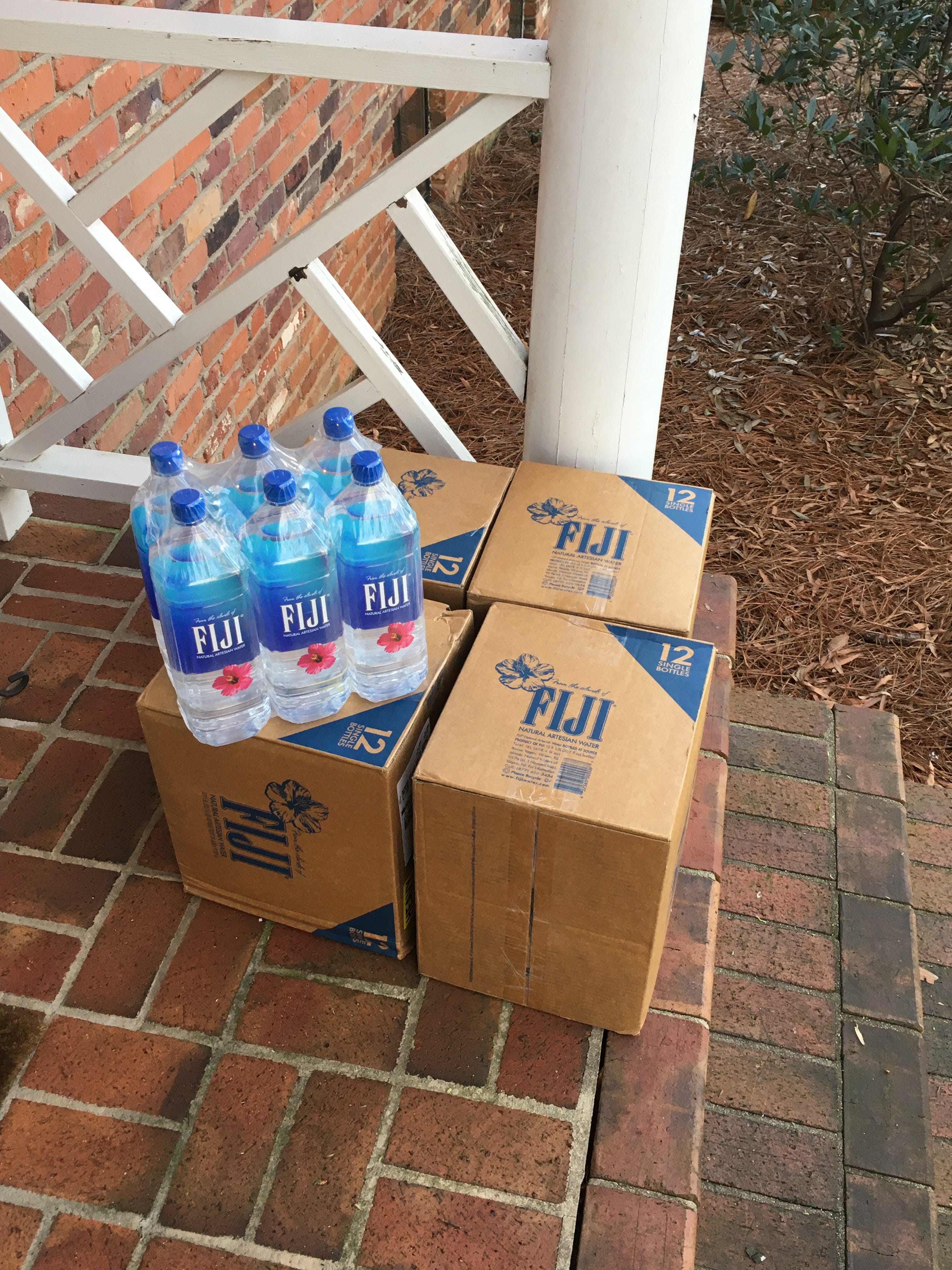
Rick and Carole’s porch, Winston-Salem. The monthly delivery.
Carole takes hers in small amounts across the day. Rick drinks half a liter on waking and half a liter before bed. (Dennis Crouse’s measurements of orthosilicic acid’s two-hour functional half-life in the kidneys would argue for Carole’s pattern as the more efficient of the two.) Both are in their sixties, both are physically active, and neither claims a trial-grade result for themselves. What they have is eight years of daily use of a mineral water chosen on the basis of what the same water did for the man they drove to seven neurology appointments.
Rick Sr’s thirty months of MOCA scores exist in a Word document on Rick Jr’s hard drive and in the memory of that household. They now also exist in the appendix of this essay.
The scores exist whether anyone funds a follow-up or not.
How to Explain It to a Six-Year-Old
A man in North Carolina was starting to forget things. He went to the doctor, and the doctor said he had the kind of forgetting that gets worse by itself. The doctor said there were two medicines he could take, and one experimental medicine from a drug company he could sign up for. The drug company said he was already forgetting too much for them to want him.
His son had been reading about a kind of water that comes from an island in the Pacific. The water has tiny invisible pieces in it that lock onto a bad metal in the body, so that the body can wash the metal out through pee and sweat. His son got him big bottles of this water and had him drink a lot every day.
Every few months, the man went back to the doctor for a thinking test. The first time, he scored 16 out of 30. Then 18. Then 21. Then 23. Then 24. The forgetting was going backward. The doctor had never seen that happen before.
Then his son stopped checking the bottles, and the man forgot to drink some days. His score went down. First to 22, then to 19. The doctor was going to help figure out what was happening, but then the doctor had to stop coming to work to take care of his own mother, who was also forgetting things.
Four years later, the man went to the hospital for a different problem, and he died there. But when he died, he still knew who he was and who his family was. That was not what the first doctor had told them would happen.
In Print
The Unbekoming library is available in paperback, printed to order through Lulu and shipped worldwide. The shelf begins with the paradigm question underneath everything else — No Virus, the isolation problem, the collapse of virology’s foundational claims, and a disease-by-disease reappraisal — and moves through the suppressed compounds mainstream medicine set aside: The DMSO Book, Chlorine Dioxide: The Forbidden Remedy, The Iodine Book, and The Hydrogen Peroxide Book. Two more recover what’s still on the kitchen shelf: Baking Soda and The Castor Oil Book. Two more recover the minerals modern soil, water, and processing quietly stripped from the diet: The Magnesium Handbook and The Boron Book. Sitting alongside these is No Contagion, co-authored with Jamie Andrews — the case against germ theory itself, catalogued through 258 failed contagion experiments.
The critique books cover what medicine, dentistry, psychiatry, and veterinary practice have become. The Unvaccinated treats the completely unvaccinated as a comparison group across twenty chapters and five appendices. Medicalized Motherhood follows a woman through 123 documented interventions from teenage pill to postpartum discharge. Drilling for Profit treats cavities, gum disease, and crooked teeth as the dietary problem they are. What Your Vet Can’t Tell You applies the same critique to pets. Escape from Psychiatry documents the fabrication of the DSM and the specific damage of every major psychiatric drug class. The Vitamin K Injection covers what happens in the first hours of a newborn’s life.
The full shelf is at lulu.com/spotlight/unbekoming. A physical book reaches the person a Substack post never will — the skeptical relative, the friend who won’t click a link but might open a book, the visitor whose eye lands on a coffee table. Buy one to keep, and one to give away.
References
Case report: Rick Murray Jr, “Update on Rick Sr’s ‘Silica’ Water trial project,” personal document, June 2020. Shared with the author by email, October 2026. Used by permission.
Crouse, Dennis N. Discovering the Magic in Water that Makes Life Possible on Earth (2026). Reader case of 24-hour urinary aluminum documented across four years of homemade silica water intake, a one-year interruption, and restart.
Exley C, Korchazhkina O, Job D, Strekopytov S, Polwart A, Crome P. “Non-invasive therapy to reduce the body burden of aluminium in Alzheimer’s disease.” Journal of Alzheimer’s Disease 10, no. 1 (2006): 17–24.
Crouse, Dennis N. Discovering the Magic in Water that Makes Life Possible on Earth (2026), and Interview with Dennis N. Crouse, PhD, Unbekoming, September 4, 2024. Account of Crouse’s mother’s diagnosis, protocol, and twelve-year outcome.
Exley, Christopher. Imagine You Are an Aluminum Atom: Discussions with Mr. Aluminum. Account of the Danone/Volvic research contract and its termination, final chapter.
Glick JL, McMillan PA. “A multipronged, nutritional-based strategy for managing Alzheimer’s disease.” Medical Hypotheses 91 (June 2016): 98–102.
Rick Sr was admitted to a Novant Health facility in early 2022 during the restricted-access COVID-floor period of hospital operations. The admission followed signs of a minor stroke; imaging confirmed three small aneurysms in his brain. The family declined the nasal swab, and no laboratory result confirmed COVID during the five-day admission. The death certificate nonetheless listed “Aneurysm and Covid-19” as cause of death. Rick Jr’s attributed reading is that the dual coding served the hospital’s eligibility for CARES Act reimbursement. The imaging-documented cause of death was the aneurysm.
Rick Sr's case is a very real example. Left to their own devices, people take what they 'feel' like taking, rather than what would be a more helpful measurement. Evidently in Rick Sr's case, his son putting him on 1.5L/day of Fiji water, + supplements, was a better option than him taking what he could be...bothered taking, for all intents and purposes. It still made a difference, but was nowhere near as good as when he was on a set amount of Fiji water + supplements from his son.
I have seen this time and time again from patients over the years. Even when studies show X-amount gives the best results, and even when their prescription is for a certain dose, people still do...what they want to do.
Now that this orthosilicate treatment is gaining traction among people who have or know someone who has Alzheimer's, will they now ban Fiji water imports? The DIY protocol of making your own is a little bit of a pain and drinking Fiji water is simpler even if more expensive.