

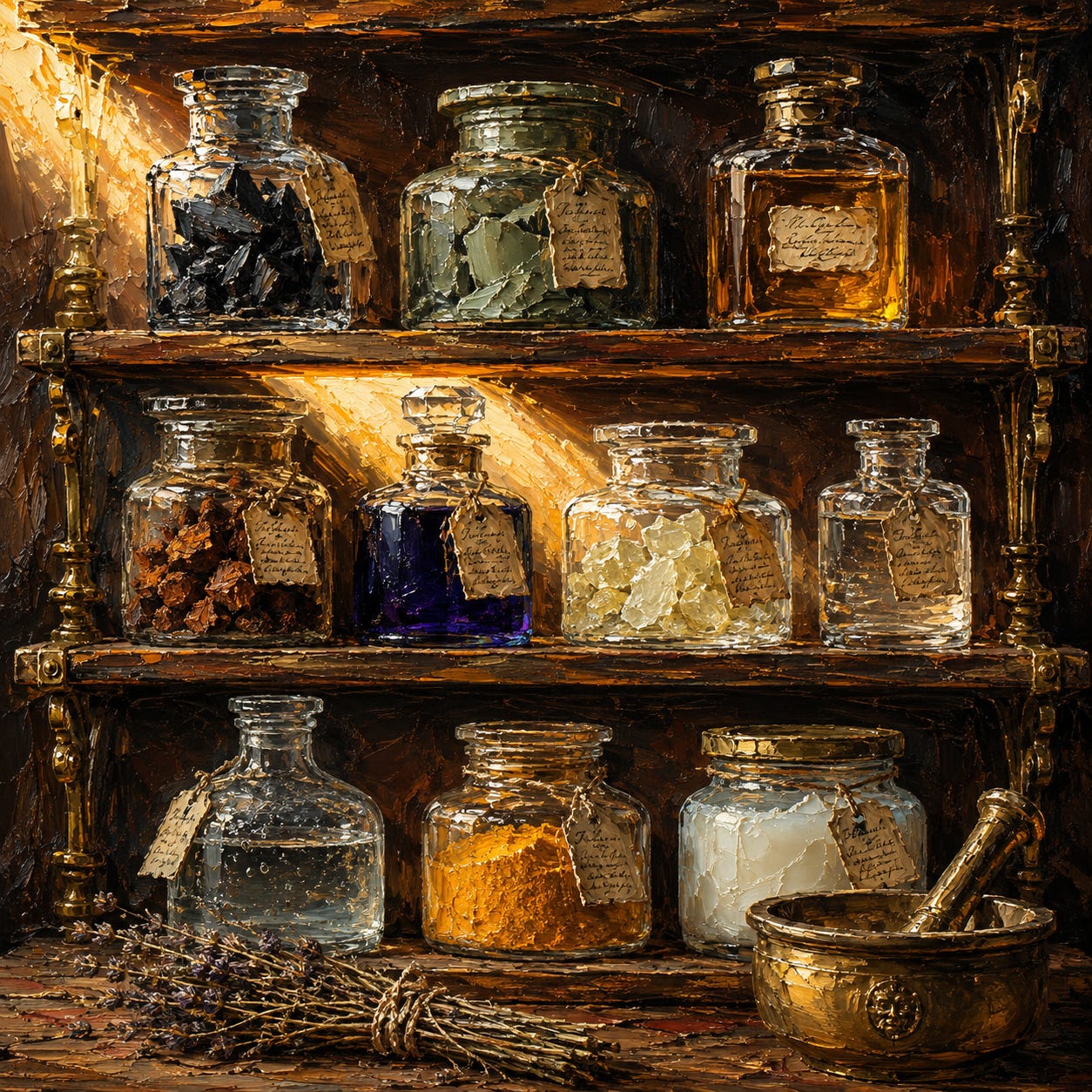
The remedies below have something in common that mainstream medicine cannot see. They do not attack invaders. They do not suppress symptoms. They work with the body, not against it. Every one of them operates through a mechanism the terrain paradigm recognises, and every one of them has been sitting in plain sight for decades or centuries, largely ignored by the institutions that should know better.
The reason they stay obscure is not that they don’t work. Charcoal has been used to draw poisons out of the body since the ancient Egyptians. Iodine was medicine’s universal remedy in the nineteenth century. Castor oil has a documented clinical record older than most pharmaceuticals. The reason they stay obscure is the streetlight effect: research money follows patents, patents cannot be granted on substances that grow in the ground or precipitate from seawater, and so the studies that would confirm what practitioners have observed for generations never get funded. The absence of studies becomes, in the hands of fact-checkers and physicians, evidence that these substances do not work. In reality it is evidence of what was not investigated.
The ten books below share a second feature. Each is written by a physician, a practitioner, or a serious researcher who noticed something the mainstream had walked past, took the time to document it, and put the case in print. Between them they cover ten substances and practices that a reader can begin using this week, without a prescription, without a specialist, and without waiting for institutional permission.
They sort naturally into three groups based on what they actually do in the body:
What draws out — substances and practices that bind toxins, mobilise stored poisons, and route them out through the body’s elimination channels.
What restores — substances that replenish minerals, electrons, and elements the modern terrain is stripped of.
What supports — practices and whole-food remedies that give the body’s own cleansing and repair systems the conditions they need to function.
The full summary and the audio deep dive for each of these ten sit behind the paywall, alongside the wider archive of book summaries the paid subscription unlocks. What follows is the introduction to each: the substance, the mechanism, and why the book belongs in a terrain reader’s library.
What Draws Out
The Oil That Heals: A Physician’s Successes With Castor Oil Treatments (1994)
Castor oil packs draw congested lymph, mobilise stored toxins from the liver, and support the drainage pathways the body uses to clear damaged tissue. William McGarey documented decades of clinical results across dozens of conditions from adhesions and cysts to chronic pain and skin conditions. The book is the closest thing that exists to a physician’s clinical manual for a single-substance drawing agent, and it explains why the pack, not the ingestion, is the primary application.

Charcoal Remedies (2005) — John Dinsley
Activated charcoal binds to poisons in the gut, on the skin, and in wounds. It has been used in hospital emergency rooms for centuries and in traditional medicine for millennia. Dinsley catalogues the internal and external uses, dosages, and combinations. What he documents is not folk medicine. It is one of the most rigorously tested drawing agents in existence, made obscure only because it competes with nothing that can be patented.

Bentonite Clay: Heal Yourself Naturally (2014) — Nancy Stine
Bentonite is a negatively charged clay that binds to positively charged toxins including heavy metals, chemical residues, and pathogens through simple electrostatic attraction. Stine’s book covers internal use for gut cleansing, external use for skin conditions and wounds, and the specific applications that made bentonite a staple of traditional healing across the Americas. Alongside charcoal, it is the drawing agent most worth keeping in the pantry.

Oil Pulling Therapy (2008) — Dr. Bruce Fife
Swishing oil in the mouth for twenty minutes each morning draws bacteria, biofilm, and toxins out of the oral cavity, where the terrain is under constant assault from mercury fillings, root canal residues, and the mouth’s role as a primary entry point for pathogens the body must otherwise process elsewhere. Fife documents the systemic effects, from resolved skin conditions to reduced joint pain, that follow when the mouth is properly cleared. A practice, not a substance, but the mechanism is drawing.

What Restores
Iodine: Why You Need It, Why You Can’t Live Without It (2008) — Dr. David Brownstein
Iodine was the nineteenth century’s universal remedy, prescribed for conditions ranging from goitre to syphilis to fatigue. It was displaced not because it stopped working but because it could not be patented and because fluoride, bromine, and chlorine now compete for its receptor sites throughout the body. Brownstein’s clinical work documents what iodine restoration looks like at meaningful doses, particularly for the thyroid and the breast. Every terrain reader should understand what this element does and why the modern diet no longer provides it.

The Miracle of MSM: The Natural Solution for Pain (1999) — Jacob, Lawrence and Zucker
Methylsulfonylmethane is the bioavailable form of sulphur, an element the body uses in every cell wall, every joint, and every detoxification pathway. Modern soil is stripped of it, cooking destroys what little food retains, and the result is a widespread depletion the mainstream does not measure and therefore does not recognise. The authors document sulphur restoration as a mechanism for joint pain, allergies, and chronic inflammation. A single-substance restoration book of the highest quality.

Curing the Incurable: Vitamin C, Infectious Diseases, and Toxins (2011) — Dr. Thomas Levy
The compound sold as vitamin C is, in Szent-Györgyi’s framing, an electron donor. At meaningful doses it restores the body’s capacity to neutralise toxins and repair damaged tissue through mechanisms that have nothing to do with the nutritional-deficiency paradigm mainstream medicine uses to dismiss it. Levy catalogues the clinical evidence from Klenner’s polio work forward, and explains the dose-response relationship that pharmaceutical medicine has spent seventy years pretending does not exist.

Hydrogen Peroxide: Medical Miracle (2010) — William Campbell Douglass
Intravenous hydrogen peroxide delivers oxygen directly to the tissues, restoring the electrical and oxidative conditions the body requires for repair. Douglass documents the physician-authored clinical record from the 1920s forward — the era when hydrogen peroxide therapy was standard hospital practice, before the pharmaceutical industry captured medical education and displaced it. The mechanism is oxygen restoration. The suppression of the therapy is a case study in how medicine forgets what it once knew.

What Supports
My Water-Cure (1886) — Sebastian Kneipp
Kneipp’s hydrotherapy is the foundational European practice for supporting the body’s own cleansing and circulation. Cold applications, warm applications, alternating baths, wraps, and treads restore vascular tone, stimulate lymphatic flow, and give the body the electrical and thermal stimulus it uses to clear stagnation. Kneipp’s clinic treated thousands successfully with nothing but water, herbs, and movement. A practice book that shows what medicine looked like before it became pharmacology.

Chaga: King of the Medicinal Mushrooms (2014) — David Wolfe
Chaga is a whole-food adaptogen that grows on birch trees in the northern latitudes and delivers a mineral-and-antioxidant matrix the body recognises and uses. It is not an isolated compound, not a supplement, not a synthetic. It is a food. Wolfe documents the traditional Siberian and Northern European uses, the modern research on its supportive effects across chronic conditions, and the specific ways to prepare it. Represents the whole-food end of the terrain toolkit — nourishment as medicine.

What To Do With This List
Ten substances and practices is more than any reader will investigate at once. The most useful way to approach the list is to pick one from each group and start there.
Pick one drawing agent — the substance or practice you would keep in your medicine cabinet for when the body needs to clear something out. Charcoal and bentonite are the most versatile starting points. Castor oil packs are the most powerful for chronic congestion. Oil pulling is the simplest daily practice.
Pick one restorative — the element or compound your terrain is most likely to be depleted of. For most readers this is iodine or sulphur. For readers dealing with chronic toxic load or damaged tissue, it is vitamin C at meaningful doses.
Pick one supportive practice or food — the daily habit that maintains the terrain rather than intervening in a crisis. Kneipp’s hydrotherapy costs nothing and can begin tomorrow morning. Chaga becomes a daily infusion.
Then read the summaries.
Each of the ten runs to thousands of words. Each has an audio deep dive on the same page. Between them they distil the clinical experience of ten physicians and practitioners — thousands of pages of dense material — into a form a reader can actually use. What would take a serious student months to read through in the original texts, a paid subscriber can move through in an afternoon.
And the ten are the beginning of it. A single paid subscription unlocks the wider archive of over 250 book summaries covering germ theory and terrain, vaccines, cancer, birth control, fasting, hidden history, central banking, consciousness, and the paradigm that ties them together. It unlocks the audio deep dive on every essay and every interview — a listening library that grows alongside the reading one. It unlocks new books as they publish. One subscription. A whole library.
For a reader who wants to understand what mainstream medicine has been busy forgetting, there is no faster way in.
As a Holistic Healthcare Practitioner of 40 years what you have done is pretty much organized all my notes and information I’ve kept in my head into these publications. THANK YOU FOR YOUR HARD WORK AND DEDICATION TO THIS HUGE PROJECT- we all benefit so much!
This is awesome I really love what you are doing and I love how u have info on central banking and how it all connects u are doing Gods work