

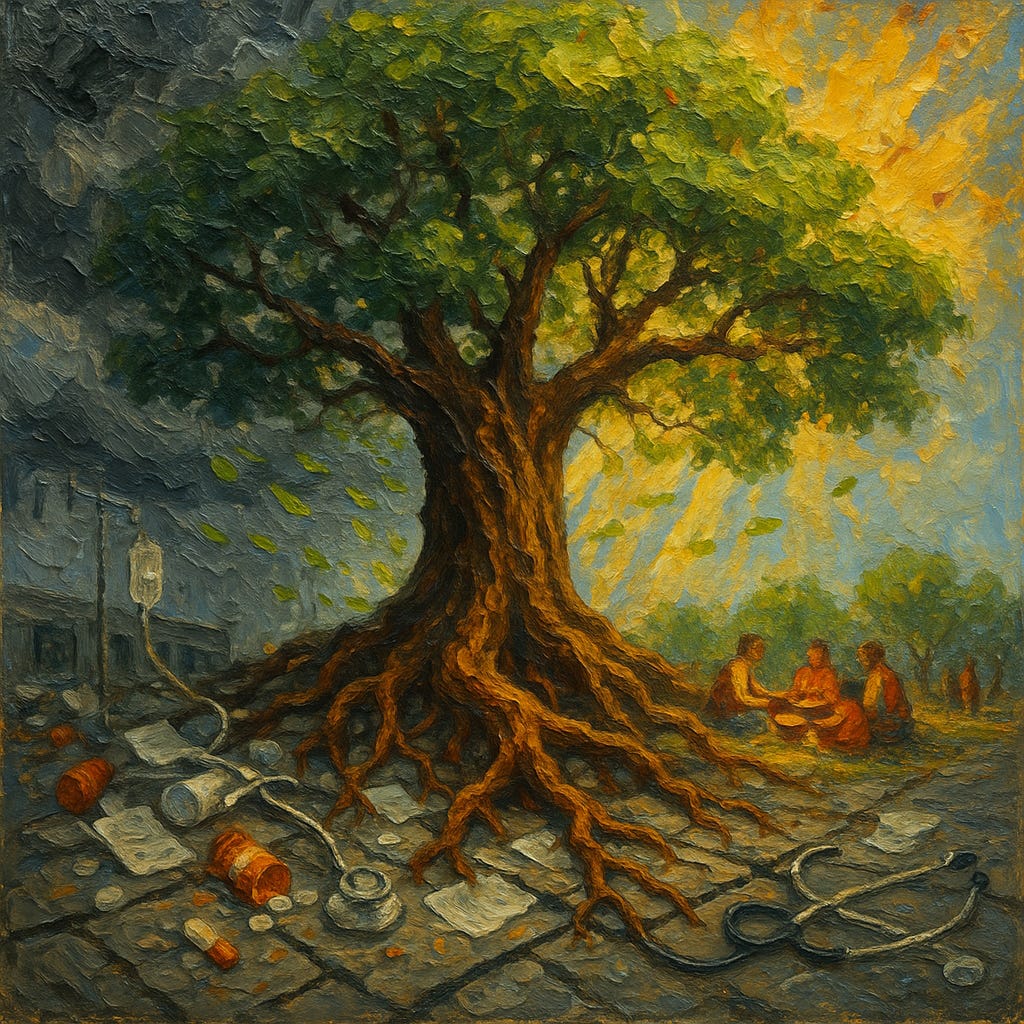
Dr. Pam Popper is a force of nature—a phrase that barely captures the energy of someone who works eighteen-hour days at nearly seventy, runs nine-minute miles, and has spent decades systematically dismantling the comfortable lies of modern medicine. When she tells you that only nine percent of Americans reach age seventy without physical, mental, or cognitive impairments, she's not just citing statistics; she's describing a healthcare catastrophe that transformed her from an overweight corporate employee into one of the most formidable critics of conventional medicine. Her journey began with two starkly different models of aging: a mother who spent twenty-five years in the medical mill, so obese she'd fall from her wheelchair requiring fire department assistance, and a father who lived independently into his nineties, chopping down trees at ninety-four. But it was her own transformation—losing fifty pounds after discovering John McDougall's work and keeping it off for decades—that revealed something profound: the medical system's greatest failure isn't what it can't do, but what it refuses to see.
What makes Popper's critique so devastating isn't just her willingness to follow the data wherever it leads—from PSA tests that save perhaps one life in a thousand while creating countless anxious false positives, to cancer drugs approved for extending "progression-free survival" by mere weeks without adding a single day to actual life, to flu shots with negative efficacy that continue being pushed year after year. It's that she understands the architecture of corruption that makes these failures inevitable. She describes a system where drug companies fund three-fifths of the FDA's budget, where the revolving door between regulators and pharmaceutical companies creates what she calls a system "ripe for abuse," where three lobbyists work every member of Congress, and where medical training has devolved from clinical judgment to rote memorization of protocols. The story of Dr. Jay Varma—the New York COVID czar who locked down eight million people while hosting drug-fueled sex parties because he was "lonely"—isn't an aberration in her telling but the perfect metaphor for public health's transformation into authoritarian theater. When she mentions the threats she's received, similar to those documented in Peter Gøtzsche's Deadly Medicines and Organized Crime, she's matter-of-fact: "I live by myself with a cat, and Winston's given me permission to do this."
But Popper isn't content to just diagnose the disease—she's building the cure from the ground up. Through Wellness Forum Health, she teaches people to practice a simple script in front of the mirror: "Thank you for the suggestion. I'll be looking into this." Through Make Americans Free Again, she's organizing voters into blocks large enough to make legislators choose between representing their constituents or their pharmaceutical donors. Her Food Over Medicine clubs gather people to learn together, not through preaching but through discovery, watching documentaries about regenerative agriculture and sharing meals that demonstrate what real food can do. She envisions ten thousand such clubs across the country, coupled with enough organized voters to deliver 26,000 letters to a state senator who won by 2,200 votes. The message is clear: power in America is supposed to flow from the ground up, and waiting for government to solve these problems is like disconnecting the oil light instead of adding oil. At nearly seventy, having survived threats and built an empire of informed consent, Popper embodies her own philosophy—that human bodies aren't fragile things requiring constant medical surveillance but remarkably strong systems that, given the right conditions, can chop down trees at ninety-four. The question she poses isn't whether the medical system can be reformed, but whether enough people will choose the inconvenience of taking responsibility for their health over the catastrophic convenience of letting others make their decisions for them.
With thanks to Dr. Pam Popper.
www.makeamericansfreeagain.com
1. Pam, you've been an advocate for informed healthcare decisions for decades. Can you please share what initially sparked your interest in this field and how your journey led to founding Wellness Forum Health?
A couple of things. The first is my mother got sick when she was in her early fifties, and she got hooked into the medical mill. She loved doctors, believed what they said, and did what they told her. I watched her for 25 years in and out of hospitals, taking really powerful drugs. She had rheumatoid arthritis—that's how it started. I don't know how many things were wrong with her by the time she died at 78, but it was 25 years of the typical crisis management usually seen in older people. It doesn't usually start that early, but she was in a wheelchair. She got so obese that she would fall out of the wheelchair, and we'd have to call the fire department because nobody could pick her up. I watched that—it's like the scared straight program. You say to yourself, "I don't want anything to do with that."
My father, on the other hand, lived to be in his early nineties and took a different route. That was much better, but I saw that made an impression on me.
But I think the big turning point was that I was really fat in my younger years. I used to say to people I was big boned, and I tried to wear vertical stripes so I didn't look so bad. But I was 50 pounds overweight, and on my size frame, that's a lot of weight. I was always on a diet—I'd lose 20 pounds and gain it back.
I had read an article in a magazine about diet and health, and I mentioned it to a coworker who said, "You should read this book by John McDougall. My husband and I knew him when we lived in the Bay Area." She loaned me the original McDougall Plan, and I read it in one sitting. It made so much sense. McDougall's message was so simple back then: eat a plant-based diet, you can have all the food you want, it's delicious, you'll lose weight, feel great, and avoid most of the common degenerative diseases.
I thought, "Well, I've tried everything else. I've lost the same 20 pounds 52 times." So I did it, and I melted down into the size I am today. I stayed that way, started running marathons. People would see me and couldn't even believe it was me—"What happened to you?" Totally different person than I used to be. One thing led to another, I just kept reading and researching, and I thought, "I think I finally found my calling." I'd been wandering around without much direction career-wise for a long time. I had different jobs, and some of them I was pretty good at, but I really couldn't tell you that I'd found my niche until this. And then this was it.
2. In your videos, you often discuss the limitations of statin drugs, noting that for primary prevention, as many as 399 out of 400 patients don't benefit. What made you start investigating the evidence behind commonly prescribed medications?
That's a really good question. When I started my career, it was really all about diet, because that was what I knew about. I was very interested in nutrition and the science of nutrition. But from the very beginning, I aspired to build something fairly large and attract a lot of people to my business. I'd had some background in marketing. I knew how to do that, and I made some observations early on.
Back in the day when I had a real job—I don't consider this a real job, by the way, because I love what I do—but back when I had a real job, we used to test ideas and product ideas. You see what's happening, and make adjustments accordingly. So I knew to be observant. How are people responding? Do they get better?
What I was observing is that a lot of people were working hard to eat a better diet because what I told them made sense. However, they were still having health issues. Digging into it a little further, it seemed that some of those health issues were a result of drugs and medical intervention.
Then the important question to ask is: “Is the medical intervention worth it? Is the benefit you get worth the risk you're going to take?” It became pretty clear to me as I started looking into things like statin drugs that they do lower cholesterol level for most people. They just don't reduce the risk of an event very much when used for primary prevention.
The risk-benefit ratio is not so great, and what occurred to me was two things. One is, people should know that. The second thing is what a powerful motivator for diet change. Because if you think the drugs you're taking will protect you against events, it's easy to say, "Well, I don't really have to worry so much about my diet." But when you know that those types of interventions are not very helpful—well, then what am I supposed to do? You might consider changing your lifestyle, because what you're doing clearly isn't going to help. So asking these questions and investigating repeatedly led us back to where I wanted people to focus.
3. You've mentioned that about 9% of US adults make it to age 70 without physical, mental, or cognitive impairments. What lifestyle changes do you believe would have the most significant impact on improving this statistic?
I think the list is actually longer than I would have answered many years ago. Diet, for sure—the average adult human eats one ton of food per year. That's a staggering amount. I always tell people, picture what that would look like dumped into the street in front of your house. You can't argue it's not going to make a difference. The volume is just too big.
So diet is part of it. Exercise is part of it, and it's necessary for independence as we age. That's a big part of it. The reason why people end up in nursing homes is they're frail, and that's super sad. Nobody desires to be there.
Sunshine and water—clean water—but it goes beyond to some other things too that I didn't use to focus on in the beginning. Things like purpose in life, satisfaction, goals, friends, social interaction. Some of the most miserable and sick older people I've encountered are often shut off from other humans. Their world closes in— they have less and less going on—and they die early for lack of engagement in life to a certain extent.
If you look at the blue zones, I think they're super instructive— these are places around the world where people live longer. They're socially connected, and they know how to have a good time. They're close to their families. They live in multi-generational households. We don't do that necessarily in the United States, but we can certainly make it a point to be connected to people, and they eat well from birth to grave. We can learn from that.
4. You frequently discuss how surrogate markers in cancer treatment like tumor shrinking don't necessarily correlate with longer survival. How did you come to focus on this disconnect between what patients want and what conventional oncology delivers?
That's the case not just with oncology, but with most areas of medicine. That's the disconnect—we're treating cholesterol, not overall health, diet, exercise, hydration. We're treating tumors, not the organism that supports the tumors. Something was wrong, or you wouldn't have grown tumors, right? So what do we do about the terrain?
Early on, I had exposure—I think sometimes G-d has been a guide for me to learn the right things. I started reading books written by people who were super critical of our medical system. John McDougall, my original source of information, also talked about cancer screening programs and the over-drugging of America. So I learned a lot from him. Then I just started researching on my own.
I remembered coworkers from the days when I had “real jobs” who died of cancer at early ages, and that made me curious about how that really happens. The more I learned about drug companies, the more I learned about how terrible they are, mainly because they have a license to behave the way they do because of how the government lets them get away with it in our country.
All drugs aren't bad—I don't want to be misunderstood on this issue—but before taking any of them, unless it's an emergency, you should look into the risk you’re going to take and the benefit you’re going to get. In the case of cancer drugs, what you find is that many of them are approved based on this metric called progression-free survival time. In other words, you get rid of the tumor or the blood markers go down, and you have this period of time before the cancer starts growing again. If you can extend that from 4 months to 6 months, you've got a drug that has a measurable action. It may not extend your life by a single day, but you get 2 more months before the cancer comes back.
Our system here is so corrupt that many times these approvals are made with the stipulation that the drug companies are supposed to deliver follow-up studies that show survival, and they don't do it. And nobody does anything about it.
The drug companies fund three-fifths of our Food and Drug Administration's budget, and they often hire people who work for this agency when they leave the government. So our regulators are sitting across the table from their potential future employers. It’s almost inevitable that this leads to some regulators thinking, “How picky do I want to be about outcomes data? If I let a few things slide, this person may offer me a $400,000 per year job, like the guy that used to have the office next to me at FDA.”
I'm a firm believer in what I call choice architecture, and that's something you can use to facilitate diet and lifestyle change. But choice architecture in the case of the relationship between the FDA and the drug companies—it's a system ripe for abuse. It's a system that leads to fraud, and if you don't change the system, the fraud won't go away.
5. I haven't heard that term before, choice architecture. Could you talk a little bit about that?
Choice architecture is where you set up your life to drive the behavior that you want to engage in.
I'm talking to you from my house right now, and if I want something sweet to eat, I'll tell you what we have: blueberries, cut-up cantaloupe, dried dates, some apples, and two peaches. If I want something sweet, that's all we have. There's no candy, no chocolate-covered pretzels, no cookies. I don't have any of that.
So when I finish teaching at 11 o'clock at night, if I want cookies or candy, I have to get dressed, get in the car, and go to the grocery store to buy it. That's a deterrent. So I'm probably going to choose from the things I have here.
Another example would be batch cooking. During the week, particularly with my busy schedule, if I'm going to eat healthy food for lunch and dinner, I need to be able to just warm it up or toss a salad. Everything's all chopped up—the beets are baked, the potatoes are baked, the soup is made. It facilitates healthy eating instead of saying, "My gosh, it's noon and I'm hungry. What am I going to do?" That's where people end up in the drive-through. They don't have a plan.
Our lives are set up to drive the behavior we're currently engaged in. If you want to change the behavior, you have to have a different setup. That's what choice architecture is all about.
Make it easy to do the right thing. People come up with all kinds of ways once they understand this. I have a client who sleeps in her workout clothes. When she gets out of bed, to not work out, she has to change her clothes. Just the thought of that makes you think before skipping a workout . That may seem extreme to some people, but we're all familiar with this behavior. We cue ourselves all the time—like putting something in front of the garage door so you have to pick it up and put it in the car to take it to work. We just have to apply it to our eating and exercise habits.
6. In one of your presentations, you discussed new research showing that cartilage can actually regenerate, contrary to common medical belief. What other areas of medicine do you think are ripe for paradigm shifts based on emerging evidence?
I think first of all, reductionism in medicine—focusing on a body part or a blood marker. All branches of medicine do this. Just to pick an easy example we already talked about: your cholesterol is high and your doctor prescribes a statin drug. You say you don't want to take it because of side effects, so you go visit a naturopath, and the naturopath gives you niacin. But you’re still manipulating a surrogate marker.
Teaching by analogy, which is what I do—think about if I get in the car to go back to the office and the oil light comes on. I say, "Boy, is that irritating!" So I'll tell you how I'm going to solve this problem. I'm going to pull over, pop the hood, and disconnect the fuse that lights up the oil lamp. Then I don't have to think about that anymore. Well, we know the inevitable end of the story—the engine's going to blow up at some point. This would have been like a $35 problem if I'd taken care of it as soon as the red light came on.
The key is taking a look at causation and addressing the cause, not shifting from paradigm to the same paradigm just with a different set of tools, but really looking at underlying causes.
I think the second thing is reductionism as in vitamin C versus an orange. People are so concerned about deficiency, and I ask them, "Do you know anybody who has scurvy?" They'll giggle. "How about beriberi? Any of your neighbors have beriberi?" These are deficiency diseases. And by the way, when sailors had scurvy, they didn't have any vitamin C factories back then. They gave them citrus fruit—problem solved.
The reductionism of paying attention to minor things because it's profitable to somebody like the supplement makers—vitamin D is probably one of the worst things that ever happened, the vitamin D hoax. I ask people, "How many people do you know have rickets?" They laugh and giggle. "Never met anybody with rickets." That's a vitamin D deficiency disease.
Then I think the other thing—this is a huge one for me—is all this hanging out with doctors and the constant barrage of health information, most of it inaccurate or misleading. It's taught people that human bodies are frail and fragile and subject to breakdown, and you've got to hang out with doctors so you catch things early. As you grow older, you're going to need more and more attention.
People ask me sometimes, "You don't have a doctor?" I tell them no. I mean, if something was wrong, I'd go have it checked out. I'm not stupid. But I work 18 hours a day, sleep like a baby, I can run 9-minute miles, and I don't really know that I want to hang out with doctors to see if they can find something wrong. I'm sure they could if they look hard enough. But do I benefit from that?
This whole idea that we need constant medical attention because bodies are frail is ridiculous - actually they're incredibly strong. One of my former employees sent me a video of her 94-year-old father chopping down a tree. That's what 94 years old should look like. And then one night you go to bed, you don't get up because your time here is finished. A much better way to experience aging!
Normal has changed because everyone is essentially ill. Our definition of normal has changed. So when you see the 94-year-old chopping down a tree, that looks abnormal, but it's just compared to the fact that everyone else has been impacted by the medical mill.
Well, there's another thing about it too. It's that in our culture, people are not as interested in growing old as I think they used to be. They perceive aging as falling apart—the world gets smaller and smaller. I'm sure it does for most people. We deal with those people all the time at Wellness Forum.
But actually, I'm enjoying being a senior citizen. The first thing is because I'm not stupid anymore. I think back to when I was 30 years old—I don't ever want to go back and do that again. I'm assuming if there's reincarnation, God gives you the grace of coming back smarter the second time.
It's nice to have some wisdom and to be calmer about a lot of things. I'm going to be 69 years old in a couple of months, and I'm thinking about all the things I want to do for the next 30 years, if I'm blessed to be alive for 30 years. This is where all the knowledge you've gained and some of the influence you've earned—you can really do some amazing things.
Just by way of example, I'm sure you've heard of T. Colin Campbell. He wrote The China Study, and he's a remarkable person. He's in his early nineties now—I think he's 91 this year. He had an incredible research career, published articles, travelled the world doing research. But he didn't write The China Study till he was 70. That's really when he started spreading his message far and wide.
If we painted a different picture for what senior citizenship looks like, people would aspire to it more and say, "Maybe I ought to take care of my body, because look at all the things you can do when you're in your seventies and eighties and nineties."
7. You've expressed concerns about PSA testing for prostate cancer screening. Could you explain why you believe the current approach to prostate cancer screening may be causing more harm than good?
The data show that this is the case—it really doesn't have much to do with what I believe. The problem with looking for cancer is the reason for doing it is supposed to be "early detection saves lives." There's one cancer screening test for which that's true, and it's pap testing. Every culture in which pap testing has become the norm, the cervical cancer death rate just plummets to almost zero.
But that's what the cancer industry or the medical profession would like everybody to believe is possible for all types of cancer. There's a very terrible story about how PSA testing became the norm. A good friend of mine who just died a couple of years ago, Richard Ablin, was the researcher who discovered PSA testing. He wrote a great book called The Great Prostate Hoax and spoke at our conferences a couple times.
PSA is just not a good marker for early detection of cancer. You can have a high PSA and no cancer. You can have a low PSA and cancer. The problem with this is, first of all, you get a lot of false positives, and they make people nervous. If you're told you have cancer, and then later you're told "never mind," we have very good data on this—it takes at least a year and sometimes longer to come down off the proverbial ledge of hysteria that "Oh my God, I could be a cancer patient." That's not good for your health.
The second thing is that it leads to overtreatment. Depending on which study you look at, it's as little as one in a thousand men who actually has his life saved by PSA testing. The data are just as awful for women and mammograms. But there's so much money in the screening programs.
It leads people to focus on the wrong things. Early detection becomes the focus instead of cancer prevention. If people knew that PSA testing, mammography, screening for lung cancer, screening for thyroid; if they knew all this stuff didn't save your life, they'd say, "Well, then what am I supposed to do?"
I'll tell you what you're supposed to do. You're supposed to exercise and drink water and eat a good diet. That's what you're supposed to do. That's the only thing that really works. The rest of it, not so much. The incessant testing takes the focus off of what really works. You see people who are overweight, sick, taking multiple drugs, and they have lots of doctors. How can you see lots of doctors and call this a success story? But we call it a success story in this country.
8. We could talk about screening all day. The more I've looked into screening, I'm just constantly shaking my head.
Teaching by analogy: I live in my dream home, by the way. I was able to buy this house because the planets lined up for it to happen. I could never have afforded it any other way. I couldn't afford to buy it now, actually. I bought it 30-some years ago, and I take very good care of it because it's a valuable asset.
But here's my point. Just think about what would happen if I put a post on Facebook that said: "Listen, Monday morning, if you're a contractor—you do anything in the way of home improvement, gutters, roofs, chimneys, flooring, whatever—I want you to congregate on my front porch at 9, and we're going to comb through 3,000 square feet of house and a big deck and a full basement and attached garage. We're going to look for stuff that's wrong, and I will pay you to fix whatever you find."
I'd have to move out. I wouldn't be able to live here for all the construction going on. That is entirely different than calling the plumber because the faucet is leaking or calling an electrician because an outlet is arcing. We all understand looking for trouble is not a good idea when it comes to maintaining things. It's not such a good idea when it comes to maintaining bodies, either.
9. In your videos, you've talked about the risks associated with biopsies potentially causing cancer metastases. How did this information impact your approach to advising cancer patients?
I'm glad you asked the question. I don't advise anybody. I tell people, look at the data.
We seem to understand that's the way to approach buying houses and cars. You might not like driving my car. I love it. Maybe I wouldn't like yours. There's room for different people to drive different cars. Well, some people would look at the risks and benefits of a biopsy and say, "I'm the kind of person who just has to know. Even if this is a tiny little mass and I wouldn't even know about it if it wasn't for the mammogram, I just have to do it." Okay, great. Then you should do it, because if you're not going to sleep at night, that's not good for your health.
The person who looks at that same data and says, "I just can't see myself doing that"—that's the right answer for that person. But objective data should be the basis for the decision.
I've been very neutral when I deal with people, and sometimes it aggravates them. They'll say, "Well, you've got to have an opinion." I tell them I do as it pertains to me. But I'm not the one with cancer right now. I'm not the one who had the heart attack. You have to make the decision. My job is just to give you the data.
They go, "That's really hard." I tell them big decisions in your life are really hard. When I signed my first mortgage—I had hives for a week. I don't know about you, but when I signed for my first apartment, I had hives too. That was a big decision back then. We are accustomed to the discomfort of making a big decision, and most of us are pretty careful about deliberating. So do that here too.
10. You've been vocal about the research suggesting flu shots may have negative efficacy. What do you think drives the continued recommendation of these vaccines despite such findings?
Boy, that's a deep question. It's a lot of things. The first thing is drug company brainwashing. They sell these products. Their job is to brainwash people to buy them and they do this well. By the way, if I had the budget of drug companies I'd like to brainwash people to join Wellness Forum and eat our foods—I think they're swell. We're all in business to sell what we do.
There are a couple of big issues we can talk about. One is from the beginning of vaccination—if you go back to vaccination in Great Britain over a hundred years ago—it's never worked. It's always been coercive, despite the fact that it doesn't work. We've always had this battle between some version of public health policy and consumers who don't want to comply.
I found an article written in the 1800s in a British medical journal that talked about coercing parents into vaccinating their kids. Many kids were injured, and one family had three injured kids. They wouldn't jab the fourth one, and authorities took their furniture away as punishment. It's always been a coercive type of thing.
I think the second thing is medical training—admissions to medical school and medical training leave a lot to be desired. Let's talk about admissions. This is pretty near and dear to my heart for many reasons.
History has shown that many medical doctors have concerning psychological issues, and often are arrogant —that we must purge from medicine. An important and very large example was World War II and the time leading up to it. There were more doctors, percentage-wise, who signed up voluntarily to help Hitler than any other profession in Germany. Fifty-five percent of doctors said, "I want to join you." Doctors stationed at the concentration camps often decided when people came out of the barracks who was going to the crematorium because they were too weak to work, who was going to be part of a medical experiment like what Mengele was doing, and who was going to go to work that day.
I want to be clear here. There are a lot of wonderful doctors with good personalities and good intentions. But there are way too many of them that have something not right. We've got to start purging people like that. We are admitting super smart people to medical school—you have to be smart, stupid people will not succeed—but we've got to do something about some of the people who just do not belong in the field. They often will do whatever they're told to do, even when it is patently wrong. You saw this during COVID.
There's also a groupthink that's taught in medical school—no independent thinking allowed. Something that happened here, I don't know if it's affected your country or not, but when we passed the Affordable Care Act, referred to as Obamacare, there was a provision in it that sounded great, like so many things that sound great but they're not. It was called "best practices."
Here’s how this started: the government was going to collect data and see who was doing the best at curing this disease or managing that disease, and then that would become the standard of care. On the surface, that sounds great. But let me tell you what it turns into. It becomes a protocol that is required for everybody, and reimbursement depends on using the protocol. You may not get reimbursed if you don't do it this particular way.
I had a physician friend recently tell me what this looks like for residency. He said when he was in residency, you'd be walking around the hospital with your supervising doc, and the doctor would say, "Here's Mrs. Jones in the bed. Here's what's wrong with her. What do you think we ought to do for Mrs. Jones?" Mrs. Jones who's 84 years old and has seven diseases, and residents were asked to come up with a treatment plan to help Mrs. Jones.
Now what they're doing is rote memorization. "Okay, John, what do we do for the blood pressure problem?" And he spits it out. "What do we do for this? What do we do for that?" Nobody's talking about what you do for the 84-year-old person who has these conditions, because that's an entirely different story than this very sanitized "What do you do for blood pressure?" kind of questioning. I’ve simplified this so it's easy to understand, but the bottom line is that clinical judgment has been slowly purged from medicine.
Instead, medicine is turning out people, many of whom I think have psychological quirks, who are taught to follow instructions. So let's go back to the vaccination issue. The CDC and the FDA say vaccinations are safe and effective, and people like Fauci, people like Peter Hotez—that creepy guy Hotez—and Paul Offit, who are so conflicted because they've made millions promoting vaccines, but we just ignore that. They say children need 87 vaccines by the time they graduate from high school, and the profession agrees and says, "Okay, great. Then that's what we're going to do."
The herd mentality is such that a person can be disciplined for NOT following protocols, either by the employer for or the medical board. So they go along to get along. Nobody wants to be an outlier. Nobody is doing research on their own. So this is what you end up with, and it's not so good.
11. It's quite military style, isn't it? The way doctors are trained?
The other thing that's happened here is most doctors used to be in private practice. I wrote about this in my book. When I was a little girl, we had a family doctor—my mom, my dad, my sister and I, my aunt and uncle and our cousins, my grandparents on my mother's side all went to the family doctor. So the doctor knew something about our family.
If my mother took us to the doctor, she had to pay, since it was before insurance was widely available. So the first thing is, you don't go so often when you have to pay. My parents didn't have much money when my sister and I were little. The second thing is, the doctor treated you well, because just like if somebody's rude to you in a restaurant, you go, "I'm never going back there again." The doctors were like small business owners, and they treated people well.
All of that is gone. Now doctors are all working for big institutions that pay off their huge medical school debt, provide a nice salary and many benefits. The cost of being an outlier is significant financially, and it's significant from an emotional and status standpoint to go against the grain. I respect the heck out of doctors who say, "Whatever the price is of independence, I'm willing to take it." I know some of those doctors here in the States, and it's been difficult for them, but they've done it.
12. You've mentioned research by Dr. Robert Becker about electrical stimulation and limb regeneration that was defunded in 1981. Do you see a pattern in promising medical research being abandoned, and what factors do you think contribute to this?
Much promising medical research is abandoned or it's denigrated. The reason is the drug companies' have way too much influence over medical centers, the hospitals, the journals, and the government regulators.
For example, I think one of the reasons we don't know how effective ivermectin might be for cancer is there's no appetite for investigating it. If you start talking about it, you're going to soon have the medical board on your doorstep, or you'll lose your job at the institution. The drug companies can't make much money on a drug that sells for 15 cents a tablet or whatever it is.
Yeah, I think it's going on in almost every area of medicine. I also think—and I have to say this for the record—it's important not to assume that just because the conventional medical profession doesn't like something, that this means that it's swell. There's a little bit of that going on too. "Oh, this stuff must be really great because the FDA won't look into it." There's a lot of quackery in alternative medicine, and I think we need a lot more open-minded curiosity, particularly on the alternative side of medicine.
But there's just no appetite to investigate many things, including diet as a treatment for disease. I think I have a solution for it, however. I think the only way this ever gets sorted out is to do what Dr. Esselstyn has done.
Cleveland Clinic would never have allowed him to put people on a diet to manage their severe and potentially fatal cardiovascular disease. So instead he recruited volunteers. People call and say, "Hey, I want to come to Cleveland. I want you and your wife and your daughter to show me how to use diet to stop or reverse my coronary artery disease." He does this and asks if he can contact them from time to time to see how they are doing.
He's followed his patients over a very long period of time, and he's reported how many die of cardiovascular disease, how many are still alive, how many events they have had after dietary intervention and so on. I think longitudinal studies like this on everything from how people survive fatal cancer to how they lose weight and keep it off to how they withdraw from blood pressure medications—I think we could collect enormous amounts of data this way. If you had an Elon Musk kind of guy who could program it, you could collect a lot of data that would be worth mining through, and you could come up with a lot of interesting conclusions that way.
13. You've talked about the tension between business decisions in healthcare and patient outcomes. How do you think the average person can navigate a healthcare system that's so heavily influenced by financial interests?
First, let's set aside emergency. If you end up in the emergency room and you're bleeding on the floor, let those people do anything they have to do to save your life. I know a couple of ER docs who are just the best doctors in our system. They are remarkable under pressure, and they save people's lives every day.
So let's put that aside for a minute and let's go to: I'm going to visit a doctor tomorrow morning. How do I keep from getting harmed? Here’s my response: Practice this in front of the mirror till it just rolls off the tongue:
"Thank you so much for the suggestion. I'll be looking into this. If you have anything you'd like for me to take with me, I'd be happy to read it. But don't worry if you don't have it. I know how to look stuff up on my own, and I'll get back to you. I'll let you know about my decision on this test, this drug, this whatever."
If people did that and then looked into whatever is recommended—because you can teach anybody, including middle school students, how to read the medical literature—most of what they're recommended to do, they would never do. That's the best way to protect yourself.
14. In discussing Dr. David Weldon's withdrawn nomination to head the CDC, you highlighted the power pharmaceutical companies have over Congress and media. How has this power dynamic evolved during your career?
The power grab by drug companies was underway even before I started. It just got worse. Drug companies have been advertising on television for a long time, and it's accelerated to the place where you can't watch 15 minutes of TV without seeing four ads for drugs. The ads are so terrible that it’ clear that the patient is the person they are trying to reach. Billions of dollars are being spent annually to control editorial content, so that news programs and talk shows won't cover the dangers of the drugs or the misbehavior of the drug companies.
That's part of the problem—the control of the drug companies over the media, which we need to do away with. The second thing is, they provide three-fifths of the Food and Drug Administration's budget, and it’s difficult to believe that this is not one of the reasons that the Food and Drug Administration approves almost all drugs which are submitted.
I'll tell you something that happened. It'll blow your mind, and most people haven't heard about it. A drug for Alzheimer's disease was so terrible that the company making it just didn't even finish the clinical trial. An FDA official called the drug maker and said, "Listen, I'm sure we can put together some data that would make this work. Why don't we sit down and talk about it?" The drug was subsequently approved. The cost? $56,000. It turned out to be so useless that the drug maker voluntarily took it off the market.
This is not unusual, and it makes people furious. Everybody gets all excited when drug companies pay criminal fines. They all have rap sheets. Somebody says, "Well, Pfizer paid a $2 billion fine. They’ve paid for their mistakes" That's like me paying a speeding ticket. I'd rather have the $200, but I'm not going to miss any meals next week. The monetary penalty is inconsequential, and the companies are not embarrassed about it at all. There's no real penalty for the bad behavior, and there's no real penalty for even the threatening behavior, because I've been the subject of it too.
Then there are problems with drug companies and Congress. There are three lobbyists for every member of the U.S. Congress and every member of the Senate. Three lobbyists for each one, and they all of these officials take drug money. So do the local state legislators.
The drug companies have bought the airwaves. They've bought the media. They've bought the FDA and the regulatory agencies. They've bought Congress. They've bought the state legislators. At this point in time, it's very unlikely that something bad will happen to them, no matter what they do. So why not threaten Dave Weldon by standing next to him at a bus stop and saying, "If you know what's good for your family, you'll let this go"?
He's not the only one. Peter Gøtzsche wrote a great book called Deadly Medicines and Organized Crime, in which he described in great detail this type of behavior and names many people who've been subjected to it.
15. You mentioned experiencing threats similar to those described in Peter Gøtzsche's book Deadly Medicines and Organized Crime. How do you maintain your resolve to continue this work despite such pressures?
I think belief in God helps. I think I'm protected. I think this is what I was meant to do.
I will say this: it's easier for me to decide to do it than it would be if I had a spouse or living children. I live by myself with a cat, and Winston's given me permission to do this—and before him, Schroeder. Of course, I'm kidding, but it's an easier decision for me to make because I'm only risking myself really.
But I also think there are some risks you just have to take. Somebody has to do it, and if enough people rise up and do it things can change. I think that's one of the goals of my nonprofit right now—gathering up enough people to put so much pressure on the system by force of numbers that things will have to change. Enormous numbers of people can vote out a member of Congress, for example, no matter how much drug money the person is taking. The drug companies won't have any interest in funding these people if citizens vote them out anyway.
I'm looking to do this before I leave the planet. Up until now, I've been training myself to lead such an effort, and it's been worth it to me. I've had some pretty scary, really scary things happen, but I would do it again. Knowing what I know now, having been through it, I would sign up and do it again, for sure.
16. Now, what about your book and Dr. Varma?
Well, the most extraordinary thing that happened makes the point. We wrote about it in our upcoming book, and I'm involved in funding a lawsuit over it. It’s the story of the illustrious Dr. Varma, and I don't know if you heard about this in Australia.
We wrote about the Epidemic Intelligence Services, which is the CDC's—they say it's their CIA. That's what they compare it to. That's bad to begin with. This is an elite squad of people they take out of med school or public health, and then brainwash them into CDC ideology, then they send them all over the country to address public health emergencies.
Varma—V-A-R-M-A—was a member of the EIS and was sent to New York City to be the COVID czar under one of the most incompetent mayors in the history of New York, de Blasio. I don't call many people stupid, but he really is a person of low IQ, really. So that was part of the problem.
Varma locked the city down – schools, businesses, synagogues, churches. City officials visited places like Brooklyn and harassed noncompliant Orthodox Jews. There were mask mandates, vaccine mandates - the whole nine yards.
It turns out that Dr. Varma is a creepy crawler, and he and his wife—she's a pediatrician - engage in a lot of group sex. He was caught undercover in a conversation that he may have thought was a potential date for him and his wife – and he bragged about the sex parties he and his wife were having at the Midtown Manhattan Marriott with their friends doing ecstasy. There's nothing better than medical doctors doing ecstasy having group sex, I've always thought – while the rest of the city was told to stay home and wear a mask if they left the house.
The reporter asked him, "What do you think the people in New York would have thought about that?" He responds, "Oh, they would have been angry—we had to do it at the hotel because we couldn't let the neighbors know we were getting together with people." But he says it really was not about the sex as much as "we were just so lonely." Well, I mean, the irony—you lock 8 million people in their houses, and then organize sex parties because you are lonely. Really!
Then the charming Dr. Varma and his wife started having dance raves in the basement of a bank building in Lower Manhattan with 200 people, unmasked, taking Molly and other drugs. He told the whole city, "Stay home and don't travel for the holiday." His wife went to Seattle. He said, "I had to stay home because it wouldn't look good, but nobody really knew that she took off."
When it gets to the vaccine, this is the best part. She says, "A lot of people get into this whole thing about vaxed, unvaxed." He goes, "Oh, it doesn't make any difference. Everybody's been exposed to it (meaning COVID) anyway."
This is a story you just can't even make up. He lost his job. He had an almost $2 million a year job with a drug company, and he lost that. He's now working for a transgender clinic in Connecticut.
It worked out well for us. Lawyers funded by our nonprofit represent police, EMTs, and firefighters who lost their jobs because of this guy and his vaccine mandates. WE were able to reopen these cases as a result of this, and we’ve filed a complaint with the medical board against him.
That's what public health in our country has turned into. It spawns people like that.
17. Have you read Peter Duesberg's Inventing the AIDS Virus?
Yes. I wrote my dissertation on that topic. Fauci was just as vicious with Duesberg as he was with dissenters during COVID. He managed to cancel Duesberg’s funding. Duesberg reported traveling to New York to be on a television show and finding out when he got there that it had been cancelled and Fauci was on the show instead. The HIV/AIDS debacle was Fauci’s first rodeo, and he really thought he was going to make a name for himself for saving the gay people of the world from death. That did not happen. I think he looked at COVID as his last chance to establish himself as the hero of the day, and that didn't work for him either. He's just a diabolical character.
We include a lot of information about this in our new book, which will be out very soon. It’s called Conversations with Pam: The Power of INFORMED™ Healthcare, which will be the first in a series with different subtitles. The name came from one of the benefits of belonging to Wellness Forum – bimonthly sessions called Conversations with Pam, during which the members can just come together and ask me questions about anything health-related.
We've been doing this for years and thought we'll write a book about the topics we’ve covered. I really liked the format of Food Over Medicine – which was a dialog between a different co-author and I, so we decided to use it for this book too.
18. You frequently emphasize the importance of informed consent in medical decisions. What information do you believe should be mandatory for doctors to share before prescribing medications or recommending procedures?
It's not just what I think. It's law in the United States. It is the law in every state that a physician should tell you what's wrong with you, the proposed plan, the risks and benefits of it, available alternatives, and the option to do nothing.
People say, "Well, why would somebody do nothing?" Well, if I was 90 years old and diagnosed with cancer, I don't know that I'd want to spend the next year of my life, which could be the last year of my life, in a medical center getting chemotherapy. So there are legitimate reasons to do nothing sometimes.
But the informed consent laws are broken every day. Probably during the time that we're having this conversation, it’s happening a thousand times right here in the county I live in.
19. You've mentioned forming "food over medicine clubs" and "Make Americans Free Again tribes." Could you explain how these community groups work and what impact you've seen them have?
A former Speaker of the U.S. House of Representatives, Tip O'Neill, wrote a great book called All Politics Is Local. And it is. We've only allowed this top-down control over our lives to happen by default. It's not supposed to be that way. Power in the U.S. is supposed to come from the ground up.
I think we can't wait for the government to solve our problems. I look at some of the silly solutions government comes up with, and I can't help but joke around a little bit about them. Our new health officials have pledged to eliminate red dye from the food, and of course, M&Ms and cookies are actually really good except for the red dye. We get that red dye out, and we can have as much as we want, I'm pretty sure. Many of our news shows have featured a very nice woman who reports that she was responsible for getting red dye removed from lipstick. You probably heard over there about all the women dropping dead on the sidewalk from red dye in lipstick, right? So thank God we got that done.
I look at this, and I try to remember that everybody's trying their best. But if you're looking at this from my perspective, what difference is this kind of busy work going to make? Zero.
What makes a difference is when you gather people together who get to know one another and trust one another, and you teach them how to become INFORMED.™ You can do this with almost any topic, including food and health.
We’re attracting many types of people and teaching them how to become INFORMED™ so that they can make good decisions about diet and health. The programming is definitely to attract everybody. For example, a lot of people want to learn about regenerative agriculture, regardless of what they are eating. A lot of people are interested in lab-grown meat, for example. Is it really environmentally friendly? Is it even safe to eat?
We gather people at these Food Over Medicine clubs—I have one here in Central Ohio—and over time people learn together. There's no question that they gravitate to a plant-based diet, but not because I preach about it, but because they learn about it. Some of the hardcore vegans soften up a little bit. We watched a movie called Kiss the Ground—I recommend it highly—about regenerative agriculture, and one of the women featured in the film said you cannot grow plants without livestock. You need animals and you need plants.
Everybody learns, and it's a way to congregate and enjoy food and enjoy company. I really think local connection is important. My dream is to have like 10,000 of these Food Over Medicine clubs blanketing the country, spreading the word about good nutrition.
The Make Americans Free Again movement came from the events of 2020. I had spent some time in what we call the medical freedom movement early on in my career. I found that these people waste a lot of time and get very little done, which is one of the reasons why we ended up in the situation in 2020.
People waste time on busy work. Take petitions for example. They don’t make any difference. People are told to send emails. Politicians don't read them. And then the really silly “Health Freedom Day at the State House.” Of course they're going to be nice to you. They know you're going to be out of there by noon. Everybody stands on the steps and says, "Senator so-and-so was so nice to me." Well, what did you expect him to do? Throw tomatoes at you? He knew you were going to be gone in 15 minutes. Just busy work. What comes of this? Not much.
My concept was based on a couple of things. Number one: we have one working branch of government right now. It's the courts. The legislatures are bought and paid for by pharma. The federal government is so huge and such a behemoth, and I think Trump is trying to do something about it. But there's only so much you can do in four years, and it can be all undone with another president three and a half years from now.
So the courts are it, and the courts in this country have been used for a long time to fix problems like smoking —selling cigarettes to children, advertising them on TV, making smoking look enticing, not telling the truth about the dangers of smoking. Good lawyers filed hundreds of lawsuits representing hundreds of people. And lawsuits are the reason that people can’t smoke indoors, cigarette companies cannot advertise on television, cigarettes are locked up in grocery stores so kids can’t purchase them, and so on.
My nonprofit is doing the same with issues related to health and to the COVID debacle.
But I also want to organize people in such massive numbers in various legislative districts that we can take out people who don't vote the way we want them to vote on a very narrow range of issues, which include medical freedom, bodily autonomy.
I'll give you an example. Most of the people sitting in the Ohio Legislature where I live win their elections by 1,500 to 3,000 votes. If you had 20,000 people in each legislative district, they can be forced to introduce and vote on bills we’d like to see passed, like those that protect freedom from mandates.
For example, I would sit down with my senator and say, "We've had a few conversations. This one's going to be short and quite different. First thing I want you to do is see the boxes stacked on a pallet in the hallway. These are letters – 26,282 of them, from people in your district who have sent me to tell you something. We want you to sponsor this bill and shepherd it through the Senate. If you don't do it, we're going to vote you out. You won your election by 2,200 votes. I've got 26,282. I don't really care what you do, because if you don't do it and we will vote you out of here, and the next person sitting here will do what we say,."
You start giving the power back to the people this way, and it's the only thing that will ever work. I don't know in what universe people think sending emails to the head of the World Health Organization, who oversaw the disappearance of 2 million people in Ethiopia when he was the Health Minister will make a difference. Do people think he's really opening emails from Ohio? It's a form of delusional thinking I just can't fathom. But people waste their time on this.
I want to just do it by power of force. I don't mean anything violent. I just mean basically saying, "We are the voters, and we're in charge, and we haven't exerted our will in this way ever before. But we're going to do it right now, and we're going to fix this problem once and for all, and we're going to show you who's in charge." Pfizer won't give any money to these legislators if they know that the people can take them out, no matter how much money they give them. That will get rid of that conflict of interest too.
20. What are you currently focused on in your work with Wellness Forum Health and Make Americans Free Again, and how can people stay connected with your ongoing research and advocacy?
Lots of ways you can stay connected. The first thing is, we offer of free stuff at Wellness Forum. I send out a newsletter every Monday. I send out videos on Tuesdays and Thursdays. They are free. How you'll find out about the other free stuff we offer is by subscribing. We offer probably five or six major free programs—every year. If you want to know about that, subscribe to the newsletter and the video clips. You can help us by sending those to other people and getting them to subscribe. Word of mouth is the best way to help us build.
In terms of joining Wellness Forum, I highly recommend it. We have a basic membership that is only $99. Almost everybody can afford it, and it includes access to our libraries and our foundational courses. Start taking control of your health, not by finding somebody else to listen to, but by learning how to do your own research.
Make Americans Free Again—it's the only hope we have for taking our government back. I don't see anything else working at this point, and God knows it's not for lack of trying. So let's just do it what I propose – gather massive people and take our country back, one district at a time.
One major challenge: people have a low appetite for inconvenience these days. People will say—I remember when the COVID thing was going on—people would say, "Pam, you ask a lot out of people, and sometimes it's really impractical." I would ask for an example. The reply: "Well, you tell people to withdraw their children from school if needed to avoid vaccine mandates. It's hard to homeschool."
Let me tell you about a family in New York one of our attorneys is helping right now. This family has a vaccine-injured child. The State of New York does not allow any exemptions other than medical exemptions. The pediatrician who administered the shot that injured the child wrote a medical exemption and the State of New York refused to honor it.
The child was expelled from school because the parents wouldn't subject him to injury again. The mother had to quit her job to stay home and take care of him, so the family's income was reduced. The child is now so large that the petite mother can't handle him by herself, and the state has retaliated by not providing any help. The family may have to move to another state, which means Dad's income may be threatened too. Now that's some inconvenience.
These parents, if they had to do it over again, would probably have figured out a way to keep that little boy out of school.
I tell people this: I expect a lot out of myself. I think we all better start expecting a lot out of ourselves if we want things to get better. Start to think about what type of inconvenience you want to sign up for, because much of life is inconvenient. But you get to pick which variety of inconvenience you want to deal with. So I spend Thursday nights at a Make Americans Free Again meeting, because I think that's less inconvenient than the alternative – government control over our lives and our healthcare.
www.makeamericansfreeagain.com
I appreciate you being here.
If you've found the content interesting, useful and maybe even helpful, please consider supporting it through a small paid subscription. While 99% of everything here is free, your paid subscription is important as it helps in covering some of the operational costs and supports the continuation of this independent research and journalism work. It also helps keep it free for those that cannot afford to pay.
Please make full use of the Free Libraries.
Unbekoming Interview Library: Great interviews across a spectrum of important topics.
Unbekoming Book Summary Library: Concise summaries of important books.
Stories
I'm always in search of good stories, people with valuable expertise and helpful books. Please don't hesitate to get in touch at unbekoming@outlook.com
Baseline Human Health
Watch and share this profound 21-minute video to understand and appreciate what health looks like without vaccination.
Very good read.... I wil disagree with her on the Vitamin D "hoax". She must know what Vit D does to help support the immune system.
As far as a plant based diet you can follow one and still eat crap food so it's the quality of the food I believe more than anything else!
..."We are admitting super smart people to medical school—you have to be smart"...oh really? Can I stop laughing now? How smart is it that most of these doctors have NO problem with injecting vaccine poisons into newborns and children for the next 18 years? And then market adults forever pushing one vaccine after another.
Every vaccine has numerous poisons in them...no exceptions. But this practice is perfectly fine with the cowardly doctors...who by the way get gargantuan bonuses for poisoning enough young children.
Don't tell me that doctors are fricking smart. The same goes for their endless drugs of which are mostly poisons too. Smart? Give me a fricking break. Most of modern medicine is based on a mountain of never ending lies.