

Dr. William McGarey documented an eighty-nine-year-old retired teacher who developed severe abdominal distention, two weeks of nausea and progressively foul-smelling vomiting, and drum-tight abdominal stretching. His examination diagnosed intestinal obstruction due to fecal impaction. In current clinical practice that presentation typically leads to emergency hospitalization, nasogastric decompression, and surgical consultation. What she received instead was a wool flannel cloth soaked in castor oil, applied to her abdomen without heat, worn continuously for six days. On the sixth day her abdomen was flat, her ankle edema had cleared, and her family described her as watching television and telling jokes again.
This was Case 33 in an eighty-one-case survey McGarey published in The Oil That Heals in 1993. The survey documented eighty-two percent excellent response to castor oil packs used alone across fifty-two different diagnostic categories, ninety-two percent excellent response in diseases of the large bowel, and one hundred percent excellent response across twelve cases of traumatic injury and post-surgical care. The book sold across nineteen printings. Almost no one still in medical practice today has read it.
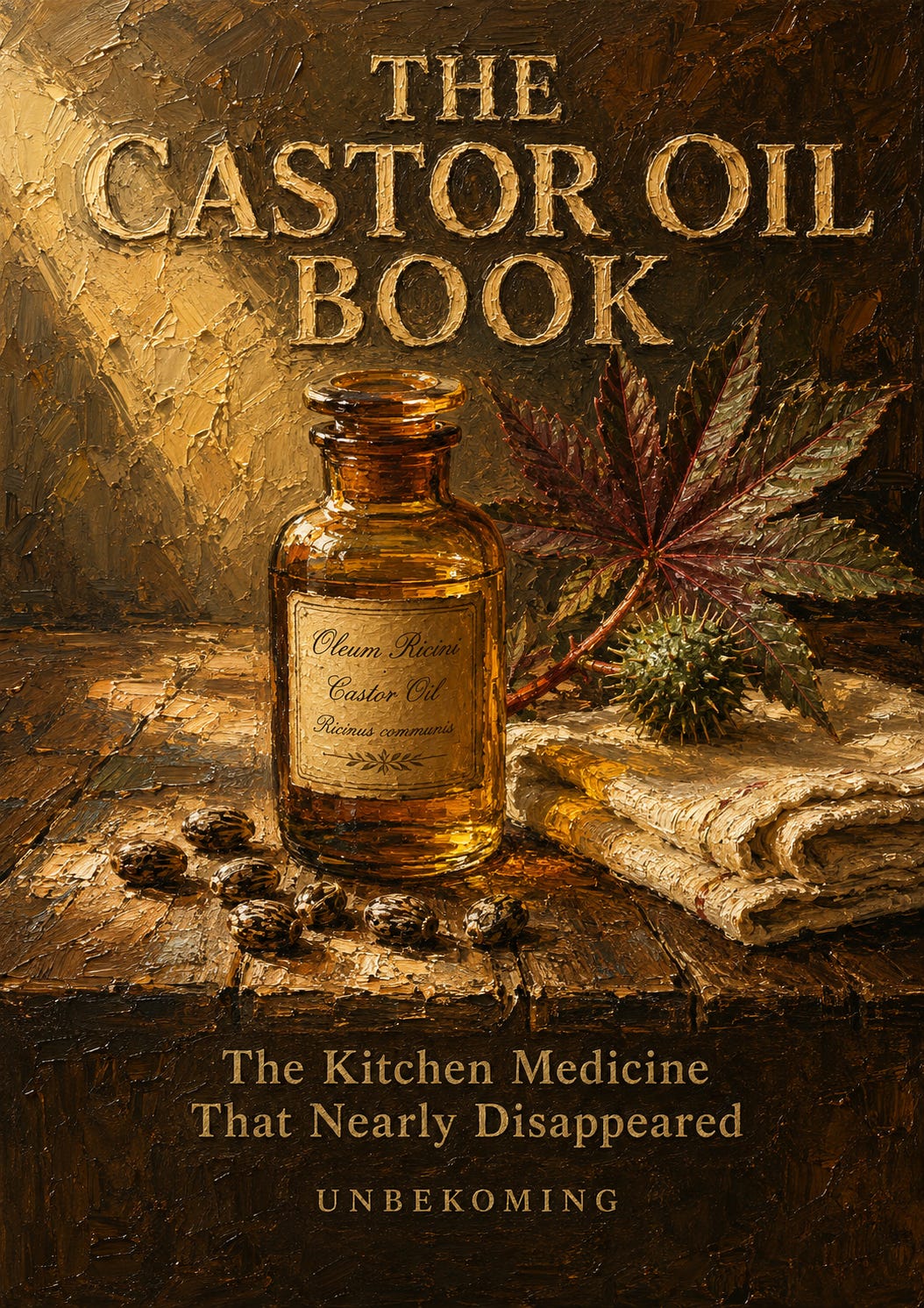
The Castor Oil Book is now available for paid subscribers, both as a digital book and as an audio deep dive, both below the paywall in this post. It draws on Barbara O’Neill’s teaching on castor oil compresses, McGarey’s clinical documentation across forty-six years of practice, the terrain-based understanding of disease articulated by Béchamp, Williams, Cowan, and the Bailey team, and specific investigation of what happens when kidney stones and appendicitis are approached through the terrain framework rather than the standard surgical and pharmacological pathways.
What the Book Contains
Four chapters and five appendices. Chapter One recovers O’Neill’s teaching on the compress: what it does, what it addresses, how to build one, the proportional rule for healing time, and the distinction between a compress that sends something in and a poultice that draws something out. Chapter Two summarizes McGarey’s The Oil That Heals with a twelve-point framework, thirty-five clinical Q&As, and the Golden Nugget on the Peyer’s patches and their role at the interface between conscious and unconscious mind. Chapter Three applies the terrain framework to kidney stones, drawing on O’Neill’s protocols, the calcium cascade, the magnesium priority, and the terrain understanding of why the body forms stones in the first place. Chapter Four does the same for appendicitis, drawing on Williams (surgeon-turned-naturopath, 1934), Cowan, and O’Neill, documenting cases at the New Biology Clinic where diagnosed appendicitis resolved without surgery, and considering the possibility that the appendix functions as a reservoir for microzymas.
Readers who follow this Substack will recognize the chapters. All four were previously published as free posts here and are collated in one place for the book. The five appendices are new material developed for the collection, and comprise the majority of what paid subscribers get from this post.
Appendix A: The Complete Pack
Construction, Materials, and Care
The practical how-to consolidated in one reference. Both variations of the pack documented in the book: O’Neill’s kitchen version, built from an incontinence pad with layered sheeting inside; and McGarey’s clinical version, built from wool flannel with a plastic sheet and heating pad. Sizing for abdominal, joint, and localized applications. Oil quantity for a fresh pack and for subsequent uses. Duration and frequency, drawing on McGarey’s clinical protocol at the A.R.E. Clinic (three days on, break, cycle for several weeks). Storage between uses. Cleanup with baking soda solution. When heat is contraindicated (appendicitis, intestinal obstruction with fecal impaction, threatened miscarriage) and when heat is useful. The reference readers return to when a new condition develops.
Appendix B: The McGarey Survey
81 Cases, 101 Conditions
The clinical documentation from The Oil That Heals reproduced with attribution. Tables I and II preserved verbatim: the response classifications (Excellent, Good, Poor) with McGarey’s own definitions; the full list of fifty-two diagnoses treated; the pack-only excellent-response rate of eighty-two percent; the combined-therapy breakdown. The specific data points McGarey narrated in his commentary: the ninety-two percent excellent for large bowel diseases; the one hundred percent excellent across twelve cases of trauma and post-surgical care; the two categories most refractory to the pack (essential hypertension and peptic ulcer disease). What the survey does not do stated honestly (not blinded, not controlled, selection effects). What the survey does do stated with the weight it earned across three decades of clinical practice by a licensed physician.
Appendix C: Selected Cases
Six Documented Outcomes from the McGarey Practice
Six documented outcomes from McGarey’s clinical record, each dated, each specific, each rated excellent to single therapy by the treating physician. Case 12: a twenty-five-year-old woman with threatened miscarriage at ten weeks, pack applied to lower abdomen without heat, pregnancy carried to term at nine months. Case 33: the eighty-nine-year-old with intestinal obstruction described in the opening, resolved in six days without hospitalization. Case 42: a sixty-five-year-old with acute cholecystitis, six nights of packs, gallbladder saved without surgery. Case 44: a sixty-two-year-old carpenter with an infected puncture wound and local cellulitis, forty-eight hours of pack dressing, wound cleared. Case 58: a thirty-nine-year-old music teacher with a thirteen-day right-sided headache resistant to salicylates and manipulation, resolved in two nights of packs with heat. Case 73: a twenty-one-year-old with an ovarian cyst, resolved with one hour daily over seven days.
Appendix D: Conditions and Protocols
A Working Reference
The most-used appendix. Sixteen conditions organized alphabetically. For each entry: where to place the pack, how to apply it, the timeline expectation drawn from documented cases where available and from O’Neill’s proportional rule where not, the source practitioner, and cross-references to the chapters and to Appendix A for construction. The conditions covered: adhesions and scar tissue; appendicitis; arthritic joints and bunions; bone spurs; cataracts; constipation; cysts (breast, ovarian, sebaceous); endometriosis and fibroids; gallstones and gallbladder attacks; headache with muscle spasm; hepatitis; recent injuries and infected wounds; intestinal obstruction with fecal impaction; kidney stones; pregnancy with threatened miscarriage; skin growths, moles, and keratoses. The reference the reader keeps handy for when the next thing arises.
Appendix E: Sourcing and Quality
What to Buy, What to Avoid
The practical bridge from paradigm to store shelf. Cold-pressed versus refined versus industrial-grade castor oil, and why the distinctions matter specifically for an oil that penetrates skin deeper than any other. Hexane extraction and why cold-pressed is the only version worth using topically. Organic sourcing and why it carries more weight for castor oil than for oils that stay on the skin surface. Recognizing quality on the label: what the words mean, and what the marketing terms do not mean. Packaging (dark glass, why plastic is a problem). Storage at home. Signs of degradation. What a working household supply looks like. Criteria only, no brand names, on the reasoning that brand recommendations date the book while the criteria stay stable.
What You Get
Paid subscribers get The Castor Oil Book in two formats, both below the paywall in this post: the complete text (introduction, four chapters, five appendices) and the audio deep dive on the book (approximately fifty minutes with alternating narrators).
A paid subscription to Lies are Unbekoming provides access to this book, to the thirty books already in the library covering heart disease, cancer, screening, dental disease, birth control, breast cancer, medicalized motherhood, chronic conditions, the fasting cure, the nuclear deception, the genetic deception, No Virus, and the rest, the full essay archive, and the audio deep dive that accompanies every book.
The chain of transmission was nearly severed. Recovering it is what this project is for.