

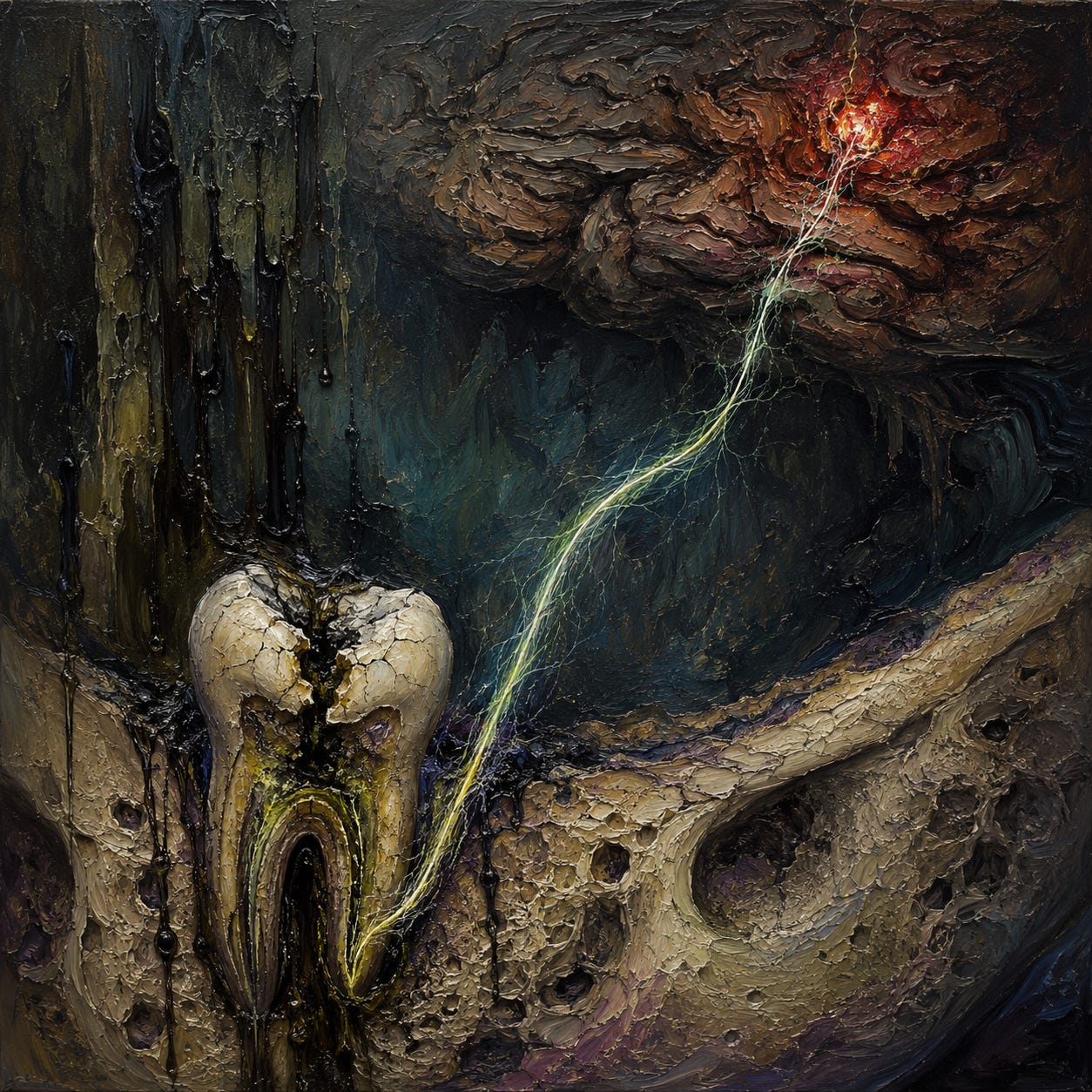
Toxins from a dead, root-canalled tooth travel along the trigeminal nerve into the brain at a measured rate of 250 millimetres per day. The literature establishing this dates to 1973. The trigeminal nerve occupies 28 per cent of the sensory cortex; a single front tooth contains roughly 500 myelinated nerve fibres with eight terminal filaments each, totalling about 120 nerve filaments per square millimetre of pulp surface. Whatever is sealed into the tooth, whatever the bacteria living in its three miles of dentine tubules produce, the nerve absorbs and conveys directly to the central nervous system, continuously, for the rest of the patient’s life. This is the documented anatomical mechanism at the centre of The Garbage Collector, published in 2022 by Robert Gammal, a retired Australian dentist whose forty years in practice forced him to confront what the procedure he had been trained to perform was actually doing.
Gammal graduated from Sydney University’s dental school in 1974 and worked across Australia, England, and Nepal, including extended periods treating Nepalese locals and Tibetan refugees. For thirteen years he performed thousands of root canals, advised pregnant women to take fluoride tablets, and implanted mercury amalgam into every patient he could. In the early 1990s he encountered Dr Horst Poehlman, a German medical physician practising in Adelaide, and shortly afterward travelled to Colorado to study with Dr Hal Huggins, the dentist who had spent decades preserving and transcribing Weston Price’s original research archive. Gammal spent the next twenty-seven years doing the reverse of what he had been trained to do. In 1994 he co-founded the Australian Society of Oral Medicine and Toxicology, the first formal challenge to the Australian dental establishment on mercury and root canals. He produced two documentaries, Quecksilber in 2004 and Rooted in 2006, both available on YouTube. The book is the distillation of forty years of clinical observation, four decades of reading the published research, and a lifetime spent inside the profession he came to describe with precision.
The book arrives a century after the original suppression. Between 1900 and 1923, Weston Price, then head of the American Dental Association’s Research Institute, conducted a twenty-five-year programme involving 1,500 patient histories, 5,000 laboratory animals, and 1,174 pages of published findings, establishing that root-canalled teeth remained infected regardless of appearance and that bacteria from those teeth could reproduce the patient’s disease in successive rabbits. Edward Rosenow at the Mayo Foundation, Charles Mayo, and Frank Billings (then president of the American Medical Association) corroborated the work. In 1923 John D. Rockefeller’s General Education Board began reorganising American medical education around patentable pharmaceuticals; medical schools teaching herbalism, homeopathy, and traditional remedies were closed or converted. In 1925 Price debated J.P. Buckley, then ADA president, who pledged to spend the rest of his life correcting what he called Price’s damnable practice. In 1927 a bacteriologist named W.L. Holeman, who had conducted no original research in the area, wrote a letter to the Journal of the American Medical Association rewriting Rosenow’s 90 per cent finding as a 50 per cent statistical artefact. The JADA editorial sequence from 1922 through 1940 instructed dentists to trust clinical observation over laboratory research and to ignore their detractors. Focal infection became a “theory” in the institutional record. Louis Grossman and John Ingles wrote endodontic textbooks built on the rewritten statistics; those textbooks are still in use.
The full summary unpacks the four mechanisms by which a dead tooth produces systemic disease: toxic insertion of the materials sealed into the canal, allergic sensitisation by the breakdown products, focal infection of distant organs by bacteria escaping the dentine tubules, and neural interference. The fourth of these is perhaps the most profound and the least known. Working in Germany in the 1940s, the Huneke brothers stumbled onto a phenomenon they called the Blitzkrieg reaction: a correctly placed injection of Procaine into the root of a dead tooth, or into an old scar, could switch off trigeminal neuralgia, joint pain, breast lumps, migraines, and other distant symptoms in seconds. Dr Peter Dosch formalised the framework around it. The dead tooth acts as an interference transmitter in the body’s electrical regulatory grid, generating disease in distant organs along the corresponding acupuncture meridian. Neural Medicine is taught widely to undergraduate medical students in Germany. It is denied entirely in Australia and America.
The summary also traces the mercury dimension: the 1976 introduction of high-copper amalgams, which the American Dental Association marketed as releasing no mercury but which European studies found released fifty times more, and the corresponding increase in reported multiple sclerosis cases that Hal Huggins documents from 8,800 per year (1970-1975) to 123,000 in 1976 alone. Professor Max Daunderer of Munich found that multiple sclerosis patients who removed amalgam alone showed a 16 per cent recovery rate, while those who accepted the full protocol including root canal extraction and alveolar bone cleaning showed an 86 per cent recovery rate. The arsenic concentration in ProRoot MTA, the cement currently marketed to seal the root tips of children’s teeth, is 116 times the level the Centers for Disease Control consider unsafe in drinking water. The manufacturer prints this on the warning label. Dentists implant it anyway.
With gratitude and appreciation to Dr. Robert Gammal.
Dr Gammal has generously agreed, via Dr. Robert Yoho, to make the full book available as a free PDF. If the work has value to you, please consider buying the book and/or leaving a positive review on its Amazon page to help the book reach more readers.

Paywall removed on this book summary.
Support This Work
The essays are free and will stay free. What paid subscribers get is the library that surrounds them: the full digital book catalogue, audio deep dives, archived, and embedded in each essay, and the Questions for Your Doctor, Before You Consent, and Package Insert series. Platinum Supporters also receive the digital edition of every paperback on the day it’s published.
Whichever tier suits, thank you for being here. If you’d like to become a paid subscriber, upgrade a tier, or gift a subscription to someone who might value the work, the options are below.
Audio Deep Dive Conversation
30 Questions and Answers
Question 1 Who was Robert Gammal, and what changed his approach to dentistry after thirteen years of conventional practice?
Answer I graduated from Sydney University in 1974 and worked as a dentist for about forty years across Australia, England, and Nepal, treating both Nepalese locals and Tibetan refugees. For the first thirteen years I did everything I was taught. I performed thousands of root canals. I poured mercury amalgam into as many people as I could. I advised every pregnant woman who came near me to take fluoride tablets. I believed my professors and deans, and I thought I was doing everyone a great service. I poisoned my friends and family. I poisoned every patient that came near me. I poisoned myself with mercury and a couple of root canals.
Then I met Dr Horst Poehlman in Adelaide, a German medical physician who introduced me to ways of thinking about the body that no one in Australia had done. I went to Colorado to study with Dr Hal Huggins in 1991 and continued learning with him for years afterward. These people opened a world of knowledge. I spent the next twenty-seven years doing the opposite of what I had been trained to do. I took out amalgam fillings. I removed dead root-canalled teeth. I banned fluoride from my practice. I watched the most amazing healings in many of my patients. The healings were so quick and so consistent that I had no choice but to keep going. In 1994 I worked with a small group of doctors and dentists to set up the Australian Society of Oral Medicine and Toxicology. I made two documentaries, Quecksilber in 2004 and Rooted in 2006, both available on YouTube.
Question 2 What does the title “The Garbage Collector” refer to, and how does it frame Gammal’s understanding of his own role as a dentist?
Answer I always told the patients who came to me for treatment that I was good at taking out the rubbish but the healing had to come from inside the patient. I just take out the rubbish, and you do the healing. I am much more of a garbage collector than a healer. The body does the healing work when given the opportunity. The dentist’s job, properly understood, is to remove what is blocking that work. A dead, gangrenous, infected tooth buried in the jawbone a few centimetres from the brain is not something the body can heal around. It is something the body has to be relieved of.
This frames the entire book. Dentistry as currently practised does the opposite. It saves the tooth, which means it preserves the source of poisoning. It implants more material. It seals carcinogens into the jawbone for the rest of the patient’s life. The garbage collector approach reverses this. Take out the dead tooth. Clean the bone. Wash the socket with Procaine. Let the body do what it has always known how to do. I have witnessed multiple sclerosis disappear after extracting one dead tooth. I have seen suicide notes torn up. I have seen brain tumours disappear. The body can often heal itself very quickly if given the opportunity. I am not the healer. I am the person who takes out the rubbish.
Question 3 Who was Dr Weston Price, and what did his twenty-five years of research at the American Dental Association Research Institute establish about dead teeth and systemic disease?
Answer At the turn of the twentieth century, Dr Weston Price was the head of the American Dental Association’s Research Institute and headed a team of some of the most brilliant minds in the dental world of America. His research was dedicated to exploring how dead teeth affected health. The work was mammoth and impeccable. It was conducted over twenty-five years by a dedicated team of scientists, dentists, and doctors. One of the most amazing feats was that he traced the medical histories of over 1,500 patients back over three generations, without computers. He correlated these histories against current disease states, X-ray appearance of dead teeth, blood parameters including calcium metabolism, and the patient’s resistance to infection.
The findings were these. Root-canalled teeth, no matter how good they looked or how free of symptoms, always remained infected. Organisms and their toxins, derived from the dead teeth, were able to spread throughout the body and cause a wide range of diseases. This spread of microorganisms from a focus of infection, the tooth, causing disease in other parts of the body, is called focal infection. He demonstrated this experimentally thousands of times. He would take a root-filled tooth from a patient with kidney disease, place it under the skin of a rabbit, and the rabbit would develop kidney disease and die. He would then remove the tooth, wash it in soap and water, disinfect it, and place it under the skin of another rabbit, which would develop the same kidney disease. He repeated this with the same tooth thirty times. He published his research in 1923 in two volumes totalling 1,174 pages and twenty-five articles in the medical and dental literature. By 1925 he had become a great embarrassment to the dental world.
Question 4 What is focal infection, what is elective localization, and how did Rosenow, Mayo, Billings, and Price demonstrate these mechanisms in laboratory animals?
Answer A focus of infection is a source or area in the body that is infected and allows the infecting organisms and their toxins to spread to other parts of the body. If the bacteria find a nice home to live in, they will cause an infection in this new part of the body. The infection that develops at the distant site is called a focal infection. Elective localization is the closely related principle that bacteria have a preferred action on preferred tissues. The same organism that caused kidney disease in a human host will preferentially cause kidney disease when introduced into a rabbit, because that organism has a tissue affinity. Any organism will have a preferred home that allows for a long life and steady ability to eat, grow, and reproduce.
The work was conducted by Dr Edward Rosenow, who served as head of experimental bacteriology for the Mayo Foundation for nearly three decades from 1915 to 1944. By 1915 Rosenow was generally regarded in prominent medical circles as the most brilliant of modern scientists. His research was supported by Dr Charles Mayo, who built the famous Mayo Clinic, and Dr Frank Billings, a president of the American Medical Association, who in a series of lectures in 1915 told the world about the findings. They all performed laborious research on the effects of microorganisms and their toxic by-products from dead teeth, demonstrating over and over how a disease in a human could be replicated in a rabbit simply by inoculating the animal with bacteria from the dead tooth. Most of the time, removal of these foci from the patient’s mouth was accompanied by improvement or complete elimination of the disease. Price worked on this for over twenty-five years and Rosenow for over thirty. The evidence is irrefutable.
Question 5 How did the dental establishment respond to Price’s findings between 1923 and 1940, and what role did the 1927 Holeman letter play in transforming established research into a dismissed “theory”?
Answer When Price published his revolutionary findings in 1923, he became the scapegoat of the dental world. The dental world was only just learning how to attempt root canal procedures and needed the support of the whole industry. These procedures had to be safe. They had to “save” teeth. They were simply not allowed to be infected, and nor were they allowed to act as a source of infection. The new information that they could be the cause of so many diseases, including cancer, was far too dangerous to allow. The dental associations decided to step sideways. They separated further from the medical faculty and claimed that good clinical observation and judgement took precedence over “test tube science.” From 1922 onward, JADA editorials by Otto King and C.N. Johnson hammered this position repeatedly. By 1925 Johnson was telling dentists to ignore their detractors and pin their faith to clinical observation rather than laboratory research.
The deciding moment came in 1927. A bacteriologist named W.L. Holeman wrote a letter to the Journal of the American Medical Association in which he rewrote Rosenow’s findings. The reality was that Rosenow and Price found a 90 per cent likelihood of a certain bug being associated with the specific disease in its human host. Holeman wrote that the work showed “not more than a 50% chance” for any strain to cause a given disease condition. With that single piece of statistical sleight of hand, he made focal infection into a “theory” rather than a cause of disease. Holeman did no research of his own in this area. He simply rewrote Rosenow’s results. The dental associations were grateful to have someone else arguing on their behalf. Some of the most brilliant and groundbreaking medical research that was ever done was instantly disregarded as a mere theory. As S.H. Shakman said, it is possibly the greatest fraud in medicine that has ever been perpetrated and perpetuated. It allowed unscrupulous people in the dental field to write textbooks like Grossman’s and Ingles’s that are used worldwide to this day, still promoting the lie Holeman created in 1927.
Question 6 How did Rockefeller’s funding of medical schools through the General Education Board in 1923 reshape what doctors and dentists were permitted to learn, and why did traditional medicine, herbalism, and homeopathy disappear from the curriculum?
Answer By 1900, John D. Rockefeller had made a great part of his fortune and owned about 90 per cent of America’s oil reserves. Already there were products being made from petroleum, such as Bakelite. It was soon discovered that petroleum could be used to make certain drugs and even the little capsules to put them in. This prompted Rockefeller to do a few things. In 1923 he and some other businessmen founded the American Society for the Control of Cancer. Not the cure. The control. He also funded and set up the General Education Board. He donated millions of dollars to almost every major medical school in America. This was done with the condition that the medical schools all started to teach a curriculum set by Rockefeller.
Almost overnight, these schools were teaching the same course to medical students, based on the use of drugs that could be patented. There were many medical schools at the time that were teaching the long-understood traditional medicine of herbs and homeopathic treatments. These schools were shut down or changed their curricula. The teachers and practitioners that refused to give up their tried and tested remedies were simply demonized. Some were run out of town. Some accidentally died. There was simply no room for anything that competed with potential patents. All treatments that worked and had a scientific foundation were no longer allowed. This is the reason that chiropractic treatments were demonized. Mercury and dead teeth, however, were allowed. They did, after all, make people sick. This is the medical model that today is regarded as state of the art.
Question 7 Where did the term “Quack” come from, and what does its origin reveal about the formation of the modern American Dental Association?
Answer “Quecksilber” is the German word for “quicksilver” or “mercury.” When amalgam was first introduced to the world in 1812, the German and Swedish dentists who used this new wonder material were called “Quecksilber dentists” or “Quacks.” All current dental associations were originally formed by the Quacks. The early dental societies in Sweden and America instructed their members never to implant mercury into their patients. The dentists who wanted to use amalgam ignored this. They formed new organizations. The new organizations replaced the old ones. The American and Swedish Dental Associations as they exist today were built on the backs of mechanics and mercury and had nothing to do with health or science.
These molar-mechanic dentists ignored the instruction of their original societies because amalgam was easy and profitable. It was the first time these dentists had an alternative to molten lead or tin for filling teeth. They were ecstatic. It didn’t matter that the material expanded wildly and cracked the teeth. It didn’t matter that mercury was already known to be highly toxic. Two of the world’s most popularly used dental alloys for the fabrication of amalgam have patents which to this day are owned by the American Dental Association: US patent 4,018,600, registered in April 1977, and US patent 4,078,921, registered in March 1978. The associations that condemn dissent as quackery were founded by Quacks.
Question 8 Who was Dr Hal Huggins, and what work did he do to preserve Price’s research and bring mercury amalgam toxicity to global attention?
Answer Dr Hal Huggins is personally responsible for bringing Dr Price’s writings into current awareness. He was sent a trunk full of Price’s original writings. He was smart enough to read and understand the message in the trunk and created a purpose-built concrete bunker to house these volumes. He then paid to have them transcribed. His efforts have been tireless in educating about the dangers of root therapy, even in the face of massive opposition. He took the dental world by the collar in the mid-1970s and gave it a great big shake. He made the world look at the dangers of mercury escaping from dental amalgam. There were many researchers in the 1970s and 80s who tried to prove him wrong, first about the amount of mercury coming off amalgam fillings and second about what this mercury can do to our bodies. They never did prove him wrong. Some of the more honest scientists at the time were horrified that they kept proving him right. They went on to form the International Academy of Oral Medicine and Toxicology.
He authored It’s All In Your Head, The Price of Root Canals, and Solving the Multiple Sclerosis Mystery. He taught many dentists how to change their dictated work habits for the benefit of their patients. I studied with him in Colorado in 1991 and had a long, close relationship with him for years afterward. His insights and knowledge left most professors floundering. His intelligence and wit were matched by his warm humanity and love of people and fun. He was once asked if all root-canalled teeth should be removed. He replied that it was only for those people who had an interest in their health. Acting on the knowledge that he gave me has saved my life and my sanity.
Question 9 Who was Dr George Meinig, and why does his late-career conversion from founding endodontist to author of Root Canal Cover-Up carry special weight?
Answer Dr George Meinig was one of the nineteen founding members of the American Association of Endodontics. In 1946 they published the first issue of the Journal of Endodontics. For many years he was the president of that association, and thus one of the leading endodontists in America. Incredibly, he did not know of Dr Price’s work, even though he was alive for many of the years that he was a specialist in the exact field that should have been teaching about Price’s research. Toward the end of his career, he came upon the work of Dr Price and realized the dangers of his specialty. It was a giant acknowledgement for him to understand the way his many years of treatments had potentially affected his patients. He wrote The Root Canal Cover-Up. He described root canal procedures as “the story of how a cast of millions become entrenched inside the structure of teeth and end up causing the largest number of diseases ever traced to a single source.”
In an interview on the Laura Lee show he made some powerful comments. He described how Price had run a twenty-five-year research program with 1,174 pages of documentation and twenty-five articles in the medical and dental literature, and how he, Meinig, had practised endodontics for forty-seven years without ever hearing about it. He described Price’s experiments with five thousand animals showing that root-filled teeth, no matter how good they looked or how free of symptoms, always remained infected. He described the rabbit kidney experiment repeated thirty times. His new-found position about the dangers of root canals did not win him many friends. He was immediately castigated and spat out by his colleagues and other mad hatters whose income was on the line. He dedicated the rest of his life to trying to wake a sleeping profession.
Question 10 What is the actual anatomy of a tooth, and why does the dentine tubule structure, containing three miles of tubing in a single-rooted tooth, make sterilization impossible?
Answer Teeth are not big chunks of inert calcified material, as dentistry would have us believe. The enamel is the part we eat and smile with, the hardest tissue in the body. Under the enamel is dentine, which makes up the bulk of the tooth. Down the centre of the root is the canal, opening at the apex deep inside the jawbone, through which pass the nerve fibres and blood vessels that bring sensation and nutrients and take away waste. Around the outside of the root is cementum, a thinner calcified layer, and around that is the periodontal ligament, the membrane that attaches the tooth to the bone and forms a fibrous seal to prevent infection tracking down the outside of the root. Around all of that is bone, and around the bone is the rest of you.
Dentine is not solid. It is made of millions of tubes that run from the surface of the root canal to the enamel and to the outer surface of the root. There are 30,000 to 75,000 tubules per square millimetre of dentine. If you were to place the tubules of a single-rooted tooth end to end, you would have about three miles of tubing. That is one root. Molars may have up to three roots each. Each tubule is wide enough to contain eight bacteria across in cross section. Billions of bacteria can and do live happily in such an environment when a tooth becomes infected. They will penetrate to the full depth of the dentinal tubules, right out to the edge of the tooth. All these tubules communicate directly with the surrounding cementum, periodontal ligament, bone, and from there with the whole body. Then there are the accessory canals, branches that come off the main canal at all sorts of angles and continue through to the surface of the root. The root canal system is not a simple tube. It is more like the taproot of a tree, with branches reaching out in three dimensions. None of the root canal medicaments will penetrate these accessory canals. Sterilizing a structure like this is not difficult. It is impossible.
Question 11 What did Ralph Steinman demonstrate about dentinal fluid flow, the autonomic nervous system, and the real causes of dental decay, and why was this finding buried?
Answer The root canal running down the centre of the tooth is lined with a membrane only one cell thick. These cells cover the pulp and send extensions of themselves up the middle of the dentine tubules. The extensions are surrounded by tissue fluid and communicate with the sensory nerves in the pulp. This fluid does not sit still. It flows outward from the pulp through the dentine tubules to the tooth surface. The outward flow of dentinal fluid is the pulp’s defence against the entry of harmful substances. It washes out bacteria. It dilutes toxins. This is the body’s design, and it works. Steinman demonstrated in the 1960s and 1970s that the direction and volume of this fluid flow is hormonally controlled and directly influenced by the autonomic nervous system. Parasympathetic stimulation, the calming side, encourages increased fluid flow. Sympathetic stimulation, the fight-or-flight side, dramatically reduces it. He found that fluid pressure, and therefore decay rate, depended principally on diet and stress. Sugar and white flour were among the worst influences. Both reduce the flow of fluid through the teeth.
This is exactly what Price found and published in 1939. Within one generation of introducing sugar and refined flour into the diet of a population, the decay rate in the next generation went from almost non-existent to what we in the wealthy Western countries consider normal. The cause of decay is systemic. It is dietary. It is hormonal. It has nothing to do with fluoride deficiency. The current Australian Dental Association even agrees in their 2007 publication. The outward flow of the dentinal fluid is important in the pulp’s defence against the entry of harmful substances. The relatively high pulp tissue pressure results in an outward flow of fluid in the dentinal tubules. The information has been published. It is buried because, if accepted, sugars and refined flour would be off the table and fluoridation would be the laughingstock of the world it deserves to be.
Question 12 What is fluoride actually doing in the drinking water supply, and what does its documented history reveal about its purpose?
Answer Fluoride is a toxic poison. It causes an increase in decay rates and a host of other systemic disasters. It calcifies the pineal gland. It causes hypothyroidism. It causes osteosarcoma. It causes heart disease. It blocks iodine uptake, with resulting obesity, diabetes, and breast inflammatory diseases. It causes musculoskeletal fluorosis, which presents as diffuse painful joints and is often misdiagnosed and treated as arthritis. There can be more fluoride in a teabag than in a litre of fluoridated water, and many middle-aged people are long-term tea drinkers who compound this with fluoridated toothpaste. Mike Godfrey describes a seventy-nine-year-old patient on the waiting list for her second hip replacement, having already had both knees done. She drank six cups of Bell’s tea per day since her teens and used Colgate toothpaste twice a day. Her urine and blood fluoride levels were elevated. After changing to herbal teas and herbal toothpaste, her “arthritis” pains decreased so much that she went on a cruise instead of having surgery. The case was published in the New Zealand Medical Journal in 2018.
I worked in both fluoridated and non-fluoridated areas of Australia. The most decay I saw in children’s teeth was in the fluoridated areas. The next best were the non-fluoridated areas where children were drinking city water. The best teeth and the healthiest children were drinking tank rainwater. Fluoride also lowers IQ across a whole population. It was put in drinking water in German concentration camps to keep the inmates more apathetic. It is used in our water supply for the same reason. Fluoride acts as an inhibitor of brain growth and maturity when foetuses are exposed in utero. Both Aboriginal and Maori populations drinking fluoride-deficient rain and river waters had no dental decay before adopting foods based on white flour and sugar. The argument that fluoride is needed for healthy teeth is a lie. The argument that it is in the water for the public’s benefit is another lie.
Question 13 What are the six “rational treatment principles” of a root canal procedure, and what has the Australian Dental Association itself admitted about whether each can be achieved?
Answer The six steps that must be fulfilled for a root canal procedure to succeed are these. Clean and shape the canal to within one millimetre of the end of the root. Remove all dead gangrenous tissue from the whole of the tooth. Sterilize the tooth, allowing no bacteria, fungi, or yeasts to survive. Fill and seal the canal completely, so bacteria cannot get in or out. Use only biocompatible materials. Restore the crown of the tooth in a way that prevents oral bacteria from re-entering. The belief that any of these objectives can be achieved is one of the greatest fantasies in dentistry and medicine. There is no published scientific research that demonstrates any of these goals are achievable. There is endless published research that demonstrates the opposite.
The Australian Dental Association has admitted as much. In 2007 they published that all instrumentation techniques left 35 per cent or more of the canal dentine surface untouched, with very little difference between the four instrument types. They published that predictable eradication of bacteria from the root canal still remains an elusive goal. They published that no current restorative dental material is able to provide a total and permanent seal, so it is always possible that micro-leakage will occur and bacteria may enter the tooth. They published in 1998 that it is impossible to completely seal a root canal. They published in 1996 that all root canals in the affected tooth must be treated, while their own research shows this is mechanically impossible. The leading endodontic textbook even admits, in 2007, that the manner of execution of treatment procedures is so diverse, even within prescribed protocols, that it is accepted this treatment intervention is not by its nature standardisable. Every dental school in the world teaches students that this procedure is essential to maintain health. Every step is painstakingly taught and examined. Millions of dentists are pretending.
Question 14 What does the root canal procedure actually involve, step by step, from the initial drilling through the final filling, and what is the dentist really doing to the patient?
Answer A large hole is drilled into the tooth from the top of the crown to gain access to the pulp chamber and the root canals. The canals are then scraped out using special files of increasing diameter to remove dead tissue and infected dentine. During this process, some of the debris and infected tissue and bacteria will be forced through the end of the root and into the surrounding bone. This happens even if the endodontist is a god-professor or has offices in Macquarie Street in Sydney or Harley Street in London. Every time the dentist scrapes the inside of the root, the patient gets a bacteraemia. The canal length is judged by taking an X-ray with a metal file inserted into the canal, and calculating an estimated working length that falls short of the true root length most of the time. Then comes the chemical irrigation. Hydrogen peroxide and sodium hypochlorite are squirted into the tooth. Sodium hypochlorite is exactly the same bleach used for cleaning dirty nappies. Research from 2003 showed that over 94 per cent of endodontists used these materials. The rest used ordinary household bleach, which is about a dollar cheaper per litre.
Between visits, antimicrobial medicaments are sealed into the tooth. The most common ones, used for over a hundred years, are camphor, phenol, menthol, and formaldehyde. They are known carcinogens. They do not work. Antibiotics, calcium hydroxide, chlorhexidine, and cortisone are sometimes added. They also don’t work. When the dentist decides the tooth is “sterile” (a determination made by smell and lack of pain, with no laboratory testing of any kind), the canal is filled. A runny cement is spun down into the canal using a twisty spiral wire, and gutta percha points are packed in tightly. The GP points act as bricks, the cement is the mortar. This is supposed to stop bacteria from getting into the tooth and reinfecting it. The reality is that the bacteria are already inside, throughout the three miles of dentine tubules, throughout the accessory canals. All materials used in the procedure are toxic. All will spread from the tooth to the rest of the body. The dentist has just created a toxin factory in the jawbone, sealed it with the patient’s name on the bill, and called it therapy.
Question 15 What materials are used to “sterilize” and fill a root canal, what do their manufacturer Material Safety Data Sheets warn about, and what is the Sargenti Technique?
Answer The materials are universally toxic. Formaldehyde is one of the most dangerous and one of the most common. The N2 paste, the foundation of the Sargenti Technique, is made largely of paraformaldehyde, which forms formaldehyde when water touches it. The manufacturer’s Material Safety Data Sheet states that formaldehyde is POISON, DANGER, SUSPECT CANCER HAZARD, MAY CAUSE CANCER. It is a probable human carcinogen, a mutagen, and a reproductive effector. It is “known to the State of California to cause cancer.” It causes nasal cancer, respiratory tract irritation, reproductive disorders, asthma, dermatitis, and multiple organ damage. It cannot be made non-poisonous. AH26 and Endomethasone are the two most commonly used root-filling cements in the world. Both break down to formaldehyde. AH26 comes with the warning that it is a danger to drinking water if even small quantities leak into the ground, that it is poisonous for fish and plankton, and that if swallowed the patient must call a doctor immediately. ProRoot MTA is a form of Portland cement contaminated with arsenic at 116 times the level the Centers for Disease Control consider unsafe in drinking water. Its manufacturer warns it contains chemicals known to the state of California to cause cancer, birth defects, and other reproductive harm. It is implanted into living children’s jawbones.
The Sargenti Technique was introduced by a Swiss dentist named Angelo Sargenti in 1954. He died in 1999 after profiting enormously from his carcinogenic paste. The American Endodontic Society was set up specifically to promote the use of this material. The technique is loved by so many dentists because the materials are cheap, the procedure requires minimal work in the canal, and the N2 paste acts as the permanent root filling. It is the most common root-filling material in the United Kingdom and other countries with national health care schemes. What the government pays for root canals is so little that none would be done if dentists used any other technique. The British government and the British Dental Association are condoning the poisoning of the population with this carcinogen. The American Association of Endodontists, the rival specialist group, recommends against paraformaldehyde-containing materials because they have proven to be unsafe and ineffective, and have been shown to travel throughout the body and infiltrate the blood, lymph nodes, adrenal glands, kidney, spleen, liver, and brain. The hypocrisy is total. The AAE denies that anything travels from a tooth through the body, then admits in the same breath that everything does.
Question 16 What is “physiological balance,” and why did endodontists invent this term?
Answer Physiological balance is a fantasy created by an incompetent profession to disguise its total inability to achieve the single most basic requirement of a root canal procedure. The issue is so huge that endodontists can no longer keep living in denial, nor can they accept failure. So they created a new name for a new concept. Instead of cleaning, disinfecting, or sterilizing the canal, they now claim to be able to achieve a state of “physiological balance” in the dead infected tooth. No one has ever defined how to assess this mythical state. No one has demonstrated how it can be achieved or maintained after completion of the procedure. No one has stated what happens to the bacteria and other organisms that are happily living and multiplying in the anaerobic milieu a year or two after this mythical state has been declared.
This is nothing but smoke and mirrors by the top professors and specialists. It is a disgusting attempt to conceal their ineptitude and maintain their income. The pattern is consistent across the profession. When something is admitted to be unachievable, it is renamed and declared to no longer be a problem. The British Dental Association now calls for “thorough cleansing” instead of sterilization. The American Dental Association writes that microbes do remain in the dentinal tubules of endodontically treated teeth but pose no health hazard. Once the goal cannot be reached, the goal is redefined as having always been something else. Then everybody is told that of course everybody knew this all along. The same lie has been used for over one hundred years.
Question 17 What are the four mechanisms by which a dead tooth can cause systemic disease, and how do they operate together?
Answer There are four mechanisms by which a dead root-canalled tooth affects the health of the body and mind. The first is toxic insertion. All the medicaments and filling materials placed in the tooth are toxic, and they all leak from the tooth into the surrounding bone and from there into the circulation, the lymphatic system, and along the nerves. Formaldehyde, phenol, camphor, mercury from retrograde amalgam fillings, arsenic from ProRoot MTA, paraformaldehyde from N2, all of them spread throughout the body. The second mechanism is the allergic mechanism. The toxic gangrenous breakdown products, the endotoxins produced by the bacteria, and the materials themselves can sensitise the tissues of the body and trigger allergic responses ranging from rashes to full inflammatory conditions. The American Dental Association acknowledged this exact mechanism in 1951 and has since pretended it does not exist.
The third mechanism is focal infection. Bacteria from the tooth escape constantly, not just during procedures. They travel through the blood and lymph and lodge in tissues where conditions suit them. The heart, the kidneys, the brain, the joints, the prostate, the uterus, the lungs. The same bug that caused the patient’s kidney disease causes the rabbit’s kidney disease. The fourth mechanism is neural interference. The dead tooth acts as an interference field in the body’s regulatory system, disrupting cellular membrane potentials and disturbing organ function along the corresponding acupuncture meridian. These four mechanisms do not operate in isolation. They operate simultaneously. A single dead tooth is leaking carcinogens, sensitising tissues, seeding focal infections, and disrupting the regulatory grid at the same time. A patient with multiple root-canalled teeth and a mouthful of amalgam and titanium implants is being assaulted from all four directions on multiple meridians twenty-four hours a day for the rest of their life.
Question 18 What are endotoxins, what are thioethers and methyl mercaptans, and why does Issels describe them as among the most potent carcinogens known?
Answer Endotoxins are the toxins produced by anaerobic bacteria. They are found mostly in the outer membrane of Gram-negative bacteria and are also called lipopolysaccharides. Many are deadly. Many cause cancer. They are found throughout the depth of the dentine tubules and they leak easily from the tooth. The dental research is full of studies that have looked at every conceivable method to eliminate them, all to no avail. Even at low concentrations, endotoxins have profound effects. They interfere with blood clotting. They alter the development and function of nerve tissue in the brain. They kill nerve cells. They alter transmission within nerve fibres. They cause headaches, nausea, vomiting, depression, personality changes, nosebleeds, breathing difficulties. They are associated with miscarriage, low birth weight, coronary heart disease, stroke, and atherosclerosis. They cause cancer.
The most dangerous endotoxins are the thioethers, such as dimethylsulfide, and the methyl mercaptans. Thioethers are strongly related, both in their structure and their effect, to mustard gas and other poison gases used in the First World War. They are among the most potent of all carcinogens. They paralyse the aerobic action of cells. They almost exclusively target the mitochondria. The mitochondria are the energy power supplies for all cells, so the tissues most affected are those with the highest mitochondrial concentration: the liver, the nervous system, the endocrine glands, the heart, and the reticuloendothelial system, whose cells may consist of up to one-fifth mitochondria. Issels makes the central point that the carcinogens primarily responsible for the development of cancer are those which inhibit the aerobic function of cells, in minimal quantities, without destroying the cell, and which are constantly present. Eventually a level builds up which causes overt cancer. Thioethers fulfil these conditions completely. Incessantly, from the moment the pulp is removed, hour by hour, year by year, minimal amounts of the most virulent of all the odontogenous toxins are released into the circulation. Minimal doses, but sufficient to paralyse the aerobic action of the cell. This is the mechanism by which a dead tooth becomes a cancer factory.
Question 19 How do toxins and bacteria from a dead tooth reach the brain and the rest of the body, and what did Stortebecker’s dye injection experiments demonstrate?
Answer The toxins, bacteria, and materials in a dead tooth reach the brain and the rest of the body through several routes. The first is retrograde axonal transport. Toxins are carried directly back to the brain along the nerve fibres. In 1973 it was demonstrated that these toxins travel at a rate of about 250 millimetres per day. The trigeminal nerve supplies sensation to the teeth, mouth, lips, skin, and face. It has the largest innervation zone of all the cranial nerves and the largest ganglion. In the sensory somatotopic projection of the body onto the brain, the trigeminal nerve takes up 28 per cent. The face, mouth, teeth, and neck together occupy about half the cortical surface area. A single adult incisor has about 500 myelinated nerve fibres and 40 to 150 unmyelinated fibres, each fibre with eight terminal filaments reaching the outer pulp. That is about 120 nerve filaments per square millimetre. The nerves in the teeth form a massive surface area that feeds directly back to the brain. They act like a net absorbing toxins and carrying them down the trigeminal channel.
The second route is the venous plexus. Professor Patrick Stortebecker, professor of neural surgery at the Karolinska Institute in Sweden, injected dye into the angle of the mandible, which is not connected to the skull by bone. Within minutes the dye filled the whole of the venous system inside the skull. This demonstrated that the non-valved venous plexus below the skull allows movement of blood in both directions. Bacteria from the mouth enter the brain through this route. The third route is macrophage transport. Macrophages are white cells that cross the blood-brain barrier carrying heavy metals like mercury and aluminium, along with bacteria and toxins, and deposit them in the brain. Stortebecker demonstrated that cerebral multiple sclerosis plaques contain the same organisms found in dead teeth, periodontal disease, and other oral infections. Spinal MS lesions contain the same organisms found in the bowel and vagina. The route from the mouth to the brain is short, well-mapped, and undeniable.
Question 20 What is the relationship between dead teeth and cancer, and why does the X-ray-positive versus X-ray-negative distinction matter so much in Issels’s clinical practice?
Answer Dr Joseph Issels was a German oncologist with one of the most respected cancer clinics in Germany. He succeeded in curing many patients. Before starting any of his treatments, he instructed the patient to rid the mouth of all toxic material, including amalgam fillings, dead or root-canalled teeth, and cavitations. He devotes a whole chapter to dental foci in Cancer: A Second Opinion. He rated his own treatments as average until the dental work was done first. With the dental work done, his success rate increased to about 80 per cent. This is a far cry from the success rate of chemotherapy and radiotherapy. A 2004 report by Morgan, Ward, and Barton found that the contribution of cytotoxic chemotherapy to five-year survival in adult malignancies was 2.3 per cent in Australia and 2.1 per cent in the USA. Professor Daunderer of Munich confirmed the same protocol. Cancer treatment without dental detoxification fails. Cancer treatment with dental detoxification works.
The X-ray distinction is crucial. When a tooth becomes infected, a strong body responds by forming a fibrous capsule around the end of the root in an attempt to quarantine the toxins from the rest of the body. This appears on an X-ray as a clearly defined dark area surrounded by a white line. Issels and Price called this X-ray positive. As the body’s defences weaken, the capsule loses its definition, then disappears entirely, and the X-ray shows what looks like normal bone or even denser white bone, called condensing osteitis. Modern dentistry reads the disappearance of the abscess as healing, evidence of a successful root canal. The reality is the opposite. The X-ray-negative tooth is the more dangerous one. The body has lost the ability to contain the toxins, and they spread freely throughout the rest of the body. Issels found that his cancer patients overwhelmingly had X-ray-negative teeth. Rosenow stated in 1940 that streptococci isolated from X-ray-negative pulpless teeth in his experience were more specifically virulent than those isolated from X-ray-positive teeth. The very mark of “success” that modern endodontics celebrates is the sign that the patient’s defences are ruined. Twelve months later the X-ray shows dense white bone and the dentist pats himself on the back, while the patient heads toward cancer.
Question 21 What did Stortebecker, Daunderer, and Huggins establish about the relationship between multiple sclerosis, dead teeth, mercury amalgam, and the venous plexus, and what cure rates have been reported?
Answer Professor Patrick Stortebecker, at the Karolinska Institute in the 1970s and 1980s, demonstrated that the primary lesion in multiple sclerosis is not demyelination but an infected plaque around the venous side of the blood supply to the brain. The organisms in these plaques match those found in dead teeth, periodontal disease, and other oral infections. The route is the non-valved venous plexus, which his dye injection experiments mapped definitively. Professor Daunderer of Munich quantified the clinical implications. Multiple sclerosis patients who had amalgam removed but refused both extraction of root canals and treatment of infected maxillary bone showed a cure rate of 16 per cent. Multiple sclerosis patients who accepted the full treatment, including root canal extraction and cleaning of alveolar bone, showed a cure rate of 86 per cent.
Hal Huggins added the mercury dimension. The cerebrospinal fluid of multiple sclerosis patients consistently shows substantially higher mercury levels than in people without MS. Mercury is converted in the body to methyl mercury, which is forty-five times more fat-soluble than ionic mercury, making it that much more dangerous to nerve cells. The myelin sheath is a highly lipid material. Methyl mercury destroys these myelin proteins. Huggins noted that the incidence of both amyotrophic lateral sclerosis and multiple sclerosis started rising sharply after 1976, when high-copper amalgams were introduced as “state of the art” fillings. The ADA claimed these new fillings released no mercury. European studies found they released fifty times more mercury than previous formulations. Huggins reports that the number of cases of multiple sclerosis increased from an average of 8,800 per year during 1970-1975 to 123,000 in 1976, the birth date of high-copper amalgams. Multiple sclerosis was not known before 1830, when mercury amalgam became a worldwide phenomenon. The Australian Multiple Sclerosis Society refuses to acknowledge any of this research. A clever doctor once told me that we will never find a cure for any disease that has a society or organization associated with it.
Question 22 What is Neural Medicine, what did the Huneke brothers discover with Procaine, and how does Dr Peter Dosch’s framework explain interference fields?
Answer Neural Medicine originated in Germany about sixty-five years ago through a fortunate accident made by two brothers, Drs Ferdinand and Walter Huneke. They were trying to help their sister, who suffered from severe migraines. One of them accidentally injected a drug containing Procaine, a local anaesthetic, into her vein instead of her muscle. The migraines disappeared completely. Years later they were treating a patient who for many years had suffered from pains in her right shoulder and immobility of the shoulder and arm. No treatment had worked. She came in because an old scar on her left leg had become inflamed. They injected Procaine into the scar. To their shock, the pain in her right shoulder vanished as though a light switch had been turned off, and she regained complete movement. They called this the lightning reaction, or Blitzkrieg reaction. This began a whole new understanding of the body’s regulatory mechanisms.
Dr Peter Dosch, one of the world’s leading experts in this field, describes the framework. Every cell is a tiny battery with a charge of 40 to 90 millivolts. Any stimulus, heat, cold, chemicals, injury, causes this potential to collapse, and the cell’s oxygen metabolism normally recharges it. After excessive stimuli such as surgery, injury, or inflammation, sometimes the cell cannot fully recharge. A cell stuck at a lower membrane resting potential can no longer fulfil its functions. Such a diseased region, like a scar that has healed but still possesses residual irritant capability, sends out irritant salvoes that overwhelm the body’s regulatory systems. It acts as an interference transmitter. Congenitally weak organs or organs weakened by previous illness pick up these signals like an old radio receiver picking up multiple stations at once, and process the irrational information into pathogenic dysfunction. The most common interference fields are the tonsils, followed closely by teeth and other dental conditions. This includes any dead tooth with or without a root canal, any impacted tooth, or any cavitation deep in the bone. The treatment is to remove the interference and inject Procaine to repolarise the tissue. In Germany, neural medicine is taught widely to undergraduate medical students. In Australia and America it is completely denied.
Question 23 What did Dr Reinholdt Voll establish about acupuncture meridians and dental positions, and what are the documented tooth-organ relationships running through the mouth?
Answer In the 1950s, the German doctor Reinholdt Voll showed that acupuncture points have a different electrical resistance from the skin on the rest of the body. He used minuscule electric currents to demonstrate the acupuncture meridians and many relationships between different parts of the body. He is regarded as the father of electroacupuncture. He mapped the acupuncture meridians and found them almost identical to the Chinese meridians known for thousands of years. He then mapped the meridian that passed through each tooth, establishing the relationship of each tooth to specific organs and systems. The modern equipment used for electrodermal testing is completely based on his methods. His work is ridiculed by the dental and medical establishments because they refuse to acknowledge that the mouth and body are connected.
The relationships are these. The front teeth sit on the Bladder meridian, so interference here may cause disturbances in the kidneys, the knees, and the reproductive system. Wisdom teeth sit on the Small Intestine meridian, which is related to the heart. This is heart attack land. Cavitations in the wisdom tooth area are very commonly associated with cardiovascular disease. The upper molars and lower premolars sit on the Stomach meridian, which passes through the breast. I lost count of the women whose breast lumps disappeared within a week of having an upper molar or lower premolar extracted. Many had carried these lumps for years. Many had been treated for breast cancer. The Stomach meridian also explains the very common appearance of sinusitis in patients with root-canalled upper molars. The Small Intestine meridian, beyond the heart, is also related to eczema, dystonia, migraine, tinnitus, epilepsy, arthritis, and facial neuralgia. The connections are not metaphors. They are clinically reproducible. Procaine injection at the interference site frequently switches off the distant symptom in real time. This is how I learned to find what was causing what.
Question 24 What are cavitations, what did Dr Eugene Ratner demonstrate about their connection to trigeminal neuralgia and referred pain throughout the body, and how common are they after routine extractions?
Answer A cavitation is a hole in the jawbone where the bone has not healed properly after a tooth extraction. They have been given many names over the years: jawbone cavities, osteocavitation lesions, pathologic bone cavities, Ratner Bone Cavities, neuralgia-inducing cavitational osteonecrosis. G.V. Black, the father of modern dentistry, described them in 1920 and called them chronic osteitis. He recommended radical surgical treatment: open the area freely and remove every particle of softened bone until good sound bone forms all the walls of the cavity. They form because forceps extractions apply massive pressure to the bone, causing compression necrosis, and because the periodontal ligament is left in the socket, biologically preventing the adjacent bone from recognising that the tooth has been extracted. A 1996 study of 691 extraction sites in 112 patients found that 77 per cent of all extraction sites had become cavitations. In molar areas the figure was 85 per cent. In wisdom tooth areas it was 88 per cent. The most obvious reason for not finding a cavitation is not looking for one.
Dr Eugene Ratner, an American dentist, published research in the 1960s and 1970s that clearly demonstrated a strong causal link between cavitations and trigeminal neuralgia. By cleaning out the cavitations and restoring health to that part of the bone, he found that trigeminal neuralgia disappeared in around 90 per cent of patients. He also mapped how cavitations in various parts of the mouth referred pain to various parts of the body. Lesions in the upper jawbone referred pain to the front of the legs, the big toe, and down the spine. Lesions in the mandible referred pain to the groin, the insides of the arms, and the three smaller fingers. Today, fifty years later, dental students are still refused this knowledge. The standard treatment for trigeminal neuralgia is brain surgery to sever the nerve. The American Association of Endodontists declares it unethical to recommend extraction of a root-canalled tooth for the prevention of trigeminal neuralgia or any other disease. They are demanding brain surgery instead of socket cleaning. The Cavitat machine, which uses ultrasound to demonstrate holes in the bone, is no longer on the market. It worked, which is probably why.
Question 25 What is mercury amalgam actually releasing into the body, and what changed in 1976 with the introduction of high-copper amalgams?
Answer Mercury is the third most toxic element known to science. Arsenic is first, lead is second. An amalgam filling releases mercury vapour twenty-four hours a day for as long as it is in the mouth. The main source of mercury exposure to the general population is dental amalgam, at a rate ten times higher than all other sources combined, including seafood. The mercury vapour is inhaled, swallowed, and absorbed through the oral mucosa. It crosses the placenta and the breast milk, storing preferentially in the foetus and the newborn baby. This process is associated with the development of autism. Mercury crosses through the bones of the palate and base of the skull directly into the brain. It is severely neurotoxic and cardiotoxic. It causes a suppression of the body’s total immune defence mechanism, making people susceptible to all kinds of infections and indirectly to certain cancers. Elemental mercury vapour is converted in the body to methyl mercury, which is forty-five times more fat-soluble than ionic mercury, making it that much more dangerous to nerve cells. The nerve cells are covered in a myelin sheath, a highly lipid material. Methyl mercury destroys these myelin proteins. The symptoms of mercury poisoning are clinically indistinguishable from those of multiple sclerosis.
In 1976 the dental industry introduced high-copper amalgams as the new “state of the art” filling material. The American Dental Association claimed these new fillings released no mercury. European studies found they released fifty times more mercury than previous formulations. Hal Huggins, who has done more research on this than anyone, noted that the incidence of autoimmune disease, amyotrophic lateral sclerosis, and multiple sclerosis began rising sharply after 1976. The actual number of cases of multiple sclerosis increased from an average of 8,800 per year during 1970-1975 to 123,000 in 1976. Multiple sclerosis was not known before 1830, when mercury amalgam became a worldwide phenomenon. If you are wondering why the dental world insists that mercury implanted into living human beings six inches from the brain is safe, the answer is that the alternative is to admit responsibility for an enormous part of the chronic disease burden of the last two centuries.
Question 26 What is a pulpotomy, what materials are sealed into a child’s tooth during this procedure, and what does Gammal mean when he calls it institutionalized child abuse?
Answer A baby tooth has roots whose ends are wide open, so the conventional root canal approach does not work mechanically. Some genius decided one could mummify the pulp of the tooth without mummifying the rest of the child. The specialist pedodontist drills out a huge hole in the top of the tooth to remove the pulp from the crown section, then bathes the stumps of the nerves at the top of the roots in solutions intended to mummify the remaining tissue. The material of choice for many years has been Buckley’s Formocresol, a mixture of 19 per cent formaldehyde, 35 per cent cresol, and 17.5 per cent glycerine. A piece of formaldehyde-soaked cotton wool is sealed into the crown. The tooth is then covered with a stainless steel crown that releases nickel into the body. Nickel is a known carcinogen. Buckley’s Formocresol was popularised in 1925 by John Peter Buckley, who was president of the American Dental Association in 1922 and Price’s opponent in the famous 1925 debate. A more recent substitute is Ferric Sulphate, which the manufacturer warns can cause liver damage, coma, and death from iron poisoning.
A 1985 study showed that 30 per cent of formaldehyde applied to the nerve stumps was transported systemically through the body within five minutes. Formaldehyde is a known carcinogen, embryotoxic, teratogenic, and capable of causing physical deformities and retarded growth. I had an eleven-year-old patient named Mary who, two years after a pulpotomy on a lower left molar at age nine, had become overweight, vague, depressed, and wet the bed every night. From the day of the dental treatment. She had not done so since infancy. We removed the tooth. The bed-wetting stopped that day and never returned. I witnessed an eight-year-old girl at Dr Huggins’s clinic who had been sent home to die of untreatable leukaemia. Within a week of removing a pulpotomy tooth with a stainless steel crown, her white cell count returned to normal. A month later the leukaemia had disappeared. Twelve months later there was still no trace. Most kids referred to the pedodontist are given general anaesthetic, and several teeth are done in one session to maximise profit. The child comes home with three or four teeth full of formaldehyde and a number of mercury amalgam fillings and nickel-releasing crowns. The number of pulpotomies done every year is an indication of the madness of dentistry. It is not an indicator of their safety. The legal profession needs to create a word that describes this type of institutionalized child abuse. A paedophile is someone who abuses children. There would be few abuses worse than implanting carcinogens into a child’s body.
Question 27 What did the 2001 Journal of the American Dental Association paper on implant failures next to root-canalled teeth reveal, and why are titanium implants and other metals in the mouth not the harmless solution they are marketed as?
Answer In 2001 the Journal of the American Dental Association published a paper titled “Implant Failures Associated with Asymptomatic Endodontically Treated Teeth.” Researchers looked at titanium implants that had been inserted into bone next to root-canalled teeth. In each case the root canal looked perfect on the X-ray. There was no clinical or radiographic evidence of pathology, and no pain. Yet each implant failed because of bacterial infection in the surrounding bone. The common factor was placement next to a root-canalled tooth. The dead tooth was harbouring chronic infection that spread through the bone and destroyed the implant. The researchers concluded that the inability to consistently identify endodontically treated teeth with microbial contamination created a new dilemma in implant cases. Translated, an X-ray of a dead tooth tells you nothing about whether it is poisoning you. Even the dental profession’s own equipment has been telling them this for decades.
Titanium implants are not inert. They release titanium ions twenty-four hours a day, and these ions are carried throughout the body. They bind to body proteins and trigger autoimmune reactions. The MELISA test, developed by Professor Vera Stejskal, diagnoses titanium allergy and links it to chronic fatigue syndrome and multiple sclerosis. There is no periodontal ligament around an implant, so all chewing forces transfer directly to the bone, affecting the cranio-sacral system. The gum does not form a fibrous seal against the titanium post, so bacteria have permanent access to the bone. Peri-implantitis, the chronic inflammation and infection around implants, has now been shown to be caused by the titanium itself. One of the main causes of implant failure is the implant. Beyond the biology there is the electrical problem. Titanium implants combined with gold crowns and porcelain in saliva create a galvanic cell, a battery, generating currents of up to 100 microamps. The brain operates at nanoamps. That is a thousandfold electrical disturbance, focused inside the bone of the jaw, two inches from the brain. Metals in the mouth also act as antennae for microwave radiation, increasing the specific absorption rate of cell phone radiation deep into the head. The state-of-the-art replacement for a dead tooth is a permanent metal battery wired into your nervous system that also picks up radio signals. There is no such thing as a good implant.
Question 28 Why does the absence of pain in a dead tooth often indicate the most dangerous condition, and what does Price’s observation about “local comfort” reveal about modern dental success criteria?
Answer Pain happens in a tooth only when there is pressure either inside the tooth or in the abscess around the end of the root. Once the pressure is gone, there is no more pain. Modern dentistry treats this absence of pain as the proof of a successful root canal. The infected dead tooth that no longer hurts is still a toxin factory. The bacteria are still multiplying. The endotoxins are still leaking. The thioethers are still paralysing the mitochondria of distant tissues. The patient feels nothing, so the patient and the dentist both believe the procedure worked. Price made this point clearly almost a century ago. Local comfort, he wrote, may constitute one of the greatest paradoxes and one of the costliest diagnostic mistakes through injury to health that exists in dental and medical practice. The absence of this local reaction, and the consequent destruction by the infection products, permits them to pass through the body to irritate and break down the patient’s most susceptible tissue.
Issels confirmed this in his oncology practice. In his cancer patients, the non-encapsulated foci, the ones that appeared X-ray negative and produced no pain, were particularly common. These are the most dangerous of all dental foci, and they most frequently prove painless and X-ray clear. The bodies of his cancer patients had lost the capacity to mount the local inflammatory response that produces pain. The infection had broken through the containment, and the toxins were free to roam. The conventional success criteria for a root canal procedure are these: it looks well filled on an X-ray, the abscess in the bone has disappeared, and there is no pain. Every one of these is either irrelevant or actively misleading. The good-looking X-ray says nothing about whether the canal is sealed, whether the dentine tubules are infected, or whether the accessory canals are loaded with gangrene. The disappearance of the abscess often means the body has stopped trying to wall the infection off because its defences are exhausted. The lack of pain means the bacteria are entrenched and the immune response has been overwhelmed. The criteria the profession uses to declare victory are precisely the markers that should signal alarm.
Question 29 What does the case-study evidence show about how quickly the body can heal after dead teeth are removed, and what categories of disease have been documented to resolve in this way?
Answer The first patient who let me remove her root-canalled teeth was Ann, fifty-five years old, with a fifteen-year history of eczema all over her body. She would wake every night to walk around naked to cool down while scratching herself raw. She had not had a full night’s sleep in fifteen years. She presented a two-inch-thick medical history of every conceivable treatment. She had four root-canalled teeth. One week after the final tooth came out, all the itching had stopped. Three months later she was hardly recognisable. Sixteen years later there are no signs of itching. Four root therapies had produced fifteen years of living hell. Helen was a young woman with a macroprolactinoma, a pituitary tumour 12 mm in size in a gland only 10 mm wide. She had one root-canalled tooth, an upper lateral incisor. We removed it. Three months later her blood prolactin had normalised and the MRI showed no tumour. Her doctor was shocked and did not want to know why. Another Helen, in her forties, came with a multiple sclerosis diagnosis and two large lesions on her MRI. She had one root-canalled tooth and a small metal-and-porcelain bridge. We removed both. Three months later her symptoms had resolved and the MRI was clear. Her neurologist declared her free of MS and did not ask what she had done. Bill, thirty-two, was diagnosed with MS nine months after a root canal. We removed the tooth. A week later his balance, numbness, and tingling began to improve. They have continued to improve since.
The categories are these. Eczema and dermatitis. Multiple sclerosis and other neurological conditions. Trigeminal neuralgia and atypical facial pain. Brain tumours, both benign and malignant. Pituitary tumours. Breast lumps, which disappeared in many women within a week of an upper molar extraction. Arthritis and rheumatoid arthritis, including a 1992 published case of sixteen-year remission after extraction of root-canalled teeth that looked perfect on X-ray. Heart disease, including cases where bacterial endocarditis resolved with extraction. Sinusitis and chronic post-nasal drip, which I would estimate affects 90 per cent of patients with upper root-canalled teeth. Bed-wetting in children. Chronic fatigue. Headaches and migraines. Asthma. Diabetes management. Trigeminal neuralgia treated with Procaine injection or extraction instead of brain surgery. And, repeatedly, depression and suicidal ideation. I personally saw six patients who removed one root-canalled tooth and went home and tore up their suicide notes. The youngest was sixteen. The eldest was forty-eight. Within a week their sanity returned and the blackness lifted. The body can heal at a speed that makes your head spin when the rubbish is taken out.
Question 30 What does Gammal recommend for someone who decides to have a root-canalled tooth removed, what is the proper extraction technique, and what are the realistic options for filling the resulting gap?
Answer Pulling teeth with forceps only is an ancient barbaric practice that should be banned. It applies massive force to the surrounding bone, causing compression necrosis. Dead bone does not heal. This is one of the most common causes of dry sockets and is a primary cause of cavitations. The proper approach is surgical, even for teeth that could in theory be pulled. The dentist places a delicate tool called a luxator between the root and the bone and uses slight finger pressure rather than arm and shoulder force to ease the root out, often popping it free without pulling. For multi-rooted teeth, the dentist sections the tooth and removes the roots separately. Once the roots are out, the abscess tissue must be removed. The periodontal ligament must be removed, because as long as it remains, the adjacent bone does not recognise that the tooth has been extracted and will not properly fill the socket. The surface bone should be gently drilled away to about a millimetre to remove any layer of infected or mummified bone. The socket is then washed with Procaine, which switches off any residual neural interference by repolarising the nerves in the area. The dental boards consider proper cleaning of an extraction site to be overservicing. They consider it more ethical to leave the infection in. The instruction to dentists is to apply gauze and let the patient go home.
The gap can be filled three ways, leaving aside the option of simply leaving the space, which is acceptable in many situations and will not cause the face to collapse. A bridge cuts down the adjacent teeth, removes their enamel, and joins crowns across the gap. Use porcelain bridges like Zirconia, never metal-and-porcelain, to avoid electrical interference and heavy metal exposure. If the adjacent teeth are healthy, do not consider a bridge. The damage to sound teeth is not worth it. A small unilateral plastic denture is a good option. They are injection-moulded, contain no metal, the pink clasps disappear into the gum, they require no drilling of any adjacent teeth, they cost about a third of a bridge, and they are about the most biologically compatible denture material available. They can be removed at any time for comfort and cleaning. Implants are the option to avoid. They are not biocompatible. They release titanium constantly. They create a galvanic battery in the jaw. They act as an antenna for microwave radiation. The gum cannot form a seal around them. Peri-implantitis is universal. The titanium is itself the cause of the bone loss that ultimately fails the implant. I would never have one in my mouth, and I have personally lost many teeth over the years. Find a dentist trained in this approach. Most are not. The training videos and the dental section of my website at realdentalinfo.com explain the protocol in detail for dentists willing to learn. The goal is to lighten the body’s toxic load. There is no promise of any specific improvement. There is only the removal of the cause. The body does the rest.
Analogy
Imagine your local council has been quietly running its sewage system the wrong way around for a hundred years.
Every house in the town is connected by a single network of pipes to a treatment plant on the outskirts. The system is designed to carry waste outward. The flow is one-directional, by design. Inside each house, the waste produced in the kitchen and bathroom is gathered, sealed off from the living areas by drains and traps, and pushed away from where the family lives, eats, and sleeps.
Now imagine the council decides one day that this is wasteful. The pipes are valuable. The houses connected to them are valuable. Throwing the waste away is throwing real estate away. They invent a new policy. From now on, when a section of plumbing fails, instead of replacing it, plumbers will seal the broken pipe shut at both ends and leave it inside the wall of the house. They will fill it with concrete to make sure nothing leaks. They will paint over the spot so the family cannot see it. They will call this saving the pipe. They will charge each family thousands of dollars for the privilege. They will form an association of master plumbers who specialise in this technique. They will write textbooks. They will give awards. They will declare that any plumber who suggests removing the sealed pipe is unethical and should be reported to the board.
What the council does not tell the families is that the concrete is porous. The waste does not stop flowing because the ends are sealed. It seeps through the pipe walls, through the plaster, into the wood frame of the house. The house begins to smell. The wood begins to rot. The family begins to get sick. Members of the household develop strange illnesses that no doctor can explain. The children develop behavioural problems. The mother develops lumps in her breast. The father has a heart attack. The grandmother develops what the doctors call multiple sclerosis. The doctors test for everything except the sealed pipes inside the walls, because the pipes were sealed by certified plumbers using approved materials, and certified plumbers are not allowed to cause illness. The doctors and the plumbers belong to different professions. They do not speak to each other. There is a strict boundary at the threshold of the house. Inside the walls is the plumbers’ jurisdiction. Inside the family’s bodies is the doctors’. Nothing crosses.
Eventually a few plumbers begin to notice something. When they go into a house and remove the sealed pipes, the smell goes away. The wood dries out. The family gets well. The breast lumps disappear within a week. The grandmother walks again. The mother sleeps through the night for the first time in years. These plumbers try to tell the others. They are accused of being mad. They are accused of wanting to return to the dark ages. They are removed from the association. Their licences are threatened. The textbooks continue to be printed. The certified plumbers continue to seal pipes inside walls. The families continue to pay thousands of dollars to be slowly poisoned by the waste they cannot see, in the walls they cannot open, behind the paint that hides what was done.
A root canal is the sealed pipe inside the wall of your skull. The dental profession is the certified plumbers’ association. The doctors are the doctors. The illness is yours.
The One-Minute Elevator Explanation
A root canal procedure does not save the tooth. It kills the tooth and leaves the corpse buried in your jaw.
The dental textbooks list six things the procedure has to achieve. Sterilize the tooth. Remove all dead tissue. Clean the entire root canal. Seal the canal completely. Use biocompatible materials. Prevent re-infection. The Australian Dental Association’s own publications admit that none of these six things can be done. A single-rooted tooth contains three miles of dentine tubules wide enough to hold eight bacteria across, plus accessory canals branching off in three dimensions. You cannot sterilize a structure like that. The standard chemicals used to try are formaldehyde, phenol, household bleach, and hydrogen peroxide. The final filling cements break down to formaldehyde. The State of California has required dentists to post warnings that root canal materials cause cancer. The American Association of Endodontists has admitted these chemicals travel from the tooth to the brain, the liver, the kidneys, the spleen, and the lymph nodes.
Dr Weston Price established all of this between 1900 and 1923, working with Mayo, Rosenow, and Billings. Their research was buried in 1927 by a single letter to the Journal of the American Medical Association that rewrote the statistics. A hundred years later, dentistry still pretends a dead tooth in your jaw is not a problem. Patients with cancer, multiple sclerosis, trigeminal neuralgia, rheumatoid arthritis, sinusitis, depression, infertility, and heart disease are not asked about their dental history. Their oncologists, neurologists, and cardiologists do not look in the mouth. Their dentists do not look at the rest of the body. The patient sits in the middle and gets worse.
The body is a self-healing organism. Remove the source of poisoning, and the body does the rest.
[Elevator dings]
If you want to follow the trail yourself, here is where to begin.
Read Dr George Meinig’s Root Canal Cover-Up and Dr Hal Huggins’s It’s All In Your Head and Solving the Multiple Sclerosis Mystery. These two were insiders, a founding endodontist and a working dentist, who turned and showed their work.
Look up the Material Safety Data Sheets for AH26, ProRoot MTA, N2 paste, and Buckley’s Formocresol. Read the manufacturer’s own warnings. Then ask whether you would consent to having these materials sealed permanently into your jawbone.
Investigate the 2018 Ramazzini Institute findings on cell phone radiation, schwannomas, and gliomas, and the work on metal dental work as an antenna amplifier of microwave exposure into the head. The interaction between dental metalwork and ambient electromagnetic fields is documented in the journals but not in the public health conversation.
Twelve-Point Summary
1. A root canal is not a treatment. It is the embalming of a corpse inside the jaw.
The procedure called root canal therapy attempts to clean and sterilize a dead tooth, fill the canal with cement, and leave the tooth in place for the rest of the patient’s life. The textbook goals are six in number: clean the canal, remove all dead tissue, sterilize the tooth, fill and seal the canal completely, use biocompatible materials, and prevent re-entry of bacteria. The Australian Dental Association has admitted in print, repeatedly, that not a single one of these goals can be achieved. A single-rooted tooth contains three miles of dentine tubules, 30,000 to 75,000 per square millimetre, each wide enough to hold eight bacteria across. It cannot be sterilized. The accessory canals branch out in three dimensions and cannot be reached by any instrument. The chemicals used to fill the canal all leak. The body of the tooth is left full of necrotic tissue. What dentistry calls “saving” the tooth is the creation of a sealed toxin factory in the jawbone, a few centimetres from the brain, where it will release bacteria, endotoxins, and carcinogens into the bloodstream and along the nerves for the rest of the patient’s life.
2. Dr Weston Price established all of this between 1900 and 1923.
Price was the head of the American Dental Association’s Research Institute. He led a twenty-five-year research program with 1,500 patient histories traced back three generations, five thousand laboratory animals, and 1,174 pages of published findings in two volumes plus twenty-five articles in the medical and dental literature. He demonstrated that root-canalled teeth, no matter how good they look or how free of symptoms, always remain infected. He demonstrated experimentally that bacteria from a patient’s dead tooth, placed under the skin of a rabbit, would produce the same disease in the rabbit. He repeated the experiment with the same tooth in thirty successive rabbits. He demonstrated that organisms and their toxins from a dead tooth spread throughout the body and cause systemic disease. This mechanism is called focal infection, and the targeting of specific tissues is called elective localization. His work was supported by Edward Rosenow, head of experimental bacteriology at the Mayo Foundation for thirty years, by Charles Mayo, and by Frank Billings, president of the American Medical Association. None of their research has been refuted. It was buried.
3. The burial was institutional, not scientific.
In 1927, a bacteriologist named W.L. Holeman, who had done no original research in the field, wrote a letter to the Journal of the American Medical Association in which he rewrote Rosenow’s findings. Rosenow had documented a 90 per cent association between specific bacteria from dead teeth and specific diseases in the host. Holeman wrote that the work showed no more than a 50 per cent chance. With that single piece of statistical sleight of hand, focal infection became a “theory” in the institutional record. S.H. Shakman has called this possibly the greatest fraud in medicine ever perpetrated. The American Dental Association seized on it. The JADA editorials of the 1920s and 1930s repeated the message: trust clinical judgement, not laboratory research. Trust the deans, not the dissenters. Ignore the detractors. Louis Grossman and John Ingles wrote endodontic textbooks based on the lie. Those textbooks are still in use in 2022. Generations of dental students have been trained on a foundation that the profession’s own internal record shows to be false.
4. The rise of modern dentistry tracks the rise of patent medicine.
In 1923, John D. Rockefeller, having made his fortune from petroleum, established the General Education Board and used it to fund almost every major medical school in America, on condition that they teach a curriculum centred on patentable drugs. Medical schools teaching herbalism, homeopathy, and traditional remedies were closed or converted. Practitioners who refused were demonized. Chiropractic was attacked. In the same year, Rockefeller and his associates founded the American Society for the Control of Cancer, notably not the Cure. The same period saw the consolidation of the American Dental Association, an organisation originally formed by the dentists who had broken away from the older societies that had instructed members never to implant mercury. These mercury-using dentists were called Quecksilber dentists, abbreviated to “Quacks.” The current dental associations were founded by Quacks. The modern medical-dental complex is the inheritance of an industrial decision made in the 1920s to make medicine a profit centre rather than a cure for disease.
5. The materials sealed into a root canal are toxic to every tissue they touch.
Formaldehyde is the active component of the Sargenti paste (N2), which is the most common root-filling material in the United Kingdom and many other countries with national health schemes. The manufacturer’s Material Safety Data Sheet warns it is a probable human carcinogen, a mutagen, a reproductive toxicant, and is known to the State of California to cause cancer. It cannot be made non-poisonous. AH26 and Endomethasone, the two most common cements worldwide, both break down to formaldehyde. ProRoot MTA, a Portland-cement-based product used to seal the root tip, contains arsenic at 116 times the level the Centers for Disease Control consider unsafe in drinking water. It is implanted into living children’s jawbones. Buckley’s Formocresol, used in children’s pulpotomies, is 19 per cent formaldehyde and 35 per cent cresol. Mercury amalgam is sometimes placed at the root tip as a retrograde filling, against the manufacturer’s instructions, releasing mercury vapour directly into the bone and the brain. Hydrogen peroxide and sodium hypochlorite (household nappy bleach) are used to “wash” the canal. Camphor, phenol, menthol, antibiotics, calcium hydroxide, and cortisone are sealed in between visits. Every one of these materials has been shown to travel from the tooth to the rest of the body. The American Association of Endodontists admits this for their rival’s preferred material while denying it for their own.
6. A dead tooth makes you sick through four simultaneous mechanisms.
The first is toxic insertion: the chemicals sealed into the tooth leak constantly into the bone, the bloodstream, the lymph, and the nerves. The second is allergic sensitisation: the breakdown products of the bacteria and the materials sensitise the body’s tissues, triggering inflammatory and allergic responses ranging from rashes to autoimmune-pattern conditions. The third is focal infection: bacteria from the tooth escape constantly through the dentine tubules, accessory canals, and the apex, lodging in tissues where conditions suit them, the heart, the kidneys, the joints, the brain, the prostate, the uterus, the lungs. The fourth is neural interference: the dead tooth disrupts the body’s electrical regulatory grid, generating disease in distant organs along the corresponding acupuncture meridian. These four mechanisms operate simultaneously. A single dead tooth is leaking carcinogens, sensitising tissues, seeding focal infections, and disrupting the regulatory system at the same time. A patient with multiple root-canalled teeth, amalgam fillings, and titanium implants is being assaulted from all four directions on multiple meridians around the clock.
7. The thioethers and methyl mercaptans produced by a dead tooth are among the most potent carcinogens known.
Endotoxins are the toxins produced by anaerobic bacteria, found in the outer membranes of Gram-negative bacteria. They leak constantly from the dentine tubules of any dead tooth, in concentrations no procedure has been able to reduce to zero. The most dangerous of them, the thioethers like dimethylsulfide and the methyl mercaptans, are structurally and functionally related to the mustard gas used in the First World War. They specifically target the mitochondria, paralysing the aerobic function of the cell without killing it. They concentrate their damage in the tissues with the highest mitochondrial density: the liver, the nervous system, the endocrine glands, the heart, and the reticuloendothelial system. Joseph Issels, the German oncologist whose clinic produced cure rates of 80 per cent in patients whose dental work was addressed before cancer treatment, identified thioethers as the most virulent carcinogens of all. Incessantly, from the moment the pulp is removed, hour by hour, year by year, minimal amounts are released into the circulation. Minimal doses, sufficient to paralyse the cell. This is the mechanism by which a sealed dead tooth becomes a cancer factory over a decade or two.
8. The route from the mouth to the brain is short, well-mapped, and undeniable.
Toxins from the tooth travel back along the trigeminal nerve at 250 millimetres per day. The trigeminal nerve, which supplies sensation to the teeth, mouth, lips, and face, occupies 28 per cent of the sensory cortical surface. The teeth themselves project a massive nerve-fibre surface area directly into the brain: a single adult incisor contains roughly 500 myelinated nerve fibres, each with eight terminal filaments reaching the outer pulp, totalling about 120 nerve filaments per square millimetre. Professor Patrick Stortebecker of the Karolinska Institute demonstrated the second route by injecting dye into the angle of the mandible and watching it fill the entire intracranial venous system within minutes through the non-valved venous plexus. The third route is macrophage transport across the blood-brain barrier, carrying heavy metals, bacteria, and toxins from the mouth and depositing them in brain tissue. Stortebecker found that cerebral multiple sclerosis plaques contained the same organisms found in dead teeth and periodontal disease. A dead tooth is not in an isolated compartment. It is in direct anatomical communication with the brain through three independent pathways.
9. The X-ray markers that dentistry uses to declare a root canal successful are the very markers that should signal alarm.
When a strong body is fighting an infection at the root tip, it forms a fibrous capsule to wall off the toxins. On X-ray this appears as a defined dark area surrounded by a white line, called X-ray positive. As the body’s defences weaken, the capsule loses definition, and eventually the X-ray shows what looks like normal bone. This is called X-ray negative. Modern dentistry reads the disappearance of the abscess on the X-ray as evidence of healing. Price and Rosenow demonstrated, and Issels confirmed in his cancer patients, that the X-ray-negative tooth is the more dangerous one. The body has lost the ability to contain the infection, and the toxins spread freely. Twelve months later the X-ray may show condensing osteitis, very dense white bone, which dentistry reads as further evidence of success, and which actually indicates the body has been overwhelmed. The lack of pain marker is the same. Pain in a dead tooth requires pressure, and when the abscess no longer pressurises, the pain disappears. The dentist celebrates. The bacteria continue to leak. The patient continues to be poisoned. The criteria the profession uses to declare victory are precisely the markers that should signal alarm.
10. Multiple sclerosis is the clearest documented case of a disease produced and reversed at the dental level.
Professor Daunderer of Munich reported a cure rate of 16 per cent in multiple sclerosis patients who had only their amalgam fillings removed, and 86 per cent in patients who accepted the full protocol including root canal extraction and cleaning of alveolar bone. Stortebecker demonstrated that the primary lesion in MS is not demyelination, as taught, but an infected venous plaque containing the same organisms found in dead teeth. Hal Huggins quantified the mercury dimension. The cerebrospinal fluid of MS patients consistently shows substantially higher mercury levels than non-MS controls. Methyl mercury, formed from amalgam vapour in the body, is forty-five times more fat-soluble than ionic mercury and destroys the myelin proteins. In 1976, the introduction of high-copper amalgams, marketed as releasing no mercury but in fact releasing fifty times more, was followed by a rise in MS cases from 8,800 per year (1970-1975) to 123,000 in 1976 alone. Multiple sclerosis was not known before 1830, when mercury amalgam became a worldwide phenomenon. The Australian Multiple Sclerosis Society refuses to acknowledge any of this research. A clever doctor once said we will never find a cure for any disease that has a society or organisation attached to it.
11. The body is a self-healing organism, and the healing is fast when the rubbish is removed.
I watched my first patient, Ann, lose fifteen years of full-body eczema within a week of removing four root-canalled teeth. The macroprolactinoma in a young woman’s pituitary disappeared within three months after extraction of one upper lateral incisor. The two large multiple sclerosis lesions in another woman’s brain cleared from her MRI within three months of extracting one tooth and one metal bridge. Bill, thirty-two, watched his MS symptoms reverse within a week of extracting a single root-canalled tooth. Breast lumps disappeared in women within seven days of extracting an upper molar. Trigeminal neuralgia switched off in real time with a Procaine injection at the root of the offending tooth. Six patients went home after a single extraction and tore up suicide notes. The youngest was sixteen. The eldest was forty-eight. None of these recoveries can be promised. All of them happened. The pattern repeats often enough that the medical world’s refusal to investigate it constitutes criminal negligence. The body is not designed to fail. It is designed to repair. The dentist’s job is not to replace the body’s healing capacity. The dentist’s job is to stop poisoning the body so the body can do its work.
12. The recovery begins with extraction done properly and ends with making informed decisions about the gap.
The proper extraction is surgical, not brute force. The dentist uses a delicate instrument called a luxator to ease the root out with finger pressure, sectioning multi-rooted teeth and removing the roots separately. The abscess tissue must be cleaned out. The periodontal ligament must be removed, because as long as it remains the surrounding bone does not recognise the tooth as gone and the socket will not heal. The surface bone is gently drilled away to a depth of about a millimetre to remove infected or mummified layers. The socket is washed with Procaine to repolarise the local nerves and switch off any residual neural interference. The dental boards consider this approach overservicing and instruct dentists to apply gauze instead. They consider it more ethical to leave the infection in. For the gap, the three real options are a porcelain bridge using Zirconia (if the adjacent teeth already need crowns, never if they are healthy), a small unilateral plastic denture (no metal, no drilling of adjacent teeth, a third of the cost of a bridge, removable for comfort), or simply leaving the space, which is acceptable in many cases and does not cause facial collapse. Implants are the option to avoid. They release titanium constantly, create galvanic batteries in the jaw, act as antennae for microwave radiation, and have a chronic inflammation problem (peri-implantitis) caused by the titanium itself. Find a dentist trained in the full protocol. Most are not. Do not let the cost of doing the job properly stop you from getting the work done. The cost of leaving the rubbish in is paid by your body, over years, in currencies more expensive than money.
The Golden Nugget
The single most profound idea in this book, and the one the fewest people would know, is this. The trigeminal nerve transports toxins from a dead tooth back to the brain at 250 millimetres per day, and this transport has been documented in the published literature since 1973.
The implications unravel in every direction. The trigeminal nerve is the largest of the cranial nerves and occupies 28 per cent of the sensory cortical surface. The face, mouth, teeth, and neck together occupy roughly half of that sensory map. A single adult front tooth contains about 500 myelinated nerve fibres and another 40 to 150 unmyelinated ones, each fibre branching into eight terminal filaments that reach the outer pulp surface of about 40 square millimetres. That works out to about 120 nerve filaments per square millimetre of pulp surface. A molar with three roots contains a multiple of that. The teeth are not peripheral. They are one of the most densely innervated tissues in the human body, with a direct wired connection to the brain. Imagine a massive net, with each fibre a sponge, absorbing whatever is in the tooth and the surrounding bone, then carrying it down the channel of the trigeminal nerve back to the central nervous system at the documented rate of 250 millimetres per day.
Formaldehyde. Phenol. Cresol. Methyl mercaptan. Thioethers. Mercury from a retrograde amalgam filling. Arsenic from ProRoot MTA. Anaerobic endotoxins. Whatever the dentist seals into the tooth, whatever the bacteria produce inside the dentine tubules, the trigeminal nerve absorbs and conveys directly into the brain. Continuously. Around the clock. For decades. The 1976 research established demyelination of the Gasserian (trigeminal) ganglion following damage as far away as the tooth pulp. The myelin sheath of the cranial nerve is being stripped by toxins originating in the tooth. This single anatomical fact, the direct retrograde axonal transport of dental toxins into the brain at a measurable rate, sits at the foundation of the relationship between dead teeth and almost every neurological condition the modern world struggles with. Trigeminal neuralgia. Multiple sclerosis. Brain tumours. Migraine. Depression. Psychosis. Suicide. The myelin destruction. The mitochondrial paralysis. The personality changes. The “no known cause” diagnoses.
The medical profession does not look at the mouth. The dental profession does not look at the brain. Between them sits a one-millimetre layer of bone separating the two jurisdictions. Through that one millimetre, twenty-four hours a day, the trigeminal nerve runs a continuous courier service from your jawbone to your central nervous system. The dentist has been allowed to seal whatever they like into your tooth because no one in either profession is responsible for what arrives at the other end of the wire.
How to Explain It to a 6 Year Old
Your body is the smartest thing in the world. When you cut your finger, you don’t have to tell it what to do. It just knows. It cleans the cut, it builds new skin, and a few days later your finger is back to normal. Nobody had to teach it. Your body has been doing this for a very long time.
A tooth is alive, just like your finger. Inside every tooth there is a tiny soft part with blood and nerves, and that part is what keeps the tooth healthy. When a tooth gets very sick, the soft part inside dies. Now the tooth is dead, like a dead leaf or a dead bug. A dead thing is not a healthy thing to keep close to you.
When a dentist does a thing called a root canal, they scoop out the dead part inside the tooth. Then they pour in special glue and put a lid on top. They tell you the tooth is saved. But the dead tooth is still dead. It is just hidden now, like a piece of rotten food in a lunchbox with the lid closed. The smell doesn’t go away. The rotten part doesn’t go away. It just sits there, hidden, getting more rotten.
The trouble is that your jaw is right next to your brain. The dead tooth sits in the bone of your jaw, and tiny pieces of the rotten stuff escape and travel up tiny roads called nerves, all the way into your brain and into the rest of your body. They go a little bit every day, every single day, for years and years. After a long time, the rotten bits start to make other parts of you sick. Maybe your skin gets itchy. Maybe your tummy hurts. Maybe you feel sad and you don’t know why. Nobody tells you it might be the hidden rotten tooth in your jaw, because the dentist and the doctor don’t talk to each other very much.
A long time ago, a very smart dentist named Dr Price figured all of this out. He spent twenty-five years looking at it carefully. He even did the experiment with rabbits, where he showed that the rotten bits from a sick person’s tooth could make a rabbit sick in exactly the same way. But the other dentists didn’t like what he found, because they wanted to keep doing the procedure. So they pretended he was wrong. They wrote it down in their books that he was wrong. And for the next hundred years, almost nobody knew.
Dr Gammal, who wrote this book, was a dentist for forty years. For the first thirteen years he did the root canals like everybody else, because that is what they teach you in dentist school. Then he met some clever doctors who showed him what Dr Price had found, and he stopped doing root canals. For the next twenty-seven years he did the opposite. He took out the dead teeth. And here is the amazing part. Lots of his patients got better. Some of them got better very fast. A lady who had been itchy all over for fifteen years stopped being itchy in one week. A lady with a lump in her brain had it disappear in three months. A boy with very bad blood (the kind that grown-ups call leukaemia) had his blood become normal again in one month. Their bodies knew what to do. They just needed somebody to take out the rotten tooth.
That is why Dr Gammal calls himself the garbage collector. He is not the one who heals you. Your body does that, because your body is very, very smart. He is just the one who takes out the rubbish so your body can do its job.
In Print
The Unbekoming library is available in paperback, printed to order through Lulu and shipped worldwide. The shelf begins with the paradigm question underneath everything else — No Virus, the isolation problem, the collapse of virology’s foundational claims, and a disease-by-disease reappraisal — and moves through the suppressed compounds mainstream medicine set aside: The DMSO Book, Chlorine Dioxide: The Forbidden Remedy, The Iodine Book, and The Hydrogen Peroxide Book. Two more recover what’s still on the kitchen shelf: Baking Soda and The Castor Oil Book. Two more recover the minerals modern soil, water, and processing quietly stripped from the diet: The Magnesium Handbook and The Boron Book. Sitting alongside these is No Contagion, co-authored with Jamie Andrews — the case against germ theory itself, catalogued through 258 failed contagion experiments.
The critique books cover what medicine, dentistry, psychiatry, and veterinary practice have become. The Unvaccinated treats the completely unvaccinated as a comparison group across twenty chapters and five appendices. Medicalized Motherhood follows a woman through 123 documented interventions from teenage pill to postpartum discharge. Drilling for Profit treats cavities, gum disease, and crooked teeth as the dietary problem they are. What Your Vet Can’t Tell You applies the same critique to pets. Escape from Psychiatry documents the fabrication of the DSM and the specific damage of every major psychiatric drug class. The Vitamin K Injection covers what happens in the first hours of a newborn’s life.
The full shelf is at lulu.com/spotlight/unbekoming. A physical book reaches the person a Substack post never will — the skeptical relative, the friend who won’t click a link but might open a book, the visitor whose eye lands on a coffee table. Buy one to keep, and one to give away.
New Biology Clinic
For those of you looking for practitioners who actually understand terrain medicine and the principles we explore here, I want to share something valuable. Dr. Tom Cowan—whose books and podcasts have shaped much of my own thinking about health—has created the New Biology Clinic, a virtual practice staffed by wellness specialists who operate from the same foundational understanding. This isn’t about symptom suppression or the conventional model. It’s about personalized guidance rooted in how living systems actually work. The clinic offers individual and family memberships that include not just private consults, but group sessions covering movement, nutrition, breathwork, biofield tuning, and more. Everything is virtual, making it accessible wherever you are. If you’ve been searching for practitioners who won’t look at you blankly when you mention structured water or the importance of the extracellular matrix, this is worth exploring. Use discount code “Unbekoming” to get $100 off the member activation fee. You can learn more and sign up at newbiologyclinic.com
Several months before I had read anything that you or Dr. Yoho had written about root canals, I began to have sinus headaches which always started about two hours after I went to sleep. They steadily got worse and worse, and it was even beginning to affect my eyesight, so I finally went to an ENT specialist. He scoped my sinuses and didn't find anything wrong, and then he said "It’s probably that root canalled molar that's causing your problems. You won't have a toothache since the nerve is gone, but it's probably causing your sinus problems." I asked him how it could be infected since it's been drilled out and filled. He looked me in the eye and said, "They're ALWAYS infected." I had the tooth pulled and my problems were completely gone in a week. Later, I went to my dentist to have two more root canalled teeth extracted, and told her why. She wasn't interested and didn't want to hear about it.
Best thing I've done is not use toothpaste and instead wet brush. Toothpaste is abrasive and removes the bacterial workers and minerals that help repair the surface. My teeth used to be sensitive to cold water and since quitting toothpaste it's gone away.
Sometimes I'll brush with non fluoride toothpaste but no more than twice a week.
I've had friends get more issues from getting root canal teeth removed as implants are even more stressful on the body.
This obsession of alt dentistry about not doing root canals is not helpful and causes paranoia. It also creates more customers for such dentists. 🤡 💵
Removing the tooth is not a superior option! Missing a tooth causes other issues, as it changes the bite which affects the way our brain senses the rest of the body.
I have had a root canal that flared up years later and then finally settled down. I'm sure there was crap in there and guess what, terrain explains that the body can get rid of things... Lymph massage is critical to help the mouth! Big 6 lymph massage https://www.youtube.com/watch?v=lT_wW5pNHa4
Teeth and jaw lymphatics. https://youtube.com/watch?v=tJJ4BV16KZA
As for removing metal fillings, if they're old it's best to not remove them as most of the mercury has already leeched out. Removal disturbs it and can cause the tooth to become damaged requiring removal as y'all talk like root canals are verboten.