

A note from the author.
A reader wrote to me last week describing vertigo that began three weeks into her aligner treatment. She knew her dentist would tell her the two events were unrelated. She wrote asking for something more than internet posts to plead her case. This essay is my answer. It is also a broader argument about the paradigm that produced her dentist’s blindness, which is the same paradigm that governs modern orthodontics as a whole. The full case is developed in my book, Drilling for Profit: The Dietary Truth Behind Dental Disease.

A Reader’s Letter
Hi. Me again. I have a quick question for you. In all the research you have done have you come across anything about invisalign or spark aligners causing vertigo? I recently started aligners, 3 weeks now, and I have had two bouts with extreme vertigo this past week. I am questioning my sanity. I know I am going to have this discussion with the dentist and he will gaslight me and tell me my vertigo is not related, but I am finding lots of random people on the internet complaining of vertigo after starting aligners, but I think I need something more than posts online from random people to plead my case and try to recoup some of my money back.
She is not imagining it. Her dentist will tell her the two are unrelated. He will be wrong. The mechanism that connects aligner treatment to vertigo is documented in published dentistry, and the anatomy it depends on has been understood since well before aligners existed.
The problem is not that the connection is obscure. The problem is that modern orthodontics operates as if it does not exist.
The Joint That Sits in Front of the Ear
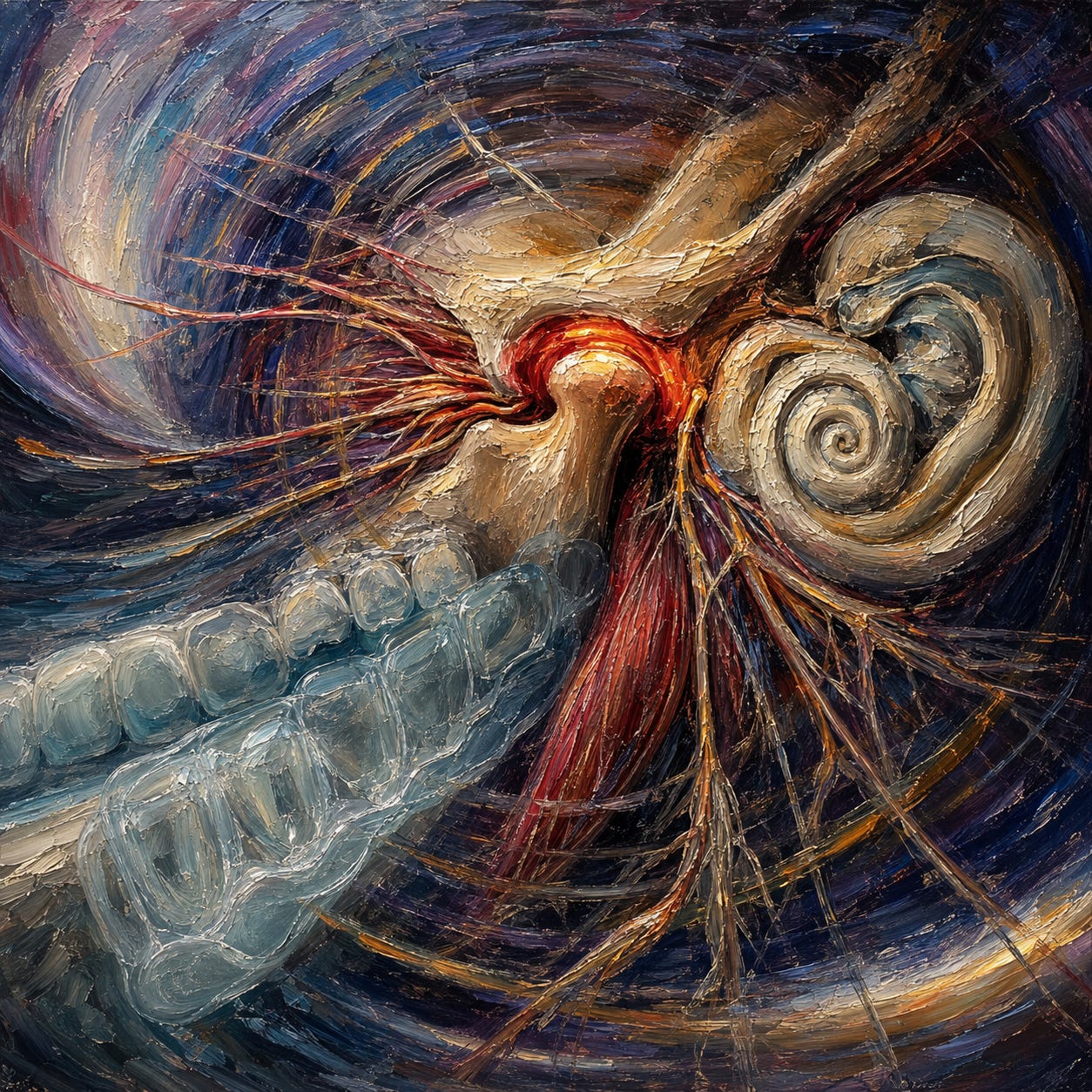
The temporomandibular joint is where the lower jaw meets the base of the skull. It sits directly in front of the ear canal. Between the top of the lower jaw (the condyle) and the socket in the temporal bone rests a cartilaginous disc that acts as a cushion when the mouth opens and closes. When the disc is displaced by even a fraction of a millimeter, the joint clicks, pops, or in more severe cases locks.
Mark Breiner, a dentist practicing since the 1970s, describes what happens when the jaw is forced into a position it was not built to hold. The cartilage acting as a cushion can become dislocated. The muscles that move the lower jaw go into chronic spasm because they never have a chance to relax. Because the joint sits in front of the ear, noises in the ears and various degrees of vertigo occur. The area is rich in nerves and blood vessels, so other symptoms follow.¹
His symptom list for TMJ dysfunction leads with dizziness. Headaches, migraines, facial pain, ringing in the ears, tooth pain, and radiating pain down the neck and arms follow.¹
This work stays free because paid subscribers make it possible. They get the full book library, the Deep Dive Audio Library, and the Questions for Your Doctor, Before You Consent, and Package Insert series. No grants, no gatekeepers — your subscription is what keeps it that way.
Audio Deep Dive (for Paid Subscribers)
Josephine
The clearest example in his files is a patient he calls Josephine.
Her vertigo was so severe she was making regular emergency room visits. The episodes did not stop. She was given injections to knock her out, because nothing else worked. She went from doctor to doctor. None of them could find anything wrong. The tests came back normal. The scans showed nothing. She was told, in various polite forms, that her symptoms were not medically explicable.
When she finally saw Breiner, he measured her jaw position. Her lower jaw was displaced 10 mm backward and 5 mm to one side. He made an appliance that repositioned it. Her dizziness resolved. So did her head pain, her chest pain, and the irregular heartbeat that had been running alongside the other symptoms. She subsequently had orthodontic treatment to correct the jaw relationship permanently.¹
Josephine is the most severe example in Breiner’s files. She is not the only one. She is what happens when a jaw is out of position and no one thinks to look at the jaw. Every physician who examined her did so within a framework that treats the mouth as a separate compartment from the rest of the head. That framework is what the reader will encounter when she asks her dentist about her vertigo.
The Anatomy Modern Orthodontics Ignores
The joint matters because it is not an isolated hinge. It is embedded in an integrated apparatus that connects the teeth to the ear, the sinuses, the eye muscles, the cervical spine, and the nervous system as a whole.
David Shirazi, a board-certified craniofacial pain specialist, goes further. In his framing, the joint is not merely connected to the spine. It is part of it. He calls the TMJ “the next cervical vertebrae above C1, what I call C0.”¹⁰ The joint the aligners move is, in his view, the top of the spinal column.
Anyone can feel the connection. Put the pad of an index finger just in front of the ear opening and open the mouth wide. The lump moving under the finger is the condyle, the top of the lower jaw, rotating in its socket. Now close and slide the lower jaw side to side. The joint under the finger is the same one that a new aligner tray quietly disturbs every time it clicks into place.
The lower jaw has 136 muscles attached to it.² These muscles connect to the base of the skull, to the neck, and downward to the shoulder girdle. From the shoulder girdle the connection continues to the pelvis and to a person’s gait. When the jaw is out of position, everything downstream is compensating. Nadine Artemis notes that the muscles surrounding the eye, which manage focus, tense and shorten in response to TMJ imbalance, producing blurred vision.²
The trigeminal nerve is the largest cranial nerve in the head. Its three main branches run to the lower jaw, the upper jaw, and the eye area, carrying signals from the teeth, gums, mouth, lips, face, sinuses, and portions of the ear. In the brain’s map of the body’s sensations, the trigeminal nerve occupies roughly 28 percent of the space. The face, teeth, mouth, and neck together take up about half of that map.³ The teeth are not peripheral to the nervous system. They are wired into a substantial portion of it.
When the jaw is misaligned, the trigeminal nerve is chronically activated. Ramiel Nagel describes what follows. Substance P is a neuropeptide involved in inflammation and pain signaling, useful when tissue needs repair. Released continuously by a nervous system that reads the jaw’s misalignment as ongoing injury, it depletes the body’s ability to send repair signals elsewhere, produces hypersensitivity to light, sound, and touch, and drives irritability.⁴ Dr. Brendan Stack, an orthopedic orthodontist, has demonstrated that some presentations of Tourette’s syndrome, including tics and involuntary movements, resolve when jaw position is corrected.⁴
The bones of the skull themselves move. The human skull contains 23 interlocking bones that shift subtly with respiration and posture. Every tooth is anchored in one of these bones. Nagel is direct about the consequence. Every time you move even one tooth, some or all of the 23 bones move with it.⁴ The dura mater and the fascia move with them.
This is the apparatus that produces vertigo when it is disturbed. The condyle sits millimeters from the ear. The trigeminal nerve carries signals from the disturbance to a quarter of the sensory map of the brain. The 136 muscles either compensate or spasm. The bones of the skull shift. The cervical spine adjusts. Somewhere in this chain, the balance signals from the inner ear pass through territory that is now inflamed, spasming, or subtly out of position.
The reader’s dentist will describe her mouth as a set of teeth being moved into better positions. That description is not neutral. It is a fiction the treatment depends on.
Why Aligners Produce This Specifically
Aligners were originally designed as an alternative to braces for minor cosmetic correction of front-tooth crowding in adults who did not want visible orthodontic hardware. Breiner, writing in 2012 when the technology was already fifteen years old, states the limit plainly: “Invisalign is not the appropriate treatment for correcting jaw discrepancies or for major orthodontic treatment.”¹
A 2024 systematic review of aligner efficacy, published in a peer-reviewed journal, confirms the same limits from within the industry’s own literature. Aligners show limited efficacy in arch expansion through bodily tooth movement, in correcting occlusal contacts, and in addressing larger antero-posterior and vertical discrepancies.⁵ Translated: they cannot reliably do the harder cases.
The reader is three weeks in. She has been through one or two tray changes. Each new tray is designed to apply continuous force to shift teeth further from their prior position. The bite is never permitted to stabilize. This is not a bug in the design. This is the design.
Two features compound the problem.
The first is interproximal reduction, known in the trade as IPR: the deliberate stripping of enamel from between adjacent teeth to create the space the trays need to close. Breiner mentions it as an offhand caveat: “room for tooth movement is usually created by stripping enamel from between the teeth.”¹ The consent forms describe it as minor. The tooth being permanently thinned to make space for movement is not minor to the tooth. Once filed away, that surface is thinner and more vulnerable for the rest of the tooth’s life.
The second is the plastic itself. Modern aligners are thermoplastic worn 20 to 22 hours per day, warmed against the oral mucosa. Industry promotional material emphasizes “SmartTrack” and other proprietary polymer formulations, which is marketing language for continuously improved plastic. The material safety questions raised about dental composites, particularly leaching of bisphenol-A related compounds and other endocrine-disrupting monomers, apply with additional force to a plastic that is worn continuously and that softens at body temperature. This is a chronic exposure question rather than the acute mechanism producing the reader’s vertigo, but it is worth naming because no one else is naming it.
None of this appears in the treatment plan. The system operates as if the aligner is a delivery vehicle for tooth movement and the tooth is the object of interest. The joint the tooth is anchored in, the muscles connecting to that joint, the nerves carrying signals from both, the cranial bones supporting the whole apparatus, and the ear sitting millimeters from the joint appear nowhere in the paperwork.
Shirazi, speaking about the parallel field of oral appliances for sleep apnea, describes what he considers the central failure of appliance-based practice: “The vast majority that treat OSA with oral appliances… have truly no concept of what to do with the jaw itself, either in the treatment of a disorder or in not causing a new problem when making an oral appliance for OSA.”¹⁰ The observation transfers directly. Aligners are an appliance placed by practitioners who have no concept of what to do with the jaw itself. The device works on the teeth. The jaw is where the injuries happen.
The result is that a reader wearing a plastic tray for three weeks develops vertigo, and her dentist is going to tell her the two events are unrelated because his training taught him to see teeth in isolation.
The Industry Behind the Product
Align Technology, which manufactures Invisalign, had treated a cumulative 19.5 million patients worldwide by the end of 2024. Clear aligners accounted for 81 percent of the company’s net revenues that year. The company had trained 271,600 practitioners globally to prescribe its product. 130,400 were actively submitting cases in 2024, a figure growing at roughly 3.6 percent per year.⁶
The training figure is worth pausing on. General dentists now account for a substantial share of active Invisalign practitioners, growing at roughly the same rate as trained orthodontists.⁶ The system was originally sold as an alternative to visible braces, prescribed by trained orthodontists after appropriate case selection. It is now deployed by general dentists whose training in orthodontic biomechanics is a small portion of dental school and whose training in temporomandibular joint dysfunction is smaller still. The reader’s letter does not specify who is treating her. Statistically, it is roughly as likely to be her general dentist as an orthodontist.
The pediatric expansion is more striking. Align Technology had treated 5.6 million teenagers and children with Invisalign by the end of 2024, with teen and child case volume growing 13.3 percent year-over-year in early 2025.⁶ 5.6 million children means 5.6 million growing jaws being pushed around by trays whose limits have been documented in the industry’s own literature. The children have no vocabulary to name what is being done to them. Some will develop headaches, or facial pain, or dizziness, and their parents will be told the same thing the reader will be told: it is not related.
SmileDirectClub illustrated what happens when the model is scaled without even the token clinical oversight of a general dentist. The company took 3D scans by mail, produced aligners without any in-person examination, and marketed directly to consumers at prices around $2,000. At its peak the company was valued at $8 billion. It filed for Chapter 11 bankruptcy in September 2023 and shut down entirely in December 2023, leaving over two million customers stranded mid-treatment.⁷ The British Dental Association documented cases of patients with advanced gum disease provided aligners by the company, potentially leading to tooth loss.⁷ Customers reported nerve damage and tooth loss from the treatment.⁸ The company required over 17,000 customers to sign non-disclosure agreements in exchange for prorated refunds after the 30-day trial period, a practice the D.C. Attorney General ruled violated the Consumer Protection Procedures Act.⁸
The SmileDirectClub collapse is instructive for two reasons. It shows what the aligner business model looks like without any clinical intermediary, which is a preview of the pressure the current clinical model is under. It also shows the industry’s approach to complaints: non-disclosure agreements, silence, and litigation. The reader’s suspicion that her dentist will gaslight her is not paranoia. It is a rational reading of the industry’s documented response to inconvenient outcomes.
The Deeper Failure
The reader’s teeth were crooked before she started treatment. That is why she is in aligners. But crooked teeth are not the problem. They are a symptom of a problem that orthodontics does not treat.
Sandra Kahn and Paul Ehrlich, in their 2018 book Jaws, document what a century of anthropological and clinical work has established. Modern human jaws are systematically underdeveloped. Pre-industrial skulls show wide dental arches, full space for wisdom teeth, straight rows of teeth without intervention, and forward-positioned faces with strong chins. Modern skulls show narrow arches, impacted wisdom teeth, crowding, retruded chins, and restricted airways. The change has occurred within a few generations, faster than any inherited biological change could account for.⁹
The cause is environmental. Soft processed food does not require the sustained chewing that develops jaw bones during growth. Mouth breathing, tongue posture problems, and prolonged pacifier and bottle use produce the wrong developmental stimulus. The dental arches never reach the width they were meant to reach. Teeth erupt into a space that is too small for them and become crooked because there is nowhere else to go.⁹
Shirazi puts the mechanism specifically. Bottle feeding narrows the palate, which is also the floor of the nose. The narrower palate produces the tooth crowding. The narrower nose forces mouth breathing.¹⁰ The developmental failure is a chain, and every link in it was set in early childhood.
John Mew, working in Britain from the 1970s onward, demonstrated this experimentally by comparing identical twins in whom one received conventional orthodontic treatment (bicuspid extraction and retraction) and the other received forward development work aimed at expanding the arch. The results, documented photographically, are not subtle. The twin whose face was expanded forward retained the balanced facial structure of traditional populations. The twin whose teeth were retracted developed the narrow, flat, elongated face that has become the modern default.⁹
The reader’s aligner treatment is doing to her, on a smaller scale, what conventional bicuspid-extraction orthodontics does to teenagers. It is pushing teeth around inside an arch that is already too small, treating the visible symptom (crookedness) while ignoring the underlying developmental failure (an underdeveloped jaw). Aligners cannot expand an adult arch through bodily bone remodeling. This is not because adult arches cannot be expanded. John Mew’s Stage One Bioblock trial in patients aged 22 to 49 documented 7 mm of arch expansion in three months, using continuous gentle force on the order of one to two grams per tooth.¹¹ Adult expansion is possible. The aligner is the wrong tool for it. The systematic review’s finding that aligners show limited efficacy in arch expansion is not a technical limitation to be improved by better plastic. It is a paradigm limitation. The tool is designed to move teeth within existing bone.
The industry has scaled the wrong intervention. Modern jaws needed forward development in childhood. What they got, at industrial scale, is a system that treats the crooked teeth those underdeveloped jaws produce as if the teeth themselves were the problem. When the intervention produces symptoms like the reader’s vertigo, the framework has no way to account for them because the framework does not include the joint, the nerve, the muscles, or the ear.
The full case for dental disease as a systemic failure produced by industrial food, industrial dentistry, and the paradigm that connects them is the subject of my book, Drilling for Profit: The Dietary Truth Behind Dental Disease. This essay draws from one thread of an argument the book develops across thirteen chapters. If what follows resonates, the book is where the paradigm is worked out in full.
What the Reader Can Do
The dentist will say the vertigo is not related to the aligners. The reader will need documentation to hold her ground.
Three practical steps establish the record.
Write down the date each tray is changed and the date and time of each vertigo episode. Continue this log for the remainder of the treatment. The temporal pattern is either there or not. If it is there, the paper record is what carries weight in any complaint, refund request, or consumer protection filing.
Check for the other signs of TMJ dysfunction Breiner catalogs. Press the pad of an index finger just in front of the ear opening. Tenderness suggests inflammation in the joint. Place fingers in the ears with the pads facing forward, then open and close the mouth. Popping or clicking indicates the cartilaginous disc is displaced. Try to fit three fingers (index, middle, ring) vertically between the upper and lower front teeth with the mouth wide open. Inability to do so is a common sign of TMD.¹ Note whatever is present.
If the treating dentist permits it, pause the aligners for 48 to 72 hours and observe. If the vertigo pattern breaks during the pause and returns when the aligners resume, the case is essentially made. That is not proof by the standards of a randomized controlled trial. It is the same reasoning by which most drug adverse effects are established: exposure, symptom, removal, resolution, reintroduction, return.
For the underlying joint work, the reader will need someone trained in whole-body dentistry or functional orthodontics. Dr. Tom Cowan’s New Biology Clinic is one route to that kind of practitioner (I have a reader discount code, Unbekoming). Practitioners trained through the Las Vegas Institute or the Sacro Occipital Research Society are others. The general dentist who prescribed the aligners is not the person to assess whether the aligners are producing joint dysfunction.
What functional orthodontics does differently is worth naming. Instead of pushing teeth through existing bone, it works to expand the arch itself and correct the underlying jaw position, using appliances that develop the maxilla forward and myofunctional therapy that retrains the tongue posture and breathing pattern responsible for the underdevelopment. It is slower, more expensive, less profitable, and rarely offered. It is also the treatment that addresses what is actually wrong.
The reader is not imagining her symptoms. Her mechanism is documented. Her dentist’s likely response is documented too, in the industry’s decades-long pattern of dismissing what it cannot explain within its framework.
What the Framework Refuses to See
The condyle sits in front of the ear. The trigeminal nerve carries signals from the mouth to a quarter of the sensory map of the brain. The lower jaw has 136 muscles attached to it. The 23 bones of the skull move with every tooth that moves. The cervical spine adjusts to every change in head balance. The balance signals from the inner ear pass through territory that is inflamed, spasming, or subtly out of position when the jaw is forced.
None of this is fringe anatomy. All of it is in the standard textbooks. What is missing is the willingness to treat the mouth as what it is: an integrated apparatus in which the position of any tooth affects everything the tooth is connected to, which is most of the head.
Aligners are the most industrialized expression of the opposite framework. They treat teeth as objects to be shifted into cosmetic alignment while ignoring the joint that positions them, the muscles that stabilize the joint, the nerves that carry signals from both, and the developmental history that produced the crowding in the first place. Nineteen and a half million people have been through the system. Five and a half million of them are children.
The reader asked whether her dentist would gaslight her about the connection between her aligners and her vertigo. He probably will. The mechanism she is asking about was described in published dentistry over a decade before her treatment began. Her dentist has not been trained to see it.
She has now.
How to Explain This to a Six-Year-Old
Your teeth are not just teeth. They are stuck into a jawbone. The jawbone is stuck to your skull. Right where the jawbone meets the skull, on both sides of your head, is a little joint. If you put your finger in front of your ear and open your mouth, you can feel the joint moving. It is right next to your ear.
Everything is connected. The joint is connected to your ear. The ear is connected to the part of your body that tells you which way is up. The teeth are connected to a big nerve that talks to a huge part of your brain. The jawbone is connected to the muscles in your neck and shoulders.
A clear aligner is a plastic mouth cover you wear all day. It squeezes your teeth to push them into new spots. Every week or two the dentist gives you a new one that pushes a little more. The aligner does not check on the joint. It does not ask the muscles or the ear or the nerve. It just pushes the teeth.
Sometimes when it pushes the teeth, the joint gets sore. The muscles start to hurt. And because the ear is right next to the joint, the person can feel dizzy, like the room is spinning. That is called vertigo.
Grown-ups who sell aligners will say the dizziness is not from the aligners. But it often is. Because the mouth is not a row of teeth. It is a machine where everything is connected.
If you ever get an aligner and you start feeling dizzy, that is your body telling you something. The best thing you can do is listen.
References
Mark A. Breiner, DDS, Whole-Body Dentistry: A Complete Guide to Understanding the Impact of Dentistry on Total Health, Quantum Health Press, 2012.
Nadine Artemis, Holistic Dental Care: The Complete Guide to Healthy Teeth and Gums, North Atlantic Books, 2013.
Robert Gammal, BDS, Garbage Collection from Balboa, 2021.
Ramiel Nagel, Cure Tooth Decay: Heal and Prevent Cavities with Nutrition, Golden Child Publishing, 2010.
Caruso S, De Felice ME, Valenti C, Pagano S, Caruso S, Gatto R, Lombardo G. “An evaluation of the Invisalign® Aligner Technique and consideration of the force system: a systematic review.” Systematic Reviews, 2024;13:43. PMC10821231.
Align Technology, Q4 2024 cumulative patient and practitioner data. Company disclosures analyzed in MatrixBCG.com, “Customer Demographics and Target Market of Align Technology,” 2025.
British Dental Association statement on SmileDirectClub collapse, December 2023.
D.C. Attorney General settlement with SmileDirectClub (2023) regarding NDA practices. FindLaw, “SmileDirectClub Bites the Dust After Crooked Business Practices,” December 2023.
Sandra Kahn and Paul R. Ehrlich, Jaws: The Story of a Hidden Epidemic, Stanford University Press, 2018.
Dr. David Shirazi, interviewed in “Bridging Dentistry, TMJ, and Sleep.” Lies are Unbekoming Substack, December 2024. TMJ and Sleep Therapy Centre of Los Angeles and Conejo Valley (TMJLA.com).
Dr. John Mew, interviewed in “The Mewing Manifesto: Dr. John Mew’s Quest for Natural Facial Development.” Lies are Unbekoming Substack, May 2025. Stage One Bioblock adult expansion trial (18 patients aged 22 to 49, 7 mm expansion in three months).
Sad what modern medicine and dentistry fail to see . 😢😡
Dr Breiner is in my town!! My Dad was a "Tufts man" thanks to the GI bill. He practiced dentistry for ten years, then took the Orthodontics program, also at Tufts. Looking back, I realized he was an engineer of the teeth. And none of his patients were under 10 or 11. He used hand calculated geometry to measure the angles needed to move the teeth. I used to play with the "big plastic triangle" on his desk. He bent every wire by hand. He soldered with a telephone dial dental machine. Took and developed x-rays. He crafted every impression on a wet grinder and hand powdered and dripped retainers in his lab. The only thing he sent out for was lunch. He was adamant about not pulling teeth, which he said collapsed the smile inward. The Rossi smile was full, rounded, beautiful. We have an Orthodontic Boutique 1/4 mile from my house. Snazzy orange interior. Enough said.
A dear friend, adult, got roped into Invisalign to prevent "future movement" and ended up with jaw pain so bad she considered litigation. She got no help or relief.