

Two minerals your body has been receiving from food and water for as long as there has been food and water. Two minerals your body no longer gets in the amounts it needs. Two minerals modern medicine does not measure, does not restore, and does not talk about.
Magnesium and boron.
What happened to them
The soil that grew the food was depleted. The industrial fertilizers that replaced natural soil renewal put nitrogen, phosphorus, and potassium back in, and left the trace minerals out. The water that used to carry them was treated, softened, and stripped. The food that reached the table was processed, refined, and cooked at temperatures that finished the job.
Then the halogens moved in. Fluoride in the water. Bromide in the bread. Perchlorate in the produce. Each one competes for the receptor sites where the mineral used to sit. Every one of them makes what little is left work less well.
Your grandmother got what you don’t. Not because she took supplements. Because the food, the water, and the soil hadn’t been hollowed out yet.
What their absence looks like
Magnesium depletion presents as: cardiovascular disease, arrhythmia, hypertension, migraines, muscle cramps, insomnia, anxiety, chronic fatigue, insulin resistance, PMS, restless legs, tension headaches, poor recovery from exercise, poor recovery from anything. The mineral runs 600+ enzyme systems. When it runs low, hundreds of things break. Not one dramatic thing, but a background low-grade version of nearly everything.
Boron depletion presents as: osteoarthritis, brittle bones, hormonal decline in both sexes, cognitive fog in older adults, joint stiffness that starts a decade before it “should,” and a fungal terrain the body has fewer tools to manage. Rex Newnham, an Australian soil scientist working in the 1970s, first documented what a century of missing boron does, and what its restoration reverses.
None of this is diagnosed as mineral depletion. It is diagnosed as a chronic condition, prescribed for, and monitored. The mineral, inexpensive and unpatentable, does not enter the conversation.
What the books do
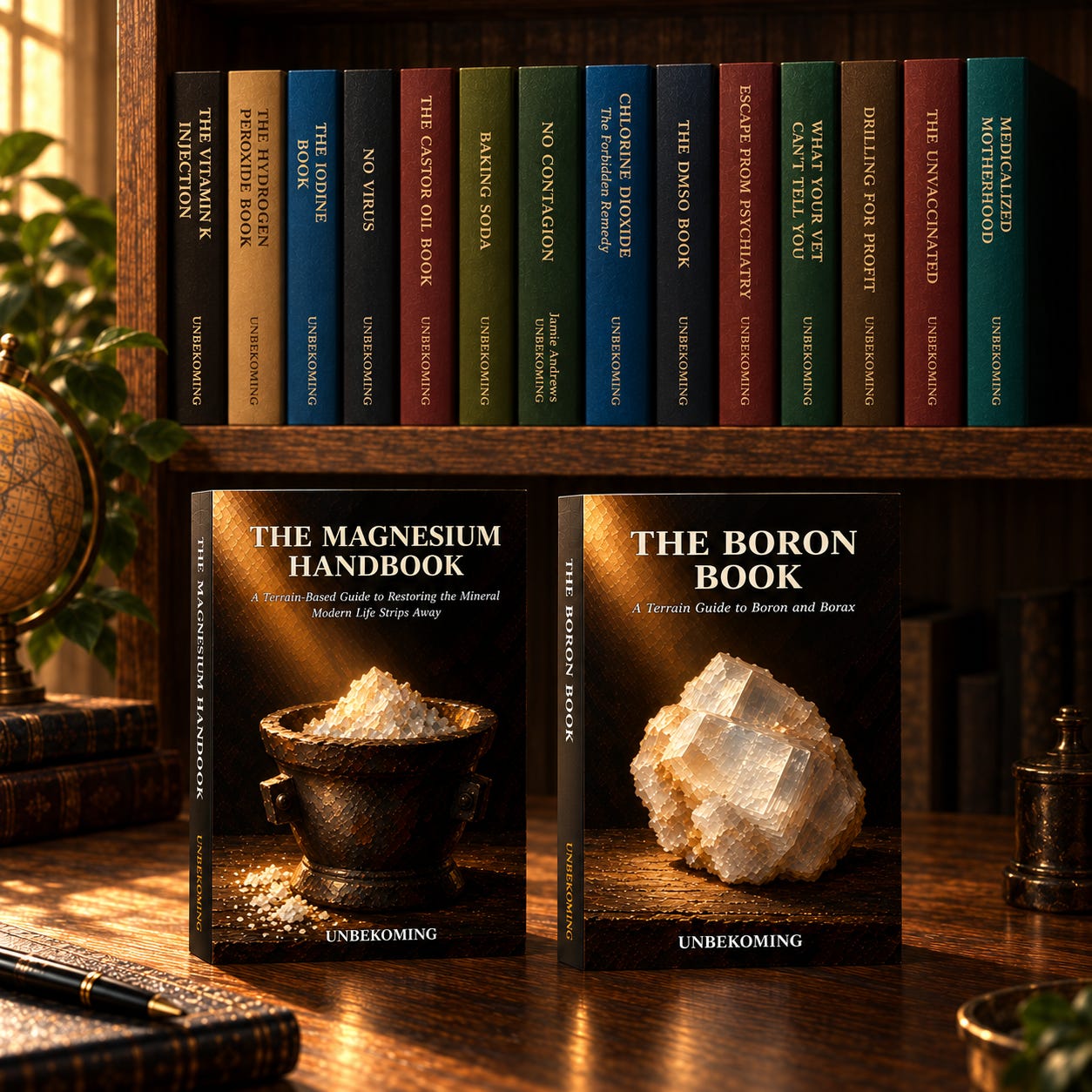
The Magnesium Handbook.
333 pages, seventeen chapters. The four evidence lines. The four insults of modern life that strip out intake. The cardiac and neurological pattern. The metabolic and hormonal picture. The reproductive terrain. The forms of magnesium and how to use each. Eight appendices with condition quick-reference, drug-depletion tables, dosing by form, food sources, transdermal protocols, troubleshooting, and further reading. A full index sends you to what you need. Draws on Jeff at Curious Outlier and his Magnesium Mastery course, Mildred Seelig, Carolyn Dean, Mark Sircus, Arthur Firstenberg and Martin Pall, and the terrain framework running from Béchamp through Shelton to Cowan.
Order The Magnesium Handbook →
The Boron Book.
268 pages. The Tibetan and Silk Road pharmacopoeia. The medieval European use. The mid-twentieth-century collapse of dietary intake. The four mechanisms that stripped modern boron from the diet: industrial fertilization, food processing, water fluoridation, halogen displacement. The Newnham Protocol. The Walter Last modification. The food-first restoration pattern. The borax chapter, covering what to buy, how to dose, and what to expect. Draws on Rex Newnham’s clinical work, Forrest Nielsen’s USDA research, and the essays of Curious Outlier.
The regulatory framework still classifies boron as non-essential. The evidence says otherwise. The minerals are inexpensive. These books are how you get them back.
How to explain it to a six-year-old
Imagine your body is a bicycle. It has hundreds of little screws holding it together. Brakes, gears, wheels, seat, handlebars. Most of the screws don’t do anything dramatic. But if they get loose, the bicycle starts to rattle and squeak and slow down. Nothing broken. Just… not right.
Magnesium is one of the screws. Boron is another.
Nobody stole the screws. They just fell out slowly, over a long time. From the soil the food grew in. From the water. From the bread. Every day a little bit less. Nobody noticed because nothing broke.
But the bicycle is rattling now. You feel it. Everyone feels it.
The screws are cheap. You can put them back.
In Print
Sixteen books are now available as paperbacks, printed to order through Lulu and shipped worldwide.
The two new ones today. The Magnesium Handbook and The Boron Book.
Injection injury. The Vitamin K Injection — what happens in the first hours of a newborn’s life.
Two on the paradigm underneath. No Contagion, the case against germ theory itself, co-authored with Jamie Andrews. No Virus, the isolation problem, the collapse of virology’s foundational claims, and a disease-by-disease reappraisal.
Four suppressed compounds. The DMSO Book, Chlorine Dioxide: The Forbidden Remedy, The Iodine Book, The Hydrogen Peroxide Book.
Two from the kitchen shelf. Baking Soda, The Castor Oil Book.
Five critique books. The Unvaccinated, Medicalized Motherhood, Drilling for Profit, What Your Vet Can’t Tell You, Escape from Psychiatry.
The full shelf is at lulu.com/spotlight/unbekoming.
A physical book reaches the person a Substack post never will. The skeptical relative. The friend who won’t click a link but might open a book. The visitor whose eye lands on a coffee table. Buy one to keep, and one to give away.
A word of thanks. The paperbacks have found their readers because you have carried them there. You’ve bought them, given them away, put them on shelves where visitors see them, and told other people they exist. The shelf is sixteen books deep because of you. It is greatly appreciated.
— Unbekoming
This work stays free because paid subscribers make it possible. They get the full book library, the Deep Dive Audio Library, and the Questions for Your Doctor, Before You Consent, and Package Insert series. No grants, no gatekeepers — your subscription is what keeps it that way.
Thank you. I ordered them both.
I am excited to receive these 2 new books and could not resist ordering five more books, once I saw your Lulu site. You have a true gift in the skill of a writing style that is clear and accessible to laypersons as well as practitioners. Luckily your interests echo my own and I feel very fortunate to have discovered your work. Nice to start the morning with a big dose of gratitude!