

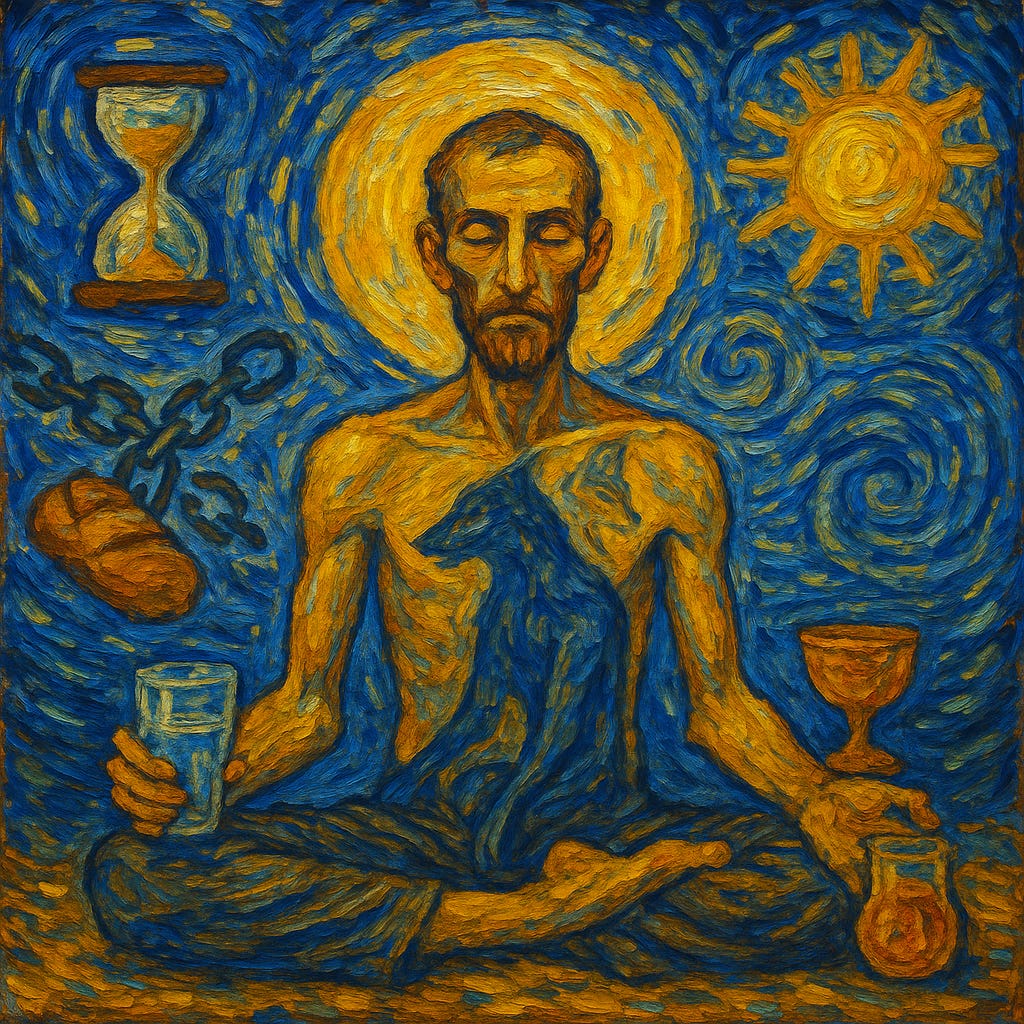
In 1906, Edward Earle Purinton published "The Philosophy of Fasting," a radical text that positioned extended fasting not merely as a cure for physical ailments but as a pathway to complete human transformation. Born a semi-invalid who took six medicines simultaneously and spent most days beside the fire or on the couch, Purinton undertook a thirty-day water fast that not only restored his health but fundamentally altered his understanding of human existence. His work presents the "Conquest Fast" - a 20 to 40-day journey consuming only water and occasional fruit juice - as a method to achieve what he calls the "triunely god-man-animal" state, where one reclaims both animal instinct and divine consciousness while transcending the limitations of being "circumscribedly human." This early exploration of fasting as therapy predates modern understanding of autophagy, ketosis, and stem cell regeneration by over a century, yet arrives at remarkably similar conclusions about the body's capacity for self-healing through the complete cessation of food intake.
What distinguishes Purinton's approach from both his contemporaries and modern fasting protocols is his insistence that true healing requires addressing the soul alongside the body and mind. While today's researchers like Jason Fung focus on insulin regulation and metabolic benefits, and protocols like August Dunning's Phoenix Protocol emphasize cellular regeneration through dry fasting, Purinton saw fasting as fundamentally about breaking humanity's deepest enslavement - the food-habit that reinforces all other dependencies. He discovered that extended fasting doesn't just cleanse toxins or activate stem cells; it dismantles the entire scaffolding of civilization's false necessities, from tight clothing to loveless marriages to fear-based religion. His transformation included not only healing fifteen forms of constitutional disease but also writing over 200 poems in ten months after never having written poetry before, developing what he called "X-ray perception" that could see "over, under, through and beyond a subject," and ultimately recognizing that "I found God through this Fast. Which is equivalent to saying I found Myself. For We are One and the Same."
Purinton's work stands as both historical artifact and living document, offering insights that remain startlingly relevant to anyone exploring fasting as a therapeutic modality. His detailed observations about the stages of fasting - from the initial crisis of elimination to the eventual arrival at what he calls "Heaven" in the third week - parallel what modern practitioners like Sergey Filonov document in their dry fasting clinics, yet Purinton adds dimensions rarely addressed in contemporary literature. He understood that fasting reveals not what we must become but what we already are beneath layers of accumulated physical, mental, and spiritual debris. His ultimate discovery, that "Love Alone Suffices," transforms fasting from a mere health intervention into a practice of uncovering one's essential nature. For those investigating fasting as therapy, Purinton provides not just another protocol but a philosophical framework for understanding why the voluntary abstention from food can catalyze such profound healing - because it forces us to confront and transcend our most fundamental assumptions about what we need to survive, ultimately proving we can thrive on "air, water, light, faith and love."
With thanks to Edward Purinton.
The Philosophy of Fasting: A Message for Sufferers and Sinners: Purinton, Edward Earle
Deep Dive Conversation Library (Bonus for Paid Subscribers Only)
This deep dive is based on the book:
Discussion No.114:
23 insights and reflections from “The Philosophy of Fasting”
Thank you for your support.
Analogy
The Mountain Climber's Transformation
Imagine a climber who has spent their entire life in a valley town, surrounded by fog so thick they've never seen the mountains towering above them. The townspeople all wear heavy packs filled with stones - stones of habit, stones of fear, stones of what they think they need to survive. Everyone insists you must carry these stones, adding more each year. The weight makes them stoop and shuffle, barely able to look up, convinced this is simply how life must be lived.
One day, the climber decides to attempt what the townspeople call impossible - to fast from carrying stones and climb above the fog line. At first, setting down the pack feels terrifying. The townspeople warn of certain death, predict weakness and collapse. The first days are indeed difficult as the climber's body, so accustomed to the weight, feels strangely untethered and uncertain.
But as they ascend, something miraculous occurs. With each step upward, breathing becomes easier. The fog begins to thin. Muscles, freed from unnecessary burden, grow stronger in their natural use. Reaching above the cloud line, the climber discovers what was always there - brilliant sunshine, clear air, and a view of such magnificence that the valley's concerns seem impossibly small. They realize the stones weren't protecting them but imprisoning them. The heavy pack wasn't sustenance but suffocation.
From this vantage point, they can see other peaks, other possibilities, the true breadth of existence. When they eventually descend - for they must return to share what they've learned - they move differently. They carry only what truly serves them, see through the fog that blinds others, and know always that the summit awaits whenever they choose to climb again. The fog no longer confuses them, for they have breathed the air above it and know their true home is in the heights.
The One-Minute Elevator Explanation
Picture this: We're all walking around carrying invisible backpacks stuffed with junk we don't need - bad habits, toxic foods, other people's opinions, fears we inherited from our parents. The Philosophy of Fasting says there's a way to drop that backpack completely - through something called the Conquest Fast, where you stop eating for 20 to 40 days.
Now, this isn't about starving yourself or punishing your body. It's about discovering that you're actually three beings in one - an animal with perfect instincts, a human with reasoning power, and a divine soul with infinite potential. But most of us are stuck being only human, which Purinton says is the worst of the three options! When you fast properly, your body cleans out decades of poison, your mind becomes crystal clear, and your soul finally gets to speak without all the noise drowning it out.
The author went from being a sickly, pessimistic invalid taking six medicines to someone who wrote 200 poems in ten months and found his life's purpose. He discovered that true health means being "half-animal and half-god" - following your natural instincts like animals do while reaching for divine consciousness. Most importantly, he learned that Love is the only force that really matters in the universe, and everything else - including food - is just a distraction from that truth.
[Elevator dings]
Want to dig deeper? Look into the water-cure methods of Sebastian Kneipp, explore the natural healing systems in Bilz's comprehensive guide, or start with Adolf Just's "Return to Nature" for the philosophy behind it all.
12-Point Summary
1. The Conquest Fast as Complete Transformation The Conquest Fast isn't ordinary fasting for weight loss or detox - it's an extreme 20-40 day journey consuming only water and occasional fruit juice, designed to achieve four specific objectives: Renovation (physical healing), Delectation (sensory rejuvenation), Domination (mental mastery), and Illumination (spiritual awakening). Unlike therapeutic fasting that focuses solely on the body, this approach recognizes that humans are "triunely god-man-animal" and must transform all aspects simultaneously. The author emphasizes this isn't for everyone - perhaps twenty souls out of thousands are truly ready for such a radical break from civilization's deepest programming.
2. Breaking Free from the Food-Habit Prison Humanity's fundamental enslavement begins with the food-habit, which the author calls our universal crutch. We eat by the clock rather than by hunger, consume what custom dictates rather than what instinct craves, and organize our entire social structure around meal times. This bondage to regular eating creates and reinforces countless other habits - from tight clothing to church attendance to loveless marriages. The Conquest Fast shatters this most basic dependency, proving we can thrive on "air, water, light, faith and love" alone, thereby demolishing our belief in all external necessities and revealing the soul's true freedom.
3. The Physical Journey: Crisis Before Clarity The body undergoes radical purification during the fast, losing approximately one pound daily as it burns through diseased tissue, undigested food particles, and decades of accumulated toxins. The first week brings severe discomfort - headaches, weakness, coated tongue, foul breath - as all elimination channels work overtime. This "crisis" represents the surfacing of deep-seated impurities, with the intensity of suffering indicating the necessity of the fast. Proper elimination through enemas, vapor baths, massage, and copious water drinking is essential, or the released toxins will poison the system. After this purgation, the body rebuilds with pure flesh and blood, ultimately achieving better health than years before.
4. Mental Liberation and Enhanced Clarity As physical toxins clear, mental fog lifts dramatically. The author reports developing X-ray-like perception, able to see "over, under, through and beyond a subject" with unprecedented clarity. Decision-making becomes swift and sure, judgment final and accurate. The brain, usually an "interloper" between soul and body, finally assumes its proper subordinate role. This mental transformation manifested practically in the author's complete style change - from verbose, pessimistic writing to clear, humorous prose, and from never having written poetry to producing over 200 poems in ten months, including 27 in a single week.
5. Spiritual Awakening and Cosmic Consciousness The ultimate achievement of the Conquest Fast is spiritual illumination - seeing "the heavens opened and the ultimate truths of the Infinite revealed." The author discovered his oneness with Omnipotence, recognizing that "We are One and the Same." This isn't theoretical mysticism but practical spirituality that includes enhanced energy, magnetism, and effectiveness in the world. The fast establishes three essential faiths: faith in Nature (ensuring health), faith in Self (ensuring success), and faith in God (ensuring abiding peace). This spiritual awakening permanently altered the author's perspective, lifting him above the "cloud-line" of mortality.
6. Instinct Versus Reason: Reclaiming Natural Wisdom The fast restores instinct to its rightful position as superior to reason. Instinct is "the register of pre-incarnate experience" - infinitely wiser than the brain's current experiments. After fasting, the author could instinctively choose foods that perfectly suited his digestion without conscious thought. He advocates the rule: "Ask Instinct what to do - ask Reason how to do it." Most human troubles stem from letting reason overrule instinct, from following the world's voice rather than the soul's whisper. Animals and children exemplify perfect instinctual living, being "absolutely true to themselves" in ways educated adults have forgotten.
7. Love as the Ultimate Truth and Power Love emerges as the supreme mystery and ultimate reality of the universe - not mere affection or sentiment, but infinite energy that must express itself. All human woes arise from love's repression or perversion. True love asks nothing but the privilege of loving, transcending personal attachment to embrace universal compassion. The fast enhances love by restoring the solar plexus (emotional brain) to natural function, eliminating toxic elements that block pure feeling, and revealing love's divinity. The author's entire philosophy culminates in the single truth: "That Love Alone Suffices."
8. Dismantling Civilization's False Structures The fast reveals civilization's arbitrary nature - from medical interventions that harm more than heal, to educational systems that deaden rather than enlighten, to religious institutions that separate humans from God. The author systematically critiques professionals who "interfere" - doctors between man and Nature, preachers between man and God, lawyers between man and man. These critiques aren't nihilistic but revelatory, showing how human systems consistently violate natural law. The fast provides perspective to see through social conventions, revealing them as "grotesque operations" that keep humanity in bondage.
9. The Sacred Nature of Sex and Passion Contrary to both ascetic denial and libertine excess, the author presents sex as sacred, inseparable from spirituality. Religious exaltation is revealed as sublimized sex-transport; the sexless are "invariably the soulless." True passion must be born in the soul, not merely brain or body. The author advocates for absolute abandon in love, but insists reverence must accompany freedom. He condemns both prudish repression and crude expression, seeking instead the divine sexuality that "transcends the mortal" while fully embracing natural desire. This integration of the sensual and spiritual marks true wholeness.
10. Practical Wisdom for the Fasting Journey Despite the mystical heights reached, the author provides thoroughly practical guidance. The Twenty Rules cover everything from choosing the right season (summer or spring) to proper breaking of the fast (single morsel, 700 chews). Key insights include: never fast around worried family, stay close to nature, avoid combining with other intensive therapies, maintain rigorous elimination protocols, and expect complete life changes afterward. The author warns against common mistakes like inadequate elimination, improper fast-breaking, and maintaining regular work schedules. Most importantly, one must fast from soul-desire, not external pressure.
11. The Integration of Animal, Human, and Divine The philosophy's core insight is that humans must be "triunely god-man-animal" to achieve saneness. Being merely human - caught between animal instinct and divine consciousness - creates disease and suffering. We must reclaim our animal nature (following instinct, enjoying the body, living naturally) while developing divine consciousness (transcending limitations, accessing cosmic awareness, embodying love). The author demonstrates this by achieving cosmic consciousness yet deliberately returning to worldly engagement, being "all god, or all man, or all animal, as the impulse moves." This integration, not denial of any aspect, creates wholeness.
12. The Declaration of Faith: Beyond Belief to Being The author's Declaration of Faith crystallizes his philosophy into lived principles rather than abstract beliefs. Central tenets include: believing in believing itself, in the undiminishable purity of the human soul, in oneself as one's own savior, in the divinity of the human body and sex, in suffering as refinement, in instinct's infallibility, in life over learning. He declares himself "unmoral" - beyond human ethical systems like animals and angels. The Declaration embraces paradoxes, champions sinners over saints, and culminates in the recognition that while countless beliefs may shift and change, one truth remains constant: "That Love Alone Suffices."
The Golden Nugget
You Are Already Perfect - You Just Can't Feel It
The most profound and least known idea in this book is that every human being is already complete, already divine, already possessing within themselves all the power, beauty, wisdom and love they seek externally - but layers of undigested food, unexamined thoughts, and unlived emotions create such a thick barrier that we cannot sense our own perfection. The author discovered through his fast that "I found God through this Fast. Which is equivalent to saying I found Myself. For We are One and the Same."
This isn't the common spiritual teaching that we must "become" divine or "achieve" enlightenment through addition - through learning more, doing more, being more. Instead, it's the recognition that divinity is our natural state, temporarily obscured by the accumulations of civilization. The fast doesn't add anything; it reveals what was always there by removing everything that isn't truly you. Most people spend their lives trying to acquire qualities they already possess, seeking external authorities to grant what only exists within, medicating symptoms instead of simply clearing the channels through which their own perfection would naturally flow. The physical toxins in the body, the rigid thoughts in the mind, and the suppressed feelings in the heart form a triple barrier that makes humans "circumscribedly human" instead of naturally divine. Remove these barriers through the complete cessation of intake - of food, of others' opinions, of social obligations - and the soul emerges in its original splendor, needing nothing because it already is everything.
30 Questions and Answers
1. What is the Conquest Fast and how does it differ from ordinary fasting?
The Conquest Fast is an extreme fast lasting twenty to forty days, undertaken with a four-fold motive rather than merely therapeutic purposes. Unlike ordinary fasting which focuses solely on cleansing the body, the Conquest Fast aims for complete transformation of body, mind, and soul simultaneously. The author distinguishes it from mere starving by emphasizing that it must be based upon and adapted to some dominant purpose beyond physical health.
During this fast, one consumes nothing but water and occasionally acid fruit-juice. The key difference lies in its comprehensive approach - while common fasting addresses physical ailments, the Conquest Fast seeks to achieve renovation of the body, delectation of the senses, domination of the mind, and illumination of the spirit. It is a conscious act of separating oneself from all external influences to discover one's true self and establish contact with the divine.
2. What are the four objectives of the Conquest Fast - Renovation, Delectation, Domination, and Illumination?
Renovation refers to the complete physical renewal of the body through the elimination of accumulated toxins and the restoration of natural health. This process goes beyond simple cleansing - it rejuvenates the entire system, making one healthier than they've been in years. The author experienced this firsthand, becoming healthier than he'd been in the previous ten years.
Delectation encompasses the restoration of childlike sensory enjoyment and the ability to appreciate life's simple pleasures with renewed sensitivity. Domination means gaining complete mental control over oneself, developing a grip on one's mind that nothing can shake. Illumination represents the highest achievement - spiritual awakening where one sees "the heavens opened and the ultimate truths of the Infinite revealed in glorious array beyond the span of the sunrise or the gleam of the farthest star."
3. What was the author's personal health journey that led him to undertake a thirty-day fast?
Born a weakling and semi-invalid, Purinton suffered from fifteen forms of constitutional disease during his boyhood and youth. He weighed only 110 pounds instead of his normal 150, took six kinds of medicine simultaneously, and spent most of his time beside the fire or on the couch. His ailments were primarily nervous and digestive, caused by an imbalanced constitution - inheriting from his father an incessantly active brain, from his mother a supersensitive soul and tremulous physique.
Physical discomforts plagued him constantly - he couldn't ride in a carriage, sit in a hammock, or climb a tree without becoming dizzy, sick, and faint. The slightest physical jar or mental irritation brought on headaches lasting for days. After trying various systems including Physical Culture, Dietetics, Hydrotherapy, Mental Science, and Oriental Philosophy with only partial success, he finally undertook the thirty-day fast. This extreme measure brought him complete transformation, solving his health problems while revealing his life's purpose.
4. How does the Conquest Fast affect the body physically, including weight loss, elimination, and healing?
During the fast, weight loss occurs at approximately one pound per day, though this varies by individual. The author emphasizes this is "good riddance of bad rubbish" - the body eliminates diseased tissue, undigested food particles, and accumulated toxins. Upon breaking the fast, weight returns rapidly at about one and a half pounds per day, but this new tissue consists of pure blood, firm flesh, and sound sinew.
The elimination process intensifies dramatically during the first week, with all excretory channels - bowels, kidneys, lungs, and pores - working overtime to expel impurities. This can cause temporary discomfort including headaches, weakness, and nausea as decades of accumulated waste matter surfaces. The author stresses that elimination must be actively supported through enemas, vapor baths, massage, and copious water drinking. Without proper elimination support, the released toxins can poison the system, negating much of the fast's benefit.
5. What mental and spiritual transformations occur during an extreme fast?
Mental clarity increases progressively throughout the fast. The author reports that thinking becomes sharper, with enhanced keenness of discernment, depth of insight, quickness of decision, breadth of vision, and finality of judgment. The brain's fog lifts, allowing one to see "over, under, through and beyond a subject, with the power of an X-ray and the accuracy of a Goerz lens." Confusion of ideas disappears as one grasps complete concepts rather than fragments.
Spiritually, the fast conducts one to what the author terms the Cosmic Consciousness. It establishes three vital forms of faith: faith in Nature ensuring health, faith in Self ensuring success, and faith in God ensuring abiding peace. The experience lifts one above the "cloud-line" of mortality into direct communion with the divine. Visions, revelations, and profound insights emerge, particularly after the third week. The author discovered through his fast that he and God are "One and the Same," experiencing the ultimate truth of existence.
6. What are the most essential rules from the Twenty Rules for Sane Fasting?
The first and most paradoxical rule is simply "Don't" - unless your Higher Self genuinely calls you to fast. The author estimates fewer than twenty out of thousands of "advanced" thinkers are truly ready for the Conquest Fast. One must analyze beforehand the errors of popular fasters, gathering facts as foundation but then forgetting them to trust instinct. The purpose must be specified clearly, whether for renovation, domination, delectation, or illumination.
Key practical rules include choosing summer or spring for optimal conditions, preparing with short fasts first, being alone or among strangers to avoid interference, keeping close to nature, and avoiding combinations with other intensive healing systems. The week before fasting requires a wholly laxative diet. During the fast, the first three days demand special attention to elimination through enemas, vapor baths, and massage. Breaking the fast properly with a single morsel, thoroughly masticated, proves crucial for success.
7. How should one properly break a long fast and what foods are recommended?
Breaking the fast represents the most critical phase, requiring one to be "half animal with the animal's unerring instinct, half mystic with the mystic's unwavering ideal, not at all man with the man's hesitancy, temptation and defeat." The stomach has grown weak from enforced inaction, digestive juices have been redirected, and the entire machinery of assimilation rests too quietly for sudden imposition.
The first meal should consist of a single article requiring mastication - popcorn, toasted Triscuit, Lust's Whole Wheat Zwieback, an apple, dried peaches or prunes, whole wheat cereal, crusty corn-bread, or thick pea soup. The author broke his fast with toasted wheat, taking 700 chews to liquefy the first spoonful and forty minutes to complete the dish. One should wait six hours before the second meal, gradually increasing to two items, then three for subsequent meals. The returning faster will require only half their previous food intake if they follow instinct absolutely.
8. Who is suited for the Conquest Fast and who should avoid it?
Those suited for the Conquest Fast must possess sufficient vital temperament to store energy and motive temperament to spend it. They must have supreme faith in themselves, steadfast purpose, and the courage to controvert fixed race-beliefs. The individual must want to fast more than eat, seeking not merely physical healing but transformation of mind and soul. They should be able to trust their instincts absolutely and dare to be simultaneously animal, man, and god as impulse moves.
The fast is contraindicated for those of extreme mental temperament lacking vitality, those who cannot leave their regular duties, anyone subject to employers' rules and suspicions, and those surrounded by worried family and friends. Lack of faith, pronounced lack of flesh, inability to recover vitality easily, and absence of proper inner preparation or outer conditions all preclude the Conquest Fast. The author specifically states that the average wife and mother with household and social duties simply cannot undertake it.
9. How does the author view the relationship between soul, body, and mind?
Soul and body are viewed as naturally unified, with the mind or brain often acting as an interfering interloper. The author states "Body and heart are one with soul, whereas brain is mostly an interloper." The soul needs to dominate, using the body as its vehicle for expression while keeping the brain in its proper subordinate place. Perfect health requires being "half-animal and half-god," while sickness comes from being "circumscribedly human."
The brain creates most human troubles by interfering between soul and body, particularly in matters of instinct, passion, and natural function. The author advocates for soul-consciousness that temporarily forgets both brain and body, yet emphasizes that brain and body must be fully developed to express soul's messages. The ideal state achieves balance where soul oversees while body works alongside brain, each knowing its place. This trinity functioning in harmony creates what the author calls the "triunely god-man-animal" state of true saneness.
10. Why does the author consider Love to be the supreme mystery and ultimate truth of the universe?
Love represents the supreme mystery because nothing in the world is so little understood yet so essential to existence. The author describes it as simultaneously beautiful and terrible, powerful and fragile, divine and human - embodying all paradoxes of existence. Love is declared to be God itself, the ultimate creative and sustaining force. All human woes arise from either repression or perversion of love, with the "virtuous" causing three-fourths of suffering through too little right love, while the "vicious" cause one-fourth through too much wrong love.
Love transcends all limited human conceptions - more than affection, sympathy, service, loyalty, passion, or wisdom. True love asks nothing but the privilege of loving, lavishing itself impartially on the whole world. It represents infinite energy that must express itself practically. The author concludes his philosophy with the ultimate knowledge: "That Love Alone Suffices." Every success measures the size of what one loves, from family to country to race to Spirit Source, with the grandest success coming from loving the Infinite.
11. What is the difference between true spirituality and organized religion according to the text?
Organized religion represents the empty form left after God has departed - "a form and a name" consisting of dusty storehouses of race rubbish. Churches are "too musty for God to live in" because "God's very breath is freedom, God's life is sunlight." The author condemns formal prayers, paid choirs, and professional sermonizers, viewing church services as places where people "substitute words for feelings without fear of detection." Theology is likened to a postmortem examination on God - the form remains but the soul has gone.
True spirituality is defined as "a man's permeability with the inflow and outflow of the Deific" - the capacity to isolate from sense-elements, become stored with primal Omnipotence, then infuse this charge into whatever one touches. It requires no church, creed, or authority, residing in no book and caring for no opinion. Spirituality is natural, energetic, magnetic, enthusiastic, tender, and includes both sensuality and worldliness properly understood. The spiritual man anchors to nothing save his own soul, making him appear like "a leaf tossed by the wind" to those seeking conventional religious labels.
12. Why does the author believe instinct is superior to reason?
Instinct represents the infallible memory and judgment system, constituting "the register of pre-incarnate experience" - what we gain rationally in this life becomes instinctive in the next. Instinct is therefore "much finer than Reason as a resurrected soul is assumed finer than a mortal of clay." While reason represents merely current experiment and the "cry of the world," instinct speaks directly from the soul as the voice of accumulated wisdom from countless existences.
The author provides practical proof through his own eating choices, instinctively selecting the only two acids that should combine for digestion from four offered. This occurred without conscious thought, demonstrating how closely he has "come to my soul that I cannot mistake its faintest whisper." The rule for reconciliation states: "Ask Instinct what to do - ask Reason how to do it." Most human troubles stem from consulting reason about destinations when only instinct knows where we truly belong. Animals exemplify perfect instinctual living, being "absolutely true to themselves," while humans "wittingly misuse and blaspheme body, mind and soul."
13. How does fasting free one from habits and social conventions?
Fasting breaks the most fundamental human habit - the food habit, which the author calls humanity's crutch. By conquering the seeming necessity to eat regularly, one demolishes the foundation of countless other habits built upon routine and social conformity. The fast demonstrates that humans can transcend supposed necessities, existing on "air, water, light, faith and love" rather than material sustenance. This shatters belief in all external dependencies.
During the fast, taste for everything unnatural disappears - liquors, tobacco, spiced foods, tight clothing, church worship, "loveless passion," and civilized habits all lose their appeal. The faster discovers that meal-times, social dining, and food-centered gatherings represent grotesque bondage rather than necessity. Freed from the tyranny of regular eating, one gains perspective to see how "insufferably plebeian" conventional life appears. The fast reveals humans herding together three times daily like animals, bound by custom rather than genuine hunger, making eating a basis for sociability rather than a natural function.
14. What criticisms does the author level against doctors, theologians, and reformers?
Doctors are accused of interfering between man and Nature, making their living through meddling rather than healing. Their diagnoses are "the first rehearsal for that tragedy known as the Post-mortem Examination," with surgeons called in for the "final rehearsal with an operating-table for a stage." The author condemns the practice of treating symptoms rather than causes, likening drugs to bribes that silence the body's protests while allowing disease to flourish. Doctors focus on isolated symptoms that "tell nothing and foretell less," missing the true principles and causes of disease.
Theologians are charged with interfering between man and God, teaching fear of the soul rather than trust. They've created a "postmortem examination on God" where form remains but soul has departed. The author declares that "a theologian is a man who doesn't love God," pursuing duty rather than desire, wearing labels instead of living truth. Reformers receive perhaps the harshest criticism - accused of not loving humanity, focusing on frowns rather than smiles, worshiping duty over desire. They fail because they've forgotten "whatever is natural is also delightful," pursuing their missions through condemnation rather than compassion.
15. How does Nature serve as both mother and teacher in the healing process?
Nature is literally capitalized throughout as "Mother" because she provides everything needed for perfect health when humans stop interfering. She grants true panaceas "fresh for each case" without human dispensaries. Nature teaches through direct experience rather than theories - showing that health exists wherever Nature exists, while disease appears wherever civilization intrudes. The fundamental lesson: "Be less human, more natural, more divine."
As teacher, Nature demonstrates that healing requires only seven simple measures: fasting, resting, airing, bathing, breathing, exercising, and hoping. She reveals that disease serves beneficially as a warning, that microbes act as undertakers disposing of dead cells, and that danger lies not in ailments but in remedies. Through fasting, one learns from Nature that the body requires far less food than supposed, that instinct provides perfect dietary guidance, and that the natural state includes joy, energy, and childlike sensitivity. Nature's classroom includes mountains, seas, stars, animals, and everything untouched by human artifice.
16. What connection does the author draw between fasting and beauty?
Beauty is declared "soul-deep" and inseparable from health - any woman content to be other than beautiful is "other than wholesome." The Conquest Fast enhances six of beauty's seven elements: Form, Color, Texture, Posture, Expression, and Animation (only Proportion remains unaffected). The secret lies in achieving perfect metabolism, which fasting accomplishes by eliminating impurities and restoring natural function.
Specific improvements include weight normalizing to ideal proportions, complexion developing delicate tints rivaling childhood memories, skin texture becoming "smooth as the petal of a rose-bud," posture straightening as excess weight and low self-respect disappear, expression brightening with health-restored hope, and animation increasing through renewed sensitivity and responsiveness. The author notes that while beauty isn't conspicuous during the fast, afterwards one experiences rejuvenation affecting every aspect of appearance. The process reduces excess, fills deficiencies, levels inequalities, and produces symmetry.
17. How do faith and courage develop through the fasting experience?
Faith develops through the fast's direct challenge to civilization's most fundamental belief - that regular eating is necessary for survival. By proving one can thrive without food for weeks, depending solely on "air, water, light, faith and love," the faster demolishes race-beliefs and establishes unshakeable faith in three vital areas: faith in Nature ensuring health, faith in Self ensuring success, and faith in God ensuring abiding peace. The fast forces reliance on inner certainty rather than outer authority.
Courage emerges from successfully confronting and overcoming humanity's deepest fears. The author fasted publicly among condemning academics, worked instead of resting, and projected himself into hostile vibrations from those who didn't understand. By the fast's end, he had "courage enough to defy a thousand worlds if need be." The faster learns that "God will tell you, 'You can!' No matter what - You can." This courage comes from "momentary blindness to the objective," like the somnambulists who navigate dangerous ledges because they don't see limitations - only possibilities.
18. What is the author's unique perspective on virtue, vice, and morality?
The author declares himself "unmoral - like both animals and angels," rejecting both morality and immorality for a state beyond human ethical systems. He defines virtue as "the utmost expression of the divine through the natural," while sin is merely "the temporary thwarting of the soul by forces outside itself." This perspective sees conventional morality as the problem rather than the solution, with the "virtuous" causing more suffering through repression than the "vicious" through excess.
Vice stems not from moral depravity but from physical and mental excess or deficiency - it begins with violating instinct, whether by wearing tight shoes or eating without hunger. The author argues it's "worse to be so good you can't be bad, than so bad you won't be good," and that "any expression is better than all repression." He contends that becoming a sinner is often justifiable as a step toward truth, while remaining a sinner is not. Churches create sin by teaching souls to fear themselves rather than trust, while true virtue requires being "a good animal" first, following Nature's commandments rather than human moral codes.
19. How did fasting transform the author's writing and unleash his poetic creativity?
Before the fast, the author's prose was "mournful," "pessimistic," "didactic," and "rhetorical" - taking dozens of verbose sallies to reach points that "weren't the ones wanted." His style was as attenuated as his physical condition. The transformation began immediately after the fast, with punctuation points becoming less scarce and smiles creeping in "shyly at first," eventually growing bold enough to "flirt."
Most dramatically, despite never having written a single poem before the fast, he produced over two hundred poems in the ten months immediately following - twenty-seven in a single week, eight in a single day. He attributes this "unparalleled volume of verse" directly to the thirty-day fast. The fast didn't just improve his writing; it revealed his life's work and connected him with the source of inspiration. Even when no direct inspiration came during country retreats, the seeds planted would bloom later - after returning to town, he wrote 125 new poems in a single month.
20. What key principles comprise the author's Declaration of Faith?
The Declaration opens with belief in believing itself - that "next to loving, believing is wisest and most Godlike," with the good residing in the act of believing rather than the specific belief. Central tenets include belief in the "undiminishable purity, sweetness, and strength of the human soul," in oneself as the highest form of belief, and in the "Fatherhood, Motherhood, and Babyhood of God." The author believes in Jesus as "his own divine savior - and in Me as mine."
The Declaration embraces paradoxes and apparent contradictions: believing in both the dreams of idealists and deeds of materialists, in avowed sinners more than avowed saints, in divorce where love is absent, in the sacredness of the human body and divinity of sex. It culminates in beliefs about personal responsibility ("my poverty is nobody's fault but my own"), the insignificance of consistency, the infallibility of instinct, and that "life is more valuable than learning." The final truth transcends all beliefs: "That Love Alone Suffices."
21. How does the author distinguish between true hunger and habit-hunger?
True hunger emerges only after the body has been completely cleansed through fasting, revealing itself as an entirely different sensation from what most people call hunger. The author discovered during his fast that when genuine hunger finally appeared around the twenty-fifth day, two-thirds of common foods were "actually impossible" to eat despite being hygienic and well-prepared. True hunger craves only what the individual body needs - in his case, primarily nuts and fruits with some vegetables and natural grains.
Habit-hunger is the false appetite that drives people to eat by the clock, consume foods that don't truly satisfy, and overeat constantly while remaining spiritually starved. Before fasting, the author "never could get enough," craving unwholesome foods like gravies, custards, cream-puffs, and excessive salt. This false hunger stems from social conditioning, regular meal times, and the toxic stimulation of undigested food in the system. The author notes that "overeating is the commonest cause of starvation" because the body cannot utilize what it receives, creating perpetual false hunger while true nutritional needs go unmet.
22. What is the role of elimination and purification during fasting?
Elimination stands as equal partner to fasting itself - "its complement" without which the fast becomes "weakly negative." All waste channels - bowels, kidneys, lungs, and pores - must maintain peculiar activity to remove latent impurities released by fasting. The author emphasizes that merely stopping food intake causes stagnation along the digestive tract, requiring extra precaution to offset this inertia. Without proper elimination support, released toxins poison the system, negating the fast's benefits.
The first three days demand special elimination focus through daily enemas, vapor baths on days one and three, thorough friction baths each morning, abdominal massage each afternoon, deep breathing exercises, and consumption of at least two quarts of water daily. Acid fruit juices, particularly orange, serve as natural febrifuges, stimulants, laxatives, and germicides to assist purification. The author experienced unusual success with bowel movements occurring even during the third and fourth weeks, attributed to fruit juice influence. This intensive elimination brings the "crisis" - the expulsion of deep-seated impurities accumulated over decades.
23. What mistakes do common fasters make that should be avoided?
The primary mistake involves assuming fasting alone suffices as a panacea, ignoring the necessity of positive regimes and proper elimination. Many fasters become addicted to the "fast-habit," starving a third of the time, which proves "just as foolish as to eat all the time." Some attempt fasting solely for body cleansing without addressing mind and soul, engaging in what the author calls mere "starving" rather than true fasting. Others follow rigid prescriptions from experts without consulting their own instinct.
Critical errors include combining fasting with energy-depleting systems like intensive water cures or physical culture regimens, failing to provide proper elimination support (leading to dangerous toxic buildup), breaking the fast improperly with inappropriate foods or quantities, fasting while maintaining regular work schedules or remaining among unsympathetic family and friends, and neglecting the mental/spiritual preparation required. The author cites the example of Milton Rathbun, who broke his thirty-five day fast with oysters, soda crackers, beef broth, and tea - "iniquities a really hungry man cannot crave."
24. What symptoms and experiences can one expect during a long fast?
Physical symptoms begin with severe headaches, particularly during the first week, accompanied by periodic weakness, faintness, and difficulty sleeping through the night (though napping becomes easier). Weight drops approximately one pound daily, pulse may fall twenty degrees (from 86 to 68 in four days), and sudden dizziness or vertigo occurs, especially when rising quickly. The tongue becomes coated, breath turns foul, and skin may develop eruptions as the body expels toxins through every available channel.
Beyond physical symptoms, fasters experience the "pestilence of personality" - suddenly finding the grossness of people unbearable once personal clarification occurs. Mental symptoms include initial brain cloudiness and body irritation, though clarity progressively increases. The author emphasizes that feeling worse indicates getting better: "the more miserable you feel, the more certain is your need for a Fast." By the third or fourth week, discomfort vanishes as one arrives at "Heaven," experiencing visions, revelations, and cosmic consciousness. Throughout, the faster should "laugh at symptoms" as meaningless isolated flickers rather than significant indicators.
25. How does the author view sex, passion, and relationships in the context of spiritual development?
Sex is deemed sacred, divine, and inseparable from spirituality - "surcharged with sex" - with the "sexless invariably the soulless." The author reveals through Havelock Ellis's studies that religious exaltation represents "a finer form of sex-transport," with mystics' trances achieved through sublimized sex-power. He condemns both those who frown at sex (never feeling its ecstasy) and those who jest at sex (never feeling its sanctity), advocating instead for sex "sublimized to the fineness of the rapture of religion."
True love between sweethearts requires passion born in the soul, not merely in brain or body. The author criticizes men for failing to send souls through their touch, leaving women longing for lovers who can combine tenderness with power. He believes in "absolute abandon of Love" but insists reverence without freedom causes less evil than freedom without reverence. Perfect marriages are "made in Heaven," requiring both lovers to be "naturalized" there first - authorized by Instinct, sanctified by Love, consummated by Abandon, and witnessed by Silence, being "lawless, wordless, thoughtless."
26. Why does the author believe children and animals possess superior wisdom to educated adults?
Children live in instinct and dreamland, maintaining the "beautiful faith" in people, future, food, sleep, play, work, fairies, dreams, and visions that adults lose through education. They instinctively rebel against forced feeding, confinement, medicine, restrictive clothing, church attendance, and social distinctions - all the "fetters, blinders, threateners of the race" that adults impose. The author views education's purpose as children teaching adults "without our knowing it," with mothers who won't learn from their children punishing them for their own delinquency.
Animals are "far more exemplary than the human race" because they remain "absolutely true to themselves," following instinct perfectly while humans consciously violate natural law. They eat alone answering only hunger's call, never sitting around waiting for meal-times or following the "cruel lash" of regularity. Animals don't gossip, complain, invoke blessings on inappropriate food, or watch enviously for the biggest portion. The author wishes beasts could laugh at human folly but notes it "takes a man to be uncharitable - animals don't know how."
27. What is the proper mental and spiritual attitude to maintain during fasting?
The essential attitude requires forgetting food absolutely - not merely stopping eating but transcending the entire concept. One must "forget everything and everybody," entering a state where "nothing should drive you save the impulse of your own soul, nothing direct you save the Voice of the Infinite." The faster should think of something besides fasting, preferably stopping thought altogether in favor of dreams and dozing, keeping the "obstreperous brain" still until the soul speaks.
Music serves as primary mental sustenance - singing as never before, playing instruments, listening to organ voluntaries, attuning senses to Nature's "celestial symphony." Reading should include poetry, philosophy, and works that enlarge horizons and inspire souls rather than anything focusing on physical aspects. The faster must trust completely in both Nature and God regardless of "scientific absurdities men have hitherto alleged," maintaining an attitude of patience and faith while expecting transformation on all levels. Above all, one must "laugh at symptoms," treating concerns of friends and personal discomforts as insignificant compared to the soul's journey.
28. How does the author reconcile being both animal and divine in human nature?
Humans are designed to be "triunely god-man-animal," with perfect health requiring one to be "half-animal and half-god." The author advocates learning from animals how to live naturally while learning from gods how to love divinely. He criticizes humans for attributing their bad qualities to animals and good ones to gods, when both animals and gods deserve better. The solution lies not in denying either aspect but in full expression of both.
Being a "good animal" represents Nature's first commandment - following instinct, enjoying the body naturally, expressing passion purely. Yet this must be balanced with divine consciousness that transcends the mortal. The author practices this reconciliation by being "all god, or all man, or all animal, as the impulse moves," knowing how and daring to alternate between summit consciousness and earthly engagement. He demonstrates this by achieving cosmic consciousness yet deliberately returning to "Lower Broadway" to maintain business ambition alongside spiritual aspiration, preventing the imbalance that makes mystics as incomplete as materialists.
29. What practical preparations and conditions are necessary for a successful Conquest Fast?
Physical preparations include spending the week before fasting on a wholly laxative diet of fresh fruits and vegetables with few nuts and crisp cereals, ensuring complete bowel clearance. One must choose summer or spring for fresh produce availability, favorable temperature, and atmospheric conditions supporting purification. Location requires isolation - camping alone, renting a remote house, or finding solitary spots in mountains or by sea. Several short fasts of two to seven days should precede the long fast for those lacking courage for an immediate month-long attempt.
Mental and spiritual preparation demands analyzing beforehand the errors of popular fasters while developing clear purpose - whether seeking renovation, delectation, domination, or illumination. Work must be congenial but not compulsory, with no subjection to employers' rules or suspicious observers. One needs absolute faith in oneself, steadfast purpose, and willingness to face hostile vibrations from those who don't understand. Practical supplies include pure soft water, materials for elimination procedures (enema equipment, vapor bath cabinet), appropriate books for inspiration, and simple foods for properly breaking the fast.
30. How does the Philosophy of Fasting ultimately lead to wholeness and saneness?
The Philosophy of Fasting serves as "a plea for human sincerity and a treatise on human wholeness," addressing the fundamental problem that humans are "anything but whole" because they are "anything but sincere." The fast strips away all externals - physical toxins, mental prejudices, social conventions, and spiritual blindness - revealing the true self beneath. By proving one can exist on "air, water, light, faith and love," it demolishes beliefs in material dependencies.
Wholeness emerges through integrating the previously separated aspects of human nature. The fast makes one "half-animal" through restored instinct and natural living, "half-god" through spiritual illumination and cosmic consciousness, ultimately achieving the "triunely god-man-animal" state of complete saneness. This integration solves permanently life's most perplexing problems: what to eat (through awakened instinct), how to live (through natural law), and why to exist (through spiritual revelation). The author concludes that nothing else can make one "so completely yourself, god-man-animal you were born to be," establishing the equation where being "sane is to be triunely god-man-animal."
I appreciate you being here.
If you've found the content interesting, useful and maybe even helpful, please consider supporting it through a small paid subscription. While 99% of everything here is free, your paid subscription is important as it helps in covering some of the operational costs and supports the continuation of this independent research and journalism work. It also helps keep it free for those that cannot afford to pay.
Please make full use of the Free Libraries.
Unbekoming Interview Library: Great interviews across a spectrum of important topics.
Unbekoming Book Summary Library: Concise summaries of important books.
Stories
I'm always in search of good stories, people with valuable expertise and helpful books. Please don't hesitate to get in touch at unbekoming@outlook.com
Baseline Human Health
Watch and share this profound 21-minute video to understand and appreciate what health looks like without vaccination.
Woke up Saturday morning, the smell of coffee made me neasusish. Spent the day under 3 blakents, shaking cold, no food, except honey water to keep my BS up. Slept the day/night out in pain. Sunday, still not able to do more than broth. Monday still havew AB pain, as appendix is out, ruled it out. Bowel is impacted. Now to try and locate some Ivermectin. Tired of being sick.
Fasting caused lots of damage to me. I won’t be doing any more of it. Good clean food (as much as I can get it) has served me well. I think fasting is a panacea connected to desperation and deeply connected to body image. I never felt spiritually connected to anything.