

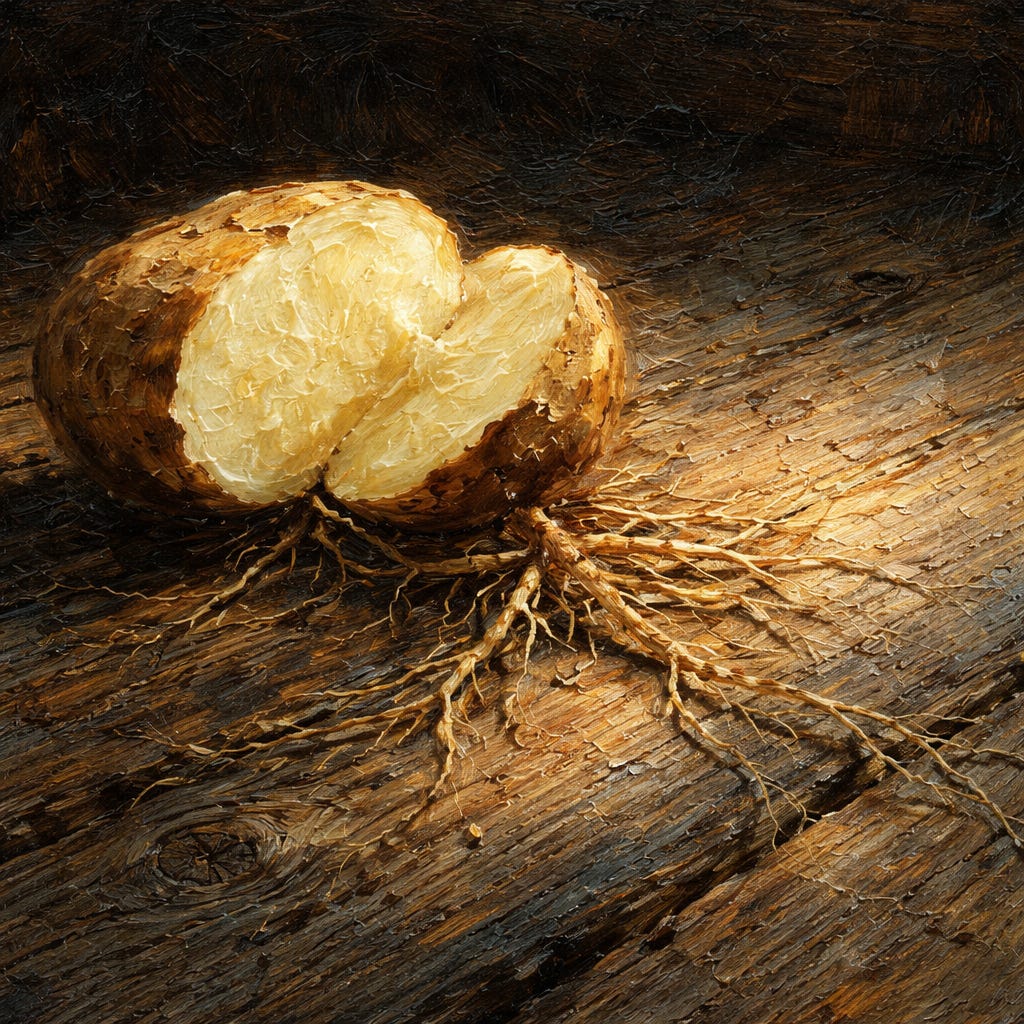
William was ten when he ran past a rotting railway sleeper at the edge of a swimming pool and came away limping. Barbara O’Neill, the Australian naturopath whose lectures on natural remedies have reached millions, tells the story of her youngest son’s injury with the patience of someone who has watched the body’s healing unfold many times.
She found a hole just under his toe, in the ball of his foot. She probed with tweezers, couldn’t find anything, assumed whatever had gone in must have come out. That night she applied a grated potato poultice. In the morning the wound looked clean, but William was still limping.
Every night for two and a half weeks, she repeated the treatment. Every morning, the foot looked fine. Every day, the limp continued.
A friend visited and did what O’Neill hadn’t dared: pressed hard on the bottom of William’s foot. The boy screamed. “There’s a hunk of wood in that foot,” the friend said.
William looked at his mother, worried. He was the youngest, the delicate one. His older brother Peter could handle anything, but William needed a gentler approach.
“It’s alright,” O’Neill told him. “We’ll do grated potato surgery.”
She intensified. Hot water for three minutes, ice cold for thirty seconds, three cycles—this brings a massive amount of blood to the area and pushes the old blood out. Then a fresh potato poultice. Hot and cold again in the morning. Another poultice. One more at midday. Non-stop grated potato, she thought. We’re going to speed this up.
After two and a half days of continuous treatment, the foot looked like a wrinkled old prune. But when she removed the poultice that morning, a black circle had appeared in the wound. The skin, softened by days of moisture, parted easily. She slipped a needle in at the side of the black spot, and out came a hunk of wood.
William brought her the used poultice. “Mum, look at this.” On the surface sat little shavings of metal, fluorescent blue in colour. The potato had pulled the rusty metal out of the foot and cleaned up the rust.
They didn’t do another thing. The limping stopped.
Support Independent Research
This work remains free because paid subscribers make it possible. If you find value here, consider joining them.
What paid subscribers get: Access to the Deep Dive Audio Library — 180+ in-depth discussions (30-50 min each) exploring the books behind these essays. New discussions added weekly. That’s 100+ hours of content for less than the price of a single audiobook.
[Upgrade to Paid – $5/month or $50/year]
Get in touch Essay ideas, stories, or expertise to share: unbekoming@outlook.com
The potato didn’t extract the splinter. What it did was change the conditions under which William’s body was working.
Potato is high in phosphorus and potassium, strongly alkaline. When grated and applied to inflamed tissue, the skin absorbs these minerals. O’Neill puts it simply: “Because it’s very alkaline it neutralizes the acid condition, cools it, and it can draw out and reduce the inflammation.”
This is the mechanism behind what she calls “drawing.” The potato doesn’t attack foreign matter. It doesn’t kill anything. It shifts the local terrain from acid to alkaline, reduces swelling, and creates the conditions for the body’s own processes—white blood cells moving, natural pressure pushing debris toward an exit—to finally work.
Pharmaceutical interventions act on the body: suppressing a symptom, killing a pathogen, blocking a receptor. The potato works with the body. It adjusts terrain. The body does the rest.
Potato succeeds where more aggressive remedies fail. Onion draws powerfully but irritates. Ginger pulls inflammation from joints but blisters tender skin if overused. Garlic is antimicrobial but too harsh for sensitive areas.
Potato goes where the others cannot: eyes inflamed with conjunctivitis, a freshly sprained ankle, an ingrown toenail too painful to touch. Gentle and persistent rather than forceful.
O’Neill’s friend called one day, her ten-month-old son screaming in the background.
“What’s the matter with Louie?”
“I don’t know what’s happened but his little penis is twice the size.”
“What are you going to do? And if you go to hospital, what are they going to do?”
O’Neill told her to make a potato poultice immediately. The mother grated potato, spread it thin on cloth, laid it over the area, fastened the diaper over it.
Within five minutes the crying stopped. The baby fell asleep—he must have been exhausted. He slept for two hours. When he woke, his mother quickly changed the diaper. Everything was back to normal.
What had caused it? The boy had been crawling around on the floor of their home. A bite, perhaps. A bit of dirt in the wrong place. Sometimes you don’t know. The potato took all the swelling down, which meant no more pain, and there was no further trouble with the area.
If there had been? “You just do it again,” O’Neill says. “You’re listening and watching to what the body says.”
A seven-year-old boy arrived at one of O’Neill’s lectures in New Zealand with a finger swollen to twice its size. Cellulitis, the doctor had called it. The boy was on his second course of antibiotics, taking sleeping tablets and painkillers. A seven-year-old on sleeping tablets.
O’Neill asked what had actually happened. A blister had broken. The boy had been playing in the dirt with his Matchbox cars. Dirt entered the wound. The body responded with inflammation—white blood cells rushing to the area, swelling to protect.
The doctor saw infection. Prescribed chemicals to kill what he assumed was bacterial invasion. The swelling persisted. More chemicals. Still no resolution.
O’Neill filled two cups: one with hot water as hot as the boy could bear, one ice cold. She put his finger in the hot for three minutes, then plunged it into the cold for thirty seconds. The alternating temperatures bring fresh blood in and push stagnant blood out—the blood carries oxygen, nutrients, white blood cells, and removes waste. In an injury, blood pools and sits. The hot and cold create a pump.
She did this three times. Under ten minutes total. By the end, the boy was smiling. How long does it take for Tylenol to have an effect? Half an hour. And yet his body language showed his pain had dropped from an eight to about a four.
She made a small potato poultice, wrapped it around the finger, bandaged it on. The boy sat there for the rest of the morning, smiling, looking at her. He had relief.
His mother reported later: when they got home, he asked to do it again. The fluid was building back up. They did the hot and cold, applied a fresh poultice. Again before bed. When he woke in the morning and they removed the poultice, everything had drained. The finger was back to normal size.
No more sleeping tablets. No more painkillers. The antibiotics went unused.
The most serious case in O’Neill’s telling involved a man named Chris who lived in a caravan at the end of her paddock in the rainforest. He had been sickling grass with bare feet—predictable outcome—and the blade went into the back of his ankle.
O’Neill heard about it but didn’t see him for days. Then another neighbour mentioned: Chris’s foot is up like a red balloon. There’s a red line going up his leg. He’s lying in bed smoking marijuana, waiting for nature to heal.
The body will heal if you give it the right conditions. The marijuana was dulling the pain, but the pain was telling him to do something.
They brought him up to O’Neill’s house. The wound had sealed on the outside but not healed underneath—exactly the condition where tetanus takes hold. There was a horse in the paddock. Chris was a perfect environment for tetanus.
O’Neill got two buckets: one hot, one ice cold. She put his foot straight into the hot water, her hand on his foot, watching his face—if it was too hot, she added cold. Three minutes. Then into the ice cold, thirty seconds. While it was in the cold, she added more hot water to the first bucket. Three cycles.
His pain reduced by fifty percent.
She made a large grated potato poultice and wrapped his foot. “Come back in two hours.” He could limp now. Just that reaction told her they were getting results.
Two hours later she removed the poultice. The wound was oozing. The red line had retreated four inches.
If he’d still been in pain, if the red line hadn’t moved, she would have taken him straight to hospital. But they could see results, and he did not want to go.
Hot and cold again. Another poultice. She told him to come back at six o’clock. Every time he returned, the red line was lower, the foot was smaller, the wound was still oozing—the potato drawing what needed to come out.
Fresh poultice overnight. Hot and cold in the morning. By then the red line was gone. The foot was back to normal, though it looked like a dried prune from all the moisture. Nobody cared about that.
A wound that had sealed wrong was coaxed open. A body that had stalled was set back in motion.
Making the Poultice
O’Neill likes her poultices mess-free. She lays down a sheet of plastic wrap, then places a thin cloth on top—a piece of old sheet, a disposable cleaning cloth, whatever is to hand. She grates fresh potato directly onto the cloth. Not too much: if the poultice gets too wet, it leaks, and leaking poultices are no fun.
Spread the potato thin. Fold two sides of the cloth over, then the other two sides, creating a package. Turn it over. The side with just one layer of cloth goes against the skin. The side with multiple layers faces out to absorb moisture. The plastic wrap extends slightly past the edges of the cloth—enough to prevent leaking, not so much that the whole thing is wrapped in plastic.
Bandage or tape in place. For feet, a firm sock holds it overnight. For fingers, paper tape is gentle on skin.
Discard after use. Vegetable matter absorbs waste and cannot be reapplied.
When to Intensify
If the poultice alone isn’t producing results after several days, add hot and cold contrast therapy. Two containers—one as hot as can be comfortably tolerated, one ice cold. Three minutes hot, thirty seconds cold, three cycles. Then apply a fresh poultice.
For stubborn cases, run the cycle multiple times per day with fresh poultices between each round. William’s foot required two and a half days of near-continuous treatment before the splinter surfaced.
How long do you do it for? As long as it takes. Three nights might be enough. If the area is still red the next morning, do it again. You’re listening to the body.
Where Potato Works Best
Tissue inflammation anywhere: sprained ankles, swollen fingers, ingrown toenails, wounds that need to stay soft and open. Red, raised, painful areas that need cooling and gentle drawing.
Eyes with conjunctivitis or irritation from welding. Tender areas where ginger or onion would cause pain. An infant’s swollen genitals, where you’re not going to use anything harsh.
When you don’t know exactly what’s wrong but the tissue is angry, the potato soothes while you figure it out. And if it doesn’t resolve—if the pain persists, if the redness spreads—you’ve lost nothing. You do it again, or you escalate, or you seek other help.
But O’Neill’s experience, across decades of applying these poultices, is that she has never had to. Everything she’s treated has brought relief.
What would have happened if O’Neill hadn’t done the potato poultice on William’s foot? The wound would have swelled. It would have got very red and very sore. She would have gone to the doctor and he would have said “You’ve got an infection”—which is just white blood cells trying to get rid of the foreign matter. Painkillers. Antibiotics. And yet all that was needed was to keep the swelling down, keep the tissue soft and open, and let the body push the splinter out by itself.
The potato asks nothing of the body except that it accept a little help with the terrain.
References
O’Neill, Barbara. Self Heal by Design: The Role of Micro-Organisms for Health. Fourth edition, Bellbrook, NSW, 2017.
O’Neill, Barbara. “Natural Remedies.” Lecture, Misty Mountain Health Retreat. Available on YouTube.
O’Neill, Barbara. “Home Remedies.” Lecture, Misty Mountain Health Retreat. Available on YouTube.
O’Neill, Barbara. “Simple Home Remedies.” Lecture, Misty Mountain Health Retreat. Available on YouTube.
Other Barbara O’Neill Remedies and Insights


Book: Medicalized Motherhood: From First Pill to Permanent Patient
Available as a free download. 123 interventions documented across six phases—from pre-conception capture through postpartum surveillance. Includes practical tools: birth plan template, provider interview questions, quick reference card, and a new chapter on interrupting the cascade. Download it, share it with someone facing their first prenatal appointment, their induction date, their cesarean recommendation. The cascade works because women don’t see it coming. This book makes it visible.
Support Independent Research
This work remains free because paid subscribers make it possible. If you find value here, consider joining them.
What paid subscribers get: Access to the Deep Dive Audio Library — 180+ in-depth discussions (30-50 min each) exploring the books behind these essays. New discussions added weekly. That’s 100+ hours of content for less than the price of a single audiobook.
[Upgrade to Paid – $5/month or $50/year]
Get in touch Essay ideas, stories, or expertise to share: unbekoming@outlook.com
Bitcoin: 3Q6BK8x8zjoPaXykQggzvoJxg5FiEbkb3U
Ethereum: 0x4CB0d39d8466a34609318FC1B003B745893788b3
New Biology Clinic
For those of you looking for practitioners who actually understand terrain medicine and the principles we explore here, I want to share something valuable. Dr. Tom Cowan—whose books and podcasts have shaped much of my own thinking about health—has created the New Biology Clinic, a virtual practice staffed by wellness specialists who operate from the same foundational understanding. This isn’t about symptom suppression or the conventional model. It’s about personalized guidance rooted in how living systems actually work. The clinic offers individual and family memberships that include not just private consults, but group sessions covering movement, nutrition, breathwork, biofield tuning, and more. Everything is virtual, making it accessible wherever you are. If you’ve been searching for practitioners who won’t look at you blankly when you mention structured water or the importance of the extracellular matrix, this is worth exploring. Use discount code “Unbekoming” to get $100 off the member activation fee. You can learn more and sign up at newbiologyclinic.com
My experience with the starchy potato happened when I was going through puberty. My facial skin has always been oily. My mom said it looked like someone had applied butter to my face. Somewhere as a young teen, I had read that a thin slice of potato rubbed over my face after washing and before bed would help, so I tried it. Every night I applied potato juice to my face. I would wake with soft skin and no oily shine. I strongly suggest using it if an oily face or back with breakouts is a problem. Washing first, then rubbing the cut piece over the area produces amazing results!! You're welcome! Thank you for these stories. We need more natural remedies and less pharmaceutical intervention for some conditions. Love reading your articles. ♥️
Thanks for the potato advice. Maybe alternate it with salt water, maybe a tablespoon per quart of water as hot as can stand, put in finger or foot or apply to area. 20 minutes three times a day.