

Note to readers from James Perloff
Thank you for this very exhaustive summary. It must be borne in mind that in 1988, there was no Internet, no search engines, so all the information had to be gathered from hard-copy resources. I didn’t even have a pc until 1989, so the manuscript was typewritten for the publisher. Of course, today we know vastly more about history and the Deep State. Whereas the CFR dictated policy-making and cabinet appointments at a national level, Klaus Schwab’s World Economic Forum now does the same thing at an international level. In America, I believe there was a seismic shift in the center of power following 9/11—away from the old-line Morgan and Rockefeller interests who dominated the CFR (the Twin Towers literally represented David and Nelson Rockefeller), and moving toward the Neocons, Zionists, and AIPAC, although they certainly overlap with the CFR to some extent. Zionism was missing from The Shadows of Power—it wasn’t on my radar screen yet, but along with communism and globalism, it is one of the heads of the hydra. People can find much updated information in my books Truth Is a Lonely Warrior (2013), Thirteen Pieces of the Jigsaw (2019), and on my website https://jamesperloff.net/.
When James Perloff published this book in 1988, the Berlin Wall still stood, the Soviet Union appeared permanent, and most Americans had never heard of the Council on Foreign Relations. Writing during the final years of the Cold War, Perloff was sounding an alarm that few wanted to hear: that the real threat to American sovereignty came not from Moscow but from Manhattan, not from foreign armies but from our own elites. His warning seemed almost fantastical at the time—that international bankers and their allies were deliberately managing both sides of the global conflict, steering the world toward a predetermined convergence where East and West would merge into a single system of control. Yet decades later, as we witness the emergence of global financial networks, supranational trade agreements, international climate accords, and calls for “stakeholder capitalism” that merges corporate and government power, Perloff’s analysis appears not paranoid but prophetic.
In the elegant townhouses of Manhattan’s Upper East Side and the oak-paneled boardrooms of Wall Street, decisions are made daily that affect the lives of millions of Americans. Yet the organizations and individuals making these decisions remain largely unknown to the public they impact so profoundly. Since 1921, the private group Perloff exposed—the Council on Foreign Relations—has quietly placed its members in the highest positions of government, banking, media, and academia. With fewer than 2,500 members representing just one in every 100,000 Americans, this organization has supplied the key officials who shaped virtually every major foreign policy decision of the twentieth century. Wars have been fought, nations have fallen, and trillions of dollars have changed hands based on plans formulated in the Council’s headquarters at 58 East 68th Street in New York City. When Perloff wrote these words, few believed such influence was possible in a democracy. Today, after witnessing decades of foreign policy disasters, endless wars, and the steady erosion of national sovereignty exactly as he predicted, his documentation demands serious consideration.
This book tells the story of how international bankers and their allies created an invisible government that operates behind America’s democratic facade. Through meticulous research into government documents, congressional testimonies, and the Council’s own publications, Perloff revealed how CFR members manipulated America into world wars, deliberately lost conflicts we could have won, betrayed our allies to Communist conquest, and systematically eroded our national sovereignty in pursuit of their ultimate goal: world government. Writing in 1988, he could not have known how subsequent events would validate his thesis—the sudden collapse of the Soviet Union that seemed more like a controlled demolition than a defeat, the immediate pivot to new international crises that justified continued global integration, the rise of China with Western financial support, and the acceleration of regional blocs evolving toward supranational governance. What seemed like speculation then now reads like history written in advance.
The implications of Perloff’s investigation extend far beyond foreign policy. The control mechanisms he documented—media manipulation, academic blacklisting, bipartisan political control, and economic warfare—affect every aspect of American life. His explanation of how the same individuals appear in administration after administration regardless of party, why our policies remain consistent despite electoral upheavals, and why certain topics remain off-limits in mainstream discourse, illuminates not just the past but our present moment. As we face new calls for “global governance” to address pandemics, climate change, and economic instability—precisely the kind of manufactured crises Perloff warned would be used to justify world government—his three-decade-old warning becomes urgently contemporary. This book provides both a historical record and a guide for recognition, exposing methods of subversion while offering concrete steps for restoration. Perloff saw what was coming because he understood what had already been accomplished. His warning from 1988 echoes across the decades: the battle between those who seek to preserve American independence and those who would dissolve it into world government continues, and it can only be won by citizens who understand the true nature of the threat.
With thanks to James Perloff.
The Shadows of Power: The Council on Foreign Relations and the American Decline: Perloff, James
Interview with James Perloff

James Perloff’s path to becoming one of America’s most persistent investigators of hidden history began with a mystery written on his own body—a purple lesion the size of a small golf ball on his neck that he’d carried since childhood, thinking it was just part of his anatomy. When he finally asked his mother about it, her casual response revealed every…
Deep Dive Conversation Library (Bonus for Paid Subscribers Only)
This deep dive is based on the book:
Discussion No.161:
Insights and reflections from “The Shadows of Power: The Council on Foreign Relations and the American Decline ”
Thank you for your support.
Analogy
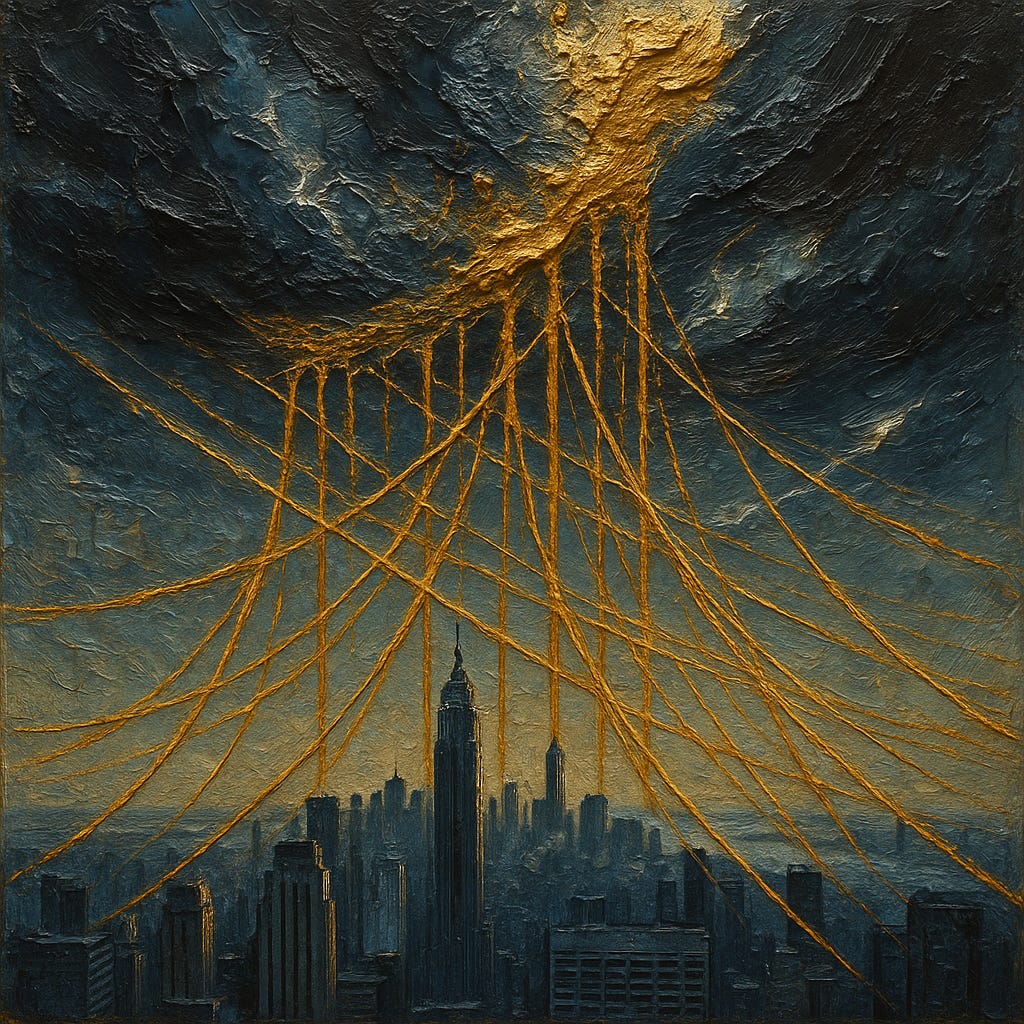
The story of the Council on Foreign Relations and America’s decline is like a master puppeteer who discovers a thriving theater filled with independent performers and a delighted audience. Rather than competing honestly, the puppeteer realizes he can gain control by secretly attaching invisible strings to the performers, the stage managers, the critics, and even the theater owners. He doesn’t announce his presence or intentions; instead, he gradually makes the performers dance to his tune while they still believe they’re acting freely. The audience notices the performances becoming strangely repetitive and contrary to their interests, but the critics assure them it’s the finest theater possible. When a few observers point out the strings, they’re ejected as troublemakers who don’t appreciate sophisticated art. Meanwhile, the puppeteer is busily connecting his strings to neighboring theaters, planning the day when every stage in the world will feature the same performance. The tragedy isn’t that one puppeteer exists, but that the performers and audience have forgotten they once controlled their own theater and could cut the strings if they only had the courage to look up and see them.
The One-Minute Elevator Explanation
Since 1921, a private organization called the Council on Foreign Relations has dominated American foreign policy by placing its members in key government positions regardless of which party wins elections. Founded by international bankers, particularly the J.P. Morgan interests, the CFR has consistently pursued policies that weaken American sovereignty while building world government institutions. Their members orchestrated America’s entry into both world wars, created the Federal Reserve to control our money supply, and designed the United Nations as a foundation for global governance. They’ve deliberately lost wars we could have won, like Korea and Vietnam, by imposing political restrictions on our military. They’ve supported Communist regimes with American taxpayer money while those same regimes killed millions and threatened our security. The CFR controls major media outlets to shape public opinion and has systematically destroyed careers of historians and journalists who expose their agenda. Their ultimate goal is eliminating national boundaries and creating a single world government where international bankers and their allies exercise total control. The tragedy is they’ve succeeded in making most Americans unaware this organization even exists, despite its members holding the highest positions in government for seven decades.
[Elevator dings]
For further investigation, research the CFR membership lists of presidential cabinets, examine the funding sources of major think tanks and universities, and trace the pattern of American foreign policy disasters to their CFR architects.
12-Point Summary
1. The Hidden Architecture of Power The Council on Foreign Relations represents the American branch of an international network that exercises decisive influence over U.S. policy while remaining virtually unknown to the public. Founded in 1921 following secret meetings at the Majestic Hotel in Paris, the CFR emerged from the failure to bring America into the League of Nations. With just 2,440 members drawn primarily from international banking, corporate law, media, and academia, this organization has supplied the key personnel for foreign policy positions in every administration since Franklin Roosevelt. Despite its enormous influence in shaping the direction of the nation, probably not one American in five hundred can identify what the CFR is, a testament to both its power over media and its preference for operating behind the scenes.
2. The Banking Foundation of Global Control International bankers discovered that lending to governments provides not just profit but policy control, as governments can guarantee repayment through taxation and grant special privileges to creditors. The Rothschild model of funding both sides of wars while manipulating outcomes for profit became the template for American financiers like J.P. Morgan, who dominated the CFR’s founding membership. The creation of the Federal Reserve in 1913 through deception gave these bankers control over America’s money supply, enabling them to create booms and busts at will. The 1929 crash was deliberately engineered through coordinated calling of broker loans after insiders had exited the market, creating the desperation necessary for accepting radical expansions of government power that furthered the bankers’ control.
3. The Paradox of Capitalists Funding Communism Wall Street’s support for the Bolshevik Revolution seems contradictory until one understands that international financiers view socialism as an instrument of monopoly control. Major CFR founders like William Boyce Thompson and Jacob Schiff provided millions to establish and maintain the Soviet regime. They understood that socialism concentrates all economic power in government, which can then be controlled through loans and corruption more easily than free markets. Communist states became dependent on Western banks for technology and development loans, creating profitable opportunities while eliminating middle-class competition and independent businesses that might challenge international corporate interests.
4. Manufacturing Wars for Profit and Power The CFR and its predecessors have consistently maneuvered America into wars through deception and manipulation of public opinion. The Lusitania was deliberately sent into harm’s way carrying hidden munitions to create outrage for entering World War I. Pearl Harbor was allowed to happen despite broken Japanese codes and advance warnings to create support for World War II. These wars served to expand government power, enrich international bankers through war loans, and advance the creation of international institutions. The pattern reveals wars not as defensive necessities but as orchestrated events serving the agenda of global government.
5. The Systematic Betrayal of Anti-Communist Allies Throughout the Cold War, CFR-dominated administrations consistently betrayed governments fighting Communism while strengthening Communist regimes. China was deliberately lost through withdrawal of aid to Chiang Kai-shek while State Department officials promoted Mao. Similar patterns destroyed free governments in Eastern Europe, Cuba, Vietnam, Nicaragua, and elsewhere. The State Department repeatedly forced anti-Communist governments to accept coalition arrangements with Communists, knowing from experience these always resulted in complete Communist takeover. This systematic betrayal suggests either incredible incompetence or deliberate facilitation of Communist expansion to create the bipolar tension necessary for advancing world government.
6. Controlled Opposition Through Limited Wars The Korean and Vietnam Wars introduced the concept of fighting not to win but to maintain perpetual conflict under international oversight. Military commanders were forbidden to pursue victory through restrictions that prevented attacking enemy sanctuaries, supply lines, or strategic targets. These limitations guaranteed stalemate and eventual defeat while maximizing casualties and war profits. The rules of engagement were designed by CFR figures like McGeorge Bundy and Robert McNamara to demonstrate that national military action was futile and that future conflicts required international solutions under UN authority.
7. Media Manipulation and Information Control J.P. Morgan interests purchased editorial control of America’s 25 most influential newspapers in 1915, establishing the template for CFR media dominance. CFR members in major media positions created selective coverage that ignored Communist atrocities while highlighting any abuses by anti-Communist governments. Historians who challenged official narratives about American foreign policy were blacklisted while court historians with CFR connections received exclusive access to documents and guaranteed publication. This information control shaped public perception to accept internationalist policies that voters would otherwise reject.
8. The Bipartisan Deception The CFR’s membership encompasses leadership from both major parties, ensuring policy continuity regardless of electoral outcomes. Presidential candidates from both parties are often CFR members, giving voters no real choice on foreign policy issues. When outsiders like Goldwater challenged this system, they faced coordinated media attacks from CFR-controlled outlets. Administrations supposedly of different philosophies retained the same CFR advisors in key positions, explaining why foreign policy remained remarkably consistent despite campaign promises of change. This bipartisan control reduced elections to meaningless exercises that changed personalities but not policies.
9. The Evolution Toward Trilateral Control David Rockefeller’s creation of the Trilateral Commission in 1973 represented a more aggressive phase of globalization, openly coordinating policies among North America, Europe, and Japan. When Trilateral members dominated the Carter administration, they implemented policies deliberately weakening America while strengthening international institutions. The Commission’s documents revealed contempt for democratic participation, arguing that populations had too much influence and needed management by experts. This evolution from hidden influence to open coordination showed growing confidence that national populations could no longer effectively resist the internationalist agenda.
10. Building World Government Through Incremental Steps After direct approaches like strengthening the UN failed due to public resistance, the CFR adopted Richard Gardner’s strategy of building world government from the bottom up through regional agreements. The European Common Market evolved into the European Union exactly as planned, with its own parliament, courts, and currency replacing national authorities. Similar regional blocs in North America and Asia would eventually merge into world government. Trade agreements created supranational tribunals overruling domestic laws, while international environmental and financial regulations transferred sovereignty piece by piece without triggering massive resistance.
11. The Constitutional Battleground America’s Constitution remains the primary obstacle to world government, with its requirements for treaty ratification, separation of powers, and federalist structure preventing rapid sovereignty surrender. The CFR has promoted constitutional conventions that could eliminate these safeguards under the guise of minor amendments. Proposals include parliamentary systems allowing easier international integration, elimination of state sovereignty, and provisions for international agreements to supersede domestic law. The battle between constitutionalists and globalists represents the fundamental conflict between national independence and world government, with America’s founding document standing as the last major barrier to complete globalist victory.
12. The Path of Resistance and Restoration Despite the CFR’s enormous power, informed citizens can resist through education, electoral action, and organized opposition. The John Birch Society demonstrated that grassroots education could expose CFR influence despite media vilification. Citizens must research candidates’ backgrounds for CFR connections, demand clear positions on sovereignty issues, and support only those committed to constitutional government. State legislatures can nullify unconstitutional international agreements and reject constitutional convention calls. Building alternative information networks, supporting local businesses over multinationals, and creating community resilience against economic manipulation are essential. The ultimate defense requires millions of Americans who understand the threat and will act to preserve their constitutional republic against the forces seeking its destruction through merger into world government.
The Golden Nugget
The most profound yet least known revelation in this book is that international financiers deliberately created and sustained their supposed ideological enemy - Communism - as a dialectical tool for achieving world government. While the public believed in a genuine struggle between capitalism and communism, Wall Street bankers were secretly funding the Bolshevik Revolution, providing the technology and loans that kept Soviet regimes viable, and protecting Communist states from military defeat. This manufactured opposition served multiple purposes: it justified massive military spending that profited connected corporations, created the crisis atmosphere necessary for building international institutions, eliminated middle-class competition in captured nations, and most importantly, set up the eventual “convergence” of East and West into a synthesized world system. The bankers understood that both monopoly capitalism and state socialism concentrate economic power in ways they could control - the apparent conflict was theater masking a deeper collaboration toward eliminating both free markets and political freedom in favor of a global technocratic state managed by financial elites.
30 Questions and Answers
1. How did international bankers, particularly the Rothschild model, establish the pattern of profiting from government loans and wars that would later influence American banking?
International banking was epitomized by the Rothschild dynasty, where Meyer Amschel Rothschild dispatched his five sons to establish banks in Germany, England, France, Austria, and Italy. These bankers discovered that lending to governments was extraordinarily profitable because governments borrow far more than individuals or businesses, they can guarantee repayment through taxation, and they often repay through granting special privileges or policy influence. War became the most lucrative opportunity for international bankers because nothing generates government borrowing faster than military conflict.
The Rothschilds perfected the art of funding both sides of conflicts, ensuring profits regardless of outcome. This model established the template that American financiers would later adopt - using government debt as a mechanism for both profit and control. The international bankers understood that a government in debt becomes beholden to its creditors, who can then influence policy decisions. This pattern would become central to how Wall Street bankers approached their relationship with the American government, seeing war and economic crisis as opportunities to expand both wealth and political influence.
2. What was the secret Jekyll Island meeting in 1910, and how did it lead to the creation of the Federal Reserve System despite public opposition to central banking?
In November 1910, a group of the nation’s most powerful bankers gathered secretly at Jekyll Island, Georgia, under the guise of a duck hunting expedition. The attendees included Senator Nelson Aldrich, Paul Warburg of Kuhn, Loeb & Company, Frank Vanderlip of National City Bank, Henry Davison of J.P. Morgan Company, and others representing roughly one-fourth of the world’s wealth. They met to draft legislation for a central banking system that would give them control over the nation’s money supply while appearing to be a government institution under public control.
The conspirators knew Americans deeply distrusted central banking after experiences with previous national banks, so they crafted their plan carefully. The resulting Federal Reserve Act was presented as a measure to prevent bank panics and break the “money trust,” when in reality it institutionalized that very trust. The legislation passed in 1913 during Christmas recess when many opponents were absent. Paul Warburg later admitted they kept their participation secret because discovery would have killed the plan. The Federal Reserve gave private bankers the power to create money from nothing, loan it to the government at interest, and manipulate economic cycles for their benefit.
3. Who was Colonel Edward Mandell House, and how did his relationship with Woodrow Wilson shape both domestic policy and America’s entry into World War I?
Colonel Edward Mandell House, despite never serving in the military, became President Woodrow Wilson’s closest advisor and virtually co-president from 1913 to 1918. House had written a novel called “Philip Dru: Administrator” revealing his vision for America’s transformation through graduated income tax, central banking, and eventually world government. When House met Wilson, he found the perfect vehicle for implementing his radical agenda. Wilson became completely dependent on House, calling him “my second personality” and “my independent self.”
House orchestrated both the passage of the Federal Reserve Act and the income tax amendment, fundamentally altering America’s economic structure. More significantly, he maneuvered America into World War I despite Wilson’s campaign promises to keep the nation at peace. House conducted secret diplomacy with British officials, practically committing America to war while Wilson still proclaimed neutrality. He stage-managed the Paris Peace Conference afterward, where he worked to establish the League of Nations as a foundation for world government. House’s influence demonstrates how a single unelected advisor with the president’s ear could redirect the entire course of American history.
4. What evidence suggests the Lusitania sinking was deliberately orchestrated to draw America into World War I?
The Lusitania’s sinking in 1915, which killed 128 Americans and helped propel America into World War I, shows multiple signs of deliberate orchestration. The ship was carrying six million rounds of ammunition and other military supplies to Britain, making it a legitimate military target under international law - facts hidden from the American public. Winston Churchill, then head of the British Admiralty, had commissioned a report predicting the political impact if a passenger ship carrying Americans was sunk, suggesting foreknowledge and planning.
Most damning was the British naval intelligence’s handling of the incident. They had broken German codes and knew U-boat locations around the British Isles. According to Commander Joseph Kenworthy of British Naval Intelligence, the Lusitania was deliberately sent at reduced speed into waters where a U-boat was known to be waiting, with her military escorts withdrawn. Colonel House had discussed with British Foreign Minister Edward Grey that sinking a ship with Americans aboard would create sufficient outrage to bring America into the war. The Germans had even published warnings in New York newspapers urging Americans not to board the ship. The internal explosions from the munitions caused the ship to sink in just eighteen minutes after a single torpedo hit, yet this crucial fact was suppressed at all subsequent investigations.
5. How was the Council on Foreign Relations founded at the 1919 Majestic Hotel meeting in Paris, and what were its stated versus actual purposes?
The Council on Foreign Relations emerged from a May 30, 1919 dinner at the Majestic Hotel in Paris, where American and British delegates to the Versailles Peace Conference met to address the U.S. Senate’s resistance to the League of Nations. Colonel House directed this meeting of his “Inquiry” members and British counterparts, who resolved to create an “Institute of International Affairs” with branches in both countries. The American branch incorporated as the CFR on July 29, 1921, while the British branch became the Royal Institute of International Affairs.
The CFR publicly claimed to be merely a discussion group spreading knowledge about international relations and developing reasoned American foreign policy. However, its actual purpose was to shift American public opinion toward acceptance of world government and abandonment of national sovereignty. The organization served as a vehicle for international bankers, particularly the Morgan interests, to control American foreign policy. While presenting itself as an objective, educational forum, the CFR consistently promoted globalism, supported international institutions over national interests, and worked to entangle America in foreign commitments that would erode its independence.
6. Why did many early CFR members support the Bolshevik Revolution financially and politically, despite its violent anti-capitalist ideology?
Wall Street’s support for Bolshevism seems paradoxical until one understands that international financiers saw socialism not as a threat but as an instrument of control. In 1917, Federal Reserve director William Boyce Thompson led a Red Cross mission to Russia that was actually fifteen Wall Street financiers who provided $1 million to the Bolsheviks for spreading their revolution. Jacob Schiff of Kuhn, Loeb & Company provided $20 million. Many of these Bolshevik supporters became CFR founding members, including Thompson himself, Thomas Lamont, and Averell Harriman.
These financiers understood that socialism concentrates all economic power in government hands, creating a monopoly system. If international bankers could control that government through loans, campaign contributions, or corruption, socialism would serve as an instrument for controlling entire societies. As Frederick Howe explained in “Confessions of a Monopolist,” the best business is politics because government-granted monopolies require no competition or innovation. The Bolsheviks’ destruction of Russia’s middle class and independent businesses eliminated potential competitors to international corporate interests. Furthermore, Communist states became dependent on Western banks for development loans and technology, creating profitable lending opportunities while keeping these nations in permanent debt servitude.
7. How did J.P. Morgan and Company establish control over the CFR’s early membership and American media outlets?
J.P. Morgan and Company dominated the CFR from its inception, with historian Carroll Quigley calling it “a front group for J.P. Morgan and Company.” The CFR’s founding president John W. Davis was Morgan’s personal attorney, vice-president Paul Cravath’s law firm represented Morgan interests, and Morgan partner Russell Leffingwell became the first chairman. The membership rolls filled with Morgan partners, attorneys, and agents, while even the academic members came from universities dependent on Morgan’s management of their endowments.
Morgan’s media control began systematically in 1915 when, according to Congressional testimony by Oscar Callaway, the Morgan interests assembled twelve men high in journalism to identify the most influential newspapers in America. They determined that purchasing editorial control of just 25 major papers would be sufficient to control the general policy of the daily press. They bought monthly editorial policies in these papers and installed editors to supervise content regarding “preparedness, militarism, financial policies” and other vital matters. This media network proved essential for manipulating public opinion toward supporting World War I, the Federal Reserve, and later CFR foreign policy objectives. The combination of controlling both policy-making through the CFR and public perception through the media created an almost unbreakable grip on American political direction.
8. What methods did the CFR use to advocate for world government through the League of Nations and later the United Nations?
The CFR employed multiple sophisticated strategies to promote world government while avoiding direct confrontation with American sovereignty concerns. Through Foreign Affairs journal, they published hundreds of articles pushing globalism, always mixed with dry, technical pieces to maintain an academic veneer. Articles condemned “America First” attitudes as early as 1922, arguing that independent nation-states made peace impossible and that sovereignty was an obsolete concept. Rather than openly declaring their world government agenda, they advocated incremental steps - international courts, regional alliances, economic integration, and strengthening international organizations.
When the League of Nations failed to gain American participation, the CFR learned to use crisis and war as vehicles for advancing internationalism. During World War II, their War and Peace Studies Project essentially took over State Department planning, designing the United Nations structure. They presented the UN not as world government but as a peace-keeping forum, knowing it could be gradually strengthened. CFR members drafted the UN Charter and dominated the American delegation at its founding conference. They promoted the concept through coordinated media campaigns, academic conferences, and placement of members in key government positions. The strategy involved making each step toward world government appear reasonable and necessary for peace, while never acknowledging the ultimate goal of eliminating national sovereignty.
9. How did the 1929 stock market crash appear to be deliberately engineered through Federal Reserve policies and coordinated calling of broker loans?
The 1929 crash followed a pattern of deliberate Federal Reserve manipulation that Congressman Charles Lindbergh had predicted when he warned that “depressions will be scientifically created.” Throughout the 1920s, the Fed maintained easy credit policies that fueled stock speculation, while CFR-connected newspapers hyped the fortunes to be made in the market. Paul Warburg, who helped create the Fed, issued a warning in March 1929 that a crash was coming, allowing insiders like John D. Rockefeller, Bernard Baruch, and Joseph Kennedy to exit the market before the collapse.
The actual crash mechanism involved the mass calling of “24-hour broker call loans.” Investors could buy stocks with 10% down, borrowing 90% from banks, but these loans could be called with just 24 hours notice. When New York financiers simultaneously called these loans, investors had to dump stocks immediately to repay them, creating a cascade of selling that collapsed prices. Curtis Dall, on the Stock Exchange floor that day, called it a calculated “shearing” of the public by world money powers. The Federal Reserve, despite its mandate to maintain elastic currency and prevent such panics, refused to provide liquidity to smaller banks, causing thousands to fail. The resulting Depression created the desperation necessary for accepting the radical expansion of government power under the New Deal.
10. How did CFR members in FDR’s administration facilitate Soviet territorial expansion and survival during World War II?
Franklin Roosevelt’s administration, heavily staffed with CFR members, systematically strengthened the Soviet Union despite its genocidal regime having killed millions. FDR called Stalin “Uncle Joe” while providing over $11 billion in Lend-Lease aid that included 14,000 aircraft, half a million vehicles, and 400 combat ships - without which the Soviets likely couldn’t have survived the German invasion. Harry Hopkins, FDR’s closest advisor, supervised these shipments and according to evidence presented to Congress, also provided nuclear materials and atomic bomb blueprints to Moscow.
At the Tehran and Yalta conferences, Roosevelt made concession after concession to Stalin, agreeing that Western armies would attack through France rather than the Balkans, thereby preserving Eastern Europe for Soviet occupation. CFR member Alger Hiss, later exposed as a Soviet spy, helped formulate the Yalta agreements that handed Poland, the Baltic states, and other nations to Stalin. The administration agreed to forcibly repatriate millions of refugees to certain death in the Soviet Union. These policies saved from extinction what became America’s greatest threat during the Cold War, suggesting either catastrophic incompetence or deliberate assistance to Communist expansion by CFR members who dominated foreign policy positions.
11. What role did the War and Peace Studies Project play in establishing CFR control over State Department policy during World War II?
Beginning in 1939, the CFR initiated the War and Peace Studies Project, a secret program funded by the Rockefeller Foundation that essentially merged the Council with the State Department. The project held 362 meetings and produced 682 memoranda for Roosevelt and State Department officials, covering every aspect of wartime and postwar planning. The CFR established committees on political, economic, territorial, and armaments issues, with their recommendations becoming official U.S. policy positions.
The project’s influence became so pervasive that Assistant State Department division chief Harley Notter resigned in protest, warning that departmental control was being lost to the CFR. The Council’s memoranda shaped American positions on the United Nations structure, international financial institutions, and postwar territorial arrangements. CFR members planned the Bretton Woods conference that created the World Bank and International Monetary Fund, designed the UN charter, and determined occupation policies for defeated nations. Through this project, an unelected private organization captured control of American foreign policy planning, establishing a precedent for CFR dominance that would continue through subsequent administrations regardless of which party held power.
12. How did CFR advisors manipulate intelligence and military decisions to ensure Pearl Harbor would be attacked without warning?
Evidence indicates that Roosevelt and his CFR advisors had foreknowledge of the Pearl Harbor attack but allowed it to proceed to create the outrage necessary for war entry. Military intelligence had broken Japanese diplomatic and naval codes, tracking their fleet movements toward Hawaii. Dutch intelligence provided specific warning of the attack timing, and the U.S. had intercepted the Japanese declaration of war before the attack, but it was deliberately delayed in transmission to Pearl Harbor commanders. General Short and Admiral Kimmel were denied crucial intelligence and ordered to avoid provocative defensive measures that might alert the Japanese.
Secretary of War Henry Stimson, a CFR member, wrote in his diary that they needed to maneuver Japan into firing the first shot while sustaining minimal damage. The newest ships were removed from Pearl Harbor before the attack, leaving older vessels as targets. Twelve Americans had advance knowledge according to a Naval Institute survey, yet commanders in Hawaii were kept ignorant. The Roberts Commission, investigating afterward, scapegoated Short and Kimmel while protecting Washington officials. This manipulation of intelligence to ensure a “surprise” attack that would unite Americans behind war entry demonstrated the CFR network’s willingness to sacrifice American lives to achieve their internationalist objectives.
13. What was the pattern of forcing coalition governments on nations fighting Communism, and why did these always result in Communist takeover?
Throughout the postwar era, CFR-dominated State Department consistently pressured anti-Communist governments to form coalitions with Communist parties, invariably resulting in complete Communist takeover. The pattern began with Poland, where the U.S. forced the legitimate government-in-exile to accept Communists, who then systematically eliminated their coalition partners. The same formula destroyed free governments in Czechoslovakia, Hungary, and China, where George Marshall threatened to cut aid unless Chiang Kai-shek formed a coalition with Mao’s Communists.
This pattern repeated in Cuba, where the State Department undermined Batista and facilitated Castro’s rise, and in Nicaragua, where similar pressure helped bring the Sandinistas to power. Communist doctrine explicitly taught using coalitions as stepping stones to total control - as American Communist leader Louis Budenz admitted, coalition governments were devices Communists used to slaughter those they brought into partnership. CFR policymakers, despite repeated failures of this approach, continued insisting on coalitions, suggesting either stunning incompetence or deliberate facilitation of Communist victories. The strategy served the globalist agenda by weakening independent nations and creating the Communist threat that justified international institutions and eventual East-West convergence into world government.
14. How did Dean Acheson and other CFR members orchestrate the loss of China to Communism while misleading Congress and the public?
Dean Acheson, as Secretary of State, led the CFR contingent that systematically undermined Chiang Kai-shek’s Nationalist government while strengthening Mao’s Communists. Acheson cut off military aid to Chiang during critical battles, claiming the Nationalists were corrupt and unpopular despite their four million soldiers fighting desperately against Communism. State Department officials like John Stewart Service, John Carter Vincent, and John Paton Davies - all Acheson protégés - actively promoted the Communist cause, with Service caught passing secrets to Communist agents yet still protected by Acheson.
General Marshall, on a mission to China, forced Chiang to accept truces whenever he was winning, allowing Communists to regroup and rearm with captured Japanese weapons the Soviets provided. Acheson’s State Department suppressed reports from ambassadors warning about Communist intentions and fabricated intelligence claiming the Chinese Communists were merely “agrarian reformers.” When Congress investigated, Acheson’s law firm was discovered to have represented Polish Communist financial interests, and his partner Donald Hiss was brother to Soviet spy Alger Hiss. The deliberate sacrifice of China to Communism resulted in millions of deaths and created a permanent Communist superpower, yet the CFR architects of this disaster continued shaping American policy in subsequent administrations.
15. Why were American forces in Korea and Vietnam subjected to politically-imposed restrictions that prevented military victory?
In both Korea and Vietnam, CFR policymakers imposed unprecedented restrictions that guaranteed military stalemate rather than victory. In Korea, General MacArthur was forbidden to bomb Chinese supply bases or pursue enemy forces across borders, leading him to declare, “We are not permitted to win this war.” When MacArthur publicly protested these restrictions and proposed strategies for victory, Truman removed him from command. The war dragged on with massive casualties until accepting division at the original border, establishing the precedent of limited war for limited objectives.
Vietnam repeated this pattern with even more absurd restrictions - pilots couldn’t attack enemy aircraft on the ground, MiG bases and SAM sites were off-limits until they fired first, and supply lines through Laos and Cambodia remained protected. The military was forbidden to close Haiphong harbor where Soviet supplies arrived, or to destroy critical infrastructure. These “rules of engagement” were micromanaged from Washington by CFR figures like McGeorge Bundy and Robert McNamara, who seemed more concerned with “signaling” than winning. The restrictions served the CFR’s purposes perfectly - perpetual conflict justified international interventions, military spending enriched connected corporations, and the eventual American defeat discredited national sovereignty while promoting the need for international solutions to conflicts.
16. How did the CFR’s “containment” policy actually serve to protect and legitimize Communist expansion rather than stop it?
The containment policy, articulated by CFR member George Kennan, supposedly aimed to prevent Communist expansion but actually institutionalized and protected existing Communist regimes. Rather than rolling back Communism or defeating it decisively, containment accepted the permanence of Communist states and merely sought to prevent further expansion. This policy guaranteed the survival of the Soviet Union and Communist China by taking military victory off the table and treating them as legitimate negotiating partners.
Containment created a stable bipolar world that justified both the military-industrial complex and international institutions. The CFR promoted massive foreign aid programs that often strengthened Communist economies through trade and technology transfers. The policy prevented anti-Communist forces from liberating their nations - Hungarian freedom fighters in 1956 received no help despite Radio Free Europe’s encouragement to revolt. The nuclear balance of terror under containment made conventional Communist expansion safer, as seen in Vietnam, Angola, and Nicaragua. By treating the conflict as permanent and manageable rather than seeking victory, containment served the CFR’s goal of eventual convergence between East and West into a unified world system.
17. What was the Trilateral Commission, and how did it represent an evolution of the CFR’s globalist strategy?
David Rockefeller founded the Trilateral Commission in 1973 as an expanded version of the CFR concept, incorporating Japan alongside North America and Western Europe. Where the CFR focused on American policy, the Trilateral Commission openly coordinated policies among the three centers of capitalist power. Zbigniew Brzezinski, who became its first director, argued that national sovereignty was obsolete and that economic integration should precede political unification. The Commission recruited approximately 300 members from business, politics, and academia across the three regions.
The Trilateral Commission represented a more aggressive phase of globalization, moving beyond influence over national governments to direct coordination among international elites. Its 1975 report “Crisis of Democracy” argued that democratic populations had too much influence over policy and needed to be managed by experts. When Commission members dominated the Carter administration - including Carter himself, Mondale, Brzezinski, Vance, and fifteen other top officials - they implemented policies that deliberately weakened America economically and militarily while strengthening international institutions. The Commission’s evolution from the CFR model showed growing confidence in pursuing world government openly, believing national populations could no longer effectively resist the internationalist agenda.
18. How did CFR members in the media create selective coverage that ignored Communist atrocities while highlighting anti-Communist government abuses?
Media manipulation by CFR members followed a consistent pattern of minimizing Communist mass murders while extensively covering any human rights issues in anti-Communist nations. During the Cambodian genocide where Communists killed a third of the population, the New York Times ran only four human rights stories in 1976, while publishing sixty-six about Chile’s anti-Communist government. The networks gave virtually no coverage to Cambodia’s killing fields. When the Soviets slaughtered over a million Afghans, the media provided minimal coverage - NBC devoted less time to Afghanistan in all of 1985 than to one evening’s Iran-Contra coverage.
This selective blindness extended to Cuba, Nicaragua, and other Communist states while scrutinizing every flaw in South Africa, El Salvador, or other anti-Communist governments. CFR media members promoted Communist guerrillas as “freedom fighters” or “agrarian reformers” while labeling anti-Communist forces as “death squads” or “right-wing extremists.” Foreign Affairs editor William Bundy’s wife wrote propaganda for Communist North Vietnam while American soldiers died fighting them. This media bias served the CFR agenda by undermining public support for anti-Communist resistance while conditioning Americans to accept coexistence with Communist regimes as normal and permanent.
19. What techniques did the Establishment use to blacklist historians who challenged official narratives about American foreign policy?
After World War II, the Rockefeller Foundation and CFR coordinated a systematic campaign to prevent the kind of historical revisionism that had exposed the manipulations behind World War I. They funded “court historians” like William Langer, Arthur Schlesinger Jr., and Henry Steele Commager who produced authorized versions supporting Roosevelt’s policies. These chosen historians received exclusive access to government documents, interviews with officials, guaranteed publication, and glowing reviews in establishment publications like the New York Times Book Review.
Meanwhile, distinguished historians who questioned official narratives faced sudden career destruction. Charles Beard, former president of the American Historical Association, found himself unable to publish his critical examinations of Roosevelt’s war policies except through a personal friend at Yale Press, and was smeared as senile before his death. Harry Elmer Barnes, previously published by major houses, was completely blacklisted and had to self-publish. Charles Tansill, John T. Flynn, and others who documented the manipulations behind Pearl Harbor and war entry found their academic careers ended and their books suppressed. This intellectual totalitarianism ensured that only establishment-approved versions of history reached the public, preventing Americans from learning how their nation had been repeatedly manipulated into wars and international entanglements.
20. How did CFR members use their positions in multiple presidential administrations regardless of party affiliation?
The CFR’s influence transcended party politics through a revolving door system that placed members in key positions regardless of whether Republicans or Democrats held power. The Dulles brothers served Eisenhower after helping shape policy under previous Democratic administrations. Dean Acheson, though publicly retired after Truman, became an unofficial advisor to Kennedy, Johnson, and Nixon, who installed a special phone in Acheson’s winter home. Henry Kissinger served as the key foreign policy figure for both Nixon and Ford after years of CFR activity.
This continuity explained why foreign policy remained remarkably consistent despite supposedly different party philosophies. CFR members occupied most Cabinet positions dealing with foreign affairs, defense, and finance across all administrations from FDR through Reagan. When voters rejected one party expecting change, they got new faces implementing the same CFR agenda. The Council achieved this through controlling both party’s foreign policy establishments - providing advisors during campaigns, staffing transition teams, and maintaining informal networks that bypassed official channels. This bipartisan dominance made electoral politics largely irrelevant to fundamental policy direction, as CFR members simply changed their party registration to match whoever won elections.
21. What evidence demonstrates that both Republican and Democratic establishments were controlled by the same CFR influence network?
The CFR’s membership rolls included leadership from both parties, ensuring policy continuity regardless of electoral outcomes. Republicans like Eisenhower filled their administrations with CFR members despite campaigning against Truman’s policies - keeping John Foster Dulles’ team that had shaped those very policies. Democrats like Kennedy promised change but retained CFR Republicans like Douglas Dillon, McGeorge Bundy, and Allen Dulles in critical positions. Nixon campaigned as an outsider but appointed over 110 CFR members including his National Security Advisor and most of his foreign policy team.
Presidential candidates from both parties were often CFR members themselves - in multiple elections, both major party nominees belonged to the Council, giving voters no real choice on foreign policy. The few candidates who weren’t CFR members, like Goldwater and McGovern, faced coordinated media attacks from CFR-dominated press. Foundation funding, controlled by the same establishment families, flowed to think tanks and academic institutions of both conservative and liberal orientations, as long as they supported internationalism. This explains why supposedly opposing parties consistently supported the UN, foreign aid, détente with Communists, and international trade agreements that undermined American sovereignty. The parties fought over domestic issues while maintaining complete consensus on the CFR’s international agenda.
22. How did international banks profit from subsidized loans to Communist countries while American taxpayers bore the risks?
International bankers discovered that loans to Communist countries provided risk-free profits through a sophisticated subsidy system. Banks would loan money to Communist regimes at market rates, but the Export-Import Bank and other government agencies guaranteed these loans with taxpayer money. When Poland needed funds to buy American products, the government bank provided the money, which went directly to corporations while Poland received the goods. Poland then repaid at subsidized low interest rates, with American taxpayers covering the difference. If Communist nations defaulted, taxpayers absorbed the entire loss while banks kept their profits.
David Rockefeller’s Chase Manhattan led this process, establishing branches in Moscow and Beijing while American soldiers died fighting Communism in Vietnam. The banks lobbied for Most Favored Nation trade status for Communist nations, allowing technology transfers that enhanced their military capabilities. They promoted détente policies that opened credit lines to the Soviet bloc, financing the very military buildup that threatened America. By 1982, Communist nations owed Western banks over $80 billion, creating pressure for continued subsidies to prevent defaults that would harm the banks. This system socialized losses while privatizing profits, using American tax money to strengthen America’s supposed enemies while enriching the international financiers who controlled the CFR.
23. What role did tax-exempt foundations play in funding and promoting world government ideology in education and research?
The Carnegie, Ford, and Rockefeller Foundations, with billions in tax-exempt assets, systematically funded education and research promoting world government while enjoying immunity from public accountability. The 1954 Reece Committee Congressional investigation discovered these foundations had interlocking directorates with the CFR and coordinated their grant-making to reshape American education toward collectivism and internationalism. They funded curriculum development that minimized American patriotism and constitutional principles while promoting global citizenship and world organizations.
These foundations captured the social sciences by making grants conditional on promoting certain perspectives. Universities became dependent on foundation money, ensuring faculty compliance with internationalist ideology. They funded the creation of area studies programs that trained future State Department officials in managing world regions rather than protecting American interests. The foundations sponsored research that always concluded in favor of international solutions, more foreign aid, and stronger UN authority. By controlling the production of knowledge itself through selective funding, they shaped what multiple generations of American leaders believed about foreign policy, creating an intellectual environment where questioning internationalism became career suicide in academia.
24. How did constitutional principles like separation of powers and treaty ratification requirements serve as obstacles to globalist plans?
The Constitution’s requirement for two-thirds Senate ratification of treaties repeatedly frustrated CFR attempts to subordinate American sovereignty to international bodies. The Senate rejected the League of Nations, blocked the International Trade Organization, and nearly defeated the UN Charter. These constitutional safeguards forced internationalists to pursue alternative strategies like executive agreements that bypassed Senate approval, or gradual sovereignty erosion through regulatory harmonization and economic integration rather than formal treaties.
The separation of powers prevented any single branch from committing America to world government, requiring the CFR to simultaneously control executive appointments, congressional leadership, and judicial philosophy. Federal structure with state powers provided additional obstacles, as states could resist international agreements affecting their authority. The Constitution’s emphasis on individual rights conflicted with collective security arrangements and international courts. CFR members increasingly promoted constitutional conventions or reinterpretations that would remove these obstacles. They argued that eighteenth-century documents couldn’t address modern global challenges, pushing for a living constitution that evolved toward international integration. These constitutional protections remained the primary defense against the complete achievement of the globalist agenda.
25. What was the John Birch Society’s role in exposing the CFR, and how was it attacked by both Communist and Establishment media?
Robert Welch founded the John Birch Society in 1958 specifically to expose and combat the conspiracy for world government centered in the CFR. The Society conducted massive educational campaigns, distributing literature documenting CFR influence, organizing local chapters nationwide, and mobilizing grassroots opposition to internationalist policies. Members infiltrated local Republican and Democratic parties, questioned candidates about CFR membership, and built alternative information networks that bypassed establishment media control. Their exposure of CFR influence became so effective that the establishment launched an unprecedented counterattack.
Both Communist and establishment media coordinated smear campaigns portraying Birchers as paranoid extremists looking for Communists under beds. Time magazine claimed they were “barely a goosestep away from goon squads” while Communist papers called them fascists, though the Society explicitly promoted constitutional government and individual liberty. CBS fabricated stories about the Society stockpiling weapons, while dirty tricks included imposters making threatening phone calls claiming to represent the JBS. Despite this vilification campaign, the Society’s educational efforts created widespread awareness of CFR influence for the first time, forcing the Council to lower its profile and modify its tactics. The intensity of attacks from both Communist and capitalist establishment sources ironically validated the Society’s claims about coordinated internationalist control.
26. What are the proposed constitutional convention threats, and how could they fundamentally alter American government structure?
By 1988, thirty-two states had passed resolutions calling for a constitutional convention, just two short of the required thirty-four. While ostensibly limited to a balanced budget amendment, legal precedent from the original Constitutional Convention showed that once convened, delegates could rewrite the entire Constitution. CFR members promoted various new constitutions eliminating troublesome provisions like the Senate’s treaty ratification power, the Electoral College, and strict separation of powers. Proposed changes included parliamentary systems allowing easier international integration, elimination of state sovereignty, and provisions for regional government superseding national authority.
The convention threat was particularly dangerous because delegates would be chosen by state legislatures already heavily influenced by establishment forces, meeting in secret like the original convention, with their product requiring only three-fourths of states for ratification rather than unanimity. Alternative proposals included the Newstates Constitution, dividing America into administrative regions without sovereign powers, and provisions allowing international agreements to supersede domestic law. The timing appeared coordinated with global movements toward regional governments in Europe and elsewhere, suggesting the convention could transform America’s government structure to facilitate merger into a world system.
27. How does the CFR’s recruitment from elite universities and placement in government positions perpetuate Establishment control?
The CFR perpetuated itself through a sophisticated talent pipeline beginning at elite prep schools like Groton, continuing through Ivy League universities, particularly Harvard, Yale, and Princeton, where secret societies like Skull and Bones identified future leaders. Rhodes Scholarships sent the brightest to Oxford for internationalist indoctrination. These students then entered Wall Street banks, corporate law firms, or establishment think tanks where CFR members mentored them and evaluated their reliability. Only after proving their commitment to internationalism were they invited into CFR membership.
Once inside, members gained access to off-the-record meetings with world leaders, inside information valuable for business, and recommendations for government appointments. The Council maintained lists of members qualified for various positions, providing administrations with pre-vetted candidates. This system ensured that regardless of elections, the same perspective dominated foreign policy positions. Young members understood that challenging CFR orthodoxy meant career death, while compliance brought steady advancement. The pipeline became self-reinforcing as successful members sent their children through the same institutions, creating multi-generational establishment families. This recruitment system transformed American meritocracy into an ideological aristocracy where advancement depended less on ability than on accepting globalist doctrine.
28. What is the relationship between socialism and monopoly capitalism in serving international banking interests?
International financiers discovered that socialism and monopoly capitalism were not opposites but complementary systems serving their interests. Socialism concentrated all economic power in government, creating the ultimate monopoly. When international bankers could control that government through loans, corruption, or placement of their agents, they effectively controlled the entire economy without competition. As CFR member Frederick Howe explained, government-granted monopolies were the best business because they required no innovation or effort, only political influence.
This explained why Wall Street funded both socialist movements and corporate monopolies. Government regulation, supposedly controlling big business, actually protected established companies from competition while socializing their losses. The Federal Reserve socialized banking profits while government absorbed failures. International trade agreements protected multinational corporations while destroying smaller competitors. Socialist countries became completely dependent on international bank loans for development, creating captive markets for establishment corporations. The convergence theory promoted by CFR members envisioned East and West meeting in a middle ground of state-corporate partnership - essentially fascism - where international financiers would exercise monopoly control through government power. This synthesis of socialism and capitalism eliminated both free markets and political freedom, creating the economic foundation for world government.
29. How have regional alliances, international trade agreements, and currency proposals served as building blocks toward world government?
Richard Gardner’s 1974 CFR strategy called for building world government from the bottom up through regional arrangements that gradually eroded sovereignty. The European Common Market, promoted by CFR members as an economic alliance, evolved exactly as planned into the European Union with its own parliament, courts, and currency replacing national authorities. NAFTA and other trade agreements created supranational tribunals that could overrule American laws. The proposed North American Union would merge the U.S., Canada, and Mexico, following the European model toward political integration.
International currency proposals began with Bretton Woods making the dollar the world reserve currency, then progressed toward Special Drawing Rights at the IMF, with the ultimate goal of a single world currency eliminating national monetary sovereignty. The Law of the Sea Treaty would have given the UN control over ocean resources, creating independent funding for world government. Each agreement transferred specific powers from national to international bodies - trade regulations, environmental standards, labor laws, monetary policy. These incremental transfers avoided the dramatic sovereignty loss that would trigger resistance, instead creating faits accomplis that became practically irreversible. The strategy counted on each generation accepting as normal the international controls established during their youth, allowing steady progression toward world government without revolutionary opposition.
30. What specific actions can American citizens take to resist the erosion of national sovereignty and restore constitutional governance?
Citizens must first educate themselves and others about the CFR’s influence, breaking through media control by creating alternative information networks and supporting independent journalism that exposes internationalist manipulation. Electoral strategy requires researching candidates’ backgrounds for CFR membership or connections, supporting only those who explicitly oppose world government and commit to withdrawing from sovereignty-threatening agreements. During elections, citizens should demand candidates take clear positions on the UN, foreign aid, international trade agreements, and constitutional conventions, making these issues politically decisive.
Legislative action includes pressuring representatives to oppose any treaties or agreements strengthening international authorities, cut funding for the UN and international agencies, and investigate the CFR and Trilateral Commission’s influence on policy. Citizens should demand withdrawal from organizations that compromise sovereignty and rejection of international courts’ jurisdiction over Americans. State-level resistance involves pressuring legislatures to rescind constitutional convention calls and pass sovereignty protection acts nullifying unconstitutional international agreements. Building grassroots organizations modeled on successful resistance movements can mobilize community opposition to globalist policies. Finally, citizens must prepare for economic independence from international financial systems, support local businesses over multinationals, and develop community resilience against potential economic warfare by international financiers. The ultimate defense requires millions of informed Americans who understand the threat and will defend their Constitution against all enemies, foreign and domestic.
I appreciate you being here.
If you’ve found the content interesting, useful and maybe even helpful, please consider supporting it through a small paid subscription. While 99% of everything here is free, your paid subscription is important as it helps in covering some of the operational costs and supports the continuation of this independent research and journalism work. It also helps keep it free for those that cannot afford to pay.
Please make full use of the Free Libraries.
Unbekoming Interview Library: Great interviews across a spectrum of important topics.
Unbekoming Book Summary Library: Concise summaries of important books.
Stories
I’m always in search of good stories, people with valuable expertise and helpful books. Please don’t hesitate to get in touch at unbekoming@outlook.com
Baseline Human Health
Watch and share this profound 21-minute video to understand and appreciate what health looks like without vaccination.
I am familiar with this work. I think Perloff represents a common view among the well-informed. But all those I have encountered in texts dont seem to know about freemasonry to the necessary extent.
In the 19th century freemasonry was under Britains control. Britain also made zionism happen and Christian Zionism had its lobby in the US already in 1891, 31 years before AIPAC.. Modern zionism did not come about due to any initial jewish request. Presumably because the jews correctly anticipated that they would have to pay the bill for all expences. So even if jews had a potential motivation, that was not the reason why modern zionism together with the Israel project came to be pushed forward.
.
The unstated motive from Britains side was, in my view, that the British did not want a reformed world economy to encourage world trade in the interest of the many nations. The British wanted trade in such a way that they were the main beneficiary themselves. So Free Trade meant only to remove tariffs when it was to Britains advantage.
.
They had no restraint against using tariffs themselves even when they demanded from others to remove their tariffs and fomented wars to enforce it. The worlds most powerful Freemason Lord Palmerston was deeply involved all over the world. If he had just been a cabinet member like he was for many years, he would have been much less powerful.
.
Therefore the British needed a hold on the financiers who until then had been useful for Britain even though Britain simultaneously underminded their relations with Britains rivals.
This undermining didnt begin in 1858 but it appears that at that time 'The Protocols of the Elders of Sion' may have been supported by British Freemasonry at that time when the Rothschilds and Bismarck had made a deal. 40% of the translated document in 1906 originated from Maurice Joly and his handler was Adolphe Cremieux a french jew in the service of British Freemasonry. Cremieux was the leader of Scottish Rite in France and held a high position in Swizz Scottish Rite as well.
What Britain feared with 'international financiers' wasnt anything they did that was in Britain's favour. It was the way that would encourage Britains rivals and the development of non-British accumulation of wealth.
.
Freemasonry has over a million members in the anglosaxon culture so there are many who are prone to be biased about this and who tend to maintain the silence when it isnt favourable for their empire.
.
So instead of telling the truth about the overwhelming anglosaxon dominance over freemasonry during a decisive era in world history what usually transpires is how the jews controlled everything including freemasonry.
.
And it is of use for the anglosaxons to use quotes from jewish individuals such as Benjamin D'Israeli. He suggested the jews were very successfully joining Freemasonry. But he didnt know the full story, he was just being opportunistic and was rewarded accordingly with his career.
.
The catholics did expose the Freemasons but that isnt often brought up in the debate since the view of the anglosaxons permeates everything. The truth according to an Irish Catholic Priest, George F. Dillon, who wrote a text titled 'War of Anti-Christ with the Church and Christian Civilization' where he exposed Grand Orient Freemasonry etc. But importantly he mentioned that Lord Palmerston became the Grand Patriarch, the highest authority in Freemasonry in 1837 after his predecessor was assassinated by Palmerston's associate Mazzini.
.
Dillon doesnt mention that this was all held a secret by a small number of insiders who actually supported the secrecy around Palmerston by writing false letters to the dead predecessor, a roman nobleman. Those letters continued to be written as late as 1848. In 1846 one letter in italian sounds like it is a protest against not have been paid for the letter. There was a group of such masonic writers of letters all with code names. It seems this was about hiding from all except a small number of insiders that Britain was in complete control of freemasonry and was simultaneously keeping it secret.
.
It was after that year 1837 that Palmerston first became enthusiastic about immigration by jews to Palestine so 1838 is when modern zionism and the Israel project took shape. It also coincides with the rise of Queen Victoria. That means Lord Palmerston was the real power for the initial decades of the Victorian era until Lord Palmerston died in 1865.
.
This was just a brief view. It is my intention for everybody to realise that the very dominating role of anglosaxons in the debate also means there are many who may feel cautious against exposing such things. Also I need to explain that the term anglosaxon is meant to be understood in a cultural sense, thus not restricted to any etnicity.
.
It means that if your understanding of world events and history is dependent on anglosaxons or those who rely on them there is a risk that the info you rely on is skewed to favour a false narrative.
So Perlof figured out what Carroll Quigley had already written about twenty years prior in his seminal tome "Tragedy and Hope: A History of the World in Our Time'".
pdf here:
http://www.carrollquigley.net/pdf/Tragedy_and_Hope.pdf