

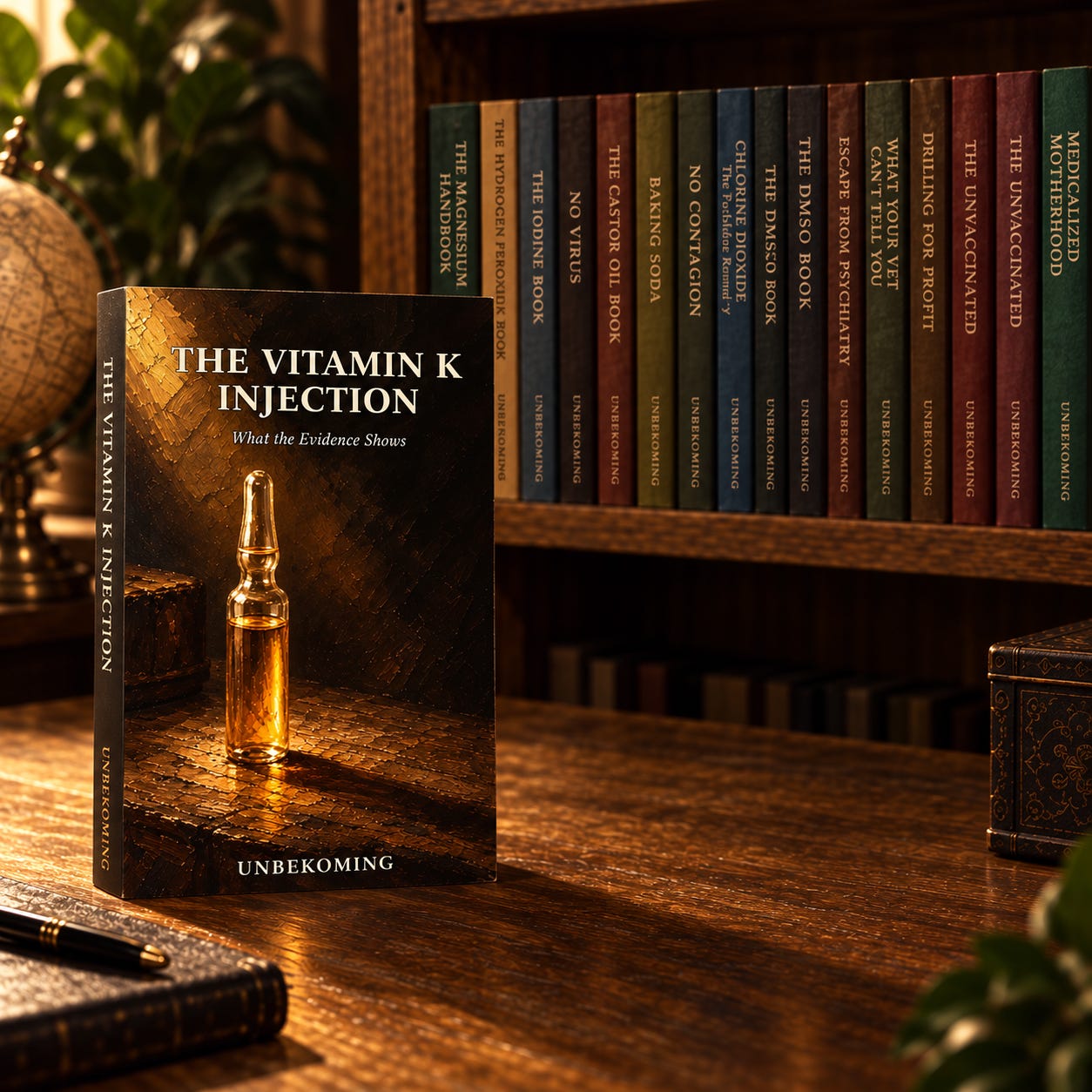
Every U.S. newborn is offered a shot in the leg in the first hour of life. Parents are rarely told the shot exists until the moment it is about to be given.
The new paperback is out today. It examines that shot.
What’s in the book
Twenty-seven chapters walk through what the vitamin K injection actually is, what it contains, what the manufacturers themselves warn against, what the studies did and didn’t find, and where the current framework came from.
The intervention itself. The three products currently in use in English-speaking countries — the U.S. Hospira formulation with its polyoxyethylated castor oil and benzyl alcohol preservative, the UK Konakion MM Paediatric with its glycocholic-acid mixed-micelle vehicle, and the Australian Konakion MM Paediatric with its lecithin base. What each carries alongside the vitamin K itself. The depot vehicle that keeps the injection releasing into the baby’s tissue for two months after the needle comes out. The aluminum contamination the manufacturer discloses without context. The peanut allergy pathway the mainstream literature acknowledges but does not track.
The manufacturer’s own warnings. Every current package insert opens with a boxed warning against the exact route of administration hospitals universally use. Every insert lists a set of adverse reactions — anaphylaxis, cyanosis, gasping syndrome, skin necrosis, cardiovascular collapse — that the doctors administering the shot are largely unaware of and that parents are never shown.
The history. A 1961 AAP recommendation set by a small committee that did not test what it was recommending. A 1985 quiet shift from targeted to universal injection. A 1992 cancer signal from a large UK cohort study that was dismissed rather than investigated. The menadione (K3) disaster that hospitals eventually withdrew — but only by switching products, never by pausing to ask whether the intervention itself was needed. Dam and Doisy’s 1943 Nobel, awarded for work in starved chickens, later used to justify universal injection of healthy newborns.
The alternatives. The oral vitamin K protocols in continuous use in the Netherlands, Germany, Switzerland, and Denmark. Their dosing schedules, their VKDB failure rates, their published surveillance data. Maternal supplementation as a route the doctors could offer but don’t. The physiologic support at birth that most modern maternity practice has already adopted for other reasons but has never been asked to interact with the shot.
The system machinery. The standing-order framework that bypasses individual consent. What refusal actually costs the parent, and what it usually doesn’t cost the baby. The circumcision-clotting interaction that turns one cultural habit into justification for another.
Two personal stories. A father’s account of what happened after his son’s shot. A mother’s account of what changed the week the injection was administered.
Two practical tools. A checklist of questions for the practitioner conversation. A country-by-country reference of the oral protocols with dosing, timing, and documented outcomes.
And at the end of every chapter, a short section titled How to Explain It to a Six-Year-Old.

Digital Edition
Platinum Supporters - immediate access
Want access now? Upgrade to Platinum Supporter to receive digital editions on paperback release day.
Standard Paid Subscribers - access in 3-6 months from date of this post
If you’re picking one up, pick two
The natural pigeon pair for The Vitamin K Injection is The Unvaccinated: What a Forbidden Comparison Reveals About the True Cost of Vaccination. The two examine the same institutional logic from different angles. Vitamin K is the first injection most newborns receive; the childhood schedule follows. Both document what the mainstream literature won’t compare, won’t study, and won’t offer as choice.

The book
The Vitamin K Injection: What the Evidence Shows
First edition. 300 pages. 6×9 paperback, matte cover, cream paper.
ISBN 978-1-7648990-4-8
USD 19.99 / EUR 18.99 / AUD 29.99 / GBP 15.99 / CAD 26.99
The full catalogue lives on the Unbekoming Spotlight.
Thank you
None of these paperbacks exist without the readership. Thank you — for buying them, for telling others about them, for putting them in the hands of the parents and practitioners who need them. Each one has been possible because the previous one found its readers. This one is no different.
This work stays free because paid subscribers make it possible. They get the full book library, the Deep Dive Audio Library, and the Questions for Your Doctor, Before You Consent, and Package Insert series. No grants, no gatekeepers — your subscription is what keeps it that way.
Despite signing paperwork saying no to this, a nurse did it anyway. They don’t ask or check and have legal coverage to do whatever they want. Very triggering article for me. Thank you for making people aware.
My mind keeps referring to the Amish. Huge control group. all healthy. No poisoned anything and no vaccine damage. We are despised, we are the stupid, obedient, sickly "English".