

This essay uses two vocabularies. Words like “virus,” “isolation,” “infection,” and “antibody” appear throughout because the essay is about what those words do and do not mean in the discipline that uses them. When they appear in my own voice, they carry the establishment’s framing, and I signal that with quotation marks, attribution, or by naming the paper, court, or agency that produced the term. When I speak in my own voice about what actually happens in a laboratory or a body, I describe what is physically there: chemicals, cells, breakdown, inference, assumption. The essay is largely about the gap between the two vocabularies, and about the single word that keeps the gap invisible.
The Placebo That Wasn’t
In May 2017, Robert F. Kennedy Jr. sat across a table from Anthony Fauci and Francis Collins at the National Institutes of Health. Kennedy asked Fauci to produce inert placebo-controlled studies for any of the then seventy-one recommended childhood vaccine doses. Fauci made a show of going through file folders that had been wheeled in on a cart. He said none of the studies were in the room but promised to send them. He never sent them. Kennedy then filed a Freedom of Information request with the Department of Health and Human Services asking for the same records. HHS responded in writing that it “did not locate any records.”¹
The exchange has a specific structure. In every other branch of medicine, when a drug company writes “placebo-controlled trial” in a product insert or a study summary, the words carry their ordinary meaning: the drug was tested against an inert substance, typically sterile saline, and produced better outcomes with fewer adverse events than the inert comparison. That is what the reader of a pharmacy pamphlet understands the phrase to mean. That is what the parent handing a form to a pediatrician understands the phrase to mean.
Childhood vaccines are not tested that way. The comparison substance in a vaccine trial is not inert saline. It is another vaccine, or the same vaccine formulation with the antigen removed but the adjuvant preserved. The adjuvant is the industrial compound, usually an aluminum salt, that drives the toxic response the industry calls “immunogenicity.” When the new vaccine and the comparison vaccine produce similar rates of adverse events, the trial reports “no significant difference between arms,” the regulator approves, and the label reads “safe and effective.” The adverse events in the two groups match because both groups are receiving the same class of toxic compound. The trial cannot fail.²
The word “placebo” has been redefined. The public still hears the ordinary meaning. Everything downstream of the trial (the marketing, the mandates, the school-entry requirements, the pediatrician’s assurance) inherits the redefinition without carrying it forward to the parent who is being asked to inject their infant. One linguistic sleight of hand does enormous work. The corrupted control becomes the substrate on which an entire industry stands.
Virology rests on the same class of trick. The word is different. The mechanism is identical.
Awareness of the placebo trick has grown in the past five years. What has not grown is the willingness to see the same trick elsewhere. Most people who now accept that vaccine trials use corrupted placebos cannot accept that the same industry, having succeeded with the first trick, would run a second. They grant the fraud in the placebo. They refuse the fraud in the isolation.
Fool me once, shame on you; fool me twice, shame on me.
The person who accepts the placebo trick has seen what this industry does when a word can be quietly redefined for profit. The next step is to look for others. Most look no further.
When a scientific paper reports that a virus has been “isolated from a patient,” the ordinary reader understands this to mean that a particle has been extracted from the patient’s bodily fluid, separated from all other material, and characterized in pure form. That understanding is what the word means everywhere science uses it. A chemist isolating a compound from a solution means this. A pharmacologist isolating a drug from a urine sample means this. A microbiologist isolating a bacterial strain from a culture plate means this. In every domain that uses the word “isolation,” the operation being described is separation of the target from everything else.
Virology has never performed this operation on any of the particles it calls a virus, in the entire history of the field.³ What virology performs under the label “isolation” is something else. The gap between what the word means and what the operation actually consists of is the sleight of hand from which the discipline inherits everything downstream.
This work stays free because paid subscribers make it possible. They get the full book library, the Deep Dive Audio Library, and the Questions for Your Doctor, Before You Consent, and Package Insert series. No grants, no gatekeepers — your subscription is what keeps it that way.
What the Word Means
The Perth Group, a research collective formed in Western Australia in 1981 that has published on retrovirology for more than four decades, put the vocabulary problem plainly in 2017: “in virology, while purification retains its everyday meaning, ‘isolation’ is an expediential term virologists assign to data they claim are proof a particular virus exists.”⁴ Every other field that uses “isolation” means separation. Only virology means something else, and only virology has to be asked what it means.
The Perth Group documented the range of definitions in use. Jay Levy defines isolation as “a sample of a virus from a defined source.” White and Fenner define it as the ability to “identify a totally unforeseen virus, or even discover an entirely new agent.” Montagnier and Weiss define it as “propagating them [viruses] in cells in culture.” The sixth edition of Fields Virology, published in 2013 and the discipline’s core reference text, defines it as harvesting excreted material and “testing for induction of the original symptoms in the identical host, or induction of some abnormal pathology in a substitute host, or in a cell culture.”⁵ None of these operations describes separating a virus from anything. Each of them assumes the presence of the virus at the start of the procedure and calls the procedure itself the isolation.
Professor Vincent Racaniello, a virologist with decades of laboratory experience, was asked in 2021 what the word means. He answered: “what happens is you’re trained in someone’s laboratory and you hear them say things and you associate a meaning with them and that’s what you do, and they may or may not be right.”⁶ The transmission of the word is by imitation from teacher to student. The definition varies by lineage. There is no fixed operational meaning.
The circular structure of the vocabulary is what allows the trick to run. Once the operation performed under the label “isolation” is examined, the entire apparatus collapses on the same fault line.
1954: The Founding Method
In June 1954, John Franklin Enders and Thomas Peebles published a paper in the Proceedings of the Society for Experimental Biology and Medicine titled “Propagation in Tissue Cultures of Cytopathogenic Agents from Patients with Measles.”⁷ Six months later, in December 1954, Enders received the Nobel Prize in Physiology or Medicine for earlier work on poliomyelitis. The June paper on measles inherited the credibility of the December prize. The measles paper became, in Stefan Lanka’s phrase, “a scientific fact which was never, ever questioned.”⁸ Every subsequent claim of viral isolation, for any alleged virus, has relied on a version of the Enders method.⁹
The method proceeded as follows. Fluids were obtained from patients clinically diagnosed with measles: throat swabs and similar material. The fluids were mixed with a preparation containing antibiotics (penicillin and streptomycin), bovine amniotic fluid, beef embryo extract, horse serum, phenol red, soybean trypsin inhibitor, and human and monkey kidney cells. Over several days, some of the kidney cells in the culture broke down. The breakdown of cells in a laboratory culture is known in the field as a cytopathic effect. Enders and Peebles concluded that a virus in the patient samples had caused the cellular destruction.¹⁰
The reasoning has a specific logical structure. If a virus is present, cells will break down. Cells broke down. Therefore a virus was present. This is the formal fallacy known as affirming the consequent. Anything else in the preparation capable of breaking down cells would produce the same result and be interpreted the same way. The preparation contained multiple substances known to break down cells: antibiotics at concentrations toxic to cellular metabolism, foreign biological material in a state of decay, altered nutrient conditions, and the mechanical stress of the culture procedure itself. Any of these could produce the observed effect. Lanka summarized the conditions the researchers actually imposed on their cells: they were “killing those cells, intoxifying them with cytotoxic antibiotics, starving them to death, reducing the nutrition, and of course, adding material proteins which are in decay, and everything which is in decay is toxic and disturbs the cell cultures in the test tube. When those cells are dying in the test tube, [the experimenters equate] it with the presence of the virus and call it an ‘isolate.’”¹¹
Enders and Peebles performed a control experiment. They subjected an identical cell culture to identical additives and identical conditions, but without the patient material. If the effect they attributed to a virus was actually caused by a virus, the control cells should have remained intact. The control cells broke down in the same way as the inoculated cells.¹²
The authors acknowledged this in their published paper. They wrote that “whatever cytopathic agent was present in the uninoculated culture could not be distinguished with confidence from the ‘virus’ present in the inoculated culture.”¹³ They added a further warning to future readers: “It must be borne in mind that cytopathic effects which superficially resemble those resulting from infection by the measles agents may possibly be induced by other viral agents present in the monkey kidney tissue, or by unknown factors.”¹⁴
Enders and Peebles understood that their experiment did not demonstrate what they claimed it demonstrated. They wrote the warning into the paper. They published the paper anyway. Seven decades of virology have proceeded as if the warning were not on the page.
More than six decades after Enders and Peebles, Stefan Lanka performed the control experiment that Enders should have completed before publishing. Lanka used Vero cells, the monkey kidney cell line that became the standard virology substrate. He reduced the fetal calf serum from ten percent to one percent, which is the standard nutrient reduction used in virus isolation attempts, and he tripled the antibiotic concentration, also standard. He added no patient material. He added no alleged virus. On day five, the characteristic cytopathic effect appeared. The cells broke down in the pattern virologists interpret as evidence of viral presence. Lanka repeated the experiment with the addition of yeast RNA, genetic material from a source unrelated to any claimed virus. The cells broke down in the same pattern.¹⁵
The cellular destruction that virology has attributed to viruses for seven decades can be produced by the experimental procedure itself, absent any patient material and absent any viral material. The effect is an artifact of the method.
2007: The Word Under Oath
In February 2007, in the South Australian Supreme Court in Adelaide, an appellate proceeding began in the case of Rex v Parenzee. Andre Parenzee had been convicted of endangering life by having unprotected sexual contact while allegedly HIV-positive. His appeal team, working without fees, argued that no reliable evidence existed that HIV had been isolated and characterized, and that no reliable evidence existed in consequence that HIV caused the syndrome called AIDS. The court called expert witnesses.¹⁶
The prosecution called three: Dr. David Gordon, Chair of the Clinical Drug Trials Committee at Flinders University; Professor Elizabeth Dax of the University of Melbourne; and Professor Martyn French of the University of Western Australia. The defense called two: medical physicist Eleni Papadopulos-Eleopulos and Dr. Val Turner, both of the Royal Perth Hospital and members of the Perth Group. Robert Gallo, credited as the co-discoverer of HIV, testified for the prosecution by video link from the United States.¹⁷
Under cross-examination, the three prosecution experts could not agree when HIV had been isolated or by whom. Gordon said Montagnier isolated it in 1983. Dax said someone isolated it in 1985. French said Gallo and Montagnier isolated it in 1983. Three establishment experts, three answers, no consensus on the founding fact of their discipline.¹⁸
The Judge then asked Gordon a direct question about the ordinary scientific meaning of the word isolation. The question and answer are on the court record.
Judge: Do you need to purify a virus in order to identify it?
*Gordon: No, not with any virus in fact. I would [question] has any virus ever been purified? The issues are exactly the same with any virus.*¹⁹
Gordon then extended his admission to the whole discipline. He testified that “acceptance of the defence experts’ arguments would lead to the conclusion that no viruses or virus diseases (such as measles, mumps, polio, hepatitis B and C, smallpox and many others) exist at all. All the issues, such as antibody testing and virus isolation, these would apply to every single virus. That is impossible.”²⁰
The Chair of the Clinical Drug Trials Committee at an Australian university medical faculty testified, under oath, in a court of criminal appeal, that no virus has ever been purified, that the requirement to purify a virus in order to identify it would collapse the discipline, and that the impossibility of the conclusion was itself the reason to reject the requirement. The reasoning runs from the desired conclusion back to the standard that must be rejected in order to preserve it.
Dr. Dominic Dwyer, Senior Medical Virologist, formerly of the Institut Pasteur in Paris, testified about how virologists actually produce the material they call a virus. To get cells to “produce” HIV in a culture, he testified, “we stimulate them with compounds such as PHA.” To get cells to “produce” influenza, “we use other things like trypsin.”²¹ Phytohemagglutinin (PHA) is a plant compound that provokes cellular stress. Trypsin is a protein-cleaving enzyme that destabilizes cell membranes. The alleged viruses are the products of chemical stress applied to living cells. Different chemicals, different “viruses.”
Eight years before Parenzee, the British virologist Robin Weiss had written to the Perth Group in a 1999 email exchange. He said: “If we are to doubt HIV as a cause of AIDS, we must cast even more doubt on variola as a cause of smallpox, and the existence of measles, mumps, influenza and respiratory syncytial virus. None of these would pass your definition of purification. None of these has been ‘purified’ even by culture propagation.”²² Weiss was conceding in writing that the Perth Group’s standard of purification, which is the ordinary scientific standard, had not been met for any of the alleged viruses on which entire branches of medicine and public health had been constructed. His reason for continuing to accept the framework was that if the standard were applied consistently, the entire structure would fall.
These are not fringe voices exposing an obscure paper. Gordon chaired his university’s Clinical Drug Trials Committee, Dwyer served at the Institut Pasteur, and Weiss’s correspondence with the Perth Group has been quoted in the discipline’s own literature. The Perth Group has been asking the same question, in the same words, for more than four decades. The question has never been answered. The concessions have been made.
2020: The Substrate of a Pandemic
On February 3, 2020, the journal Nature published a paper by Fan Wu and colleagues titled “A new coronavirus associated with human respiratory disease in China.”²³ The paper announced the discovery of what would be named SARS-CoV-2. Every subsequent claim about the alleged virus, every PCR test used to declare a case, every genomic sequence deposited in every database, every variant designation, every vaccine spike protein sequence, and every mandate and lockdown built on the premise that a novel infectious agent was circulating, traces back to this single paper. It is the paper on which everything downstream was built.
Mark Bailey’s forensic analysis of the paper’s methods section reveals what the researchers actually did.²⁴
They obtained bronchoalveolar lavage fluid, a wash of the lower lung airways, from a single patient: a forty-one-year-old man who worked at a seafood market in Wuhan and had presented with pneumonia. They extracted total RNA from 200 microliters of the fluid using a commercial spin-column kit. The extraction did not separate any virus from anything. The extract contained genetic material from every source present in the patient’s lower airways: human cells, bacterial fragments, fungal material, cellular debris of every origin.
They fed the total extracted RNA into a high-throughput sequencing platform, which produced 56,565,928 short reads, each averaging about 150 nucleotides in length. They fed these reads into two software packages, Megahit and Trinity, that assemble short sequences into hypothetical longer sequences by looking for regions of overlap. Megahit generated 384,096 possible overlapping sequences, called contigs. Trinity generated more than 1.3 million contigs, of which the longest was only 11,760 nucleotides.
Fan Wu et al. selected the longest contig produced by Megahit, 30,474 nucleotides, and declared it to be the genome of a new virus. Their basis for the declaration was that this sequence showed 89.1% similarity to a sequence in GenBank designated “bat SL-CoVZC45.” The bat coronavirus sequence to which the Wuhan sequence was compared was itself an in silico construct, assembled from fragments by the same class of software in 2018 and deposited in the database with a viral label. Each hypothetical genome validates the next.²⁵
At no point in the procedure was a viral particle separated from anything or characterized in isolation. At no point was the physical existence of a 30,000-nucleotide RNA strand demonstrated to exist in the patient’s sample or in any sample. The genome exists in silico, as a computational model assembled from short fragments of unknown origin found in an unpurified sample from a single sick person. In Andrew Kaufman’s description, an in silico genome is “an artificial version of something that doesn’t exist. It is a model or a simulation.”²⁶
Bailey observed the logical gap plainly: “They have a hypothetical model with no way to check that it exists in its full length outside of their simulation.”²⁷ No laboratory technique can directly verify the existence of a complete 30-kilobase RNA strand in the original sample. The claim that a genome of that length exists in the sample is an inference from software, not an observation.
The circularity extended further. When Fan Wu et al. reported that they had “confirmed” their sequence by PCR, they were performing a procedure that presupposes the target sequence. PCR expert Stephen Bustin, whose textbook is the reference work in the field, put it directly: “PCR requires you to know what the sequence of your target is.”²⁸ PCR amplifies pre-selected sequences. It cannot identify the origin of a sequence. It cannot demonstrate that a sequence belongs to a virus, or to a cell, or to a bacterium, or to a piece of ribosomal RNA. It amplifies what the primers are designed to find. When the primers are designed against a hypothetical sequence, and the amplification succeeds, all that has been demonstrated is that fragments matching the hypothesis are present in the sample, in a quantity too small to detect before amplification.
An independent reanalysis of Fan Wu’s raw sequencing data, published in 2021, could not reproduce the original assembly. The reanalysis found 28,459 contigs where the original reported 384,096, and the longest contig was 672 nucleotides shorter than Fan Wu’s claimed genome. The reanalysis also found that segments of Fan Wu’s data matched a human ribosomal RNA sequence with 98.85% accuracy. The human sequence had not yet been published at the time Fan Wu’s data was deposited. The most parsimonious interpretation is that a substantial fraction of what Fan Wu identified as viral material was in fact human ribosomal RNA misidentified by an algorithm.²⁹
Fan Wu et al. did not perform control experiments. They did not attempt to assemble the same “genome” from RNA extracts of healthy patients or of patients with pneumonia of other origins. They did not attempt to isolate a viral particle from the patient sample. They did not attempt to demonstrate the physical existence of the assembled sequence outside their software. The single paper that founded the pandemic performed the Enders trick with modern instruments. The instruments are more sophisticated. The trick is the same.
216 Institutions, 40 Countries
In 2020, Christine Massey began filing Freedom of Information requests with public health agencies around the world. The requests were carefully worded to eliminate ambiguity. She asked whether any institution in the jurisdiction possessed a record of any virus, and initially SARS-CoV-2 specifically, having been isolated from a sick patient’s bodily fluid and purified using any method, without first passing the material through a cell culture.
The distinction matters, because the standard virology procedure adds substances (the antibiotics, sera, and additional cells of the Enders method) rather than removing them. Isolation in the ordinary scientific sense removes. Virology adds. Massey’s request asked, in effect, for any record of isolation performed the way the word ordinarily means.
As of June 2023, 216 institutions in 40 countries had responded to Massey’s requests.³⁰ Not one produced a record of any virus isolated in that way. The United States Department of Health and Human Services responded on November 2, 2020 that it had “no records” of SARS-CoV-2 isolation, and confirmed on March 1, 2021 that “the isolation of a virus cannot be completed without the use of another medium,” conceding that the standard method requires the very additives Massey’s request excluded.³¹ The Public Health Agency of Canada responded on December 20, 2021 with the same absence of records.³² The UK Health Security Agency responded on March 25, 2022 with the same.³³
Massey expanded her requests to cover adenovirus, Ebola, Epstein-Barr, hepatitis B and C, herpes, HIV, HPV, swine flu, avian flu, measles, MERS, monkeypox, rabies, RSV, SARS, smallpox, West Nile, and Zika. The responses were consistent across viruses and jurisdictions: no institution in any country possessed a record of any alleged virus having been isolated in the ordinary scientific sense of the word.³⁴
The pattern is not evidence of an oversight or an administrative failure. It is the institutional confirmation, in writing, on official letterhead, from every jurisdiction that has been asked, that the operation the discipline calls “isolation” is not the operation the word means.
Veteran virologist Charles Calisher was asked directly in 2020 whether he knew of a single published paper in which SARS-CoV-2 had been isolated and truly purified. His answer: “I know of no such publication. I have kept an eye out for one.”³⁵
Torsten Engelbrecht and Konstantin Demeter separately contacted the research teams behind the key papers cited in support of SARS-CoV-2 identification. They asked each team a single question: does the electron microscope image in your study depict a completely purified virus? Not one team answered yes. Responses included: “Our electron microscope image does not show a completely purified virus.” No team wrote back to argue that complete purification was unnecessary.³⁶
What Was Isolated
The word “isolation” in virology does not describe the separation of a viral particle from other material. It describes the addition of patient material to a chemically stressed cell culture, the observation of cellular breakdown produced by the chemical stress, and the attribution of the breakdown to a viral entity whose independent existence has not been demonstrated. The cellular breakdown is real. The chemical stress is real. The entity to which the breakdown is attributed has never been shown to exist as an independent object of study.
What has been isolated is a word. The word does the work. The word carries the vaccine that the parent injects into the infant. The word carries the mandate that closes the school. The word carries the sequence uploaded to GenBank. The word carries the diagnosis handed to the man who will spend the next decade on the drugs it prescribes. The word carries pharmaceutical markets that move hundreds of billions of dollars every year. All of it rests on the assumption that the operation performed under the word is the operation the word describes.
The operation is not the operation the word describes. The discipline’s own senior figures have said so, under oath, in writing, for thirty years. The record has been complete for some time.
You will meet people, including doctors, who insist that viruses have been isolated many times. What they were taught in medical school is not what the records of their own health agencies show.
The trick, once seen, cannot be unseen. There is no rabbit in the hat. The audience is applauding an empty gesture, and an industry has been built on the applause. The rabbit is a word.
How to Explain It to a Six-Year-Old
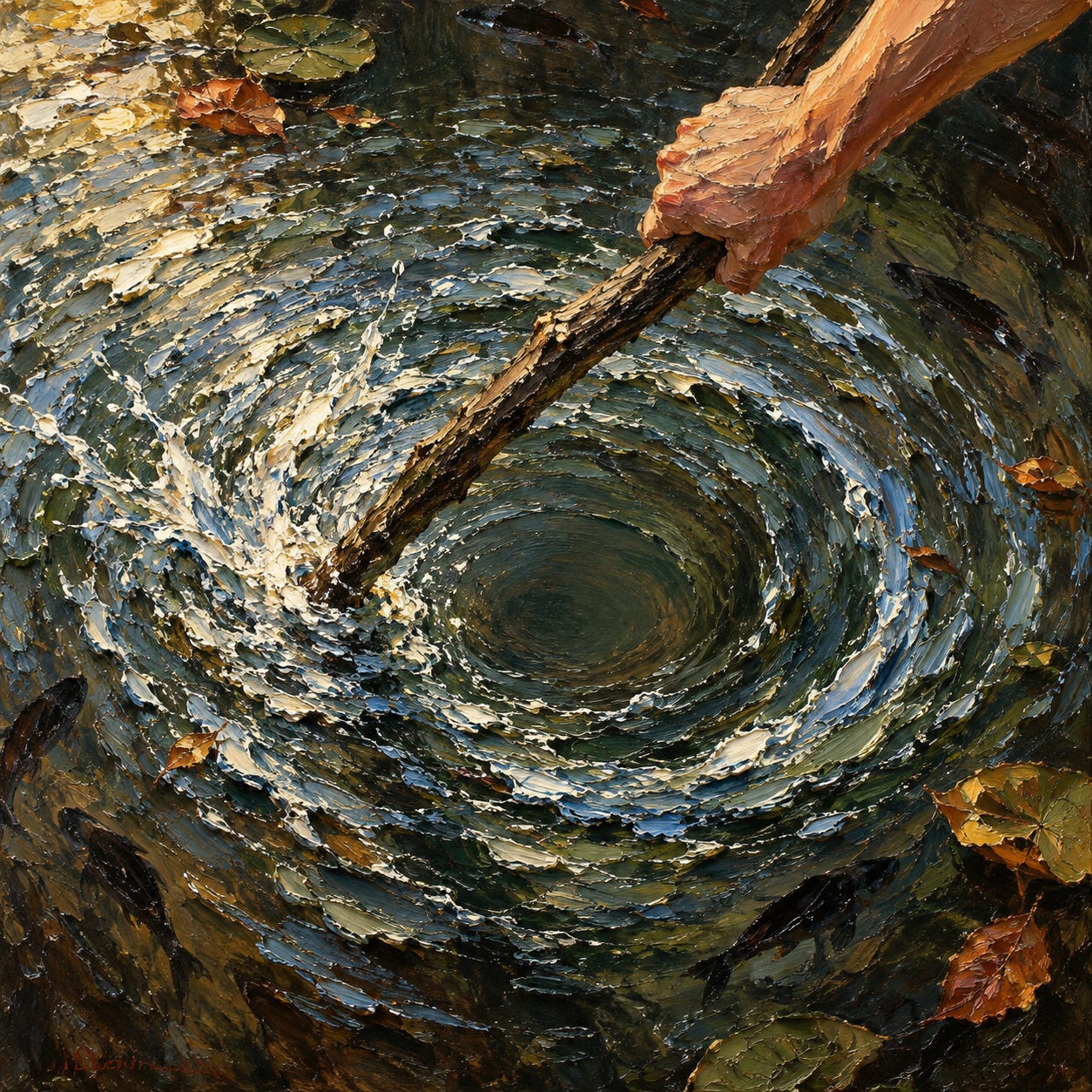
A boy tells you there is a magic frog at the bottom of the pond. You can’t see the frog, he says, because the pond is muddy. To prove the frog is there, he stirs the pond hard with a stick. The mud swirls up. Fish dart around. Leaves come to the top. The whole pond seems to move.
The boy points and says: “See? The frog did that. Look how the water moved.”
You watched him stir the pond. The water moved because he stirred it. You ask him: “Can you take the frog out and show me?” He stirs the pond again and points at the swirling water. “The frog is right there. See how the water is moving?”
You ask a different boy to try the same thing without saying anything about a frog first. He puts his stick in the pond and stirs. The water moves the same way it moved for the first boy. Everything that was supposed to prove the frog was there happens again, without any frog.
There is no frog. There was never a frog. There is only a boy with a stick who has been telling everyone for a very long time that the moving water proves the frog is there.
Everything built on the frog is built on the moving water. All the songs about the frog, all the medicines they make against the frog, all the fences around the pond, all the rules about not disturbing the pond. Every last one of them rests on a boy with a stick.
In Print
Thirteen of my books are now available as paperbacks, printed to order through Lulu and shipped worldwide. The Unvaccinated lays out the completely unvaccinated as a comparison group across twenty chapters and five appendices — as far as I know, the only book of its kind. Medicalized Motherhood follows a woman through 123 documented interventions from teenage pill to postpartum discharge. Drilling for Profit argues that cavities, gum disease, and crooked teeth are a dietary problem the dental profession treats surgically. What Your Vet Can’t Tell You applies the same critique to pets — food, vaccines, and a profession trained by the industries whose products cause the harm. Escape from Psychiatry documents the fabrication of the DSM, the collapse of the serotonin hypothesis, and the specific damage done by every major psychiatric drug class.
Two go to the paradigm underneath the whole shelf. No Contagion, co-authored with Jamie Andrews, catalogues 258 failed contagion experiments and the case against germ theory itself. No Virus takes the examination one layer deeper — the isolation problem, the collapse of virology’s foundational claims, and a disease-by-disease reappraisal of the entities the framework is built on.
Four take on the remedies and paradigm questions mainstream medicine actively suppresses. The DMSO Book covers 100,000 studies, zero deaths, and one approval — the suppressed science of medicine’s most versatile compound. Chlorine Dioxide: The Forbidden Remedy collects the interviews, protocols, and evidence from the doctors and researchers they tried to silence. The Iodine Book recovers an essential mineral driven out of easy reach by bromide, fluoride, and perchlorate — and the pharmacological tradition that kept its therapeutic use alive across the decades mainstream medicine set it aside. The Hydrogen Peroxide Book recovers a century of practice with a compound the body already makes — mitochondrial, phagocytic, part of thyroid hormone synthesis — suppressed precisely because its clinical utility threatened the pharmaceutical direction that captured twentieth-century medicine.
Two more take on the remedies already in your kitchen. Baking Soda locates sodium bicarbonate inside the terrain framework industrial medicine buried — the compound already in your cupboard, and what it does at the level of the blood, kidneys, lungs, digestion, and skin. The Castor Oil Book recovers four thousand years of documented practice on the medicine mainstream healthcare quietly stopped talking about — the kitchen bottle that doesn’t sit well in a system built on prescriptions and procedures.
A physical book reaches the person a Substack post never will — the sceptical relative, the friend who won’t click a link but might open a book, the visitor whose eye lands on a coffee table. The full shelf is at lulu.com/spotlight/unbekoming. Buy one to keep, and one to give away.
References
Del Bigtree recollection of the May 2017 meeting with Anthony Fauci and Francis Collins at the National Institutes of Health, cited in Mark Gober, An End to Upside Down Medicine, Chapter 2. HHS Freedom of Information response cited in the same chapter.
Aaron Siri, “Proof Regarding the Clinical Trials Relied Upon by the FDA to License the Childhood Vaccines on the CDC Childhood Vaccine Schedule,” August 2023. See also Children’s Health Defense, Turtles All the Way Down: Vaccine Science and Myth, 2022, discussed in Gober, Chapter 2.
Christine Massey, Freedom of Information request compilation, fluoridefreepeel.ca. Summarized in Gober, Chapter 2, and in No Virus, 2nd edition, Chapter 3.
The Perth Group, “HIV, a Virus Like No Other,” July 12, 2017. Cited in Mark Bailey, A Farewell to Virology (Expert Edition), 2022.
Ibid.
Vincent Racaniello, 2021 presentation, quoted in Bailey, A Farewell to Virology.
Enders, J. F., and Peebles, T. C., “Propagation in Tissue Cultures of Cytopathogenic Agents from Patients with Measles,” Proceedings of the Society for Experimental Biology and Medicine, 1954, 86(2):277–286.
Stefan Lanka, quoted in Gober, An End to Upside Down Medicine, Chapter 2.
No Virus, 2nd edition, Chapter 2.
Enders and Peebles, 1954. Method summary in Daniel Roytas, Can You Catch a Cold?, Chapter 9; in No Virus, Chapter 2; and in Gober, Chapter 2.
Stefan Lanka, quoted in No Virus, Chapter 2.
Roytas, Can You Catch a Cold?, Chapter 9. Enders and Peebles, 1954.
Enders and Peebles, 1954, p. 11.
Enders and Peebles, 1954, p. 15.
Stefan Lanka control experiments, described in Gober, An End to Upside Down Medicine, Chapter 2, and in No Virus, Chapter 2.
Rex v Parenzee [2007] SASC 143, South Australian Supreme Court. Documented in Janine Roberts, Fear of the Invisible, 2nd edition, 2009, chapter titled “Searching for Fragments.”
Roberts, Fear of the Invisible, “Searching for Fragments.”
Ibid.
Ibid., citing the trial transcript of Dr. David Gordon’s testimony.
Ibid.
Dr. Dominic Dwyer’s Parenzee testimony, cited in Roberts, Fear of the Invisible.
Robin Weiss, 1999 email to the Perth Group, cited in Roberts, Fear of the Invisible.
Fan Wu et al., “A new coronavirus associated with human respiratory disease in China,” Nature, 579, 265–269, February 3, 2020. DOI: 10.1038/s41586-020-2008-3.
Mark Bailey, A Farewell to Virology (Expert Edition), 2022, pp. 42–43.
Ibid. See also Bailey and Bailey, The Final Pandemic, 2022, Chapter 1.
Andrew Kaufman, cited in Gober, An End to Upside Down Medicine, Chapter 2.
Bailey and Bailey, The Final Pandemic, 2022.
Stephen Bustin, interview with Eric F. Coppolino, Planet Waves FM, February 1, 2021. Transcript at cormandrostenreview.com.
Independent reanalysis of Fan Wu et al. sequencing data, discussed in Bailey, A Farewell to Virology, pp. 42–43.
Christine Massey, summary presentation, June 10, 2023. Cited in Gober, Chapter 2, and in No Virus, Chapter 3.
U.S. Department of Health and Human Services, FOI responses, November 2, 2020 and March 1, 2021. Available at fluoridefreepeel.ca.
Public Health Agency of Canada response to Christine Massey, December 20, 2021. Available at fluoridefreepeel.ca.
UK Health Security Agency response, March 25, 2022. Available at fluoridefreepeel.ca.
Christine Massey, expanded FOI compilation, fluoridefreepeel.ca. Discussed in Gober, Chapter 2.
Charles Calisher, cited in Torsten Engelbrecht et al., Virus Mania, 3rd English edition, 2021.
Torsten Engelbrecht and Konstantin Demeter, “COVID-19 PCR Tests Are Scientifically Meaningless,” OffGuardian, June 27, 2020.
The whole Virology System is based on the Emperor's new Clothes.type of story. I have never worried about germs. If you cant see them, why worry about them? i am into health. I do everything I know how to do to keep well. If a problem would arise, I would ask myself, what have i unknowingly done to create it? Several years ago, i woke up one morning and couldn't walk my ankle was red, swollen and sore. The first thing I thought of, what have I been eating to cause this? Then, I realized that i had been using jalapena peppers in my eggs. I eliminated the peppers and it took a month, before i could walk without pain. Solanine is a poison in the nightshade family of plants, which affects the joints, In 1986, when i had excruciating pain in my elbows and couldn't lift my arms, I checked my diet and stopped eating grains. It took 2-1/2 weeks, before the stiffness and pain were gone. Grains cause joint problems and 200 other diseases per Dangerous Grians by James Braly M.D. and Ron Hoggan, M.A.
Sounds like the masses need to be “isolated” from these useful idiots that are trying to sell us a bag of tricks ???