

Author’s Note
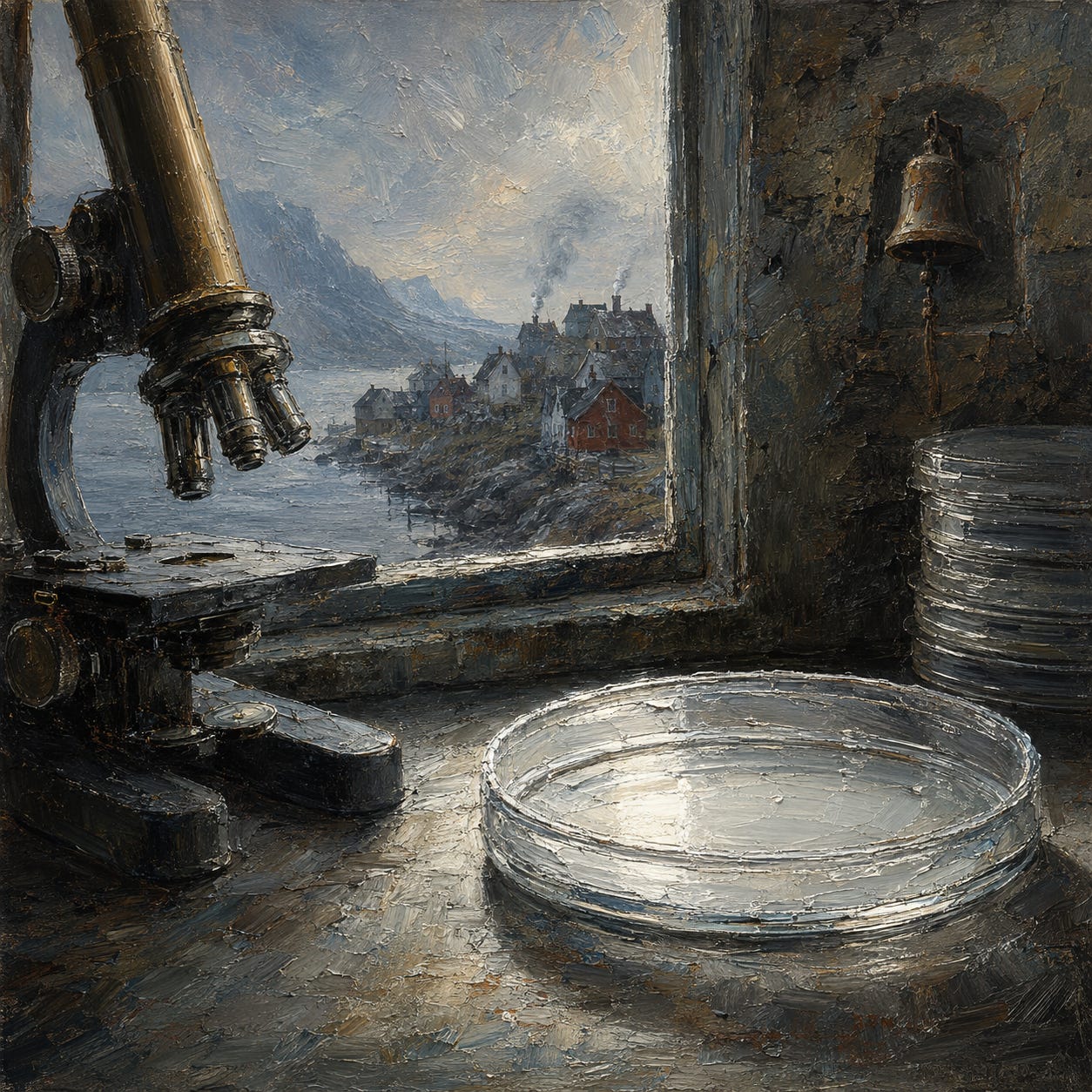
For a thousand years, leprosy meant exile: the bell tied to the wrist, the door barred against the sick, the priest reading the office of the dead over a living body. The disfigurement was real. What caused it was another question, and it was never asked seriously until 1873, when a Norwegian physician named Gerhard Armauer Hansen looked into a microscope and decided he had the answer. The essay below examines what he actually found, what he never demonstrated, what actually made people sick in the places called leprous, and what made the disease disappear from Europe centuries before any medicine existed for it. The paradigm is the target. The suffering was always real.
On November 3, 1879, at the Bergen leprosy hospital in western Norway, a physician named Gerhard Armauer Hansen ordered a thirty-three-year-old patient into his office. Her name was Kari Nielsdatter Spidsøen. She had lived with a mild form of leprosy for seventeen years. Hansen held a cataract knife tipped with material he had scraped from an active lepromatous nodule on another patient. In front of colleagues, without warning her, without her consent, he attempted to inoculate the material under her conjunctiva. She fought him off. She reported the assault to the hospital pastor. The pastor reported it to civil authorities. Hansen was tried and convicted the following year.
Six years earlier, in 1873, Hansen had observed a rod-shaped bacillus in the tissue of another Bergen patient and named it as the cause of the disease. The Bergen assault was his attempt to prove the causation he had already claimed. It produced no transmission. Spidsøen did not develop the more severe form of the disease. And 152 years after Hansen’s initial observation, no laboratory anywhere in the world has ever grown Mycobacterium leprae in a culture dish. Every claim that followed, that leprosy is an infectious disease caused by M. leprae, that it spreads by droplet or contact, that antibiotics cure it, that a vaccine will finish it off, rests on the assumption Hansen tried and failed to demonstrate in Kari’s eye.
“Axenic media” is the technical term: a defined nutrient preparation, free of other organisms, in which a bacterium can be reproducibly divided and passaged. Every standard medical bacterium meets this test. M. leprae does not. The most recent comprehensive review, published in Frontiers in Microbiology in May 2025, opens with the confession: the bacterium “remains uncultivable in axenic media, a constraint that continues to hamper leprosy research.”¹ The reviewers examined 78 studies. Every historical claim of successful cultivation on egg-based or synthetic media proved irreproducible, or the organism grown turned out to be a different mycobacterium entirely. The only reproducible method for sustained laboratory growth is inside a live animal: the mouse footpad, or the armadillo. The bacterium the entire modern account rests on cannot be persuaded to divide in a dish.
Robert Koch, whose postulates still define the standard for demonstrating microbial causation, required that the microorganism be isolated from a diseased host and grown in pure culture. The second postulate has never been fulfilled for M. leprae. Not by Hansen, who first observed the bacillus under a microscope in Bergen in 1873. Not by any of the researchers, in any of the 78 studies just reviewed, over the century and a half that followed. The bacterium was named, described, published, cited, and inscribed as the causative agent of leprosy on the strength of an observation and an assumption. The proof was never produced, and the medical account has since built around the missing proof rather than obtaining it.
What sits on top of the missing proof is a cascade of admissions. The CDC’s own transmission page states, plainly: “It is not known exactly how Hansen’s disease spreads between people.”² The same CDC page reports that “more than 95% of all people have natural immunity to the disease.”³ A November 2011 review of leprosy vaccine research, published in Human Vaccines and cited approvingly by the industry, states that “M. leprae infection does not always cause disease, and it is estimated that anywhere between 30–75% of infections are spontaneously cleared without causing significant symptoms.”⁴ The same review describes leprosy as “one of the most renowned, but least understood diseases of man.”⁵ The medical establishment cannot say how the bacterium reaches its host, cannot say why the host resists it in the overwhelming majority of cases, and cannot claim to understand the disease it has spent 152 years attributing to a single cause.
This work stays free because paid subscribers make it possible. They get the full book library, the Deep Dive Audio Library, and the Questions for Your Doctor, Before You Consent, and Package Insert series. No grants, no gatekeepers — your subscription is what keeps it that way.
Audio Deep Dive (for Paid Subscribers)
The Disease Before the Bacterium
The word “leprosy” was never a diagnosis in the modern sense. For most of its history, it labeled almost any visible skin disorder that disfigured the sufferer badly enough to warrant exclusion. Herbert Shelton, writing in the natural hygiene tradition, observed that “for ages the term leprosy was applied to a wide variety of skin diseases.”⁶ The medieval European leprosaria housed patients whose actual conditions, by any modern differential, would have included eczema, syphilis, chronic fungal skin conditions, arsenic poisoning, mercurial dermatitis, and tuberculoid skin lesions of every etiology. What united them was appearance, not etiology. The category was social before it was medical.
The biblical category is more revealing than usually noticed. Tsara’ath, translated as leprosy in the King James Bible, encompassed three categories the priest was instructed to examine: skin conditions, mildew on woolen and linen cloth, and damp rot and mold on the walls of houses. Leviticus 14:45 instructs the priest to demolish the affected stones of the house and carry them outside the town. No bacterium infects wool and stone. Whatever tsara’ath was, it was a category of visible surface degradation across biological and non-biological materials, and the remedy for household tsara’ath was mold remediation as still practiced. The uniting principle was not one causative agent. It was a class of visible outcome: surface breaking down under environmental stress. Skin, cloth, and wall respond to their environments in analogous ways, and the ancient category captured all three under one label.
The medieval response was exile. Cities passed leprosy statutes; the sick were declared civilly dead, stripped of property rights, made to carry a rattle or bell so that healthy citizens could avoid them. Priests read the Missa pro mortuis over living patients as they entered the leprosarium. This was the terrain in which the diagnosis operated for a thousand years: not laboratory confirmation, but visible disfigurement, judged by clergy and civil authorities against a standard set by scripture and custom.
Then leprosy left Europe. It began to fade from most of the continent in the fifteenth century, four centuries before Hansen would observe the bacillus in his microscope. It was rare across most of Western Europe by the seventeenth century. By the eighteenth it was essentially gone, well before the germ theory existed. Even the Leprosy Mission’s own historical account admits that “the reason for this decline is not well understood,” and speculates about improvements in living conditions.⁷ Whatever removed leprosy from Europe operated without any specific medical intervention against it. The decline was already essentially complete when Hansen arrived to explain it.
Norway was the striking exception. On the wet, crowded, malnourished western coast, in the closed fjord communities of Vestland, the disease re-emerged in the eighteenth century and peaked in the mid-nineteenth. By the 1850s, some Bergen districts recorded prevalence of 25 per 1,000 population.⁸ These are the conditions Hansen worked in. His fame rests on the coincidence that the last European stronghold of leprosy happened to be the country where he lived.
The Bacterium That Cannot Be Grown
Hansen was appointed medical officer for leprosy in Norway in 1875, two years after his initial observation of the bacillus. He knew, and his contemporaries knew, that the observation alone did not establish causation. Koch, corresponding with Hansen from Breslau, had already begun formalizing what would become the postulates. Hansen understood that he needed to transmit the disease. He tried, and failed, in twelve consecutive animal experiments.⁹ The bacillus he had observed refused to cause the disease he claimed for it. The 1879 assault on Spidsøen was his thirteenth attempt and his last.
The court case that followed is remembered for its ethical narrative. What is not usually reported alongside it is what the failed experiment demonstrated. Hansen conceded, in court, that he had neither obtained her consent nor informed her of his purpose. The judgment, published in 1880 and reproduced in the historical record by Vogelsang, found him guilty of injuring the patient without cause.¹⁰ ¹¹ He lost his post at the leprosy hospital, though in a political compromise he retained his position as chief medical officer for leprosy in Norway. Spidsøen already carried the mild tuberculoid form of the disease. Hansen was attempting to induce the more severe lepromatous form by direct inoculation of active lepromatous material under her conjunctiva. No nodule developed. No lepromatous transformation occurred. The most direct human transmission attempt in the historical record, conducted by the discoverer of the bacillus, on a patient already believed susceptible, produced no transmission.
The bacillus he could not grow, he could not transmit either. And in the 146 years since, the situation has not improved. The 2025 Frontiers review, cited above, documents that the only sustained growth of M. leprae in a laboratory remains growth inside a live animal host. Mouse footpad inoculation was developed by Charles Shepard in 1960. The armadillo model, exploited because armadillos have a lower core body temperature than most mammals, was developed by Waldemar Kirchheimer in the early 1970s. Both require whole living animals. Neither is a fulfillment of Koch’s second postulate. Neither has produced a definitive causation experiment that would satisfy the third.
The armadillo model has been turned into something stranger. When wild armadillos in Louisiana and Texas were found to carry M. leprae, the CDC reversed the direction of inference: not that armadillos had been inoculated from human sources during the mid-twentieth-century research programs at the National Hansen’s Disease Center at Carville, but that armadillos are a natural reservoir from which humans acquire the disease.¹² A bacterium that cannot be grown in the laboratory is now described, on the CDC’s own page, as passing from armadillo to human in the southern United States, though the mechanism, once again, is left unspecified. Growing a bacterium in a live animal is not the same as culturing it. The vast majority of M. leprae-positive armadillos are asymptomatic. Attributing human cases to armadillo contact does not demonstrate transmission; it identifies a correlation of unknown direction. The armadillo is a workaround for a bacterium that fails every direct test, not an answer to the question the establishment claims to have answered.
The Cascade of Confessions
The establishment position on leprosy, when its own statements are laid side by side, is internally incoherent. The CDC and HRSA both state that around 95 percent of the human population, in the paradigm’s phrasing, has “natural immunity” to the bacterium and cannot be made to develop the disease even under prolonged exposure.¹³ ¹⁴ The observation is real. The label is the establishment’s attempt to explain away the observation without confronting what it implies: if the bacterium fails to produce the disease in 95 percent of those it reaches, the bacterium is not the cause. The IDRI review of vaccine development, funded by the Bill and Melinda Gates Foundation, notes that 30 to 75 percent of “infections” resolve spontaneously without any treatment.¹⁵ The WHO fact sheet reports an incubation period ranging from one to twenty years and states, without further explanation, that this anomaly exists.¹⁶ The CDC concedes that the mode of transmission is not known.¹⁷ The reviewers of the vaccine literature, writing in Human Vaccines, describe the condition as one of the least understood diseases in medicine.¹⁸
Koch’s first postulate requires that the microorganism be found in all those with the disease, and not in those without. Both criteria are violated. M. leprae is found in armadillos, in soil samples, in nasal secretions of healthy contacts, in patients who never develop symptoms, and is absent, or undetectable, in a fraction of clinical cases. Peter Duesberg’s dictum applies: “A single exception would be enough to pronounce the microbe innocent of creating that disease.”¹⁹ The exceptions here are not single. They are the majority.
The establishment’s response to these violations has been to elaborate rather than to reconsider. The concept of “natural immunity” was retrofitted onto the observation that most exposed people do not become ill. The concept of an “asymptomatic carrier state” was retrofitted onto the observation that the bacterium is found in healthy people. The concept of “spontaneous clearance” was retrofitted onto the observation that most people who develop the bacterium eliminate it without any treatment. Each addition preserves the causation claim while explaining why the causation cannot be observed. What the additions cannot preserve is the claim that Koch’s postulates have been met. They have not been. The vaccine literature admits this openly, then continues to develop the vaccine.
The pattern operates in real time. A 2023 case report in the CDC’s own Emerging Infectious Diseases journal documented a Central Florida man with no travel history, no immigration background, and no known armadillo contact, who nonetheless received a leprosy diagnosis. The authors declared central Florida an endemic zone and appealed for expanded surveillance, then reproduced the standard cascade: transmission mechanism unclear, most people naturally immune, incubation possibly exceeding a decade, further study needed. The case adds a leprosy diagnosis to a state whose environmental toxicity profile, from mercury deposition in the Everglades to agrochemical exposure in the citrus belt, is documented and, once again, not investigated as a leprosy factor.²⁰
The medical literature concedes a further point that undermines its own model. M. leprae is acknowledged in the mainstream literature to be pleomorphic: it changes form in response to the conditions of its environment, appears as bacillary rods under some conditions and as coccoid or cell-wall-deficient variants under others, and cannot be assigned the fixed morphology and pure-culture identity Koch required.²¹ This is what an environmental caretaker organism looks like. It is not what a specific pathogen with a stable causal identity looks like.
What is being protected here is not the science. It cannot be the science, because the science, on its own admissions, does not support what is claimed. What is protected is the institutional structure that names the disease, that trains the specialists, that manufactures and distributes the antibiotics, that operates the national leprosaria (Carville, until 1999) and international programs, and that funds the coming vaccine. The bacterium never grown supports a global industry that requires it to exist as an infectious agent.
Norway: The Natural Experiment That Ran for Fifty Years
The cleanest data set on leprosy transmission in the historical record comes from Norway. The National Leprosy Registry, established in 1856, tracked every diagnosed case in the country by name, address, date of onset, hospital admission, death, and emigration. It is the oldest disease registry of its kind in the world. It was analyzed most rigorously by Meima, Irgens, and Habbema in a paper published in the International Journal of Epidemiology in 2002.²² Their conclusion, using conventional epidemiological modeling: “The decline cannot be explained fully by the Norwegian policy of isolation of patients; an autonomous decrease in transmission, reflecting improvements in for instance living conditions, must also be assumed.”²³
The Norwegian caseload fell from 1,800 known cases in 1875 to 575 in 1901 to essentially zero by 1920. The Leprosy Acts of 1877 and 1885 mandated isolation of cases the acts labeled infectious, but the modeling shows that the decline began before the acts and continued at a pace the isolation policy alone cannot account for. Something else was working. Living conditions, in Norway during this period, meant food security, indoor space per person, ventilation, reduced dampness, and less industrial toxicity. The disease tracked those conditions more closely than it tracked the isolation policy.
The Minnesota data are more striking. Between 1857 and 1895, roughly 5,053 new cases of leprosy occurred in Norway. Approximately 170 of the patients emigrated to the American Midwest, settling primarily in the Norwegian farming communities of Minnesota, Iowa, and Wisconsin.²⁴ The 1942 US Public Health Service report on the episode noted the finding: “Although no new cases of leprosy developed in the Scandinavian settlement during the first 50 years, seven cases occurred between 1895 and 1916, most of them in families of the imported cases. None have occurred since then.”²⁵
Between 160 and 200 Scandinavian leprosy patients settled among Norwegian-American immigrant communities living in close family and cultural contact. In fifty years, no secondary cases appeared. Seven appeared in the second half-century, all in the families of the original patients. Then the disease stopped. If leprosy were meaningfully contagious in the sense germ theory claims, some measurable fraction of the Norwegian-American community should have contracted it from prolonged close-quarters contact with the imported cases. None did. The disease did not travel.
Dr. J.H. Holmboe, the Bergen leprosy hospital surgeon, visited the Minnesota settlements in 1864 to assess exactly this question. He found twelve cases, one of which had recovered entirely after arrival. His conclusion, on returning to Norway, was that the patients’ condition of health was better in America than it would have been at home.²⁶ Professor William Boeck of Christiania made a follow-up visit in 1869–70 and confirmed the general pattern: transplanted patients did well, some improved dramatically, and where new cases appeared they appeared almost entirely within the families of the original imported patients, not among the wider community.²⁷ The controlling factor was not exposure to the bacterium. The controlling factor was the terrain the exposed people were living in.
The Norwegian data, taken as a whole, dismantle the contagion hypothesis on the paradigm’s own historical record. Same people. Same bacterium. Same close contact. Different terrain, different food, different housing, different work. No transmission. This is a natural experiment of a rigor the establishment cannot ordinarily obtain, and its result is that the disease disappeared without any specific medical intervention against it and did not follow the exposed populations to a healthier place.
Dr. Gerhard Buchwald, writing in Vaccination: A Business Based in Fear, captures the wider pattern: “Leprosy was a constant guest in the times when increasing numbers of people lived together in the most cramped spaces as the city walls made the expansion of cities difficult. As soon as the cities grew beyond the city walls and people had more space available, leprosy disappeared.”²⁸ The gap between the retreat of leprosy from Europe and the introduction of any specific medical intervention against it is five hundred years. Whatever removed the disease from Europe operated in the absence of any germ-theoretic understanding of what it was, and without any deliberate targeting of the alleged causative organism.
The Toxicological Convergence
If the bacterium is not the cause, the symptoms attributed to leprosy require an explanation. The medical literature provides one, hidden in the sections marked “differential diagnosis” and “other causes.” Every major symptom the establishment attributes to M. leprae has a well-documented chemical origin that the treating physician is trained to consider only after the bacterium has been excluded.
Peripheral neuropathy, the numbness and eventual disfigurement of the hands and feet that defines the most feared form of leprosy, is a textbook consequence of arsenic, lead, and mercury poisoning. A 2017 review in the Annals of Indian Academy of Neurology on the epidemiology of peripheral neuropathy in India, where nearly 60 percent of the world’s leprosy cases occur, catalogs the neurotoxic exposures that cause the identical clinical picture: arsenic, lead, mercury, and a range of pharmaceutical chemotherapeutic agents “with a propensity to affect peripheral nerves.”²⁹ The Indian subcontinent has extensive arsenic contamination of groundwater. West Bengal and Bihar carry some of the highest measured arsenic exposures in the world. The distribution of peripheral neuropathy across the region maps more accurately onto arsenic contamination than onto any bacterial transmission model.
The skin symptoms of leprosy are similarly overdetermined by chemical exposure. A 2000 study in the International Journal of Dermatology, titled High prevalence of vitiligo in lepromatous leprosy, reported that pigment loss frequently co-occurs with leprosy but is rarely reported in the literature.³⁰ A 2010 review in the Indian Journal of Dermatology, on chemical leucoderma, identifies the responsible substances directly: “Chemical leucoderma is an industrial disorder in developed countries and the common causative chemicals are phenols and catechols.”³¹ Phenols and catechols are petrochemical derivatives. The list of chemicals known to be toxic to melanocytes, the pigment-producing cells whose destruction produces the depigmenting skin lesions of leprosy, includes mercury, arsenic, phenols, catechols, and azo dyes, the last a family of synthetic industrial colorants used in textile, leather, food, and cosmetic manufacture across the Indian subcontinent.³²
The physical toxins are documented. So is the pharmaceutical toxicology. From the 1300s until the twentieth century, the standard treatment for leprosy skin lesions was mercury ointment. Dr. Carolyn Dean, in Death by Modern Medicine, records the assessment: “Mercury is second only to plutonium in toxicity. When it first began to be used, centuries ago, nobody really knew its dangers. Mercury ointment was a treatment for the skin lesions of leprosy, beginning in the 1300’s.”³³ For six hundred years the treatment was itself neurotoxic, dermatotoxic, and nephrotoxic. Every mercury-treated patient added mercury poisoning to whatever else was producing the symptoms. Chronic mercury exposure produces peripheral neuropathy, cognitive decline, skin lesions, and progressive breakdown of the body’s cleansing and repair capacity. The treatment was capable, on its own, of producing every symptom of the disease it was applied to.
The pattern extends to smallpox vaccination, in which mercury and calf lymph and other biologically foreign material were introduced directly under the skin of nineteenth-century populations. Eleanor McBean, writing in Swine Flu Expose, cites the observation that had circulated among sanitarians throughout the period: “Many vaccines also cause other diseases besides the one for which they are given. For instance, smallpox vaccine often causes syphilis, paralysis, leprosy, and cancer.”³⁴ The claim is easy to dismiss until one considers that the toxic and antigenic loads introduced by nineteenth-century vaccinia inoculation would have been more than sufficient to trigger the sensitization response Charles Richet later documented for the injection of any foreign protein.
The geography of leprosy in the present tense confirms the toxicological reading. According to the WHO’s Global Leprosy Strategy 2016–2020, Brazil, India, and Indonesia together account for 81 percent of new cases globally.³⁵ These are the three largest developing economies where industrial pollution, groundwater contamination with heavy metals, occupational chemical exposure, and persistent malnutrition coexist at population scale. Brazil’s principal endemic zones overlap with the mining regions, particularly the artisanal small-scale gold mining that releases mercury directly into rivers used for drinking water and fishing.³⁶ India’s endemic zones overlap with arsenic-contaminated aquifers, chemical dye industries, and heavy pesticide use. Indonesia’s endemic zones overlap with the industrial pollution of the outer islands, the deforestation-agrochemical corridor, and mining runoff. The disease appears where the terrain is toxic. It disappears where the terrain is clean. The bacterium is the CDC’s marker of last resort, the label placed on a chemical injury for which no other diagnosis has been sought.
On the Body
In its milder tuberculoid form, leprosy leaves patches of skin without feeling. A patient can burn a hand on a stove and not know it until the smell of the burning flesh reaches the nose. Feet develop unnoticed ulcers that eat down to the bone. Thickened peripheral nerves can be felt beneath the skin at the elbows and wrists. In the more severe lepromatous form, the face coarsens: thickened forehead, collapsed nasal bridge, pendulous earlobes. Medicine calls the pattern leonine facies, the face of a lion. Fingers shorten as bone resorbs beneath insensate skin. Feet drop. Eyebrows fall out. This is the presentation that produced the leprosarium, and this is what any honest account of the disease has to explain.
A modern patient placed on multidrug therapy for the twenty-four months of the standard course does not escape the picture. The rifampicin turns urine, tears, and sweat red. The dapsone destroys red blood cells and produces the fatigue and breathlessness of chronic anemia, methemoglobinemia in a fraction of recipients, and, on longer exposure, its own peripheral neuropathy. The clofazimine colors the skin reddish, then brown, then, in some patients, almost black, and adds abdominal pain and diarrhea from crystal deposition in the gut. Two years in, the patient is discolored, exhausted, and, if the drug-induced neuropathy has progressed, losing sensation in the exact pattern the disease is claimed to produce. The regimen is described in the fact sheets as curative.
The Poisons Called Cure
The current WHO-recommended treatment for leprosy is multidrug therapy (MDT), comprising dapsone, rifampicin, and, for multibacillary cases, clofazimine. The regimen is provided free of charge by the WHO through pharmaceutical donations.³⁷ It is described in the fact sheets as curative.
Dapsone (4,4’-diaminodiphenylsulfone) was introduced in the 1940s as a sulfone drug related to the earlier sulfa antibacterials. Its documented adverse effect profile includes dose-dependent hemolytic anemia (the destruction of red blood cells), methemoglobinemia (the conversion of hemoglobin to a form that cannot carry oxygen), agranulocytosis (collapse of the body’s infection-fighting white cell count), hepatotoxicity progressing in severe cases to vanishing bile duct syndrome and acute liver failure, and three severe skin reactions: DRESS syndrome, Stevens-Johnson syndrome, and toxic epidermal necrolysis, each of which produces widespread skin loss, systemic organ involvement, and, at the severe end, death.³⁸ ³⁹ The list is not obscure. It is on the drug’s label, in the standard pharmacology references, and in the NIH LiverTox database.
The most instructive of dapsone’s documented adverse effects, given the disease it is prescribed for, is peripheral neuropathy. Dapsone directly damages the long nerve fibers of the arms and legs, and the damage progresses with the dose.⁴⁰ The principal drug in the treatment of a disease whose defining severe manifestation is peripheral neuropathy causes peripheral neuropathy. A patient diagnosed with leprosy on the basis of nerve damage, then treated with dapsone, will have any subsequent nerve damage attributed to progression of the disease. There is no clinical test that can distinguish drug-induced neuropathy from disease-induced neuropathy in a patient receiving both. The pharmacology literature admits the toxicity. The clinical literature does not credit the drug for the progression.
Rifampicin, the second drug in the regimen, produces liver toxicity in a substantial fraction of recipients. Chronic rifampicin exposure ramps up the liver’s main drug-processing enzymes, altering the metabolism of every other drug the patient is taking and depleting endogenous compounds the liver would otherwise process. Clofazimine, the third, colors the patient’s skin reddish to almost black, produces gastrointestinal disturbances that include nausea, vomiting, and diarrhea, and, at higher doses, forms crystalline deposits in body tissues including the small intestine, where they can cause bowel obstruction.⁴¹ The medication that turns the patient’s skin the color of the disease it is treating is a treatment in name only.
The establishment defends the toxicity of the regimen with the argument of “resistance.” When dapsone monotherapy began to fail in the 1970s, the interpretation was that M. leprae had developed resistance to the drug. The multidrug protocol was introduced to “overcome” this. Every antibiotic used against leprosy has, in due course, produced “resistance” in the same way, requiring the addition of new drugs. The alternative interpretation, that the drugs are not treating what the establishment claims and that continued dosing progressively poisons an already toxin-burdened patient, is not entertained. The failure of the drug is treated as evidence of the cleverness of the bacterium rather than as evidence of the wrongness of the paradigm.
Historically, the same pattern held. Chaulmoogra oil, adopted from Indian medicine by Western physicians in the early twentieth century, produced apparent improvements that medicine attributed to antibacterial activity. Whether the benefit reflected any specific action, or the general effect of removing the patient from active mercury treatment while providing dietary fat in an often malnourished population, is a question the establishment did not ask.
BCG, the Coming Vaccine, and What History Records
The BCG vaccine, developed for tuberculosis, is also deployed against leprosy on the argument that M. leprae and M. tuberculosis are structurally similar. If the two bacteria are similar enough that a vaccine against one protects against the other, they cannot be responsible for two entirely distinct diseases. The medical account holds both positions.
The BCG data are, in any case, unimpressive. A large field trial conducted by the WHO in India between 1968 and 1971 vaccinated approximately 364,000 people across 309 villages, with a comparable unvaccinated area used for comparison. The results showed no protective effect against tuberculosis, and in some age groups more cases occurred in the vaccinated area than in the unvaccinated one.⁴² The vaccine is still administered on the basis that whatever it does, it is better than nothing.
A dedicated leprosy vaccine has been in development for over a decade. The Infectious Disease Research Institute (IDRI), funded by the Bill and Melinda Gates Foundation, moved a candidate called LepVax into Phase I human trials in 2017.⁴³ The vaccine is being developed on the basis that MDT is not working, that “resistance” is spreading, and that a specific leprosy vaccine is needed to close the gap. The reasoning is circular. The MDT protocol was introduced because dapsone monotherapy failed. The vaccine is being developed because MDT is failing. Each failure justifies the next intervention against the same alleged causative organism. Each institutional failure is treated, by the institutions, as evidence that more of the same is needed.
The observation about vaccines and leprosy is not a fringe claim. Vaccinia and other nineteenth-century injections were noted repeatedly in the sanitarian literature to precipitate skin conditions, chronic ill health, and occasional cases of what was diagnosed as leprosy. Charles Richet’s Nobel-winning 1913 work on anaphylaxis established that injection of foreign proteins produces sensitization; subsequent exposure produces escalating and eventually severe response.⁴⁴ Mass injection of biological material into malnourished populations across the nineteenth and twentieth centuries may have precipitated some measurable fraction of the cases the establishment subsequently attributed to bacterial transmission. Investigating this would implicate the vaccine industry in producing the disease the vaccine industry is now developing a new product to prevent.
What Leprosy Actually Is
In a body burdened with mercury from six centuries of medical treatment, arsenic from the groundwater, lead from the roofing, phenols from the workplace, and a diet from which industrial processing has stripped its mineral cofactors, the appearance of M. leprae is not the origin of the disease. It is the arrival of the cleanup crew at a site of terrain collapse. The bacterium is a marker, not a cause. Its presence indicates that the terrain has failed, not that the terrain is under attack.
The disease disappeared from Europe not because the bacterium was killed, but because the terrain improved. Leprosy tracked the terrain, not the bacterium.
Medicine has been here before. Helicobacter pylori was identified in stomach tissue in the 1980s, declared the cause of peptic ulcer disease, and treated with triple antibiotic therapy. Barry Marshall and Robin Warren shared the 2005 Nobel Prize for the identification.⁴⁵ Two decades on, the picture has quietly collapsed into something more complicated. More than half of the world’s population carries H. pylori. Only a small fraction develop ulcers. The bacterium is now positioned as one factor among several, alongside non-steroidal anti-inflammatory drugs, chronic stress, and other terrain conditions. The antibiotic protocol persists as the standard of care, but the specific-cause claim that produced the Nobel Prize is no longer defended in the form in which it was made. Leprosy is on the same trajectory, several decades further along. The bacterium is a marker of something, not the cause of everything the diagnosis names. The paradigm eventually admits this. It does so slowly, without acknowledging how badly it got the story wrong, and it never revisits the interventions it prescribed on the basis of the original error.
The persistence of the paradigm in the face of this record is not a scientific problem. It is an institutional one. The bacterium sustains a global program: the WHO’s MDT distribution, the pharmaceutical companies producing dapsone and rifampicin and clofazimine, the research institutes developing the vaccine, the specialist physicians whose careers depend on the diagnostic category, and the national leprosy programs of the affected countries. A terrain reading of leprosy would dismantle this apparatus. The apparatus has an interest in the bacterium’s continued causal status. The interest is not in truth.
Kari Nielsdatter Spidsøen, whose eye Hansen tried to inoculate, did not develop the more severe form of leprosy after the assault. She had had the mild form for seventeen years and continued to live with it. She remained in the Bergen leprosarium, having been the subject of the most direct transmission attempt the establishment ever conducted, which produced a null result. Her name appears in the historical footnotes because she resisted the knife. The bacterium she was inoculated with was never grown in a laboratory dish. It has not been grown since. The disease she carried, the disease Hansen claimed to have identified the cause of, was made by the terrain Hansen never asked about: the mercury on her skin, the crowding of her village, the water she drank. The microscope was pointed at the wrong thing.
How To Explain It To A 6 Year Old
A long time ago, people were very afraid of a sickness that made spots on the skin. The spots did not go away. Sometimes fingers and toes went numb and stopped working. People with this sickness had to leave their families and live in special houses far away from the town. They had to ring a bell so that everyone would know they were coming and could stay away.
The name of the sickness was leprosy. For a very long time nobody knew what made people sick with it. Some doctors thought it was in the food. Some thought it was in the air. Some thought it was punishment from God. The way they treated the sickness was to put mercury paste on the skin. Mercury is a metal that is very poisonous. So the medicine was making the sickness worse, but the doctors did not know that.
Then a doctor in Norway named Hansen looked into a microscope one day in 1873 and saw a tiny thing in the skin of a sick person. He decided this tiny thing was what made the person sick. He wanted to prove it. He tried to make animals sick with it, twelve times, and could not do it. He tried to grow the tiny thing in a dish. It would not grow. Then, on a day in 1879, he grabbed a woman named Kari who lived in his hospital, held her down, and tried to push some of the tiny thing into her eye with a knife. She fought him off. She told the priest. The priest told the police. Hansen went to court and lost his job at the hospital.
The tiny thing still would not grow in a dish. It still will not grow in a dish today, 152 years later. Nobody has been able to make it grow in a dish, ever. But everyone was told that the tiny thing was what made people sick, and this is still what they are told now.
The leprosy sickness went away from Europe hundreds of years ago, before any doctor had a medicine for it. It went away because the towns got bigger, people had more room to live in, they got more food, they had cleaner water, and they stopped putting mercury paste on their skin. Where the towns are still crowded and the water is dirty and the workers touch bad chemicals, the sickness is still there. Where the towns and water and work are clean, the sickness goes away.
The medicine that doctors give people with leprosy today is called dapsone. One of the things dapsone does to people is make their hands and feet go numb. This is one of the same things leprosy does. So when a person on the medicine gets more numb, the doctor says the sickness is getting worse and gives more medicine. Nobody says the medicine is the reason.
The story people are told about leprosy is not right. The tiny thing Hansen saw is a real tiny thing. But it is not the reason for the sickness. It is like a fire truck that shows up when there is a fire. Nobody thinks the fire truck started the fire. The fire truck is there to help clean up. The tiny thing is there to help clean up too. The fire is the poison in the water and the bad food and the mercury on the skin and the smoke from the factories. Take those things away and the sickness goes away, whether the tiny thing is there or not.
In Print
Seven of my books are now available as paperbacks, printed to order through Lulu and shipped worldwide. The Unvaccinated lays out the completely unvaccinated as a comparison group across twenty chapters and five appendices — as far as I know, the only book of its kind. Medicalized Motherhood follows a woman through 123 documented interventions from teenage pill to postpartum discharge. Drilling for Profit argues that cavities, gum disease, and crooked teeth are a dietary problem the dental profession treats surgically. What Your Vet Can’t Tell You applies the same critique to pets — food, vaccines, and a profession trained by the industries whose products cause the harm. Escape from Psychiatry documents the fabrication of the DSM, the collapse of the serotonin hypothesis, and the specific damage done by every major psychiatric drug class.
Two more take up what the first five leave out — the remedies the first five explain why you need. The DMSO Book covers 100,000 studies, zero deaths, and one approval — the suppressed science of medicine’s most versatile compound. Chlorine Dioxide: The Forbidden Remedy collects the interviews, protocols, and evidence from the doctors and researchers they tried to silence.
A physical book reaches the person a Substack post never will — the sceptical relative, the friend who won’t click a link but might open a book, the visitor whose eye lands on a coffee table. Buy one to keep, and one to give away.
References
“Silence on the plate: revisiting the enigma of Mycobacterium leprae cultivation.” (2025). Frontiers in Microbiology. Published May 2025. https://www.frontiersin.org/journals/microbiology/articles/10.3389/fmicb.2025.1708557/full
Centers for Disease Control and Prevention. Transmission: How Hansen’s Disease Spreads. https://www.cdc.gov/leprosy/transmission/index.html
Ibid.
Duthie MS, Gillis TP, Reed SG. (2011). “Advances and hurdles on the way toward a leprosy vaccine.” Human Vaccines, 7(11):1172-1183. Cited in Lester D, Parker D. (2019). What Really Makes You Ill? Why Everything You Thought You Knew About Disease Is Wrong.
Ibid.
Shelton HM. Natural Hygiene: Man’s Pristine Way of Life. Cited in Lester & Parker (2019), op. cit.
The Leprosy Mission International. The History of Leprosy. https://www.leprosymission.org/what-is-leprosy/the-history-of-leprosy/
Grokipedia. History of leprosy, citing Irgens LM et al. on peak prevalence in Bergen c. 1850s reaching approximately 25 per 1,000. https://grokipedia.com/page/History_of_leprosy
Høvik LV. (2018). “Armauer Hansen’s Experiment and the Discovery of the Lepra Bacilli.” Historical account reviewing Vogelsang, Blom, and primary Norwegian sources. https://medium.com/@hoevik/armauer-hansens-experiment-and-the-discovery-of-the-lepra-bacilli-b78bb3727fa9
Lanska DJ. (2025). “Gerhard Armauer Hansen’s unethical person-to-person leprosy transmission experiment in 1879.” Hektoen International. https://hekint.org/2025/07/10/gerhard-armauer-hansens-unethical-person-to-person-leprosy-transmission-experiment-in-1879/
Vogelsang TM. (1963). “A serious sentence passed against the discoverer of the leprosy bacillus (Gerhard Armauer Hansen), in 1880.” Medical History, 7(2):182-186. See also Blom K. (1973). “Armauer Hansen and human leprosy transmission. Medical ethics and legal rights.” International Journal of Leprosy and Other Mycobacterial Diseases, 41(2):199-207.
Centers for Disease Control and Prevention. About Leprosy (Hansen’s Disease). https://www.cdc.gov/leprosy/about/index.html
Ibid.
Health Resources and Services Administration. Frequently Asked Questions About Hansen’s Disease. https://www.hrsa.gov/hansens-disease/frequently-asked-questions
Duthie MS et al. (2011), op. cit.
World Health Organization. Leprosy Fact Sheet, March 2019 edition, cited in Lester & Parker (2019), op. cit.
CDC Transmission, op. cit.
Duthie MS et al. (2011), op. cit.
Duesberg P. (1996). Inventing the AIDS Virus. Cited in Lester & Parker (2019), op. cit.
Bhukhan A, Dunn C, Nathoo R. (2023). “Case Report of Leprosy in Central Florida, USA, 2022.” Emerging Infectious Diseases, 29(8):1698-1700. https://wwwnc.cdc.gov/eid/article/29/8/22-0367_article
Pleomorphism of M. leprae documented in the mainstream literature; see Job CK, Karat AB, Karat S. (1966). “The histopathological appearance of leprous rhinitis and pathogenesis of septal perforation in leprosy.” Journal of Laryngology & Otology, 80(7):718-732; and cell-wall-deficient / L-form observations reviewed in Mattman LH. (2001). Cell Wall Deficient Forms: Stealth Pathogens, 3rd ed., CRC Press. Summarized in Lester & Parker (2019), op. cit.
Meima A, Irgens LM, Habbema JDF. (2002). “Disappearance of leprosy from Norway: an exploration of critical factors using an epidemiological modelling approach.” International Journal of Epidemiology, 31(5):991-1000. https://pubmed.ncbi.nlm.nih.gov/12435774/
Ibid.
Public Health Service, US. (1942). Public Health Reports, Vol. 57, No. 18, May 1, 1942. Report on leprosy in Minnesota, Iowa, and Wisconsin. https://stacks.cdc.gov/view/cdc/70218/cdc_70218_DS1.pdf
Ibid.
Holmboe JH. (1864). Report on Norwegian-American leprosy cases in the Midwest. Cited in Grønvold C. (1879). “Notes of Four Cases of Leprosy in Minnesota.” https://www.ncbi.nlm.nih.gov/pmc/articles/PMC8824979/
Boeck W. (1870). Investigation report. Nordiskt Medicinskt Archiv, Band III, No. 1. Cited in Grønvold (1879), op. cit.
Buchwald G. Vaccination: A Business Based in Fear. Cited in Lester & Parker (2019), op. cit.
Trivedi S, Pandit A, Ganguly G, Das SK. (2017). “Epidemiology of Peripheral Neuropathy: An Indian Perspective.” Annals of Indian Academy of Neurology, 20(3):173-184. https://pubmed.ncbi.nlm.nih.gov/28904445/
High prevalence of vitiligo in lepromatous leprosy. (2000). International Journal of Dermatology. https://www.ncbi.nlm.nih.gov/pubmed/11123444
Bajaj AK, Saraswat A, Srivastav PK. (2010). “Chemical leucoderma: Indian scenario, prognosis and treatment.” Indian Journal of Dermatology, 55(3):250-254. https://pubmed.ncbi.nlm.nih.gov/21063517/
Ibid.
Dean C. Death by Modern Medicine. Cited in Lester & Parker (2019), op. cit.
McBean E. Swine Flu Expose. Cited in Lester & Parker (2019), op. cit.
World Health Organization. Global Leprosy Strategy 2016–2020. http://www.searo.who.int/entity/global_leprosy_programme/documents/global_leprosy_strategy_2020/en/
Global Burden of Disease of Mercury Used in Artisanal Small-Scale Gold Mining. Environmental Health Perspectives, 2017. https://www.sciencedirect.com/science/article/pii/S2214999616308207
WHO Leprosy Fact Sheet, op. cit.
National Institutes of Health. Dapsone. LiverTox: Clinical and Research Information on Drug-Induced Liver Injury. https://www.ncbi.nlm.nih.gov/books/NBK548936/
Dapsone pharmacology summarized in ScienceDirect Topics. https://www.sciencedirect.com/topics/neuroscience/dapsone
Ibid. Dapsone-induced peripheral neuropathy documented as axonal, primarily motor, dose-dependent.
WHO. Guidelines for the Diagnosis, Treatment and Prevention of Leprosy, adverse effect profiles of clofazimine documented within.
WHO field trial of BCG for tuberculosis, Chingleput, India, 1968–1971. Results summarized in Lester & Parker (2019), op. cit.
Infectious Disease Research Institute press release, October 2017. Promising New Leprosy Vaccine Moves into Human Trials. https://www.idri.org/promising-new-leprosy-vaccine/
Richet C. (1913). Nobel Prize in Physiology or Medicine, awarded for work on anaphylaxis. Background documented in Lester & Parker (2019), op. cit.
Marshall BJ, Warren JR. (1984). “Unidentified curved bacilli in the stomach of patients with gastritis and peptic ulceration.” Lancet, 1(8390):1311-1315. Nobel Prize in Physiology or Medicine awarded to Marshall and Warren, 2005. https://www.nobelprize.org/prizes/medicine/2005/summary/
That's totally brilliant. I spent a few years in India in the 1970's and took time to visit a leper's colony/refuge near Wardha in the center of the country. I learned of all the projects going on and was particularly interested in the biogas tanks making cooking gas from the cow manure.
Everything you've said fits my experience of it.
No doubt the toxins you've mentioned were present. I saw liberal use of DDT. It was sprayed on all internal walls, it was available in paper bags at the local shop and the powder was spread in lines along the kitchen benches to keep the ants away. In the orchards it was spread by a hand-wound blower that left the operator so covered in it he would beat clouds of it out of his clothes each time he refilled the apparatus.
The words, 'The Cure is worse than the disease." are so true..Mercury is a very toxic element. In 1938, I remember getting a smallpox shot in order to get into kindergarten. I remember the pain I experienced in my arm; it lasted for days. I read in the 1930s, the smallpox vaccine was known to be responsible for a few cases of autism that surfaced. It is appalling that an industry was permitted to exist, which damaged the health of every recipient by injecting toxic elements directly into the bloodstream. Ignorance is not bliss.