

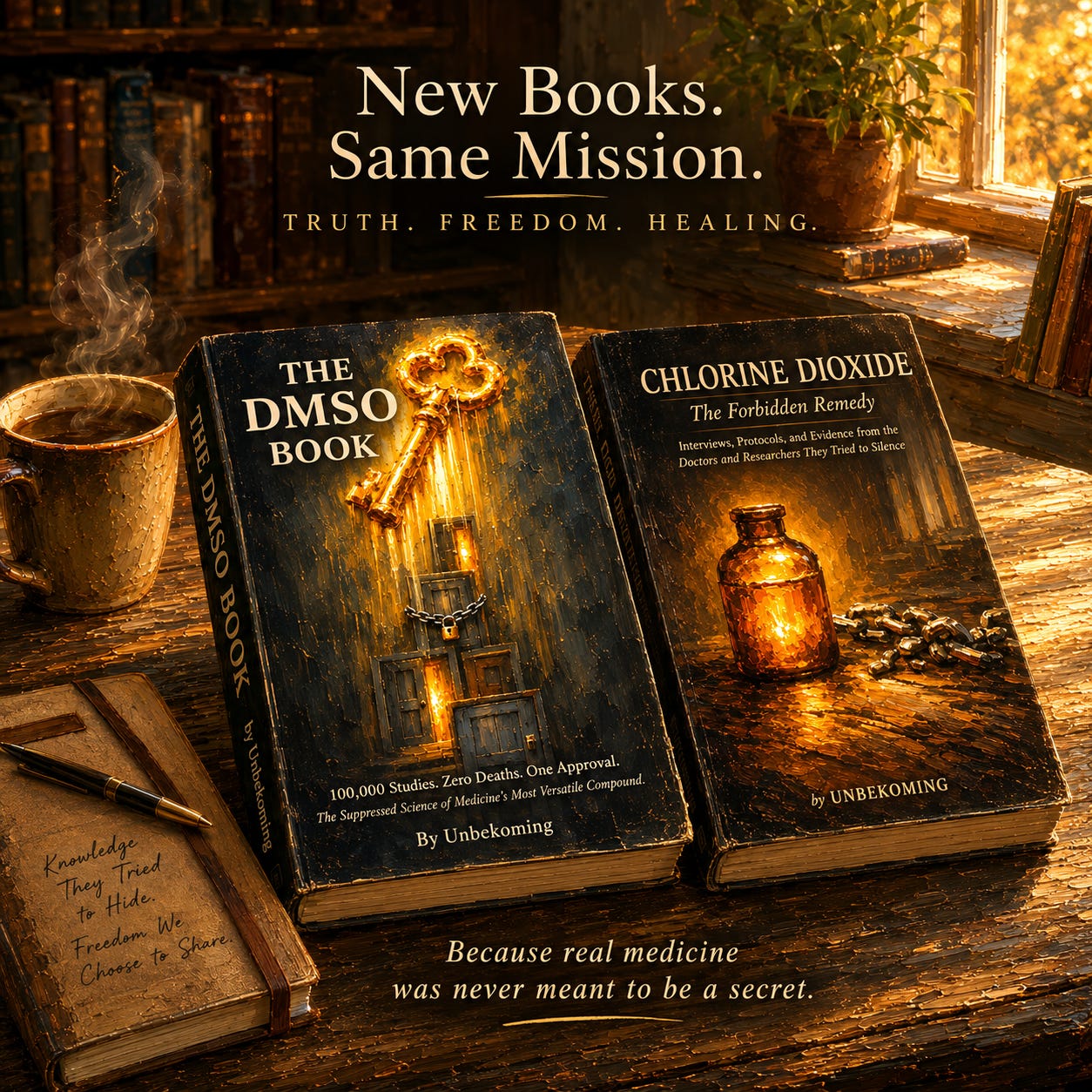
Two molecules. Both cheap. Both simple. Both used for decades. One has been approved for a single condition. The other has been officially demonized. Neither has killed anyone.
In June I wrote about twelve remedies they can’t patent. The essay described a pattern: the cheaper a substance is, the more versatile it is, the more the evidence stacks up, the harder the door gets pushed shut. Two of those twelve now have their own books.
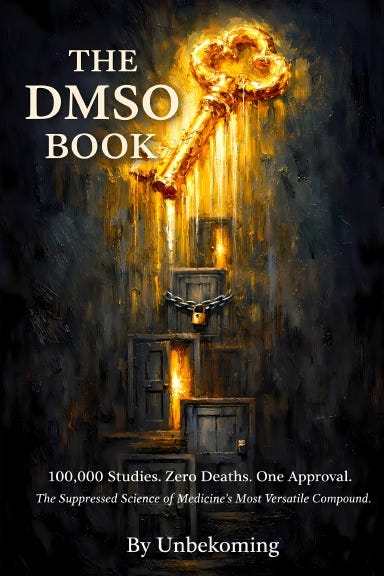
The DMSO Book: The Suppressed Science of Medicine’s Most Versatile Compound
Buy on Lulu → · 219 pages · USD $19.99
100,000 studies. Zero deaths. One FDA approval. Dimethyl sulfoxide has been studied for over sixty years, used by millions, and killed no one — and the FDA has approved it for exactly one condition. The DMSO Book compiles nearly 330 questions and answers across six major sources: A Midwestern Doctor’s combination-therapy series, Morton Walker’s foundational 1993 text, Amandha Dawn Vollmer’s practical guide, Archie Scott’s clinician handbook, klimer’s first-person survivor account, and A Midwestern Doctor’s work on DMSO and cancer. It covers chronic pain, burns, strokes, autoimmune conditions, antibiotic-resistant infections, eye diseases, and cancer. It documents preparation, dosage, and combination protocols with antibiotics, chemotherapy, magnesium, ivermectin, anaesthetics, and antifungals. It traces the history — Zaytsev’s 1866 synthesis, Herschler’s discovery at Crown Zellerbach, Jacob’s clinical breakthrough at Oregon Health Sciences — and the FDA’s decades-long suppression of the research.
The compound wasn’t dangerous. It was too versatile to be allowed.
For the person managing chronic pain who has been offered nothing but escalating prescriptions. For the household that wants a single reference to keep on the shelf next to the first-aid kit.
Digital Edition
Platinum Supporters - immediate access
Want access now? Upgrade to Platinum Supporter to receive digital editions on paperback release day.
Standard Paid Subscribers - access in 3-6 months from date of this post
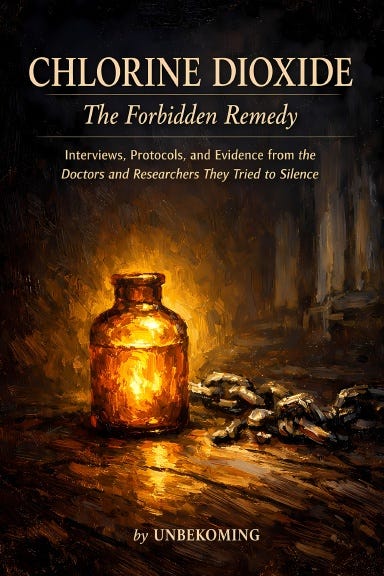
Chlorine Dioxide: The Forbidden Remedy
Buy on Lulu → · 201 pages · USD $19.99
Chlorine dioxide is not bleach. It is a molecule that works with the body rather than against disease — at a voltage of 0.95 volts, within the electrical range of human tissue, delivering oxygen precisely where it is needed and breaking down into salt and oxygen when its work is done. It has been used in water purification for decades. Its oxidative properties are not disputed even by the agencies that warn against its therapeutic use. What is suppressed is the possibility that a substance this simple, this inexpensive, and this widely available could address conditions that generate billions in pharmaceutical revenue.
The book brings together five independent voices who arrived at overlapping conclusions through separate pathways: Dr. Andreas Kalcker, biophysicist and world authority on chlorine dioxide research; Kerri Rivera, whose autism recovery protocol has restored speech and behaviour in nonverbal children; Xuewu Liu, whose intratumoral injection work is showing significant promise in cancer; Curious Outlier, whose Universal Antidote documentary has reached millions; and Jim Humble, who discovered the Master Mineral Solution in the Bolivian jungle in 1996. Their protocols are documented in full. Their limitations are stated honestly. Their evidence — clinical observation supported by studies involving thousands of patients, validated by the daily practice of over 5,000 doctors in the COMUSAV network across sixty countries — is presented so the reader can evaluate it themselves.
For the parent of a nonverbal child who has been told there is nothing left to try. For anyone who has watched a family member exhaust the conventional options and wants to know what the record actually shows.
Digital Edition
Platinum Supporters - immediate access
Want access now? Upgrade to Platinum Supporter to receive digital editions on paperback release day.
Standard Paid Subscribers - access in 3-6 months from date of this post
A note of thanks
The first five books have been out for a matter of weeks, and something I did not expect has already happened: a meaningful number of you are buying the shelf. Two books, three, the full set, sometimes more than one copy of the same title to give away. I see every order. Each one is a real person deciding to put money and space on a shelf behind this work. Thank you. I know what it costs to buy books you have, in effect, already read online — and I know what it means that you are doing it anyway.
The shelf
Seven books now. More coming.
The first five took on specialisms trained not to see the thing they treat — motherhood, vaccination, dentistry, veterinary medicine, psychiatry. These two take on something different: not a profession, but a category of substance. Cheap. Simple. Versatile. Too useful to be allowed a fair hearing.
The books are printed to order and shipped worldwide from Lulu. The full shelf is at lulu.com/spotlight/unbekoming.
— Unbekoming
Thank YOU for doing this! I just ordered these 2 plus the vet I had on wait till other books came out. The shipping is kinda high but that is okay. I by far prefer physical books to Ebooks, it seems I remember much better what I read like that than on the screen. Plus, of course, you can always take that book from the shelf without the search engine being unable to find it!!!
I think it's great that you are making these as real paper books. And even better to hear that people are purchasing them! I have a few books on my shelf that I've got e-books of, too, but I much prefer my paper copies. So much quicker for referencing sometimes, although the Ctrl-F for e-books is still very useful when you're looking for something specific! No flicking through the pages, (hopefully) remembering what it was you wanted to double check. But there's something about reading a physical book. It's special. And it's better on your eyes!
As a paid subscriber, I've downloaded all your e-books, but I'd love to purchase some of your paper books in the future. I never quite trust the internet, or computers. Books trump electronics because electricity can be out, your laptop battery could be dead, the internet might not connect etc.