

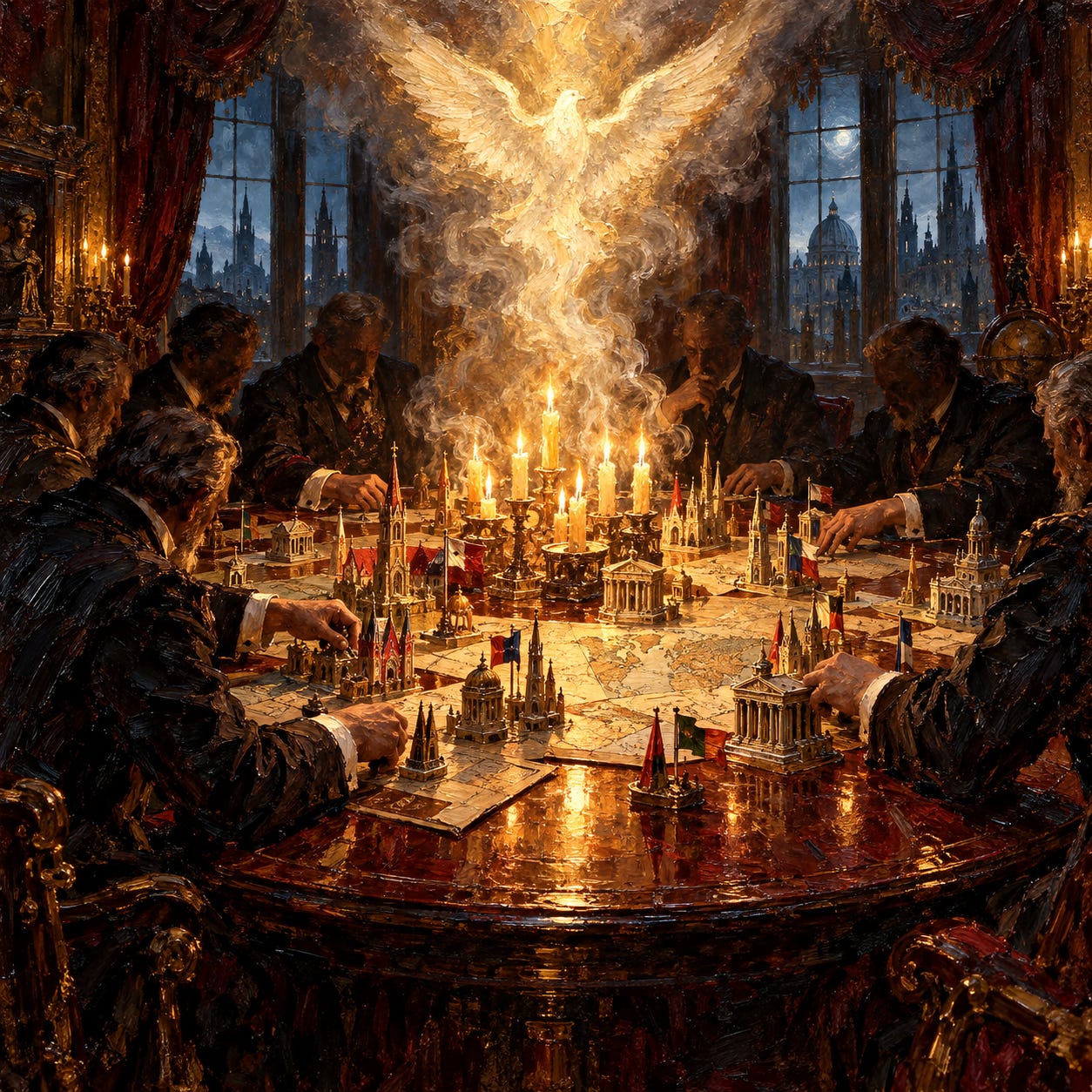
The Informal Agenda Group that Secretary of State Cordell Hull assembled in 1943 to draft the United Nations Charter was staffed overwhelmingly from a single institution. Of its eleven members by the end of that year, eight were present members of the Council on Foreign Relations or active in its War and Peace Studies Project. The organization that drafted the United Nations and the organization that had been planning for world federation since the Paris Peace Conference of 1919 were, in operational terms, the same body wearing a State Department hat. World Federation: The Ecumenical Agenda (2021) documents the twenty-five-year coordinated campaign that produced the United Nations, carried out by a transatlantic network of corporate lawyers, bankers, academics, and church leaders operating through law firms, academic institutes, philanthropic foundations, and the organized Protestant churches of the English-speaking world.
Martin Erdmann holds a doctoral degree in Modern Church History from Brunel University London, awarded in 1999, and a Habilitation in Systematic Theology from the Károli Gáspár University of Budapest, conferred in 2017. He trained in theology at Columbia International University, the University of Basel, and the University of Aberdeen, headed the New Testament department at the Staatsunabhängige Theologische Hochschule Basel, served as Senior Scientist researching the ethical implications of nanotechnology at the University Hospital in Basel, and taught Biblical Studies at Patrick Henry College in Virginia. The book originated as his Brunel doctoral thesis under Peter Cotterell and Meic Pearse of London School of Theology, with primary research conducted at the British Library, the Bodleian Library’s Rhodes House collection at Oxford, and the John Foster Dulles Papers at Princeton. Since 2003 he has directed the Verax Institute. The foreword, written by Meic Pearse, identifies the central institutional reversal the book then documents in detail.
The standard account of the United Nations’ founding treats it as the sober response of exhausted nations to the devastations of the Second World War, improvised at Dumbarton Oaks and completed at San Francisco under the pressure of events. The archival record Erdmann works from tells a different story. Carroll Quigley, the Georgetown historian granted limited access to Round Table papers in the 1960s, had sketched the outlines of this history in Tragedy and Hope and The Anglo-American Establishment, but Quigley’s work was dismissed by mainstream historiography and the subject remained largely closed. Published in 2021, World Federation opens the archive again at a moment when questions of supranational authority, global governance, and the political role of transnational institutions have returned to public argument with renewed force. The book establishes that the institutional capacity to generate such projects was built deliberately, across decades, with specific people, specific funders, and specific operational techniques that remain in continuous use.
World Federation belongs on the shelf alongside Quigley’s The Anglo-American Establishment as one of the works that establish, from primary sources, the private institutional architecture behind twentieth-century public history. The full summary unpacks the Sullivan & Cromwell client relationships that connected John Foster Dulles’s law firm to the financing of National Socialism through the Schroder bank, I.T.T., and SKF; the systematic method by which the Round Table replicated its South African unification technique at imperial and then global scale; and the specific institutional inversion Meic Pearse identifies in the foreword, by which church leaders who began by representing their churches to the ecumenical bodies ended by representing the ecumenical bodies back to the churches they still nominally belonged to. At Copenhagen in June 1931, Arnold Toynbee stated the project in his own words: “We are at present working discreetly but with all our might to wrest this mysterious force called sovereignty out of the clutches of the local national states of our world. And all the time we are denying with our lips what we are doing with our hands.”
Related


The rest of this summary — the analogy, one-minute elevator explanation, 12-point summary, Q&As, and Golden Nugget — is for paid subscribers.
Your subscription also unlocks every other book summary in the library, the Deep Dive Audio Library, my original books (new ones added monthly), and three series for the moments when a real decision is in front of you: Questions for Your Doctor, Before You Consent, and Package Inserts.