

The PSA test was never a cancer test. The protein it measures sits in every prostate — healthy, enlarged, inflamed, cancerous. It leaks into the blood for a hundred reasons that have nothing to do with cancer. The man who discovered it, Richard Ablin, knew this in 1970 when he first identified the protein at Roswell Park in Buffalo. He did not propose it as a screening test. He proposed it as a tool for monitoring whether a prostate removed for cancer had been removed completely — a limited use, in a defined population, in a surgical context.
Twenty-four years later, in 1994, the FDA approved it for screening the general male population. In 2010 Ablin wrote in The New York Times that the approval was “a hugely expensive public health disaster.” In 2012 the US Preventive Services Task Force assigned the test a Grade D recommendation, meaning the harms outweigh the benefits. The screening continues. Thirty million American men every year. Of every thousand sent for a biopsy on the strength of an elevated reading, three or four have a cancer that could ever hurt them. The rest get a needle through the rectal wall into a sterile organ, a cascade of surgeries and radiation and strong medicine, and the two companies that have grown rich on the aftermath — one selling pills for the men who can no longer function with their wives, the other selling diapers for the men who leak.
What has not been treated at book length, until now, is the whole case brought together in one volume — the test and the industry built on it, the terrain-paradigm account of what cancer actually is, and what a man can do about his own case before the screening machinery takes hold of him.
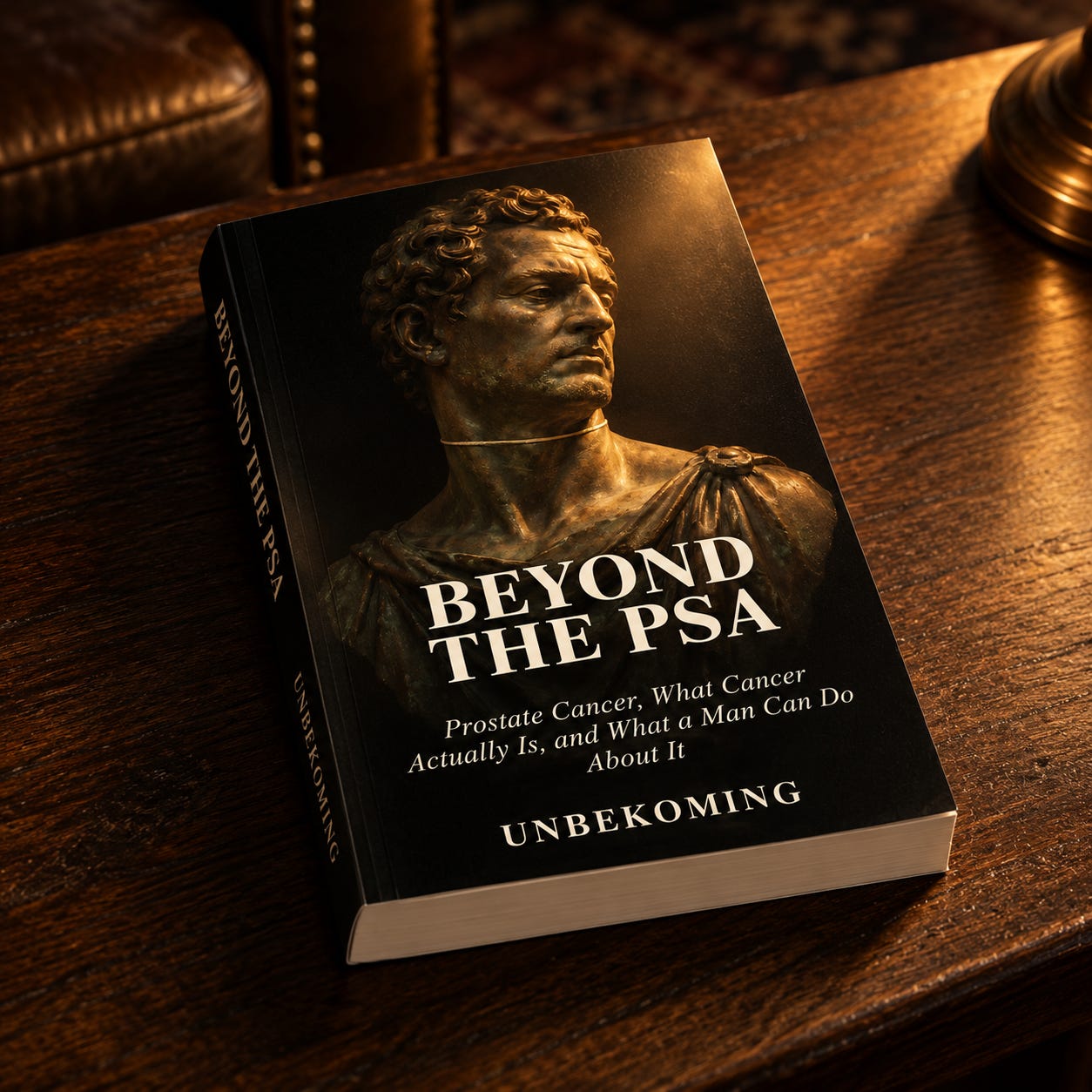
Beyond the PSA assembles the primary voices — Richard Ablin on the test, Anthony Horan on the surgery, H. Gilbert Welch on overdiagnosis, Thomas Cowan and Thomas Seyfried on terrain-paradigm cancer, Max Gerson on practical treatment, Vernon Coleman on the system that holds it all up — into a single reference for a man facing the decision.
That is why the book is divided into five parts. 477 pages, twenty chapters, four appendices and a full back-of-book index. The five parts walk through the whole case: what the test actually is, what it does to the men it finds, how patients are manufactured out of healthy men, what cancer actually is once the terrain paradigm is allowed back into view, and what to do before consenting to the next PSA test. The structure is the argument.

What the book shows
Part One: The Test. Richard Ablin on the test he discovered and the scandal that got built around it. Anthony Horan on four decades of prostatectomies inside a surgical culture that cannot stop cutting. Fifteen devastating facts about the screening program, each one documented from inside the medical literature. And the biopsy itself — twelve to twenty needles driven through the rectal wall into a sterile organ, and what no one mentions about what that procedure does to the men who undergo it.
Part Two: The Human Cost. The men who were sent through the machinery and came out the other side. Erectile dysfunction. Incontinence. Suicide. Vernon Coleman on why and how doctors kill more people than cancer — the clearest single statement in the catalogue of what the medical profession has become.
Part Three: How Patients Are Manufactured. H. Gilbert Welch on overdiagnosis — the practice of calling a man sick who was never going to be sick. The twelve diagnostic thresholds that were lowered to create millions of new patients at a stroke, each with the committee that voted and the industry money that funded the committee. The case against screening in general, stated by the physicians who built the case from inside the literature. And the survivorship-bias error at the heart of modern medicine — the dead don’t write survival rates.
Part Four: What Cancer Is. Thomas Cowan and Thomas Seyfried on cancer as a terrain phenomenon rather than a genetic lottery, a containment response rather than an invasion to be killed. The primary cause behind what has been renamed as a thousand different diseases. Turbo cancer, named and placed in the record. The role of water, the body’s wisdom, and the cellular environment the pharmaceutical model has no vocabulary for. What vitamins are and are not. Fasting as the foundation of recovery. The twelve things an oncologist was trained not to tell the patient.
Part Five: Before You Consent. Max Gerson and the German cancer therapies — the recovered tradition that treats the body rather than the tumour. And the chapter that gives the book its purpose: what to ask before the next PSA test, in language a man can use with his GP tomorrow morning.
What is at the back
Four appendices and a full back-of-book index. Where to go for help — the practitioners and clinics working outside the mainstream model, with contact details. Primary sources — the specific books and papers the chapters are built from. An annotated bibliography. A glossary. And a full back-of-book index, cross-referenced so a man can find the one page he needs when he needs it.
Who this book is for
If you have been reading me on Substack for a while and you have been waiting for the one book on the PSA, prostate cancer, and what a man can actually do, this is that book.
If you are new, start here. You do not need to have read anything else to follow it. If you are a man who has just been handed an elevated reading, or who is being asked to take the test for the first time, start here and read every page before the next appointment.
If someone you love — a father, a brother, a husband, a son — is in the middle of the decision now, this is the one volume I would send.
The companion piece: Breast Cancer: Before You Consent
Breast Cancer: Before You Consent, published in September, did for women what Beyond the PSA does for men. Same thesis — a mass screening program marketed to healthy people, built on evidence that will not survive honest scrutiny, feeding a diagnostic funnel that manufactures patients and then treats them. Same structure — a compact clinical guide for the person with an appointment on the calendar, the full evidence behind it, the terrain-paradigm account of what cancer actually is, and the practical tools for the room where the decision gets made.
The mammogram and the PSA test are the two most aggressively marketed cancer screening programs in the Western world. Both have been argued against from inside the medical literature for forty years by physicians who built the case from the primary data — Peter Gøtzsche and H. Gilbert Welch on the mammogram, Richard Ablin and Anthony Horan on the PSA. Both continue regardless. The two books put the full case for refusal, screening by screening, in the hands of the people being asked to consent.
Readers who want the breast cancer screening case in full should read Breast Cancer: Before You Consent. Readers who want the prostate cancer screening case in full should read Beyond the PSA. In a household with a woman and a man of screening age, both belong on the shelf. The pair reinforces.
Breast Cancer: Before You Consent on Lulu

Audio Deep Dive (for Paid Subscribers)
Digital Edition
Platinum Supporters - immediate access
Want access now? Upgrade to Platinum Supporter to receive digital editions on paperback release day.
Standard Paid Subscribers - access in 3-6 months from date of this post
EPUB Edition — Platinum Supporters
An EPUB edition, readable on Kindle, Kobo, Apple Books, and any e-reader that supports the format. Platinum Supporters can download it below.
For the full paperback shelf
Both books sit on the Lulu shelf alongside the rest of the catalogue. The Boron Book. The Magnesium Handbook. No Autoimmunity. The Genetic Deception. Extraction. Colloidal Silver. The Vaccine Books. The pet terrain titles.
Thank you
Thank you for reading, for sharing, for buying, for lending, for recommending. The imprint runs on your attention and your word of mouth. Every book that goes out into the world does so because someone in this subscriber list decided it belonged on a shelf, in a library, on a coffee table, or in the hands of a man who needs it.
The PSA test was never a cancer test. The record is in these pages, and so is the way out.
With gratitude,
Unbekoming
Support This Work
The essays are free and will stay free. What paid subscribers get is the library that surrounds them: the full digital book catalogue, audio deep dives, archived, and embedded in each essay, and the Questions for Your Doctor, Before You Consent, and Package Insert series. Platinum Supporters also receive the digital edition of every paperback on the day it’s published.
Whichever tier suits, thank you for being here. If you’d like to become a paid subscriber, upgrade a tier, or gift a subscription to someone who might value the work, the options are below.