

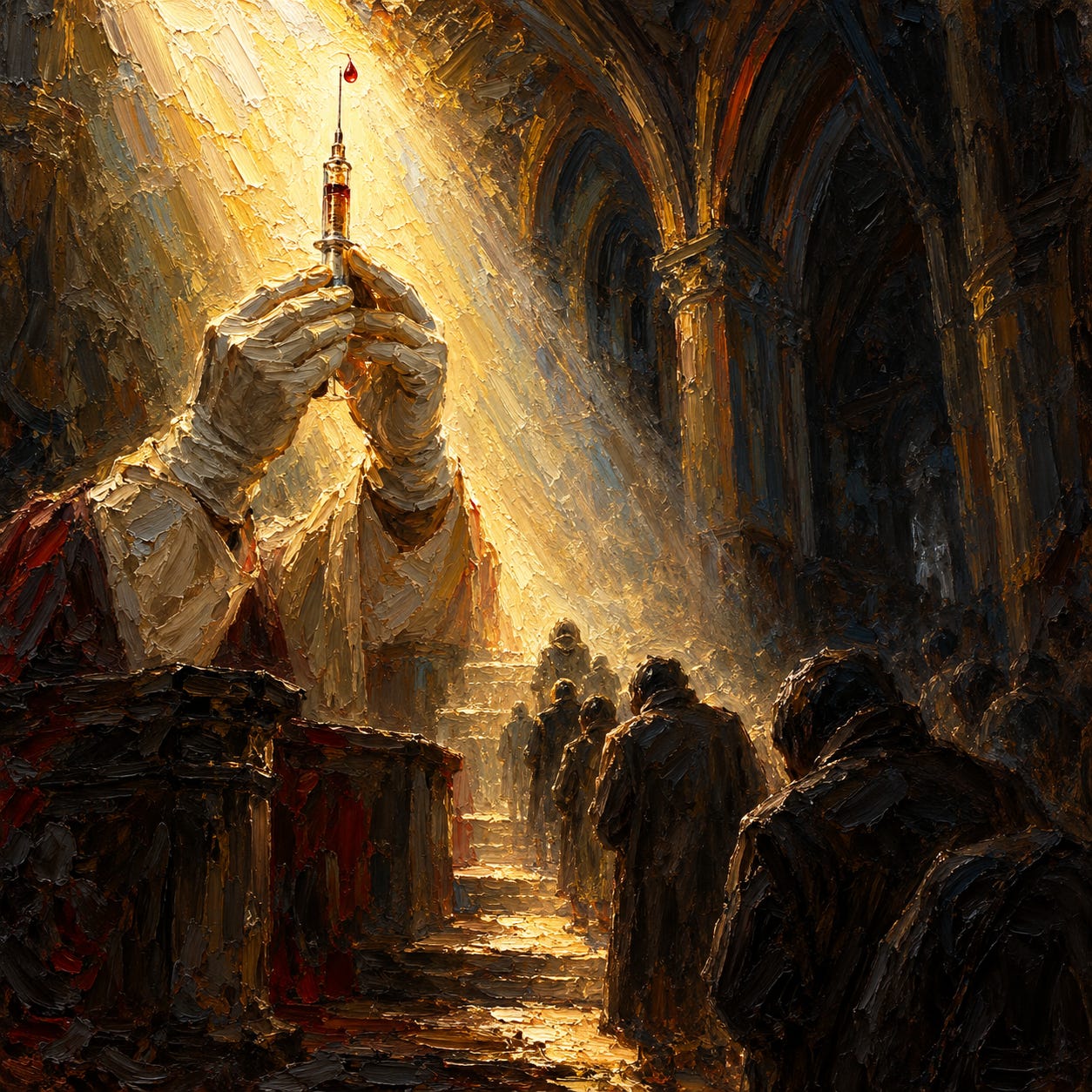
Eric Hoffer wrote The True Believer in 1951, on the San Francisco docks, with no university training behind him. He never wrote about medicine. The pattern he catalogued in that book maps the modern vaccination movement with precision he would have recognized, and the essay below walks through six of his diagnostic features applied to it in sequence. Two registers operate throughout. Establishment vocabulary (virus, antibody, pandemic, immune system, autoimmune, contagion, genetic) appears only inside direct quotation, in attribution to official bodies, and in reference titles. The author’s analytical voice operates within the terrain paradigm, in which illness arises from the body’s response to toxic, nutritional, electromagnetic, and emotional insults rather than from the work of invading pathogens. The shifts between registers are deliberate.
She brought him in for his twelve-month visit. At the kitchen table that morning he had pushed a cheerio across the tray with his finger and watched it fall over the edge, then looked up and laughed. He was walking with a sideways gait like a sailor on a listing deck. He said mama and dada and a word for the dog that was close to the dog’s name without quite being it. He had a thin crust of cradle cap behind his left ear that he scratched absently when he was thinking about something. The pediatrician looked him over, pronounced him on track, and the nurse came in with the tray.
Four needles. The whole visit took twelve minutes.
Three weeks later she brought him back. The child was not responding to his name. He had stopped reaching for the dog. He would sit on the kitchen floor with his cheek pressed against the cool tile for an hour at a time, and when she picked him up his body went rigid in her arms. He would not look at her face.
The pediatrician’s expression moved through several registers the mother could not have named at the time but would recognize years later, on a different pediatrician’s face. The literature was clear on this, she was told. Developmental regression at this age was common. Timing was deceptive. A referral to a specialist could be arranged. Until then, she should try not to read things online. In the meantime, the child was due for his next round at fifteen months.
She left with the child who was not the child who had arrived.
By the time her son was three she had been removed from one playgroup, dropped by two friends who thought she had become obsessed, and asked by her mother-in-law not to raise the subject at Thanksgiving. She had stopped raising it anywhere.
Nothing of what she lived through at any of those tables is unusual. The same scenes recur in households across the country and have for a long time, with the same features in roughly the same order. Hoffer’s book, written at the end of the Second World War, catalogues the structure she was living inside. The pattern is older than medicine and larger. Each of its features is present, point for point, in the movement that dismissed her.
PDF Download & Audio Deep Dive (for Paid Subscribers)
Support This Work
The essays are free and will stay free. What paid subscribers get is the library that surrounds them: the full digital book catalogue, audio deep dives, archived, and embedded in each essay, and the Questions for Your Doctor, Before You Consent, and Package Insert series. Platinum Supporters also receive the digital edition of every paperback on the day it’s published.
Whichever tier suits, thank you for being here. If you’d like to become a paid subscriber, upgrade a tier, or gift a subscription to someone who might value the work, the options are below.
I. The Frustrated Self
Faith in a holy cause is to a considerable extent a substitute for the lost faith in ourselves.¹
In the public conversation about vaccines the term “true believer” is reserved for the parent who refuses them. She is said to have faith against evidence. The pediatrician who administers them is said to have evidence against faith. Hoffer’s book turns this around. The believer in his framework is the person for whom the cause has become the condition of the self, and whose attachment to the cause is independent of the cause’s truth. By that measure the pediatrician in the exam room is the believer. The mother carrying her son out of the clinic is the apostate.
The modern pediatrician enters practice at the end of a long training in which the schedule arrives already settled, treated as the floor the discipline stands on. Pediatrics is largely defined by it. Remove the schedule and what remains is a few scoliosis checks, the occasional strep swab, and some developmental scoring. The pediatrician’s identity, measured in years of training, debt load, standing in the community, and her conception of herself as a protector of children, depends on the schedule being correct. The schedule’s correctness has long since ceased to be an empirical question for her. The question was settled by the architecture of her life before she had reason to ask it.
Hoffer wrote that the true believer, in the register the public conversation misses, is primarily a frustrated self. His individual existence has become too much for him to hold, and he escapes it by immersing himself in a cause larger and more certain than he is. “People who see their lives as irremediably spoiled cannot find a worth-while purpose in self-advancement,” Hoffer wrote. “Nothing that has its roots and reasons in the self can be good and noble.”² The strength of a believer’s attachment reflects the cost of the cause’s collapse, not the strength of the evidence for it.
Consider the view from across the exam room. The pediatrician has trained for twelve years to be in this room. She chose pediatrics because she loves children and because she wanted a specialty in which the main work was keeping them well. Her own son is three, fully vaccinated according to her careful schedule, and sleeps now in the next room when she comes home at night. When the mother in front of her today describes a regression after the twelve-month visit, the pediatrician does not experience herself as dismissing a possibility. She experiences herself as holding the line against a confusion she has been trained to recognize and manage. The confusion is dangerous because it causes mothers to withhold care from their children. The confusion is sympathetic because the mother is clearly suffering. The pediatrician’s work in this moment is to offer the mother the correct frame and the next step. She does this gently. She does it well. She does it without any sense of doing anything other than her work. If, for a single moment, she allowed herself to consider that the mother in front of her might be describing something real, several things would collapse at once. The next appointment would not be in three months. The schedule itself would be a question. Her own son would become a question. The years of training would become a question. She cannot afford this, and so she does not do it, and the professional reflex that performs the redirect does not feel to her like avoidance. It feels like competence.
For the pediatrician the cost of collapse would be total. If the schedule is not correct, she has spent her career injecting into children, one needle at a time, with the parents’ consent given on her authority, the thing that injured them. The mind cannot hold this. The mind performs the redirect. The redirect is a reflex. Developmental regression is common. The literature is clear. The next appointment is in three months.
The parent in the group chat performs the same operation at the amateur level. She brought her son in for his twelve-month visit. If what the questioning parents are saying is correct, she is implicated in whatever has happened to her own child, and she cannot yet know what has happened because he is still three. The strength required to look at this directly is more than most people have on hand. The group chat offers a cheaper alternative. The questioning mother becomes the problem; the schedule remains intact; the regression, if there was one, returns to its default category of coincidence; and the parent in the group chat is reconfirmed as a Good Parent who did Everything Right. The expulsion is a small ritual of reassurance performed collectively.
The pharmacist operates from a script that she did not design, and that structures her encounter with every customer. Her name tag reads her first name and the chain’s logo. The counter in front of her is scuffed where the elbows of ten thousand previous customers have worn the laminate. The script instructs her to ask after outstanding doses at every visit (flu, shingles, COVID booster, pneumococcal, RSV, pertussis) and to pursue uptake at each refusal. Refusals are logged. At some chains her compensation partly depends on the uptake rate at her location. The script’s purpose is uptake. The believer is what the script leaves behind after years of recitation, once the tone the training required of her has become the tone she uses when she speaks to anyone about anything.
Mass movements, in Hoffer’s framework, cannot recruit the happy, self-sufficient person. He has no vacancy for the movement to fill. The movements recruit from the places where the self cannot hold. Modern medicine, as it has configured itself at the clinic desk and the pharmacy counter and the hospital employment contract, has produced a professional class whose selves cannot hold without the schedule being true. The schedule is the ground these selves are standing on. They defend it the way anyone defends the ground they are standing on.
II. The Holy Cause
A substitute embraced in moderation cannot supplant and efface the self we want to forget. We cannot be sure that we have something worth living for unless we are ready to die for it.³
Every mass movement rests on a story that proves its holy cause. Christianity has the resurrection; the French Revolution has the storming of the Bastille; Bolshevism has October 1917; Zionism has the founding of the state. The story enters the movement’s catechism, is repeated at ceremonies, and is taught to children as the first thing they learn. Its function is to establish that the cause has already triumphed once, definitively, so that every subsequent action of the movement can be understood as the continuation of an already-vindicated purpose.
The vaccination movement’s story is polio.
The story has a particular shape: children in iron lungs, summer playgrounds closed off, mothers afraid to let their children swim, and then Jonas Salk, the vaccine, the aftermath in which the iron lungs became museum pieces and the children were free. The before-and-after is clean and total. Salk is a secular saint, the vaccine the physical proof that the movement works.
Suzanne Humphries and Roman Bystrianyk assembled the evidence that unmakes the story in Dissolving Illusions. Deaths from measles in the United States had fallen by more than 98 percent before the measles vaccine was introduced in 1963. Deaths from whooping cough had fallen by more than 90 percent before the vaccine arrived in the 1940s.⁴ The schedule did not end these diseases as public killers; the schedule arrived after they had already stopped killing. For polio the picture is more intricate, and the story the movement tells about polio requires it to stay simple.
Polio’s distinguishing horror was never death, which it caused rarely. The horror was paralysis. The trajectory of paralysis depends decisively on the question of what, exactly, was being counted as polio in each year.
Before 1954, a physician in the United States who diagnosed polio recorded a patient with any paralysis lasting more than twenty-four hours. Laboratory confirmation was not required. In 1955, the year the Salk vaccine was released, the diagnostic criteria tightened. Residual paralysis sixty days after onset was now required for the diagnosis. The diagnostic laboratories distinguished polio from a growing list of other conditions that had previously been reported under its name: aseptic meningitis, Guillain-Barré syndrome, transverse myelitis, coxsackie-attributed illness. Dr. Bernard Greenberg, head of biostatistics at the University of North Carolina School of Public Health and chairman of the American Public Health Association’s Committee on Evaluation and Standards, observed that these changes alone had “predetermined” the fall in reported paralytic polio cases, “whether or not any vaccine was used.”⁵ The schedule credited itself with the fall.
Forrest Maready’s The Moth in the Iron Lung reconstructs the material question that the morality play erased. The paralysis that filled the summer wards and the iron lungs of the first half of the twentieth century did not pattern itself the way an illness carried from one person to the next would be expected to pattern itself. It clustered in children, in summer, and in industrial regions whose shared feature was heavy agricultural and residential pesticide use. The great summer waves of paralysis in the United States tracked, decade by decade, the aggressive spraying of first lead arsenate and then DDT. Lead arsenate was invented near Boston in 1892, in the campaign against the gypsy moth, and was taken up over the following decade across New England orchards and farms. The Rutland, Vermont episode of 1894, long treated as the first American polio event of the modern era, falls in the same window and in the same region where lead arsenate was being newly deployed by farmers still working out the correct dilution.⁶ In the 1940s and 1950s DDT took over the public spraying. It was dropped from airplanes over playgrounds, sprayed from trucks across public parks, applied to the walls of children’s rooms, and marketed as safe to spray on sandwiches in children’s lunchboxes, which the advertisements of the period show it doing.⁷ Arsenic and DDT both produce, in animals and in humans, acute flaccid paralysis of the kind the iron lungs were built to receive. The polio case curve begins to fall after the pesticides are phased out.
None of this reaches the believer. The polio story is a different kind of story. It functions as the movement’s sacramental history, told to the child the way the exodus is told to a child at the seder: a founding event into whose truth the child is being inducted, received rather than examined. If polio can be examined, the schedule stops being a continuation of a prior triumph and becomes a decision made in the present, dose by dose, by a parent who could in principle ask for the evidence. The believer cannot allow the examination to begin, because every subsequent injection depends on it staying unexamined.
Hoffer measured the effectiveness of a holy cause by its capacity to supplant the self, which it accomplishes through total embrace rather than careful consideration. The polio story is embraced totally. Any lesser hold on it would admit the questions that would collapse the schedule, and the collapse of the schedule would collapse the professional lives of millions of people who have organized themselves around administering it. The story is held because releasing it would cost the holders too much else. The question of whether it is true, after a certain point, becomes a question nobody who still has to earn a living around the schedule can afford to answer either way.
III. The Leadership Class
A movement is pioneered by men of words, materialized by fanatics and consolidated by men of action.⁸
Hoffer’s three-stage model of leadership maps the vaccination movement with uncomfortable precision. The three roles are not always played by three different people, and a single figure can combine two of them. The categories are useful because the sequence holds.
Men of words prepare the ground. They work by demolition. They discredit what stood where the movement will stand, publish the pamphlets, give the lectures, establish the vocabulary the next generation will inherit. For the modern vaccination movement, the preparatory men of words include Edward Jenner, whose cowpox hypothesis entered medical practice on the strength of a small case series and extensive self-promotion rather than durable evidence; Louis Pasteur, whose private notebooks, opened to historians by his family a century after his death, show results fabricated and procedures misreported in the public record he had so carefully built;⁹ and in the current period a smaller set of figures whose books, interviews, and press appearances make the schedule’s defense a daily operation at the public register: Paul Offit, author of multiple volumes defending the schedule and discrediting those who question it; Peter Hotez, whose books and public commentary have cast the parent movement that questions vaccine safety as an organized threat to science; and Anthony Fauci, whose magazine covers and White House briefings made him for several years the public face of the holy cause.
The man of words rarely creates the movement he precipitates. His function is to discredit what stood in the place the movement will occupy. The pre-schedule norm, in American pediatrics through the first half of the twentieth century, was the family doctor who used vaccines sparingly and treated the mother’s description of her child as central medical evidence. The men of words made the mother’s observation hearsay and the schedule authoritative. The ground was prepared.
Fanatics materialize the movement. They do the work of building it into an institution that compels participation. For the vaccination movement in the United States, the fanatics occupy the regulatory and advisory bodies that have hardened the schedule from recommendation to requirement. The Advisory Committee on Immunization Practices added vaccine after vaccine to the childhood schedule from the mid-1980s onward, each addition presented not as a question for the public but as a settled matter already decided inside the committee room. State legislators in California, New York, Maine, and Connecticut moved the schedule from recommendation to mandate, closing religious and philosophical exemptions as the compliance rate drifted below the figure the fanatics required. Medical boards disciplined physicians who questioned the schedule into silence or out of practice. The fanatic’s distinguishing feature, Hoffer wrote in Section 61, is that he “cannot be convinced but only converted.” His attachment to the cause is not an attachment to the cause’s propositions. It is a holding on to something that keeps him from drowning in his own uncertainty.
The schedule-questioning parent, in this frame, is a sharper threat to the fanatic than any opposing specialist. The specialist has credentials the fanatic can discount. The parent has only her observation, and her observation is the thing the fanatic has spent his career teaching himself not to see.
The practical men of action consolidate the institution. For the vaccination movement they are the pharmaceutical executives who hold the patents and manage production, the hospital administrators who build vaccine compliance into employment contracts, the insurance actuaries who integrate the schedule into pediatric billing codes, and the federal officials who run the Vaccine Injury Compensation Program as a liability shield for the manufacturers. The men of action are indifferent to the holy cause as such. They administer the structure the fanatics built and prefer not to see it debated, because debate interferes with operations. In Hoffer’s framework, the arrival of the men of action marks the end of the movement’s active phase. The movement is no longer renovating the world; it is managing it.
The three groups do not share a theory. They share a function. Each is required for the movement to continue in the form it takes. The pediatrician in the exam room sits downstream of all three, administering on their behalf an operation whose intellectual, institutional, and operational structure she inherited whole and will pass on whole to whoever succeeds her at that desk.
IV. The Unverifiable Doctrine
If a doctrine is not unintelligible, it has to be vague; and if neither unintelligible nor vague, it has to be unverifiable.¹⁰
Hoffer wrote that the effectiveness of a doctrine comes from its certitude rather than its meaning. “No doctrine however profound and sublime will be effective unless it is presented as the embodiment of the one and only truth.”¹¹ The property that matters is whether the doctrine is held to be beyond examination. In the twentieth-century movements he catalogued, the doctrines that bound the believers together shared this property: Marxist-Leninist theory as the master key to historical motion, the Nordic race as the destined bearer of civilization, the eucharist as the actual body of the actual god. Each was held beyond the reach of inquiry, which was what made each operational.
The vaccination movement’s foundational doctrine is germ theory. Every subsequent claim grows from its three propositions: that pathogens cause disease, that pathogens travel from one host to the next, and that an injection containing a weakened pathogen (or a sequence coding for a piece of one) trains the body to defend itself against the live form. Every medical school teaches these propositions at the floor level, as the ground on which the rest of the discipline is built, with no provision made for their examination.
The circularity at the foundation has been documented in the work of Stefan Lanka, Thomas Cowan, Mark and Samantha Bailey, and others. It is simple to state. The establishment’s method for identifying what it calls a virus begins with a sick person’s bodily fluids. The fluids are placed on a cell culture that has been starved of nutrients and treated with antibiotics. The culture breaks down. The breakdown is attributed to a hypothesized viral agent in the fluids, not to the starvation and the antibiotics, because no control cultures running the same starvation and antibiotics without patient material are performed. Particles are observed in the broken-down culture. The particles are declared to be the virus. The virus is then declared the cause of the illness in the patient. The illness has been found, after a long detour, in a sick cell line in a laboratory, and been given a name.
No study in the published literature has produced a complete independent isolation of any of the particles the establishment classifies as viruses, meaning: taking a sick person’s fluids, purifying a single type of particle from them by physical means without cell culture, characterizing it, and demonstrating that it causes the same illness in a healthy host under controlled conditions. The literature contains no such paper. Christine Massey’s series of freedom-of-information requests to public health agencies in multiple countries, filed between 2020 and 2024, returned the same answer from each: no such paper exists in the agency’s possession.¹²
The standard reply from working virologists is that this misunderstands modern methods. Virology, the response goes, has produced thousands of isolation papers, and the terrain critics are demanding a procedure abandoned a century ago. The reply holds only if the word isolation is permitted to mean what twentieth-century molecular biology quietly redefined it to mean. Koch’s postulates, formulated in the 1880s, required that an organism be purified from a diseased host, grown in pure culture, shown to cause the same disease in a healthy host, and recovered from the new case. For bacteria the postulates held and still largely hold. For the particles the establishment classifies as viruses they were dropped in the 1950s and replaced by what the discipline calls molecular isolation: cell culture, electron microscopy, and genomic sequence assembly, with the particle’s identity inferred from a computational sequence match rather than demonstrated by purification and challenge. The redefinition made the question tractable. It also made it unanswerable, because the new procedure cannot in principle return a negative result. Every stressed cell culture yields particles. Every sequencing run assembles a genome. The method confirms itself at every step.¹³
This is the position Hoffer described. The doctrine does not need to be demonstrated. The doctrine requires that it not be demonstrated. If germ theory were demonstrated, it would become a scientific claim and therefore mortal; it could be amended or discarded. Its imperviousness to demonstration is what allows it to function as the ground beneath the entire movement. The unanswered FOIA requests do not trouble the believer because the believer never examined the question. The doctrine was received whole and is held the way received things are held, without the need to understand what one is holding.
Beneath germ theory the daughter doctrines work the same way. “Safe and effective” is the phrase recited at the sacrament. It is less a scientific finding than a liturgical formula. “Safe” is defined by the manufacturer, with regulatory acceptance, from what shows up in the trial, where the trial design excludes the control populations and the follow-up periods that would permit the question of safety to be answered. “Effective” is defined by proxy measures the test laboratory calls antibody titers, which have never been shown to predict protection in the field; by relative risk reductions in trial arms where the baseline rates are low enough that the absolute reductions are small; and by the removal of the comparative data that would permit the claim to be evaluated independently.¹⁴
“Herd immunity” is the holiest of the daughter doctrines. It specifies a mathematical threshold, around 95 percent of the population for the measles-containing schedule, above which, by the doctrine’s own claim, the illness cannot sustain itself in a population. The threshold has never been empirically derived from a measured population. It is calculated from parameters that are themselves assumptions. The threshold is routinely crossed by clusters of illness in highly vaccinated populations, which are then attributed to vaccine waning (requiring additional sacraments) or to pockets of the unvaccinated (requiring the devil). The doctrine cannot fail. Every outcome is consistent with it.
The believer never notices this. The believer does not need to notice this. The function of the doctrine lies in a different direction entirely. It insulates the self from questions the self has become structurally unable to afford.
The Difference
This essay has walked, until now, inside Hoffer’s catalogue. The six features he identified in the mass movements of the first half of the twentieth century are present in the vaccination movement, in a form Hoffer himself would have recognized. The remaining two will follow in due order. First, though, the catalogue has to be put down briefly, because the vaccination movement departs from Hoffer’s examples in a way that matters.
The doctrines Hoffer catalogued were unverifiable, but the consequences those doctrines produced were not. The ruins of Berlin in 1945 settled what German nationalism had actually done, as the famines of 1932 and 1933 settled it for collective agriculture, as the Place de la Révolution had settled it a century and a half earlier for the Jacobin project. Each of these movements met external reality through consequences nobody controlled, and in each case the consequences broke the movement or forced it to transform. The doctrine was unverifiable; the outcome was not.
The vaccination movement has broken this circuit. Its doctrine is unverifiable in Hoffer’s sense, and so is its outcome, because the movement controls the apparatus that would adjudicate the outcome. The agency that defines a vaccine injury is also the agency that counts the injuries and reports the count. The journals that would publish contrary evidence are curated by editors whose standing depends on the schedule being correct. Each new category of childhood chronic illness, once named, enters an ICD coding system maintained by the same institutional complex that administers the schedule, where the category is quietly absorbed. And the passive reporting system that would capture adverse events was found, in a study funded by the federal health agency itself, to collect fewer than one percent of actual cases, with the low numbers in the system then cited by that same agency as evidence that the schedule is safe.²² In each place where a twentieth-century mass movement encountered external reality, this movement has installed its own mirror.
The result is a mass movement that cannot be ended by events. Hoffer’s catalogue traces the arc from active phase to institutional consolidation to decline, and the arc depends in part on each movement eventually meeting consequences it cannot absorb. This movement has arrested the arc by owning the instruments that would measure the consequences. It makes the same promises today it made in Jenner’s time, and the measurements that would adjudicate those promises are kept by the people making them. Hoffer catalogued the species. This one is of a different genus, and he did not see it coming because the apparatus that makes it possible did not exist in 1951.
Now the catalogue can be picked up again.
V. The Manufactured Devil
Mass movements can rise and spread without belief in a God, but never without belief in a devil. Usually the strength of a mass movement is proportionate to the vividness and tangibility of its devil.¹⁵
Hoffer identified this feature decades before the word “anti-vaxxer” appeared in print. Every major mass movement he catalogued had required an identifiable enemy group to anchor the believer’s hatred, drawn from the populations culturally at hand: the Bolsheviks took the kulak, the Nazis the Jew, the Jacobins the aristocrat before them. The movement does not invent the enemy from scratch. It selects an available group, concentrates the features that make the group recognizable, and amplifies them until the resulting figure can carry the hatred the movement requires in order to function. “It is essential,” Hoffer quoted Hitler as saying, “to have a tangible enemy, not merely an abstract one.”¹⁶
The vaccination movement’s devil has moved through several forms. In Jenner’s England the devil was the smallpox victim who refused variolation and brought the illness into the parish. The Salk period produced a different figure: the ignorant parent who refused the shot and endangered the neighborhood. The current period has produced the “anti-vaxxer,” a category constructed over the past three decades to carry the particular hatred the modern movement requires.
The vocabulary that has gathered around the term is dehumanizing in a technical sense. It describes the opposing group as a vector of harm, a danger to children, a fifth column within the community that must be identified and excluded from it. During the COVID campaign the language reached its most explicit form. “The pandemic of the unvaccinated,” repeated at the presidential level, instructed the citizen that illness and death in the general population were the particular responsibility of the identifiable minority who had refused the sacrament. Hospital admissions were categorized by vaccination status in daily press briefings. Social media platforms, acting on advisories from the federal government, suspended accounts and removed posts flagged as discouraging vaccine uptake. Employment, educational access, and foreign travel were restricted on the basis of vaccination status; in some jurisdictions grocery stores and restaurants were as well.¹⁷
Hoffer catalogued the features of the ideal devil, and the “anti-vaxxer” exhibits each. He must be a single foe: “the genius of a great leader consists in concentrating all hatred on a single foe.”¹⁸ The vaccination movement collapses every variety of resistance into the one category. The parent with questions about one vaccine, the person who declined the COVID injection, the physician who warned about a specific adjuvant, and the researcher who published inconvenient data are all treated as members of the same group. The category flattens the distinctions until the devil can carry the hatred. He must be omnipresent, which the “anti-vaxxer” is said to be, with organizations and funding and influence appearing wherever a parent hesitates. He must be partly foreign in origin, which is why Russian disinformation campaigns are routinely invoked when American conversation turns against the schedule, and why American campaigns are invoked when European dissent appears. He must be depraved. The “anti-vaxxer” is said to profit from his position, to kill children through his advocacy, and to work from motives of malice or greed.
The construction permits the believer to hate without guilt. Hoffer wrote that the believer who has renounced his individual judgment acquires, with that renunciation, the right to hate those who have not. “The torture chamber is a corporate institution.”¹⁹ The mother in the group chat does not experience herself as practicing cruelty. She experiences herself as protecting children. The pediatrician who dismisses the questioning mother does not experience herself as gaslighting a parent. She experiences herself as holding the line against misinformation that could harm other families. The construction of the devil permits the hatred to be experienced as virtue, which is what makes it so difficult to interrupt from outside.
The devil in this movement is also, in a sense specific to it, a creation of the laboratory. The entity the establishment calls the viral enemy, against which the vaccinated community is said to be defending itself, has no demonstrated independent existence outside the cell cultures and computational assemblies that produce it as a theoretical object. The devil is therefore manufactured in two stages. The alleged pathogen is manufactured in the laboratory. The alleged “anti-vaxxer” is manufactured in the public communications. Each defends the other. The alleged pathogen justifies the schedule. The alleged “anti-vaxxer” justifies the mandate. Each is held to be real on the authority of the other.
Mass movements that lose their devil must find another one or dissolve. The vaccination movement has never been without one. In the slow years between declared public health emergencies, the devil is the schedule-questioning parent. In the acute phases, the devil is upgraded to the unvaccinated adult. Between acute phases the devil is retained as a background threat so that the apparatus of exclusion remains in working order. The devil has become permanent infrastructure. Removing him from the architecture would be the same as removing the movement.
VI. The Sacrament
In every act, however trivial, the individual must by some ritual associate himself with the congregation, the tribe, the party, etcetera.²⁰
The movement makes itself visible in the needle.
The childhood schedule, as recommended by the Centers for Disease Control and Prevention and enforced through state school-attendance laws, calls for approximately seventy-two doses of vaccines before a child’s eighteenth birthday, with roughly thirty of those doses given before the age of two.²¹ This is not a treatment program for sick children. It is a ritual program applied to well children, administered on predetermined dates (two months, four months, six months, twelve months, fifteen months, eighteen months, two years, four years, six years, eleven years, sixteen years), each visit accompanied by paperwork, a card to be stamped, a record transmitted to the state registry, and the parent’s informed consent given to the pediatrician without the pediatrician being required to supply the manufacturer’s package insert.
The structure is sacramental in the strict sense. The visit is a scheduled occasion of consecrated action. The agent (the pediatrician or nurse) is licensed and in some loose sense robed. The parent is instructed to produce the child, to hold the child in a specified position, and to receive the ritual on the child’s behalf. The substance (the vaccine) is treated with the care appropriate to a consecrated element: handled through gloves, drawn from a sealed vial, administered at a precise anatomical site. The record (the vaccine card) is maintained with the care appropriate to a baptismal certificate; it is required for school enrollment, for international travel, for access to many forms of employment. The ritual proceeds whether or not the child is well; indeed, well children are the ritual’s required subject. Children who are too ill to receive their scheduled doses are flagged in the computer system for completion as soon as they recover.
The COVID campaign made the sacramental logic visible at the adult level. The vaccination site set up in the empty stadium or convention center was architecturally a religious procession, with its lanes to enter, its greeter at the door, its vaccinator’s station, its waiting area where recipients remained under observation for fifteen minutes, and its sticker given at the exit to mark completion. The vaccinator wore blue nitrile gloves and said “small pinch” before the needle went in. The sticker said I Got My Shot and was displayed on social media as the pilgrim’s badge. Public figures and ordinary citizens posted their vaccinated selves in the same compositional format a devout Catholic uses to post her child’s first communion. The second shot was framed as the completion that the first had initiated. The booster introduced a liturgical cycle. The sacrament had to be renewed, with each renewal requiring the believer to present herself again.
The pharmacy counter extends the sacrament into daily life. The flu shot is offered each September; the shingles vaccine at the designated age; the COVID booster when the formulation is updated; the pneumococcal when the pharmacist’s screen flags it due. Each offer is made at the moment of transaction, and each refusal is recorded in a file that will prompt the next offer. The sacrament has become continuous. The believer need not attend a scheduled appointment to participate; she need only enter the pharmacy for an unrelated purpose, and the sacrament will be offered to her.
The ritual’s authority depends on its ritual character remaining invisible to the people performing it. The parent at the twelve-month visit is told the four injections are medicine. The adult at the stadium is told the shot is a public health measure. In both settings the ritual aspect goes unnamed. If it were named, the question would return to the individual: should I do this, and on what evidence? The movement cannot sustain the question in the mouth of its believer. The question is the end of the believer as a believer. The schedule is designed so that the question does not arise.
The needle is where the movement’s architecture becomes physical. The doctrine can be sidestepped, the devil reframed, the holy cause privately contested. The needle allows none of this, because the needle is already in the arm. It is in the schedule, in the pharmacy, in the stadium, in millions of arms every week. The believer sees medicine. Hoffer saw a sacrament. They are looking at the same needle.
How to Explain It to a Six-Year-Old
There was once a knight who was afraid of almost everything.
He was afraid at night in his room, when the shadows got long and the house got quiet. He was afraid when he tried to do things on his own and they did not work the way he had hoped they would. And he was most afraid of all when the other children looked at him for too long, because he did not yet know who he was, and he worried they would see that too. The afraid-feeling was with him every day, from the time he woke up to the time he fell asleep. He did not know how to put it down.
One day the king gave him a suit of armor. The armor was shining and heavy and covered him from head to foot, so that no one could see his face anymore. The king told him that the kingdom had terrible enemies, and that the knight’s job from now on was to find them and fight them. The knight put the armor on. He went out and he found the enemies. When he fought them, something happened that changed his life. He was not afraid anymore. He felt brave. He knew who he was. He was a knight, and the armor was his skin, and the enemies were his purpose, and the afraid boy who had lived in the dark room had been left behind.
After that the knight could not take the armor off. If he tried, even for a moment, the afraid-feeling came rushing back, bigger and heavier than it had been before. So he kept the armor on all the time. When he could not find the old enemies, he went looking for new ones, and when there did not seem to be any new ones, he agreed with the king that there must be some hiding somewhere, and he went to find those too. If anyone said that the enemies the king had named were not really enemies, or that some of them were just people who had done nothing wrong, the knight would get very angry at that person. The person was threatening to make him take the armor off. The angrier he got, the surer he felt that the armor was keeping him safe. He did not understand, and he could not let himself understand, that the armor was the only thing between him and the afraid-feeling that would otherwise swallow him whole.
The pediatrician in the opening of this essay is wearing a suit of armor. So is the parent in the group chat. So is the pharmacist at the counter. The anger they turn on the mother who asks the question is the armor defending itself against the question that would require it to be taken off. The holy cause, the doctrine, the devil, the sacrament, the leadership class, these are the pieces of the armor. Under each of them is a scared person. Hoffer wrote the book that lets you see the person inside.
References
Eric Hoffer, The True Believer: Thoughts on the Nature of Mass Movements (New York: Harper & Row, 1951), Section 8.
Hoffer, The True Believer, Section 7.
Hoffer, The True Believer, Section 13.
Suzanne Humphries and Roman Bystrianyk, Dissolving Illusions: Disease, Vaccines, and the Forgotten History (CreateSpace, 2013), Chapters 11 and 12. Mortality trajectory for measles and whooping cough predating respective vaccine introductions.
Humphries and Bystrianyk, Dissolving Illusions, Chapter 12, quoting Dr. Bernard Greenberg (head of biostatistics, University of North Carolina School of Public Health; chairman, Committee on Evaluation and Standards, American Public Health Association). The quoted passage appears in H. Ratner et al., “The Present Status of Polio Vaccines,” Illinois Medical Journal, vol. 118, nos. 2–3 (1969), pp. 84–93 and 160–168, edited from the transcript of a panel discussion before the Section on Preventive Medicine and Public Health at the 120th annual meeting of the Illinois State Medical Society, Chicago, May 26, 1969. Humphries attributes Greenberg’s underlying statement to 1960; the attribution date should be verified against primary sources before publication.
Forrest Maready, The Moth in the Iron Lung: A Biography of Polio (Feels Like Fire, 2018), chapters on lead arsenate and the Rutland and Boston episodes of the 1890s.
Humphries and Bystrianyk, Dissolving Illusions, Chapter 12, section on DDT, including the 1948 “Knox Out DDT” advertisement reproduced on p. 2855 of the source text.
Hoffer, The True Believer, Section 113.
Gerald L. Geison, The Private Science of Louis Pasteur (Princeton University Press, 1995).
Hoffer, The True Believer, Section 57.
Hoffer, The True Believer, Section 57.
Thomas Cowan, The Contagion Myth (Skyhorse, 2020), chapters on virology methodology; Mark Bailey, “A Farewell to Virology” (expert edition, 2022); Stefan Lanka, published FOIA correspondence and legal filings; and Christine Massey’s series of freedom-of-information requests to public health agencies in multiple countries (2020 to 2024), compiled at fluoridefreepeel.ca and subsequent archives. The current count of agencies that returned negative responses should be verified against the live compilation before publication.
On Koch’s postulates and their abandonment for the particles classified as viruses: Robert Koch, “Die Aetiologie der Tuberculose,” Mittheilungen aus dem Kaiserlichen Gesundheitsamte 2 (1884); Thomas M. Rivers, “Viruses and Koch’s Postulates,” Journal of Bacteriology 33, no. 1 (1937), pp. 1–12 (the standard reference for virology’s modification of Koch’s framework); and the critique developed in Bailey, “A Farewell to Virology,” and Cowan, The Contagion Myth. The historical sequence from classical isolation to molecular isolation is also reconstructed in the Baileys’ public lectures (2021 to 2024). Secondary citations should be verified against the primary record before publication.
Peter Doshi et al., published analyses of mRNA trial endpoints and absolute versus relative risk reductions, British Medical Journal and related outlets, 2020 to 2022. Specific citations should be verified against the current BMJ record before publication.
Hoffer, The True Believer, Section 65.
Hoffer, The True Believer, Section 65, quoting Hermann Rauschning, The Voice of Destruction (New York: G. P. Putnam’s Sons, 1940).
Public records of CDC press briefings, White House statements, and major platform content policies during the COVID campaign period, 2021 to 2023.
Hoffer, The True Believer, Section 67.
Hoffer, The True Believer, Section 77.
Hoffer, The True Believer, Section 44.
Centers for Disease Control and Prevention, Recommended Child and Adolescent Immunization Schedule, current edition. The exact dose count varies modestly year to year and should be verified against the current published schedule before publication.
Ross Lazarus et al., Electronic Support for Public Health: Vaccine Adverse Event Reporting System (ESP:VAERS), final report to the Agency for Healthcare Research and Quality, U.S. Department of Health and Human Services, Grant No. R18 HS 017045, Harvard Pilgrim Health Care, Inc. (2010). The report concludes that fewer than 1 percent of vaccine adverse events are captured by VAERS. The study was funded by HHS; the CDC continues to cite VAERS data as safety evidence while declining to formally acknowledge the finding. Both the report itself and the subsequent public-communication record should be verified before publication.
Many thanks. What a cult it is. You say vaccination's story is polio, but the Jenner story is more the foundation and further back in the mists of time to give it a suitable aura with no one alive as witnesses to the fraud.
https://alphaandomegacloud.wordpress.com/2022/04/24/a-typical-church-service-according-to-the-covid-cult/
Your comparison with Hoffer raises an interesting question about how strongly people can become attached to their beliefs. But I think the same scrutiny needs to apply to the essay's own claims, especially those concerning viruses, polio, and vaccine safety. Questioning medical institutions is legitimate, but questioning established evidence requires equally rigorous evidence in return. Otherwise, we risk reproducing the very certainty we're criticizing.