

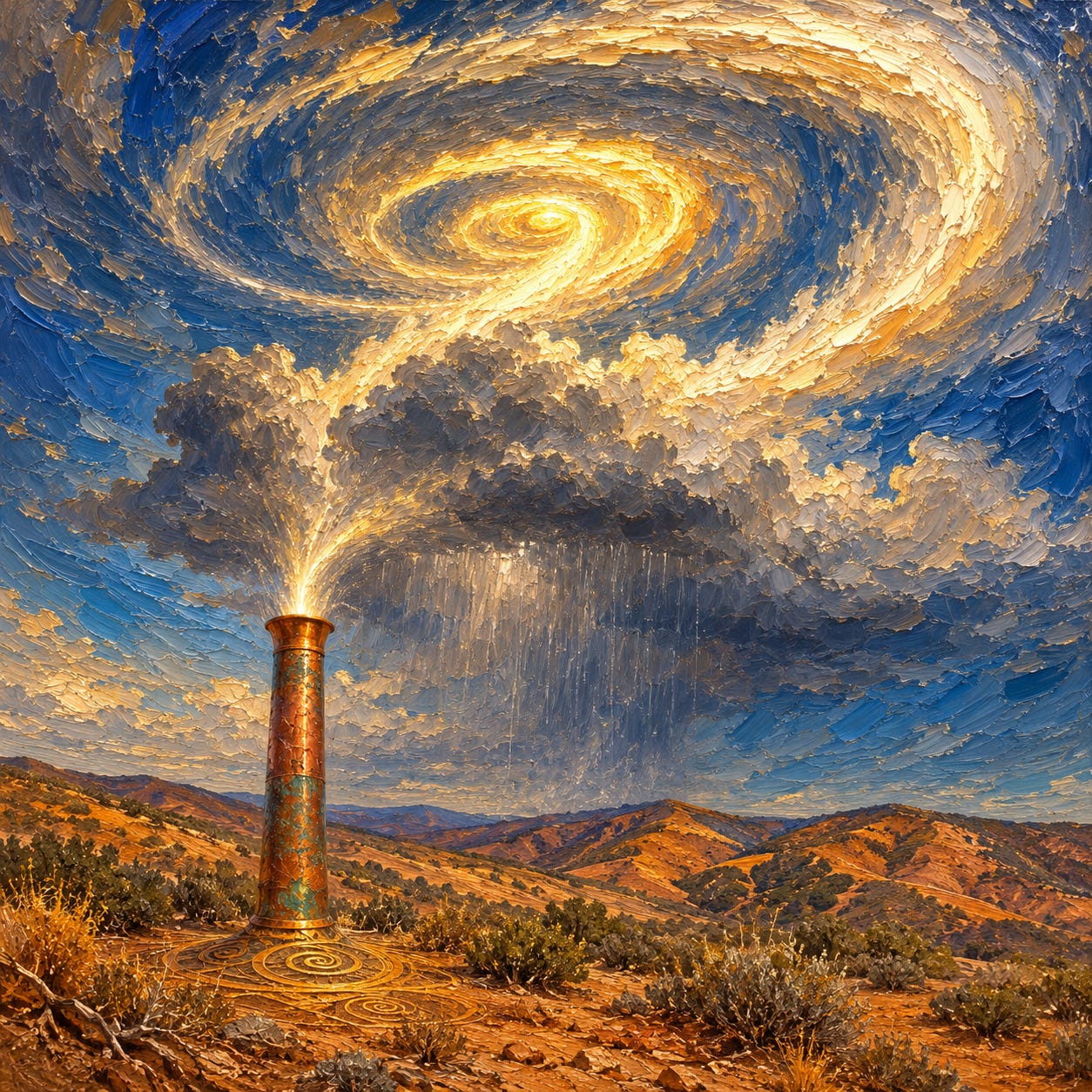
Trevor James Constable made it rain over Los Angeles in late July 1986, filed in advance with NOAA. Thomas Joseph Brown, who had just taken over Borderland Sciences, saw Constable’s old El Camino on Highway 5 with weather tubes hanging from the back, sent a fax noting the plate number, and was drawn into Operation Pincher 2. From there he directed Borderland for ten years, put out fifty issues of the Journal of Borderland Research, edited the second edition of Constable’s Cosmic Pulse of Life, and has spent the decades since in the fields mainstream science abandoned.
What Brown carries forward is the pleomorphic lineage medicine spent a century burying: Béchamp’s microzymas, Reich’s bions, the work of Rife, Enderlein, Naessens, Littlefield, and Morley Martin. The somatidian cycle moving through alkaline terrain into bacterial and fungal forms as the tissues acidify. Reich died in Lewisburg Federal Penitentiary in 1957 for refusing to accept that courts had jurisdiction over scientific experiment. A friend of Brown’s who works in a modern blood lab told him, quietly, that what Béchamp described is still visible under the microscope today. They are called “molecular granulations,” classified as non-motile, and ignored.
The interview ranges wider than the terrain essays most readers will come here from. It moves from Constable’s etheric weather engineering and the atmospheric critters he photographed in infrared, through the hemispheric split between emissary and master, cardiognosis grounded in HeartMath neurocardiology, bioarchitecture with phi-ratio proportion, fungi reading their environment through the Trivium, and forty years of work on the Ruskin-Lehrs dictum that form stands against force. Life organizes charge into coherent form at every scale. The paradigm which insists on a dead universe does so because what can be felt, measured, and in Constable’s case engineered, cannot be commercialized.
Brown trained with Constable directly and edited Cosmic Pulse. His Chronicles of Alkemix at alkemix.art is where the work lives now, alongside the Sacred Geometry of Water workshop, the Path of Light work on Goethe’s prism against Newton’s seven colors, and a paper in progress on Firstenberg and the electromagnetic shaping of modern disease. He answered sixteen long questions here without hurry and without hedging.
With thanks to Thomas Joseph Brown.

Interview PDF Download (Free Subscribers)
Audio Deep Dive (Paid Subscribers Only)
Support This Work
The essays are free and will stay free. What paid subscribers get is the library that surrounds them: the full digital book catalogue, audio deep dives, archived, and embedded in each essay, and the Questions for Your Doctor, Before You Consent, and Package Insert series. Platinum Supporters also receive the digital edition of every paperback on the day it’s published.
Whichever tier suits, thank you for being here. If you’d like to become a paid subscriber, upgrade a tier, or gift a subscription to someone who might value the work, the options are below.
1. Thomas, you’ve had an extraordinary journey from Chicago to becoming director of Borderland Sciences and working with pioneers like Trevor James Constable. What initially drew you to explore these frontier areas of science that most academics avoid?
Thank you, Unbekoming, for the opportunity to discuss these ideas, and for the remarkable body of work you’ve built at Lies are Unbekoming. Your essays, interviews and book summaries do a rare service: they bring overlooked research back into the light and let readers weigh it for themselves. I’ve valued the pieces I’ve read, and I’m honored to join the conversation.
I came from a very academic family background, although I think I was probably the disappointment as a dropout, with my father as chairman of the College of Commerce of a large Catholic university in downtown Chicago. Though I thoroughly regained his respect directing Borderland.
I grew up in a house full of books, full encyclopedia set, dictionaries and a globe, reading and writing long before I got to school. My siblings and I were on the spot intellectually from the inception of our ability to converse. Somewhere in my grammar school years I awoke to my wide-ranging interests, and started coming across books by authors such as Frank Edwards, Brad Steiger, Charles Berlitz, Bermuda Triangle type stuff. Chariots of the Gods, Erich von Däniken. All of that material intrigued me. But I was also critical. Like after Chariots came out, a book called Crash Go the Chariots appeared, which refuted a lot of the points. I loved reading both sides, to evaluate the stories, and I always felt inside that there was something outside the orthodox perspective. Authors like Vincent Gaddis drew me in, with Mysterious Fires and Lights and Invisible Horizons (he coined the term “Bermuda Triangle” in a 1964 Argosy article). I later met Vince and rescued him from a nursing home, and he lived with us like a grand old uncle for 8 years in California while I was running Borderland. By the end of my teens, I was reading everything I could find, from John Michell and pyramid energy books, to Pauwels and Bergier, Crowley, Grant and Buddhist texts like Hui Neng’s Platform Sutra. I was fortunate to have the old Occult Bookstore in Chicago, whose proprietor, Russell Thorne, was a Dadaist occultist who directed me to a lot of fascinating ideas. So, I’ve always been fascinated with a wide range of ideas outside the orthodox paradigm. I dropped out in the third year of a top college prep school in Chicago. I just was not interested in the regular curriculum, so I suppose that was just me. I was, as they said in the old Illuminatus! trilogy by Robert Shea and Robert Anton Wilson, “gullible in the right sort of way.”
I consumed and collected these books. I still have many of them. Warren Smith books, this whole Strange series, eventually I came on to Charles Fort. I had much wider interests, too. I was very interested in Egyptian works. The Egyptian Book of the Dead, I got when I was in sixth grade, for my birthday, I’d asked for it, the deluxe Dover edition. Which led me on to the Tibetan Book of the Dead, and the early Evans-Wentz translations of Tibetan texts in my mid-teens, after evolving past Lobsang Rampa’s books I read early on at 12 or so. I was deep into the Tibetan texts by 16, mapping out the Bardos in a notebook. Still working on that.
I was just fascinated by anything out of the ordinary. And I continued to collect books. At some point in the early 80s, someone turned me on to Borderland. I was telling them about some of my research looking at Tibetan ritual instruments as radionic instruments. And they said, oh, that sounds like Borderland Sciences. I’m like, who are they? I got into them about 1983, started corresponding with Riley Crabb, who had been running it since 1959. Around that time, I was hanging around California. I started going to visit Riley in Vista. And every Tuesday, he would hold court at the local Bob’s Big Boy. I would go and meet the most fascinating stream of people coming through and having wonderful conversations. I’d meet people who became dear friends, like Richard Horton, who was Richard Shaver’s (Shaver Mystery) best friend, and had all his old notebooks.
As an assiduous book collector in this realm, I knew Riley was old, and I just wanted to acquire a copy of each of the Borderland publications before he passed away. That was my intention. But at some point, he asked me to take over, and I did. And I directed it for 10 years, 1986–95, and put out 50 issues of the Journal of Borderland Research on a wide variety of subjects. I would have to say that, yes, a lot of it was definitely steered by my connection with Trevor James Constable.
Looking back, the common thread was the phenomena themselves. I wanted to experience and comprehend what actually appears, before any theory decides what is allowed to appear. At Borderland, Goethe gave that impulse a method.
2. You were mentored by Trevor Constable for decades. What was it like learning directly from someone who could literally part fog at sea and make it rain in deserts? How did that relationship shape your understanding of reality?
Not long after I took over Borderland, I got a, I can’t remember if it was a letter or a fax, because everybody used faxes in those days, from Trevor Constable, basically just extending a hand of friendship and saying that if I needed anything, he was there, and wishing me well. It was probably early in 1986, because I took over in late ’85. I actually put out the last edition, November–December ’85, under Riley’s name. I did most of the work just to keep his style going till my announcement in ’86. Anyway, it was probably around March or April ’86, I was driving down Highway 5 in Southern California, and I saw an old El Camino with some weather tubes hanging out the back. I knew they were the type of equipment Trevor was using. So, I sent him a fax. I said, hey, I saw this car going down the road and here’s the license plate number. They’re doing the same stuff you are. And he got back and said, look, that was my associate Irv Trent, I might as well bring you in on what we’re doing. And he did. Trevor took me under his wing and showed me what they were doing with the operations. That was Operation Pincher 2, and I’ve published on that. Operationally, he was bringing up streams of atmospheric orgone energy, from the Gulf of California, up over the Banning Pass, and a second stream up the coast from Mexico. They were engineered to meet over LA in late July and make it rain in the middle of summer, which he did, as filed in advance via NOAA official notice.
Trevor at that time ploughed me into Steiner, as he would put it. He said, take a look. I had read a lot of Christian mystics like Thomas Merton and Teilhard de Chardin, and I thought Steiner was in that stream. I hadn’t really looked or felt interested. He said, no, look at the natural scientific work. And I did. I got into Goethe and Steiner and read many books like Man or Matter by Ernst Lehrs, which Trevor recommended as an essential tome. And that truly was what dictated my next decade of Borderland, and my life to present. It was based on a fundamental phenomenological approach to the finer forces of Nature. We could even call it pragmatic metaphysics, where the etheric forces are accessible cognitively and operationally. As Trevor would say, people have been arguing about the reality of the ether for thousands of years. He said, “I don’t have time for an argument. I just get to work and engineer it.” Which he demonstrated regularly, such as parting the fog at sea, or creating rain in the desert. General Curtis LeMay got onto Trevor’s work late in his life. He participated in Operation Clincher in 1990, LA basin smog reduction, and wanted to utilize the technology to clear fog on air bases. He passed away not long after seeing Trevor’s technology at work, before any of that eventuated.
Before Trevor, I was already familiar with Reich’s cloudbuster and radionics, because I had been reading about these ideas pretty much since I was a teenager. I first came across radionics in 1972 in Analog magazine, Science Fiction/Science Fact, because I liked reading science fiction, like Roger Zelazny. I was fascinated by the worlds he could create. Analog always had a science fact article, in one issue “Magic, Science of the Future,” on the Hieronymus machine. It just blew me away. I loved these ideas, when shown to be operative in objective reality. I’ve just been immersed in this all my life. Trevor helped provide me a framework, a theory of knowledge, for cognizing how it is all a structured, ordered science when approached properly.
Overall, what Trevor gave me was a stance, a new foundation. Experience the etheric as a working reality, take it into the field, and let the results speak. Learning beside someone who brought rain to Los Angeles in late July changed the question for me from “is this real?” to “how does it work, and how do we work with it responsibly?” Reality, from then on, was a living field of formative forces that answers to geometry, rhythm and disciplined intention.
3. In your article on etheric weather engineering, you describe how Trevor Constable evolved from water-based cloudbusters to geometric orgone accumulators. For readers unfamiliar with this technology, how does sacred geometry actually interface with atmospheric conditions to produce rain?
Well, this is a very important question. Reich’s cloudbusters were connected to water grounds, flowing water or deep wells, with movable long pipes pointing to the atmosphere, and they would basically move atmospheric energy around, what Reich called orgone, which Trevor equated with the Chemical or Tone Ether of Steiner’s lexicon of finer forces.
Trevor’s first innovation was batteries of tubes angled to the sky, with water trickling through them. He discovered he could increase the effect by making the tubes geometric, applying sacred geometry with certain ratios between circumference and length, ideas like that. And the geometry brought him into cones as well.
Trevor was using these on the Matson Lines flagship, the SS Maui. He was Chief Radio Officer for Matson. Because of his professional stature and his methodical approach to doing this work, he was allowed to do these experiments onboard. At some point, one of the Commodores of the ship said, look, Trevor, you’re a smart guy. We don’t want this water running around on deck here anymore. And that’s when Trevor went to pure biogeometric engineering, as we call it.
Now, this ties in with my thesis. I’ve learned to explain this a little bit better. We can say the ethers have basically geometric components to them, as we can see life does, because we see the phi ratio throughout life, in the plant world and its variations, the Fibonacci series, and also in the human. Our skulls are basically sacred geometry, our hearts and our heartbeats; we’re imbued with the phi ratio. And it’s quite interesting. Scientific papers have shown that as you go towards what we call “the lesser animals” the ratio isn’t as fine. In the higher animals, coming up to the primates and humans, the ratio gets more precise.
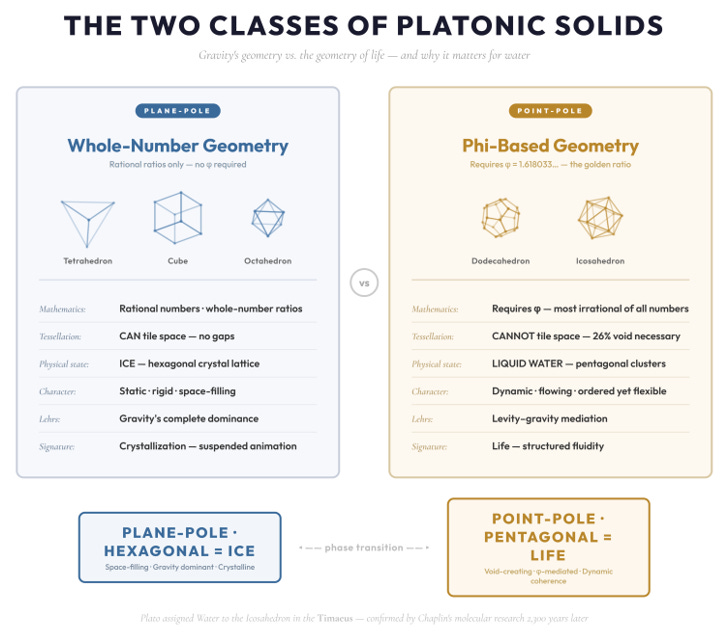
I’ve done a lot of research on the nature of water, and I’ve accomplished a workshop and a number of articles on what I call the Sacred Geometry of Water. I know there’s a lot of different ideas in the field, and there’s some brilliant research on it. I know a lot of people are into what they call hexagonal water, from Gerald Pollack’s work. And I say Jerry Pollack has done some of the most phenomenological research on what we could call exclusion zone water, biologically oriented water. Fascinating and epochal. But he hypothesizes that it is hexagonal in that state. In my research of all these different researchers, and even in talks going back in previous years, I would show both Prof. Martin Chaplin’s work, where he was showing the icosahedral and dodecahedral clustering, and Jerry’s hexagonal. And I sort of left it an open question. And here is what resolved it for me: take an icosahedron and look at it face-on, and its outline is a perfect regular hexagon. Pollack’s hexagons and Chaplin’s icosahedra are the same living geometry, seen from two different aspects. The hexagon is the shadow; the φ-based icosahedron is the body.
In my workshop, I presented a three-level causal chain tracing the etheric into physical water: Steiner’s chemical ether as the formative force, Chaplin’s icosahedral clusters as its geometric structure, and Del Giudice’s coherent domains as the electromagnetic field that holds that structure in coherence.
What deepened it further was projective geometry, which, again, I learned through the Steinerian circles, and which shows how space really works. Space isn’t three-dimensional. Three dimensions are our interpretation of space imposing the Cartesian coordinate system on what we experience. Space itself functions on projective geometry. George Adams’ approach to projective geometry shows that the operative polarity of space is point and plane, mediated by the line. A point and a plane can be the same object at different projections. Just think of a point as a balloon that you keep blowing up, hold it with your arms as it gets bigger. How big does it have to be before your arms are straight out? How big before you can cut a flat tabletop out of it? Imagine that to infinity. In projective geometry, a plane is a sphere of infinite radius.
I related that to space-related functions of the Platonic solids, where there’s two classes. The first class, the tetrahedron, octahedron, and cube: they are the space-filling family. They fit together, can tessellate in certain arrangements. They’re based on solid ratios. If we look at the dodecahedron and icosahedron, they’re based on phi ratios. You can’t tessellate them in space. There’s always a gap: in Chaplin’s model, the icosahedral clusters close-pack like spheres, filling 74% of space and leaving a 26% interstitial void between them. That gap is the functional space where the etheric polarity operates, keeping water in its liquid state. When it goes hexagonal, it freezes into a regular, space-filling lattice, and the gap closes. I’m just making this really simple. It took me about 4 hours in my workshop to put this whole picture into coherence. I’ve learned a lot even since then and done subsequent articles. This is why I feel we can explain how the geometry of Trevor’s gear is actually acting with the atmosphere: the phi ratio in the equipment interacting with the etheric peripheral forces coming in, from a projective geometric perspective. I know that’s a mouthful in a short interview, but there is a solid qualitative science behind it, and it’s taken me longer articles to explain this in detail. And I’m still thinking about it further, with potential future papers.
4. You write about “critters,” plasma-like beings that Trevor Constable photographed in infrared. Are these the same phenomena showing up in recent UAP sightings, and what does their existence tell us about the nature of life itself?
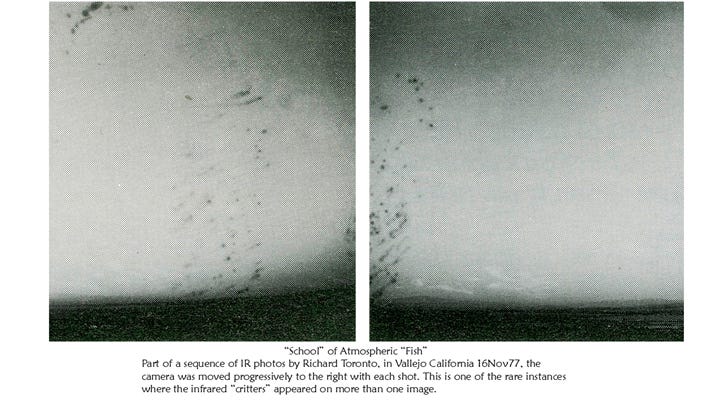
Yes, Trevor’s critters, Amoeba constablea. Absolutely fascinating. He took many infrared photos of these bioforms, as he termed them, in the 1950s, detailed in his They Live in the Sky (1958) and later in The Cosmic Pulse of Life. He described them as microbe-like macro-organisms living in the atmosphere in the plasma state.
I know there were a lot of critics of his IR photography and conclusions. Even Bob Beck gave him a stereo infrared camera to take photos, and Trevor didn’t use it, he says, because Beck didn’t understand the true process. He said he’s still thinking mechanically. A critter may show up on the emulsion on one side but not the other, so it wouldn’t do more than provide fuel for skeptics. I edited the second edition of The Cosmic Pulse of Life, Trevor’s book, and we presented a lot of the images in there.
What really solidified their reality as critters in my mind was some of the images from my friend Richard Toronto of Shavertron (Shaver Mystery) fame. I’m still in touch with Richard well over 40 years later; still very good friends, he’s writing some great pulp noir detective stories these days. Richard reproduced Trevor’s IR film work, and he got some of the most convincing photos of all. He was a professional photographer, and one series, he was just standing on a hillside in Vallejo, California doing a 360, taking shots around. He came up with a flock of these that appeared on three different images. So that was pretty conclusive to me. We published those images in the updated edition of Cosmic Pulse.
And what are they? Reichenbach’s sensitives saw these critters, floating over graveyards. It’s quite interesting. When I was talking to Richard about when he took it, I wondered what was over in that direction. He said, a graveyard. And this also ties in with the sightings called the Kaikoura UFOs, in New Zealand in 1978, and the Australian journalist Quentin Fogarty. He and his cameraman, David Crockett, filmed these UFO lights on a night flight, and he wrote his whole story up in the book Let’s Hope They’re Friendly. The main part of the book is basically the fact that the event happened, he saw and filmed the mystery lights, and then what happened with his career, the ups and downs. It’s quite a fantastic story. Through most of it he holds back on what he thinks. Then at the end, he says, he had a feeling that these objects were collecting souls of the dead. There are some really interesting ideas around these critters.
So what does this have to do with the current UAPs, as they call them now, what we used to call UFOs? Some of them could be the same. I know that there’s a lot of mysterious goings-on on our planet. I tend to go along with William Lyne’s Space Aliens from the Pentagon thesis. I think a lot of these craft and sightings are most likely above top secret projects, perhaps breakaway civilization stuff. Also, there’s a lot of strange energetic stuff happening on our planet. I know people like to say HAARP did this, HAARP did that. There are so many different projects that nobody even knows about. Where in the world, what sort of energies are being created, and what sort of reactions are happening? We also have the NASA UFOs, which were filmed during the Shuttle tether incident [STS-75], these pulsating critter-like things estimated at 1 to 3 miles across, very similar to what Trevor photographed down in the atmosphere. And they were filmed in the infrared, actually, because the cameras were sensitive down to infrared as well as optical range. I would sort the UAPs into three streams: terrestrial black-project craft, energetic side effects of large-scale electrical technologies, and a third stream that matches Trevor’s bioforms closely: pulsating, amoeboid, luminous, visible in infrared and invisible to the eye, perhaps universal in character.
So what the bioform UAPs are is a very good question. I think it’s a bigger question than I can actually answer. I’m just observing. As Vincent Gaddis would admonish me, the sign of a true Fortean is to retain a suspended judgment until all the facts are in.
What I can say about the critters, though, is that they indicate that there is more to life than just what we can observe. Which brings me to a sort of paradox in my philosophy. There are memes, and I’m sure you’ve all seen them: oh, we can only see this tiny little band of the electromagnetic spectrum, and there’s all this stuff we can’t see. Which is true. Yet, I always like to point out, yeah, well, most people don’t even know what they can actually really see. Like Goethe said, what is the hardest thing to see? That which is before thy very eyes. But that’s getting a little off the subject. The main point is there is some sort of etheric life happening, finer living intelligent forces. In ancient days there were different names for the different elemental creatures: Gnomes, Undines, Sylphs and Salamanders, denizens of Earth, Water, Air and Fire accordingly. These may be very real. And as Trevor noted in Cosmic Pulse, when radars first came out, they were picking up these “radar angels,” and they would actually scramble fighter jets to go up and check them out, and there was nothing there, even though they showed up on radar. Radar operates in the microwave band, adjacent to the infrared, below the optical range. But then apparently, they stopped appearing. So who knows, maybe the electrification, the radar, actually killed them off or chased them off the planet up into space. Because we know from Arthur Firstenberg’s work that this persistent and increasing electrification of the planet has caused quite an increase in modern diseases... and who knows what else?
5. Your work on hemispheric brain imbalance draws from McGilchrist, Shlain, and others. You argue that literacy fundamentally rewired human consciousness. How exactly did the alphabet “kill the Goddess,” as Shlain puts it?
Well, I think the answer to this is actually rather simple. We can go back to the story of Thoth, via the myth of Theuth and Thamus in Plato’s Phaedrus, where there is the creation of the arts of writing, geometry, astronomy, all of these wonderful arts. Theuth hails them as wonderful aids to help people remember, whereas Thamus says, no, it’s the opposite. They’re not aids to memory. They’re aids to reminding. People will no longer remember, because they’re losing their ability to practice memory. I think Shlain is saying something similar, but with a difference. Shlain’s core thesis is that alphabetic literacy did more than transmit ideas: it changed habitual patterns of thought, favoring linear, abstract analysis over holistic, image-based perception, and thereby helped strengthen patriarchy, weaken goddess worship, and diminish women’s status. Whereas the Theuth–Thamus story concentrates on external reminders replacing internal memory, Shlain proposes that literacy alters the balance of perception and social power.
Cultures without linear script used picture languages, like the hieroglyphs in Egypt. And according to Shlain, wherever linear script came in, this right-brain ability for imagery was lost. And he uses the Ten Commandments, the linear script there: I am the only God, there is no God other than me, no graven images. Why is that one of the Ten Commandments, that you can’t have graven images? Because images stimulate the right brain, which is where independent thought arises. Shlain presents a dynamic hypothesis, with points of varying strength, but when considered alongside Iain McGilchrist, Riane Eisler, and Julian Jaynes, one does get the distinct impression that the left brain has taken control, shut down higher cognitive capacities in the right brain, and warped the balance of the masculine and feminine, in both personal interactions and the social order in general.
McGilchrist gives us the mechanism. The left hemisphere, the emissary, attends narrowly; it grasps, abstracts and re-presents. The right hemisphere, the master, attends broadly; it receives the living whole in context. The alphabet trains the first mode relentlessly, letter by letter, line by line. Over generations, the emissary took the master’s seat, and the Goddess, the image of the living, relational whole, receded with the right hemisphere’s mode of knowing. The remedy, as I see it, lies in a third cognitive center that holds both hemispheres in balance: the heart.
6. You propose “cardiognosis,” using the heart’s intelligence to bridge our divided brain hemispheres. This sounds poetic, but you ground it in neurocardiology. What’s actually happening physiologically when the heart mediates consciousness?
Physiologically, the heart is a sensing and signaling organ in its own right. It has its own intrinsic nervous system, some 40,000 neurons, which J. Andrew Armour called the “heart brain.” Most of the vagal traffic flows upward, from heart to brain. When we hold a sincere feeling of appreciation, the heart’s rhythm shifts into a smooth, sine-like pattern of heart rate variability, which HeartMath’s research shows entrains brain activity and synchronizes the autonomic system. HeartMath also reports the heart’s electromagnetic field as the strongest rhythmic field the body generates. The heart leads, and the brain follows.
Internally, there is a shift in beingness: the limbic and prefrontal regions come into harmony, which expands cognitive capacities because the process is driven by, and thereby connected to, the heart. A state of emotional balance. One can practice this till it becomes one’s natural state. Find a comfortable meditation position; breathe gently and naturally. Bring your attention to your chest or heart region, not looking for anything special, just as a center of awareness. Bring to mind an experience where you felt genuine positive emotions: appreciation, affection, compassion. Or imagine a beautiful aspect of Nature you have experienced that raises your appreciation of life. Allow these feelings to become integral with your observational awareness rather than directing your emotional state. Learn to observe with the heart in this manner, as it is in this manner that participatory cognition may take seed and grow, in the Goethean sense. You are not reacting to emotions; you are appreciating them as a shared connection to objective experience. One becomes settled, with a firmer foundation of consciousness, not swayed by beliefs or emotions, but able to appreciate clear experience. The body destresses and there is harmony amongst its organic functions.
7. You’re advocating for bioarchitecture as the next evolution of etheric technology. How would buildings designed with these principles actually affect the people living in them day-to-day?
Well, I think in the same way as people walking in a forest, or sitting in an orgone accumulator; as Reich found: you’re concentrating the life energy. So naturally the healthy state is going to get stronger, more vibrant. You’re pulling in the higher, finer forces of life in this process. The process is to utilize φ-proportions drawn from the human body, curved and domed forms, natural and layered materials echoing Reich’s organic–metallic accumulator layering, siting and orientation (Feng Shui / Vastu), and electrical hygiene. Lakhovsky offers a useful parallel: if cells are resonant oscillators, a building is the resonant environment they live inside.
I think you’re going to see some rather concrete effects: better sleep, vitality, mood, and in how water and plants do in the space. Juan Schlosser, of Bio Arc, my bioarchitect associate, did experiments almost 10 years ago now (reported on bioarc.co), comparing ordinary buildings, basically concrete and brick squares, growing sprouts in them, with healing domes he made on his geometric principles. And you could see that the growth rates were greatly increased in the domes. So this is something that I think just makes sense. If you build something with quality, bio-beneficial materials with a harmonic geometry based on the proportions of the human body, naturally you’re going to feel a lot better and healthier. Of course, you still have to be careful with the electricity that you’re bringing in and all of that. There are a lot of considerations, but clearly this is a step forward. We even expect, and it has long been expected, that buildings like this are going to harmonize the environment in the area. It’s more than making you feel inspired, which helps, and more than a pretty building that looks fascinating: you’re actually connecting heaven and earth with the human beings in between, and whatever other animal and plant life is around, increasing life energy. The buildings become organs of the biosphere. This is basically re-engineering society based on energetic, beneficial, sacred geometric principles.
8. The Jain Stupa project in India reportedly creates light rains when installing its petals. Is this building literally harmonizing Earth with the heavens, and how does that work?
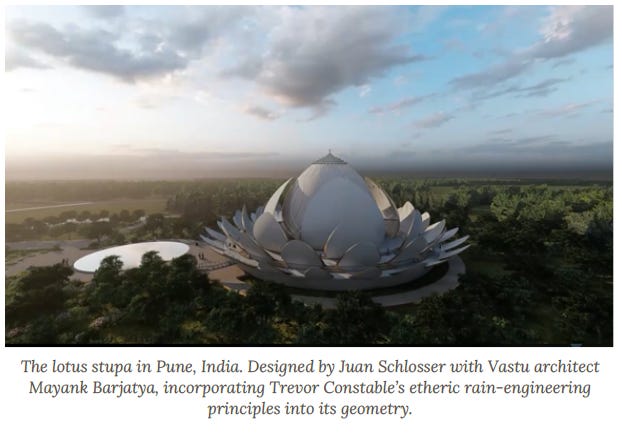
This is a large lotus stupa being built in Pune, India, designed by Juan Schlosser, with the main architect being our good friend and associate Mayank Barjatya, a brilliant Vastu architect there. And yes, we only have preliminary reports being fed back. What they have noticed, what their Guru has noticed, is that it’s basically greening the area, and there have been light rains, kind of like a release of atmospheric tension. We haven’t had any real in-depth reports on this. These were just some preliminary reports that came back as they are building it, but it makes a lot of sense to us, because fundamentally Juan incorporated a lot of the concepts of Trevor Constable’s etheric rain engineering technology into his architectural design. In Trevor’s terms, stagnant atmospheric energy is restored to flow, and rain is the natural discharge of that restored circulation. In electrical terms, the stupa acts as a harmonic node between earth potential and atmospheric potential, and the light rains are the visible sign of that exchange. Juan is a brilliant bioarchitect in his designs and his concepts of Nature and materials. And without going into detail, there are certainly integral parts of this technology based on intentionally harmonizing heaven and Earth in the process. That was the plan, and it appears to be working.
9. Your articles on somatids and microzymas challenge fundamental assumptions about disease. You present cancer as reversible through terrain restoration. What exactly are somatids, and why has mainstream medicine ignored this research for 150 years?
A fascinating question, and I just wrote another article on this, and I’m still working on a more major paper in further detail. There’s a whole history of people showing that even after solutions were sterilized, or matter from ancient geological strata, life is still able to arise from the apparently inorganic.
The somatids, or microzymas, as Béchamp termed them, are basically the smallest part. Béchamp called them the third anatomical element of the blood (along with red and white blood cells) and theorized they are responsible for clotting, and they appear to survive even cremation and to be part of rebuilding life again. Why has all this been ignored? Go back to the 1870s and the rivalry between Pasteur and Béchamp. Pasteur held that fixed microbes invade the body from outside; Béchamp held that the microzymas within us transform according to the condition of the terrain. Pasteur’s model won, through politics and the dominance of left-brain materialism, and an entire medical and pharmaceutical edifice was built upon it. Pleomorphism asks that edifice to reconsider its foundation.
The somatids go through three stages in the normal blood and health of a person. But when the system goes more acid, away from alkaline, they start transforming. There’s a whole cycle, and they morph into various forms: different bacteria, rod-shaped bacilli, and even what some call viruses. I know there are a lot of people saying there are no viruses, and there’s this whole contention around what’s actually seen at that level. And I agree, there are a lot of serious questions. As I said earlier, until all the facts are in, I’m not making a final determination on this. I’m keeping an open mind, and there are some very open questions about the reality of what these small bodies are and what they actually do.
But the fact is there’s this whole historical record of them, and of life arising spontaneously. I just released my most recent article on this in detail, going from Andrew Crosse to H. Charlton Bastian, Béchamp, Enderlein, Reich, Rife, Gaston Naessens, Charles Littlefield, Morley Martin. There’s a whole string of these researchers. I have a friend who works at a laboratory that tests blood, and she’s very much into this, which she keeps quiet on at work. I asked her, all of what Béchamp, Rife, Naessens, etc. observed, is any of this actually observed in the lab these days? And she said yes. They just call them molecular granulations. They’re non-motile, so they ignore them, because they don’t extract them to do experiments with like some of these early researchers did.
And as Trevor pointed out in many conversations with me, as well as in Cosmic Pulse and in articles, wherever the life force appears, there is this absolute rejection of it, this biopathic rejection. Reich was imprisoned for contempt of court after an FDA injunction against his accumulators and literature, and died in Lewisburg Federal Penitentiary in 1957. He refused to accept that the courts had jurisdiction over his experiments. He said, look, this is human knowledge, it’s science; courts can’t have jurisdiction over the advancement of human knowledge. And they said, watch this, buddy. And he went into jail, where he mysteriously died. So officially there is no life force, in medicine or law. As Trevor would note, you can go to the greatest Western medical universities, and they can’t tell you the intrinsic difference between a living being and a corpse. They know which is which, but there is no definition of the life force. Yet, he said, you can go to Shanghai or Hong Kong, and even the street sweepers are practicing their qigong, circulating their qi inside. It’s obvious there’s something there.
And this probably ties in with Shlain and McGilchrist and this whole left brain, right brain thing. That’s where I see the problem arising, and why the living force and living energies aren’t being brought into the fundamental arts of healing: you can’t commercialize it and run it as a multi-billion-dollar business at that point. As well, it completely disrupts all the concepts of evolution. It turns science upside down and makes one think. Keep your conclusions in suspension; all the facts aren’t in yet. Let’s collect some more facts. Isn’t that what science is supposed to be about?
10. Wilhelm Reich’s bions seem central to your synthesis of pleomorphism and bioelectricity. You describe them as “luminous vesicles of charge.” How do these relate to what Eastern traditions call chi or prana?
Well, I think I answered that in part in the last question. For sure, the orgone is the chi or qi energy. And why not? It’s the life energy. We can call it by different names, but obviously we’re alive. And as Reich showed in experiments, and as we see from all these other researchers I’ve mentioned, life can spontaneously arise from inert matter under the correct conditions. When Reich heated sand or coal to incandescence and placed it in a nutrient solution, he observed tiny vesicles that pulsed and glowed blue: bions. They sit precisely at the threshold between the inert and the living, and their blue luminescence is the orgone itself. The yogi calls it prana, the Taoist qi; the Chinese character for qi carries the image of rising vapor, breath made visible. Reich found that breath glowing under his microscope, a living charge bounded by a membrane, the first step from mineral toward cell. So where did life come from in the first place? Where did consciousness come from? I don’t have the answers to those. I just know that I’m here thinking and my heart’s going. And obviously there is a living energy driving all of this, which has been measured, even if they threw the man who discovered it in jail to shut him up.
11. The “Six Phases of Cancer” model traces cancer back to prolonged psycho-emotional trauma. This contradicts the genetic mutation theory. Can you walk us through how emotional states actually create the conditions for cancer?
Well, sure. These ideas come from a paper, “Psycho-Oncology: The Six Phases of Cancer,” by Glenn Russell. Someone serendipitously posted it on LinkedIn while I was writing some of these articles. So, I haven’t gone into it in great depth; I analyzed it for the article as it showed a clear, stepped eventuation. It’s a pretty simple process, and it ties in with Reich’s emotional character armoring bringing on cancers (in his Cancer Biopathy), explained in more detail. First, prolonged psycho-emotional trauma disturbs your neuroendocrine system. I think that’s pretty understandable without going into technical detail. What this causes is adrenal depletion and mitochondrial breakdown; the system starts losing its ability to function properly. Then you start getting glucose and lactic acid buildup (Otto Warburg, Nobel laureate in 1931, found that cancer cells shift to fermenting glucose into lactic acid), and you start moving away from the alkaline state, which allows the somatids, or microzymas, to go through their more advanced pathogenic pleomorphic cycle. The somatids go into a fungal phase and start infiltrating the cells, and this cuts off the pathways for defense. The cells become malignant and start growing independently; it takes over. But the important point of this paper, as well as explaining how it happens and showing that the somatidian process is essential to it, is that pathogenic conditions like this are terrain-based rather than genetic. Russell’s thesis holds that such conditions are totally reversible with restoration of the natural terrain balance of the body.
12. Your article on fungal intelligence suggests mushrooms operate like natural neural networks following the classical Trivium. Are fungi actually thinking, and what does their intelligence teach us about consciousness?
I am convinced that fungi are a form of vast distributed intelligence. There appears to be no doubt on that. Relating to the Trivium, with its Grammar, Logic and Rhetoric processes of acquiring, comprehending and expressing knowledge and experience; in fungi, grammar is reception: the hyphal tips read their chemical and electrical surroundings. Logic is integration: the network weighs and routes that information across its whole extent. Rhetoric is expression: it answers by directing growth, fruiting, and sending signals to the trees and soil life it serves.
What exactly this intelligence is and how it thinks, whether it’s discursive, like our conversation here, or in another state that we don’t really know about in our current state, that’s a good question. But clearly intelligent. Mycelial networks transfer intelligence over vast areas using chemical signaling very similar to neurotransmitters in animals. They’re obviously thinking. And we know from Suzanne Simard’s work on the “Wood Wide Web” that these are actually part of the communication links between trees. So where is the line between species? What is really happening here? Are things individual species, or is the biosphere one organism, and these are different organic functions within it? Fungi lack a centralized brain, but they exhibit the behaviors of distributed networks, anticipatory planning and so on. And we have fungi in our microbiome. It’s essential to our life; we’re integral with it as well. Structurally, our human cells are actually closer to fungal cells than to bacteria.
Overall, it makes us think, well, what is consciousness? How do we really know anything? We have it while we’re thinking, and we go, yep, I’m feeling something in consciousness right now. But how can we get to the roots of that and trace it back to its origins? Looking at intelligences like fungi really makes us think, especially when they act, as I say, with a Trivium process, with grammar, logic, and rhetoric. They’ve got these inbuilt processes, which are like the basic cognitive functions not only of our minds but also in a general sense of computer systems: input, processing, output. If they’re functioning at that level, then where is their intelligence seated? And let’s look at a side view of this with Jagadish Chandra Bose, who showed that metals like copper and zinc have response curves to drugs the same as animal and plant tissues; they’re also responding. Where’s the line between life and non-life, consciousness and non-consciousness? I think humans are so wrapped up in their discursive, lower egoic points of view that they can’t conceive that their life is integral in this vast biospheric milieu energetically connected to an intelligent cosmos.
13. You describe a fundamental polarity between form and force that runs through all your investigations. Ernst Lehrs says “form before force,” but Reich seems to show force creating form. How do you reconcile this apparent contradiction?
Now, this is a great question, and I’ve pondered it for the past 40 years. The dictum comes from John Ruskin, whom Lehrs quotes in Man or Matter. In The Ethics of the Dust, asked “What is life?”, Ruskin answers with a laconic injunction: “Always stand by Form against Force.” He enlarges it with an image: “Discern the moulding hand of the potter commanding the clay from the merely beating foot as it turns the wheel.” Lehrs points out that Ruskin is really contrasting two kinds of forces: the potter’s foot, producing mere numerically regulated movement that a machine could replace, and the potter’s hand, striving toward an end and so creating definite form. For Ruskin, form is the true signature of life, the dynamic element through which a being reveals itself to us as a whole.
Lehrs carried that stance into natural science. For many years I read the dictum in two ways: as a method of cognition, and as the archetype arriving from a Platonic realm, a blueprint impressed upon matter. György Doczi’s The Power of Limits changed my reading of this. The archetype works as a tendency, and the limits it meets give it its actual form. So, I now see one dictum unfolding as a single path, from the phenomenon, through the living forces, to the archetype as process.
The path begins with a discipline of cognition. In the Goethean approach, we begin with the phenomenon as it presents itself: the metamorphosis of the leaf up the stem, the colored edges seen through the prism, the gesture, polarity and sequence of what we actually observe. Only afterward do we turn to the forces, as partial descriptions of what has already shown itself. Form is read first; force is inferred second. That order keeps our own symbols from hardening into causal idols.
From there we can approach the supersensible forces themselves, and here Reich’s work fits Lehrs rather than contradicting him. Orgone, like the etheric formative forces described by Guenther Wachsmuth and others in the Anthroposophical tradition, works from the periphery inward. George Adams showed through projective geometry that every center has its counterpart in a periphery. Lehrs describes form arriving from that periphery, the etheric plane-pole, and Reich’s orgone, which Trevor equated with the Chemical or Tone Ether, moves in the same direction. Reich’s examples are vivid: his cosmic superimposition, where two converging orgone streams spiral into the form of a galaxy or a hurricane, and the bions, organizing out of disintegrating matter into pulsating vesicles and then protozoa. So, when Reich shows force creating form, he is observing the same peripheral, formative activity that Lehrs points to. As Trevor would note, the etheric forces move from low to high. A living being holds a strong potential and draws in weaker ones from its surroundings, just as an orgone accumulator does. Reich called this the orgonomic potential, the reverse of mechanical energy, which always runs from high to low. In Ruskin’s image, mechanical energy is the potter’s foot; the orgonomic potential is the potter’s hand.
Cymatics shows how that formative movement becomes form. A tone sets a plate vibrating, and a figure appears. Change the plate’s size, shape or edge, and the same tone draws a different figure. The tone carries the tendency; the limit of the plate decides the figure. We see here Doczi’s power of limits: boundary as the womb of form, whether membrane, skin, bark or the rim of a vessel. Richard Merrick’s Interference Theory says the same from the side of resonance: harmonic order is what interference looks like when it holds. Form appears where process meets limit, and geometry is the record of that meeting. The archetype lives as a lawful tendency, flexible and metamorphic in the Goethean sense, realized afresh through each meeting of process and limit. Lehrs shows the same in Goethe’s leaf sequence, where each new form comes to the fore through forces that “increasingly prevented the leaf from filling in the whole of its ground-plan.” Goethe saw adaptation itself as “the response of the spiritual type to the conditions meeting it from outside.”
This is also where the Platonic reading leads us astray when applied loosely, and the same temptation runs through contemporary harmonic cosmologies: treating the geometry we recognize in finished forms as the engine that produced them, or as a fixed law dictating what may exist. Spirals, vortices, branching and rings recur throughout Nature because similar processes meeting similar limits leave similar traces. Geometry illuminates, constrains and records the living activity from which it arises.
So, form before force describes one path. We stand first with form as we experience it, follow the forces as living process, and recognize form as what becoming looks like when it pauses at its limits. That makes it the essential dictum of the qualitative sciences.
14. Your work suggests life exists on a spectrum from plasma beings in space to microzymas in our blood. Does this mean consciousness is everywhere, and we’re living in an animate universe?
Well, my feeling in philosophy is that, yes, consciousness is everywhere, and matter is actually the expression of consciousness, through stages. From Trevor’s bioforms in the sky to Béchamp’s microzymas in the blood, the same pattern repeats at every scale: life organizing charge into coherent, pulsing form. That pattern is what I mean by a hylozoic, panpsychic universe. As Steiner indicated in his work, especially in his Agriculture Course, the elements of the chemist are the corpses of cosmic processes, of things that have come before. Modern science looks at everything as dead. It looks at the centers of galaxies as black holes only because of the limited scope of the modern gravity-based equations. Whereas if we really look at what’s happening around galactic centers, they’re like active plasmoids, with organic molecules nearby, and water (H2O) and organic molecule masers in star-forming regions. Halton Arp’s work points towards galaxies themselves giving birth to quasars, proto-galaxies, which then grow into galaxies in turn; the universe growing rather than expanding. There are a lot of amazing phenomena occurring in space, which the reigning paradigm attributes to collapsing, crashing and explosions instead of building up, all dead kinetics. The Electric Universe / Thunderbolts Project group has put out some really excellent videos on what’s happening around galactic centers, if people really want to go and have a look rather than just believe in imaginary things like black holes, the dead-end objects of the modern scientismic religion. We live in a universe of life and light, much more wonderful to conceive than one of dead matter, terrifying black holes, and dark matter and energies, all dark and dead.
If not everywhere, then where else would consciousness be? Just look at the order of everything: the order of the planets, the order of life, down to the smallest types of life and their complexities. And if we can see, through the researchers we discussed earlier, that life arises de novo under certain conditions out of so-called inorganic materials, some of which, as Bose showed, react to stress and drug chemicals and things like that, then the complexity that arises from those has to come from some sort of archetypal pattern or force, which apparently metamorphoses too. Because if we look at the different geological layers of our planet, they’re taken as evidence for evolution, but what we really see is a progressive punctuated equilibrium of transformed biospheric systems, each with different types of life within them.
So, yes, I think that we live in an animated universe. Everything’s moving and living, and everything that happens, within the Sun, solar activity, what the Moon is doing, all of these affect our consciousness and our bodily functions. We’re totally wired in. Of course, we need to have individuality, and we need to selfishly take care of our biological units, otherwise we can’t be thinking about all these fascinating concepts. But fundamentally, that also limits us. It restricts us from grasping the true extent of consciousness in the universe. And that’s why I like taking the Goethean approach, working through Lehrs’ Man or Matter, as I’ve mentioned. Once you start studying plant metamorphosis and understand what higher organs of cognition are, you start leaving the realm of discursive consciousness while still retaining this type of awareness. And it’s no longer a matter of “do you think this is happening?” It’s that you can experience it in many different ways, and these experiences can be common. This is the main complaint of skeptics: well, how can you prove that? Well, prove it to yourself. And how can anyone prove it isn’t happening, especially if you can implement it into technologies, which is something we’ve striven for, such as in the bioarchitecture we’ve discussed, and in the BioVortexer water structuring unit I developed with Juan Schlosser? I think that’s a very concrete example of the pathway these ideas can take.
15. Given all you’ve learned about consciousness, energy, and life, what gives you hope for humanity’s future despite the current global challenges?
Well, I hope people don’t get too upset about this answer, but I’ve got to be honest: I don’t really have much hope for humanity on its present course. I think in the long run, the life wave is going to carry on in certain ways. I think we’re heading into some very dark days, and that’s why I promote the work and ideas that I do, because it’s not about humanity as a whole. It’s about individual spiritual liberation through a pragmatic metaphysics, through finding what I call a spiritual proprioceptivity amongst the living energies of the objective world that we live in, what could be called the Nirmanakaya level of the Vajrayana. By spiritual proprioceptivity I mean the capacity to sense where one stands within the living field, much as the body senses the position of its limbs, so that one moves through the experiential world oriented by direct perception of its forms and forces. And this orientation will carry on after death; this is how I see the training for passage through the after-death bardo states. Long ago, a friend got upset at me because he said, “Oh, you can help save the world.” I said, “I don’t want to save the world.” He said, “Why not?” I said, “I’ve got enough work just trying to save myself. I’m on a path that will carry on past this lifetime.” What we do is the best we can: you resonate these ideas out and let people pick them up. It’s about individual action. Look at tales like Star Wars. The system, the Empire, everybody’s marching in hierarchical order all grim and dark of intent. And who are the Jedi? They’re a bunch of oddball individual characters who connect their inner being with the living force of the universe. I suppose if there’s any hope, it’s in people like this.
It appears that we’re heading into a geomagnetic excursion, in other words a shifting of the magnetic poles, in the next few decades, noted by the progressive weakening of the field since the 1840s and the growth of the South Atlantic Anomaly, amongst many other earmarks. How much of humanity will survive that is an unknown, and I expect it will be a small number that will rebuild on the next upswing of the yugas. It will be the incarnation of souls that developed their spiritual proprioceptive nature through their experiences, who can come back and begin building, drawing from the archetypal nature of reality to reconstruct civilization. That’s speculative, of course, but it’s the way I think. Personally, I don’t plan on coming back, if that’s even possible, because I see a whole universe off planet. I’ve been plotting the bardo pathways for over half a century for this purpose. My perspectives on how this all came about and exists, from the plasma / electric universe concepts, and Halton Arp’s work describing galactic arrangements far at variance with the presently accepted model, the latter of which curiously finds congruences with John Lash’s interpretation of the Sophia Mythos, lead me to see a higher realm above it all. Call it Heaven, call it the Pleroma. I conceive of the Pleroma as being in the center of our galaxy (for us), and my general plan is to head there after this current personal biological lifewave of mine ceases. See what happens next from that perspective. Thankfully, I have more time to meditate on it all and continue preparing.
16. What projects are you currently working on, and how can readers who resonate with these ideas stay connected with your research and upcoming work?
I have a few major papers in progress. I work in a rather undisciplined manner, a bit like a cat who is curious about things for a while, then finds fascination in something else and scurries over to check it out. I’m working on an article on Firstenberg’s Invisible Rainbow thesis, tying the manifestation and evolution of modern diseases in with the progression of electric and electronic technologies on our planet, and comparing that with heliobiology records and related data, along with several other concordant streams. Another reviews the whole 2020 global coup attempt in light of certain cosmic alignments critical to the Era-2012 alignments, along with scientifically recorded machinations and developments. I get these insights and inspirations, and work to accumulate and assess the data, and at some point, I get overwhelmed working to make my vision simple enough to transmit. My recent article on The Living Universe, for example: Conceived decades back, with continual accumulation of data, then I worked on that for over a year, then it sat fallow for months, then I finished it off in a couple of days. So I have a lot of work in progress and lined up. Being a natural philosopher is not a very high-paying job, so with no deadlines there’s an aspect of motivation missing. Yet it is very satisfying being able to complete larger thoughts and see their connections with other streams of ideas. And when I get there I feel it is my obligation to share.
I did a lot of work in the past year on the Sacred Geometry of Water, which I see as of some significance, and which explains a lot of ideas and phenomena in Nature and the biological realms. I’m also working now on creating a Path of Light workshop, on the Goethean perspective of how color forms from the interaction of light and dark, refuting the concept that there are seven colors inherent in light. One can readily see this with simple prism experiments. Trevor turned me on to this. I’ve had prisms all my life, since I was young. At 28, inspired by Lehrs, I pulled out my big prism and looked through it, and realized I had been wrong up to then in believing the Newtonian dogma. There’s a lot to this. It’s a workshop I’ve given in various forms in the past; this one will be more in depth, answering critiques of the Goethean theory through experiments. It also delves into the plasma critters, Reichenbach, electricity, and the natural light / electric wave polarities of propagation as per Steiner, and more. The tiny portion of the electromagnetic spectrum we can see is the key to awakening to the higher forces; the archetypes are visible once we shed our paradigmatic armor.
If people want to follow my work, my Chronicles of Alkemix Substack is where I mostly publish; future articles and announcements will come through there. https://alkemix.art
My recent article is a good place to start.

Some of my workshops including the Sacred Geometry of Water are available at for those interested.
In Print
The Unbekoming library is available in paperback, printed to order through Lulu and shipped worldwide. The shelf begins with the paradigm question underneath everything else — No Virus, the isolation problem, the collapse of virology’s foundational claims, and a disease-by-disease reappraisal — and moves through the suppressed compounds mainstream medicine set aside: The DMSO Book, Chlorine Dioxide: The Forbidden Remedy, The Iodine Book, and The Hydrogen Peroxide Book. Two more recover what’s still on the kitchen shelf: Baking Soda and The Castor Oil Book. Two more recover the minerals modern soil, water, and processing quietly stripped from the diet: The Magnesium Handbook and The Boron Book. Sitting alongside these is No Contagion, co-authored with Jamie Andrews — the case against germ theory itself, catalogued through 258 failed contagion experiments.
The critique books cover what medicine, dentistry, psychiatry, and veterinary practice have become. The Unvaccinated treats the completely unvaccinated as a comparison group across twenty chapters and five appendices. Medicalized Motherhood follows a woman through 123 documented interventions from teenage pill to postpartum discharge. Drilling for Profit treats cavities, gum disease, and crooked teeth as the dietary problem they are. What Your Vet Can’t Tell You applies the same critique to pets. Escape from Psychiatry documents the fabrication of the DSM and the specific damage of every major psychiatric drug class. The Vitamin K Injection covers what happens in the first hours of a newborn’s life.
The full shelf is at lulu.com/spotlight/unbekoming. A physical book reaches the person a Substack post never will — the skeptical relative, the friend who won’t click a link but might open a book, the visitor whose eye lands on a coffee table. Buy one to keep, and one to give away.
Thank you very much for this magnificent interview and for bringing back historical and scientific perspectives that have been sidelined for far too long.👍🙏🏼🏆
We are dealing with prominent researchers who, from various vantage points, dare to challenge the boundaries of conventional medical thought. They confront the profound myopia of modern medicine—a field overly fixated on reductionism, symptoms, and treatments—which frequently overlooks the complexity of the organism and its innate regulatory mechanisms.
I find the view of life as a dynamic, integrated system—where cellular metabolism, mitochondria, bioelectricity, water, the microbiota, and the biological environment are in constant interplay—to be particularly valuable.
I would also highlight the renewed attention given to the work of Béchamp, Reich, and other researchers who questioned the overly reductionist explanations prevalent in biology. Their approaches invite us to broaden our perspective and investigate phenomena that we still do not fully understand.
We need a medical approach that goes beyond merely combating symptoms; one that investigates root causes, respects physiology, and pays far greater attention to the biological terrain, metabolism, and natural repair mechanisms.
Special mention must be made of Gerald Pollack’s extraordinary work on the properties of water—specifically its fourth phase (EZ water)—and its potential role in cellular organization and function. It is truly remarkable that Gerald Pollack remains so active within both the scientific and public-outreach spheres. His interview, published in May 2026, demonstrates that he continues to advance and share his research on water, bioelectricity, and the fundamental principles of life. https://soundquality.org/2026/05/the-water-cover-up-gerald-pollack-phd/?utm.com
Medicine requires fewer dogmas, more scientific curiosity, and a truly holistic view of life.❤️