

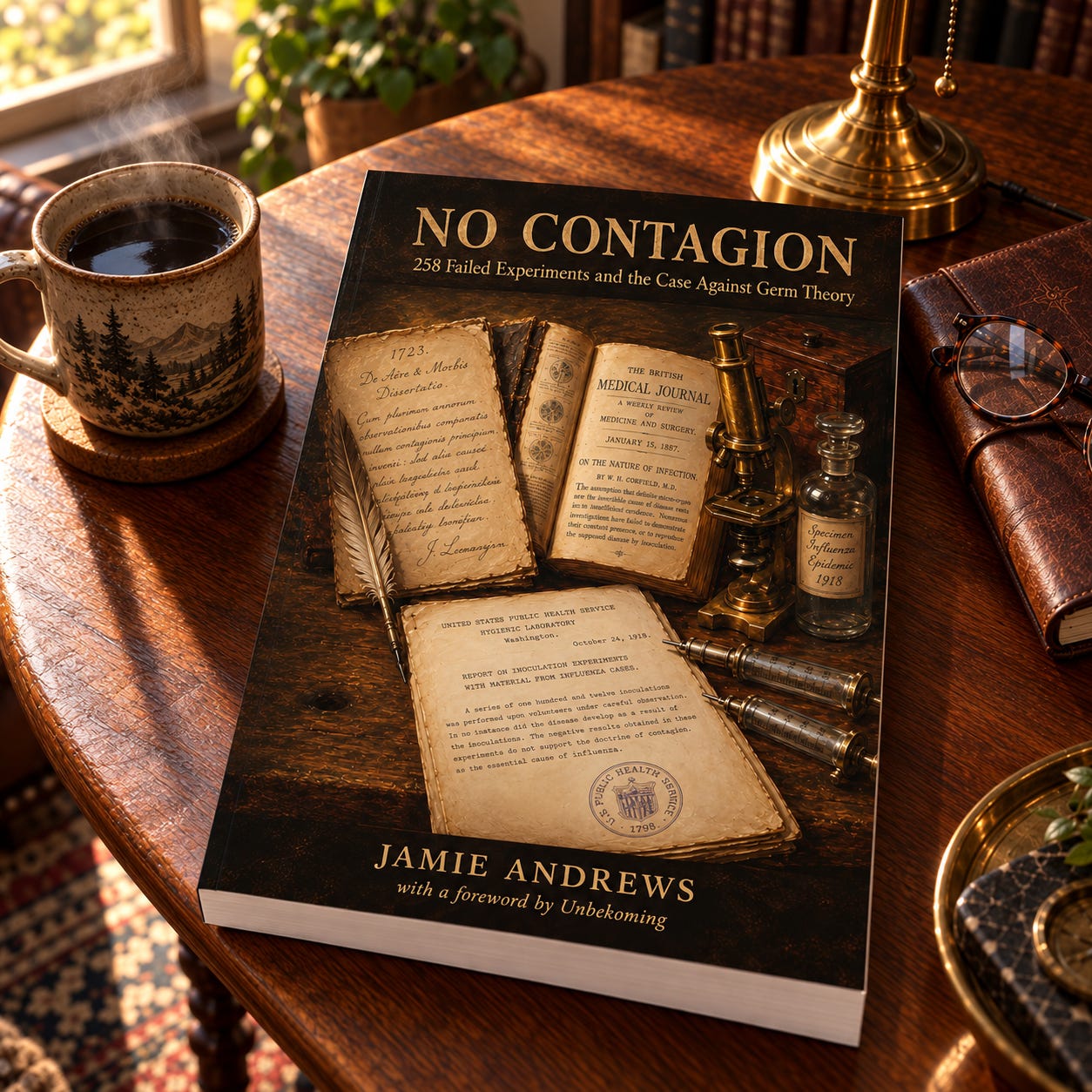
Germ theory has a test. It failed.
No Contagion is the catalogue of that failure. 258 controlled human infection experiments spanning three centuries, each one an attempt to demonstrate the specific mechanism the theory rests on: that a sick person’s fluid, transferred to a healthy body by any route the theory identifies as sufficient, produces the same illness. Across three centuries, the mechanism has not been demonstrated. The book documents the alleged pathogen, the method, the exposure route, the subject count, and the outcome for every entry. The Index of Diseases at the front lets a reader look up any specific disease, whether measles, polio, chickenpox, whooping cough, cholera, or HIV, and jump straight to the studies that tested it.
The standard the book judges against is the theory’s own. Robert Koch’s postulates required that a microbe claimed to cause a disease be found in all cases of the disease, isolated in pure culture, and then reproduce the disease when inoculated into a healthy host. Koch struggled with his own rules from the start. His 1884 cholera work identified an organism in patients but could not reliably produce cholera when inoculated into healthy volunteers. In 1937 Thomas Rivers rewrote the postulates for what he called filterable agents, dropping the pure-culture requirement, softening the requirement to produce disease in a healthy host, and permitting causal inference from indirect evidence. That weakened framework is the operational one for what modern medicine calls viral disease. The 258 experiments in the catalogue apply the original standard.
The 1918 experiments are the signature case. At the height of the deadliest respiratory illness event on record, 161 healthy Navy volunteers at three US quarantine stations were subjected to what the investigators called the most comprehensive human contagion experiments ever undertaken: cultures sprayed into their nostrils, mucus from sick men administered by every route, direct face-to-face exposure to men severely ill, breathing and coughing into their faces. Not one fell ill. The lead investigator, Rosenau, published in the Journal of the American Medical Association: “we are not quite sure what we know about the disease.”
Two case appendices at the back go deep on the two most-cited events in the germ theory record. The first documents the polio and arsenic-DDT pesticide connection, 1869 to 1960, a pesticide-poisoning history sold as a viral epidemic. The second covers the 1918 flu, First World War chemical warfare, and the Rockefeller Institute’s meningitis vaccine trial at Camp Funston. The “what actually happened” answer for the two events germ theory keeps pointing to.
Coming to terms with the false narrative of contagion is critical to coming to terms with virology itself. Virology’s load-bearing claim is that viruses are causal agents of disease that hop from person to person. Remove the contagion claim and the framework has nowhere to stand. This book is the audit of the claim.
The digital editions are now available, following the print-only window: PDF for paid subscribers, EPUB for platinum supporters.
Digital Edition - Paid Subscribers
EPUB Edition — Platinum Supporters
An EPUB edition, readable on Kindle, Kobo, Apple Books, and any e-reader that supports the format. Platinum Supporters can download it below.
I remain grateful to Jamie Andrews for the opportunity to publish his book and contribute the foreword.
For readers who came in through No Virus and want the evidentiary twin, or who came in through No Contagion and want the framework audit that sits underneath it, the two books are a pair. No Virus is the framework critique, a systematic examination of germ theory’s foundational claims. No Contagion is the evidentiary catalogue, 258 failed contagion experiments the framework never demonstrates. Together they are the paradigm case, both sides of the same argument.
If you already have the paperback, the digital edition is the same book in searchable form. The Index of Diseases becomes a live navigation tool, and every study entry is a tap away. If you don’t have either book in print yet, both are still on Lulu.
Buy No Contagion. Paperback, ships worldwide in 3 to 5 business days.
Buy No Virus. The companion volume.
Read them. Hand them to the people who need to see them.
None of this work happens without paid and platinum subscribers. Thank you.
Support This Work
The essays are free and will stay free. What paid subscribers get is the library that surrounds them: the full digital book catalogue, audio deep dives, archived, and embedded in each essay, and the Questions for Your Doctor, Before You Consent, and Package Insert series. Platinum Supporters also receive the digital edition of every paperback on the day it’s published.
Whichever tier suits, thank you for being here. If you’d like to become a paid subscriber, upgrade a tier, or gift a subscription to someone who might value the work, the options are below.
I learned not to fear germs. When I was eleven years old, I was roller skating and fell on the street. I opened my knee to the point, where you could see white cartilage, before the blood started pouring out. I crawled to the curb and sat there praying for the blood to stop. it was quite awhile, but the bleeding finally stopped. I hobbled home and went into the medicine chest. There was some adhesive tape there. i cut some and taped the wound closed. I never said a word to my parents.. The wound healed without a problem. However, I knew when it ws going to rain for years...it twinged. I learned later that the bleeding cleanses the wound...and it didn't become infected. Being a child, i never worried about it. Today, I still feel the same way...I don't worry about contagion...if you can't see a germ, why worry about it?
How can the rift between the covidians and the covidiots be mended?
It’s like two religions in a forever war now.