

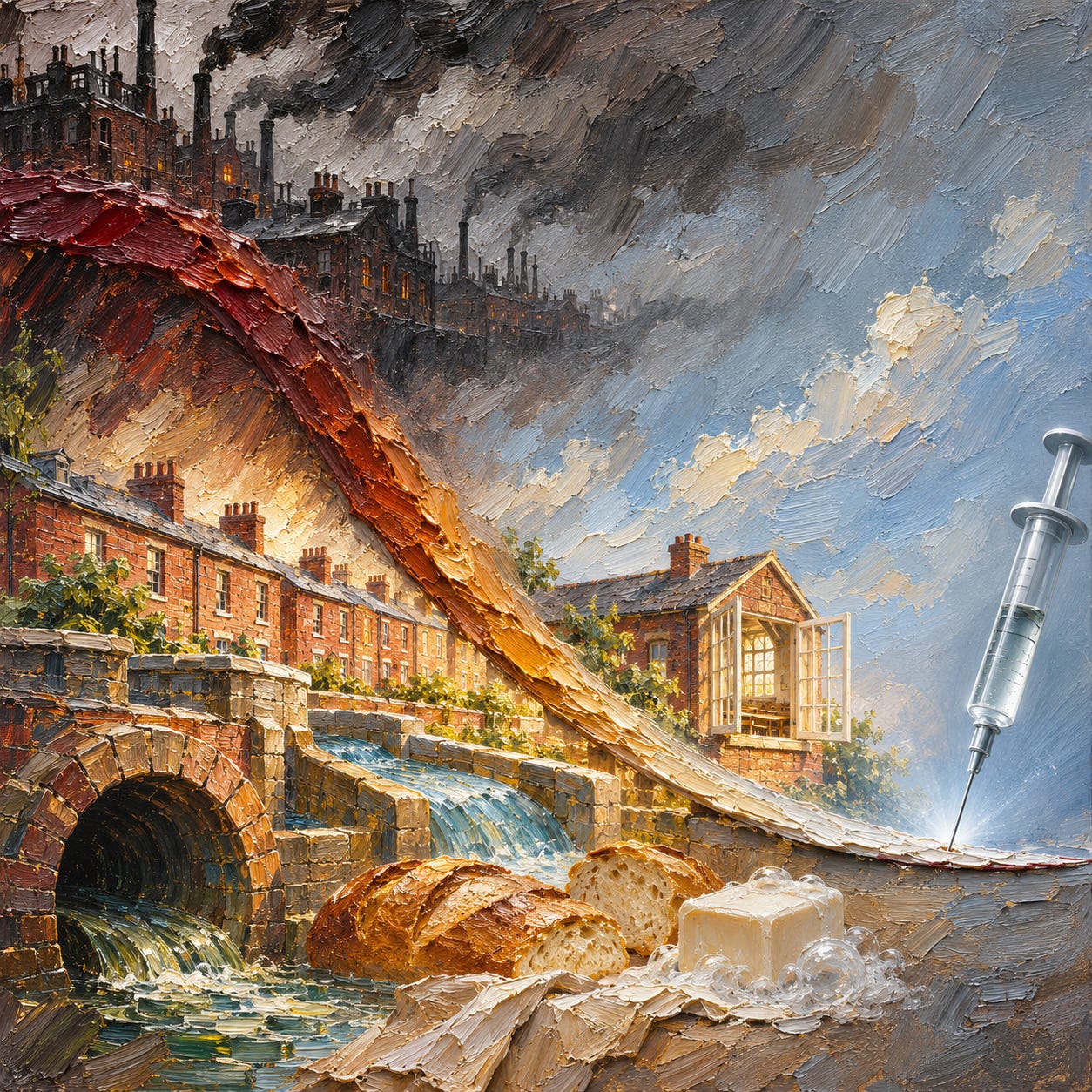
Author’s note: This essay examines nineteenth and twentieth century mortality data alongside the civil-engineering measures that drove those deaths down. Where the record is reported in establishment terms (bacterial causation, germ theory classifications, standard disease categories), those terms appear within quotation or attribution. The terrain paradigm operates in the analytical voice throughout. The question is not whether bacteria exist. Bacteria exist. The question is what caused these diseases to disappear, and whether the story medicine tells holds up against the data medicine itself produced.
“Medical measures (both chemotherapeutic and prophylactic) appear to have contributed little to the overall decline in mortality in the United States since about 1900.”
John B. and Sonja M. McKinlay, The Milbank Memorial Fund Quarterly, 1977
I. The two anchor curves
Victorian England buried more children from scarlet fever than from measles, diphtheria, and whooping cough combined.¹ The disease then vanished. No vaccine was ever developed for it, and penicillin arrived only in 1944, when the decline was already in its eighth decade. In the early 1860s the death rate from scarlet fever among English children peaked at approximately 2,300 per million. By 1945 it had fallen to a level low enough that scarlet fever ceased to feature in the leading causes of childhood death in the United Kingdom.²
Tuberculosis followed the same pattern on a larger scale. In the United States, death from “all forms of tuberculosis” was recorded at approximately 194 per 100,000 in 1900. By 1945, before the mass availability of streptomycin and before any national campaign using BCG, the figure had fallen to approximately 40 per 100,000. The decline of over three-quarters preceded the arrival of effective antibiotic treatment and preceded widespread use of the vaccine that institutional citations often credit with controlling the condition.³
The pattern these two curves document is simple to state. A condition rises during the industrial transition, peaks under conditions of urban crowding and malnutrition, and falls as those conditions are corrected by sewer construction, water filtration, housing codes, labor reform, meat inspection, and the gradual replacement of industrial squalor with industrial infrastructure. The fall precedes the medical intervention. In many of the twelve cases that follow, no medical intervention is ever introduced. In others, the intervention arrives at the end of the curve, and the curve is credited to the intervention.
The point is not that medicine never contributed to any decline in disease mortality. The point is that medicine systematically took credit for declines it did not cause. The pattern of credit-taking became the template by which vaccination’s reputation was built. A reader who understands the template can test it against any claim medicine makes about any specific disease. The record of twelve diseases below is the material on which that lens is built.
Medical education in the United States and the United Kingdom does not routinely teach the mortality curves of the nineteenth century alongside the chronology of pharmaceutical introduction. A graduating medical student will have memorized the dates of key vaccines and the organisms they target. The same student will not have seen the mortality graphs that show those vaccines arriving at the floor of curves that had already fallen. The omission is not accidental. The curves and the dates together constitute an answer to a question the curriculum does not pose, because posing it would unravel the attribution structure on which the profession’s public standing depends.
Essay PDF Download (Free Subscribers)
Audio Deep Dive (Paid Subscribers Only)
Support This Work
The essays are free and will stay free. What paid subscribers get is the library that surrounds them: the full digital book catalogue, audio deep dives, archived, and embedded in each essay, and the Questions for Your Doctor, Before You Consent, and Package Insert series. Platinum Supporters also receive the digital edition of every paperback on the day it’s published.
Whichever tier suits, thank you for being here. If you’d like to become a paid subscriber, upgrade a tier, or gift a subscription to someone who might value the work, the options are below.
II. Scarlet fever
Scarlet fever is reported in the standard medical literature as a complication of streptococcal infection, specifically “group A streptococcus.” The organism was identified in the 1870s. The decline in scarlet fever mortality began in the 1860s, before the organism was identified, and continued through the first half of the twentieth century without any effective targeted treatment. Penicillin, which the official history now credits with controlling streptococcal disease, became available only in 1944. By 1944, scarlet fever had already fallen by approximately ninety-five percent from its Victorian peak.⁴
The decline tracks closely with specific civil-engineering milestones. The Public Health Act of 1875 consolidated and expanded sanitation requirements in England, including sewer construction and water-supply standards. The Housing of the Working Classes Act of 1890 required local authorities to clear slum housing. The Factory Acts of 1874, 1878, and 1891 progressively reduced child labor and limited working hours. The Public Health (Notification of Infectious Diseases) Act of 1889 required cases to be reported, enabling local authorities to isolate affected households and clean contaminated premises. The Education Act of 1870 had already begun removing young children from the mills and the mines into schools, where they received at minimum some meal provision and some respite from industrial labor. These statutes produced, over the following decades, a population of children who were less crowded, less malnourished, less exhausted, and less exposed to raw sewage than the children of the 1860s.
The mainstream sometimes attributes the fall to “changes in the virulence of the streptococcal strain.” The strains available to twentieth-century microbiology are presented as functionally identical in laboratory terms to those circulating in the Victorian period.⁵ By the mainstream’s own evidence, the organism did not change. The children in whom it was identified changed, along with the sanitation, food, and housing in which they lived. The disease followed those changes down.
Charles Creighton’s A History of Epidemics in Britain, published in two volumes in 1891 and 1894, documented the Victorian scarlet fever curves in detail. Creighton, Britain’s leading epidemiological historian of the late nineteenth century, recorded the rise and fall of scarlet fever alongside the measurable changes in living conditions that accompanied it. His documented curves have not been seriously disputed in the historical literature since. No medical intervention appears in his account that could plausibly have produced the decline.
Scarlet fever is the cleanest demonstration case in the mortality literature because no vaccine ever existed to confuse the attribution. The curve fell to near-zero without any vaccine campaign and without any targeted antibiotic until the final years of the decline. What produced the fall was the correction of the terrain in which the illness had manifested: acts of parliament, civil engineers, and reformers who insisted that working-class children should not sleep eight to a room on streets flooded with sewage. The vaccines administered today against measles, diphtheria, and whooping cough are credited with declines that scarlet fever, more deadly to Victorian children than all three combined, accomplished without a vaccine.
III. Tuberculosis
Tuberculosis mortality in the industrial cities of the nineteenth century was so high that modern readers struggle to credit the numbers. In London in the 1830s, pulmonary tuberculosis accounted for roughly one in three deaths among adults between fifteen and thirty-five.⁶ Across the industrial populations of Europe and North America, tuberculosis was the leading cause of death. By the mid-twentieth century it had become a condition of the destitute, the imprisoned, and the elderly.
The decline is the single most important data point in the mortality literature of the industrial era, because the official credit sequence for the decline is so clearly contradicted by the chronology. The BCG vaccine was developed in 1921 by Albert Calmette and Camille Guérin at the Pasteur Institute. The vaccine was never adopted as part of the American childhood schedule. Streptomycin, the first antibiotic effective against the tubercle bacillus, was isolated in 1943 and did not become widely available until the late 1940s. Isoniazid, which became the mainstay of tuberculosis chemotherapy, was not introduced until 1952. By 1945, tuberculosis mortality in the United States had already fallen to roughly a fifth of its 1900 level, which was itself a fraction of the mid-nineteenth-century level.⁷ The Massachusetts record illustrates the scale at the state level: tuberculosis deaths per 100,000 fell from 375 in 1874 to 2.4 by 1970, a decline of over ninety-nine percent that was already well underway before any antibiotic for the condition existed.
Thomas McKeown, a British physician and professor of social medicine at the University of Birmingham, documented the chronology at length in his 1976 work The Role of Medicine. McKeown’s thesis, which has never been successfully refuted at the level of mortality data, is that the overwhelming majority of the decline in tuberculosis mortality in England and Wales occurred before any effective medical intervention existed. Approximately ninety-seven percent of the total decline in tuberculosis mortality from the first recording of cause of death occurred before antibiotics or the BCG vaccine arrived. McKeown’s own calculation of the chemotherapy contribution was precise: “Chemotherapy reduced the number of deaths in the period since it was introduced (1948–1971) by 51 per cent; for the total period since cause of death was first recorded (1848–71) the reduction was 3.2 per cent.”⁸ McKeown attributed the decline primarily to improved nutrition, with contributions from reduced crowding, better housing, and reduced working hours. The decline was produced by the same measures that drove scarlet fever to the margins: improvements in food, housing, and the hours a worker could legally be kept in the mill.
McKeown’s weighting has been contested, most notably by the historian Simon Szreter, who argued that specific nineteenth-century public-health interventions (sanitation infrastructure, housing codes, factory legislation, public-health acts) deserved greater weight than McKeown gave them and that general nutritional improvement deserved less.⁹ The academic debate matters only in that it confirms the central point. The specific interventions Szreter emphasizes are the same civil engineering credited here with the fall. Whether the primary mechanism was better food (McKeown) or better sewers (Szreter), the mechanism was not a vaccine and was not a drug. The disagreement concerns which civil-engineering measure mattered most; it does not concern whether civil engineering was the cause.
The sanatorium movement, which operated through the late nineteenth and early twentieth centuries, provided fresh air, rest, and nutrition. Mortality within sanatoria was high because patients arrived in late stages. The movement’s broader significance lies in its treatment principles, which were not pharmaceutical interventions but the correction of the conditions under which the disease manifested. The sanatoria treated tuberculosis with the inversion of industrial conditions.
John and Sonja McKinlay produced the companion American analysis in a 1977 paper in the Milbank Memorial Fund Quarterly titled “The Questionable Contribution of Medical Measures to the Decline of Mortality in the United States in the Twentieth Century.” Their analysis showed that for the diseases responsible for the bulk of the twentieth-century American mortality decline (tuberculosis, pneumonia, influenza, measles, and others), medical interventions introduced in the mid-twentieth century accounted for only a few percent of the total decline from 1900 levels.¹⁰ The great majority of the decline was already in the past when the medical interventions arrived. The McKinlay paper has been cited widely in the public-health literature and has not been successfully refuted at the level of its arithmetic. It is simply absent from medical education.
Edward Kass, founding member and first president of the Infectious Disease Society of America, delivered the summation from within the establishment itself: “The overall decline in deaths from tuberculosis was not altered measurably by the discovery of the tuberculosis bacillus, the advent of the tuberculin test, the appearance of BCG vaccination, the widespread use of mass screening, the intensive anti-tuberculosis campaigns, or the discovery of streptomycin.”¹¹ Kass was not a dissident. He was the founding president of the professional society for infectious disease medicine in the United States. His statement that none of the interventions associated with tuberculosis measurably altered its decline is the most compact possible expression of what the mortality data record.
By the time antibiotics arrived, the question of what caused the tuberculosis decline had already been answered by the data. The data were then quietly reinterpreted, and the credit was awarded to the drugs that arrived last.
IV. The three waterborne declines
Typhoid, cholera, and dysentery share a reporting profile in the official literature (contaminated water as the mode of transmission) and a decline mechanism in the historical record (clean water). The three can be treated together because the civil-engineering response to all three was the same municipal response, implemented in overlapping timeframes.
In Chicago in 1891, the death rate from typhoid was approximately 174 per 100,000. The Chicago River was reversed in 1900 to prevent sewage contamination of the Lake Michigan drinking-water supply, and progressive installation of water filtration and chlorination followed through the 1910s and 1920s. By 1927 the typhoid rate had fallen to approximately 1 per 100,000.¹² A typhoid vaccine existed from the late 1890s but was never administered to the Chicago civilian population in sufficient numbers to account for the decline. The water was cleaned and the disease fell. The pattern repeats in every major American city that installed modern water infrastructure between approximately 1890 and 1920. David Cutler and Grant Miller’s 2005 study in Demography found that the installation of clean water technologies in major American cities between 1900 and 1936 accounted for approximately half of the overall mortality decline in those cities during that period, three-quarters of the infant mortality decline, and nearly two-thirds of the child mortality decline.¹³ Neither vaccine nor pharmaceutical produced effects of that magnitude in that period. Water filtration and chlorination produced them.
Cholera entered Europe in the 1831 pandemic and recurred in waves through the nineteenth century. The last major cholera outbreak in London occurred in 1866. John Snow had demonstrated in 1854 that the disease was waterborne by mapping the Broad Street pump cases.¹⁴ The response was infrastructural. London’s Metropolitan Board of Works, under Joseph Bazalgette, constructed the modern sewer system between 1858 and 1875. Bazalgette’s system intercepted the sewage that had previously discharged into the Thames at points above the main water intakes and carried it miles downstream to outfall sites below the city. The engineering cost in modern terms exceeded any single public-health intervention of the century. Cholera as a cause of mass mortality in London ended with the sewers. No vaccine was involved in the English decline.
Dysentery and related diarrheal illnesses were a leading cause of childhood death in the United States at the turn of the twentieth century. By 1950, mortality had fallen to a small fraction of the 1900 rate.¹⁵ No vaccine was developed. The decline tracks with the same water and sewage infrastructure that eliminated typhoid, and with the shift from private wells and privies to municipal water and modern sanitation.
The three waterborne declines constitute one of the strongest pieces of evidence in the mortality literature that disease decline follows infrastructure, not pharmaceuticals. The timing is unambiguous, the mechanism is documented, and no vaccine exists in the chain of causation.
V. Puerperal fever
Between 1841 and 1846, the First Obstetrical Clinic at the Vienna General Hospital reported maternal mortality from puerperal fever running between twelve and eighteen percent.¹⁶ Approximately one in eight women admitted to the clinic for childbirth died within days of delivery. The Second Clinic, staffed by midwives rather than physicians, ran at roughly two percent for the same period.
Ignaz Semmelweis, a Hungarian physician at the First Clinic, observed in 1847 that physicians moved directly from autopsies to deliveries without washing their hands. He instituted a hand-washing protocol using chlorinated lime. Maternal mortality in the First Clinic fell from approximately eighteen percent to approximately one percent within months.¹⁷
Semmelweis’s finding was rejected by his contemporaries, who found the implication that physicians were carrying contamination from the dissection room to the delivery room to be socially intolerable. The idea that a gentleman physician could, by his own hands, be transporting cadaveric material into the bodies of healthy women contradicted both the self-image of the profession and the prestige hierarchy that placed physicians above midwives. Carl von Rokitansky and Josef Škoda, the leading figures of the Vienna school of pathology, were among the few who supported Semmelweis’s findings in the early years. The broader obstetric establishment did not. Friedrich Scanzoni von Lichtenfels, the leading obstetrician in Würzburg, dismissed the findings. Charles Meigs, a prominent American obstetrician, declared that physicians were gentlemen and gentlemen’s hands were clean. The response to Semmelweis across the profession was institutional dismissal, not scientific refutation. He lost his position in Vienna, published his findings in Hungarian and German to little effect, pursued the hand-washing argument through the remaining years of his life, suffered a mental collapse, and died in 1865 in an asylum of injuries sustained there.¹⁸ His finding was validated after his death. The evidence had never been unclear, only socially inconvenient. The women who died in the intervening twenty years were the cost of that inconvenience.
The puerperal fever case is unusual because the civil-engineering measure (hand-washing) is small in physical scale and large in result. Neither a vaccine nor any pharmaceutical was ever involved. A single hygienic practice, applied to the physicians who were carrying contamination from room to room, ended the condition in the context where it was most lethal. The antibiotic era, which standard histories now partially credit with controlling puerperal fever, inherited a condition that had already been functionally controlled by soap in the sites where soap was used.
VI. Rheumatic fever
Rheumatic fever is reported in the standard literature as a sequela of streptococcal pharyngitis. Mortality from rheumatic fever in the United States peaked in the first decade of the twentieth century and fell steadily through the following half-century, becoming uncommon by 1960 and rare by 1980.¹⁹
Penicillin was not available for streptococcal pharyngitis treatment before 1941 and was not widely prescribed for sore throats until the 1950s. The bulk of the rheumatic fever decline occurred before this prescribing pattern was established. The institutional explanation for the pre-antibiotic decline is weak and is generally conceded to be weak. The honest conclusion is that rheumatic fever declined for reasons the standard literature does not identify. The terrain paradigm identifies them directly: improvements in housing, nutrition, and working conditions produced children who were better rested, better fed, and less crowded. The condition that had developed in the children of mill workers did not develop as frequently in the children of office workers.
No vaccine was ever developed for rheumatic fever. The curve fell through the twentieth century without a targeted intervention. It fell during the same decades, in the same populations, through the same conditions, that produced the scarlet fever decline. Both conditions are reported in official terms as streptococcal in origin. Both declined together, through the same civil engineering, in the absence of any pharmaceutical intervention that can account for the timing.
The parallel decline of scarlet fever and rheumatic fever is itself strong evidence against the standard account. Both conditions are attributed in official reporting to the same organism, and both declined together across the same populations and decades, without a vaccine against either and before antibiotic treatment for either had reached widespread prescription. The standard account offers no mechanism for the fall absent a change in the organism that the laboratory record does not support. What changed was the terrain in which the organism was found: the housing in which children slept, the food they ate, and the hours they worked. The organism did not change; the children in whom it was identified did.
VII. Two diseases that receded with their environments
The last major outbreak of bubonic plague in Western Europe was the Great Plague of Marseille in 1720, which killed approximately 100,000 people in the city and its surrounding region.²⁰ After 1720, no plague epidemic of comparable scale recurred in Western Europe. The disease did not vanish globally. It persists in reservoirs across Central Asia, parts of Africa, and the American Southwest. In Europe, it ended.
No vaccine was involved in the European decline. The plague vaccine, which has limited efficacy and is used only for high-risk occupational exposure, was developed in the late nineteenth century, more than a century after plague had already left Europe.
The direct experimental evidence confirms what the European record implies. In 1945, the US Naval Research Unit at the University of California Berkeley conducted inoculation experiments on prisoners at San Quentin. Approximately two hundred prisoners volunteered; fifty were selected and injected directly with Yersinia pestis, the bacterium the standard account identifies as the cause of plague. None developed plague. Some reported sore arms and headaches two days after the injections.²¹ The most direct transmission attempt the paradigm’s own research record contains, performed with the paradigm’s own identified causative organism on fifty healthy adults, produced no disease.
The standard account offers several candidate explanations for the European decline, including the gradual replacement of the black rat (Rattus rattus) by the brown rat (Rattus norvegicus), which has nesting habits that reduced rodent contact with human living spaces; improvements in domestic housing that denied rats access to those spaces; and quarantine protocols at ports, including the Venetian and Marseille lazarettos, which held suspect ships in enforced isolation for forty days. None of these is a pharmaceutical intervention. All of them are forms of civil engineering, broadly construed: housing, trade regulation, sanitation. The conditions that had sustained the plague receded, and the illness pattern receded with them.
The last major yellow fever epidemic in the United States occurred in New Orleans in 1905 and killed approximately 452 people.²² Smaller outbreaks occurred earlier that decade and in the final decades of the nineteenth century. The 1878 Mississippi Valley epidemic had killed over 20,000. After 1905, yellow fever ceased to appear in the United States as an epidemic condition.
The yellow fever vaccine was developed by Max Theiler in 1937 and licensed shortly thereafter. By 1937, yellow fever had been absent from the United States for more than three decades. The decline is attributed in the historical record to mosquito control, specifically the elimination of Aedes aegypti breeding sites through drainage, oiling of standing water, and screening of windows and doors. Walter Reed’s 1900 Yellow Fever Commission in Cuba identified the mosquito as the vector; William Gorgas implemented eradication campaigns in Havana and later in Panama, where the campaigns made possible the completion of the canal that had defeated the French in the preceding decades. The campaigns worked and the illness left. The vaccine arrived decades later, after yellow fever had already been eliminated from the places where the vaccine was administered.
Both diseases receded from the industrialized world as the environmental conditions that had sustained them were engineered out of human habitation. The vaccines that now exist for both were developed after the eliminations and could not have produced them.
VIII. The parasite and the mislabeled fevers
Trichinosis, which the standard account attributes to the parasite Trichinella spiralis in undercooked pork, declined through regulatory and agricultural intervention. The Federal Meat Inspection Act of 1906 established mandatory inspection of slaughterhouses in the United States.²³ Garbage feeding of swine, which had been a common practice and the primary vehicle for parasite transmission, was progressively regulated and eventually eliminated for commercial production. Mechanical refrigeration enabled widespread freezing of pork, which kills the parasite. Public education on cooking temperatures continued through the century.
No vaccine was developed for trichinosis. The condition declined through a combination of inspection, feeding regulation, refrigeration, and cooking practice. These are forms of civil engineering applied to the food system.
Through the nineteenth century, a substantial portion of childhood and adult mortality was recorded under categories that have since dissolved: “fever,” “spotted fever,” “nervous fever,” “putrid fever,” “congestive fever,” “intermittent fever.” These labels accounted for a significant share of deaths in nineteenth-century mortality tables. By the mid-twentieth century, most of them had vanished from the death statistics. Part of the disappearance was reclassification into more specific nomenclature. The remainder of the disappearance is simply disappearance.²⁴
The honest reading of the “fever” category is that it concealed a mixture of conditions, some of which were later renamed, some of which disappeared, and some of which were absorbed into other categories. Whatever these fevers were, the aggregate burden they placed on nineteenth-century mortality disappeared across the same decades, in the same populations, through the same civil-engineering measures that drove down the named diseases discussed above. Neither vaccine nor pharmaceutical intervention was involved.
IX. Leprosy in the developed world
Leprosy, now called Hansen’s disease in the standard literature, declined from a medieval European peak estimated at hundreds of thousands of cases to functional elimination from Western Europe by the sixteenth century.²⁵ The decline occurred over roughly three hundred years, in a period during which no specific medical treatment existed and no vaccine had ever been developed.
The bacterium medicine identifies as the cause of leprosy has never been grown in a laboratory dish. A comprehensive May 2025 review in Frontiers in Microbiology opens with the admission that Mycobacterium leprae “remains uncultivable in axenic media, a constraint that continues to hamper leprosy research.”²⁶ The reviewers examined seventy-eight studies spanning the 152 years since Gerhard Hansen first observed the bacillus in Bergen in 1873. Every historical claim of successful cultivation on egg-based or synthetic media proved irreproducible, or the organism grown turned out to be a different mycobacterium entirely. Koch’s second postulate requires that the microorganism be isolated from a diseased host and grown in pure culture. The postulate has never been fulfilled for M. leprae. Hansen himself attempted transmission in twelve consecutive animal experiments, all of which failed. His thirteenth attempt, the 1879 inoculation of a patient named Kari Nielsdatter Spidsøen in the eye without her consent, produced the court conviction that cost him his hospital post and produced no transmission either.
The Norwegian historical record provides the cleanest natural experiment on leprosy transmission available anywhere. Between 1857 and 1895, approximately one hundred and sixty to two hundred Scandinavian leprosy patients emigrated to the Norwegian farming communities of Minnesota, Iowa, and Wisconsin. Dr. J.H. Holmboe of the Bergen leprosy hospital visited the settlements in 1864 and reported that the transplanted patients’ condition of health had improved after the move, with one case having recovered entirely. Professor William Boeck of Christiania conducted a follow-up visit in 1869–70 and confirmed the pattern. The 1942 US Public Health Service report on the longer episode recorded the finding: no new cases developed in the Scandinavian settlements during the first fifty years; seven cases occurred between 1895 and 1916, almost entirely within the families of the imported cases; none have occurred since.²⁷ A peer-reviewed epidemiological modeling of the broader Norwegian decline, published in the International Journal of Epidemiology in 2002, concluded that the Norwegian isolation policy alone cannot explain the fall, and that an autonomous decrease in transmission, reflecting improvements in living conditions, must also be assumed.²⁸ The patients, the bacterium, and the close family contact were constant; the terrain changed. Transmission did not follow the patients across the ocean.
The institutional account offers several explanations for the medieval European decline, including isolation of affected individuals in leprosaria (of which approximately 19,000 are estimated to have operated across Europe at the peak), improved nutrition following the gradual recovery from the Black Death’s demographic shock, and shifts in the mix of related bacteria circulating in medieval populations. The terrain reading is simpler. Leprosy flourished in a population that was crowded, poorly fed, and in continuous close contact. As European populations gradually improved in nutrition and housing across the late medieval and early modern period, the condition for which the terrain had been hospitable became a condition for which the terrain was no longer hospitable.
A modern leprosy vaccine has been attempted but is not in widespread use. The twentieth-century further decline of leprosy in the developed world occurred without a vaccine, through the same conditions that drove down the other diseases discussed in this essay. The condition that defined medieval Europe is now so rare in the United States that most physicians will complete their careers without seeing a case.
Leprosy’s inclusion in this list serves a specific purpose. The condition had vanished from Western Europe centuries before germ theory existed, and well before any vaccination or pharmaceutical treatment could have been applied to it. The decline cannot be credited to any medical measure because no medical measure existed. It is a pure demonstration of what happens when a population’s living conditions improve over time: the terrain changes slowly, over centuries, and the condition it had supported recedes with it. The direction is unmistakable.
X. The vaccine-credit template
The twelve diseases follow a single pattern. A condition rises in prevalence during the industrial transition, as populations crowd into cities, drink contaminated water, breathe polluted air, work excessive hours, eat progressively more adulterated food, and raise children in housing designed to maximize rents rather than health. It peaks during the worst years of this transition and falls as the transition is corrected, through sanitation infrastructure, housing codes, labor reform, nutritional improvement, meat inspection, vector control, and the gradual replacement of industrial squalor with industrial infrastructure.
The medical intervention, where one exists at all, arrives at the end of the curve. Sometimes it arrives after the curve has already fallen to its floor. In other cases it arrives decades after the condition has effectively vanished from the population it is administered to. The intervention is small compared to the civil-engineering effect that preceded it, and the intervention is credited with the entire decline.
This is the template. It was built on the twelve diseases documented above, where no vaccine or where only a late and limited vaccine existed to confuse the attribution. It was then applied to the diseases where vaccines did exist. The measles mortality curve in the United States had already fallen by over ninety-eight percent before the 1963 vaccine was introduced.²⁹ The polio mortality curve had been in decline before the Salk vaccine arrived in 1955, and the sharp drop in polio incidence that followed the vaccine’s introduction occurred against a backdrop of substantial case-definition changes in the mid to late 1950s, including the reclassification of many cases previously counted as polio into categories such as “aseptic meningitis” and “viral meningitis.” The pertussis mortality curve had fallen substantially before the whole-cell pertussis vaccine achieved broad coverage.
Diphtheria follows the same pattern with an additional wrinkle worth naming. Diphtheria mortality in England and the United States had been in long decline for decades before the diphtheria antitoxin arrived in the 1890s and before the toxoid vaccine arrived in the 1920s. The antitoxin had measurable effects on case fatality once the condition had already developed in a patient, which is distinct from producing the long underlying decline in the number of cases. The two are routinely conflated in institutional accounts. The toxoid vaccine arrived at the floor of a mortality curve that had fallen through the civil-engineering decades. The modern childhood vaccine is administered against a condition that civil engineering had already pushed to the margins before the vaccine existed, and credit for the whole decline is assigned to the toxoid.
In each of the vaccinated diseases discussed above, the published mortality graphs show the great decline preceding the vaccine, often by decades. The vaccines arrived near the floor of curves that were already falling. The vaccines were then credited with the curves.
A reader who holds the twelve cases in this essay in mind acquires a lens that does not come off. Every subsequent vaccine-success claim is tested against the template. When did the curve begin to fall? What civil-engineering measures were implemented in that period? When did the vaccine arrive relative to the fall? What fraction of the decline occurred before the vaccine was introduced? These are the questions the mortality data answer directly, in the published statistics of the public-health agencies themselves. The answers are not disputed. They are simply not taught.
The reason they are not taught is that the template is the central support structure of the vaccination industry’s claim to public credit. If civil engineering produced the great declines, the vaccination industry has produced little that it has not been credited for. The twelve diseases documented in this essay left without vaccines. The diseases that received vaccines were leaving on the same curves and for the same reasons, and the vaccines were introduced against conditions that civil engineering had already engineered out of children’s lives.
The industry’s response to this challenge is not to engage with the mortality curves but to shift the frame of comparison. Mortality is replaced by incidence as the metric of success; where incidence also disappoints, the frame shifts again to hospitalization; where hospitalization disappoints, the final retreat is to counterfactual, the unmeasurable assertion that mortality and incidence would have risen again without vaccination. Each substitution takes the argument further from the published mortality data and closer to assertions that cannot be checked. The published mortality data are where the argument began, and they are where it should end. The twelve diseases in this essay, with no vaccine or with only a late and limited vaccine, prove that falling disease mortality in the industrial era was the normal outcome of civil engineering. The claim that the vaccinated diseases followed a different mechanism requires evidence that has not been produced.
A parent who asks a pediatrician what the measles mortality curve looked like before 1963 will not, in most cases, receive an answer. A parent who asks what fraction of the twentieth-century decline in American childhood mortality was produced by water filtration, housing improvement, and labor reform will not, in most cases, receive an answer. The information is not confidential. The graphs are in textbooks of public-health history. The data are in the published statistics of the Centers for Disease Control. The decision not to teach these graphs to the professionals who recommend the vaccine schedule is the decision that keeps the credit template intact.
The mortality curves and the civil-engineering history are both documented in the public records of the governments that produced them. The chronology aligning the two is a matter of simple arithmetic. The question is why the arithmetic is not taught alongside the vaccine schedule.
How to Explain It to a Six-Year-Old
Imagine a town where the water tap at the park is dirty. Every summer, kids who drink from the tap get sick. Some of them die.
For a long time, the grown-ups in the town work on the problem. They dig deeper wells. They build a filter. They fix the pipes. They put up a sign that says do not drink from the tap. They train someone to check the water every week. Slowly, over many years, fewer and fewer kids get sick.
By the end, almost no kids get sick anymore.
One summer, when almost no kids are getting sick anymore, a doctor shows up at the park. The doctor gives all the kids a small pill. The doctor says, “This pill will stop you from getting sick from the water.”
That year, no kids get sick.
The doctor says, “See? My pill worked. The pill stopped the sickness.”
The newspaper writes a story. The story says the doctor’s pill saved the children of the town.
But the kids were already safe. The water was clean. The wells were deep. The pipes worked. The sign was up. The pill did not do anything. The water did.
What happened in the town is what happened with twelve diseases that used to kill many children. For a long time, grown-ups fixed the water. They fixed the houses. They fixed the food. They fixed the hours children had to work. The sickness went away. At the end, someone showed up with a shot and said, “My shot did it.”
The shot came late. The grown-ups did the work.
Now, when someone tells you a shot saved the children, the first question to ask is: when did the sickness start going away, and what were the grown-ups fixing at the time?
If the sickness was already going away, the grown-ups did it. Not the shot.
In Print
The Unbekoming library is available in paperback, printed to order through Lulu and shipped worldwide. The shelf begins with the paradigm question underneath everything else — No Virus, the isolation problem, the collapse of virology’s foundational claims, and a disease-by-disease reappraisal — and moves through the suppressed compounds mainstream medicine set aside: The DMSO Book, Chlorine Dioxide: The Forbidden Remedy, The Iodine Book, and The Hydrogen Peroxide Book. Two more recover what’s still on the kitchen shelf: Baking Soda and The Castor Oil Book. Two more recover the minerals modern soil, water, and processing quietly stripped from the diet: The Magnesium Handbook and The Boron Book. Sitting alongside these is No Contagion, co-authored with Jamie Andrews — the case against germ theory itself, catalogued through 258 failed contagion experiments.
The critique books cover what medicine, dentistry, psychiatry, and veterinary practice have become. The Unvaccinated treats the completely unvaccinated as a comparison group across twenty chapters and five appendices. Medicalized Motherhood follows a woman through 123 documented interventions from teenage pill to postpartum discharge. Drilling for Profit treats cavities, gum disease, and crooked teeth as the dietary problem they are. What Your Vet Can’t Tell You applies the same critique to pets. Escape from Psychiatry documents the fabrication of the DSM and the specific damage of every major psychiatric drug class. The Vitamin K Injection covers what happens in the first hours of a newborn’s life.
The full shelf is at lulu.com/spotlight/unbekoming. A physical book reaches the person a Substack post never will — the skeptical relative, the friend who won’t click a link but might open a book, the visitor whose eye lands on a coffee table. Buy one to keep, and one to give away.
References
Humphries, S., and Bystrianyk, R. Dissolving Illusions: Disease, Vaccines, and the Forgotten History. CreateSpace, 2013. Chapters on scarlet fever and pre-vaccine childhood disease mortality curves.
Office for National Statistics, United Kingdom. Historical mortality data, scarlet fever, England and Wales, 1838–1960.
McKinlay, J.B., and McKinlay, S.M. “The Questionable Contribution of Medical Measures to the Decline of Mortality in the United States in the Twentieth Century.” Milbank Memorial Fund Quarterly 55, no. 3 (1977): 405–428.
Humphries and Bystrianyk, Dissolving Illusions. Scarlet fever mortality in England and Wales, graphical presentation of 1838–1965 data.
Katz, A.R., and Morens, D.M. “Severe streptococcal infections in historical perspective.” Clinical Infectious Diseases 14, no. 1 (1992): 298–307.
Hardy, A. The Epidemic Streets: Infectious Disease and the Rise of Preventive Medicine, 1856–1900. Oxford: Clarendon Press, 1993.
United States Public Health Service, historical statistics on tuberculosis mortality, 1900–1970. See also McBean, E. The Poisoned Needle: Suppressed Facts About Vaccination. Health Research, 1957.
McKeown, T. The Role of Medicine: Dream, Mirage, or Nemesis? Princeton University Press, 1976. Chemotherapy-contribution calculation quoted as cited in Bystrianyk, R. “Tuberculosis: The Latest Microbe Fear Campaign.” Roman Bystrianyk Newsletter, May 12, 2025.
Szreter, S. “The Importance of Social Intervention in Britain’s Mortality Decline c. 1850–1914: A Re-interpretation of the Role of Public Health.” Social History of Medicine 1, no. 1 (1988): 1–37.
McKinlay, J.B., and McKinlay, S.M. “The Questionable Contribution of Medical Measures to the Decline of Mortality in the United States in the Twentieth Century.” Milbank Memorial Fund Quarterly 55, no. 3 (1977): 405–428.
Kass, E.H. Address as founding member and first president of the Infectious Disease Society of America, 1971. Cited in multiple reviews of the McKeown thesis and reproduced in Bystrianyk, R. “Tuberculosis: The Latest Microbe Fear Campaign.” Roman Bystrianyk Newsletter, May 12, 2025.
Cutler, D., and Miller, G. “The Role of Public Health Improvements in Health Advances: The Twentieth-Century United States.” Demography 42, no. 1 (2005): 1–22.
Cutler and Miller, “The Role of Public Health Improvements.”
Snow, J. On the Mode of Communication of Cholera. 2nd ed. London: John Churchill, 1855.
McKinlay and McKinlay, “The Questionable Contribution of Medical Measures.”
Semmelweis, I.P. The Etiology, Concept, and Prophylaxis of Childbed Fever. Translated by K. Codell Carter. University of Wisconsin Press, 1983.
Nuland, S.B. The Doctors’ Plague: Germs, Childbed Fever, and the Strange Story of Ignac Semmelweis. W.W. Norton, 2003.
Nuland, The Doctors’ Plague.
Markowitz, M. “The decline of rheumatic fever: role of medical intervention. Lewis W. Wannamaker Memorial Lecture.” Journal of Pediatrics 106, no. 4 (1985): 545–550.
Benedictow, O.J. The Black Death and Later Plague Epidemics in the Scandinavian Countries. De Gruyter Open, 2016.
US Naval Research Unit, University of California Berkeley, San Quentin bubonic plague inoculation experiments, 1945. Documented in historical reviews of US biological warfare research; summarized in Latypova, S. “Weaponization of Disease Agents” series, Due Diligence and Art Substack, 2023–2025. See also Regis, E. The Biology of Doom: The History of America’s Secret Germ Warfare Project, Henry Holt, 1999.
Patterson, K.D. “Yellow fever epidemics and mortality in the United States, 1693–1905.” Social Science & Medicine 34, no. 8 (1992): 855–865.
Young, J.H. Pure Food: Securing the Federal Food and Drugs Act of 1906. Princeton University Press, 1989.
Humphries and Bystrianyk, Dissolving Illusions. Discussion of nineteenth-century fever categorizations and reclassification.
World Health Organization, historical data on leprosy incidence in Europe; see also Hays, J.N. Epidemics and Pandemics: Their Impacts on Human History. ABC-CLIO, 2005.
“Silence on the plate: revisiting the enigma of Mycobacterium leprae cultivation.” Frontiers in Microbiology, May 2025. Reviews 78 cultivation studies; opens with the admission that the organism remains uncultivable in axenic media.
US Public Health Service. “Leprosy in the Scandinavian Settlements of the American Midwest.” Public Health Reports, Vol. 57, No. 18, May 1, 1942. Contemporary observations by Holmboe (1864) and Boeck (1869–70) documented in Grønvold C., “Notes of Four Cases of Leprosy in Minnesota,” 1879, and summarized in the 1942 Public Health Service synthesis.
Meima, A., Irgens, L.M., and Habbema, J.D.F. “Disappearance of leprosy from Norway: an exploration of critical factors using an epidemiological modelling approach.” International Journal of Epidemiology 31, no. 5 (2002): 991–1000.
United States Centers for Disease Control, historical measles mortality data, 1900–1970; see also Humphries and Bystrianyk, Dissolving Illusions, graph of U.S. measles mortality 1900–1987.
Health is built upon a biological foundation: caring for the organism—and maintaining its metabolic, immunological, and cellular balance—is the basis for disease prevention and resilience. The microbe is nothing; the terrain is everything: a balanced body is the best shield against any illness. 👍🙏🏼
Improvements in sanitation, access to clean water, nutrition, hygiene, housing, and working conditions have profoundly transformed public health—a contribution that deserves far greater recognition than it typically receives, especially when contrasted with interventions that harm health and give rise to chronic diseases.
When a friend's husband developed Tb years ago, they were told it were his poor eating habits and his alcoholism that caused it. He took several rounds of multiple antibiotics and survived. She hesitantly told me also, that Tb was transmissible between people, but I don't think she believed it herself. In Belgium rabies has been eliminated for 15 years, 10 years ago they stopped with vaccination (which used to be oral and offered lifelong protection, according to the vet there). Here in GA vaccination with a shot is mandatory, even though we are sprayed every year. This covers obviously only the wild life. Your dog and cat who run outside, are not covered. Unstand who can. The vet admits the 1 and 3 year jabs are identical and the same for all animals no matter the size, and last for at least 7 years... someone is making huge amounts of money from all these jabs (and their lovely side effects).