

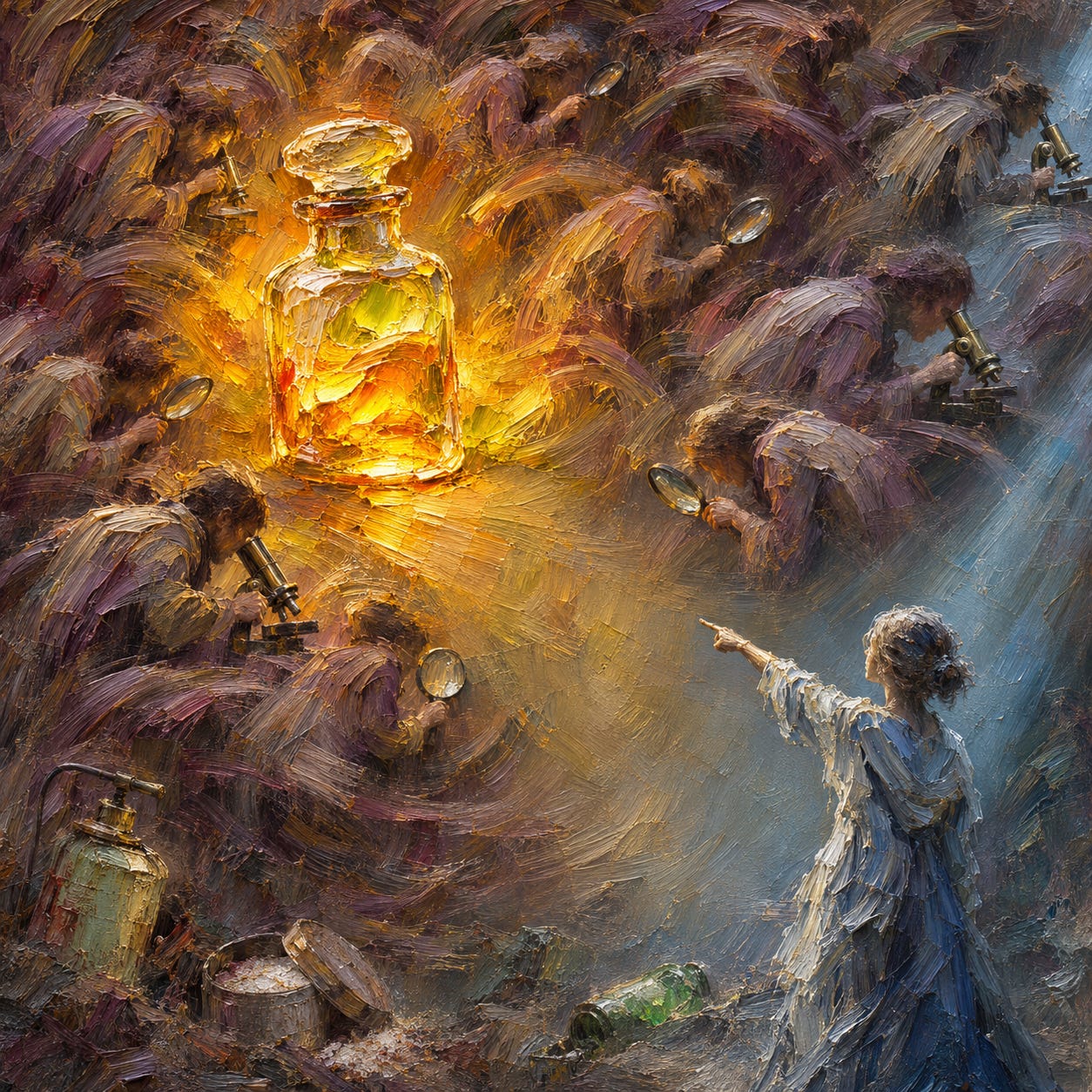
The twelve historical episodes gathered in this essay share a sequence. People fall ill in large numbers. The condition is declared contagious. A germ is named or searched for. Resources flow into transmission studies. Decades later, after enormous human cost, the actual cause is located in something people had been eating, drinking, breathing, applying to their children’s gums, or being prescribed. The “epidemic” dissolves. Each case was conceded, in the end, by the mainstream itself. The clearest and most recent example opens the series.
A word on the title. Nine of the twelve cases are poisoning in the strict sense: something was added to bodies that should not have been there. Three, scurvy and beriberi and pellagra, are the opposite shape: something the body required was taken out of the diet. Both forms were declared contagious. Both were pursued as germ-hunting problems for decades. The historian K. Codell Carter named the structural blind spot the two forms share, and the closing section returns to his formulation. “Poisoning” in the title is doing the loose work of covering both: a cause in what people were consuming or being given, rather than a germ passing from person to person.
A note on vocabulary. The language of each era, including virus, bacteria, pathogen, infectious disease, and immune system, appears throughout, because that is the language in which these cases were investigated and the language in which the official records are written. In this essay the establishment vocabulary sits inside quotation, attribution, and the names of official bodies and journal titles. The analytical voice proceeds from the terrain understanding: the body is a self-regulating organism, and when many people fall ill together, the cause lies in shared exposure to toxins, nutritional depletion, electromagnetic insult, or psychological strain, not in the transmission of invading agents. The two registers run alongside each other. Keeping the attributions visible is the only way to prevent the reader from absorbing one framework while reading an essay about the other.
1. SMON
In Japan between the late 1950s and 1970, approximately ten thousand people developed a condition that would blind many of them and leave many more with permanent paralysis of the lower body. It began with abdominal pain and numbness in the legs. The Japanese medical establishment named it SMON, for subacute myelo-optic neuropathy, and classified it as an infectious disease.¹ Several laboratories reported that they had isolated the “SMON virus.” Public health authorities organized the search for the mode of transmission.
In 1970, a physician named Tadao Tsubaki published evidence in The Lancet that a widely prescribed anti-diarrheal drug called clioquinol was present in every case he examined.² The drug was banned in Japan that year. Within months, new cases of SMON stopped appearing. The virus was never confirmed. The epidemic had been the drug.
SMON is the archetype because the sequence is so clean and the compression so visible. A condition emerges. The condition is declared contagious. Resources flow to the virus hunters. The actual cause is identified in a product people had been taking. The product is withdrawn. The “epidemic” ends. Clioquinol, marketed under the brand name Entero-Vioform by Ciba-Geigy, had been prescribed in Japan for travelers’ diarrhea and dysentery. The pharmaceutical company eventually paid compensation to thousands of SMON victims after a long campaign of litigation and denial.
Eleven cases from the historical record follow the same shape.
Essay PDF Download (Free Subscribers)
Audio Deep Dive (Paid Subscribers Only)
Support This Work
The essays are free and will stay free. What paid subscribers get is the library that surrounds them: the full digital book catalogue, audio deep dives, archived, and embedded in each essay, and the Questions for Your Doctor, Before You Consent, and Package Insert series. Platinum Supporters also receive the digital edition of every paperback on the day it’s published.
Whichever tier suits, thank you for being here. If you’d like to become a paid subscriber, upgrade a tier, or gift a subscription to someone who might value the work, the options are below.
The Nutritional Cases
2. Scurvy
For centuries scurvy was discussed in nautical medicine as a condition caught from the air of the hold, from stagnant bilge water, from the moral failings of ships’ companies. The idea that it was transmissible shaped the way ships were ventilated and the way captains disciplined their crews. It survived into the eighteenth century as serious medical opinion, in a period when an estimated two million European sailors died of the condition. Magellan’s circumnavigation of 1519 to 1521 lost four-fifths of its crew. Vasco da Gama’s 1497 voyage lost two-thirds. Commodore George Anson’s 1740 circumnavigation killed 1,400 of his 1,900 men, most of them from scurvy.
In May 1747 aboard HMS Salisbury, James Lind placed twelve scurvy-stricken sailors into six pairs, each pair given a different treatment: cider, vitriol, vinegar, seawater, a paste of garlic and mustard, or two oranges and a lemon daily. After six days, only the citrus pair had recovered. Lind published the result in A Treatise of the Scurvy in 1753.³ The Royal Navy did not implement citrus rations fleet-wide for another forty-eight years.
Part of the delay was Lind’s own. He never stated plainly that citrus was the cure. He continued to believe that scurvy’s true cause was dampness, and that citrus merely offered protection against it. Worse, he recommended a boiled juice concentrate called “rob,” whose preparation destroyed the ascorbic acid. Sailors who drank rob daily developed scurvy anyway, and the medical establishment, committed to the theory that scurvy was a disease of putrefaction, read the failures of rob as confirmation that Lind’s original citrus observation was unreliable.
In 1795, the physicians Gilbert Blane and Thomas Trotter secured the Admiralty mandate for a daily ration of fresh lemon juice. By 1797, the First Lord of the Admiralty visited Haslar Hospital and asked to see a scurvy patient. None could be found. Across the final four years of the Napoleonic Wars, only two cases were recorded in the fleet.
The resolution came through dietary change. The microbe hunters never found their germ. Albert Szent-Györgyi later isolated the compound called ascorbic acid as the molecular fragment the research tradition fastened upon, but the practical finding predated the chemistry by nearly two centuries.⁴ Men whose diet included fresh plant foods did not develop the condition. Men whose diet consisted of hard tack, salt beef, and beer did.
The Royal Navy’s subsequent experience is instructive. When the Navy switched its citrus source from Mediterranean lemons to West Indian limes in the mid-nineteenth century, scurvy returned, with serious outbreaks including during Robert Falcon Scott’s Antarctic expedition. The received explanation points to differing concentrations of ascorbic acid. The practical point is that the active element in the historical cure had never been a single isolated compound. It had been fresh food, with every supporting substance intact. The downstream economics of the lemon mandate, which turned Sicily into Europe’s dominant citrus supplier and seeded the organizational structure of the Sicilian mafia, are traced in a companion essay in this archive.
3. Beriberi
In the 1870s and 1880s, the Imperial Japanese Navy was losing sailors to a condition called kakke, known in the English literature as beriberi. The sailors developed heart failure, swelling of the legs, weakness, and in severe cases paralysis and death. The medical thinking inside the Navy split. Takaki Kanehiro, trained in British naval medicine, had come to suspect the diet. Others held that beriberi was infectious, caused by a bacillus not yet isolated.
Takaki designed a comparative test. In December 1882, the training ship Ryūjō sailed with 376 men eating the standard polished-rice ration. By the time it reached port, 169 sailors had beriberi. Twenty-five were dead. The ship had to stop in Hawaii because too few crew could stand. In 1884, the Tsukuba sailed the same route with 333 men on a diet of barley, meat, fish, beans, condensed milk, bread, and vegetables. Fourteen cases of beriberi, all among men who refused the new food. Zero deaths.⁵ The naval diet was changed. Within two years, beriberi had largely disappeared from the Japanese Navy.
The Imperial Army, under the senior army physician Mori Ōgai, declined to adopt the change. Ōgai had trained under German bacteriologists and insisted that the cause was an unknown pathogen he called etowasu, from the German etwas, meaning “something.” He denounced Takaki as a fake doctor. During the Russo-Japanese War of 1904 to 1905, over two hundred thousand Japanese soldiers developed beriberi, and twenty-seven thousand died of it against forty-seven thousand combat deaths in the same war. More Japanese soldiers died from a dietary stripping than from Russian weapons. The cure had been demonstrated twenty years earlier.
The germ-hunting continued elsewhere even after the dietary evidence was in. Max Glogner, in an 1894 report translated and published in the Indian Medical Gazette, insisted that beriberi was caused by a protozoan and should be treated with quinine. In 1912, Edward Jenner Wood proposed arsenic as the treatment on the grounds that the disease was likely of “animal parasitic origin.” Christiaan Eijkman’s observation in Java that chickens developed a comparable condition on polished rice and recovered on rice bran provided the laboratory parallel.⁶ His colleague Adolphe Vorderman surveyed one hundred and one Javanese prisons housing nearly three hundred thousand inmates and found beriberi rates roughly three hundred times higher in the prisons using polished rice. The compound later called thiamine was isolated in 1926 by the Dutch chemists Barend Jansen and Willem Donath. The beriberi bacillus was never found. Robert R. Williams, who later worked on the chemistry of thiamine, reflected on the delay with unusual candor: “all young physicians were so imbued with the idea of infection as the cause of disease that it presently came to be accepted as almost axiomatic that disease could have no other cause.”⁷ The modern extension of the same pattern, in which a different nutritional stripping drives the heart-failure epidemic that mortality statistics show spreading in step with the rise of long-term polypharmacy, is traced in a companion essay in this archive.
4. Pellagra
Pellagra appeared in epidemic form in the United States from approximately 1902, concentrated in the cotton-tenant South. The condition presented as the four Ds: diarrhea, dermatitis, dementia, death. Over the following four decades, estimates place total cases at approximately three million and deaths at approximately one hundred thousand, though both figures are historical approximations and should be read as such. Through most of that period, the medical establishment classified pellagra as an infectious disease.
The Illinois Pellagra Commission concluded in 1911 that the cause was “a living micro-organism of unknown nature.” The Thompson-McFadden Commission, reporting a few years later, concluded that pellagra was “an infectious, contagious, gastrointestinal disease.” The Italian pathologist Guido Tizzoni announced in 1912 that he had isolated the responsible bacterium, which he called Streptobacillus pellagrae. Louis Sambon, a prominent London tropical-medicine researcher, argued that pellagra was transmitted by the Simulium black fly. Hospitals refused to admit pellagrins. Nurses went on strike rather than treat them. Elementary schools excluded children whose relatives were sick.
Joseph Goldberger of the United States Public Health Service was dispatched in 1914 as the Surgeon General’s second opinion. His first observations in Southern mill-town institutions were decisive before he reached a laboratory. The inmates and children in asylums and orphanages developed pellagra. The staff who shared the same buildings, often attending the same patients, did not. The staff ate different food. The inmates ate cornbread, molasses, and salt pork.
Goldberger’s clinical trials, in which dietary enrichment reversed the condition in orphans and prisoners, were published starting in 1914.⁸ When his findings were resisted on the grounds that pellagra was contagious, he undertook what came to be called the filth parties. In 1916, Goldberger, his wife Mary, and several colleagues ingested capsules containing the scabs, nasal discharge, urine, and feces of pellagrins. They injected themselves with blood from pellagra patients. None of them developed pellagra.
The institutional response was not acceptance. The Southern press and much of organized medicine denounced the findings as an insult to the South. The resistance had regional and economic foundations: the cotton-tenancy system depended on sharecroppers who could not afford varied diets, and acknowledging that pellagra was a disease of poverty required acknowledging what the cotton economy was doing to its workers. The dietary explanation was not fully accepted until the identification of niacin by Conrad Elvehjem at the University of Wisconsin in 1937 and the subsequent flour-fortification programs of the Second World War.⁹ By then, pellagra had killed Americans for nearly four decades under the hypothesis of contagion.
What produced the pellagra “epidemic” was the cotton-tenancy economy, which impoverished farmers and reduced their diets to carbohydrate monocultures stripped of the whole-food matrix the body required. The resolution came through dietary change. The microbe hunters never found their germ.
The Pharmaceutical Cases
5. The Mercury and Antimony “Smallpox” Treatments
“Smallpox” presents a harder historical case than the others in this essay. The received narrative is that it was a transmissible condition caused by a virus and that treatments were palliative. The record of what the standard treatments actually did complicates that narrative substantially.
Calomel, which is mercurous chloride, was a standard emetic and purgative throughout the heroic-medicine era. Benjamin Rush and his generation prescribed it in doses of ten to fifty grains, repeated. Its documented effects on the body include salivation, gum necrosis, tooth loss, intestinal bleeding, skin eruptions, and systemic damage. Tartar emetic, which is antimony potassium tartrate, was prescribed as another standard treatment, producing severe gastrointestinal toxicity and pustular skin reactions. Mercury poisoning presents with a diffuse pustular rash. Antimony poisoning presents with a pustular eruption. What was called smallpox, in the era when calomel and antimony were in heavy use, presented as a pustular eruption with systemic illness.
The pattern of a toxic metal producing a presentation that medicine labelled as a distinct infectious disease is not confined to smallpox. On September 14, 1946, the British dermatologist F. Parkes Weber published a paper in The Lancet titled “Arsenical Chicken-Pox,” documenting patients taking arsenic-containing medications who developed skin eruptions clinically indistinguishable from what medicine called chickenpox.¹⁰ Weber noted that it seemed incredible that a common “infectious disease” could be produced by a drug, but he had seen it happen repeatedly. He treated the finding as a curiosity. The finding generalizes: a poison producing a presentation that the diagnostic framework had already named, and that medicine was already treating as something transmissible. A 2020 paper in Current Problems in Pediatric and Adolescent Health Care, titled “All that glitters is not gold: Mercury poisoning in a family mimicking an infectious illness,” described patients heavily exposed to elemental mercury whose presentation was initially mistaken for infectious disease. The authors’ observation that significant mercury toxicity “can resemble an infectious illness” holds for the twenty-first-century presentation as it would have for the nineteenth-century one.
Where mercury and antimony treatment was aggressive, mortality was high. Where it was minimal or absent, as in some homeopathic hospitals that kept careful comparative statistics in the mid-nineteenth century, mortality from the condition was substantially lower.¹¹ The homeopathic hospitals kept these records specifically to challenge the dominant allopathic practice, and the discrepancies they documented have been debated continuously since.
The germ-theory account of smallpox does not require examination of what the standard cures were doing to the patient. The record of what those cures were doing is extensive.
6. Pink Disease (Acrodynia)
Between the 1890s and the 1950s, infants and small children in the United States, the United Kingdom, Australia, and elsewhere developed a distinctive condition. The hands and feet swelled and turned a dusky pink. The skin peeled. The children were miserable, had severe pain, refused food, slept poorly, and often died. The condition was named acrodynia and later pink disease. At peak, approximately one in five hundred infants in affected regions developed it, with mortality in the ten to thirty percent range in the worst years, though these figures are regional estimates and vary across the literature.
The medical establishment framed pink disease as idiopathic or possibly viral. Various agents were sought. In 1948, Josef Warkany and Donald Hubbard at the University of Cincinnati published their finding that children with acrodynia had very high levels of mercury in their urine.¹² The source was calomel, used extensively in teething powders, worming medicines, and diaper-rash ointments administered to infants. Calomel is mercurous chloride.
The response was slow but eventually decisive. Calomel teething powders were withdrawn from the United Kingdom market in the mid-1950s. Pink disease disappeared in parallel. The condition that had killed and maimed infants for over sixty years, under the hypothesis that it was perhaps viral and certainly mysterious, resolved when a mercury-based pediatric product was removed from pharmacy shelves.
7. The 1918 Mortality
The mortality event of 1918 to 1920 was the largest in modern history attributed to an infectious disease. Estimates range from twenty million to one hundred million deaths worldwide, with the methodological disputes behind these figures substantial. In public memory, the event is the Spanish flu, caused by a virus. The historical record of what was being done to patients during those years tells a longer story.
The age profile is the first anomaly. Previous and subsequent flu waves killed the very young and the very old, producing a U-shaped mortality curve. The 1918 wave killed young adult men preferentially, producing an unprecedented W-shape with peaks in the 15-to-24, 25-to-34, and 35-to-44 age bands. That demographic overlaps precisely with the men who were being drafted, crammed into troopships, housed in tent cities, exposed to chemical warfare, injected with experimental bacterial vaccines, and dosed with eight to thirty grams of aspirin per day for the condition circulating in their ranks. Each of these factors is documented. Only the viral agent is inferred.
The physician Karen Starko published a paper in Clinical Infectious Diseases in 2009 titled “Salicylates and Pandemic Influenza Mortality, 1918-1919 Pharmacology, Pathology, and Historic Evidence.”¹³ She documented that aspirin, newly off-patent following the expiry of Bayer’s monopoly, had been recommended in doses of eight to thirty grams per day. The threshold for salicylate toxicity in modern pharmacology is roughly four grams per day. The fluid in the lungs and bloody frothy sputum at autopsy, characteristic of 1918 fatalities, are consistent with salicylate overdose, which produces exactly these findings. The timing of the mortality spike aligned with the general availability of generic aspirin after the Bayer patent lapsed.
A second strand concerns the experimental bacterial vaccine campaigns conducted on military populations in 1918. Dr. Frederick L. Gates ran a program at Camp Funston, Fort Riley, Kansas, between January 21 and June 4, 1918, administering three doses of an experimental meningitis vaccine prepared at the Rockefeller Institute from horse serum.¹⁴ Fort Riley housed 26,000 men in close proximity with thousands of horses and mules producing approximately nine tons of manure per month, which the base disposed of by burning on open fires that sent the smoke across the camp. The soldiers and the animals shared the same respiratory environment and the same experimental biological preparations. On the morning of March 4, 1918, Private Albert Gitchell reported to the Fort Riley hospital with cold-like symptoms. Corporal Lee W. Drake followed immediately. By noon, camp surgeon Edward R. Schreiner had a hundred sick men on his hands. The March 1918 Fort Riley outbreak is widely cited as the origin of the 1918 wave. It coincided exactly with the conclusion of the Rockefeller vaccination program at the same base. Charles Richet’s 1913 Nobel Prize had been awarded for the demonstration that injection of foreign proteins creates sensitization in the host, so that subsequent exposures provoke responses of escalating intensity. The Rockefeller program, delivering multiple doses of horse-derived bacterial preparations to young men over short intervals, was a textbook application of the mechanism Richet had described fifteen years earlier.
A third strand is chemical. Between 1915 and 1918 the European theater was saturated with mustard gas, phosgene, diphosgene, chlorine, and other toxic agents released in quantities that remain difficult to compute. Mustard gas alone has been credited with 1,205,655 non-fatal injuries and 91,198 deaths in official counts, and persisted in soil, clothing, and lung tissue for months or years after a given attack. The clinical presentation of gassed soldiers, reported in battlefield accounts, included bluish-gray skin, purple lips, violent coughing, and lungs filling with a yellowish froth that threatened to drown them. That presentation matches the reports of 1918 flu deaths so closely that the two cannot, on bedside grounds, be reliably distinguished. In 2008, researchers at the National Institutes of Health reviewed 8,398 autopsies from fifteen countries of patients classified as having died of the 1918 flu. They found compelling histologic evidence of severe acute bacterial pneumonia as the predominant pathology, either alone or alongside other findings, in ninety-two percent of cases.¹⁵ The viral etiology on which the entire category depends was not what killed the patients at autopsy.
The transmission studies conducted during the event are the piece most quietly set aside. Milton Rosenau at the Public Health Service, working with the US Navy at Gallops Island in Boston Harbor in late 1918, took one hundred Navy volunteers, mostly aged eighteen to twenty-five, and attempted to transmit the condition from sick patients to healthy men by every method he could design: thirteen different strains of Pfeiffer’s bacillus sprayed into the throats of volunteers, mucus from the lungs and noses of patients transferred to the mucous membranes of volunteers, blood from sick patients injected into volunteers, and face-to-face exposure with patients coughing on volunteers from two inches away. McCoy and Richey ran parallel experiments at Goat Island in San Francisco Bay. The results of all of these studies, published in the Journal of the American Medical Association in 1919, were unambiguous. Rosenau wrote: “As a matter of fact, we entered the outbreak with a notion that we knew the cause of the disease, and were quite sure we knew how it was transmitted from person to person. Perhaps, if we have learned anything, it is that we are not quite sure what we know about the disease.”¹⁶
The confluence of these strands is sufficient to account for the 1918 mortality signature without invoking a hypothetical pathogen that transmission studies could not demonstrate. Unprecedented aspirin dosing produced the lung edema and hemorrhage recorded at autopsy. Mass experimental vaccination produced the Richet-pattern sensitization and the initial Fort Riley outbreak. Chemical warfare exposure produced lung damage and acute presentations indistinguishable from what was called flu. Overcrowded troop transports and bacterial pneumonia closed the circle. A fuller treatment of the bacterial-vaccine, chemical-warfare, and electrification strands of 1918 is set out in a companion essay in this archive.
The Food and Drink Cases
8. Milk Sickness
In the American frontier of the early nineteenth century, settlers in Indiana, Ohio, Illinois, Kentucky, and surrounding states developed a condition they called “milk sick” or the “puking fever.” Cattle in the same regions developed a parallel condition called “the trembles.” The two were sometimes connected by observers, sometimes not. Whole families died. Nancy Hanks Lincoln, the mother of Abraham Lincoln, died of milk sickness in Little Pigeon Creek, Indiana, in October 1818. Her son was nine.
The medical thinking in the frontier states, where it existed in any organized form, variously classified milk sickness as miasmatic, contagious, or caused by a microbe not yet isolated. Several outbreaks were investigated as epidemics on the assumption that a mode of transmission would be found.
A physician named Anna Pierce Hobbs Bixby, practicing in southern Illinois in the 1830s, was told by a Shawnee woman that the responsible plant was white snakeroot. Her investigation confirmed that cattle grazing on the plant, Ageratina altissima, developed the trembles, and that humans who drank the milk or ate the butter from these cattle developed milk sickness. Pierce Hobbs Bixby’s identification was not accepted by organized medicine. The toxic constituent, called tremetol, was finally confirmed by James F. Couch of the United States Department of Agriculture in work published in 1927.¹⁷
The condition that had killed Lincoln’s mother and uncounted frontier families was eventually traced to a plant toxin passed through dairy cattle. The frontier medicine that classified it as contagious was wrong. The Shawnee woman and the country doctor had been right for nearly a century before the United States Department of Agriculture confirmed it.
9. Jake Leg Paralysis
In early 1930, during the final years of Prohibition in the United States, tens of thousands of poor Americans, concentrated in the South and Midwest, developed a sudden paralysis of the lower legs that left them with the characteristic high-stepping gait called “jake walk” or “jake leg.” Blues songs recorded the condition in detail during the years when it was still spreading. Estimates of the number affected range from thirty thousand to fifty thousand, with some historians placing the figure as high as one hundred thousand. The numbers should be read as approximate.
The culprit was identified relatively quickly. Jamaica Ginger, a patent medicine containing roughly seventy to eighty percent ethanol, had been widely used as a legal workaround during Prohibition. The Treasury Department required that the preparation contain enough ginger extract to be unpalatable. Harry Gross and his business partner, seeking to meet the requirement cheaply, substituted an industrial plasticizer, triorthocresyl phosphate, as a filler. The compound is an organophosphate neurotoxin.
The United States Public Health Service identified the adulterant within months. The paper by M. I. Smith, E. Elvove, and W. H. Frazier, titled “The pharmacological action of certain phenol esters, with special reference to the etiology of so-called ginger paralysis,” appeared in Public Health Reports in October 1930.¹⁸ The victims received almost no compensation. The adulterated Jamaica Ginger was withdrawn. The “epidemic” ended.
Jake Leg is significant because the identification was rapid, the causation clear, and the social indifference to the victims unmistakable. The condition had the clinical hallmarks of an infectious neurological illness, including sudden onset, geographic clustering, and distinctive gait, yet it moved from mystery to adulterant within weeks because the public health system was willing to investigate what the victims had consumed.
10. The Spanish Toxic Oil Syndrome
In May 1981, a cluster of patients in Torrejón de Ardoz, a working-class suburb of Madrid, began appearing in hospitals with high fever, respiratory distress, muscle pain, and a rash. The condition progressed in many cases to severe fluid in the lungs and in some to death. Spanish health authorities initially classified the outbreak as “atypical pneumonia,” and the search began for a transmissible agent, with the mycoplasma genus suspected.
A pediatrician named Juan Manuel Tabuenca, treating affected children, noticed a food pattern. On June 10, 1981, the Spanish government announced that the cause was adulterated cooking oil. Imported rapeseed oil, denatured with aniline for industrial use, had been sold illegally for human consumption by itinerant vendors.¹⁹ Over twenty thousand people were affected in all, with approximately one thousand deaths in the acute phase and more than twenty-five thousand cases of chronic disability.
The specific toxic agent in the oil has never been conclusively identified. A minority view, held notably by Dr. Antonio Muro, who was involved in the early epidemiological investigation, has argued that the actual cause was organophosphate pesticides on tomatoes grown in the Almería greenhouses, and that the oil story served to protect the vegetable industry. The mainstream account, and the compensation framework, is built on the oil hypothesis. The uncertainty about the specific agent should be acknowledged.
What is settled, and what matters here, is that the condition was not infectious. The initial medical response, mobilizing microbiology against an “atypical pneumonia,” was wrong. The victims had been poisoned.
The Environmental Cases
11. The 1950s Polio Clusters
The condition called poliomyelitis occupies a particular place in twentieth-century memory. The paralysis of children, the iron lungs, the national campaigns of the 1950s, the vaccine credited with ending the “epidemic,” all form a cultural memory that resists examination. The record of what else was happening during the polio years is instructive.
Alfred Vulpian showed in 1878 that dogs poisoned with lead developed symptoms indistinguishable from those of human polio victims. Miezeyeski Popow demonstrated in 1883 that arsenic produced the same paralysis. The arsenic-based pesticide Paris green had been in heavy agricultural use since 1870. When Dr. Charles Caverly investigated a cluster of cases in Vermont in 1894, he stated plainly that “we are very certainly not dealing with a contagious disease.” A polio outbreak in Massachusetts followed two years after the state’s 1892 adoption of lead arsenate, an even more toxic pesticide, as a replacement for Paris green. In 1908, Karl Landsteiner and Erwin Popper in Vienna announced the hypothetical polio virus. Resources flowed to the virus hunters. The pesticide question went unexamined.
A physician named Morton Biskind, writing in the American Journal of Digestive Diseases in 1949 and 1953, documented a strong correlation between the introduction and intensive use of chlorinated hydrocarbon insecticides, particularly DDT, and the geographic and temporal pattern of polio cases in the United States.²⁰ Biskind testified before the House Select Committee to Investigate the Use of Chemicals in Food Products, known as the Delaney Committee, in 1950 and 1951. His position was that the symptoms attributed to polio, including central-nervous-system damage, paralysis, and gastrointestinal involvement, overlapped substantially with the symptoms of DDT and related organochlorine poisoning. Peak DDT use in the United States ran from the late 1940s through the mid-1950s, correlating closely with peak polio incidence. Lead arsenate residues on fruit and in orchard soils compounded the exposure.
Dr. Ralph Scobey of Syracuse, New York, who also testified before the Delaney Committee, documented cases of what the establishment called polio that corresponded closely with pesticide exposure. His paper “The Poison Cause of Poliomyelitis and Obstructions To Its Investigation” set out the case for central-nervous-system poisoning as the primary mechanism.²¹
The polio incidence curve declined before the Salk vaccine was introduced in 1955. The decline aligned temporally with the phasing out of DDT and lead arsenate, with changes in diagnostic criteria that narrowed what counted as polio, and with the introduction of the term “aseptic meningitis” to re-classify cases that would previously have been counted. The vaccine was given credit for the decline. The underlying picture is at minimum ambiguous and at the pattern level consistent with a decline in environmental toxicity.
The condition the establishment called polio is a case where the mainstream has not fully conceded the poisoning interpretation. It is included here because the documentary record, including congressional testimony from practicing physicians and the published work of Biskind and Scobey, establishes the question with sufficient force that it belongs in any historical survey.
12. Minamata Disease
In the Japanese fishing town of Minamata, from the late 1940s through the 1960s, residents developed a devastating neurological condition. Numbness started in the hands and feet. Speech slurred, vision narrowed, and children were born with severe brain damage, cerebral palsy, and intellectual disability. Cats in the town were afflicted first, with a distinctive uncontrolled staggering and sometimes self-destructive leaping into the sea that locals called “cat dancing disease.” Birds fell from the sky. Shellfish died in the bay.
The initial medical response, triggered by a cluster of five severely affected patients reporting to a local hospital in May 1956, was to classify the condition as a “strange disease” of unknown origin, with infectious transmission considered possible given the clustering within fishing families. Unconfirmed reports suggested the illness was infectious meningitis. The town fell into panic. People from neighboring towns ostracized Minamatans. Homes were disinfected. The sick were quarantined. Early figures counted at least 55 people with the condition and 17 deaths.
By 1959, a research team at Kumamoto University had identified methylmercury as the causative agent. The Chisso Corporation had been discharging methylmercury into Minamata Bay from its chemical plant, where it was a byproduct of acetaldehyde production, since 1932. The fish and shellfish of the bay accumulated the methylmercury. The people of the town ate the fish. The methylmercury crossed the placenta to produce the congenital cases. In February 1963, the research group’s formal announcement attributed the condition to methylmercury contamination of seafood.²²
Chisso denied responsibility, suppressed internal evidence, and continued discharging methylmercury until 1968. Dr. Hajime Hosokawa, the Chisso Corporation’s own company physician, had conducted cat experiments showing that cats fed Chisso wastewater developed the characteristic neurological condition. He was ordered by Chisso management to suppress the findings. The Japanese government officially acknowledged the methylmercury cause in 1968, after the discharges had been continuing for thirty-six years. Over two thousand victims have been certified. The actual number of people affected is estimated in the tens of thousands.
Minamata is instructive because the initial medical response treated the condition as potentially infectious, and because the company and the government combined for over a decade to delay identification of the industrial source. The epidemiological pattern, geographic concentration around a specific bay, clustering within fishing families, feline cases paralleling human cases, pointed toward environmental exposure from the beginning. The resistance to acknowledging the industrial source was institutional and economic, not medical. Years after the mercury cause was publicly announced, surviving victims were still being forced to assure strangers that they were not contagious.
The Default Hypothesis of Contagion
The contagion hypothesis is reached for first for reasons that overlap and reinforce each other. Intellectual tradition is one. Germ theory achieved institutional hegemony in the late nineteenth century and has been the organizing framework of medical research since. The methods, careers, laboratories, journals, grant structures, and regulatory bodies of modern medicine are built around infectious-disease models. When a cluster of illness appears, the equipment to investigate it as infectious is already in place and the equipment to investigate it as poisoning is not.
The historian of medicine K. Codell Carter, writing in Medical History in 1977, named the structural blind spot the framework produces. The assumption “that disease is caused by the presence of something” concealed “the idea that disease could also be caused by something that is lacking.” Carter was writing specifically about the four-decade delay in acceptance of beriberi’s dietary cause. The formulation applies without modification to every case in this essay, and extends further than Carter went: when a product removes something the body requires, or adds something the body cannot handle, the resulting illness has no cause the germ-theory framework can see. The illness gets named, classified, and treated as a new disease. The product that caused it keeps being sold.
Political convenience reinforces the preference. If a cluster of illness is attributed to a pathogen, no economic actor is at fault. Nobody has to recall a product. No manufacturer is sued. No industry is regulated. No agricultural practice is questioned. The response is public-health containment, which may be onerous but which disrupts no commercial arrangement. If a cluster is attributed to a product, the costs to industry and to regulatory bodies that approved the product can be severe. The historical record shows that pharmaceutical companies have fought for decades to delay identification of their products as causes of harm, from SMON to Vioxx to the opioid approvals. Ciba-Geigy paid for SMON only after a protracted campaign of denial. Chisso paid for Minamata only after a protracted campaign of denial. Harry Gross served a short sentence for Jake Leg and the victims received almost nothing.
There is also an epistemological pull. Transmission from person to person is a visible, dramatic, personally resonant phenomenon. Poisoning across a population through a diffuse product or environmental exposure is harder to perceive. The clustering of illness invites a narrative of spread, even when the clustering is actually the geographic distribution of a product or an exposure.
The twelve cases above form a pattern. People fall ill together. The default move is to call it contagion. The default has been wrong, repeatedly, for decades at a time, at enormous human cost. Reaching for contagion first, as the medical establishment reflexively does, has misdirected human attention and allowed real causes to continue damaging real people long after they could have been identified and removed.
Twelve is a structural choice, not a limit. The historical record contains more: ergotism blamed on witchcraft and divine punishment before the fungal contamination of rye was identified; phossy jaw in match factories, blamed on various causes until white phosphorus was banned; Devonshire colic traced to lead-lined cider presses; chlorosis in young women, which responded to iron and the loosening of corsets; the 1976 Guillain-Barré cluster that followed the swine flu vaccination campaign; the long contest, still unresolved in the mainstream literature, over whether bovine spongiform encephalopathy correlates more cleanly with organophosphate pesticide application than with cross-species protein feeding. The pattern repeats.
The historical record is clear on this. The present application of the same pattern is where this essay stops. The reader is better placed than I am to decide what to do with it.
How to Explain It to a Six-Year-Old
Imagine thirty children at a birthday party. By the end of the party, twenty of them have stomach aches, and five are being sick in the garden.
The grown-ups look at each other and say: there must be a bug going around. One of the children must have brought a tummy bug, and the others caught it. They start calling other families in the neighborhood to see if anybody else is sick. The parents of the five sickest children keep them home from school, worried about what else might be catching.
But a quiet aunt is looking at the cake. The cake was left out in the sun too long, and the cream in the middle has gone sour. Twenty of the thirty children had cake. The ten who did not eat the cake are fine. The five sickest children had the biggest slices.
The grown-ups do not want to listen to the aunt. The person who made the cake is a friend. Nobody wants to say the friend’s cake made the children sick. It is easier to say there is a bug going around, and to keep looking for it, and to tell everyone to wash their hands.
Twelve times in the last two hundred years, we have done this at a bigger scale. Every time, there was a cake nobody wanted to look at. The bug was easier.
In Print
The Unbekoming library is available in paperback, printed to order through Lulu and shipped worldwide. The shelf begins with the paradigm question underneath everything else — No Virus, the isolation problem, the collapse of virology’s foundational claims, and a disease-by-disease reappraisal — and moves through the suppressed compounds mainstream medicine set aside: The DMSO Book, Chlorine Dioxide: The Forbidden Remedy, The Iodine Book, and The Hydrogen Peroxide Book. Two more recover what’s still on the kitchen shelf: Baking Soda and The Castor Oil Book. Two more recover the minerals modern soil, water, and processing quietly stripped from the diet: The Magnesium Handbook and The Boron Book. Sitting alongside these is No Contagion, co-authored with Jamie Andrews — the case against germ theory itself, catalogued through 258 failed contagion experiments.
The critique books cover what medicine, dentistry, psychiatry, and veterinary practice have become. The Unvaccinated treats the completely unvaccinated as a comparison group across twenty chapters and five appendices. Medicalized Motherhood follows a woman through 123 documented interventions from teenage pill to postpartum discharge. Drilling for Profit treats cavities, gum disease, and crooked teeth as the dietary problem they are. What Your Vet Can’t Tell You applies the same critique to pets. Escape from Psychiatry documents the fabrication of the DSM and the specific damage of every major psychiatric drug class. The Vitamin K Injection covers what happens in the first hours of a newborn’s life.
The full shelf is at lulu.com/spotlight/unbekoming. A physical book reaches the person a Substack post never will — the skeptical relative, the friend who won’t click a link but might open a book, the visitor whose eye lands on a coffee table. Buy one to keep, and one to give away.
References
Nakae K, Yamamoto S, Shigematsu I, Kono R. Relation between subacute myelo-optic neuropathy (S.M.O.N.) and clioquinol: nationwide survey. The Lancet. 1973;1:171-173.
Tsubaki T, Honma Y, Hoshi M. Neurological syndrome associated with clioquinol. The Lancet. 1971;1:696-697.
Lind J. A Treatise of the Scurvy. Edinburgh: Sands, Murray and Cochran; 1753.
Svirbely JL, Szent-Györgyi A. The chemical nature of vitamin C. Biochemical Journal. 1932;26:865-870.
Sugiyama Y, Seita A. Kanehiro Takaki and the control of beriberi in the Japanese Navy. Journal of the Royal Society of Medicine. 2013.
Eijkman C. Antineuritic vitamin and beriberi. Nobel Lecture, 1929.
Williams RR. Toward the Conquest of Beriberi. Cambridge, MA: Harvard University Press; 1961.
Goldberger J. The etiology of pellagra: the significance of certain epidemiological observations with respect thereto. Public Health Reports. 1914;29:1683-1686.
Elvehjem CA, Madden RJ, Strong FM, Woolley DW. The isolation and identification of the anti-black tongue factor. Journal of Biological Chemistry. 1938;123:137-149.
Weber FP. Arsenical Chicken-Pox. The Lancet. 1946;248(6421):402.
Bradford TL. The Logic of Figures or Comparative Results of Homeopathic and Other Treatments. Philadelphia: Boericke and Tafel; 1900.
Warkany J, Hubbard DM. Mercury in the urine of children with acrodynia. The Lancet. 1948;1:829-830.
Starko KM. Salicylates and pandemic influenza mortality, 1918-1919 pharmacology, pathology, and historic evidence. Clinical Infectious Diseases. 2009;49(9):1405-1410.
Gates FL. A report on antimeningitis vaccination and observations on agglutinins in the blood of chronic meningococcus carriers. Journal of Experimental Medicine. 1918;28(4):449-474.
Morens DM, Taubenberger JK, Fauci AS. Predominant role of bacterial pneumonia as a cause of death in pandemic influenza: implications for pandemic influenza preparedness. Journal of Infectious Diseases. 2008;198(7):962-970.
Rosenau MJ. Experiments to determine mode of spread of influenza. Journal of the American Medical Association. 1919;73(5):311-313.
Couch JF. The toxic constituent of richweed or white snakeroot (Eupatorium urticaefolium). Journal of Agricultural Research. 1927;35:547-576.
Smith MI, Elvove E, Frazier WH. The pharmacological action of certain phenol esters, with special reference to the etiology of so-called ginger paralysis. Public Health Reports. 1930;45:2509-2524.
Tabuenca JM. Toxic-allergic syndrome caused by ingestion of rapeseed oil denatured with aniline. The Lancet. 1981;2:567-568.
Biskind MS. Public health aspects of the new insecticides. American Journal of Digestive Diseases. 1953;20(11):331-341.
Scobey RR. The Poison Cause of Poliomyelitis and Obstructions To Its Investigation. Archive of Pediatrics. April 1952.
Smith WE, Smith AM. Minamata. New York: Holt, Rinehart and Winston; 1975.
Thank you Unbekoming, for what will surely be an interesting read!
You could almost make the argument that in the last two hundred years, nothing that we've been told from mainstream from a sickness disease is real and is actually a result of society poisoning the people, then blaming it on the disease.
These guys I swear. I can only image they did this because they figured no one would ever know. Well, we know now. Maybe years later, but we know now: https://unorthodoxy.substack.com/p/a-century-of-lies-is-unraveling