

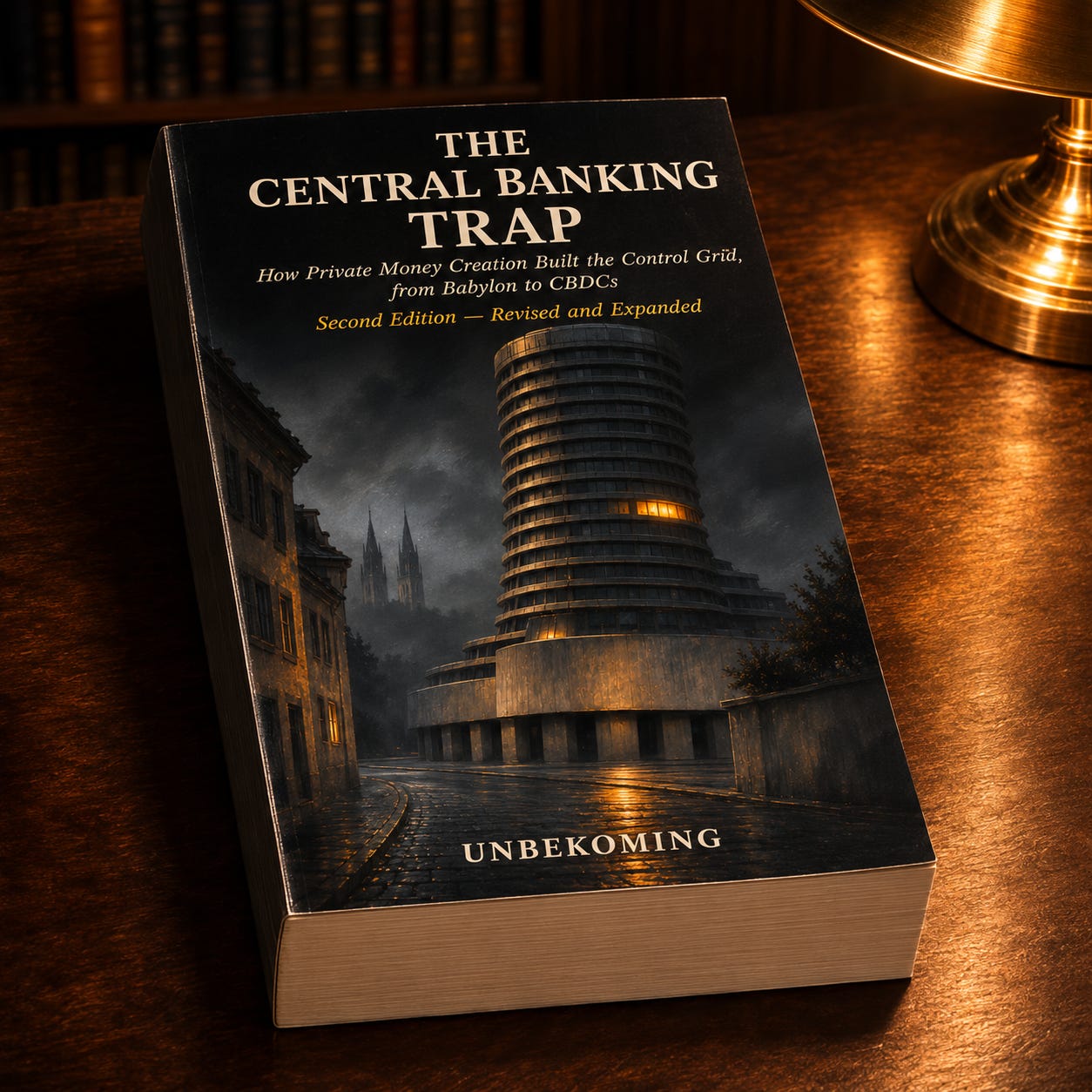
Private money creation is the oldest control grid in the world. Not a modern invention. Not a conspiracy theory. Not a fringe thesis. A continuous four-thousand-year arrangement with a documented paper trail. It began in the temples of Babylon, moved to Venice, then to Amsterdam, then to London, then to New York. In 1930 it moved to a cylindrical tower in Basel that is not part of any country and whose officials no one has ever voted for.
The paper trail runs through specific institutions in specific years. The Venetian salt-tax bonds of the thirteenth century. The Bank of Amsterdam, founded 1609. The Bank of England, founded 1694. The Federal Reserve, founded December 1913 at a secret meeting on Jekyll Island. The Bank for International Settlements, founded May 1930 by central bankers who wanted a venue outside any nation’s jurisdiction. Each installation ran the same mechanical specification — the right to create a nation’s money, lend it to that nation’s government at interest, enforce the loan through the courts of that same government, and never submit the arrangement to a vote. Documented by Carroll Quigley across two Oxford volumes (Tragedy and Hope, 1966; The Anglo-American Establishment, 1981), by Murray Rothbard in a half-shelf of monographs on money and banking, by G. Edward Griffin in a 580-page book on Jekyll Island (1994), by Stephen Mitford Goodson in a 2014 history of central banking, by Adam LeBor in a 2013 book on the Tower of Basel, by Ron Paul in a book-length case for ending the Fed (2009). None of them a conspiracy theorist. All of them documented.
What has not been treated at book length, until now, is the whole machine — the four-thousand-year monetary arrangement as a single continuous operating system, traced from installation to installation, documented through the works of the people who saw each piece of it clearly, and shown as an integrated architecture rather than as a sequence of unrelated historical episodes.
The Central Banking Trap reconstructs the arrangement through the shelf of books that documented it piece by piece. Joseph Farrell’s Babylon’s Banksters (2010) and Financial Vipers of Venice (2010) on the first installations. Carroll Quigley’s Tragedy and Hope (1966) and The Anglo-American Establishment (1981) on the Round Table network that carried the arrangement through the twentieth century. Stephen Mitford Goodson’s A History of Central Banking and the Enslavement of Mankind (2014). G. Edward Griffin’s The Creature from Jekyll Island (1994) on the November 1910 secret meeting at which the Federal Reserve was drafted. Murray Rothbard’s What Has Government Done to Our Money? (1963). Ron Paul’s End the Fed (2009). Smedley Butler’s War Is a Racket (1935), the US Marine Corps Major General’s unanswered testimony on what the arrangement’s military does and for whom. John Perkins’s Confessions of an Economic Hit Man (2004) on how the arrangement extracts from nations the military does not need to enter. Adam LeBor’s Tower of Basel (2013) on the Bank for International Settlements. Martin Erdmann’s The Greed for Gold and Glory (2025) on the theological groundwork of modern monetary rule.
These are not obscure works. Quigley’s Tragedy and Hope is 1,300 pages. Griffin’s Creature from Jekyll Island is 580 pages. LeBor’s Tower of Basel is 320 pages. Together with the rest of the shelf they run to something north of five thousand pages — the canonical works on money and central banking, written across nine decades, widely cited but rarely read end to end because the subject has been kept hard on purpose. The Central Banking Trap carries each of them in six different reading levels: a thirty-question Q&A drawn from the source material, an analogy that captures the central move, a one-minute elevator explanation, a twelve-point summary, a golden-nugget insight, and an explanation for a six-year-old. Six distilled passes through each book, carrying the substance in six different forms. Meet each book at the level that fits.
That is why the book is long. 790 pages, twenty-five chapters, seven appendices, a 175-term index. The largest book in the catalogue to date. The length is the shelf, compressed.

The Central Banking Trap on Lulu
What the book shows
Part One — The Arrangement. One chapter, What Is Empire?, that sets the operating-system frame before the historical case studies begin. The arrangement is treated not as an episode in history but as a continuous mechanism with specifiable parts, installed into successive host nations.
Part Two — Origins: Babylon to Venice. Five chapters. Joseph Farrell’s Babylon’s Banksters (2010) on temple banking and the earliest documented versions of the arrangement. Farrell’s Financial Vipers of Venice (2010) on the Venetian family-banking apparatus that ran the Mediterranean through the middle ages. Carroll Quigley’s 1981 Venetian Conspiracy lecture, naming the continuity with what came later. An interview with Dr. Martin Erdmann on the theological groundwork of modern monetary rule. Erdmann’s The Greed for Gold and Glory (2025), connecting the premodern installations to the dynasties that still occupy their seats.
Part Three — London: The Bank and the Money Lords. Six chapters. Stephen Mitford Goodson’s A History of Central Banking and the Enslavement of Mankind (2014). The Rothschilds and Opposing the Money Lenders (2016) on the nineteenth-century London financial apparatus. England’s Money Lords (1939), written on the eve of the war that the arrangement went on to finance from both sides. Carroll Quigley’s Tragedy and Hope (1966) and The Anglo-American Establishment (1981) on the Round Table network that carried the arrangement forward through the twentieth century — the chapters added to this Second Edition that the first edition was missing.
Part Four — New York: The Federal Reserve and the Dollar Empire. Seven chapters. Antony Sutton on the Federal Reserve’s installation. G. Edward Griffin’s The Creature from Jekyll Island (1994) on the November 1910 secret meeting at which the Fed was drafted. Murray Rothbard’s What Has Government Done to Our Money? (1963) — the fourth of the new book-length chapters added to this edition. Ron Paul’s End the Fed (2009). Smedley Butler’s War Is a Racket (1935), the US Marine Corps Major General’s unanswered testimony on what the arrangement’s military does and for whom. John Perkins’s Confessions of an Economic Hit Man (2004) on how the arrangement extracts from nations that the military does not need to enter. Our Country, Then and Now (2023) on what the arrangement has done to the host.
Part Five — Basel: The Apex. Three chapters. The Tower in Basel as the architectural opening. Adam LeBor’s Tower of Basel (2013) on the Bank for International Settlements — the institution whose officials are not elected by any country, whose records are not open to any legislature, and whose presence at the top of the arrangement is explicitly structural rather than accidental. Princes of Deception on the dynastic continuity between the Venetian families, the London money lords, and the contemporary BIS membership.
Part Six — The Digital Grid. Three chapters. The Climate Racket on the manufactured scientific consensus that supplies the justification for the next upgrade. The Invisible Corral on the compliance-and-settlement layer being built at the BIS Innovation Hub. The House Always Wins on the central bank digital currency architecture and the removal of consent from the payment rail. The arrangement’s current installation, documented from primary central-bank sources, caught in the act of being switched on.
What is at the back
Seven appendices and a 175-term index.
Appendix One is The Seven Components — the mechanical specification of the arrangement as it has run across every installation, extracted from the eleven primary works and presented as a single operating diagram. Appendix Two is The Carbon Dollar — Companion Volume, pointing the reader into the full-length treatment of the current upgrade. Appendix Three is Admissions — the public statements by central bankers, treasury officials, and BIS principals that document, in their own words, what the arrangement is doing. Appendix Four is Players — the people and institutions occupying the arrangement at each installation, cross-referenced to the chapters in which they appear. Appendix Five is the four-thousand-year Timeline. Appendix Six is the Glossary. Appendix Seven is the Bibliography. The index spans 175 marked terms, so a reader tracing a specific thread — the BIS, the Rothschilds, the Round Table, the petrodollar, carbon accounting, the Fed — can follow it from first mention to last.
Who this book is for
For the subscriber who read the First Edition. This Second Edition adds four new book-length chapters that were not in the February 2026 printing — Murray Rothbard on money, Carroll Quigley’s Tragedy and Hope and The Anglo-American Establishment, and Martin Erdmann’s The Greed for Gold and Glory. It also carries a new 2026 Iran-war Preface that reads the arrangement’s enforcement in real time, and a tightened digital-grid closing sequence that follows the carbon dollar and the CBDC architecture from intention to installation. The arrangement is the same arrangement. The book now has the pieces the first edition was missing.
For the reader starting here. No prerequisites. The book is designed to be read front to back without background in monetary history or central banking. Each author-chapter meets you at the level you are starting from — the six-year-old explanation if you want the shortest possible version, the twelve-point summary if you want the structured one, the thirty-question Q&A if you want the full case. The arrangement unfolds as you read, from Babylon to Basel, without anyone demanding you accept the framework before you have been shown the evidence.
For someone you love. A friend who sensed something was wrong with the 2008 bailouts but could never get a clear explanation of what actually happened. A family member asking what CBDCs actually are and why they should care. Someone who watched the 1971 Nixon shock and never got a clean explanation of what actually ended, and what began. The book is designed to be given. Each chapter stands alone. The appendices are the reference apparatus for the reader who then wants to go further.
The Central Banking Trap on Lulu
The companion piece: The Carbon Dollar
The Central Banking Trap closes with three chapters on the arrangement’s current upgrade — the carbon-emissions compliance layer, the central bank digital currency rail, and the removal of consent from the settlement system. Three chapters is the right size for a closing sequence. It is not the right size for the subject.
The Carbon Dollar, published separately, is what happens when those three chapters become a full treatment: the accounting standards that measure every economic actor’s emissions, the settlement infrastructure being built at the Bank for International Settlements, the compliance layer that punishes any bank refusing to enforce the rules, the manufactured scientific consensus that supplies the justification, and the 1974 petrodollar precedent that showed the arrangement how to install a new compliance layer without anyone being allowed to vote on it.
The Central Banking Trap is the four-thousand-year architecture. The Carbon Dollar is the specific module being installed next. Read one, and the shape of the whole system comes into view. Read both, and the current moment becomes legible. The arrangement is ancient. The upgrade is present-tense.

Audio Deep Dive (Paid Subscribers Only)
Digital Edition
Platinum Supporters - immediate access
Want access now? Upgrade to Platinum Supporter to receive digital editions on paperback release day.
Standard Paid Subscribers - access in 3-6 months from date of this post
EPUB Edition — Platinum Supporters
An EPUB edition, readable on Kindle, Kobo, Apple Books, and any e-reader that supports the format. Platinum Supporters can download it below.
For the full paperback shelf
The Unbekoming catalogue runs across monetary history, terrain medicine, food, fasting, and the pet-terrain titles. The Carbon Dollar. Extraction: The Middle Class as Colony. The Food Book. Fasting: The Oldest Medicine. The Garlic Book. Colloidal Silver: The Silver That Medicine Dropped. More are in production. The full shelf is here: lulu.com/spotlight/unbekoming.
Thank you
The imprint runs on attention and word of mouth — on readers who read, who share, who buy, who lend, who recommend. Every one of those actions is what keeps the shelf growing. Thank you to the subscribers who read the First Edition and told me what was missing from it. Thank you to the readers who wrote asking when the Rothbard and Quigley chapters would be added. Thank you to everyone who has sent an earlier book in the catalogue to a family member or a friend. The shelf exists because you have carried it.
The arrangement is four thousand years old. The current installation is the first one being built into the money itself. That is what the book makes visible.
With gratitude,
Unbekoming
Support This Work
The essays are free and will stay free. What paid subscribers get is the library that surrounds them: the full digital book catalogue, audio deep dives, archived, and embedded in each essay, and the Questions for Your Doctor, Before You Consent, and Package Insert series. Platinum Supporters also receive the digital edition of every paperback on the day it’s published.
Whichever tier suits, thank you for being here. If you’d like to become a paid subscriber, upgrade a tier, or gift a subscription to someone who might value the work, the options are below.
Thank you very much for this extraordinary research and for addressing a fundamental issue that rarely receives the attention it deserves: the relationship between the creation of money, financial power, and control over the real economy.👍👌🙏
For decades, the power to create credit has enabled the accumulation not only of financial wealth but also of the capacity to acquire, control, and exert influence over tangible assets, large corporations, and—potentially—political decisions and the media.
Major commercial banks, investment institutions, and asset managers are interconnected through extensive networks of shareholdings, financing agreements, and investment relationships. Among the largest global financial institutions are BlackRock, Vanguard, State Street, JPMorgan Chase, and Morgan Stanley. Vanguard and BlackRock are the two largest owners of Time Warner, Comcast, Disney, and News Corp—four of the six media companies that control more than 90% of the U.S. media landscape. A Bloomberg report states that, by 2028, the two firms combined will hold investments totaling $20 trillion. That means they will own almost everything.
Attention should be paid to several structural mechanisms:
1. The power to create money through debt. Commercial banks create money when they issue loans. This means that a significant portion of monetary expansion depends on private decisions regarding whom to finance, under what conditions, and for what purpose.
2. The concentration of ownership and resources. Privileged access to credit allows for the acquisition of companies, real estate, infrastructure, and strategic resources. In this way, financial power can progressively transform into economic and asset-based power.
3. Influence over governments. Governments require financing, monetary stability, and access to markets. This dependency can limit their room for maneuver and allow financial interests to exert a disproportionate influence on public policy decisions.
4. Corporate and media concentration. When capital and financing become concentrated, so too can the capacity to influence markets, information, and public opinion. Democracy should not be limited to the election of representatives; it must also prevent concentrations of economic power that shape collective decision-making.
5. The influence of international financial institutions. The Bank for International Settlements and the mechanisms for cooperation among central banks play a significant role in the international monetary architecture. Their influence, transparency, and accountability warrant much greater public debate.
7. The future of money and individual freedom. Financial digitalization and central bank digital currencies (CBDCs) create new opportunities, but they also raise questions regarding privacy, surveillance, the freedom to make payments, and the concentration of monetary control.
Ultimately, the problem arises when the creation of money and credit, the ownership of assets, and the capacity to influence institutions become excessively concentrated. A truly robust democracy requires financial transparency, competition, accountability for risks taken, and a monetary system that serves the productive economy and the people.
****MONEY SHOULD BE A TOOL FOR CREATING PROSPERITY AND COLLECTIVE WELL-BEING, NOT A SOURCE OF POWER CAPABLE OF SHAPING THE FUNCTIONING OF SOCIETY AS A WHOLE.****
References:
1. Who Owns the World? The Concentration of Corporate and Financial Power
https://www.globalresearch.ca/who-owns-world-concentration-corporate-financial-power/5945724
2. Creation of bank money – Bank of England
https://www.bankofengland.co.uk/explainers/how-is-money-created
3. Structure of the Federal Reserve – Official documentation
https://www.federalreserve.gov/faqs/about_12593.htm
4. History of the Bank for International Settlements (BIS)
https://www.bis.org/about/history/overview
5. Ownership and financial concentration – Bank for International Settlements
https://www.bis.org/about/organisation/members
6. Digital currencies and the future of money – Bank for International Settlements
https://www.bis.org/publ/arpdf/ar2021e3.htm
This is probably the most thorough comprehensive amalgamation of the debt based currency system, and the extraction model of commerce, that I have ever seen put together. It illustrates how this model concentrates all wealth and power into the hands of the few bankster class of parasitic sociopaths. We are now at the inflection point, where this system has ultimately consolidated almost all of the power and wealth on planet earth, and is about to collapse under it's own weight.
And you do see the irony here, right? Asking for fiat debt based federal reserve notes as equitable exchange for life force rendered, right? The postulate going forward, is what would a non debt based equitable exchange model look like after this one collapses? Remember, the current model has a 100% certainty of collapse at some point. Yes, you can kick the can down the road if you have a printing press, but ultimately that will not work.
Historically, no system has ever survived a debt to GDP ratio over 125%. Historically, it is usually one currency that fails, in one country over there somewhere, but this time it is every country, everywhere, all at the same time, globally overleveraged 300% debt to GDP. It's a wonder it's held together this long. So, why are we still accepting fiat currency for trade? Why are we still accepting paper promises way into the future?
What is the new system we will be willing to accept going forward? The ancient bankster androgine pedivore class are planning a tokenized biodigital credit score voucher system, where the stakeholders own everything and the rest of us get vouchers based on our social credit score, if we survive the great culling.
What I propose is we first break the energy monopolies and release the free energy technology. Then adopt and accept and use privacy digital assets like Monero, and go private, stepping outside the fiat extraction model all together. Don't fall for treasury backed stablecoins. I realize this will be difficult, since the banksters own almost all the means of production, and these resources are centrally controlled. Breaking the energy monopoly should collapse the current systems an open up many doors for a new system to emerge. We will be forced to go back to localized community resource management, and local equitable exchange, until the bankster monopolies begin to crumble and break. We will be forced to collapse the existing administrative municipal corporate franchises that used to be public trusts, and establish new life affirming trust structures among the empathic humans, which are life affirming, and not part of the death cult extraction model.
There is no negotiating with the parasitic class. It is not in their nature. They cannot help but consume everything like locusts. They have no divinity, no soul, no boundary, and no empathy. There is not enough life force, not enough tangible earthly resources, not enough power, not enough wealth to satiate them, or to bring them to the empathic point of view. They are incorrigible psychopathic hedonistic self aggrandizing parasites. Let's be clear about that.
Now, after thousands of years living under this extraction model, it's time to begin the discussion on how to extricate ourselves, and develop new systems of equitable exchange, and what we want the new system to look like. It's up to the divine sentient ensouled empathic humans to take back planet earth, and create the future we want. I want a future where life expands, where humans thrive, where consciousness expands, where life force is directed towards creativity, novelty, empathy and love. Are you with me?