

Traditional food was food. Not organic food. Not slow food. Not wellness food. Food. Bone broth was food. Raw milk was food. Fermented vegetables were food. Butter was food. Eggs were food. Honey was food. Liver was food.
Weston Price travelled from 1931 to 1936 across fourteen populations — Swiss villagers in the Lötschental valley, Gaelic communities in the Outer Hebrides, Inuit in Alaska, Native Americans in northern Canada, Māori in New Zealand, Masai in Kenya, Melanesians in the South Pacific, Peruvian Indians in the Andes. He photographed their faces. He measured their dental arches. He weighed their vitamin and mineral intake. He published the results in 1939 in Nutrition and Physical Degeneration. The pattern was consistent across every population. The generation raised on ancestral foods had broad faces, straight teeth, strong bone structure, and virtually no chronic disease. The generation raised on refined flour, refined sugar, and canned goods did not.
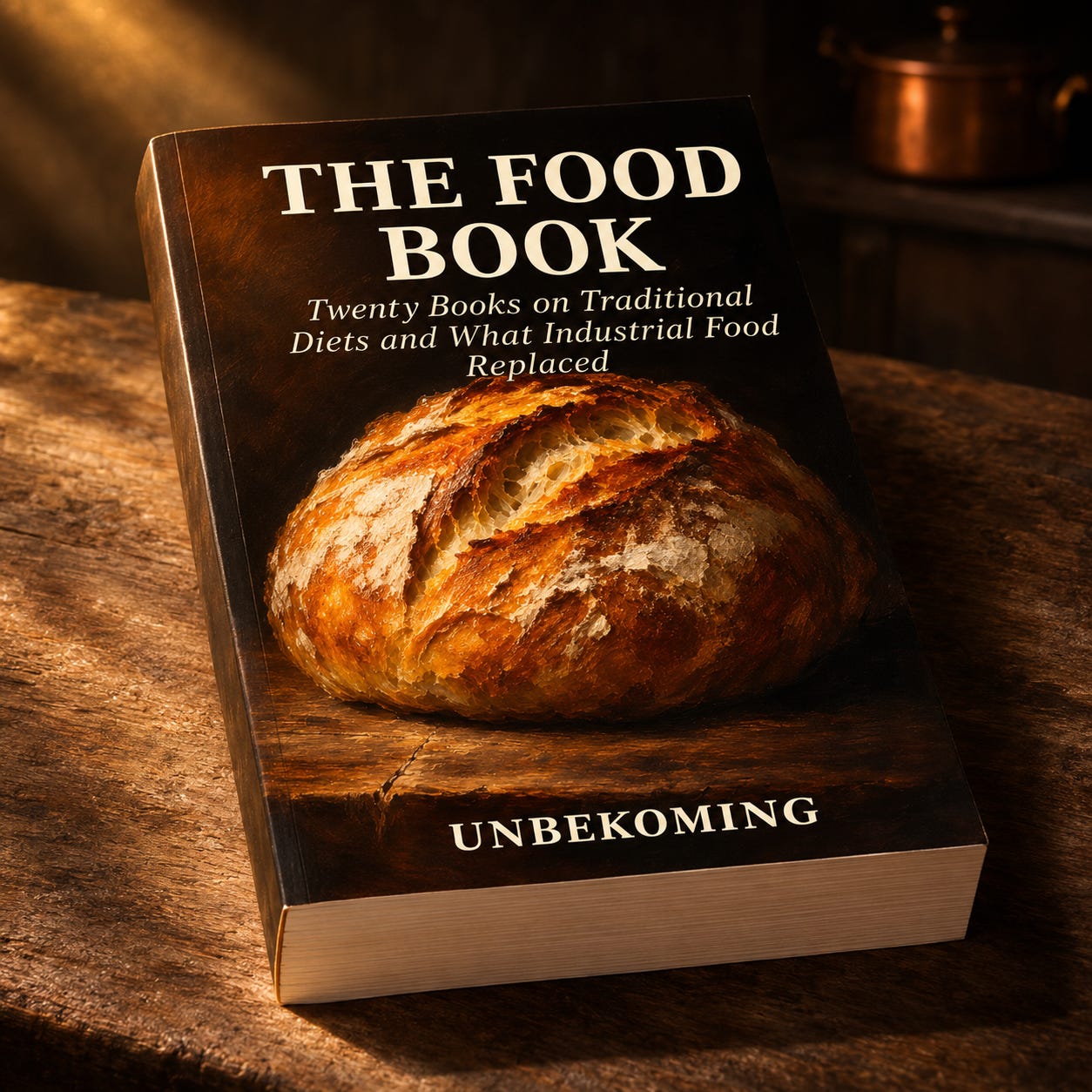
What has not been treated at book length, until now, is the whole shelf — the twenty works that, taken together, describe what the traditional kitchen was, what industrial food replaced it with, and what the body does when the replacement runs for a century.
The Food Book reads twenty of those works as a single library: Weston Price and Sally Fallon on the tradition that was lost; Francis Pottenger on what cooking does to a species over four generations; Sandor Katz on fermentation as an ecology; William Dufty on the two-and-a-half-century history of refined sugar; William Campbell Douglass on raw milk; James DiNicolantonio on the inversion of the salt argument; Max Gerson on cancer; Ulric Williams on medicine as a cartel; William Engdahl on seed sovereignty; Stephen Harrod Buhner on what plants do, chemically, that pharmaceuticals disrupt.
That is why the book is long. 581 pages, twenty chapters, four appendices, a 152-headword index. The length is the library.
What the book shows
Part One — Traditional foods and the pantry (eleven chapters). Begins with Weston Price’s 1939 documentation of fourteen isolated populations and ends with Morton Walker on the healing powers of garlic. Between them: Sally Fallon’s operations manual for the Price-tradition kitchen (Nourishing Traditions, 1995); Francis Pottenger’s four-generation study of cats fed cooked versus raw food (Pottenger’s Cats, published 1983 from research dating to the 1940s); Sandor Katz on fermentation as a relationship with an ecology (Wild Fermentation, 2003); John and Jan Belleme on the Japanese traditional pantry (Japanese Foods That Heal, 2007); Ronald Fessenden on the therapeutic chemistry of honey (The Honey Revolution, 2008); Henry Bieler on food as the first line of medicine (Food is Your Best Medicine, 1966); Nancy Appleton on natural-foods healing (Heal Yourself with Natural Foods, 1998); Kaayla Daniel on the industrial soy story (The Whole Soy Story, 2005); and Sally Norton on oxalate overload (Toxic Superfoods, 2023).
Part Two — Sugar, salt, milk and therapeutic diets (nine chapters). William Dufty on the two-and-a-half-century history of refined sugar — a history that runs through the slave trade, through the sugar trust, through the breakfast cereal industry (Sugar Blues, 1975). William Campbell Douglass on raw milk and the politics of dairy (The Raw Truth about Milk, 1984). James DiNicolantonio on the inversion of the salt argument — the data the salt-causes-hypertension consensus was built on, and the data it ignored (The Salt Fix, 2017). DiNicolantonio and Siim Land on the hunger hormones (The Obesity Fix, 2024). Natasha Campbell-McBride on the gut-and-physiology protocol (Gut and Physiology Syndrome, 2020). Max Gerson’s cancer therapy (The Gerson Therapy, 2001). Ulric Williams’ 1934 diagnosis of medicine as a cartel — a book written in New Zealand ninety years ago that reads as if written yesterday (Terrain Therapy, 1934 / republished 2022). William Engdahl on the industrial capture of the seed supply (Seeds of Destruction, 2007). Stephen Harrod Buhner on the planetary chemistry of plants and what pharmaceuticals disrupt (The Lost Language of Plants, 2002).
Each of the twenty chapters follows the same reader’s-guide structure: a thirty-question Q&A drawn from the source material, an analogy that captures the central move, a one-minute elevator explanation, a twelve-point summary, a golden-nugget insight, and an explanation for a six-year-old. One hundred and twenty distilled passes across the twenty books, carrying the substance in six different forms. Meet each book at the level that fits.

What is at the back
Four appendices and a full index.
Appendix A is the terrain pantry — the convergent food list that every traditional population ate some version of.
Appendix B is the industrial replacement list — what the modern food supply put in its place, and what to take out of the kitchen.
Appendix C is a reading order by reader type: six doors into the twenty books depending on where the reader is starting from.
Appendix D is the terrain food timeline — the chronology of what was replaced, and when. The index runs across 152 marked terms.
Who this book is for
For the subscriber who has been reading the food essays for years. This is the shelf, bound. Every book you have seen mentioned in essays, every author whose work was quoted in a Q&A, every pattern argued across posts — collected, normalised into the reader’s-guide format, and carried from first mention to full appendices in a single volume. The working library in one place.
For the reader starting here. No prerequisites. Appendix C is designed for this — it sketches six doors into the twenty depending on where you are starting from (the parent of a sick child, the adult with a chronic diagnosis, the cook wanting to rebuild the pantry, the historian wanting to see the arc of industrial replacement, the clinician looking for the convergent protocol, the sceptic who wants the hardest-hitting chapter first). Open the door that fits. Read the chapter it points to. Let the shelf unfold from there.
For someone you love. A family member heading into a chronic-disease diagnosis. A friend asking what they should actually eat. A child about to start a kitchen of their own. The book is designed to be given. Each chapter stands alone. The reader’s-guide structure lets the newcomer meet a difficult book without first having to read it cover to cover.
The companion piece: The Garlic Book
The Food Book‘s thirteenth chapter is Morton Walker’s The Healing Powers of Garlic — thirty questions on what garlic actually does in the body, from blood chemistry to heart protection to the response to microbial colonisation. Thirty questions is the right size for a chapter in a twenty-book shelf. It is not the right size for the substance.
The Garlic Book, published two weeks before this one, is what happens when that single chapter becomes a full treatment: the four-thousand-year clinical record, the allicin chemistry, the raw-versus-cooked question, the dosage question, the storage question, the role in traditional kitchens across every continent. The chapter sketches the subject. The book carries the whole of it.
The pattern is deliberate. Every chapter in The Food Book is a doorway to a longer conversation. Some of those conversations deserve their own volume. The Garlic Book is the first full-length expansion. More will follow.

Audio Deep Dive (Paid Subscribers Only)
Digital Edition
Platinum Supporters - immediate access
Want access now? Upgrade to Platinum Supporter to receive digital editions on paperback release day.
Standard Paid Subscribers - access in 3-6 months from date of this post
EPUB Edition — Platinum Supporters
An EPUB edition, readable on Kindle, Kobo, Apple Books, and any e-reader that supports the format. Platinum Supporters can download it below.
For the full paperback shelf
The Unbekoming catalogue runs across terrain medicine, food, fasting, the history of medical capture, and the pet-terrain titles. Fasting: The Oldest Medicine. The Garlic Book. Colloidal Silver: The Silver That Medicine Dropped. Extraction: The Middle Class as Colony. More are in production. The full shelf is here: lulu.com/spotlight/unbekoming.
Thank you
The imprint runs on attention and word of mouth — on readers who read, who share, who buy, who lend, who recommend. Every one of those actions is what keeps the shelf growing. Thank you to the subscribers who have been here from the first essays, to the readers who bought the earlier books, to the people who have sent them to a family member or a friend. The shelf exists because you have carried it.
Traditional food was food. The twenty books, taken together, remember what that meant.
With gratitude,
Unbekoming
Support This Work
The essays are free and will stay free. What paid subscribers get is the library that surrounds them: the full digital book catalogue, audio deep dives, archived, and embedded in each essay, and the Questions for Your Doctor, Before You Consent, and Package Insert series. Platinum Supporters also receive the digital edition of every paperback on the day it’s published.
Whichever tier suits, thank you for being here. If you’d like to become a paid subscriber, upgrade a tier, or gift a subscription to someone who might value the work, the options are below.
Thank you for bringing together works and insights that invite reflection on something as essential as the relationship between nutrition and health.
I find it particularly interesting to revisit the research of Dr. Weston A. Price, one of the authors included in this collection.
Price observed that certain traditional populations maintained extraordinary oral health and physical condition. His perspective went beyond just diet; he believed the difference also lay in the wisdom accumulated over generations—in their dietary customs and their knowledge of which foods best supported their health.
It is important to reclaim this idea: to return to fresh, whole, and minimally processed foods, to restore plant diversity, incorporate nuts and seeds, and adopt beneficial traditional practices—all while evaluating this knowledge against modern science. In short, we should recover the best of this ancestral wisdom and combine it with today’s scientific advancements.
It is also valuable to learn to listen to our own bodies, as we do not all tolerate the same foods in the same way.
Prevention begins in our daily lives—through our diet, physical movement, and the care of our metabolic terrain.
Reference:
Christopher Masterjohn – Understanding Weston Price on Primitive Wisdom (2011).
A reflection on ancestral dietary wisdom, the knowledge passed down through generations, and its influence on health.
The article explores several key aspects:
- Soil care and fertility as a means to obtain more nutritious food.
- Knowledge of local plants and food sources.
- The selection of specific foods during pregnancy, breastfeeding, and periods of growth.
- Adapting one’s diet to environmental conditions.
- The transmission of practical knowledge from one generation to the next.
https://www.westonaprice.org/health-topics/nutrition-greats/understanding-weston-price-on-primitive-wisdom/#gsc.tab=0
Still baking my own bread, cooking from scratch, with the cleanest products I can find. My digestive system does not like garlic and not even regular onions, but I use green onions instead. Rereading the Price book, that I bought years ago. Our teeth won't come back and our bones won't un-deform, but at least we can do the best we can !