

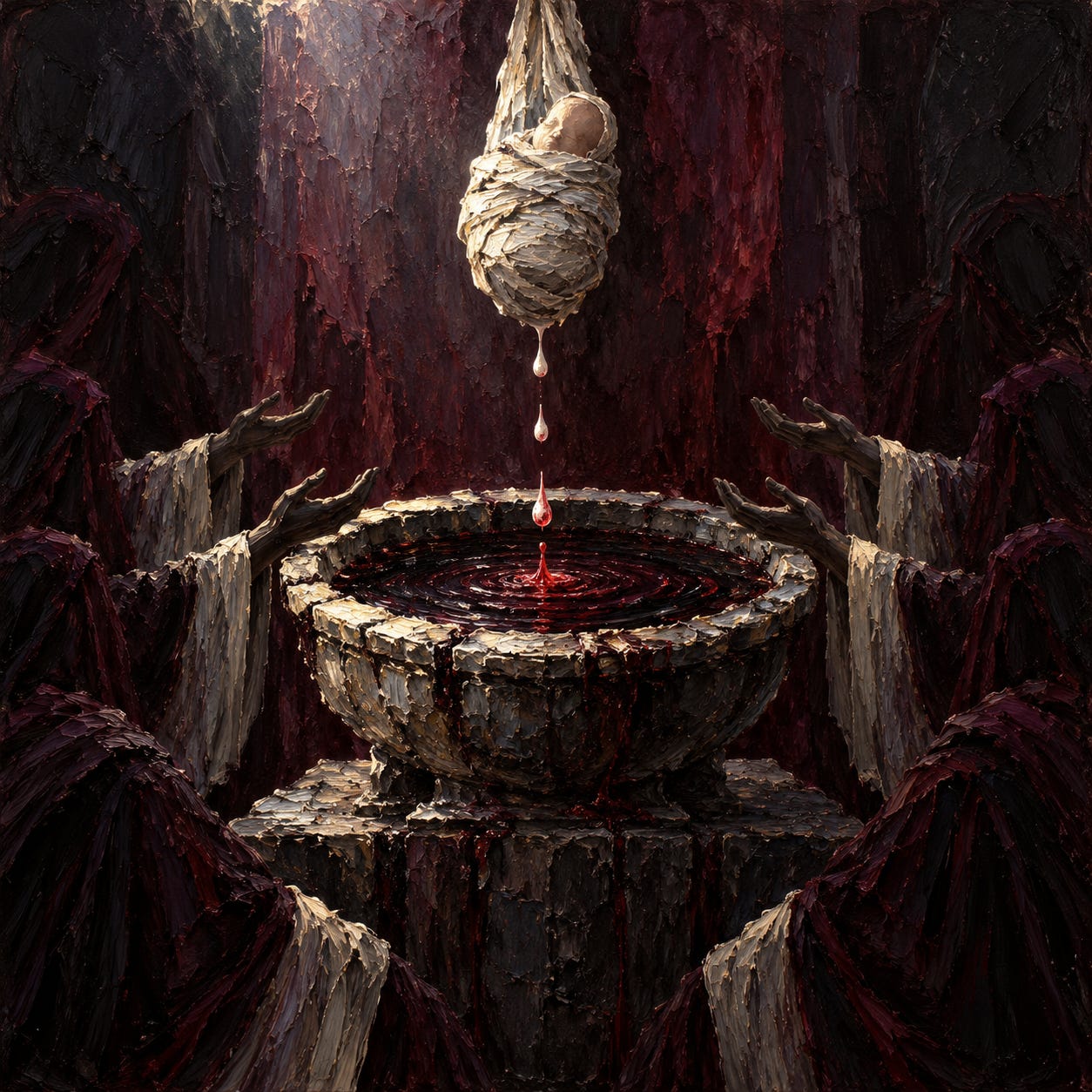
The essay examines the childhood vaccine schedule through the frame of Ernest Becker’s 1973 book The Denial of Death. Where establishment vocabulary appears, including condition names, product labels, and the catechism’s own language about protection and prevention, the terms are presented in quotation, attribution, or reference to official bodies. The analytical voice operates from a terrain paradigm. The two registers do different work. Readers should expect the shift between them.
“An immunity bath” from “the greatest evil: death and the dread of it.”¹
G. Stanley Hall, the first president of the American Psychological Association, used the phrase in 1915 to describe what the ancient mystery cults of the Eastern Mediterranean were for. Osiris. Dionysus. Mithras. Hall was writing about ritual, not biology. The devotee entered the temple, submitted to the rites performed by the priest, and emerged bathed in symbolic protection against the one thing no mortal creature can defeat.
Ernest Becker quoted Hall in Chapter Two of The Denial of Death, the 1973 book that reorganized a century of psychoanalytic thought around a single thesis. “The idea of death, the fear of it, haunts the human animal like nothing else; it is a mainspring of human activity, activity designed largely to avoid the fatality of death, to overcome it by denying in some way that it is the final destiny for man.”² What Hall had observed about the mystery cults, Becker generalized into a theory of culture itself. Every society, he argued, is a hero-system. “Society itself is a codified hero system, which means that society everywhere is a living myth of the significance of human life, a defiant creation of meaning.”³
The hero-system changes form across civilizations. Egyptian pyramids, Christian cathedrals, Soviet workers’ palaces, American skyscrapers. In each case the devotee participates in the construction of a symbolic edifice larger than himself and lends his small life to its eternity. The transaction is always the same. The terror of mortality is laid down at the altar of a system that promises something beyond mortality. In exchange the devotee is permitted to carry on. He bears the mark that lets him sleep at night.
What the modern Western hero-system no longer offers through religion, it now offers through medicine. The priesthood wears white coats. The sacrament arrives in a syringe. The catechism is called a vaccination schedule. The excommunication is a diagnosis of selfishness, ignorance, or danger, often accompanied by removal of the child from school and the parent from polite society. The ritual Hall described in 1915 is still being performed. The thing being bathed in has only changed its name.
Essay PDF Download (Free Subscribers)
A Note on the New Essay PDFs
Most essays now come with a designed PDF, available to all subscribers for now. Built as a slim 6×9 monograph with a line-art cover, proper typography, and back-matter pages that compress the argument into four beats, pull the hardest numbers onto a receipts page, and distill practical takeaways into a quick-reference sheet. The format is new and still finding its shape. What works? What doesn’t? What would you add, cut, or redesign? All ideas welcome.
Audio Deep Dive (Paid Subscribers Only)
Support This Work
The essays are free and will stay free. What paid subscribers get is the library that surrounds them: the full digital book catalogue, audio deep dives, archived, and embedded in each essay, and the Questions for Your Doctor, Before You Consent, and Package Insert series. Platinum Supporters also receive the digital edition of every paperback on the day it’s published.
Whichever tier suits, thank you for being here. If you’d like to become a paid subscriber, upgrade a tier, or gift a subscription to someone who might value the work, the options are below.
The Priest
In the mystery cults the priest stood between the devotee and the terror. He knew the rites. He had access to the god. The devotee did not need to understand what the priest was doing. The devotee needed only to trust him and to submit.
Freud, writing fifty years before Becker, described this submission in clinical terms. He called it transference. In Becker’s summary of the Freudian observation, the patient “blows the physician up larger than life just as the child sees the parents. He becomes as dependent on him, draws protection and power from him just as the child merges his destiny with the parents.”⁴
Becker, following Rank and Ferenczi, generalized the mechanism. Transference is not a quirk of the analytic couch. It is the universal human disposition to find a larger figure to lean on, and to receive from that figure what Kierkegaard called “the courage to be.” The transference object may be a parent, a leader, a god, a flag, an employer, or a physician. “The need to be subject to someone remains; only the part of the father is transferred to teachers, superiors, impressive personalities.”⁵ The physician is one of the most reliable transference objects in modern life because the physician makes the oldest promise. I will stand between you and the terror.
The pediatrician’s office is where this transference first forms around the child. The parent, who has carried for nine months and then delivered this small life into a world where children die, hands the baby to a stranger in a white coat. The stranger weighs the child, listens to the chest, pronounces the child healthy, and says the schedule calls for the first injections. The parent has already lost the argument before it begins. The parent has already submitted to the figure in the room who stands between the baby and the terror the parent has not been able to look at directly.
The physician is not acting in bad faith. The physician believes the schedule she administers is protective. This is the condition the transference requires. If the figure in the white coat knew the ritual was theater, the parent could not submit to it. The priest’s own belief in the sacrament is what makes the submission possible, which is why the priesthood recruits only those who believe and expels those who come to doubt.
Suzanne Humphries, in Dissolving Illusions, describes her own encounter with this bond from the opposite side. She was a nephrologist, trained inside the system, dispensing the sacraments. When another physician laughed at her for suggesting that diet might have anything to do with meningitis cases in college students, she realized she had been inside the transference without knowing it. “The God-given sense that I was endowed with was temporarily replaced by supposed evidence-based medicine and mindless rules, protocols, and guidelines.”⁶ She had been operating as the priest. When she stepped outside the role, what she saw was that the structure she had been serving was a hero-system, and the hero-system was false.
The parent in the clinic does not know she has entered a transference. She knows only that this person is a doctor, and doctors protect children, and the thing the doctor says must be the thing a loving parent does. The ritual proceeds.
The Sacrament
The CDC’s Pink Book, now in its fourteenth edition, directs that the first injection of what medicine calls Hepatitis B vaccine be administered within twenty-four hours of birth.⁷ The infant has not left the delivery room, or has only just left it. The umbilical cord has recently been cut. The mother is often still being stitched. The nurse arrives with the syringe. The first act performed on the child by the medical establishment, after the weighing and the wiping, is to be injected.
The vial contains the recombinant surface protein the manufacturer markets as the vaccine, suspended in an aluminum hydroxide adjuvant chemically selected to provoke the inflammatory response the catechism calls protective. By his eighteen-month birthday, Handley documents, the fully vaccinated child will have received 4,925 micrograms of injected aluminum, nearly four times what a child born in the mid-1980s received across the same window.⁸
This is the ritual. The timing is the point.
Religions have always understood that the moment of birth carries ritual weight. Baptism marks the child’s arrival into the symbolic community and simultaneously claims the child for the god who will protect the soul. The injection at the hospital does the same work. It marks the child’s arrival into the medical community, claims the child for the hero-system of modern medicine, and inaugurates a timetable of further injections that will continue through the next eighteen years. The parent is told the injection prevents a condition the newborn has no realistic exposure to in the first week of life. The parent is correct to find this strange. The injection is not for the condition. The injection is to open the ritual relationship.
Becker, writing about the primitive ceremonies the mystery cults inherited, saw this function clearly. The purpose of ritual is “a vehicle for earthly heroism.”⁹ The devotee receives his role, the priest confirms it, and in the receiving and confirming a bargain is struck between the mortal and the system that stands against death. The devotee is now one of the saved. He may carry on.
The parent at the hospital enters the same bargain. The baby is now vaccinated. The baby is now inside the hero-system of modern medicine. The parent has done the thing a good parent does. The terror the parent has not been able to look at directly, the terror of losing the child, has been laid down at the altar. In exchange the parent has been given a certificate. The hero-identity of the good parent is confirmed.
What is actually in the syringe matters less, inside the ritual, than what the syringe accomplishes socially. The hero-system does not require that the medical claims be true. The hero-system requires only that the ritual be performed. This is why challenges to the medical claims so often produce responses that have nothing to do with evidence. The challenge is not a scientific question. The challenge is a question about whether the parent is one of the saved. To doubt the vaccination is to doubt the parent’s hero-status, which is to invite back the terror the ritual exists to hold off.
Over the eighteen years that follow the first injection, the schedule expands. J.B. Handley, writing in How to End the Autism Epidemic, documents the arithmetic. In 1962 the maximum number of vaccinations a child would receive by age five was three. In 1983 it was ten. By the mid-2010s it had reached thirty-eight, “nearly quadruple what it was in 1983 and more than twelve times what it was in 1962.”¹⁰ The sacrament has not merely survived. It has multiplied.
The Catechism
Every priesthood requires a catechism. The devotee must know the story. How the ritual came to be. What it has accomplished. Why it must be continued. What will happen if it is abandoned.
The modern vaccination catechism has four articles of faith. The ritual was discovered by heroes. It has defeated the great plagues of history. It is grounded in settled science. Those who refuse it endanger others.
The first article rests on Edward Jenner and a boy named James Phipps. Humphries, drawing on nineteenth-century sources that are rarely cited in modern textbooks, lays out what actually happened. In 1796 Jenner took material from a pustule on the hand of a dairymaid, Sarah Nelmes, and scratched it into the arm of Phipps, an eight-year-old. The child did not develop smallpox when later deliberately exposed. Jenner declared the method successful on the basis of this single case.¹¹ Dr. Charles Creighton, writing in 1889, reviewed Jenner’s work and found that the founding experiment had been promoted by its author in a form that “enabled Jenner to suppress the true and suggest the false.”¹² Jenner did not have a stable product. He drew from cows, from horses with a condition called the grease, from goats, and later from arm-to-arm passage of human lesions. What is now called “vaccinia” is, in Humphries’ summary, “a human/animal hybrid agent that never existed in nature until the era of vaccination.”¹³
None of this is secret. The sources are in the medical journals of the time. The catechism survives because it does not depend on the sources. The catechism depends on the hero-story. A country doctor with the courage to experiment. A brave young boy who did not die. A scourge banished from the earth. A nation delivered. The story serves the ritual. The ritual needs the story. The sources are allowed to lie in the archive.
The second article, that vaccination defeated the great plagues, dissolves against the mortality curves. Humphries documents what the compulsory smallpox vaccination laws actually produced. “The enforcement of the compulsory smallpox vaccination law in 1867, when the death rate was already falling, was accompanied by an increase in the deaths from 100 to 400 deaths per million.”¹⁴ Cholera, typhoid, dysentery, and typhus, which killed vastly more people in the nineteenth century than smallpox did, were brought down by sanitation and nutrition. There were no vaccines for cholera or typhoid during the period in which their mortality collapsed. The curves tell one story. The catechism tells a different one. The catechism wins because the catechism is what the hero-system teaches.
The third article, settled science, functions in the ritual the way scripture functions in a religion. The devotee is not expected to read the primary sources. The devotee is expected to receive the summary from the priest and to trust that the summary is accurate. When a parent asks a pediatrician for the ingredient list, the manufacturer’s package insert, the pre-licensure trial data, or the long-term outcome studies, the parent is told, often with visible irritation, that these questions are not necessary. The science is settled. The priest has read it so the devotee does not have to.
The fourth article, that refusal endangers others, converts the ritual into a civic obligation and provides the mechanism for enforcement. If the vaccinated are not fully protected unless the unvaccinated are also vaccinated, then the unvaccinated child becomes a public threat and the parent of the unvaccinated child becomes a public enemy. This is the article that permits the excommunication.
The Excommunication
Every mystery cult required an outside. The devotee’s status depended on there being someone who was not initiated, not saved, not inside the ritual. Becker, following Rank, understood this as a structural feature of the hero-system. “Human conflicts are life and death struggles, my gods against your gods, my immortality project against your immortality project.”¹⁵ The threat to the hero-system is not the enemy from outside the city. The threat is the person inside the city who declines to participate.
The modern vaccination hero-system has produced an elaborate taxonomy of excommunications. The parent who asks too many questions is noncompliant. The parent who requests an alternative schedule is anti-science. The parent who refuses one injection is anti-vaccine. The parent who refuses the whole schedule is a danger to the community. The physician who agrees to see the family is tracked and sometimes delicensed. The child is removed from school. The parents are reported to child protective services. The social cost is total.
What is harder to look at, inside Becker’s framework, is that the excommunication falls hardest not on the parents who refused from the beginning but on the parents who vaccinated and then saw the injury. Handley’s book opens with his own case. His son Jamison was vaccinated on schedule. The decline followed. The pattern matched what other parents were reporting. The diagnosis arrived. “Were vaccines the primary trigger for an epidemic of autism? Were we really doing that to kids? The scale of damage was nearly incomprehensible. This would be a recurring theme for us on this journey. We’d meet highly intelligent parents, doctors, and scientists who would tell us that, yes, that’s exactly what’s going on. It was two different realities.”¹⁶
The phrase to notice is “two different realities.” One is the reality the hero-system teaches, in which the ritual protects the child. The other is the reality the parent has seen with his own eyes, in which the ritual has done something to the child that was not supposed to be possible. The parent cannot occupy both realities. The parent must choose. Most parents, Handley observed, cannot choose the second reality unless the evidence has become undeniable in their own home. “I never would have believed it if it hadn’t happened to me.”¹⁷
Becker’s framework predicts this exactly. The hero-system is the structure by which the parent manages the terror of child mortality. To admit that the ritual has caused the injury is to admit that the parent, acting as a good parent, delivered the child to the thing that harmed him. The admission does not merely require revising a medical opinion. The admission requires the dismantling of the parent’s own hero-identity. The parent must say: I believed I was protecting my child. The system I trusted was in fact hurting him. I handed him to it, repeatedly, on schedule, for years. Few people can bear this. The character-armor, in Becker’s vocabulary, is designed precisely to make such admissions impossible. “We don’t want to admit that we are fundamentally dishonest about reality, that we do not really control our own lives. We don’t want to admit that we do not stand alone, that we always rely on something that transcends us, some system of ideas and powers in which we are embedded and which support us.”¹⁸
The parents who do make the admission are then expelled. Paul Thomas, a pediatrician who treated vaccine-injured children and spoke publicly about what he was seeing, had his medical license suspended. Andrew Wakefield lost his career. Humphries lost hers. Handley became, in the official taxonomy, a dangerous activist. The hero-system does not merely exclude these figures. The hero-system teaches the remaining devotees to feel contempt for them. The teaching is necessary because the figures threaten the ritual, and the ritual is what stands between the devotees and the terror. The contempt the devotee feels for the excommunicated is a measure of how much the devotee depends on the ritual being true.
Thomas, in a cover endorsement for Handley’s book, used a phrase that lands directly in Becker’s framework. “We have sacrificed too many children at the vaccine altar.”¹⁹ The word altar is not metaphor. The structure is a ritual structure. Children are placed on it. The sacrifice is real.
The Inversion
The ritual was supposed to be an immunity bath against death.
What the childhood schedule produces, in the United States and across the industrialized world, is a generation of children who are not well. Rates of what medicine labels autism, asthma, eczema, food allergies, type 1 diabetes, juvenile arthritis, and chronic neurological conditions have climbed in parallel with the expansion of the schedule. Handley documents the parallel across chronic childhood conditions.²⁰ Heather Fraser documents it specifically for the peanut allergy epidemic, which did not exist as a mass phenomenon before 1990 and now affects between two and three percent of children across the United States, the United Kingdom, Canada, and Australia.²¹ The CDC’s 2022 surveillance data, released in 2025, places one in thirty-one American children on the autism spectrum, up from one in thirty-six in the prior reporting cycle and one in one hundred and fifty at the turn of the millennium.²² Miller and Goldman, examining infant mortality rates across thirty industrialized nations against the number of vaccine doses routinely given, found that nations with higher dose counts had higher infant mortality rates.²³ The age distribution of unexplained infant deaths peaks between two and four months, which coincides with the first major block of scheduled injections. Children who were previously healthy regress after specific appointments. The parents who see this and say so are told they are mistaken.
The thing the ritual was supposed to protect against is the thing the ritual is now producing.
This is the inversion Becker’s framework always predicts. “Our heroic projects that are aimed at destroying evil have the paradoxical effect of bringing more evil into the world.”²⁴ The hero-system that promises to defeat death becomes, in its operation, a producer of the injuries and deaths it was built to prevent. The ritual continues not because it works but because stopping it would require admitting what it has cost. The admission would be unbearable, so the ritual is defended, and the children who have been injured by it are reclassified as having mysterious new conditions whose causes are, the catechism insists, unknown. The hero-system absorbs the evidence of its own failure and keeps running.
Hall described the ritual in 1915. Becker named its function in 1973. More than a century on, the paper is still laid on the examination table, the vial still sits on the nurse’s tray, the schedule still glows on the parent’s phone, and the priest is still making the mark. The thing the mark was supposed to defend against is the thing it is now causing.
How to Explain It to a Six-Year-Old
A long time ago, people were scared of a monster called Death. Nobody could beat the monster. But some clever people built a special room with a door and told everyone that if you went inside and sat still while a man in a special costume put a mark on you, the monster could not find you. The special man was called a priest. The mark was called a blessing. The room was called a temple. And everyone said this was how to be safe.
People came from everywhere to get the mark. Some of them felt better afterwards even though nothing had really changed. They felt better because they had done the thing the clever people said would protect them. The priest told them they were safe now. They believed him and went home.
The mark did not actually keep the monster away. Nothing could keep the monster away. But people needed to believe that something could, because they could not stand being scared all the time. So they kept going to the temple, and the priest kept making the mark, and everyone agreed not to say out loud that it might not work.
Hundreds of years went by. The old temple fell down and the old priest retired and people stopped using that mark. But they still needed something to keep the monster away. So they built a new temple. This one they called a hospital. The new priest wore a white coat and used a needle instead of a brush. The new mark was called a vaccination. Parents brought their babies in to get the mark, and when the babies cried the parents told themselves it was for a good reason, because the monster was still out there and the mark would keep their babies safe.
Some of the babies got very sick after the mark. Some of them stopped talking. Some of them never got better. Some of them died. The parents of those babies tried to tell the other parents what had happened. But the other parents could not hear them. Because to hear them would mean the mark did not work. And if the mark did not work, then the monster was still out there, and the parents had nothing to put between the monster and their own babies except a needle that might have been hurting them all along.
So the parents who had seen what happened were pushed away. The temple kept running. The mark kept being made. And the babies kept getting hurt.
That is what this essay is about. It is about a very old thing happening in a new building.
In Print
The Unbekoming library is available in paperback, printed to order through Lulu and shipped worldwide. The shelf begins with the paradigm question underneath everything else — No Virus, the isolation problem, the collapse of virology’s foundational claims, and a disease-by-disease reappraisal — and moves through the suppressed compounds mainstream medicine set aside: The DMSO Book, Chlorine Dioxide: The Forbidden Remedy, The Iodine Book, and The Hydrogen Peroxide Book. Two more recover what’s still on the kitchen shelf: Baking Soda and The Castor Oil Book. Two more recover the minerals modern soil, water, and processing quietly stripped from the diet: The Magnesium Handbook and The Boron Book. Sitting alongside these is No Contagion, co-authored with Jamie Andrews — the case against germ theory itself, catalogued through 258 failed contagion experiments.
The critique books cover what medicine, dentistry, psychiatry, and veterinary practice have become. The Unvaccinated treats the completely unvaccinated as a comparison group across twenty chapters and five appendices. Medicalized Motherhood follows a woman through 123 documented interventions from teenage pill to postpartum discharge. Drilling for Profit treats cavities, gum disease, and crooked teeth as the dietary problem they are. What Your Vet Can’t Tell You applies the same critique to pets. Escape from Psychiatry documents the fabrication of the DSM and the specific damage of every major psychiatric drug class. The Vitamin K Injection covers what happens in the first hours of a newborn’s life.
The full shelf is at lulu.com/spotlight/unbekoming. A physical book reaches the person a Substack post never will — the skeptical relative, the friend who won’t click a link but might open a book, the visitor whose eye lands on a coffee table. Buy one to keep, and one to give away.
References
G. Stanley Hall, “Thanatophobia and Immortality,” American Journal of Psychology 26 (1915): 550–613, quoted in Ernest Becker, The Denial of Death (New York: Free Press, 1973), Chapter Two.
Ernest Becker, The Denial of Death (New York: Free Press, 1973), Preface.
Becker, The Denial of Death, Chapter One, “Introduction: Human Nature and the Heroic.”
Becker, The Denial of Death, Chapter Seven, “The Spell Cast by Persons: The Nexus of Unfreedom,” summarizing Sigmund Freud, Group Psychology and the Analysis of the Ego (London: International Psycho-Analytical Press, 1922).
Sándor Ferenczi, quoted in Becker, The Denial of Death, Chapter Seven.
Suzanne Humphries and Roman Bystrianyk, Dissolving Illusions: Disease, Vaccines, and the Forgotten History (independently published, 2013), Introduction.
Centers for Disease Control and Prevention, Epidemiology and Prevention of Vaccine-Preventable Diseases (The Pink Book), 14th edition, Hepatitis B chapter, recommending that medically stable infants weighing at least 2,000 grams receive the HepB vaccine birth dose within 24 hours of birth.
J.B. Handley, How to End the Autism Epidemic (White River Junction, VT: Chelsea Green, 2018), Chapter Five, citing a cumulative total of 4,925 micrograms of aluminum delivered through the schedule by eighteen months of age.
Becker, The Denial of Death, Chapter One.
Handley, How to End the Autism Epidemic, Chapter Three.
Humphries and Bystrianyk, Dissolving Illusions, chapter on the beginnings of smallpox vaccination.
Charles Creighton, Jenner and Vaccination: A Strange Chapter of Medical History (London: Swan Sonnenschein, 1889), quoted in Humphries and Bystrianyk, Dissolving Illusions.
Humphries and Bystrianyk, Dissolving Illusions, on the hybrid origin of vaccinia.
Humphries and Bystrianyk, Dissolving Illusions, Introduction.
Becker, The Denial of Death, Preface, “fourth strand.”
Handley, How to End the Autism Epidemic, Chapter One.
Handley, How to End the Autism Epidemic, Chapter One.
Becker, The Denial of Death, Chapter Four, “Human Character as a Vital Lie.”
Paul Thomas, MD, cover endorsement for J.B. Handley, How to End the Autism Epidemic (Chelsea Green, 2018).
Handley, How to End the Autism Epidemic, Chapter Two, documenting parallel rises in autism, asthma, allergies, and other chronic childhood conditions alongside the vaccine schedule expansion.
Heather Fraser, The Peanut Allergy Epidemic: What’s Causing It and How to Stop It, Introduction and Chapter One, dating the mass emergence of peanut allergy to the early 1990s and documenting its subsequent spread across industrialized nations in parallel with vaccine schedule expansion.
Centers for Disease Control and Prevention, Autism and Developmental Disabilities Monitoring (ADDM) Network surveillance summaries, with the 2022 reporting cycle (released April 2025) placing autism prevalence at approximately 1 in 31 among 8-year-olds.
Neil Z. Miller and Gary S. Goldman, “Infant mortality rates regressed against number of vaccine doses routinely given: Is there a biochemical or synergistic toxicity?” Human and Experimental Toxicology 30, no. 9 (2011): 1420–1428.
Becker, The Denial of Death, Preface, “fourth strand.”