

Cupping is one of the oldest medical interventions in continuous practice, documented systematically for at least 3,500 years and still used daily across much of the world. Most Western readers encountered it for the first time on Michael Phelps’s shoulders during the 2016 Rio Olympics, filed it as athletic recovery theater, and moved on. The actual history is longer, the mechanism is more interesting, and the practice was common in every major European hospital in 1850 before being almost entirely forgotten by 1950, for reasons that have more to do with how medicine was reorganized than with anything the practice itself was or was not doing.
Where my clinical sources describe the lymphatic network as part of “the immune system,” they are using the establishment’s military metaphor. I use that language only in quotation and attribution. The lymphatic system is real; its primary function is cleansing and repair, not defense against invaders. Where sources frame cupping marks as “immune response,” I describe what is actually happening: the mechanical mobilization of stagnant fluid in the fascia, visible on the skin for a few days afterward. The terrain analysis is in my own voice. The shifts between registers are deliberate.
What the Rings Were
The purple rings on Michael Phelps’s shoulders in Rio were not bruises.
A bruise is tissue damage from blunt force. It appears after impact, hurts to the touch, and resolves through the color sequence of trauma healing: red, then purple, then that distinctive yellowy green as the blood is reabsorbed. What appeared on Phelps’s skin was something else. The clinical term is ecchymosis: the painless surfacing of stagnant blood and lymph from deeper tissue toward the skin.¹ The rings did not hurt, and they did not pass through the yellow-green stage of a bruise as the days went by.
They were not injury. They were visible terrain.
For a few days in August 2016, the most photographed swimmer in the world carried on his shoulders what his body had been holding beneath the surface. Fluid stagnation in the fascia. Blood that had been pooling in micro-regions of poor circulation. Metabolic waste that the lymphatic network had not been able to carry away. All of it drawn upward by suction, surfacing where it could be seen.
The response was swift and almost uniform: cupping is Chinese athletic recovery, interesting but not important, a curiosity Phelps happened to find useful. The actual history is longer. The practice is at least 3,500 years old in continuously documented use. It was mainstream Western medicine as recently as 150 years ago. It was taught by Hippocrates, defended by Galen, recommended by the Prophet Muhammad, developed systematically in China for two millennia, and practiced in every major European hospital through the nineteenth century. It appears in the oldest intact medical text that survives, written in Egypt around 1550 BCE and probably copied from earlier records.²
What cupping does to the body is simple. What it reveals about the body is harder to accept inside the current medical paradigm.
Essay PDF Download (Free Subscribers)
Audio Deep Dive (Paid Subscribers Only)
Support This Work
The essays are free and will stay free. What paid subscribers get is the library that surrounds them: the full digital book catalogue, audio deep dives, archived, and embedded in each essay, and the Questions for Your Doctor, Before You Consent, and Package Insert series. Platinum Supporters also receive the digital edition of every paperback on the day it’s published.
Whichever tier suits, thank you for being here. If you’d like to become a paid subscriber, upgrade a tier, or gift a subscription to someone who might value the work, the options are below.
A Practice Carried Across Civilizations
The Ebers Papyrus, written in Egypt around 1550 BCE and found in the mid-nineteenth century, contains more than 800 entries on symptoms and treatments. It is the oldest intact medical text in existence, likely copied from earlier records that trace to approximately 3000 BCE.² Among its prescriptions is cupping, described as a method for “removing foreign matter from the body.”² The language is specific in a way that modern medical framing is not: there is no invader to fight and no organ to treat; there is matter in the body that does not belong there, and the point of the intervention is to get it out.
Egyptian cupping used animal horns and hollowed clay, and eventually glass vessels. By roughly 1500 BCE the Egyptians had developed glass cups for the purpose. Carvings in the temple at Luxor show cupping equipment alongside other medical instruments.³ Hippocrates, born on the Greek island of Kos around 460 BCE and generally credited as the founder of Western medicine, was a devoted cupping practitioner and taught the technique to his students.⁴ Galen, writing in the second century of our era, prescribed cupping for conditions ranging from headache to apoplexy and defended its use against physicians who had abandoned it in favor of other interventions. In Galen’s framework, disease arose from imbalance (dyscrasia) in the body’s humors; cupping restored balance by drawing the offending matter toward the surface where it could be expelled.⁵
The Chinese tradition is at least as old. The Mawangdui Silk Texts, discovered in a tomb in Hunan Province in 1973 and dated to approximately 175 BCE, contain explicit instructions for cupping.⁴ The Huang Di Neijing (The Yellow Emperor’s Classic of Medicine) discusses cupping repeatedly; it is traditionally attributed to the Yellow Emperor and dated to around 2600 BCE, though modern scholars suggest a more probable composition date of around 300 BCE.⁴ What survives through this literature is a continuous Chinese practice that moved from animal horns to bamboo and ceramic to glass, and from empirical application to a sophisticated clinical framework built around what Chinese medicine calls stagnation of blood, fluid, and qi.⁶ Rough translation into terrain language: regions of the body where fluid dynamics have slowed or stopped, where metabolic waste has accumulated, where microcirculation is no longer carrying what it should carry.
The Islamic tradition absorbed cupping and gave it a central place in prophetic medicine. The Prophet Muhammad is reported in multiple hadiths to have practiced and recommended cupping, which in Arabic is called al-hijamah, from a root meaning “to restore to basic size” or “to diminish in volume.”⁶ The thirteenth-century scholar Ibn Al-Qayyim, writing in Damascus, documented specific locations on the body where cups should be applied for specific conditions, along with timing within the lunar cycle and dietary preparation before and after treatment.⁶ Ibn Sina (known in the Latin West as Avicenna), writing in the eleventh century, specified timing within the lunar month for the most effective cupping sessions. Cupping remains, in 2026, a daily practice across the Muslim world.
Europe inherited the technique through multiple channels: directly from the Greeks, through the Arab Islamic transmission into Spain and then Italy from the ninth century onward, and through the Ottoman Turkish tradition that passed cupping into eastern and central Europe through the hamams.⁷ By the seventeenth century, cupping was standard practice in European hospitals. From the seventeenth through the nineteenth centuries, every major European hospital and most American ones used cupping routinely.⁷ The London cupper Samuel Bayfield’s 1823 treatise described cupping as “an art, the value of which every one can appreciate who has had opportunities of being made acquainted with its curative power.” The surgeon Charles Kennedy, writing in 1826, called the technique “so well known, and the benefits arising from it so long experienced, that it is quite unnecessary to bring forward testimonials.” A Virginia physician, Dr. W.A. Gillespie, writing in the Boston Medical and Surgical Journal in 1834, took the time to recommend that glass cupping sets (which were “often broken when carried around”) could be substituted with polished cow horn as a durable alternative in the field.⁸
Then it was gone.
Between the mid-nineteenth century and the mid-twentieth, cupping disappeared from mainstream Western medicine almost entirely. By the time the first antibiotic was marketed, you could complete medical training in London, New York, or Berlin without ever encountering the practice. The question of why that happened is not primarily about efficacy. It is about what kind of medicine was fundable, patentable, and institutionally defensible in the industrial pharmaceutical era that followed the mid-century reorganization of American and European medical education. The suppression story returns in a later section. For now, note the scale of what was lost: a practice that outlived every empire in the recorded history of medicine was displaced from Western clinical use within three generations.
A brief resurrection followed the Second World War, when German clinicians found themselves with populations needing care and almost no pharmaceutical supply.⁹ Cupping returned to European practice through the back door of necessity. It never fully recovered its mainstream status. It never had to disappear in the Muslim world, in China, in Japan, in Korea, or in the Mediterranean folk traditions where it had always been maintained in family homes.
What the Suction Actually Does
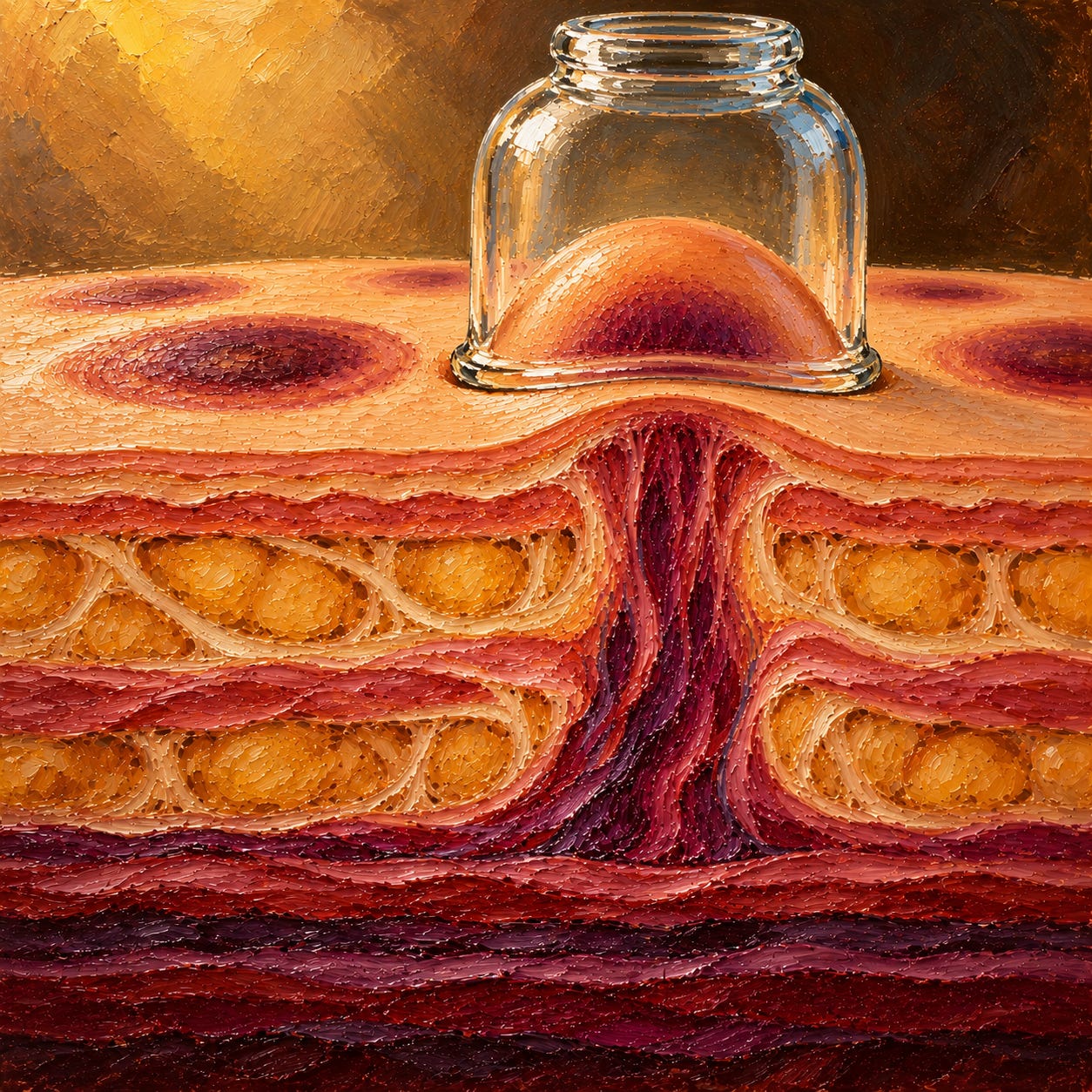
Place a cup on the skin. Remove the air inside it, either by introducing a flame briefly before applying the cup to the body, or by pumping the air out through a valve. The pressure inside the cup drops below atmospheric pressure. The skin and the tissue beneath it are pulled upward into the cup, with a force proportional to the pressure differential. With a standard cup, the skin tumefies (swells upward) by several centimeters, and the tissues underneath are displaced in the same direction.
What is being pulled upward is where the terrain analysis begins.
Mainstream anatomy for most of the twentieth century treated the skin as an envelope and the muscles as the structural layer beneath it, with the intervening tissue dismissed as packing material. That intervening tissue is fascia, and the past two decades have reversed the dismissal. Fascia is a continuous web of collagen-rich connective tissue that wraps every muscle, every organ, every blood vessel, and every nerve. It is a single tissue, structurally continuous from the scalp to the sole of the foot. Within the fascia run the smallest blood vessels (capillaries), the lymphatic vessels, and the fluid matrix of ground substance in which cells live and through which they communicate.
The fascia is where terrain lives. The capillaries and lymphatics do not deliver nutrients directly to cells; they deliver them into the fascial matrix, from which the cells draw what they need and into which they deposit what they discard. If the matrix becomes dense, sticky, or stagnant, every exchange slows. The cells live in increasingly polluted water.
When Ilkay Chirali, author of the standard reference text on clinical cupping and a practitioner of fifty years, describes the mechanism, he puts it this way: “the skin and the fascia, in which the blood vessels, glands, nerves, muscles, ligaments and tendons are wrapped, are lifted and forcefully moved against atmospheric gravity towards the suction cup, resulting in local myofascial decompression.”¹⁰ The last phrase is doing significant work. The default state of modern fascia is compression: hours of sitting, chronic postural loading, repetitive strain, and the sheer density of modern connective tissue after decades of toxic exposure and inadequate movement. The fascia becomes sticky. Fluid stops moving freely through it. Capillaries that should carry fresh blood into tissue, and lymphatics that should carry waste out of it, are pinched by the surrounding dense connective matrix.
The suction reverses this. It pulls the fascia upward and apart. Fluid that has stagnated begins to move. Capillaries that were closed open. The microcirculation (the fine capillary network at the tissue level where the actual exchange of nutrients and waste happens) is restored.
The research supporting this is thin, which is unsurprising for a practice that cannot be patented. What exists is suggestive. A 2020 study by Zhou and colleagues at Hong Kong Polytechnic University, published in Biomedical Optics Express, applied optical-resolution photoacoustic microscopy to track what happens inside tissue during a cupping treatment. They used a mouse ear (thin enough that the imaging could reach into the vessels) and a low-pressure facial cup for five minutes.¹¹ The density of visible blood vessels increased by sixty-four percent. Total hemoglobin concentration rose by sixty-two percent in the venous system and forty percent in the arterial. Blood that had been invisible to the imaging became visible, meaning it had moved from a stagnant microvascular state into active circulation. The parameters returned to baseline about two hours later, which is consistent with the clinical observation that a cupping treatment is a prompt and self-limiting intervention rather than a permanent alteration. The researchers also observed microbleeding into surrounding tissue, which corresponds to the reddening (erythema) seen on human skin after a cupping treatment.
The biomechanical question of how force transmits through tissue has been addressed in a 2006 paper by Tham and colleagues in the Journal of Biomechanics.¹² Their analysis found that wider cups produce deeper transmission of tensile force at any given vacuum pressure. This runs against the traditional assumption that smaller cups must produce deeper effects because the suction is concentrated. The actual physics works the other way: a wider cup pulls a larger volume of tissue upward, and the mechanical stress travels through more of the fascial sheet, affecting tissue several centimeters below the surface rather than only the immediate skin and the capillary bed beneath it. This matters clinically because the stagnation that cupping addresses is not primarily skin-level; it is in the deeper fascia and the muscular fascia that wraps and separates the structures beneath.
The lymphatic effect is harder to image but easier to feel. The lymphatic network is the body’s primary cleansing architecture: a system of thin-walled vessels that drain the fluid matrix between cells, carry it through lymph nodes where it is filtered, and return the cleaned fluid to the bloodstream. Unlike blood, which is pumped by the heart, lymph moves only when the body moves (through muscular contraction and breathing) or when external pressure moves it.¹³ For a sedentary modern person, lymphatic stagnation is close to a baseline condition. Cupping moves lymph that is not otherwise moving.
Mainstream sources tend to describe the lymphatic system as part of “the immune system,” meaning they frame it as a defense network that identifies and destroys foreign invaders. The frame is a conceptual overlay rather than a description of what the lymphatic vessels anatomically do. The lymphatic network’s primary function is cleansing. White blood cells (which the establishment casts as the soldiers of the immune army) perform phagocytosis: they engulf and break down cellular debris and metabolic waste. This is waste management. What cupping stimulates is a sanitation system; the army framing is a metaphor laid over the anatomy, not a description of what the anatomy does.
The fascial and lymphatic effects converge. The suction pulls on the fascia, which decompresses the lymphatics running through it. The decompressed lymphatics begin to move the fluid they have been holding. The fluid they move includes metabolic waste, breakdown products, and whatever toxins the body has been storing in the connective matrix because it could not clear them. Over the next hours and days, the lymph nodes process this material and the kidneys and liver filter and eliminate it.
The zeta potential of blood, which this publication has addressed in a prior essay, is a related mechanism worth naming briefly. Zeta potential is the net electrical charge on the surface of red blood cells. When the charge is healthy, the cells repel each other and the vessel walls, and the blood flows smoothly. When the charge collapses (through dehydration, toxic exposure, chronic inflammation, or the injuries that have become widely documented since 2021), the cells clump into stacks and sludge, and the smallest vessels can no longer carry what they are meant to carry. Cupping’s suction, by pulling fresh flow through the stagnant region, is one of the mechanical interventions that helps break up this sludging. The marks on the skin are, in part, a surface readout of what the capillaries and the fascial matrix had been holding.
What appears on the skin during the treatment, in the colors that range from pink through red to dark purple, is the material the suction has brought up. The cup has acted as a localized pressure differential that pulled fluid out of stagnation and into circulation. The darker the mark, the more stagnant the material it reveals.¹⁴
This is the mechanism, in terrain language, with no military metaphor required.
Reading the Marks
The marks are information.
Chirali’s clinical texts describe a diagnostic framework developed over centuries of Chinese and Islamic practice and refined through his own fifty-year clinical experience. The framework reads the colors appearing on the skin after cupping as indicators of what the terrain is carrying in that region.¹⁴
Pink to light red: the expected response from healthy skin with good circulation. The cup has mobilized fluid, the fluid is moving, no significant stagnation was present.
Bright red that persists for more than a week: inflammation or blood stagnation at the location. Common in chronic muscular tension, old injuries that never fully resolved, and sites where the fascia has been dense and compressed for years.
Dull red: typically chronic injury, a region the body has been managing for a long time without resolution.
Dark red or purple: chronic blood stagnation and high toxic burden at the site. The cup has pulled significant stagnant matter upward. This is the color most patients find alarming and most practitioners find informative. In the terrain reading, dark purple marks are not injury. They do not hurt and do not swell, and the color fades without passing through the yellow-green stage of a bruise. They are a visible readout of what the fascia and the capillary network had been holding.
Pale: poor blood supply to the region, often a sign of what Chinese medicine calls a “cold pattern,” which in terrain terms describes a region where circulation and metabolic activity have been chronically low. This appears often in people who work outdoors with lower back exposure, and in the extremities of older patients whose peripheral circulation has declined.
The clinical significance of the colors emerges across sessions. On the first and second treatments, dark marks are common. By the fifth or sixth treatment at the same location, the marks are usually lighter. The practitioner is reading, across weeks, the gradual decongestion of a region. The patient is watching the terrain clear.
Mainstream commentary tends to describe the marks as evidence that cupping is bruising people, which is a category error. A bruise is caused by impact and involves active injury to the capillary wall, with blood escaping into tissue because the vessel has been damaged. The capillary responds with inflammation and a pain response. The cupping mark is ecchymosis: fluid and some blood cells have moved through intact vessel walls (a process called diapedesis) under sustained low pressure. There is no injury. There is no pain. The mark fades without passing through the trauma-healing color sequence.¹⁵
What the diagnostic reading of the marks reveals, more than anything, is that the terrain is observable. The condition of the fluid matrix in the fascia and the lymphatic drainage of a region is not hidden; it is right there, on the surface, as soon as the suction brings it up.
Dry and Wet
For as long as cupping has been documented, practitioners have distinguished two methods: dry and wet.¹⁶
In dry cupping, nothing is removed from the body. The cup is applied, the suction draws the tissue upward, fluid moves, the cup is removed. The marks surface and resolve over the following days as the mobilized material is cleared by the body’s own processes.
In wet cupping (sometimes called bleeding cupping, and in the Islamic tradition al-hijamah), the practitioner makes small superficial incisions in the skin before or during the cupping application. The suction then draws a small quantity of blood and lymph out of the body entirely. In modern practice, this is done with sterile disposable lancets and typically involves between twenty and one hundred milliliters of blood across the session, depending on the number of cups and the duration.¹⁷
Western readers often respond to wet cupping with discomfort, which is understandable given a century of propaganda against bloodletting as medieval superstition. Part of the hostility is earned. Nineteenth-century heroic medicine did include aggressive venesection protocols that weakened already-sick patients; George Washington’s death in December 1799, which followed repeated heavy bloodletting over the course of a single day, is the best-known case. The backlash against those protocols had legitimate clinical grounds. The error of modern medicine was not the backlash itself but what came with it. Drawing twenty milliliters of blood from a stagnant region in an otherwise robust patient is not the same clinical event as draining a liter from a febrile patient already weakened by fever. Treating the two as the same and abandoning both was the decision modern medicine made. The abandonment was then also pushed by the ascendance of a different model of disease (one in which specific pharmaceutical agents treated specific named conditions) and by the fact that bleeding, like cupping, could not be patented. Within the terrain framework, therapeutic bleeding at modest volumes is straightforward in its mechanism: it removes a measurable quantity of blood and lymph from the body, which obliges the body to produce fresh blood and lymph; it reduces local pressure in stagnant regions; and it removes some portion of the toxic burden the body has been carrying in its fluids.
The strongest empirical argument for wet cupping as a legitimate intervention is that it has been in daily clinical use across the Islamic world and parts of Asia and the Mediterranean for 3,500 years, in populations whose health outcomes have not been noticeably worse than those of populations without access to the practice. The hadith literature records the Prophet Muhammad as a regular practitioner. Ibn Sina specified timing within the lunar month for the most effective wet cupping sessions. The practice has been continuous across the Islamic world for more than fourteen centuries and continues to be documented in modern clinical studies, though these are rarely translated or amplified in Western medical literature.⁶
Chirali undertook a small clinical trial of his own, involving six patients over fourteen days with blood samples taken before the treatment began, at the midpoint, and at the conclusion.¹⁸ Working with a biochemist in northern Cyprus, he tracked seven blood markers: uric acid, erythrocyte sedimentation rate, pH, rheumatoid factor, white blood count, red blood count, and hemoglobin. The sample size is too small to carry statistical weight, and Chirali says so plainly in the write-up. What is interesting about the study is not the result but the fact that it is roughly the only such trial in the English-language cupping literature. A practice this old, in continuous clinical use, has not received serious research funding in the modern era because there is no revenue model that would justify it.
Between dry and wet cupping the underlying mechanism is the same: the suction draws stagnant material upward from the fascia and the microcirculation and brings it to the surface. Dry cupping leaves it under the skin to be cleared by the body’s own processes over the following days. Wet cupping removes some portion of it from the body entirely. Practitioners choose between the two based on the condition being addressed, the patient’s constitution, and the practical considerations of the setting.
Why We Stopped Knowing
Cupping was universal in Western medicine in 1850 and almost unknown in Western medicine by 1950. The transition is worth examining because nothing about the practice itself had been disproven.
The first part of the story is cultural. Through the nineteenth century, Western medicine reorganized itself around what it took to be the German model of laboratory-based scientific medicine. Hospitals built research wings. Universities built medical schools around chemistry and bacteriology. Clinical practices that could not be reduced to a laboratory assay were systematically devalued. Cupping, which worked by hands-on observation and could not easily be studied with the instruments available, was pushed to the margins.
The second part of the story is financial, and it has specific actors. Between 1908 and 1910, Abraham Flexner (who was not a physician) surveyed 155 medical schools in the United States and Canada on behalf of the Carnegie Foundation for the Advancement of Teaching. His 1910 report, Bulletin Number Four, recommended reducing that number to 31. The report singled out schools teaching homeopathy, eclectic medicine, osteopathy in its original form, and other paradigms that did not fit the Johns Hopkins model of laboratory-based, hospital-affiliated, chemistry-centered medicine. By 1920, there were 85 MD-granting institutions left in the United States. By 1935, there were 66.¹⁹
The Carnegie Foundation paid for the survey. The Rockefeller General Education Board paid for the implementation. In 1913, Flexner was hired as assistant secretary of the GEB; by 1917 he was secretary. Over the next twenty-five years he raised more than $500 million in GEB funds for medical education reform, roughly $6 billion in today’s money, directed at the schools that had adopted the Hopkins model and withheld from those that had not.²⁰ Abraham Flexner’s brother Simon Flexner was by then the first director of the Rockefeller Institute for Medical Research and a close adviser to John D. Rockefeller Jr. The Carnegie-Rockefeller alignment was not a conspiracy; it was a family of philanthropic institutions holding a shared view of what medicine should become.
What became of the practices that lost the argument has a concrete face. The Eclectic Medical Institute of Cincinnati, chartered in 1845, taught the use of botanical remedies, hands-on physical interventions including cupping and massage, and a therapeutic philosophy centered on supporting the body’s own capacity to restore itself. It was the mother school of the eclectic movement. It graduated its last class in 1939 and closed in 1942.²¹ The Lloyd Library and Museum in Cincinnati preserves its books along with those of the sister schools that closed one by one in the preceding decades. Sixteen homeopathic medical schools closed between 1910 and 1920. Five of the seven historically Black medical schools in the United States closed following Flexner’s recommendations, with lasting consequences for Black physician supply that are still being measured.
The restructuring was not inherently malicious. The arguments for standardizing medical education on a scientific basis were serious, and conditions in some of the proprietary schools being closed were genuinely poor. The problem is that “scientific” came to mean a specific set of methods and a specific industrial model, and interventions that did not fit the model were excluded from the surviving institutions. The pharmaceutical industry grew rapidly in the following decades, aligned closely with the surviving schools, and funded the research infrastructure that would decide which interventions were “evidence-based.” Cupping was never going to clear that bar. There was no patent to defend and no product to market, and the research budget required to run the kind of trials modern medicine demanded as proof of efficacy did not exist, because the medicine did not generate the revenue stream that funded such trials. The absence of trials was then used as evidence of unproven status.
The pattern is familiar from other practices that work on terrain rather than on specific named diseases: fasting, hydrotherapy, breath work, sunlight exposure, nutritional density, spinal manipulation. Each was common clinical practice in the nineteenth century, and each was pushed to the margins by the pharmaceutical reorganization of medicine. The rediscovery is happening now, practice by practice, outside the mainstream institutions. Cupping is further along in that rediscovery than most, in part because the marks are so visible that the practice could never be fully hidden, and in part because elite athletes with sports-science budgets have reintroduced it into the public eye. The Phelps moment signaled what has been true all along: the practice has survived every institutional change thrown at it, and the ninety years of Western neglect did not erase what three millennia of clinical experience accumulated.
What Cupping Offers Now
Cupping does not treat specific diseases. It intervenes on the terrain.
For a reader whose terrain is burdened (which, in the current environment, is close to a universal condition), cupping offers a way to mobilize the stagnation that has been accumulating in the fascia and the lymphatic network. For a reader whose circulation is sluggish, whose lymphatic drainage has slowed under the combined weight of sedentary work, processed food, and the toxic exposures ordinary life now imposes, cupping offers a direct mechanical intervention in the fluid dynamics of the connective tissue.
What this looks like clinically depends on the terrain being addressed. For musculoskeletal pain, cupping over the affected region tends to produce immediate relief, often substantial, because it decompresses the fascia around the painful tissue and restores microcirculation there. Chirali’s clinical catalog across fifty years includes applications for the full range of conditions that fit this profile: lower back pain, shoulder and neck tension, sports injuries, headaches, hamstring and quadriceps strains, iliotibial band syndrome, myofascial trigger points through the back and limbs. For sluggish lymphatic function, which presents as puffiness, persistent tiredness, slow wound healing, and a general sense that the body is carrying weight it should not be carrying, moving cupping along the lymphatic drainage pathways can produce visible changes within sessions. For patients recovering from the kinds of injection injuries that have been widely documented since 2021 (blood sludging, microcirculatory dysfunction, fluid stagnation at the cellular level), cupping is one of the simpler and more direct interventions available, because it addresses the mechanism rather than attempting to counteract some specific molecular effect.
The traditional clinical catalog is wider than most Western readers would expect. Prosper Alpinus, a sixteenth-century physician who worked in Egypt as a Venetian consular physician and wrote on Egyptian medicine, documented cupping’s use for lessening inflammation, restoring appetite, strengthening digestion, promoting menstrual flow, drawing deep-seated matter toward the surface, and moderating fevers.² Chirali’s modern Chinese medicine framework includes cupping protocols for the common cold, respiratory complaints, asthma, digestive problems, skin conditions, and the general category of what Chinese medicine calls “bi-syndrome” (patterns of pain, stiffness, and restricted movement that terrain analysis would recognize as regional fluid stagnation with associated fascial compression).²² Manz’s German clinical practice adds protocols for conditions ranging from acute inflammation to chronic venous and lymphatic disorders.²³
These applications share a common structure. The underlying terrain disturbance in each case includes fluid stagnation, microcirculatory congestion, or fascial compression, and the suction addresses the mechanical and fluid-dynamic components of the problem. The condition improves to the extent that those components were contributing to it. Cupping does not resolve the originating insult (the toxic exposure, the nutritional depletion, the chronic stress, the EMF burden), but it clears some of the downstream stagnation that the body has not been able to clear on its own.
None of this requires accepting the Chinese medical theoretical framework of qi, meridians, and the five elements. The clinical observations hold up in terrain terms: compression of the fascia, stagnation of lymph, congestion of microcirculation, accumulation of metabolic waste. The cup addresses these by applying negative pressure to the surface and pulling the stagnated matter upward. The body does the rest.
What cupping does not do matters as much as what it does. Cancer, acute medical emergencies, and conditions requiring surgical intervention are outside its scope, and no serious practitioner is claiming otherwise. A reader who approaches cupping expecting a treatment for “autoimmune conditions” or “chronic Lyme” or any of the other diagnostic categories that modern medicine has constructed will likely be disappointed. The practice does not operate at that level. It operates at the level of fluid dynamics in connective tissue, which is a mechanism underneath whatever label a given condition has been assigned. For someone whose underlying terrain is improving (through improved nutrition, reduced toxic exposure, better movement, and the other elements of terrain restoration), cupping is a useful tool for helping the body clear what it has been holding. For someone whose underlying terrain is continuing to be insulted, cupping will help, but the help will be partial, because the stagnation will keep returning.
Cupping is one of the oldest and most elegantly simple terrain interventions available. It costs very little and carries almost no risk when competently practiced. It does something the body is already trying to do but cannot do on its own. For a population whose fascia is dense and whose lymph is sluggish, with capillary networks congested by the residue of a toxic environment, this is not a minor thing.
How to Explain It to a Six-Year-Old
Your body has lots of tiny rivers inside it. Some carry food to places that need it. Some carry trash to places that take trash out. The rivers need to move all the time, like a stream flowing downhill. If the rivers get blocked, trash starts to pile up inside you, and that is when you feel tired, sore, or sick.
Cupping is a way of gently pulling your skin up with a little cup, like how a straw pulls juice up a glass. When your skin gets pulled up, it also pulls up the stuff underneath. The blocked rivers start moving again. The trash that was stuck gets carried away to where your body can take it out. For a few days, you can see where the trash was, because little round marks show up on your skin. The marks are not bruises and they do not hurt. They are just the trash that was hiding, coming to the surface so your body can clean it up.
People have been doing this for a very long time. For longer than there have been books or printed stories, going back thousands of years. They did it because it works.
In Print
The Unbekoming library is available in paperback, printed to order through Lulu and shipped worldwide. The shelf begins with the paradigm question underneath everything else — No Virus, the isolation problem, the collapse of virology’s foundational claims, and a disease-by-disease reappraisal — and moves through the suppressed compounds mainstream medicine set aside: The DMSO Book, Chlorine Dioxide: The Forbidden Remedy, The Iodine Book, and The Hydrogen Peroxide Book. Two more recover what’s still on the kitchen shelf: Baking Soda and The Castor Oil Book. Two more recover the minerals modern soil, water, and processing quietly stripped from the diet: The Magnesium Handbook and The Boron Book. Sitting alongside these is No Contagion, co-authored with Jamie Andrews — the case against germ theory itself, catalogued through 258 failed contagion experiments.
The critique books cover what medicine, dentistry, psychiatry, and veterinary practice have become. The Unvaccinated treats the completely unvaccinated as a comparison group across twenty chapters and five appendices. Medicalized Motherhood follows a woman through 123 documented interventions from teenage pill to postpartum discharge. Drilling for Profit treats cavities, gum disease, and crooked teeth as the dietary problem they are. What Your Vet Can’t Tell You applies the same critique to pets. Escape from Psychiatry documents the fabrication of the DSM and the specific damage of every major psychiatric drug class. The Vitamin K Injection covers what happens in the first hours of a newborn’s life.
The full shelf is at lulu.com/spotlight/unbekoming. A physical book reaches the person a Substack post never will — the skeptical relative, the friend who won’t click a link but might open a book, the visitor whose eye lands on a coffee table. Buy one to keep, and one to give away.
References
Chirali, I.Z. (2007). Traditional Chinese Medicine Cupping Therapy, 2nd edition. Edinburgh: Churchill Livingstone. Discussion of ecchymosis versus bruise, Chapter 6.
Chirali, I.Z. (2007). Traditional Chinese Medicine Cupping Therapy, 2nd edition. Edinburgh: Churchill Livingstone. Chapter 1: Cupping in the Western World and the Middle East. See also Lawrence, D. A Practitioner’s Guide to Clinical Cupping, Chapter 1: The History of Cupping Therapy. Both authors cite the Ebers Papyrus (circa 1550 BCE) as the oldest intact medical text documenting the practice.
Chirali, I.Z. (2018). Cupping Therapy for Bodyworkers. London: Singing Dragon. Chapter 1: A Brief History of Cupping.
Lawrence, D. A Practitioner’s Guide to Clinical Cupping, Chapter 1. Dates for Hippocrates (460–375 BCE) and the Mawangdui Silk Texts (circa 175 BCE) are drawn from this source. The Huang Di Neijing dating is discussed with the modern scholarly revision from circa 2600 BCE to circa 300 BCE.
Chirali, I.Z. (2007). Traditional Chinese Medicine Cupping Therapy, 2nd edition. Discussion of Galen’s dyscrasia framework and his cupping advocacy, Chapter 1.
Chirali, I.Z. (2007). Traditional Chinese Medicine Cupping Therapy, 2nd edition. Chapter 1: Cupping in the Middle East and the Muslim World (Hajama). Citations from Ibn Al-Qayyim’s Healing with the Medicine of the Prophet and from Ibn Sina’s Al-Qanun are discussed at length.
Chirali, I.Z. (2018). Cupping Therapy for Bodyworkers, Chapter 1. See also Chirali (2007), op. cit., Chapter 1.
Chirali, I.Z. (2007). Traditional Chinese Medicine Cupping Therapy, 2nd edition, Chapter 1. Samuel Bayfield (1823) and Charles Kennedy (1826) are quoted at length. The W.A. Gillespie reference is to the Boston Medical and Surgical Journal, 1834.
Manz, H. The Art of Cupping. Preface and Chapter 2. Manz notes that cupping was “resurrected after the end of World War II, when medications and technical therapeutic equipment were sparse” in German clinical practice.
Chirali, I.Z. (2018). Cupping Therapy for Bodyworkers, Chapter 2: The Mechanics of Cupping Therapy.
Zhou, Y., Cao, F., Li, H., Huang, X., Wei, D., Wang, L., Lai, P. (2020). “Photoacoustic imaging of microenvironmental changes in facial cupping therapy.” Biomedical Optics Express 11(5): 2394–2401. DOI: 10.1364/BOE.387985. The 64% increase in blood vessel density, 62% elevation of hemoglobin in veins, 40% elevation in arteries, and return to baseline at approximately two hours are reported from this source.
Tham, L.M., Lee, H.P., Lu, C. (2006). “Cupping: From a biomechanical perspective.” Journal of Biomechanics 39(12): 2183–2193. DOI: 10.1016/j.jbiomech.2005.06.027. Finding on wider cups producing deeper tensile force transmission (and the counter-intuitive implication that smaller cups do not produce deeper effects) is drawn from this source.
Chirali, I.Z. (2007). Traditional Chinese Medicine Cupping Therapy, 2nd edition, Chapter 2: Benefits of Cupping Therapy. Discussion of lymphatic circulation requiring external pressure or movement.
Chirali, I.Z. (2018). Cupping Therapy for Bodyworkers, Chapter 6: What to Anticipate During Cupping Therapy. The color interpretation framework is drawn from this source.
Chirali, I.Z. (2007). Traditional Chinese Medicine Cupping Therapy, 2nd edition. See discussion of ecchymosis versus bruise. See also Lawrence, D., A Practitioner’s Guide to Clinical Cupping, Chapter 4, for a complementary biomechanical account including the diapedesis mechanism.
Chirali, I.Z. (2007). Traditional Chinese Medicine Cupping Therapy, 2nd edition. Chapter 1 discusses the historical dry/wet distinction across traditions.
Chirali, I.Z. (2018). Cupping Therapy for Bodyworkers, Chapter 5: Wet cupping (bleeding) technique. The 20–100 ml range per session is reported from this source.
Chirali, I.Z. (2007). Traditional Chinese Medicine Cupping Therapy, 2nd edition. The blood test trial undertaken in North Cyprus with six patients over 14 days is described in detail.
Flexner, A. (1910). Medical Education in the United States and Canada. Carnegie Foundation Bulletin No. 4. The 155 schools surveyed between 1908 and 1910, the recommended reduction to 31 schools, the subsequent reduction to 85 MD-granting institutions by 1920, and the further reduction to 66 by 1935 are documented in the standard scholarly literature on the report (see for example Beck, A. “The Flexner Report and the Standardization of American Medical Education,” JAMA 2004; 291: 2139–2140; Ludmerer, K. “Understanding the Flexner Report,” Academic Medicine 2010; 85: 193–196; and the Rockefeller Archive Center’s documentation of the GEB implementation program).
On Abraham Flexner’s biography and his role with the Rockefeller General Education Board, see Wheatley, S. (1988). The Politics of Philanthropy: Abraham Flexner and Medical Education. Madison: University of Wisconsin Press; and Bonner, T.N. (2002). Iconoclast: Abraham Flexner and a Life of Learning. Baltimore: Johns Hopkins University Press. The $500 million GEB funding figure (approximately $6 billion in present-day terms) is reported in multiple secondary sources and documented in the Rockefeller Archive Center records (RAC, RG 1.1, Series 200A).
Haller, J.S. Jr. (1999). A Profile in Alternative Medicine: The Eclectic Medical College of Cincinnati, 1845–1942. Kent, OH: Kent State University Press. The Eclectic Medical Institute’s history, final 1939 graduation, and 1942 closure are documented here. The Lloyd Library and Museum in Cincinnati preserves the Eclectic schools’ collected libraries. On the closure of homeopathic and historically Black medical schools following the Flexner Report, see Campbell, E.G. et al. (2020). “Projected Estimates of African American Medical Graduates of Closed Historically Black Medical Schools,” JAMA Network Open 3(8): e2015220.
Chirali, I.Z. (2007). Traditional Chinese Medicine Cupping Therapy, 2nd edition. Treatment chapters covering common cold, respiratory conditions, asthma, digestive complaints, skin conditions, and bi-syndrome protocols.
Manz, H. The Art of Cupping. Clinical application chapters covering inflammatory, venous, and lymphatic conditions.
General sources consulted
Chirali, I.Z. (2007). Traditional Chinese Medicine Cupping Therapy, 2nd edition. Edinburgh: Churchill Livingstone.
Chirali, I.Z. (2018). Cupping Therapy for Bodyworkers. London: Singing Dragon.
Lawrence, D. A Practitioner’s Guide to Clinical Cupping.
Manz, H. The Art of Cupping.
Thank you for this excellent article, which offers a great descriptive and practical analysis. I find the connection you draw between the fascia, microcirculation, and the lymphatic system—in the context of musculoskeletal pain and osteoarthritis—to be particularly relevant.
We often focus our attention on cartilage, muscles, or joints, forgetting that the fascia forms a continuous network of connective tissue—rich in nerve endings—that plays a role in force transmission, pain perception, and fluid exchange.
It is also important to remember that the lymphatic system is not involved solely in immunity; it contributes to the removal of excess interstitial fluid, the transport of proteins and immune cells, and the regulation of the resolution of inflammation. Its relationship with the health of articular tissues is an increasingly compelling area of research.
Two scientific references that deserve special attention:
----1. The role of the lymphatic system in musculoskeletal system health and disease (2026).
A review on the importance of the lymphatic network in homeostasis, inflammation, and the repair of muscles, bones, and joints.
https://www.nature.com/articles/s41413-025-00449-8
----2. The Role of Myofascial Release Techniques as an Adjunct to Other Therapies in Knee Osteoarthritis (2025).
A systematic review of 12 studies that identifies potential benefits of myofascial release as a complementary approach for improving pain and mobility in knee osteoarthritis.
https://onlinelibrary.wiley.com/doi/10.1002/hsr2.71354---------------------------------------------------------------
One combination that I find particularly interesting is the use of thermotherapy alongside cupping.
Moderate local heat can temporarily reduce stiffness and facilitate the extensibility of superficial tissues. Applied beforehand, it could prepare the area for the mechanical stimulation provided by cupping, which lifts and deforms connective tissue, stimulates mechanoreceptors, and may temporarily modulate pain perception.
The hypothesis is that combining both stimuli could improve tolerance to myofascial treatment and enhance mobility. Regarding cupping marks, they do not represent the removal of "stagnant blood" or toxins; rather, they are small instances of blood extravasation. Therefore, it is advisable to use moderate suction and avoid unnecessary trauma.
Another reference for further insight into potential mechanisms:
----3. Cupping therapy and its potential mechanisms of action:
https://pubmed.ncbi.nlm.nih.gov/?term=cupping+therapy+mechanisms+systematic+review ---
We must move toward a more integrative view of osteoarthritis—addressing not only the cartilage but also the fascia, synovial membrane, microcirculation, and lymphatic system.
----A. Pre-treatment thermotherapy: Moderate heat can reduce stiffness, temporarily increase the extensibility of superficial tissues, and prepare the area for manual intervention.
----B. Cupping: Negative pressure lifts and mechanically deforms the skin and superficial tissues. This can stimulate mechanoreceptors and lead to temporary pain modulation.
----C. Gentle joint mobilization and range-of-motion exercises for progressive muscle strengthening, along with myofascial techniques, if indicated.
A possible approach:
• Gentle local heat: 10–15 minutes.
• Silicone cupping with light suction, ensuring no pain or severe bruising is caused.
• Brief, controlled application, ideally performed by a physical therapist.
• Conclude with gentle joint mobilization.
The combination of thermotherapy, cupping, myofascial release, and therapeutic exercise presents an interesting hypothesis for further research into the management of musculoskeletal pain and stiffness. Distinguishing between plausible physiological mechanisms and clinical benefits that have been genuinely demonstrated is essential for further progress.
Very interesting about cupping but also was the best explanation I’ve read explaining how today’s drug based medical “care” came to be.
Bottom line, every natural method was strategically eliminated since money making drugs weren’t involved.
Also, thank you for explaining fascia. I now understand it much better.