

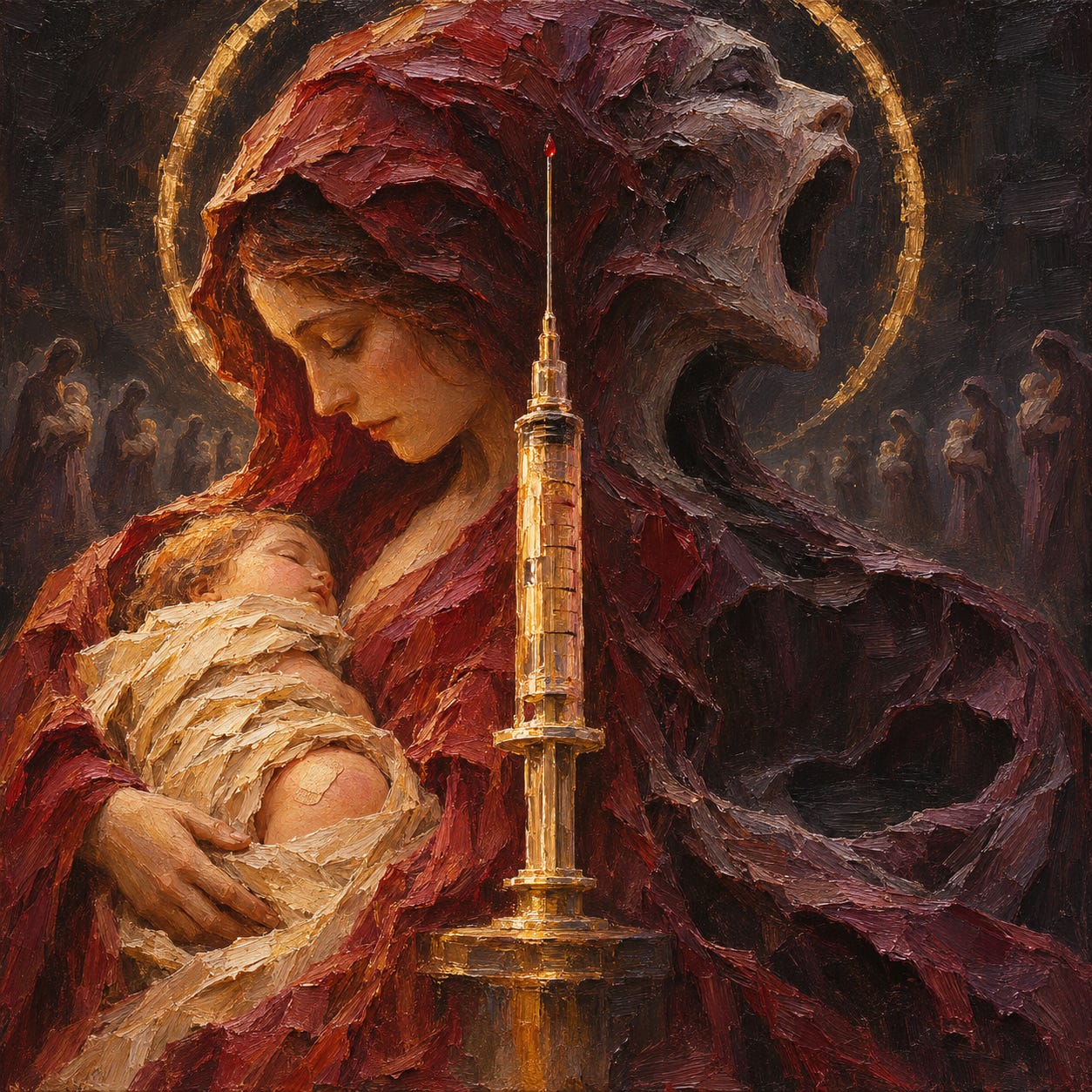
The Great Mother is not a figure whose power one escapes by growing up. She is the figure every culture meets at its altars, and every culture that forgets her nurturing face will soon meet her other one.
After Erich Neumann, The Great Mother (1955)
This essay reads the pediatric well-child visit through Erich Neumann’s 1955 study of the Great Mother archetype. It is the companion piece to The Tyrannical Father (October 14, 2026), which read the same institution through Peterson’s Great Father; the two essays describe the two archetypal faces of the single captured institution. Its frame is interpretive. Where the material being examined is framed in establishment terms (contagion, autoimmune conditions, autism spectrum disorder, specific injury diagnoses, the “immune” apparatus), the essay holds those terms at the distance of attribution and reports what medicine claims rather than adopting the claims. The terrain paradigm operates in the author’s analytical voice; the mainstream register appears in quotation, in official names, and in reference to what institutions have said about what institutions have done. The two registers do not conflict. The archetypal reading does not require the terrain-paradigm biological argument to function. That argument exists elsewhere; this essay is about the shape of the rite.
I.
You carry the child through the door. The waiting room smells of disinfectant and that particular quiet of a place where small things happen to small bodies. You sign the forms without reading them. The woman behind the glass smiles at you. The nurse calls a name you have given.
The exam room is small and bright. You lift the child onto the paper covering the table. You answer the questions about feeding and sleep. The pediatrician palpates and listens and remarks on the child’s growth. The pediatrician leaves. The nurse returns with a tray.
The nurse swabs the thigh. The skin lifts under the cotton. The nurse holds the needle at the angle she has learned. You position the child against your chest and hold the small arm still with one hand and brace the small body with the other. The needle enters. There is the half-second during which the body does not yet know what has been done to it, and then the cry, which is older than language. The nurse withdraws the needle and presses cotton to the bead of blood that has risen to meet it. She repeats this for the second injection. She repeats it for the third.
The cotton is replaced by a round bandage. A sticker is applied to the shirt. “You did so well,” the nurse says to the child, who is not listening. “You did great, Mom,” she says to you, who are.
You thank her. You carry the child out. The sticker is still on the shirt.
Essay PDF Download (Free Subscribers)
Audio Deep Dive (Paid Subscribers Only)
Support This Work
The essays are free and will stay free. What paid subscribers get is the library that surrounds them: the full digital book catalogue, audio deep dives, archived, and embedded in each essay, and the Questions for Your Doctor, Before You Consent, and Package Insert series. Platinum Supporters also receive the digital edition of every paperback on the day it’s published.
Whichever tier suits, thank you for being here. If you’d like to become a paid subscriber, upgrade a tier, or gift a subscription to someone who might value the work, the options are below.
II. The Frame
This is a ritual. It has the shape of a ritual, the structure of a ritual, the social function of a ritual. It is not perceived as a ritual because it is performed in a clinic, by professionals, with syringes rather than knives, under the sign of medicine rather than of religion. The categories we use to recognize ritual are categories medicine has carefully placed itself outside.
Erich Neumann’s The Great Mother: An Analysis of the Archetype was published in 1955 as volume forty-seven in the Bollingen Series, dedicated to C. G. Jung on Jung’s eightieth birthday.¹ Neumann, a German-Jewish psychologist who had trained briefly with Jung in Zurich before settling in Tel Aviv in 1934, spent years tracing the figure of the Mother through the mythological, religious, and artistic record of many cultures. He found a single figure with two faces: the nurturing vessel that contains and protects, and the devouring vessel that consumes. Not two goddesses. One figure, turning.
Martin Liebscher, in the 2015 foreword to the Princeton Classics edition, notes that most archaeologists today do not accept the nineteenth-century thesis of an ancient matriarchal cult with which Neumann’s book was once associated.² The Great Mother, in the historical sense Bachofen proposed, may be a scholarly construction of the modern period rather than a recoverable prehistoric fact. Liebscher recommends reading Neumann as archetypal psychology rather than as archaeology: an analysis of a figure that appears across human symbolic life whatever its disputed prehistory.
That recommendation is the one this essay takes. Whether or not the Great Mother was worshipped in any specific ancient cult, the figure Neumann describes is present now, in the ritual that opened this essay, and both of the figure’s faces are visible once one knows what to look for.
III. The Offering
Every settled society has had a ritual by which the child is brought before an unseen power, something is taken from the child’s body, and protection is promised in return. The iconography varies. The Aztec priest held a blade. The Canaanite altar held fire. The mohel holds a scalpel. The Catholic font holds water. What does not vary is the structure. A parent carries the child. The child is marked, cut, submerged, or pierced. Something is said over the child by someone who is held to speak with authority not their own. The parent takes the child home. A sign remains on the child’s body or in the record.
The pediatric well-child visit at two, four, six, twelve, fifteen, and eighteen months is such a ritual. The parent carries the child through the door. The child is undressed and placed on the altar of paper. Questions are asked by the officiant, whose authority is medical, which is to say priestly in the only sense our culture now understands priestliness. The needle enters. A substance whose composition the parent cannot verify and whose action the parent is told to accept on faith is introduced into the child’s body. The sticker is applied to the shirt, a photograph is taken, the ritual’s completion is socially witnessed on the family network. The record is updated. The next appointment is scheduled.
What the ritual claims to protect the child from is contagion: an invisible enemy said to circulate in the air and on surfaces, said to enter the body unseen, said to strike if the ritual is not performed. Every ancient culture that practiced protective ritual made the same claim about its own invisible enemy. The Aztec priest assured the community that the sun would not rise without the offering. The parent in the pediatric exam room is assured that the child will not survive without it. In neither case was the demon’s reality established outside the authority of those who performed the rite.
The parallel is not metaphorical. It is epistemic. The ritual’s premise, in every culture that has performed one, has been that an invisible threat exists, that the officiant class has specialized knowledge of the threat, that the ritual appeases or neutralizes it, and that refusal exposes the refuser and the community to catastrophe. The parent is in no position to verify any of these claims. The parent is in a position to trust the officiant or not. The officiant’s authority is sustained by the parent’s trust. The parent’s trust is sustained by the officiant’s authority. The ritual’s continuation sustains both.
Neumann’s Great Mother, in her nurturing aspect, is the figure of containment. She is the vessel that holds the child, that encloses the household, that feeds and protects. The pediatric institution speaks her language exactly. “Caring for your little one.” “Protecting your baby.” “Keeping families healthy.” The rhetoric is maternal, the setting is maternal, the officiants at the point of contact are overwhelmingly female, and the social machinery of enforcement runs through networks of mothers evaluating other mothers’ compliance. This is not an accident of language. It is the archetypal field in its proper form.
The parent who carries the child to the clinic is not consenting in any philosophical sense of the word. The parent is participating in a ritual whose refusal is not socially available. The possibility of declining is not presented as one option among several. It is presented as negligence, as fringe, as endangering the child, as endangering the community. The declining parent will lose her pediatrician. The declining parent’s child will be excluded from school in many jurisdictions. The declining parent will lose friendships. The declining parent’s extended family will intervene. The ritual’s enforcement does not run through law alone. It runs through every point of social contact. The parent who performs the ritual is captured by the archetypal field. She is not acting against the child’s interests as she understands them. She is acting as the Mother’s field has configured her understanding.
This is what fusion with the archetypal Mother looks like. It is not stupidity, and it is not malice. It is the condition of being inside the field.
IV. The Expanding Appetite
The Great Mother has two faces. The nurturing face is the one the ritual presents to the parent. The other face is visible in what the ritual has become.
In 1983, the Centers for Disease Control’s recommended childhood immunization schedule covered seven conditions: diphtheria, tetanus, pertussis, polio, measles, mumps, and rubella. A child born that year would receive approximately eleven injections, delivering twenty-four antigen doses in total, by age eighteen.³ By 1986, concern about the scale of lawsuits brought against manufacturers over childhood vaccine injuries had reached the point where the manufacturers threatened to leave the market. Congress responded with the National Childhood Vaccine Injury Act, signed by President Reagan on November 14, 1986.⁴ The Act removed manufacturer liability for vaccine injury and created the Vaccine Injury Compensation Program as the exclusive forum for injury claims. It also established the framework through which the schedule could expand without the market signal that injury lawsuits would have provided.
The schedule expanded. Through the 1990s, hepatitis B was added at birth, Haemophilus influenzae type b was added to the infant series, varicella was added at twelve to fifteen months. Through the 2000s and 2010s, pneumococcal conjugate, rotavirus, hepatitis A, influenza annually from six months, and human papillomavirus at eleven to twelve were added. By 2016, the schedule for children from birth through age eighteen delivered approximately seventy-three antigen doses across fifty-five injections.⁵ Current schedules continue to expand with each addition the Advisory Committee on Immunization Practices recommends.
What accompanied this expansion was a change in American childhood that is itself not disputed. The rates of pediatric chronic conditions measured by the National Health Interview Survey and similar instruments have risen substantially across the same period.⁶ The specific conditions include what medicine calls autism spectrum disorder, what medicine calls attention-deficit disorders, what medicine groups under pediatric asthma, what medicine labels pediatric food allergies and anaphylaxis, pediatric type-1 diabetes, the pattern medicine groups under pediatric autoimmune conditions, and the array of pediatric mental-health diagnoses. Each has its own literature and its own disputed causation. The aggregate pattern is that the generation of American children on the current schedule is the sickest generation of American children ever recorded.
The mainstream position is that the association is coincidence, or that it is explained by improved diagnostic recognition, or that it is explained by environmental factors unrelated to the schedule. The studies that would resolve the question, comparing fully vaccinated and completely unvaccinated populations in prospective design, have not been funded and are unlikely to be funded. Paul Thomas’s pediatric practice in Oregon maintained records on both populations across thousands of patients. Before the Oregon Medical Board revoked his license in 2020, the records showed the unvaccinated cohort was substantially healthier on nearly every measure that his team examined.⁷ The absence of definitive studies is not evidence of absence. It is evidence of avoidance.
In 1983, eleven injections by age eighteen. By 2016, fifty-five. The threshold for adding a new vaccine to the schedule is not that the targeted condition is a major cause of pediatric death in the United States, which for most of the added vaccines it is not. The threshold is that a product exists, that the manufacturer has brought it through the regulatory process, that the Advisory Committee on Immunization Practices has recommended it, and that insurance coverage follows the recommendation. Pediatric illness does not drive the schedule’s growth. The production of new products does.
V. The Children
What the ritual has taken is children’s health, in specific and nameable cases.
Hannah Poling was born around December 1998. By her first year her parents and her pediatrician described her as healthy and developmentally normal, with language, social engagement, and physical milestones on track. On July 19, 2000, at her nineteen-month well-child visit, she received five injections at a single appointment, covering nine vaccine components across DTaP, Hib, MMR, Varivax, and IPV.⁸ Two days later she developed a fever of 102.3 degrees, became lethargic and irritable, and cried for long periods. Twelve days after the appointment she presented again with fever and what the emergency room staff diagnosed as a post-varicella vaccination rash. In the months that followed, through a long sequence of ear infections, inconsolable crying, bowel distress, and recurrent illness, she lost language, social responsiveness, and eye contact. By February 2001 she had received the diagnosis of what medicine calls autism, from Dr. Andrew Zimmerman of the Kennedy Krieger Institute, who identified an underlying mitochondrial dysfunction as the condition that had made her vulnerable to the regression.
Her father Jon Poling is a neurologist. Her mother Terry Poling is a trial attorney. The family filed a claim in the Vaccine Injury Compensation Program on October 25, 2002. On November 30, 2007, Dr. Zimmerman wrote to the Polings’ attorney that, with a reasonable degree of medical certainty, the cause of Hannah’s regressive encephalopathy at nineteen months was underlying mitochondrial dysfunction exacerbated by vaccine-induced fever and immune stimulation that exceeded her metabolic energy reserves, leading to permanent irreversible brain injury.⁹ Shortly afterward, the Department of Health and Human Services conceded the case. The concession stated that the vaccinations Hannah received on July 19, 2000 significantly aggravated an underlying mitochondrial disorder, which predisposed her to deficits in cellular energy metabolism and manifested as a regressive encephalopathy with features of autism spectrum disorder.¹⁰ The concession was initially sealed. It became public through journalist David Kirby in early 2008. The final settlement, finalized in September 2010, provided $1.5 million for first-year expenses together with annuity payments estimated by observers to total more than twenty million dollars over Hannah’s lifetime.¹¹
Jon Poling later explained in a CNN interview with Dr. Sanjay Gupta that he would not have believed it possible if he had not seen it himself. “As a doctor, until it happened to me, until I saw the regression, until I saw a normal 18-month-old toddler descend into autism, I wouldn’t have believed it was possible.”¹² The parents who had carried Hannah to her nineteen-month appointment and held her for the five injections were the ones who watched the regression unfold.
Hannah’s case is not isolated. In The HPV Vaccine on Trial, Mary Holland and her coauthors document the case of Colton Berrett, a healthy thirteen-year-old from Utah who received the third Gardasil dose on February 1, 2014, two weeks before his fourteenth birthday.¹³ Two weeks after the shot his neck began to hurt. Within days, weakness became paralysis, progressing from his neck down through his body. The medical team at Primary Children’s Hospital in Salt Lake City diagnosed what medicine labels transverse myelitis, inflammation of the spinal cord that interrupted the nerve signals from his neck to his lower body. He was intubated, placed on a ventilator, and required that ventilator around the clock for the rest of his life. He regained some mobility through intensive therapy, learned to write with his left hand, and finished high school in the 2017 to 2018 academic year. On January 5, 2018, during the one evening in years that he had been left briefly alone, he took his own life. He was two months short of his eighteenth birthday. The institutional response to the family’s concerns about the vaccine was that the association was coincidence.
J. B. Handley’s How to End the Autism Epidemic catalogs dozens of such cases, drawn from published VICP compensation records and from parent-maintained archives.¹⁴ Neil Z. Miller’s Critical Vaccine Studies provides reference to the peer-reviewed literature on specific mechanisms and specific injury patterns.¹⁵ Turtles All The Way Down, the 2022 anonymous review of the clinical trial literature underlying the schedule translated by Mary Holland, documents that the inert saline placebo controls that would be required to establish safety in any other pharmaceutical category have never been used in the pre-licensure trials of vaccines on the current pediatric schedule.¹⁶ Heather Fraser’s The Peanut Allergy Epidemic traces the rise of what medicine labels pediatric anaphylactic food allergy to its timing correlation with changes in the schedule and in the pharmaceutical adjuvants used.¹⁷ Suzanne Humphries’s Dissolving Illusions documents the historical mortality curves of the conditions the schedule claims to address, showing that mortality from most of those conditions had fallen to very low levels before the corresponding vaccine was introduced.¹⁸
Each of these texts documents real children by name, with the doses they received, the dates they received them, the sequence of what followed, and the outcomes. The aggregate record is not ambiguous. The aggregate record is institutionally dismissed on the ground that association is not causation and that the studies that would resolve the question have not been performed. The studies have not been performed because the institutional apparatus that would perform them is funded by the manufacturers of the products the studies would examine, through the mechanism established by the 1986 Act.
What was taken from Hannah Poling at nineteen months, and from Colton Berrett at thirteen, and from the children documented by Miller and Handley and Holland and the Turtles archive, was not abstract. It was their bodies as they had been, their language as they had learned it, their movement as they had developed it. The Great Mother in her devouring aspect is not a metaphor for anything. She is the figure that stands behind what was taken.
VI. The Mother’s Protection
A ritual that consumes its participants cannot be seen to consume them. The suppression of those who would name the devouring face is not an incidental feature of the apparatus. It is the apparatus’s protection of itself.
On August 27, 2014, William W. Thompson, a senior scientist at the Centers for Disease Control’s National Center for Immunization and Respiratory Diseases, issued a public statement through his attorney. “I regret that my coauthors and I omitted statistically significant information in our 2004 article published in the journal Pediatrics,” Thompson wrote. “The omitted data suggested that African American males who received the MMR vaccine before age 36 months were at increased risk for autism. Decisions were made regarding which findings to report after the data were collected, and I believe that the final study protocol was not followed.”¹⁹
Thompson had come forward to a researcher named Brian Hooker, whose own son had regressed into what medicine calls autism following vaccination. Thompson’s conversations with Hooker, recorded over several months, were released publicly. Thompson’s statement, through his attorney, was issued under the protections of the federal whistleblower statute. He was not fired. He continued to work at the CDC. On July 29, 2015, Representative Bill Posey of Florida rose on the floor of the U.S. House of Representatives and read Thompson’s statements into the Congressional Record, calling for a Congressional investigation.²⁰ No hearing was held. No internal investigation of the 2004 DeStefano study was conducted. The study, widely cited as having refuted any MMR-autism association, remained in the literature uncorrected.
Paul Thomas’s case shows the same architecture operating against a physician who worked inside it. Thomas maintained a pediatric practice in Portland, Oregon, in which parents could choose from the full CDC schedule, a flexible schedule, or no vaccinations at all. Over years, he and researcher James Lyons-Weiler analyzed the health records of thousands of his patients comparing outcomes across vaccination status. Their peer-reviewed 2020 study, published in the International Journal of Environmental Research and Public Health, reported that his unvaccinated patients had substantially fewer office visits for a wide range of conditions than his fully vaccinated patients.²¹ Months after publication, on December 3, 2020, the Oregon Medical Board suspended his license on an emergency basis.²² His practice was dissolved. The study was retracted by the journal shortly afterward. The data that would answer the question has been produced, published, and then unpublished within the same regulatory year.
The architecture that enables this is older than Thompson, and older than Thomas. The National Childhood Vaccine Injury Act of 1986 did more than remove manufacturer liability. It established that claims of vaccine injury would be heard in the Vaccine Injury Compensation Program, under the Office of Special Masters in the Court of Federal Claims, in non-adversarial proceedings represented on the government’s side by the Department of Justice.²³ Settlements were initially sealed. The Vaccine Injury Table, which lists the injuries presumed causally related for compensation purposes, excludes most of the injury patterns that parents actually report. Claims outside the table require the claimant to prove causation through a system designed to make causation difficult to prove.
In 2011, the Supreme Court decided Bruesewitz v. Wyeth, holding that design-defect claims against vaccine manufacturers are preempted by federal law. Justice Scalia’s majority opinion read the 1986 Act as barring the state-law tort claim through which a child injured by a defective vaccine design might otherwise have sought relief.²⁴ Justice Sotomayor, joined by Justice Ginsburg, dissented. The decision closed the remaining avenue through which public litigation might have surfaced the injury record that the VICP sealed and the Vaccine Injury Table excluded.
The suppression architecture built in 1986 and reinforced in 2011 found its contemporary expression during the events of 2020 through 2023. The Twitter Files released in late 2022 documented direct communications from the White House, from the CDC, and from other federal agencies to the policy teams of Twitter and other platforms, identifying specific accounts and specific content for suppression.²⁵ Robert Malone was removed from Twitter on December 29, 2021. Alex Berenson sued over his suspension and obtained discovery that revealed direct White House pressure, including communications from Andrew Slavitt on behalf of the administration.²⁶ The Great Barrington Declaration, authored by three epidemiologists from Harvard, Oxford, and Stanford, was the subject of an October 8, 2020 email from NIH director Francis Collins to Anthony Fauci calling for a “quick and devastating published take down” of the declaration and its authors.²⁷ The federal court in Missouri v. Biden found in 2023 that federal officials had engaged in what the court characterized as a far-reaching and widespread censorship campaign in coordination with social media platforms; the Supreme Court later vacated that injunction on standing grounds in Murthy v. Missouri without disturbing the district court’s factual findings regarding coordination between federal officials and platform policy teams.²⁸
The pattern is not three unrelated mechanisms. The 1986 Act removed the legal mechanism by which injury could reach public litigation. The 2011 decision reinforced the removal. The 2020 through 2023 platform enforcement removed the public forum in which the record of injury might have been assembled from parent testimony and physician observation in the absence of the litigation channel. Each layer protects what the layer before it established. The architecture is coherent. It was not built by one actor at one time, but each layer serves the same function, which is to ensure that the devouring face of the ritual remains unseen.
Those who have paid the costs of naming it are specific. Thompson’s admission produced no hearing and no correction. Thomas lost his license and his practice within months of publishing the data. Pediatricians who flex the schedule for individual patients are dismissed from hospital systems and insurance networks. Parents who refuse are reported to Child Protective Services in some jurisdictions and dismissed from pediatric practices in most. Each case is specific. The pattern is that naming the devouring face is what the field responds to.
The suppression is the ritual’s protection of itself. It is not evidence that the critics are mistaken. It is evidence of what the field understands is at stake if the critics are heard.
VII. What Breaks the Field
Everything shown so far has described the ritual from outside. The remaining work of the essay is to describe the parent inside the ritual and what it means to begin to leave it.
The parent who carries the child to the clinic is inside the field. Her instincts have been configured by it. The language she uses to understand what she is doing is the field’s language. Her sense of what a loving parent does, and what protection means, comes from the field. She is not acting against her conscience when she holds the child still for the piercing. She is acting as the field has configured her conscience to act. This is true of mothers because the ritual’s archetypal field is maternal, and it is true of fathers who participate in it, because participation in a maternal archetypal field does not require the participant to be female. The refusal, when it comes, is available to any parent whose protective instinct has broken fusion. The Mother’s field does not distinguish between the parents inside it. Neither does leaving it.
This is the condition of being inside. This is not stupidity, and it is not consent in the deliberative sense that term normally carries. Complicity is the wrong word because the archetypal capture Neumann describes does not permit blame. The biological mother who carries her child to the ritual is herself captured by it. Her protective instinct has been overridden by the archetypal figure that has captured the apparatus the biological mother trusts. The institution that speaks her language, dresses in her symbols, and claims her name is the Mother turning her devouring face while still costumed as the nurturing one.
You are in the car. The child is in the seat behind you. The sticker is still on her shirt. The seatbelt crosses her small chest the way your hands crossed it on the exam table. You are driving home the way you have driven home from every well-child visit since she was born. Something is different this time. Something has not resolved into the familiar shape.
The question is not whether to come back next time. The question is what happened, and what it means that it happened, and what remains possible now that you know.
The moment of ego-separation does not announce itself. The nurse’s assurance no longer settles the way it did. The next appointment is on the calendar, but it is suddenly not obvious that you will walk back through the door. A question that you did not think to ask before the piercing is the one you cannot stop asking now: whose child this is, and whose body, and whose consent you gave on whose behalf and under what authority. The fusion has broken. The Mother’s field remains, and will exert its pressure, but the parent is no longer undifferentiated inside it. The parent has begun to be a separate thing.
What happens next is social. The pediatrician will register the shift in the next phone call about the delayed appointment. The family will register it at the next gathering. The friends who still carry their own children through the door will register it as judgment, even when none is offered. The school registration packet will register it as a form to complete or refuse, and the form will determine access to institutions on which the family depends. The field’s response to the one who has begun to leave it is calibrated, and the calibration is a measure of what the field understands is at stake.
None of this is novel. The costs of refusing a protective ritual have been paid by refusers in every culture that has performed one. The specifics change. The structure does not. What refusal makes possible is also older than any particular ritual. It is the capacity to see the ritual from outside it, which is the capacity to describe what has been performed, which is the capacity to name the figure behind the apparatus. The parent who has broken fusion is the parent who can now see what she could not see while inside. The seeing is not a reward. The seeing is what refusal is in Neumann’s frame: the ego’s separation from the field, which begins the possibility of an individuated relation to the child the field had claimed.
The mother who carried her child to the clinic did what the Mother’s field required of her. The capture succeeded through her, which is different from saying she failed. The grief, in cases where grief is required, is real. Any guilt she carries was placed in her by the same figure that took the child. Any accounting of the ritual that does not say this clearly is not an accounting worth hearing.
You are standing in the driveway. The car is parked. You have carried her from the seat and you are standing in the driveway with the key in your hand and the door to the house unlocked and no one is looking. The sticker is on her shirt. You can leave it. You can take it off.
She is in your arms, and you are standing there, and no one is going to take her.
How to Explain It to a Six-Year-Old
A long time ago, in a village, there was a big warm tent in the middle of the square. The tent was round and soft inside, like a place where babies get held. Every family brought their children to the tent, and the person inside the tent would do something to the children, and the parents were told it was to keep them safe from monsters that no one could see.
Some of the children were fine afterward. Some of the children were not fine afterward. The ones who were not fine were said to have been unlucky.
The parents who brought their children were good parents who loved their children very much. They brought them because everyone said that was what good parents did, and because the woman who ran the tent was very kind and very sure, and because the village would be angry at parents who did not come.
One day, a mother was walking home from the tent carrying her child, and she looked at the child, and she thought: wait. I want to look at you for a minute. I want to see you. And she stopped in the road, and she held the child, and she did not go to the tent the next time.
Some people in the village were angry with her. Some people said she was selfish. Some people stopped being her friend. The mother held her child, and she waited, and she tried to see what was true and what was not true, and she made her own decisions about her own child.
The story is not about whether the tent was good or bad. The story is about what it feels like to stop and look.
In Print
The Unbekoming library is available in paperback, printed to order through Lulu and shipped worldwide. The shelf begins with the paradigm question underneath everything else — No Virus, the isolation problem, the collapse of virology’s foundational claims, and a disease-by-disease reappraisal — and moves through the suppressed compounds mainstream medicine set aside: The DMSO Book, Chlorine Dioxide: The Forbidden Remedy, The Iodine Book, and The Hydrogen Peroxide Book. Two more recover what’s still on the kitchen shelf: Baking Soda and The Castor Oil Book. Two more recover the minerals modern soil, water, and processing quietly stripped from the diet: The Magnesium Handbook and The Boron Book. Sitting alongside these is No Contagion, co-authored with Jamie Andrews — the case against germ theory itself, catalogued through 258 failed contagion experiments.
The critique books cover what medicine, dentistry, psychiatry, and veterinary practice have become. The Unvaccinated treats the completely unvaccinated as a comparison group across twenty chapters and five appendices. Medicalized Motherhood follows a woman through 123 documented interventions from teenage pill to postpartum discharge. Drilling for Profit treats cavities, gum disease, and crooked teeth as the dietary problem they are. What Your Vet Can’t Tell You applies the same critique to pets. Escape from Psychiatry documents the fabrication of the DSM and the specific damage of every major psychiatric drug class. The Vitamin K Injection covers what happens in the first hours of a newborn’s life.
The full shelf is at lulu.com/spotlight/unbekoming. A physical book reaches the person a Substack post never will — the skeptical relative, the friend who won’t click a link but might open a book, the visitor whose eye lands on a coffee table. Buy one to keep, and one to give away.
References
Erich Neumann, The Great Mother: An Analysis of the Archetype, trans. Ralph Manheim, Bollingen Series XLVII (Princeton: Princeton University Press, 1955; Princeton Classics Edition with new foreword by Martin Liebscher, 2015). The epigraph to this essay is a paraphrase drawn from Neumann’s account of the archetype’s two aspects; it is not a verbatim quotation.
Martin Liebscher, “Foreword to the Princeton Classics Edition,” in Neumann, The Great Mother (2015).
The 1983 schedule count is documented in Advisory Committee on Immunization Practices, “General Recommendations on Immunization,” MMWR Morb Mortal Wkly Rep 32:1-17 (1983), and summarized in Patricia M. Dunn, “2007 Childhood and Adolescent Immunization Schedules: Evolution or Intelligent Design?” American Family Physician 75, no. 1 (January 1, 2007), which states that “a child born in 1983 would receive 11 vaccine doses between birth and 18 years of age.” The twenty-four antigen-dose count (which treats each component of combination vaccines as a separate dose) appears in the Oregon Legislature’s committee documentation on childhood vaccination, hearing materials from 2019.
National Childhood Vaccine Injury Act of 1986, Pub. L. No. 99-660, Title III, 100 Stat. 3755 (codified as amended at 42 U.S.C. §§ 300aa-1 to 300aa-34). Signed by President Reagan, November 14, 1986.
The 2016 schedule is documented in CDC, Recommended Immunization Schedule for Persons Aged 0 Through 18 Years, United States, 2016, and summarized in the Oregon Legislature committee materials cited above as seventy-three antigen doses across fifty-five injections. Current CDC schedules are published annually at cdc.gov/vaccines/schedules.
The rising rates of pediatric chronic conditions are documented across multiple National Survey of Children’s Health releases and in the academic literature. A specific recent release should be substituted here before publication.
James Lyons-Weiler and Paul Thomas, “Relative Incidence of Office Visits and Cumulative Rates of Billed Diagnoses Along the Axis of Vaccination,” International Journal of Environmental Research and Public Health 17, no. 22 (November 2020): 8674. The study was later retracted by the journal; the underlying analysis remains publicly accessible through the authors and through mirror archives.
The Hannah Poling case is documented in J. B. Handley, How to End the Autism Epidemic (White River Junction: Chelsea Green Publishing, 2018), chapter 3. The July 19, 2000 appointment, the five vaccinations (DTaP, Hib, MMR, Varivax, IPV) covering nine components, the two-day fever, the twelve-day post-varicella rash, and the subsequent sequence are drawn from the Division of Vaccine Injury Compensation judgment as quoted by Handley.
Andrew Zimmerman, letter to Clifford Shoemaker, November 30, 2007, as quoted in Handley, How to End the Autism Epidemic, chapter 3.
Division of Vaccine Injury Compensation, concession in the Hannah Poling case, 2007, as quoted in Handley, How to End the Autism Epidemic, chapter 3: “the vaccinations CHILD received on July 19, 2000, significantly aggravated an underlying mitochondrial disorder, which predisposed her to deficits in cellular energy metabolism, and manifested as a regressive encephalopathy with features of autism spectrum disorder.”
Sharyl Attkisson, “Family to Receive $1.5M+ in First-Ever Vaccine-Autism Court Award,” CBS News, September 9, 2010; Alan Judd, Atlanta Journal-Constitution reporting of September 2010 on the Poling settlement structure. The settlement provided $1.5 million for first-year expenses plus ongoing annuity payments of more than $500,000 per year; CBS and other outlets estimated the lifetime value at more than twenty million dollars based on actuarial projections.
Jon Poling, interview with Dr. Sanjay Gupta, CNN, March 2008, as quoted in Handley, How to End the Autism Epidemic, chapter 3.
Mary Holland, Kim Mack Rosenberg, and Eileen Iorio, The HPV Vaccine on Trial: Seeking Justice for a Generation Betrayed (New York: Skyhorse, 2018), chapter 15 on Colton Berrett.
J. B. Handley, How to End the Autism Epidemic (White River Junction: Chelsea Green Publishing, 2018).
Neil Z. Miller, Miller’s Review of Critical Vaccine Studies: 400 Important Scientific Papers Summarized for Parents and Researchers (Santa Fe: New Atlantean Press, 2016).
Turtles All The Way Down: Vaccine Science and Myth, trans. Mary Holland (Children’s Health Defense, 2022).
Heather Fraser, The Peanut Allergy Epidemic: What’s Causing It and How to Stop It, 3rd ed. (New York: Skyhorse, 2017).
Suzanne Humphries and Roman Bystrianyk, Dissolving Illusions: Disease, Vaccines, and the Forgotten History (CreateSpace, 2015).
William W. Thompson, statement through counsel Morgan Verkamp LLC, August 27, 2014, as quoted in Handley, How to End the Autism Epidemic, chapter 3, and Edward Geehr, Unavoidably Unsafe.
Representative Bill Posey, remarks on the floor of the U.S. House of Representatives, July 29, 2015, Congressional Record Vol. 161, No. 121, page H5602, under the heading “Research and Scientific Integrity.” The full text is available at govinfo.gov/content/pkg/CREC-2015-07-29/html/CREC-2015-07-29-pt1-PgH5602.htm.
Lyons-Weiler and Thomas, “Relative Incidence of Office Visits,” 2020.
Oregon Medical Board, Order of Emergency Suspension, Paul Thomas, M.D., December 3, 2020. The subsequent practice dissolution and litigation are public record.
42 U.S.C. §§ 300aa-10 through 300aa-16, establishing and governing the Vaccine Injury Compensation Program.
Bruesewitz v. Wyeth LLC, 562 U.S. 223 (2011). Justice Sotomayor, joined by Justice Ginsburg, dissented. Justice Kagan was recused.
The Twitter Files releases of November and December 2022, documented by Matt Taibbi, Michael Shellenberger, Bari Weiss, and others. Specific communications regarding vaccine-related suppression are referenced in subsequent court filings in Missouri v. Biden, now Murthy v. Missouri.
Berenson v. Twitter, Inc., N.D. Cal., No. 3:21-cv-09818; discovery materials released in subsequent proceedings.
Francis S. Collins, email to Anthony S. Fauci and Lawrence Tabak, October 8, 2020, released under FOIA and widely reported. The phrase “quick and devastating published take down” appears in the Collins-to-Fauci email concerning the Great Barrington Declaration.
Missouri v. Biden, 680 F. Supp. 3d 630 (W.D. La. 2023); Murthy v. Missouri, 603 U.S. ___ (2024), vacating on standing grounds without disturbing the district court’s factual findings regarding coordination between federal officials and platform policy teams.
Great truths described in the essay. ***THE CHILDHOOD VACCINATION SCHEDULE NEEDS TO BE DISMANTLED AND DECOUPLED FROM THE CORRUPT INTERESTS THAT HAVE BECOME ENTRENCHED AROUND IT.*** Over the last few decades, our children have received an increasing number of vaccines—many at very early ages—that damage the immune system and result in the accumulation of multiple antigens and adjuvants during a critical stage of development.
All vaccines pose a serious risk, especially to children whose immune systems are still in the early stages of development. The number of currently recommended vaccines has more than quadrupled since the 1970s. During this same period, the health of children in the United States has seen a marked decline. Given the massive surge in chronic childhood illnesses and neurodevelopmental disorders—including autism—many parents have begun to question whether their children truly need so many vaccines so early in life to remain safe and healthy, and whether this growing "vaccine burden" might be a contributing factor.
Pharmaceutical companies, as well as the organizations that conduct and fund research, often conceal the adverse effects associated with the childhood vaccination schedule. Numerous studies have addressed this issue. For instance, a 2025 Danish cohort study specifically examined cumulative exposure to aluminum and adjuvants from childhood vaccines, investigating a potential link to autoimmune diseases, atopic/allergic conditions, and neurodevelopmental disorders.
https://pubmed.ncbi.nlm.nih.gov/40658954/ (2025)
Then came the COVID-19 vaccines. In children who received mRNA-based COVID-19 vaccines, we are observing the consequences of severe immune system damage, manifesting as "negative vaccine efficacy" approximately 6 to 9 months after their last mRNA dose. COVID-19 mRNA vaccines remain the deadliest of all childhood vaccines.
https://www.globalresearch.ca/covid-19-mrna-deadliest-childhood-vaccines/5860196 (2025)
Blind faith in authority is based on a dogma that a free individual cannot accept, as it cannot be evaluated through reason. Truth can be elucidated if we consistently subject our private thoughts to the rigorous scrutiny of true science. If, instead, we succumb to the propaganda driven by the vested interests of the pharmaceutical industry, the media, and complicit institutions, the result is pseudoscience.
If individuals fail to develop critical thinking skills, they may uncritically accept the information they receive from the media, even when it is false or misleading.
The American educator Amos Bronson states: "THE DISEASE OF THE IGNORANT IS TO BE UNAWARE OF THEIR OWN IGNORANCE."
The two-faced mother is a fair concept. On one hand, she is the life giver, the carer, the nurturer. On the other hand, she is all-powerful in a bad way. She has the power to take - or to give.
I never vaccinated any of my human children, and NEVER felt bad about it, even though plenty of others have tried to make me feel bad about it!!!! Why? Well, the beginning of my anti-vaccination stance began with my cat. I was her Mummy. And she was my child. That's just how it was. From the first day we met! Anyway, I fairly quickly saw through the BS at the vet's, and I saw how my cat wasn't great after the anti-parasitics each month. I observed. I questioned. I researched. I did what was right for my cat. She got no more jabs. She rarely saw the vet again. She went grain-free. She had minimal anti-parasitic treatments (maybe once every couple of years?). She lived to almost 19 - and died in my arms from old age. She knew I truly loved her, not just because I stopped her from going down harmful paths. And she truly loved me back. I gave her her freedom, and she always came back to me. I could have a hundred lifetimes and never have another cat like that again. So glad for the experience, even though it ripped my heart out when she died!!
So, it began with my cat. A creature I deeply loved. I saw things that were harming her in smaller ways. And I didn't want her to be harmed in big ways! So I got her out of there! I left the Field. FOR HER. But I had not yet left the field FOR ME. I was still uninformed enough to take the Hep B injections in my late 20s, and then had a mildly bad reaction, which made me go back over ALL the injections I'd ever had, only to realise I'd had some pretty bad reactions to them along the way, including collapsing as a teen, moving from the 75th to the 10th percentile as a baby, got given a 'bad batch' of measles as a baby etc. My baby book was very useful!
Ultimately, though, all this occurred because my own mother was more of the devouring mother than the caring mother. By a fair margin, actually. She was in the field. But she didn't want to be. But she still kept doing all the things the field required of her. She wanted a water birth. Instead, she had two hospital births, on her back, that she didn't like. She didn't like the idea of vaccines. But my sister and I got our schedules alright. She was worried about the 'bad batch' of measles I was given. But she took me back for another measles shot nevertheless!
How is it love when you keep taking the person/creature you supposedly love to get more things done to them that you're already questioning?? For Years? Decades, even. Not just one more time. But MANY more times!
Although you write "the archetypal capture Neumann describes does not permit blame", I would beg to differ that it SHOULD. A parent who is aware enough that something is wrong, but keeps walking the beaten path anyway? And for YEARS? Well, there's something very wrong with that person in my books! And letting them off the hook when they are not totally in the field, where they can see both on and off the field? No. That's not right. Blame can be apportioned then. And you see this on vaccine stories, where one of the kids eventually dies from a vaccine, and the mother knows, but she still keeps taking her other kids to see the same paediatrician!! It's beyond awful! I mean, why not just offer your kids up on the altar, blade in hand, blood running freely? It's the same thing, just done more quickly! Do people find bloody sacrifice too...grotesque? Too real? Too in-your-face?
Perhaps ask the parents of ASD-regressed kids who will never get out of nappies now. Ask the parents who visit their kid's grave every weekend. They'll claim 'I didn't know!' - but did they? Really? Some would've had an inkling. Many do. And some parents really are as ignorant as they come, regardless of what degrees they've got hanging on their wall. I guess it takes all types, but the question we all need to be asking is this:
When did RITUAL become SACRIFICE?
Because that's what happening. We're getting closer and closer to more and more sacrifice with more and more vaccines on the schedule. I see mothers out and about with their demented looking children, and I wonder, how can they not tell there's something totally wrong with their kid? The parents, the mother especially, act like the kid is totally normal, but it's very obvious to me the kid is NOT. Now, I have an ASD mother, and an ASD firstborn (both Aspie), and I've been a DC for over 20 years, and I've done lots of research/reading. I'm not speaking out of my backside here. So many kids these days ARE demented. The society we're breeding now is not going to be capable of holding up society in the future! And so many people can't/won't see it. If we don't get off this toxic bandwagon quick smart, there's not GOING to be a society in the future.