

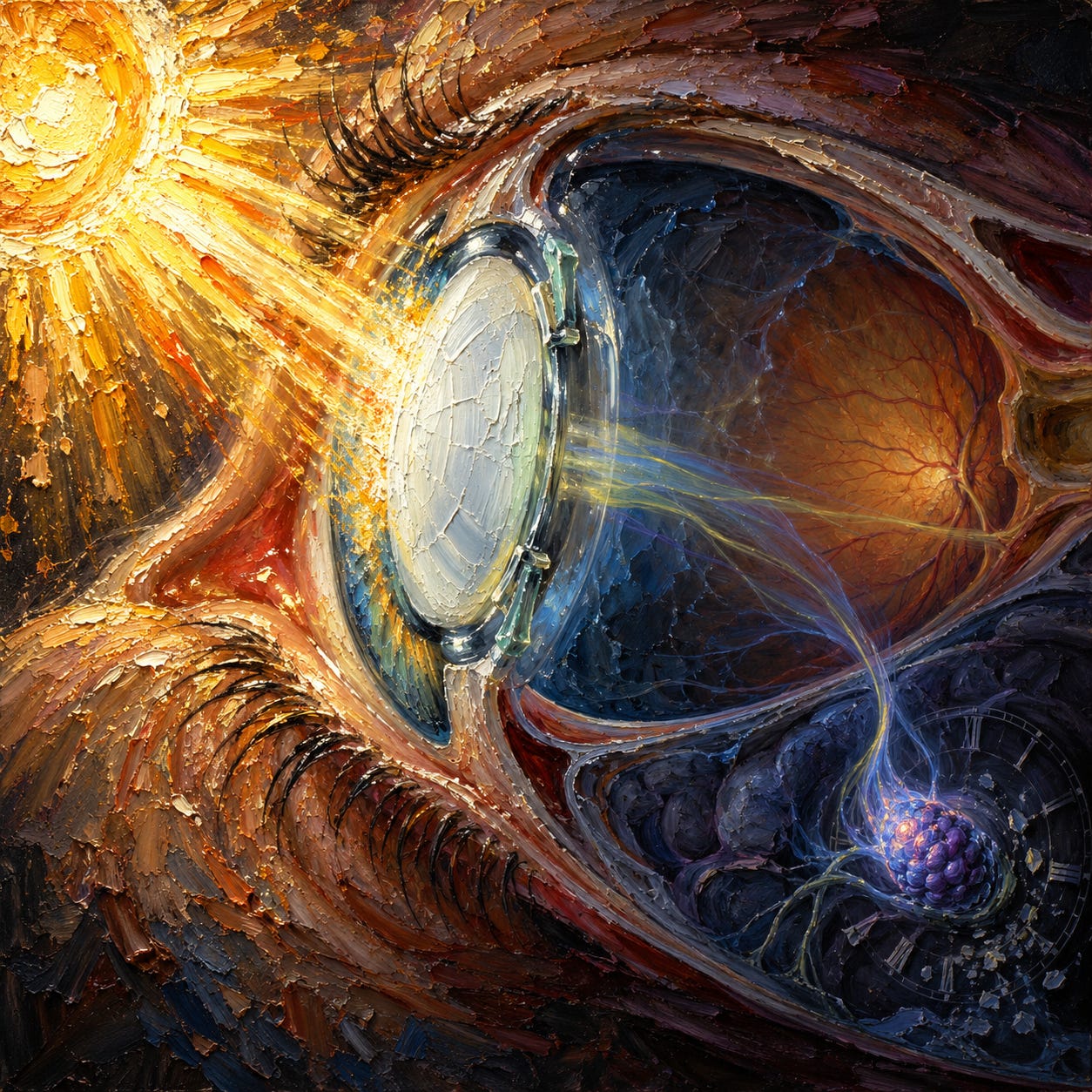
The occasion for this essay, and for the two that will follow it on glasses and on floaters, was a March 2025 conversation between Dr. Andrew Kaufman and Matt from Cultivate Elevate on eye health, in which the point about plastic polymer IOLs blocking UV for life was raised in passing and never let go of me. This essay takes up the surgical response to cataract. The companion essay, Cataract (February 2026), examines what the cataract itself is in terrain terms; readers who want that question answered first should start there. The present piece works in two registers. Where mainstream chronobiology, dermatology, and ophthalmology have documented the role of ultraviolet light in human physiology, their findings are reported in their own vocabulary, with attribution. Where the essay speaks in its own voice, the frame is terrain. Michael Holick appears here as a convergent witness on sun deprivation and the industry capture of the anti-UV campaign; his explanatory apparatus, the vitamin D model, is set aside, and readers interested in that paradigm examined on its own terms should see The Vitamin D Paradox. The question of this essay is narrower. Why does the standard surgical response to a clouded lens install a permanent filter against the spectrum the eye itself requires?
Finsen’s Nobel
In 1903, Niels Ryberg Finsen was awarded the Nobel Prize in Medicine for curing a tubercular skin condition with concentrated light that included ultraviolet wavelengths.¹ His Institute in Copenhagen treated hundreds of patients. European and American hospitals replicated his cabinets through the 1920s and into the 1930s and built solariums as standard clinical infrastructure for rickets, tuberculosis, psoriasis, and other conditions.¹
A little over a century later, cataract surgery is among the most-performed procedures on earth. The clouded natural lens is removed. An artificial intraocular lens, or IOL, is inserted. The standard IOL incorporates a UV-blocking chromophore. It permanently filters out most of the spectrum Finsen won the Nobel for using to heal.
The patient is not told this.
Essay PDF Download (Free Subscribers)
Audio Deep Dive (Paid Subscribers Only)
Support This Work
The essays are free and will stay free. What paid subscribers get is the library that surrounds them: the full digital book catalogue, audio deep dives, archived, and embedded in each essay, and the Questions for Your Doctor, Before You Consent, and Package Insert series. Platinum Supporters also receive the digital edition of every paperback on the day it’s published.
Whichever tier suits, thank you for being here. If you’d like to become a paid subscriber, upgrade a tier, or gift a subscription to someone who might value the work, the options are below.
What UV Does to the Eye
Light reaching the retina sets the human circadian clock. The pathway is described in the mainstream chronobiology literature and has been for decades. Photoreceptors in the eye detect incoming light. Signals travel via the optic nerve to the suprachiasmatic nucleus, a cluster of cells in the hypothalamus that functions as the master biological clock. The SCN coordinates with the pineal gland to regulate the daily rhythm of melatonin, cortisol, body temperature, mood, and alertness. Daylight entering the eye suppresses melatonin production. Darkness releases it. This is the mechanism that tells the human organism when to be awake, when to sleep, when to eat, and when to repair.²
The signaling spectrum is not restricted to visible light. Ultraviolet wavelengths carry regulatory weight that longer wavelengths do not. Bright light therapy for seasonal affective disorder works at intensities between 5,000 and 10,000 lux, simulating midday sunshine, and succeeds in roughly 80% of patients.³ Submariners who live for extended periods without natural light show measurable circadian drift. People who get regular daytime light sleep better at night, because the suppression of melatonin during the day produces stronger melatonin signaling after sunset.³
The lens, cornea, and retina are not passive conduits. Thomas Cowan, writing from the terrain framework, identifies the lens as a crystalline water structure organized by proteins, lipids, and minerals into a transparent gel. Gerald Pollack’s research on the fourth phase of water indicates that this kind of structured water is maintained by energy inputs including heat and light, with infrared and ultraviolet wavelengths carrying particular weight in expanding and strengthening its exclusion zone. Natural sunlight is not something the eye merely tolerates. It is something the eye requires for the maintenance of its own structure.⁴
The circadian pathway and the structured water pathway describe the same thing in two vocabularies. Both frameworks converge on the same conclusion. The eye is built around solar input. Deprive it of that input and the system it anchors drifts toward collapse.
A Note on the Holick Citations
A reader may notice that Michael Holick is cited through much of what follows and may ask how his vitamin D framework squares with the terrain paradigm this essay works within. It does not, and the citation strategy is deliberate. Holick’s laboratory measurements, his documentation of the erased heliotherapy tradition, and his arithmetic on the industry capture of the anti-UV campaign stand independently of the explanatory model he applies to them. The vitamin D model is a mainstream interpretation of what the body does with the sun. The terrain reading, developed in work including Cowan’s structured water framing and Pollack’s exclusion zone physics, offers a different interpretation of the same observations. Readers who want the vitamin D framework examined on its own terms should see The Vitamin D Paradox. For this essay, Holick’s data serves the terrain position on a narrow claim: that sun deprivation is a real insult, that the anti-UV campaign acquired scientific packaging after its commercial foundations were laid, and that the measurable consequences of blocking UV light are substantial. The IOL question is a particular case of the general phenomenon his career has documented.
The Implant
The modern UV-blocking IOL became standard across the industry between the mid-1980s and the mid-1990s, as manufacturers added UV chromophores to polymer lens designs that had, until then, transmitted ultraviolet light to the retina. The most widely implanted lens family in the world, Alcon’s AcrySof series, specifies on its own data sheet that the lens blocks essentially all UVB and the vast majority of UVA, with transmission dropping to near zero below approximately 400 nanometers. Johnson & Johnson’s Tecnis platform specifies similar performance. Bausch and Lomb’s enVista line, likewise. A smaller class of blue-light-filtering IOLs, introduced in the early 2000s, extends the blockage further up the spectrum into visible blue.
The specification sits adjacent to a measurement Holick’s own laboratory published decades ago on removable sunscreens applied to skin. SPF 8 blocks 97.5 percent of UVB. SPF 15 blocks 99.9 percent.¹ The IOL does the same thing, inside the eye, for the remainder of the patient’s life. The sunscreen washes off. The implant does not.
The patient leaves the surgery with clearer vision and with a lifetime filter installed between their retina and the solar spectrum. The first is what they came for. The second is what they received without being asked.
The Protection Argument
The strongest version of the defense of UV-filtering IOLs runs like this. The natural lens absorbs UV; after cataract extraction, with no lens in place, the retina was being exposed to unfiltered UV, which carried a risk of photochemical damage; the UV-blocking IOL restores the protective function the natural lens performed. On its own terms the argument is coherent. It is also the argument that structured the manufacturers’ development decisions through the 1980s and 1990s and that structures the current standard of care.
The argument has a flaw that is physiological, not rhetorical. It treats everything the natural lens did with UV as blockage. The crystalline lens of a young adult transmits a measurable portion of near-UV wavelengths to the retina, with the transmission profile shifting as the lens yellows across the decades but never dropping to zero in a healthy eye. The retina receives that signal and the chronobiology pathway documented above depends on it. Treating the entire UV spectrum reaching the retina as a hazard to be eliminated requires treating the circadian signal as an acceptable casualty.
The protection argument also rests on a counterfactual that was never tested at scale. Clear, non-UV-filtering IOLs were implanted for roughly two decades before UV filters became standard. If the aphakic retina (without any lens in place) was being damaged by unfiltered UV, the eyes implanted with clear IOLs in that period were receiving something closer to natural lens transmission than the aphakic state. The population exists. The retinal outcomes could be compared against modern UV-blocked cohorts. The study is not performed, because the question would require the industry to admit the counterfactual is interesting.
Blocking UV to the retina to protect the retina is like unplugging a nerve to stop the signals that annoy you. The protection succeeds on its own terms. What it costs is the function the signal was performing.
The Question Deferred to the Companion Essay
The question of what the cataract itself actually is sits outside this essay. In the companion piece Cataract (February 2026) I examined the lens as a structured water gel disrupted by converging insults: toxic light and electromagnetic exposure, chronic nutritional and metabolic acidification, pharmaceutical drugs, and cumulative oxidative stress.⁴ The reader who wants to understand why individual lenses cloud when they do, why cataracts appear at fifty in some people and never in others, and why the surgical rate reflects a terrain crisis rather than inevitable aging should start there.
This essay accepts, for the sake of its own argument, the entire mainstream framing of the cataract. Even if the lens was damaged beyond repair. Even if the surgery was medically indicated. Even if everything the surgeon told the patient about the cataract itself was correct. The question remains: why does the standard surgical response to it install a permanent UV filter inside the eye? That question stands on its own.
What the Eye Loses When UV Stops Reaching the Retina
The consequences of permanent UV blockage inside the eye are not hypothetical. They follow from the physiology the mainstream has already documented.
The eye-pineal pathway is the first casualty. Melatonin regulation depends on daytime light suppressing the hormone and darkness releasing it. The daytime signal is carried in part by the UV wavelengths the IOL blocks. The chronobiology literature documents that patients receiving cataract surgery often report changes in sleep timing, sleep quality, and mood in the months following the procedure, and these changes are typically attributed to surgical stress, to pre-existing age-related conditions, or to the general disorientation of elderly patients in medical environments. The confounder of a lifetime UV filter installed in the patient’s primary circadian interface during the same operation is not addressed in the attribution.
The study that would resolve the question, comparing patients implanted with UV-blocking IOLs against patients implanted with non-UV-blocking IOLs, has not been performed at scale. The industry has no reason to fund it. Its answer, whichever direction it ran, could only be bad for IOL sales.
The pineal gland modulates sleep, seasonal rhythms, aspects of reproductive timing, mood, and the broader coordination of hormonal cycles that depend on the day-night signal. Install a permanent filter against part of the daytime signal and the gland receives, for the rest of the patient’s life, a muted version of the input it was built around.
Beyond the circadian system, the lens itself was performing work the implant cannot. The natural lens is a structured water gel actively maintained by light. In Cowan’s framing, drawing on Pollack and Ling, the gel organization that produces transparency is sustained by solar energy inputs, with infrared and UV wavelengths carrying particular weight.⁴ Replace the gel with an inert plastic lens and the maintenance function stops. The implant is transparent. It is not alive. It does nothing. The retina behind it receives a filtered spectrum from an eye that has lost its own capacity to interact with light at the structural level.
Cowan’s assessment of the surgery is direct. Eye doctors, he writes, know nothing of the structured water dynamic that produces the clear lens in the first place, and so they resort to mechanical intervention to replace the diseased lens with a plastic one. This is not healing. It is a temporary fix that can never resolve the underlying cause.⁴ The surgery works, in the sense that visual acuity is restored on the day of the procedure. It does not work in any sense that engages what produced the cataract. The lens, having been clouded by the terrain insults documented in the companion essay, is removed. The terrain insults continue. The patient now has an inert plastic lens in place of the structured water gel the terrain insults were damaging. The UV filter is the additional insult layered on top.
Meir Schneider, who regained usable vision after being declared incurably blind in childhood and who built a practice around natural vision restoration, states the point directly in the context of sunglasses: artificial lenses that block the spectrum weaken the eye’s natural adjustment mechanisms and deprive the eye of the inputs it requires to function.⁵ The sunglass is removable. The IOL is not.
The Erased Clinical Tradition
The present-day indifference of mainstream ophthalmology to UV’s physiological role is not the historical position of medicine. It is a position reached by erasure.
In the 1820s, Jedrzej Sniadecki treated rickets in Warsaw children by taking them out of the industrial city and into the sunshine of the Polish countryside. The treatment worked. The mechanism was not understood in the vocabulary that would be developed later, but the clinical outcome was documented.¹
Finsen’s 1903 Nobel, the one named in the opening of this essay, sat inside a broader clinical tradition that treated light as medicine. Through the 1920s and into the 1930s, European and American hospitals built solariums as standard clinical infrastructure.¹ The clinical photograph of a row of beds under glass with patients receiving graduated UV therapy was unremarkable in that period.
By the time Holick was publishing on sun deprivation in the 1980s and 1990s, this entire clinical tradition had been erased from professional memory.¹ His own account of the erasure identifies two forces: the rise of pharmaceutical drugs beginning in the late 1920s, which displaced non-patentable therapies, and the subsequent development of the cosmetic sunscreen industry beginning in the 1950s and accelerating through the 1970s and 1980s.¹ The industry campaign reached its peak with SPF ratings climbing past 30 and dermatology guidelines advising skin coverage during daylight. The scientific packaging was applied afterward. The FDA’s own 1995 conference on melanoma described the relationship between melanoma incidence and sunlight exposure as, in its own word, baffling.¹
Holick’s own arithmetic frames the result. Non-melanoma skin cancer, the condition the anti-sun campaign is nominally about, claims roughly 1,200 American lives a year. The internal cancers he tracks to sun deprivation claim roughly 175,000.¹ The public health response has treated the smaller number as the governing concern. The larger number is the collateral.
The surgical ophthalmology that installs UV-blocking IOLs did not develop in a vacuum. It developed inside a medical culture that had been taught, over decades, that UV was dangerous and that blocking it was prudent. The implant specification follows the culture. The culture was shaped by the industry campaign. The patient at the end of the chain receives a lifetime filter installed in their eye without being told what the filter costs them, because the surgeon installing it does not themselves see the cost. The erasure is upstream of the operating theater.
What the Patient Was Not Told
The consent form for cataract surgery discloses the standard surgical risks. Infection. Retinal detachment. Posterior capsule opacification. The small percentage of cases in which visual outcomes are poor. These are the risks the regulatory system has identified as material. The patient reads them, or does not, signs the form, and proceeds to the operation.
The consent form does not disclose the lifetime UV filter, the eye-pineal pathway, or the circadian consequences. It does not disclose that non-UV-filtering IOL designs existed and were implanted routinely before the UV chromophore became industry standard. It does not disclose that the decision to install a UV filter was made in the manufacturers’ product development offices, not in the consulting room, and that the patient was never offered the choice of a lens without one.
The consent process assumes the patient is being told what matters. The patient assumes the surgeon knows what matters and would have told them. The surgeon assumes that if the UV filter mattered, the regulatory system would have raised it. The regulatory system assumes the professional literature governs the standard of care. The professional literature inherited the anti-UV culture from a century of industry campaigns and does not treat UV deprivation as a disclosable harm. The chain of assumptions ends at the patient receiving an implant whose full effects on their physiology no one in the chain is responsible for explaining.
This is how an iatrogenic intervention becomes the standard of care. Through a cascade of assumptions in which no single actor is accountable for the aggregate outcome. The IOL manufacturers produce the lens that meets the specifications the market will accept. The surgeons install the lens the manufacturers produce. The regulators approve what the surgeons use. The patients receive what the regulators approve. The pineal gland, at the end of the chain, receives a muted signal for the rest of the patient’s life.
The Reversal Question
A cataract surgery performed is not easily undone. The natural lens, once removed, cannot be replaced. The implant can in principle be exchanged for a different IOL, but the exchange procedure carries its own surgical risks and is not routinely offered as a response to concerns about UV blockage. For the millions of patients who have already undergone the operation, the question of what the implant costs them is retrospective. The time to ask was before the surgery.
For patients who have not yet had the surgery, the question is prospective. The companion essay, Cataract, lays out the terrain reversal pathway: light hygiene, dietary correction, hydration and movement, castor oil applied to the eyelids, detoxification, drug review.⁴ The pathway is slow and requires sustained attention. It does not guarantee reversal in every case. It is not what ophthalmology offers. It addresses what produced the cataract rather than what the cataract looks like, and it does not install a lifetime filter inside the eye.
For patients who proceed to surgery, the question of which IOL to request is the one the current consent process does not raise. A patient who understands the eye-pineal consequences can ask the surgeon directly whether any non-UV-filtering options are available, and under what conditions. The surgeon is unlikely to raise the question unasked.
How to Explain It to a Six-Year-Old
Imagine your eye is a window, and every morning the sun comes through the window and tells your body it’s daytime. Your body uses that sun signal to know when to wake up, when to be happy, when to be hungry, and when to sleep.
If the window gets cloudy, the doctor can take out the cloudy glass and put in a new clear one. You can see through it again. That part is fine.
But the new glass has an invisible coating that blocks part of the sunshine. The light you can see still comes through. The part your body uses to tell what time it is gets stopped by the coating. The doctor doesn’t take that coating off, because the glass comes from the factory with it already there. And the doctor doesn’t tell you about the coating, because nobody told them it was important.
So you can see through your new window. But your body stops getting the right sun signal every morning. And it starts to get a little confused about when to wake up, when to sleep, and how to feel. Nobody tells you that’s happening either, because to everyone it just looks like you got older.
The window is cleaner. The body is more lost.
In Print
The Unbekoming library is available in paperback, printed to order through Lulu and shipped worldwide. The shelf begins with the paradigm question underneath everything else — No Virus, the isolation problem, the collapse of virology’s foundational claims, and a disease-by-disease reappraisal — and moves through the suppressed compounds mainstream medicine set aside: The DMSO Book, Chlorine Dioxide: The Forbidden Remedy, The Iodine Book, and The Hydrogen Peroxide Book. Two more recover what’s still on the kitchen shelf: Baking Soda and The Castor Oil Book. Two more recover the minerals modern soil, water, and processing quietly stripped from the diet: The Magnesium Handbook and The Boron Book. Sitting alongside these is No Contagion, co-authored with Jamie Andrews — the case against germ theory itself, catalogued through 258 failed contagion experiments.
The critique books cover what medicine, dentistry, psychiatry, and veterinary practice have become. The Unvaccinated treats the completely unvaccinated as a comparison group across twenty chapters and five appendices. Medicalized Motherhood follows a woman through 123 documented interventions from teenage pill to postpartum discharge. Drilling for Profit treats cavities, gum disease, and crooked teeth as the dietary problem they are. What Your Vet Can’t Tell You applies the same critique to pets. Escape from Psychiatry documents the fabrication of the DSM and the specific damage of every major psychiatric drug class. The Vitamin K Injection covers what happens in the first hours of a newborn’s life.
The full shelf is at lulu.com/spotlight/unbekoming. A physical book reaches the person a Substack post never will — the skeptical relative, the friend who won’t click a link but might open a book, the visitor whose eye lands on a coffee table. Buy one to keep, and one to give away.
References
Holick, Michael F. and Jenkins, Mark. The UV Advantage. iBooks, 2003. Source for the Finsen 1903 Nobel and the 1920s–1930s hospital solariums; for Sniadecki’s 1820s rickets treatment; for the pharmaceutical and sunscreen industry displacement of heliotherapy; for the SPF 8 and SPF 15 UVB blockage figures (97.5 percent and 99.9 percent); for the FDA’s 1995 melanoma conference reference to the melanoma-sunlight relationship as “baffling”; for the arithmetic on non-melanoma skin cancer deaths (approximately 1,200 annually) against internal cancers tracked to sun deprivation (approximately 175,000 annually).
The circadian pathway and the role of light in melatonin suppression and release are described across the mainstream chronobiology literature, including the sustained work of Charles Czeisler at Harvard Medical School and George Brainard at Thomas Jefferson University on the suprachiasmatic nucleus and melatonin regulation.
Holick, Michael F. and Jenkins, Mark. The UV Advantage. Source for the bright light therapy intensities (5,000 to 10,000 lux) and the approximately 80 percent response rate in seasonal affective disorder; for the submariner circadian drift observations.
Cowan, Thomas S. “Cataract: An Essay on Light, Poison, and the Wisdom of Opacity.” Unbekoming, February 2026. Drawing on Cowan and Fallon Morell, The Contagion Myth, Skyhorse Publishing, 2020, Chapter 8; Pollack, Gerald H., The Fourth Phase of Water, Ebner & Sons, 2013; Ling, Gilbert N., Life at the Cell and Below-Cell Level, Pacific Press, 2001.
Schneider, Meir. Vision for Life: Ten Steps to Natural Eyesight Improvement. North Atlantic Books, 2012.
Highlighting the importance of circadian cycles in metabolic diseases, obesity, and cardiovascular and neurodegenerative conditions. Exposure to light—especially artificial light at night—can modulate and disrupt the balance of leptin and ghrelin levels in adults. This affects appetite regulation and metabolism, leading to increased caloric intake and contributing to issues such as obesity. Sleep deprivation disrupts the circadian rhythm and hormone production, resulting in a decrease in leptin (the satiety hormone) and an increase in ghrelin (the hunger hormone), which drives a greater craving for high-calorie foods.
An alteration of the biological clock has been observed in obesity, leading to an increase in the expression of inflammatory cytokines—a process further exacerbated by the condition itself. Furthermore, the disruption of the circadian rhythm may contribute to metabolic dysfunction in adipose tissue, thereby increasing the risk of developing cardiometabolic diseases.
The interplay between the circadian rhythm and cancer involves the regulation of cell division, DNA repair, immune function, and hormonal balance, as well as the potential for chronotherapy. Circadian rhythm disruptions can promote abnormal cell development and tumor metastasis, potentially due to immune system imbalances and hormonal fluctuations.
Dysfunction of the 24-hour circadian rhythm is a common occurrence in older adults; it is particularly severe in individuals with age-related neurodegenerative diseases, including dementias associated with Alzheimer’s disease and Parkinson’s disease. The manifestations vary depending on the type and severity of the neurodegenerative condition and, in some patients, may appear even before the onset of the typical clinical symptoms of neurodegeneration.
https://www.sleepfoundation.org/circadian-rhythm (2023).----
https://link.springer.com/article/10.1007/s10549-022-06792-0 (2023).---
https://www.sciencedirect.com/science/article/pii/S1044579X23000366 (2023).---
https://undergradsciencejournals.okstate.edu/index.php/MRCMB/article/view/17654 (2023).--
https://www.ncbi.nlm.nih.gov/pmc/articles/PMC10069698/ (2023).---
https://www.mdpi.com/2072-6694/15/2/408 (2023).--
https://link.springer.com/chapter/10.1007/978-3-031-63657-8_2 (2024)---
https://link.springer.com/article/10.1007/s13679-025-00610-6 (2025)---
https://www.researchgate.net/profile/Kampala-International-University-Vi/publication/401243161_Circadian_Rhythm_Disruption_Sleep_Disorders_and_Their_Role_in_Obesity-Linked_Diabetes/links/69a016a364ca8a382091f5ec/Circadian-Rhythm-Disruption-Sleep-Disorders-and-Their-Role-in-Obesity-Linked-Diabetes.pdf (2026)---
https://iadns.onlinelibrary.wiley.com/doi/full/10.1002/fsh3.70108 (2026)---
I have had cataract surgery on one eye. The 4 weeks of eye drops following that was horrific. I had terrible side effects. I haven’t had the other eye done and now finding out about the UV rays being blocked. I’m in no hurry. I spend a lot of time outside most especially early morning. I love to see the sunrise. I understand the circadian clock very well. I sleep very well most nights and sure don’t want to mess that up.