

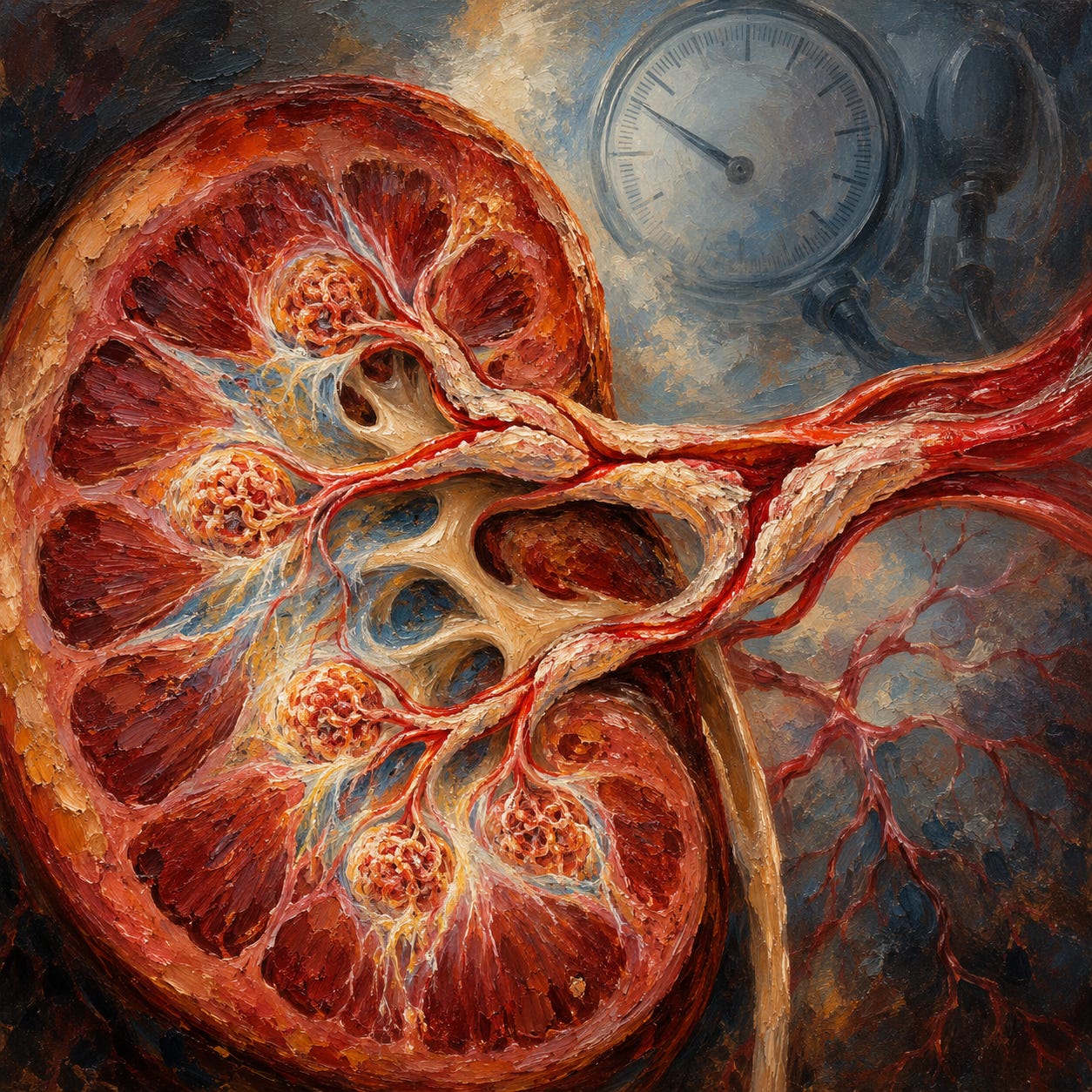
This essay examines a clinical observation about blood pressure drugs and kidney failure, and the primary-text lineage that observation sits inside. Two registers of language operate here. The first is medicine’s own vocabulary. Hypertension as a diagnostic category, essential hypertension as a species of it, antihypertensive drugs as its correction, renoprotection as a protective effect established in trial endpoints: these terms appear in quotation, in trial names, and when the mainstream shelf is being described. The second register is the terrain reading in the author’s analytical voice. It treats elevated blood pressure as a response the body is making for a reason, and the drugs that force it down as interference with that response. The two registers describe the same physical events differently. Shifts between them are intentional. Nothing in this essay is medical advice. No reader should stop a prescribed medication unilaterally. The question posed here is a different one, and it belongs in a conversation with a physician who will engage it.
Kaufman’s Observation
In November 2017, 31 million Americans became hypertensive overnight. Their bodies had not changed. Two professional societies had moved the diagnostic threshold from 140/90 to 130/80 mmHg, and the population of the diseased expanded by fourteen percent of the adult population in a single publication cycle.¹⁷
The reading was unchanged. The name applied to it had migrated downward. The question underneath, what the body was doing when it raised the pressure, went unexamined in the publication cycle that moved the threshold, and continues to go unexamined in the practice that followed. The mainstream Cochrane literature has, meanwhile, already answered a related question: whether the drugs the new threshold brought under indication help the population the new threshold targeted.
Andrew Kaufman, a working clinician, says the most common cause of kidney failure in his practice is blood pressure medication. He makes a stronger claim: he has never seen a patient with kidney disease who was not taking an antihypertensive drug. When the body raises pressure at rest, Kaufman argues, something has reduced the flow of blood to the organs, and the higher pressure is the body’s correction. Lower the pressure chemically without addressing the reason it rose, and the organs return to the under-perfused state the body was trying to escape.¹
The strongest form of that observation collapses on inspection. Nearly every patient diagnosed with hypertension is prescribed an antihypertensive by current protocol. The correlation Kaufman reports is near-automatic. A physician who sees hundreds of hypertensive patients will see hundreds on medication, and the overlap with later kidney decline is confounded by indication from the moment the diagnosis is made.
What the pattern cannot do is close the question underneath. If the body raises blood pressure for reasons, lowering it chemically without identifying those reasons leaves the reasons in place. The organs that depended on the higher pressure for perfusion are now receiving less of it. Over time, in some patients, that reduction damages them. The mechanism does not depend on Kaufman’s census, and it is not his invention. Tilden described a version of it in 1921, Shelton a sharper version in 1964, Richard Moore a biophysics-adjacent version in 2001. Dawn Lester and David Parker synthesized the modern terrain reading in 2019. Twenty years of establishment pharmacovigilance has reached parts of the same mechanism from a different direction.
Support This Work
The essays are free and will stay free. What paid subscribers get is the library that surrounds them: the full digital book catalogue, audio deep dives, archived, and embedded in each essay, and the Questions for Your Doctor, Before You Consent, and Package Insert series. Platinum Supporters also receive the digital edition of every paperback on the day it’s published.
Whichever tier suits, thank you for being here. If you’d like to become a paid subscriber, upgrade a tier, or gift a subscription to someone who might value the work, the options are below.
Audio Deep Dive (for Paid Subscribers)
Tilden, 1921
John Henry Tilden spent twenty-five years prescribing drugs. Then he stopped. He practiced for another thirty-three years without them, and in 1926 he gave his tally in Toxemia Explained: the drugs he had once prescribed were “unnecessary, and in most cases injurious.”²
His framework was toxemia. Toxic residues from imperfect digestion, inadequate elimination, and habits that drained nerve energy accumulated in the body for years. When the accumulation reached an organ already compromised, that organ gave way, and medicine named the organ’s failure. The toxemia was underneath all along.
In Impaired Health, published in 1921, he set out the drivers he had identified in his hypertensive patients. Tobacco. Tea. Coffee. Alcohol. Nervous overstimulation. Excessive eating of foods that putrefy in the intestine. These, he wrote, were “the most intense etiological factors” in arteriosclerosis.³ Elevated pressure was what the body did downstream of these habits, not a disease in its own right. Stop the stimulants, he claimed, and the arteries might soften, a timeline that overshoots what any controlled study could demonstrate but a doctrinal position that still holds. The leading orders in treatment, in his phrase, were proscriptions.
The sentence that reaches furthest into the question Kaufman raises comes from the epistaxis chapter. Tilden had observed that patients prone to apoplectic events sometimes bled from the nose, and that these bleeds were followed by lower pressure. He named the bleeding “conservative.” The body, he reasoned, was spending pressure through the easiest available outlet to protect something more valuable from losing it. Bleeding is not therapy. Modern stroke care has moved on. What Tilden named in 1921 language is the pattern Kaufman describes a century later. The pressure was doing something.
In the chapter on acute Bright’s disease, Tilden wrote that kidneys already weakened by toxic insult become “very susceptible” to the irritant drugs of his period: atropine, cantharides, potash, carbolic acid. The named agents are not antihypertensives. The pharmacology of ACE inhibition did not exist in 1921. The logic is what carries. Drugs act in the body. Weakened organs are more vulnerable to their side actions than healthy ones. A kidney already compromised by toxemia is a kidney that will be further compromised by whatever is added to the stream. Tilden’s response was removal of the toxic load. Elevated pressure sits downstream of a chain of insults, and drugs added to that chain extend it.
Shelton, 1964
Herbert Shelton reached for a garden hose. The hose at full flow. Water running out the open end. Now a nozzle at the tip, tightened until the opening narrows. The water still has to get through. The pressure behind the nozzle rises. Shelton applied the image to the body. When the arterioles throughout the body narrow under systemic irritation, pressure rises behind them, because the heart is still trying to deliver the same volume of blood to the same tissues.⁴
He called elevated pressure “an ending in a chain of causes” that reached back years into the life of the patient. The chain he named in that 1964 chapter: nervous strain, excessive eating, coffee, tea, tobacco, alcohol. Salt was a contributor, but not the whole story, and assigning everything to salt was a way of letting the rest of the chain go unexamined. Drugs that reduced the pressure without touching the chain produced what Shelton called a “forced reduction.” The pressure dropped only so long as the drug was taken. In his patients it often began to climb again despite the drug, because the chain was still intact and still generating the response.
“Genuine reduction” was pressure that fell because the causes had been removed. Shelton’s vehicle was fasting. Rest. Water. No further toxic load. The systemic irritation declined, and pressure declined with it. In his cases the lowered pressure tended to stay down after eating resumed, provided the eating did not rebuild the chain. The clinical observations were uncontrolled and should be read as such. The doctrinal distinction underneath, between pressure forced down by drugs and pressure that falls because its causes have gone, is what reaches into the modern argument.
The nephritis chapter is where the lineage becomes directly visible on the kidney. Bright’s disease, Shelton wrote, was a condition of people who ate heavily and continuously of foods that burdened the organs of elimination. The sentence that stands behind the whole kidney argument of this essay sits in that same chapter: “Many drugs produce inflammation of the kidneys.”⁵ He named the drugs of his period that did it. He also warned against the then-fashionable practice of forcing fluids on compromised kidneys. Excessive water drinking, he wrote, served no purpose for an organ already failing to process what it had.
Shelton closed the hypertension chapter with the formulation that frames the end of this essay. If we cut out causes instead of cutting out organs, he wrote, we secure a genuine elimination of effects. Modern pharmacology has, from a different direction, begun to confirm it.
Moore, 2001
Richard Moore held an MD from Indiana University and a biophysics PhD from Purdue. He taught biophysics at the State University of New York at Plattsburgh. His 2001 book The High Blood Pressure Solution took the Hygiene reading and translated it into cellular biophysics. His own mechanism was the potassium-to-sodium ratio inside the cell, which he called the K Factor. Diets heavy in sodium and poor in potassium disturbed the electrical balance of every cell. Elevated blood pressure was one visible marker of that disturbance.⁶ Moore overreached when he argued for the K Factor as a near-complete explanation; his claim that a Finnish salt-substitution program drove a sixty-percent decline in stroke and heart attack deaths compresses a multi-factor cardiovascular shift into a single story. The essay is not building on that part of his argument.
What Moore gave the lineage was a bridge. He said the thing Shelton had said, in a vocabulary modern readers could receive without rejecting on sight. Blood pressure, Moore wrote, was a marker, or a sign that something is out of balance. He compared it to body temperature. A fever is a sign that something is wrong, not the illness itself. Treating the fever without finding the inflammation it reports is treating a signal rather than its source.
The pharmacology paragraph is the one Lester and Parker extracted for their chapter on antihypertensives. Antihypertensive drugs, Moore wrote, produce side effects because they alter basic body functions, in the nervous system and kidneys as well as the blood vessels. They do not have a kidney side effect by accident. They alter kidney function by design, because the kidney is a central site of blood pressure regulation and the drugs operate on the mechanisms the kidney uses. Lester and Parker drew the inference Moore stopped short of: kidney disease could, on this reading, be a result of antihypertensive drugs rather than a prior cause of elevated pressure. Moore himself prescribed a program whose first step was “see your doctor.” His book is not a withdrawal pamphlet. Neither is this essay.
Moore remembered a 1950s pharmacology classroom. His instructors had told the students that every drug can also be a poison. Three decades later he sat in a lecture in which a side effect was named and a drug to manage that side effect was named in the next slide, with no reminder of the earlier teaching. The pharmacology of a drug and the pathology of a poison are two readings of the same molecule.
Moore’s framework found its modern physiological articulation in the work of Thomas Cowan, a cardiologist trained inside mainstream medicine. In Human Heart, Cosmic Heart, Cowan documented that roughly eighty percent of ischemic cardiac events are preceded by a chronic reduction in parasympathetic nervous system activity. The parasympathetic branch, mediated by the vagus nerve and acetylcholine, is the body’s restorative arm. When its tone collapses under sustained load, the sympathetic branch dominates. Vessels tighten. Pressure rises. Cowan listed what suppresses vagal activity: smoking, diabetes, sustained psychological strain, and hypertension itself.¹⁸ The reading called hypertension is one of the factors that produces the autonomic imbalance that produces the readings called hypertension.
Kaufman Today
Kaufman stands at the end of the lineage. His language is modern clinical informality rather than nineteenth-century prose or mid-century Hygiene doctrine, but the shape of what he describes is unchanged. Pressure rises because something is reducing flow. Flow is reduced either because volume is low or because the vessels have stiffened or narrowed. The pressure elevation is the body’s response to the reduction. Kaufman is a working clinician reproducing an argument whose primary-text evidence spans three previous generations and now converges with pharmacovigilance the establishment itself has published.
Lester and Parker, 2019
Dawn Lester and David Parker’s What Really Makes You Ill?, published in 2019, gathered the lineage for modern readers. On antihypertensive drugs they followed Moore’s pharmacology sentence to its conclusion: kidney disease, they argued, could be a result of the drugs rather than a prior cause of the elevated pressure the drugs were prescribed to lower.¹⁵ On hydration they declined to follow Batmanghelidj into his universal etiology; dehydration, they wrote, may be a contributing factor but cannot be regarded as the main cause of chronic conditions. They inherit the Hygiene reading, discipline its overreaches, and keep the mechanism intact for the modern pharmacovigilance.
How the Drugs Act on the Kidney
Each kidney holds about a million glomeruli, filtering units the size of a sand grain. A small artery feeds blood into each one. A second small artery carries the filtered blood out. The pressure inside the glomerulus is what drives the filtration. That pressure depends on how hard the blood arrives through the incoming arteriole and how much resistance the outgoing arteriole offers on the way out. The kidney adjusts both to keep filtration steady while the body’s systemic pressure moves around.
ACE inhibitors and angiotensin receptor blockers, the most widely prescribed antihypertensives in current practice, work on the outgoing arteriole. The renin-angiotensin system is the mechanism the kidney uses to tighten that outgoing vessel and preserve filtration pressure when the body’s systemic volume or pressure drops. The drugs block the system. The outgoing vessel relaxes. Filtration pressure falls. Systemic blood pressure falls with it, which is the clinical goal. Serum creatinine, a marker of what the kidney is clearing, typically rises in the first weeks on these drugs, because the kidney is doing less filtering per unit of blood received.⁷ Nephrology teaching has long treated rises up to roughly thirty percent as acceptable hemodynamic effects, provided they stabilize. More recent analyses have found that larger rises correlate with worse later outcomes, which complicates the picture rather than clarifying it. What is not disputed is the mechanism. The drug reduces the pressure the kidney is receiving. The kidney does less work.
In a patient with adequate volume and no additional stressors, this trade-off may be tolerated for a long time. In a patient without those conditions, the trade-off narrows. The National Institute of Diabetes and Digestive and Kidney Diseases publishes patient-facing guidance on what nephrologists call “sick-day rules.” When a person on an ACE inhibitor or ARB becomes dehydrated, or starts a non-steroidal anti-inflammatory drug, or combines these with a diuretic, the risk of acute kidney injury rises sharply. The combination of a RAS blocker, a diuretic, and an NSAID has a name in the nephrology literature: the triple whammy. Each component is defensible on its own. The combination can be enough to cross the autoregulatory floor and leave the kidney with too little perfusion to clear its load.⁸
Biff Palmer named the broader problem in a 2002 New England Journal of Medicine review on renal dysfunction complicating the treatment of hypertension. The autoregulatory window in which the kidney maintains filtration pressure across a range of systemic pressures is narrower in people with chronic hypertension and existing kidney disease than in healthy adults. Dropping systemic pressure in these patients can push filtration pressure below the floor. The resulting injury is often reversible if the drug is held or the dose reduced. Repeated exposure accumulates damage.⁹ The establishment has been describing this mechanism in its own journals for twenty years.
What the Renoprotection Trials Showed
Before the pharmacovigilance shelf is laid out, the case for antihypertensive renoprotection has to be stated in its strongest form. Edmund Lewis published a trial of captopril in type 1 diabetic patients with established nephropathy in 1993. Captopril slowed the doubling of serum creatinine and the progression to end-stage renal disease compared with placebo.¹⁰ Barry Brenner’s RENAAL trial, published in 2001, tested losartan against placebo in type 2 diabetic patients with nephropathy and reported similar renoprotective effects on hard renal endpoints.¹¹ A parallel trial of irbesartan, IDNT, reinforced the finding. Current clinical guidelines treat ACE inhibitors or ARBs as first-line therapy in patients with albuminuric diabetic kidney disease on the strength of this literature. The trials are real. The population they studied, patients with established diabetic nephropathy and significant proteinuria, is the population in which the renoprotective effect has been documented.
The scope of that documentation is where this reading reopens the question. The trials demonstrate that in patients with proteinuric diabetic kidney disease, these drugs slow progression on specific renal endpoints over several years. They do not demonstrate that lowering intraglomerular pressure is identical to restoring a healthy kidney. They do not demonstrate benefit in patients without proteinuria or without diabetes. They do not resolve what happens over the decades of exposure that current practice assumes.
The scope question has a second answer, more pointed, from the same mainstream literature. The population the 2017 threshold change expanded the diagnosis into is mild hypertension without prior cardiovascular disease. In 2012, Diao, Wright, Cundiff, and Gueyffier reviewed the randomized controlled trial evidence for exactly this group in a Cochrane analysis covering 8,912 participants across four trials. Four to five years of antihypertensive drug therapy compared to placebo did not reduce total mortality, did not reduce coronary heart disease, did not reduce stroke, and did not reduce total cardiovascular events. The intervention did increase withdrawals due to adverse effects.¹⁹
A 2015 meta-analytic update in the same tradition reported a number needed to harm of thirty-six. For every thirty-six patients started on antihypertensive drug therapy for mild hypertension, one withdrew because of a reaction severe enough to stop taking the drug.²⁰ The ones who continued despite the reaction, and metabolized whatever the drug did to them into some other category of illness, were not counted. On the mainstream’s own meta-analytic data, in the population the current threshold brought under indication, the drugs do not help on the hard endpoints and harm one in thirty-six at the rate the trials were able to measure. That finding sits beside the renoprotection trials, not against them. The two shelves describe different populations.
What the Pharmacovigilance Shelf Shows
In 2008, Johannes Mann and colleagues published the renal outcomes of the ONTARGET trial in the Lancet. The trial had tested whether combining an ACE inhibitor (ramipril) with an ARB (telmisartan) would be more protective than either alone in patients at high vascular risk. The combination increased the composite renal endpoint of dialysis, doubling of serum creatinine, or death, compared with ramipril alone. More blockade of the renin-angiotensin system was not more protection. It was more harm.¹² The ALTITUDE trial, testing the renin inhibitor aliskiren on top of standard RAS blockade, was terminated early for similar reasons. The VA NEPHRON-D trial of combined ACE inhibitor and ARB in diabetic nephropathy ended for safety concerns.
In 2015, the SPRINT trial reported that intensive systolic targets below 120 mm Hg reduced cardiovascular events and mortality compared with standard targets below 140. That result is real and has driven subsequent guideline revisions. In 2018, Michael Rocco and colleagues published the acute kidney injury data from the same trial. The intensive arm had a hazard ratio of 1.64 for acute kidney injury compared with the standard arm. The most common precipitant was volume depletion. Most events were mild and recovered toward baseline, but the signal was clear and the mechanism was the one the Hygiene writers had been describing: pressure forced lower than the body had set it, in conditions where the body needed what it had set.¹³
The most provocative modern finding sits in a 2021 paper by Hirofumi Watanabe and colleagues in JCI Insight. The authors examined kidney tissue from two sources. The first was mice given long-term renin-angiotensin inhibition. The second was human biopsies, from patients who had been taking these drugs for years. The finding was the same in both. The incoming arterioles, the small vessels that deliver blood into each individual glomerulus, had thickened concentrically. The walls had grown inward. The lumens, the hollow channels through which blood actually flows, had narrowed. Markers of renin-cell transformation were elevated. The vessels that fed the kidney’s filtering units were being remodeled over years of exposure to the drugs prescribed to protect those vessels from the pressure that had risen to compensate for narrowed vessels elsewhere in the body.¹⁴
The authors are careful. They do not recommend that patients benefiting from these drugs stop taking them. They note that prospective morphologic trials are needed. Those caveats are theirs. The finding stands.
Shelton wrote in 1964 that many drugs produce inflammation of the kidneys. Watanabe in 2021 photographed one of the ways that happens. Shelton did not have the microscope. He had the pattern.
The Hydration Question
Shelton’s warning from the nephritis chapter is the baseline the lineage holds. For a kidney already compromised by continuous insult, excessive water drinking serves no useful purpose. Flooding an organ that cannot process what it already receives does not restore it. That line sits uneasily with the popular hydration literature of the last three decades, which has gone in the opposite direction.
Fereydoon Batmanghelidj made the strongest version of the opposite case in Your Body’s Many Cries for Water and a long series of related publications. He proposed that chronic cellular dehydration was the primary cause of hypertension and of a long list of other conditions, that the body raised blood pressure specifically to force water across cell membranes against osmotic resistance, and that adequate water intake plus salt would eliminate hypertension altogether. The further claims he attached to this program, that it cures asthma within hours, prevents Alzheimer’s, and cures multiple sclerosis, are not supportable from the evidence he offered. Lester and Parker, writing from inside the terrain paradigm, declined to endorse him. Dehydration, they wrote, may be a contributory factor but cannot be regarded as the main cause of chronic conditions.¹⁵
A systematic review of what is called the osmopressor response, the rise in blood pressure that follows rapid water ingestion in patients with autonomic failure, has reported substantial systolic increases in that patient group. Drinking water, in those patients, raises pressure. The relationship between hydration and blood pressure is more variable than any single theory accommodates.
What remains after these qualifications is a smaller claim. Kaufman’s clinical anecdote about a patient who switched from tea and orange juice to water and whose chest pain resolved sits in the usual evidentiary category for a single case: suggestive, not demonstrative. The underlying beverage distinction, water rather than caffeinated or sugared drinks, is consistent with the Hygiene frame and with the mainstream nephrology literature on volume status. Habitual replacement of caffeinated and sugared drinks with water is not a universal cure for hypertension. Flooding a compromised kidney is not safe. Within those limits, the distinction is a plausible contribution to improved systemic conditions.
Goldhamer, 2001
A single modern cohort gives the Hygiene reading of hypertension a counted echo. Alan Goldhamer and colleagues at the TrueNorth Health Center in California published a 2001 case series of 174 consecutive hypertensive patients treated with medically supervised water-only fasting. The protocol was two to three days of fruits and vegetables, roughly ten to eleven days of water-only fasting, and six to seven days of refeeding on a low-fat, low-sodium vegan diet. Mean reduction in blood pressure across the cohort was 37/13 mm Hg. In stage 3 hypertensives, with systolic over 180 or diastolic over 110, the mean reduction was 60/17. About 90 percent of participants finished the protocol with blood pressures below 140/90. All 6.3 percent of participants who had entered on antihypertensive medication discontinued their medication under supervision during the study.¹⁶
The series is uncontrolled. There was no drug comparator. The setting was inpatient, with physician supervision, in a facility whose clinical philosophy is explicitly Hygienic. Funding included contributions from the American Natural Hygiene Society and the International Association of Hygienic Physicians. These disclosures are not disqualifications, and they are not substitutes for the controlled trial that has not been done. Water-only fasting of this duration is not safe without medical supervision and is contraindicated in several conditions. The point of including the data is to show that the terrain reading has a modern clinical datapoint, not to recommend a protocol. The pressure fell substantially when the inputs that had sustained it were removed.
Where This Leaves the Reader
Kaufman’s strong-form claim that the most common cause of kidney failure he sees is blood pressure medication is confounded by prescribing patterns and cannot be sustained. The weaker form of the argument stands. Elevated blood pressure is a response the body is making to conditions it is trying to manage. Lowering the response without changing the conditions returns the organs to the state the response was defending against. Over time, in some patients, that return damages the kidneys. The Hygiene writers reached this through clinical observation. Cowan has articulated the autonomic physiology that sits underneath. Modern pharmacovigilance has reached the kidney damage directly, through pathology.
The renoprotection trials are not wrong in their populations. Lewis, Brenner, and the IDNT investigators showed that in patients with proteinuric diabetic nephropathy, these drugs slow progression on specific endpoints over several years. The Cochrane literature on mild hypertension without prior cardiovascular disease shows no comparable benefit and documented harm. The two findings sit beside each other, describing different populations.
A medicated reader will want to know whether to stop. That question answers itself under a prescriber’s hand and is not the question this piece was built to pose. The question underneath, which the lineage has been asking for a hundred years, is what is being done to remove the reasons the pressure rose. Dehydration. Dietary burden on the organs of elimination. Sustained sympathetic activation. Arterial stiffening from accumulated insults. Environmental toxic load. Nothing in that list is mysterious. Each item was identified in the lineage texts walked through above, and each is removable with sustained effort and competent clinical support. The reasons were listed in 1921 and listed again in every generation that followed. The mainstream pharmacovigilance that confirmed parts of the mechanism was published in 2002, 2008, 2018, and 2021.
Shelton closed his hypertension chapter sixty years ago with the formulation that frames all of this. If we cut out causes instead of cutting out organs, he wrote, we secure a genuine and lasting elimination of effects. The organ-cutting in his sentence has a modern form. Watanabe’s biopsies show the kidney’s own feeding arterioles thickening and narrowing under the drugs prescribed to protect it. The under-perfusion the body raised the pressure to prevent is produced, in the organ the pressure was reaching for, by the pharmacology the number recruited. The drug cuts out the organ by inches, over years, in the vessels the organ depends on, while the doctor watches the number on the cuff.
How to Explain It to a Six-Year-Old
Imagine a garden hose watering some flowers. The pump at the tap is pushing the water through the hose, and the flowers at the end are getting the water they need. Now imagine someone has pinched the hose somewhere in the middle. The flowers start to droop because less water is reaching them. The pump senses this and pushes harder, which raises the pressure inside the hose. The water starts getting through again, and the flowers perk back up.
Now a visitor comes along, sees the high pressure in the hose, and says the pressure is too high. The visitor turns the pump down. The pressure in the hose drops, but the pinch is still there. The flowers at the end start drooping again, because less water is reaching them. If this goes on for long enough, the flowers die.
The pressure was high because the hose was pinched. The pump raised it to keep the flowers alive. To help the flowers, someone has to find the pinch and unpinch it. Turning down the pump makes the pressure number look better. It also makes the flowers die.
The kidneys are the flowers.
In Print
The Unbekoming library is available in paperback, printed to order through Lulu and shipped worldwide. The shelf begins with the paradigm question underneath everything else — No Virus, the isolation problem, the collapse of virology’s foundational claims, and a disease-by-disease reappraisal — and moves through the suppressed compounds mainstream medicine set aside: The DMSO Book, Chlorine Dioxide: The Forbidden Remedy, The Iodine Book, and The Hydrogen Peroxide Book. Two more recover what’s still on the kitchen shelf: Baking Soda and The Castor Oil Book. Two more recover the minerals modern soil, water, and processing quietly stripped from the diet: The Magnesium Handbook and The Boron Book. Sitting alongside these is No Contagion, co-authored with Jamie Andrews — the case against germ theory itself, catalogued through 258 failed contagion experiments.
The critique books cover what medicine, dentistry, psychiatry, and veterinary practice have become. The Unvaccinated treats the completely unvaccinated as a comparison group across twenty chapters and five appendices. Medicalized Motherhood follows a woman through 123 documented interventions from teenage pill to postpartum discharge. Drilling for Profit treats cavities, gum disease, and crooked teeth as the dietary problem they are. What Your Vet Can’t Tell You applies the same critique to pets. Escape from Psychiatry documents the fabrication of the DSM and the specific damage of every major psychiatric drug class. The Vitamin K Injection covers what happens in the first hours of a newborn’s life.
The full shelf is at lulu.com/spotlight/unbekoming. A physical book reaches the person a Substack post never will — the skeptical relative, the friend who won’t click a link but might open a book, the visitor whose eye lands on a coffee table. Buy one to keep, and one to give away.
References
Kaufman, Andrew. Spoken clinical commentary on blood pressure medication and kidney function. Transcript provided to the author, 2026.
Tilden, John H. Toxemia Explained: The True Interpretation of the Cause of Disease. 1926. Public reprints and extracts via Horne, Ross, chapter 24, Soil and Health Library.
Tilden, John H. Impaired Health: Its Cause and Cure. Vols. 1 and 2. 1921. Public reprints, chestofbooks.com (Arteriosclerosis, Alimentary Poison, Acute Bright’s Disease, Chronic Bright’s Disease, Uremia, Epistaxis, Aneurism chapters).
Shelton, Herbert M. Fasting Can Save Your Life. Natural Hygiene Press, 1964. Chapters 26 (”High Blood Pressure”) and 33 (”Nephritis”).
Shelton, Herbert M. Fasting Can Save Your Life, chapter 33, “Nephritis,” ibid.
Moore, Richard D. The High Blood Pressure Solution: A Scientifically Proven Program for Preventing Strokes and Heart Disease. 2nd ed. Rochester, VT: Healing Arts Press, 2001. Preface and chapter extracts.
Bakris, George L., and Matthew R. Weir. “Angiotensin-Converting Enzyme Inhibitor-Associated Elevations in Serum Creatinine: Is This a Cause for Concern?” Archives of Internal Medicine 160, no. 5 (2000): 685-693.
National Institute of Diabetes and Digestive and Kidney Diseases. “Keeping Kidneys Safe: Smart Choices about Medicines.” niddk.nih.gov.
Palmer, Biff F. “Renal Dysfunction Complicating the Treatment of Hypertension.” New England Journal of Medicine 347, no. 16 (2002): 1256-1261.
Lewis, Edmund J., et al. “The Effect of Angiotensin-Converting-Enzyme Inhibition on Diabetic Nephropathy.” New England Journal of Medicine 329, no. 20 (1993): 1456-1462.
Brenner, Barry M., et al. “Effects of Losartan on Renal and Cardiovascular Outcomes in Patients with Type 2 Diabetes and Nephropathy.” New England Journal of Medicine 345, no. 12 (2001): 861-869.
Mann, Johannes F. E., et al. “Renal Outcomes with Telmisartan, Ramipril, or Both, in People at High Vascular Risk (the ONTARGET Study): A Multicentre, Randomised, Double-Blind, Controlled Trial.” Lancet 372, no. 9638 (2008): 547-553.
Rocco, Michael V., et al. “Effects of Intensive Blood Pressure Treatment on Acute Kidney Injury Events in the Systolic Blood Pressure Intervention Trial (SPRINT).” American Journal of Kidney Diseases 71, no. 3 (2018): 352-361.
Watanabe, Hirofumi, et al. “Inhibition of the Renin-Angiotensin System Causes Concentric Hypertrophy of Renal Arterioles in Mice and Humans.” JCI Insight 6, no. 24 (2021): e154337.
Lester, Dawn, and David Parker. What Really Makes You Ill? Why Everything You Thought You Knew About Disease Is Wrong. 2019. Chapters on hypertension, antihypertensive drugs, and hydration.
Goldhamer, Alan C., Douglas Lisle, Banoo Parpia, Scott V. Anderson, and T. Colin Campbell. “Medically Supervised Water-only Fasting in the Treatment of Hypertension.” Journal of Manipulative and Physiological Therapeutics 24, no. 5 (2001): 335-339.
Bakris, George, and Matthew Sorrentino. “Redefining Hypertension: Assessing the New Blood-Pressure Guidelines.” New England Journal of Medicine 378 (2018): 497-499. Muntner, Paul, et al. “Potential US Population Impact of the 2017 ACC/AHA High Blood Pressure Guideline.” Circulation 137, no. 2 (2018): 109-118.
Cowan, Thomas. Human Heart, Cosmic Heart: A Doctor’s Quest to Understand, Treat, and Prevent Cardiovascular Disease. White River Junction, VT: Chelsea Green Publishing, 2016.
Diao, Diana, James M. Wright, David K. Cundiff, and François Gueyffier. “Pharmacotherapy for Mild Hypertension.” Cochrane Database of Systematic Reviews 2012, no. 8: CD006742.
Sundström, Johan, et al. “Effects of Blood Pressure Reduction in Mild Hypertension: A Systematic Review and Meta-analysis.” Annals of Internal Medicine 162, no. 3 (2015): 184-191.
Thank you, U. Now that I'm wise to their lies no pharma Rx for me ever again.
The question you always have to ask is ,is this by design or incompetence?
Thanks again!