

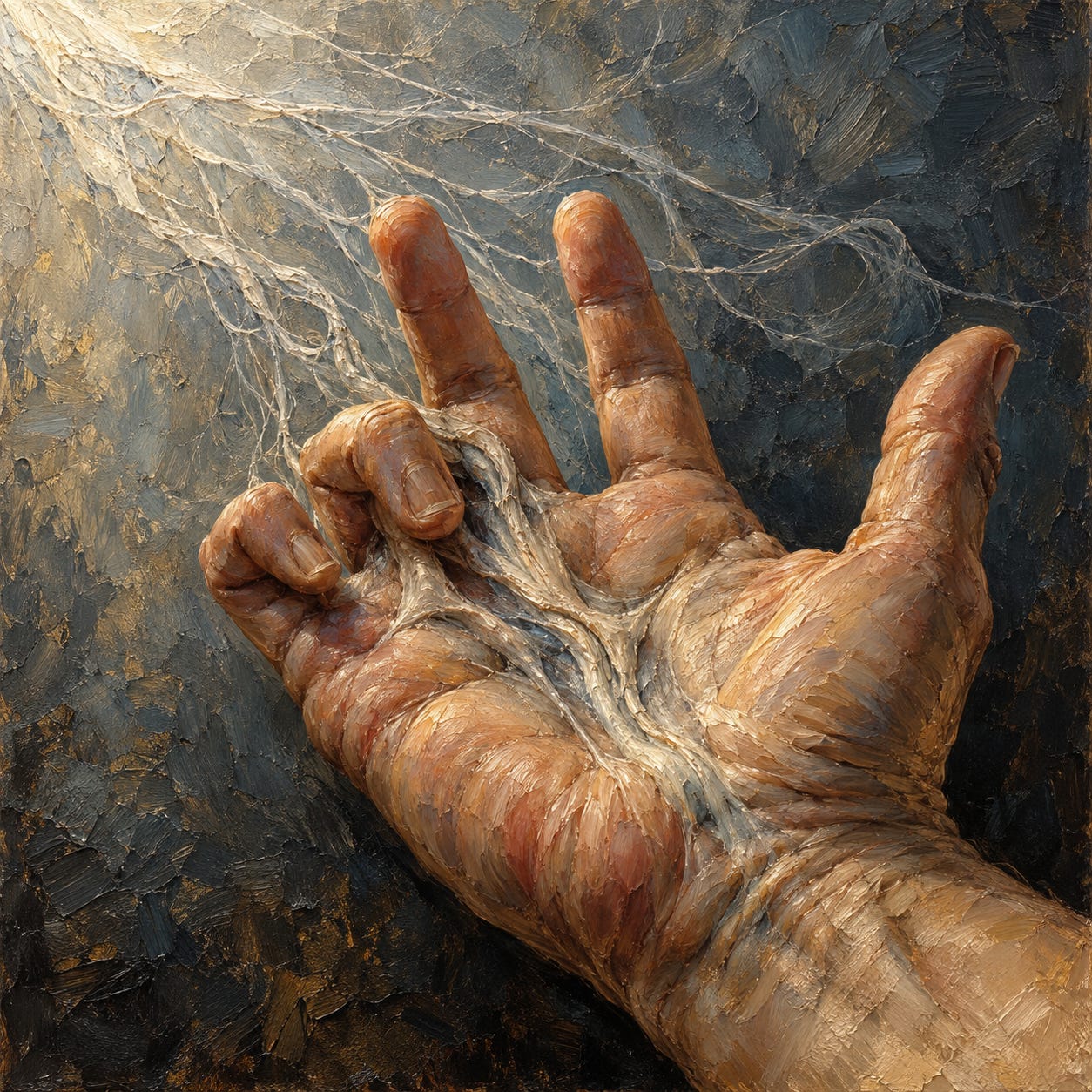
A reader writing in asked for sources on Dupuytren’s disease and for alternatives to surgery and injection. The question deserves a careful answer. What follows holds two registers in view. The surgical, genetic, and radiological vocabulary of the mainstream literature appears in quotation, attribution, and reference titles, where its own evidence is examined for what it says and what it does not say. The terrain reading operates in the author’s own analytical voice and is labeled wherever it extends a claim beyond what the source made. Herbert Shelton and John Tilden did not write about Dupuytren’s disease. Weston Price’s ethnographic survey did not catalogue it. The extension from their work to this fascia is ours, and it is marked.
The Operation That Does Not Cure It
“Although DD is not curable, good treatments are available. Recurrences reflect the pathophysiology of the disease and should not be considered complications of treatment.”¹
That sentence is from a 2021 continuing medical education review in Deutsches Ärzteblatt International, written by a hand surgeon for other hand surgeons. In plain English, it says that the operation does not fail. What the operation does and what the disease does are two different things. The cord grows back because the condition that produced it is still present.
Baron Guillaume Dupuytren described the disease and operated on it in Paris in 1831. The operation itself is older. Sir Henry Cline suggested dividing the palmar cords in 1777, more than fifty years before the disease carried the name it now carries.² For nearly two and a half centuries, hand surgeons have been cutting these cords. The cords have been returning.
Ruettermann’s working definition, from the same review: “progressive idiopathic fibrosis of the palmar aponeuroses of the hands, leading to extension deficit in the fingers and the formation of nodules.”¹ A nodule is the active lump in the palm, usually at the base of the ring or little finger. A reader checking a hand against this essay would notice it as a firm thickening under the skin that does not yet keep the palm from laying flat. A cord is what the nodule becomes as it extends toward the finger: a tendon-like rope the hand feels catch when it tries to open all the way, and that eventually holds the finger permanently bent toward the palm.
The staging most of the published literature uses was published by Tubiana. Stage N means a nodule or a cord without any extension deficit. Stage 1 means a deficit of up to 45 degrees. Stage 2 is 45 to 90. Stage 3 is 90 to 135. Stage 4 is greater than 135, which is a finger folded nearly flat against the palm. The reader who asked about alternatives was asking a specific question. Every established treatment for this disease releases a rope. The disease is the tendency to weave another one. Alternatives have to be judged by whether they stop the weaving.
Support This Work
The essays are free and will stay free. What paid subscribers get is the library that surrounds them: the full digital book catalogue, audio deep dives, archived, and embedded in each essay, and the Questions for Your Doctor, Before You Consent, and Package Insert series. Platinum Supporters also receive the digital edition of every paperback on the day it’s published.
Whichever tier suits, thank you for being here. If you’d like to become a paid subscriber, upgrade a tier, or gift a subscription to someone who might value the work, the options are below.
Audio Deep Dive (for Paid Subscribers)
The Two Diatheses
The surgical literature has its own word for the question of why some hands grow cords and others do not. The word is diathesis.
John Hueston, who taught generations of hand surgeons, named a cluster of features that predicted whether a patient would see the cord return after an operation. Ruettermann summarizes the cluster: positive family history, bilateral disease, onset under fifty, ectopic fascial lesions (plantar fibromatosis in the sole, called Ledderhose disease; Peyronie’s disease in the penis; and Garrod’s knuckle pads), and male sex.¹
Hindocha and colleagues revised the cluster and tested it empirically in a Northwest England series of 322 patients.³ Family history in a parent or sibling, bilateral disease, male sex, onset before fifty, and Garrod’s pads specifically. Recurrence appeared in 46 percent of the men, 47 percent of those with bilateral disease, 48 percent with a family history, 47 percent with onset under fifty, 52 percent with ectopic lesions, and 63 percent with Garrod’s pads. Their predictive model, with all the revised factors present, raised the risk of recurrent disease to 71 percent above a baseline of 23 percent in patients with none of the factors.
That is a forecast of return after cutting. It is not a theory of what produced the cord in the first place.
The cluster includes something worth noticing. The same tendency expresses in three fascial territories in the same men, more often than chance. Mohede and colleagues, working from the Groningen group that has produced much of the modern Dupuytren literature, documented the co-occurrence in a series of 730 patients with Dupuytren’s disease.⁴ Lethuillier and colleagues, working from both directions, reported that 12.3 percent of hand-first patients also had Peyronie’s and 29.1 percent of penis-first patients also had Dupuytren’s; the asymmetry reflects which clinic each patient entered through, not a biological difference between the directions.⁵ Dolmans and colleagues tested the nine genomic loci known to be associated with Dupuytren’s in 111 men with Peyronie’s disease and found one shared signal at WNT2, odds ratio 0.61.⁶ One locus of nine. A 2004 microarray study by Qian and colleagues, with nine samples per group, reported similar patterns in collagen-degradation and myofibroblast genes across the two tissues.⁷ The shared molecular signature is thin. The clinical cluster is not. Something travels through these men across three fascial territories, and the mainstream has not identified what.
Herbert Shelton, writing in his Hygienic System in the mid-twentieth century, used the word diathesis for something more general.
Diathesis is a bodily condition, or constitution, or tendency that predisposes to a particular “disease” or class of “diseases.” It seems to be largely a defective anatomism, hereditary, congenital, or acquired, which acts as the localizing agency.⁸
Shelton’s example, which the Dupuytren literature happens to validate, was alcohol:
Two men acquire the drink habit. Shortly thereafter one develops hyperemia of the liver which goes on to the production of cirrhosis, ascites and death. The other develops neuritis, and, if he continues to drink, graver forms of nervous degeneration. ... When alcohol produces liver “disease” in one man and nervous “disease” in another, the difference is in the vulnerability of the respective organs of these men and not in the alcohol.⁸
The paragraph does not mention the palm. Shelton did not name palmar fascia as a target tissue, and the honest reading of his work does not pretend he did. The extension is ours. A third man, drinking the same whiskey the first two drank, develops neither cirrhosis nor neuritis. His fascia takes the hit. Shelton would have recognized the pattern. He would not have recognized the disease by the name under which hand surgeons meet it.
Shelton was aware of the limit of his own word. On the same page: “What is a diathesis? What are its causes? It must be confessed that it is often only a term to cover our ignorance.”⁸
John Tilden, writing a generation earlier, used the same word for something different. His gouty diathesis was a constitutional sketch of a specific type of person. The sketch is detailed, specific, and not the Dupuytren patient.
Tilden’s gouty subject is nervous, dry-skinned, early-bald, sugar-loving, poor at digesting nitrogenous foods, with excess phosphates and uric acid in the urine.⁹ The constitutional derangement, which he called nutritive perversion, “favors the development of arthritis, herpes, gout, inflammatory rheumatism, neuralgia, stone formation, and all skin derangements of a nervous type.” It does not include palmar fibromatosis. Tilden’s closest sentence to a theory of fibrosis is a remark that tuberculosis in a gouty subject tends to “take on a fibrous character, which is curable.” The sentence is about tuberculosis changing character. It is not about a cord in the palm.
The surgical word diathesis and the Hygienic word diathesis share a Greek root and almost nothing else. Hueston’s cluster is a prognostic forecast of recurrence after cutting. Tilden’s constitutional sketch is a nineteenth-century typology of a different patient. Collapsing one into the other is the trap this essay would most easily fall into. What travels from Hygiene to Dupuytren’s palm is Shelton’s broader localization rule. The extension to this fascia is ours, and Shelton’s own admission that the word covers ignorance travels with it. Tilden’s gouty sketch stays where it was written, inside a constitutional theory of other diseases.
What the Fascia Is Doing
The palmar aponeurosis is the fascial sheet beneath the skin of the palm. Pretendinous bands run from the aponeurosis toward each finger. In Dupuytren’s disease these bands and the deeper digital sheets thicken, first into a nodule, then into a cord. Newer dissections have mapped what the surgical literature calls the palmodigital spiral system, which can wrap the digital nerve as the cord contracts. Fat visible between skin and cord warns that the nerve has been pulled out of its usual line, which is one reason a needle placed into the finger is not a trivial puncture.¹
The cellular picture changes along the stage. In early nodules, the dominant cell is the myofibroblast. The myofibroblast both lays down collagen and contracts. Later cords are quieter and more tendon-like. Resected tissue with high cellularity and mitoses, a pattern called Rombouts type 1, predicts a higher risk of recurrence after surgery.¹ The standard teaching version of the arc, from Luck’s mid-century histology, runs proliferative, involutional, residual.
Dolmans and colleagues, in a 2011 New England Journal of Medicine paper, reported nine genomic loci in 2,325 Dupuytren’s patients and 11,562 controls. Six of the nine contained Wnt-pathway genes.¹⁰ Riesmeijer and colleagues, in a 2024 meta-analysis of six European genome-wide studies with 11,320 cases and 47,023 controls, reported 85 genome-wide significant variants across 56 loci. Eleven of the loci were new. The identified variants explained between 13.3 and 38.1 percent of disease variance.¹¹ Pathway prioritization pointed at Hedgehog and Notch signaling alongside the older Wnt story. The paper reported a genetic correlation with frozen shoulder. It did not report a genetic correlation with Peyronie’s. Variance explained by identified hits is not the same number as heritability.
The modern mechanism paper closest to a Hygienic sentence was written by people who did not consider themselves Hygienists. The RIDD investigators, reporting a phase 2b randomized trial of injected anti-TNF therapy in 2022, described the process in terms a terrain reader will recognize. On their account, the development and maintenance of the myofibroblast depends on low amounts of tumor necrosis factor secreted by local macrophages and mast cells.¹² That is a sentence about tissue irritation sustaining tissue change. The authors reached for an injected biologic to shut it down. They did not reach for cause removal.
The cord is the end of a cellular process. The process has a vocabulary now. Surgery and collagenase argue with the rope. Radiotherapy, intranodular steroid, and anti-TNF argue with the nodule. Nothing in the published treatment literature argues with whatever keeps recruiting the myofibroblast.
Heritability as the Hard Limit
The hardest number against a terrain reading of this disease comes from a Danish twin study. Larsen and colleagues, in 2015, analyzed 30,330 same-sex twin pairs, 365 of whom had been diagnosed with Dupuytren’s.¹³ Among identical male twin pairs, when one brother had the disease the other brother had it in roughly 37 percent of pairs, with a confidence interval of 26 to 50 percent. Among fraternal twin pairs, concordance fell to 7 percent. The paper’s heritability estimate was approximately 80 percent. Ruettermann rounds it up: “genetic factors account for 80% of the factors involved in causing this disease.”¹ The twin paper’s own conclusion was narrower and more careful: “genetic factors play a major role.”
Heritability does not say what the surgical rounding implies. It is a population-specific estimate of the proportion of variance in a trait attributable to inherited variation, within one cohort, under the assumptions that cohort’s design allows. A Danish adult cohort from the same decades shares many background exposures, and heritability estimates there will reflect that uniformity. The same study in a cohort of mixed exposure histories would yield a different number. Eighty percent is not an estimate that 80 percent of any given person’s disease was caused by their genes. It is an estimate about the structure of variance in Danish twins.
Hindocha and colleagues, working separately on familial aggregation, found that siblings of Dupuytren’s patients had 2.9 times the baseline risk of developing the disease.¹⁴ In their series, environmental risk factors did not track family history. Their reading was that familial clustering looked genetic rather than a shared household toxin.
The Viking story, which the lay literature keeps alive, is dead inside the mainstream. Complex genetic analyses by Ng and colleagues found no evidence to support the postulated association between Dupuytren’s disease and Nordic or Viking ancestry.¹ The clinical observation that prevalence remains high among people of Northern European descent is a description of where doctors have found the disease, not a medieval migration proof.
What a terrain reading can honestly do with the twin number is this. Shelton’s localization rule is a theory of inherited or acquired tissue vulnerability. His word for it was defective anatomism. The twin study is evidence of a localizing tendency with inheritance in its ancestry, which is what Shelton named. Hueston’s surgical word for the same observation predicts recurrence after cutting. Shelton’s broader word predicts which tissue will take the hit from a given insult. The two uses of the word are pointing at the same observable thing from different sides. The twins do not refute the terrain framework. They are evidence that the framework has to make room for inherited vulnerability as the thing that decides which fascia receives the exposure. Shelton already did, and said so plainly, and admitted in the same breath that the word for it covered his ignorance.
The number is honest. The rounding of it into “80 percent genetic cause” is not.
The Exposures That Are Real
The exposures for which the Dupuytren literature has evidence are the exposures Shelton would have expected. Weston Price’s survey of fourteen traditional populations did not catalogue palmar fibromatosis, so the ethnographic record for this particular fascia is empty. The mainstream association literature is what we have.
Godtfredsen and colleagues, in the Copenhagen City Heart Study, examined 7,254 people in 1981 to 1983 and again in 1991 to 1994.¹⁵ By the second examination, 772 had signs of the disease. Heavy drinkers, defined as 36 or more drinks per week, had an adjusted odds ratio of 2.09 compared to nondrinkers, confidence interval 1.42 to 3.06. Heavy smokers at 25 grams per day or more had an adjusted odds ratio of 1.73 compared to never-smokers. The combination of heavy drinking and heavy smoking, measured against never-smoking nondrinkers, produced an adjusted odds ratio of 4.20. The authors reported no statistical interaction. The two risks were independent, and together they were large.
Burge and colleagues, in a 1997 case-control study of 222 patients, found current smoking associated with an adjusted odds ratio of 2.8 and an AUDIT alcohol score above seven associated with an odds ratio of 1.9.¹⁶ Mean weekly alcohol consumption was 7.3 units in cases versus 5.4 in controls. Lifetime cigarette consumption was 16.7 pack-years in cases versus 12.0 in controls. Ruettermann’s review quotes a pooled alcohol odds ratio of 1.71 from a later meta-analysis.¹
These are associations with having the disease, or with being operated for it. They are not evidence that stopping alcohol or stopping smoking will unweave a cord. The trial that would test that question has not been run.
The disease co-occurs with diabetes at rates well above population baseline. Salari’s 2020 meta-analysis of 85 studies and more than 6.6 million people reported a pooled prevalence inside type 1 diabetes samples of 34.1 percent, confidence interval 25 to 44.6.¹⁷ Geoghegan and colleagues, in a community case-control study, confirmed the diabetes association.¹⁸ Alser, Kuo, and Furniss, in a 2020 systematic review of nongenetic factors, confirmed heavy alcohol and smoking as the dose-response factors.¹⁹ The authors concluded that causation remained unsettled.
One finding complicates the usual terrain reading. The metabolic-syndrome bridge that fits benign prostatic hyperplasia and cardiovascular disease and the diabetic terrain generally does not fit this particular fascia. Majeed and colleagues, using Mendelian randomization, found that higher body mass index tracked lower odds of Dupuytren’s disease, not higher.²⁰ A paradigm strong enough to be useful is also strong enough to say when a bridge it usually reaches for does not reach. The exposures that fit this disease are alcohol, tobacco, the specific diabetic terrain, and mechanical load on the hand. Adiposity in general does not. The finding is what it is.
Natural history is the other limit on any claim that a treatment changed what would have happened. The RIDD authors, citing earlier work, noted that progression from nodule to cord occurs in approximately 20 percent of patients over seven years in one series and 35 percent over eighteen years in another.¹² Many nodules never become a disabled finger. Any treatment claiming to have prevented contracture has to beat that background. The NICE evidence overview said so in bureaucratic English.²¹
The Treatments, by Evidence
The reader asked for alternatives to surgery and injection. The honest tier walk starts with the surgical and injection evidence itself, because the alternatives have to be judged against something.
Tier 1. The One Head-to-Head Randomized Trial
Dias and colleagues, in the 2024 DISC trial published in the New England Journal of Medicine, randomized patients with Dupuytren’s contracture to collagenase clostridium histolyticum injection or limited fasciectomy.²² The trial tested whether collagenase injection could match the results of surgery. It could not. DISC was the first head-to-head randomized comparison between the injection and surgery, and it arrived more than a decade after collagenase had been approved by regulators and adopted as the standard non-surgical option. Hundreds of thousands of injections had been administered in the intervening years on the working assumption that the two treatments would prove equivalent. The assumption was wrong.
The product had already been withdrawn commercially in Europe. The European Medicines Agency’s public statement in February 2020 recorded that the marketing authorization for Xiapex was being withdrawn at the manufacturer’s request for commercial reasons, effective March 1, 2020.²³ No safety recall. A commercial decision about an authorized indication for which the manufacturer no longer wished to supply the European market.
Needle fasciotomy sits inside the same tier. Van Rijssen and colleagues, in a five-year randomized trial, compared percutaneous needle fasciotomy against limited fasciectomy.² Needle fasciotomy recurred more often. Open fasciectomy recurred less often, with more complications and longer recovery. The CORD I collagenase trial by Hurst in 2009 reported strong early reduction of contracture.²⁴ The CORDLESS five-year follow-up by Peimer in 2015 reported substantial recurrence in previously treated collagenase joints over the follow-up period.²⁵ The rope-releasing literature produces the same finding under different names. Release the cord, and in some proportion of patients the cord returns on a timescale measured in years rather than months.
Tier 2. Radiotherapy
Low-dose radiotherapy to the palm has been studied for early-stage disease on the theory that proliferating fibroblasts and myofibroblasts are radiosensitive and that a quiet nodule may not become a cord.
Seegenschmiedt and colleagues, in a 2001 dose-finding comparison, randomized 129 patients between 30 Gray in two courses and 21 Gray in one course.²⁶ Both arms received irradiation. There was no untreated arm. The paper’s own conclusion asked for at least five years of follow-up and did not claim an effect against natural history, because the design could not support one.
The follow-up chapter published in 2012 by the same group reported long-term results on 489 patients.²⁷ The chapter is often cited as having included a control group. The design, read closely, is this. After counseling, 83 patients decided not to receive radiotherapy. The remaining 406 were randomized between 21 Gray and 30 Gray. The 83 non-irradiated patients served as the comparison. The NICE evidence overview, in its appendix, described the design in a single line: “RCT (only the treated patients were randomised).”²¹ Among hands analyzed, the non-irradiated group carried more recurrent disease after prior surgery (9 percent against 1 percent in each treated arm) and more stage 2 through 4 disease at baseline (9 percent against 1 to 2 percent). The chapter is not peer-reviewed. The control group chose itself.
NICE’s own 2016 guidance, migrated to a HealthTech guidance number in 2026 with recommendations unchanged, states that the evidence on efficacy remains inadequate because the natural history is uncertain and many nodules never develop into contracture.²¹
The one piece of controlled trial evidence in this entire treatment modality comes from the cousin fascia. De Haan and colleagues, in the LedRad trial, randomized 84 patients with Ledderhose disease to radiotherapy or sham radiotherapy.²⁸ The primary endpoint was pain on a numeric rating scale at twelve months. Mean pain was 2.5 in the treated arm and 3.6 in sham. Pain relief was reported in 74 percent of treated patients and 56 percent in sham. Fifty-six percent of patients who received no actual treatment, in a double-blind design, reported pain relief at one year. That number is the natural-history ghost every uncontrolled Dupuytren radiotherapy series has been borrowing against. LedRad does not randomize Dupuytren’s, it does not measure extension in the hand, and its endpoint is pain in the foot rather than a cord in the palm. What it does is set a floor on what a sham arm can produce when the endpoint is subjective. The Dupuytren radiotherapy literature has never tested itself against that floor.
Tier 3. Nodule Injections and Local Biologics
Ketchum and Donahue, in 2000, injected 63 patients and 75 hands with triamcinolone, an average of 3.2 injections per nodule over four years.²⁹ Ninety-seven percent of hands showed softening or flattening. Fifty percent had reactivation one to three years later and required further injections. The authors’ conclusion was modest. Injection “may modify the progression of the disease.” It did not demonstrate a contracture-prevention rate.
Nanchahal and colleagues, in the 2022 RIDD trial, injected adalimumab, an anti-TNF biologic, into Dupuytren nodules.¹² The primary outcome was nodule hardness. Nodules softened. The authors noted that longer follow-up would be required to see whether softer nodules translated into fewer contractures.
Tier 4. Everything Else
Ball and colleagues, in a 2016 systematic review of non-surgical treatments for early Dupuytren’s disease, identified 26 studies.³⁰ Twenty were case series, one was a cohort, the rest case reports. All publications were graded level of evidence 4 or 5. The compound sold as vitamin E, which has carried a mid-century reputation in this disease, sits inside this review’s uncontrolled early-disease literature. Diet, fasting, oral enzymes other than injected collagenase, verapamil, tamoxifen, 5-fluorouracil, interferon, and imiquimod all circulate in the experimental literature. The identified literature contains no controlled trial reporting positive results for any of these in Dupuytren’s.
What Each Treatment Is Actually Doing
Grouped by target, the field looks like this. Surgery, collagenase, and needle fasciotomy argue with the rope. Radiotherapy, intranodular steroid, and intranodular adalimumab argue with the nodule. Nothing in the published literature argues with whatever keeps recruiting the myofibroblast in the first place. The rope-arguing treatments have the hardest endpoints and the clearest recurrence data. The nodule-arguing treatments have softer endpoints and uncontrolled or baseline-imbalanced designs. The cause-arguing treatments do not have trials, because the trial was not funded.
What Cause-Removal Can and Cannot Say
Tilden, writing about arthritis deformans in a different volume of his Impaired Health, left a sentence that travels further than the disease it was written for.
A lost joint is lost forever, but the disease may be checked.³¹
He was writing about chronic joint disease with bony nodes and ankylosis. He was not writing about palmar fibromatosis. The sentence travels anyway, because it names a distinction that Dupuytren staging makes anatomically precise. A finger already contracting at 90 degrees is a mechanical problem. The cord is tendon-like tissue drawing the finger down, and fingers already down are what hand surgeons release. The nodule that has not yet made a cord, which the staging calls stage N, is where the cellular process is still active and where the question of cause is at least aimed at the right tissue. The destroyed structure stays destroyed. The process that destroys it may still be addressable, if the field had asked.
The field has not asked.
The exposures with evidence are alcohol, tobacco, the diabetic terrain, and mechanical load on the hand. The published literature does not contain a trial of alcohol cessation in early Dupuytren’s. It does not contain a trial of smoking cessation, of removal of vibration exposure, of any dietary intervention, or of any supplement regime. The field has run collagenase trials, radiotherapy trials, adalimumab trials, needle-versus-knife trials. It has not run a cause-removal trial, because a cause-removal trial is not a product.
A reader with early nodules might reasonably decide that stopping drinking and stopping smoking are worth doing on their own merits, independent of whether a particular fascia unweaves. A reader with a diabetic terrain might reasonably decide the terrain is worth addressing on grounds extending well beyond this disease. These are decisions about how a person wants to live. The essay cannot promise that any of them unravel a cord already laid down. What it can say is that the only exposures where the Dupuytren association runs in the direction a terrain reading would predict are the same exposures where the trial has never been attempted.
The absence is not a verdict against the hypothesis. It is a record of what the field asked.
What Hygiene contributes to this disease it never named is two sentences, each labeled as our extension. Shelton: the same insult hits the vulnerable organ, and the vulnerability travels with the person. Tilden: a structure already destroyed is a different problem from a process still making it. Both sentences arrive at the same operational point. The nodule stage is the only window where cause-removal is aimed at the right tissue. The finger already drawn down is a mechanical fact a hand surgeon handles. What the mainstream field does not do, and what no trial in the available literature has done, is address the weaver.
Nothing above is advice to refuse a fasciectomy, to irradiate a palm, to inject a nodule, or to fast. A finger that will not open, a numb or white digit, and a wound that will not heal are clinical problems a hand surgeon handles. This is an account of what the sources say.
How to Explain It to a Six-Year-Old
Imagine the inside of your hand has a little weaver who normally works slowly, patching small tears in the stretchy sheet under your skin so the sheet stays smooth. In some people, the weaver starts making too much thread. The thread turns into little lumps. The lumps turn into tiny ropes. The ropes pull your fingers down toward your palm, and after a while you cannot open your hand all the way.
Doctors can cut the ropes with a special needle, or with a knife, or sometimes with medicine that dissolves them. The ropes go away for a while. But the weaver is still inside your hand, and the weaver is still making thread. After a few years, the ropes come back.
The weaver seems to work faster in people who have been drinking a lot of alcohol for many years. Faster still if they also smoke. Faster still if they also have the kind of blood sugar that stays too high because of diabetes. And faster still if they do work that shakes or squeezes their hands all day. The things that would probably help the weaver slow down are staying away from those. Nobody has actually tested whether this works. The doctors have mostly been busy cutting ropes.
In Print
The Unbekoming library is available in paperback, printed to order through Lulu and shipped worldwide. The shelf begins with the paradigm question underneath everything else — No Virus, the isolation problem, the collapse of virology’s foundational claims, and a disease-by-disease reappraisal — and moves through the suppressed compounds mainstream medicine set aside: The DMSO Book, Chlorine Dioxide: The Forbidden Remedy, The Iodine Book, and The Hydrogen Peroxide Book. Two more recover what’s still on the kitchen shelf: Baking Soda and The Castor Oil Book. Two more recover the minerals modern soil, water, and processing quietly stripped from the diet: The Magnesium Handbook and The Boron Book. Sitting alongside these is No Contagion, co-authored with Jamie Andrews — the case against germ theory itself, catalogued through 258 failed contagion experiments.
The critique books cover what medicine, dentistry, psychiatry, and veterinary practice have become. The Unvaccinated treats the completely unvaccinated as a comparison group across twenty chapters and five appendices. Medicalized Motherhood follows a woman through 123 documented interventions from teenage pill to postpartum discharge. Drilling for Profit treats cavities, gum disease, and crooked teeth as the dietary problem they are. What Your Vet Can’t Tell You applies the same critique to pets. Escape from Psychiatry documents the fabrication of the DSM and the specific damage of every major psychiatric drug class. The Vitamin K Injection covers what happens in the first hours of a newborn’s life.
The full shelf is at lulu.com/spotlight/unbekoming. A physical book reaches the person a Substack post never will — the skeptical relative, the friend who won’t click a link but might open a book, the visitor whose eye lands on a coffee table. Buy one to keep, and one to give away.
References
Ruettermann M, Hermann RM, Khatib-Chahidi K, Werker PMN. “Dupuytren’s Disease: Etiology and Treatment.” Deutsches Ärzteblatt International 2021;118:781-788.
van Rijssen AL, ter Linden H, Werker PMN. “Five-Year Results of a Randomized Clinical Trial on Treatment in Dupuytren’s Disease: Percutaneous Needle Fasciotomy versus Limited Fasciectomy.” Plastic and Reconstructive Surgery 2012;129:469-477.
Hindocha S, Stanley JK, Watson S, Bayat A. “Dupuytren’s Diathesis Revisited: Evaluation of Prognostic Indicators for Risk of Disease Recurrence.” Journal of Hand Surgery, American Volume 2006;31:1626-1634.
Mohede DCJ, Riesmeijer SA, de Jong IJ, Werker PMN, van Driel MF. “Prevalence of Peyronie and Ledderhose Diseases in a Series of 730 Patients with Dupuytren Disease.” Plastic and Reconstructive Surgery 2020;145:978-984.
Lethuillier V, Peyronnet B, Richard C, et al. “When Fibrosis Intersect: Association and Risk Factors between Peyronie’s and Dupuytren’s Diseases.” French Journal of Urology 2024;34:102759.
Dolmans GH, Werker PM, de Jong IJ, Nijman RJ, Wijmenga C, Ophoff RA. “WNT2 Locus Is Involved in Genetic Susceptibility of Peyronie’s Disease.” Journal of Sexual Medicine 2012;9:1430-1434.
Qian A, Meals RA, Rajfer J, Gonzalez-Cadavid NF. “Comparison of Gene Expression Profiles between Peyronie’s Disease and Dupuytren’s Contracture.” Urology 2004;64:399-404.
Shelton HM. “Diathesis: Predisposition.” Chapter in The Hygienic System: Orthopathy. Transcription available at chestofbooks.com.
Tilden JH. “Gouty Diathesis.” Chapter in Impaired Health: Its Cause and Cure, Volume 1. Transcription available at chestofbooks.com.
Dolmans GH, Werker PM, Hennies HC, et al. “Wnt Signaling and Dupuytren’s Disease.” New England Journal of Medicine 2011;365:307-317.
Riesmeijer SA, et al. “Genome-Wide Association Study Meta-Analysis of Dupuytren’s Disease.” Nature Communications 2024.
Nanchahal J, Ball C, Rombach I, et al. “Anti-Tumour Necrosis Factor Therapy for Early-Stage Dupuytren’s Disease (RIDD): A Phase 2b, Randomised, Double-Blind, Placebo-Controlled Trial.” Lancet Rheumatology 2022;4:e407-e416.
Larsen S, Krogsgaard DG, Aagaard Larsen L, Iachina M, Skytthe A, Frederiksen H. “Genetic and Environmental Influences in Dupuytren’s Disease: A Study of 30,330 Danish Twin Pairs.” Journal of Hand Surgery, European Volume 2015.
Hindocha S, John S, Stanley JK, Watson SJ, Bayat A. “The Heritability of Dupuytren’s Disease: Familial Aggregation and Its Clinical Significance.” Journal of Hand Surgery, American Volume 2006;31:204-210.
Godtfredsen NS, Lucht H, Prescott E, Sørensen TI, Grønbaek M. “A Prospective Study Linked Both Alcohol and Tobacco to Dupuytren’s Disease.” Journal of Clinical Epidemiology 2004;57:858-863.
Burge P, Hoy G, Regan P, Milne R. “Smoking, Alcohol and the Risk of Dupuytren’s Contracture.” Journal of Bone and Joint Surgery, British Volume 1997;79:206-210.
Salari N, Heydari M, Hassanabadi M, et al. “The Worldwide Prevalence of Dupuytren Disease: A Comprehensive Systematic Review and Meta-Analysis.” Journal of Orthopaedic Surgery and Research 2020;15:495.
Geoghegan JM, Forbes J, Clark DI, Smith C, Hubbard R. “Dupuytren’s Disease Risk Factors.” Journal of Hand Surgery, British Volume 2004;29:423-426.
Alser O, Kuo RYL, Furniss D. “Nongenetic Factors Associated with Dupuytren Disease: A Systematic Review.” Plastic and Reconstructive Surgery 2020.
Majeed H, Wiberg A, Ng M, Holmes MV, Furniss D. “The Relationship Between Body Mass Index and Dupuytren Disease: A Mendelian Randomization Study.” Journal of Hand Surgery, European Volume. PMID 32972297.
National Institute for Health and Care Excellence. “Radiation Therapy for Early Dupuytren’s Disease.” HealthTech guidance HTG427 (formerly Interventional Procedures Guidance IPG573), published 21 December 2016, migrated to HTG427 in January 2026 with recommendations unchanged. nice.org.uk/guidance/htg427.
Dias J, et al. “Collagenase Injection versus Limited Fasciectomy for Dupuytren’s Contracture (DISC).” New England Journal of Medicine 2024.
European Medicines Agency. “Xiapex: Public Statement on Withdrawal of the Marketing Authorisation in the European Union.” EMA, 24 February 2020.
Hurst LC, Badalamente MA, Hentz VR, et al. “Injectable Collagenase Clostridium Histolyticum for Dupuytren’s Contracture.” New England Journal of Medicine 2009;361:968-979.
Peimer CA, Blazar P, Coleman S, Kaplan FT, Smith T, Lindau T. “Dupuytren Contracture Recurrence Following Treatment with Collagenase Clostridium Histolyticum (CORDLESS): 5-Year Data.” Journal of Hand Surgery, American Volume 2015;40:1597-1605.
Seegenschmiedt MH, Olschewski T, Guntrum F. “Optimization of Radiotherapy for Dupuytren’s Disease: Initial Results of a Controlled Trial.” International Journal of Radiation Oncology, Biology, Physics 2001;49:785-798.
Seegenschmiedt MH, Keilholz L, Wielpütz M, Schubert C, Fehlauer F. “Long-Term Outcome of Radiotherapy for Early Stage Dupuytren’s Disease: A Phase III Clinical Study.” Chapter in Dupuytren’s Disease and Related Hyperproliferative Disorders (2012).
de Haan A, van Nes JGH, Kolff MW, et al. “Radiotherapy for Ledderhose Disease: Results of the LedRad-study, a Prospective Multicentre Randomised Double-Blind Phase 3 Trial.” Radiotherapy and Oncology 2023;185:109718.
Ketchum LD, Donahue. “The Injection of Nodules of Dupuytren’s Disease with Triamcinolone Acetonide.” Journal of Hand Surgery, American Volume 2000;25:1157-1162.
Ball C, Izadi D, Verjee LS, Chan J, Nanchahal J. “Systematic Review of Non-Surgical Treatments for Early Dupuytren’s Disease.” BMC Musculoskeletal Disorders 2016;17:345.
Tilden JH. “Chapter III. Disease Peculiar to the Gouty Diathesis. 1. Arthritis Deformans.” Chapter in Impaired Health: Its Cause and Cure, Volume 2. Transcription available at chestofbooks.com.
Humans are flexion oriented creatures especially in the hand region. Flexor contractions are easily treated with advanced bodywork skills and repetition starting in the neck region, working downward, and bilateral spinal musculature. Most humans want the quick, surgical solution that the surgeon offers instead of the lifetime of doing some stretches, basic exercises and maybe having to pay an "alternative"(lol) manual practitioner to release the fascia(glue).
Medicine rarely pays for a "massage therapist" for treatment as massage is what wives get on cruise ships, right?
This falls in a similar camp to carpal tunnel, which also, is clearable with the right touch! Almost every time......
Mc
It used to be associated with heavy drinking .