

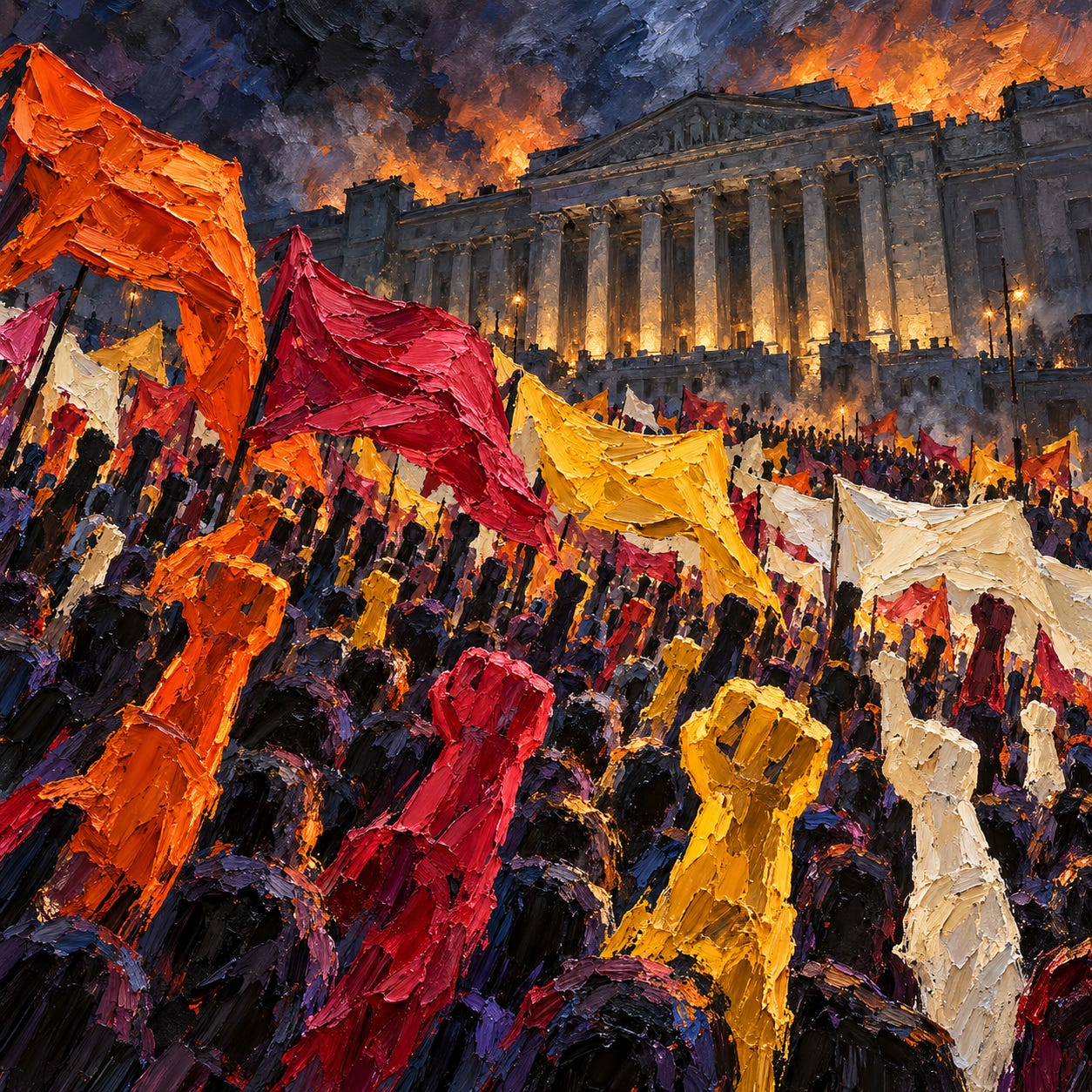
Patrick Pillow, who writes as Libertarian Overwatch on Substack and at the Libertarian Institute, has been documenting individual regime-change operations one at a time. His piece is a synthesis of that work: the recurring elements across a dozen colour revolutions from Belgrade in 2000 to Tunisia in 2011. He works in the register of Mark MacKinnon and Matthew Collin, close to the ground-level record of what happened, who did it, and how the pieces travelled between operations.

“Colour Revolutions Decoded,” which I published earlier this year, asked a different question of the same material: what strategic system these operations belong to and what it serves. Patrick’s essay asks what the operations were and how they were built. Both questions are worth asking, and readers who take on both pieces will finish with a picture neither offers alone. If you’ve read mine, his gives you the granular record I compressed. If you’re coming to the topic through his, mine gives you the strategic frame his register leaves for the reader to draw.

Support This Work
The essays are free and will stay free. What paid subscribers get is the library that surrounds them: the full digital book catalogue, audio deep dives, archived, and embedded in each essay, and the Questions for Your Doctor, Before You Consent, and Package Insert series. Platinum Supporters also receive the digital edition of every paperback on the day it’s published.
Whichever tier suits, thank you for being here. If you’d like to become a paid subscriber, upgrade a tier, or gift a subscription to someone who might value the work, the options are below.
Audio Deep Dive (for Paid Subscribers)
The Tenets of a Color Revolution
By Patrick Pillow at Libertarian Overwatch
On October 5, 2000, hundreds of thousands of protesters arrived in Belgrade demanding the removal of Yugoslav President Slobodan Milošević.
Among those protesting were members of Otpor, a Serbian youth movement whose black clenched fist would go on to become iconic in revolutionary movements. Seen on walls, T-shirts, posters, and through millions of stickers which carried a simple message: Gotov je—“He’s finished.”
Then came the bulldozer.
Ljubisav Đokić, perhaps known best as “Joe the Bulldozer,” drove a front-end loader into the headquarters of Radio Television Serbia. Protesters stormed the building while occupying it, as police resistance largely collapsed. A day later, Milošević had conceded defeat.
The scenes in the streets of Serbia were dramatic, but it was the unseen movements that provided even more intrigue.
According to a Washington Post investigation, the United States spent approximately $41 million supporting the Serbian opposition in the year leading up to Milošević’s removal. American assistance helped support independent media, polling, opposition parties, election monitoring, and Otpor itself. Notably, the U.S. even helped pay for 5,000 cans of spray paint and 2.5 million stickers to flood the Serbian streets with.
Serbia was just the start of a multi-year revolutionary process.
In 2003, protesters arrived with roses as Eduard Shevardnadze was removed from power in Georgia. The next year, the streets of Kyiv were filled with orange as hundreds of thousands met on the Maidan to protest the second round of elections. Kyrgyzstan’s 2005 Tulip Revolution followed suit, as the Belarusian opposition prepared for the 2006 election after years of planning with denim serving as their symbol.
After Serbia, the model was set. Activists traveled country to country, shared non-violence strategies, translated revolutionary books, all while watching Serbia’s documentary of a successful protest, Bringing Down a Dictator.
After 2000, the revolutions had started to span the globe.
I. The Grievance Comes First
While foreign involvement plays a large role across these movements, the protesters didn’t require outside help to be angry in the first place.
In Serbia, years of war, sanctions, and economic concerns caused a movement to arise. In Georgia, the country faced issues with corruption, conflicts emerged in the provinces of Abkhazia and South Ossetia causing displacement, and electricity blackouts hit during the winter. During Kyrgyzstan’s 2010 revolution—the second revolution in the span of five years—heating prices increased by 200%, leading to the violent conflict that would soon unfold out in the streets.
Similar concerns were raised during the 2010s. Years before Egyptians occupied Tahrir Square in 2011, the Kefaya opposition movement had protested against the Iraq War, while labor unrest and concerns over police abuses continued. Tunisia had its own issues that overlapped with the countries of the 2000s: unemployment, corruption, and regional inequalities all existed well before 26-year-old Mohamed Bouazizi set himself on fire in December 2010, helping spark the Arab Spring.
Former USAID official Krishna Kumar has described Serbia’s overthrow of Milošević as a “case study” and a transferable model. Still, in most cases, these revolutions were not simply invented in Washington, as the “color revolutions” also required the infrastructure in place to support the movements on the ground.
Serbia had both.
American support extended beyond the youth group Otpor. The U.S. aided and funded Serbia’s independent media, trained political parties, and supported civil society in a crucial way in the lead-up to the revolution. An example of this was seen through the International Republican Institute, which reportedly trained around 400 Serbian election monitors, who then trained an additional 15,000 in the country.
When the September 2000 presidential election arrived, that level of support became crucial.
After Milošević claimed that opposition candidate Vojislav Koštunica had not reached the 50% threshold needed to avoid a runoff, the opposition pointed to its own vote count to support its position.
The political crisis in Serbia had now moved from the voting booths and into the streets.
II. The Revolutionaries Learn From One Another
But long before the September election, Otpor had already received another kind of assistance.
During the campaign against Milošević, retired U.S. Army Colonel Robert Helvey taught members of the Serbian youth movement how to organize, while the works of Gene Sharp remained highly influential as he spent decades writing about non-violent resistance.
Sharp argued that governments depend on people and institutions to follow the rules provided for them. If these institutions stop cooperating—especially when that includes the military or security forces—the opposition can achieve its goals.
Otpor put these methods to the test and received worldwide recognition.
The youth group employed a variety of tactics to spread its message including the use of humor, theatrical performances, graffiti, and the ever-present methods of nonviolence. Instead of trying to simply overpower the Milošević government, they attacked it directly in novel ways with authorities unsure of how to respond.
After October 2000, the Serbians had something else: a successful revolution.
Georgia was paying attention.
Before the 2003 Rose Revolution, members of the Georgian youth movement Kmara met with veterans of Otpor and learned about the Serbian experience. Georgia’s influential Rustavi-2 television station repeatedly aired Bringing Down a Dictator, a documentary detailing Otpor’s campaign against Milošević.
The influence was not particularly subtle.
One Georgian activist later described the uprising as a “copy of that revolution—only louder.”
The model would soon spread even further. During Lebanon’s 2005 Cedar Revolution, activists used similar tactics from earlier movements including overnight encampments and handing flowers to soldiers.
Ukraine, however, was paying even closer attention.
As the Rose Revolution unfolded, future Ukrainian Pora activist Mykhailo Svystovych watched the events on CNN. In his words, the Georgian success “gave us faith.” If it could happen there, he concluded, “it would definitely be possible here.”
During the spring of 2004, Ukrainians attended a multi-day workshop in Novi Sad, Serbia. Former Otpor activist Siniša Šikman later recalled teaching them fundraising, teamwork, negotiation, media relations, door-to-door campaigning, and methods for motivating students. Journalists Mark MacKinnon and Matthew Collin reported that the seminars were funded by Britain’s Westminster Foundation for Democracy.
The Ukrainians soon created their own identity.
Otpor had its fist and the slogan “He’s Finished.” Pora—“It’s Time”—used a clock for its visuals with slogans noting that “the clock is ticking.” Split into two branches—Yellow Pora and Black Pora—the black branch described its objective as creating a “social lightning bolt” across the country.
The connection between the groups remained strong. Youth from Belarus, Serbia, and Georgia held training sessions while sharing their personal experiences with Ukrainian activists. Black Pora’s website noted how the youth groups in Serbia, Georgia, Ukraine, Belarus, and Albania were its “friends and/or spiritual partners.”
Before the election, Pora held a week-long camp in Crimea consisting of more than 300 regional leaders. Pora later noted how they had received around $130,000 from the German Marshall Fund, Freedom House, and the Canadian International Development Agency.
The following month, representatives from nearly all of Pora’s 80-plus regional branches attended a seminar hosted by the U.S.-funded National Democratic Institute.
When Pora filled the streets of Kyiv in November, it was not a spontaneous movement. This was a plan that was months in the making.
III. Building the Infrastructure
Foreign funding remains the most controversial element of the “Color Revolutions.” Regarding the role of some of these organizations, Allen Weinstein, who helped establish the National Endowment for Democracy, described in The Washington Post how “A lot of what we do today was done covertly 25 years ago by the CIA.”
The support that followed was generally far less secretive, reaching civil society groups, independent journalism, election-monitoring efforts, and NGOs.
Among the most important organizations involved during the “Color Revolutions” are the U.S. Agency for International Development (USAID), the National Endowment for Democracy (NED), Freedom House, George Soros’s Open Society foundations, and two organizations affiliated with NED—the National Democratic Institute and International Republican Institute.
From country to country and year to year, the influence of these organizations was seen in different ways, with Ukraine in 2004 providing a key example.
The Western-funded Znayu campaign maintained a range of roles: developing voter education, running hotlines, training activists, and distributing millions of leaflets. Freedom House helped fund the campaign, though one official from its Kyiv office later noted that Znayu was “really just a small part of our whole work” and that “the variety of projects we funded was huge.”
Freedom House seminars also brought in veterans of Otpor, while the Albert Einstein Institution helped distribute Gene Sharp’s From Dictatorship to Democracy. Pora activist Oleh Kiriyenko later described Sharp’s book as “the bible of Pora.”
Exit polling and independent vote counts also became common during the revolutions. Before Georgia’s 2003 election, the election-monitoring group ISFED sent thousands of observers across the country to conduct their own vote count. Their results showed the opposition National Movement ahead, conflicting with the early results released by the government, with the findings then broadcast on the opposition-friendly Rustavi-2.
Similar methods would soon appear in Ukraine where independent exit polling received significant foreign support. With American, Canadian, British, Dutch, Norwegian, Swedish, Danish, and other international sources providing support for polling, the results were heavily monitored. As the exit polls contrasted with the official runoff results, hundreds of thousands of leaflets carrying the polling figures were passed around on the Maidan.
USAID itself would later highlight its role in these movements. In its September 2005 Democracy Rising pamphlet, the agency discussed the Rose, Orange, Cedar, and Tulip Revolutions while stating that “the colorful revolutions were created by citizens from Ukraine to Lebanon, with U.S. and other support.”
None of this shows that foreign sources controlled the events on the ground, but it does show how much infrastructure had been built around these movements before protesters entered the streets.
One of the most important parts of that infrastructure was independent media.
IV. Winning the Information War
With state-run media having a large market share in many of these countries, support for independent media became essential.
Serbia had support for both independent radio and television. Georgia had the widely popular opposition channel Rustavi-2. Ukraine had Channel 5, the online newspaper Ukrainska Pravda, and the website Maidan.org.ua.
By 2004, Maidan.org.ua started to become seen as a “virtual meeting place” for opposition movements. The website received millions of visits, reported on election discrepancies, and even published telephone numbers to reach authorities when activists were detained.
Channel 5 was known for its openly favorable coverage of Yushchenko, and as the Maidan crowds swelled, the station moved to 24-hour “marathon” coverage of the demonstrations while attracting journalists from other networks.
One of the first visible signs of cracks in the regime was seen through the media. During a broadcast on state television, sign-language interpreter Natalia Dmytruk told deaf viewers that the official election results “are all lies.”
Other journalists soon refused to follow the government topic lists provided to the stations known as temnyky, and the rest is history.
Kyrgyzstan had its own example. With support from the U.S. government, Freedom House established a printing press that produced as many as 28 independent newspapers. When electricity to the facility was cut during the 2005 election campaign, the U.S. brought in two generators allowing the printing to continue. The next issue of the opposition newspaper MSN carried a simple headline: “Your Time Has Run Out—Step Down.”
Modern advances in technology also changed the methods used by revolutionaries as the movements continued.
In the Philippines in 2001, text messaging played a major factor during the demonstrations that removed President Joseph Estrada. By 2009, the Moldova uprising became known by some as the “Twitter Revolution.” Tunisia and Egypt similarly benefited from the use of social media, with Facebook serving an important purpose.
A similar role was played by BahrainOnline, a popular opposition forum that became a gathering place for activists before Bahrain’s 2011 Pearl Revolution. As demonstrations spread in February, one user noticed only 126 people were viewing the forum and took it as a good sign: “most people are outside demonstrating.”
As methods started to evolve, governments responded accordingly. Hosni Mubarak’s government shut down most of Egypt’s internet during the 2011 uprising in an attempt to limit gatherings.
The plan backfired, with activist Samar El Hussieny calling it a “fatal mistake.” With the internet down, the only way to get information on what was happening in the country was to go outside.
The trend continued during Ukraine’s Euromaidan nearly a decade after the Orange Revolution. On November 21, 2013, journalist Mustafa Nayyem called on his Facebook followers to meet at Independence Square. The Euromaidan Facebook page that followed became another organizing tool, providing protesters with everything from meeting locations to maps showing where they could find free tea and warm spaces.
But getting the message out was only part of the challenge. Protest movements also had to give people a reason to stay involved.
V. Making Revolution Cool
Getting people into the streets was one thing. Keeping them engaged was another.
A key reason for Otpor’s success was the low stakes and entertaining methods used to encourage engagement.
In one of its more notable moments, activists from the group put a picture of Milošević on an oil barrel with a baseball bat left beside it, with customers from a nearby shopping district taking the opportunity to vent their frustrations.
When police arrived, the only thing they could do was drag the barrel away.
As Otpor’s Srđa Popović described it, this was the event that made the group a household name.
The humor first employed in Serbia continued for many years to come.
During Ukraine’s 2004 campaign, opposition leader Viktor Yushchenko was poisoned by dioxin during the campaign season. Shortly thereafter, the other candidate, Viktor Yanukovych, collapsed dramatically after being struck by some at-the-time unidentified object.
Yanukovych supporters claimed he had been hit by a stone or video-camera battery, with his campaign describing the incident as a “terrorist act.”
Then video of the incident eventually emerged and showed that the candidate had instead been hit by a simple egg thrown by a seventeen-year-old student.
It didn’t take long for activists to seize on the event.
Pora developed a theatrical street performance known as “The Egg-Traveler,” featuring the recently cracked egg’s supposed relatives, before handing out boiled eggs to the crowd.
Other activists took it upon themselves to develop a cartoon series and a satirical video game where players launched eggs at a spider with Yanukovych’s head.
Symbols meanwhile helped give the revolutions a recognizable image.
Of the “flower revolutions,” there was the Rose in Georgia, Tulip in Kyrgyzstan, Lotus in Egypt, and Jasmine in Tunisia. There were also the revolutions associated with a certain color including Yellow for the Philippines, Orange for Ukraine, Purple in Iraq, Pink in Kyrgyzstan, Blue in Kuwait, and Green in Iran. Lebanon added the Cedar Revolution, though inside the country the movement was also known as the “Independence Intifada.”
The branding worked. In Ukraine, orange was so prominent that markets started to sell the color at an upcharge. For Iran, opposition members of the national soccer team even wore green wristbands during a 2009 World Cup qualifier match.
The festival-like atmosphere of the protests also helped increase interest in the movements. The Maidan was compared by one newspaper to Woodstock. Ukrainian bands performed all night long, celebrities appeared on the Maidan stage, while the radio station Gala FM even opened its own press center in the tent city. At one point, demonstrators chanted “Yush-chen-ko!” along to the beat of songs by Kylie Minogue and The Prodigy.
Nearly a decade later, many of the same scenes returned during Euromaidan. Protesters once again occupied Independence Square as music played from a large stage, food was handed out, volunteers provided medical care, and supplies poured into the growing encampment.
Politics had become a culture.
VI. Governments Learn Too
The governments were watching as well.
Belarus took notes as Milošević fell in Serbia, Shevardnadze was overthrown in Georgia, and Akayev departed in Kyrgyzstan. Ahead of its 2006 presidential election, the government restricted NGOs, arrested activists, and prevented the establishment of a tent city like the one seen in Ukraine two years prior.
Kyrgyzstan had an entirely different approach. As the opposition formed a youth movement called KelKel before the 2005 Tulip Revolution, pro-government forces created their own organization with the exact same name to confuse the message.
Russia took a more preemptive approach. After witnessing revolutions spread through neighboring countries, the Kremlin supported the youth movement Nashi as a counterweight to any Russian version of Pora.
By the 2007 election, Nashi was preparing thousands of activists across locations where protests and tent encampments were expected. Even the opposition recognized the problem, with Oborona noting that the government understood Gene Sharp’s theories and that their task was “more difficult than that faced by democrats in Serbia, Georgia, and Ukraine.”
With government preparation, it became evident that using the Otpor model did not necessarily guarantee success. Belarus had Zubr, its own Otpor-inspired youth movement that was formed all the way back in 2001, yet Alexander Lukashenko remained in power as the state response crushed attempts at revolution.
Azerbaijan provided another example. Youth activists borrowed Ukraine’s orange branding, translated Gene Sharp’s From Dictatorship to Democracy, and trained with members of Otpor, Kmara, and Pora.
This time however, the government was ready.
When protesters attempted to establish a sit-in following the 2005 election, authorities moved quickly to disperse the crowd, fearful of a repeat of Ukraine’s Orange Revolution. Activists later argued in the documentary How to Plan a Revolution? that they also lacked the level of outside support seen in places such as Serbia and Ukraine.
Burma followed two years later with 2007’s Saffron Revolution, where monks and thousands of civilians took to the streets. Sharp’s work had been translated into Burmese, while monk organizer Ashin Kovida later pointed to Bringing Down a Dictator and Otpor as influences. The protests were ultimately suppressed.
Then came Iran where the Green Movement brought massive crowds to the streets in 2009, but the Iranian government had spent years warning about the possibility of its own “color revolution.”
Those concerns had even made their way onto Iranian television. In 2008, a cartoon produced by Iranian intelligence was aired on Khozestan TV, depicting Gene Sharp, George Soros, John McCain, and others sitting around a table supposedly discussing plans to destabilize Iran.
Before the election, Revolutionary Guards spokesman Reza Saraj pointed directly to the earlier movements. “In all those countries where they have had ‘color’ revolutions, they didn’t have a Revolutionary Guards Corps,” he stated. “We do.”
Gene Sharp’s work had made its way to Iran as well. Farsi downloads of From Dictatorship to Democracy increased from just 79 in May 2009 to 3,487 in June as the protests spread. Former Revolutionary Guard member turned opposition activist Mohsen Sazegara also promoted Sharp’s ideas through daily videos while providing Farsi translations of his work online.
The Iranian government was paying attention. During the trial of around 100 opposition figures, prosecutors claimed that more than 100 of Sharp’s 198 methods of nonviolent action had appeared during the unrest. The indictment even pointed back to Serbia, Georgia, Ukraine, and Kyrgyzstan.
Iranian authorities had even requested and received copies of Sharp’s work years earlier. By 2009, they had also closely studied previous “velvet revolutions.”
Still, months of protests were not enough.
It may have taken years to see it, but it became evident: the playbook had limits.
VII. The Geopolitics Behind the Revolution
Behind these revolutions remained another factor: geopolitics.
With the Baku-Tbilisi-Ceyhan (BTC) pipeline running through Georgia—which carried Caspian oil and bypassed Russia—pipeline politics remained a point of contention throughout the early 2000s.
Ukraine’s geographic location between Russia and Europe led to increased discussions over NATO integration, relations with the European Union, and energy projects like the Odessa-Brody pipeline.
Those tensions remained nearly a decade later when protesters returned to the Maidan in 2013. Assistant Secretary of State Victoria Nuland and U.S. Ambassador Geoffrey Pyatt visited Independence Square while handing out food to protesters and security forces. Months later, a leaked conversation between the two revealed them privately discussing Ukraine’s opposition leaders, with Nuland famously remarking that “Yats is the guy.”
In Kyrgyzstan, air bases created new tensions as the U.S. maintained the Manas airbase while Russia had the Kant base. Monetary promises were made as arguments continued over who should remain in the region.
The situation became more complicated in Egypt as former Secretary of State Hillary Clinton maintained friendly relations with Hosni Mubarak, even going so far as to consider him “a friend of my family.”
The possibility of unrest in Egypt had also caught Washington’s attention. In August 2010, Obama issued Presidential Study Directive 11 (PSD-11), leading to a classified review of potential unrest across the Arab world. Advisers reportedly studied previous uprisings to determine why some succeeded and others failed, with Egypt identified as a major flashpoint.
The directive itself has never been publicly released.
Once the uprising actually began, the White House attempted to reach out to the opposition and even developed a “matrix” of over 100 officials and leaders to contact about the situation in the country.
Region to region, the geopolitics differ, but U.S. involvement rarely occurs without some objective in mind.
Still, foreign governments can provide money, training, political support, or diplomatic pressure, but once protesters enter the streets another institution becomes considerably more important.
VIII. Who Holds the Power?
While there is no denying the role NGOs, financial support, youth movements, election observers, and independent media play in the success or failure of these revolutions, something even more basic also plays a factor: will the state still continue to support the person at the top when challenged?
In Serbia, when workers at the Kolubara coal complex began to protest at the end of September, police didn’t stop them and one activist declared “the battle for Serbia was won here.” When hundreds of thousands arrived in Belgrade days later on October 5, the standard set in Kolubara continued at a mass scale and Milošević was defeated.
Ukraine came very close to a violent suppression. On November 28, more than 10,000 Interior Ministry troops were reportedly prepared to use live ammunition, but the military and SBU refused to act. Later accounts described SBU chief Ihor Smeshko as a key player in preventing the confrontation, with advancing Interior Ministry forces eventually ordered back.
Tunisia’s military was unable to save President Zine El Abidine Ben Ali’s presidency in 2011. In Egypt, the military recognized the “legitimate” demands of the protesters and noted they would not use force against the people of Cairo.
Sometimes it becomes as simple as this: does the person at the top still control the people with the guns?
IX. What Comes After?
Changing the government was one thing. What came next was another.
Georgia initially looked like one of the success stories. Under Saakashvili, state revenues increased, pensions were paid, tax reforms were launched, and the government reasserted control over Adjara.
In less than five years however, protesters were once again gathering outside Parliament. Police violently dispersed the crowds, hunger strikers were beaten, journalists were told to stop filming, and the opposition station Imedi TV was raided before a state of emergency was declared.
While the state of emergency was lifted after just over a week, the damage was already done.
By 2008, Georgia was at war with Russia, leaving hundreds dead and thousands displaced. The crisis led to one of the lasting images of Saakashvili: the president caught by the BBC chewing on his tie as events unraveled around him.
Then, just weeks before the 2012 parliamentary election, videos emerged showing prison officers beating and sexually abusing inmates. Saakashvili’s party was decisively defeated weeks later, falling from 119 seats in parliament to just 65 as the opposition Georgian Dream coalition won 85.
Saakashvili eventually left the country and served as governor of Odesa in Ukraine. He returned to Georgia in 2021 where he was arrested and remains imprisoned.
Ukraine unraveled even faster as the Orange coalition started to split almost immediately. In September 2005, Yushchenko fired his entire cabinet, as accusations of corruption ran rampant. It was in this environment that Viktor Yanukovych returned to the government as prime minister.
By 2010, Yushchenko was receiving just over 5% of the vote in the first round of the presidential election. Tymoshenko advanced to the second round instead, only to lose to Yanukovych. Five years after protesters filled Independence Square to prevent him from taking office, Yanukovych had finally become president.
In one of his final acts as president, Yushchenko also awarded Stepan Bandera, the controversial nationalist leader whose Organization of Ukrainian Nationalists collaborated with Nazi Germany, the title “Hero of Ukraine.” The award was later annulled by a Ukrainian court.
Kyrgyzstan would see similar outcomes. Bakiyev, who came to power following the Tulip Revolution, soon faced many of the same accusations that had followed Akayev. Opposition newspapers were confiscated, NGOs faced new restrictions, and corruption remained rampant. Roza Otunbayeva, one of the leading figures of the 2005 uprising, later summed up the result bluntly: “we witnessed only how one clan was changed for another one.”
The disappointment came quickly. By September 2006, just eighteen months after the Tulip Revolution, Antiwar.com columnist Justin Raimondo was already declaring that the revolution had “wilted” as increased political instability, attacks on independent media, and growing concerns over Bakiyev’s government continued.
Five years after Akayev fled the country, Bakiyev followed suit. Another uprising erupted in April 2010, this time leaving nearly 90 people dead as protesters stormed government buildings and Bakiyev eventually fled to Belarus. Kyrgyzstan adopted a new constitution that weakened the presidency and shifted power toward parliament, but the cycle was not over. Another political upheaval would follow in 2020.
Even those who had been most hopeful about the revolutions were left disappointed. Edil Baisalov, a prominent member of the opposition during the 2005 uprising who later joined the interim government following the second revolution in 2010, resigned only months later.
“Nothing has changed,” he argued. “It’s the same old corrupt schemes.”
The hope that these revolutions would change things for the better rarely matched what came afterward.
X. A Playbook
There was no single formula for a “color revolution,” but by the mid-2000s a playbook had been established.
Serbia was the model. Georgia followed Belgrade’s lead, while Ukrainians studied the methods used by both Serbia and Georgia. Gene Sharp supplied influential pieces of literature, former revolutionaries provided training, and foreign organizations helped provide funding and infrastructure. Independent media, election monitoring, branding, humor, and eventually social media all became recurring parts of the movements.
Former Otpor members eventually formed the Center for Applied NonViolent Actions and Strategies (CANVAS), continuing international seminars and trainings long after Milošević was gone.
Still, not every piece of the playbook appeared in every country, and having them never guaranteed success.
The grievances were not invented. Elections presented some serious concerns. Protesters had their own motivations, and movements that had similar forms of foreign assistance sometimes failed completely.
The Orange Revolution reflects the tug-of-war between domestic and foreign relations. Pora maintained direct contact with foreign organizations and Serbian activists, while its members also built a nationwide movement as branches expanded across Ukraine.
Foreign governments supported exit polling, but Ukrainians physically occupied the Maidan and remained overnight. Western organizations funded democracy programs, while Russia provided significant funding to support Yanukovych. Ultimately, it was Ukraine’s Supreme Court that overturned the disputed runoff results, which they described as filled with “systemic and massive violations.”
While the revolution may not be made in Washington, its influence is frequently seen. In Egypt, it was seen even in the deployment of tear gas which was emblazoned with the marking of “Made in the U.S.A.,” leading demonstrator Aly Eltayeb to declare “the way I see it the U.S. administration supports dictators.”
With grievances seen in India, the Philippines, Serbia, Albania, and Nepal just to name a few—the question becomes where will we see the playbook used next?
In Print
The Unbekoming library is available in paperback, printed to order through Lulu and shipped worldwide. The shelf begins with the paradigm question underneath everything else — No Virus, the isolation problem, the collapse of virology’s foundational claims, and a disease-by-disease reappraisal — and moves through the suppressed compounds mainstream medicine set aside: The DMSO Book, Chlorine Dioxide: The Forbidden Remedy, The Iodine Book, and The Hydrogen Peroxide Book. Two more recover what’s still on the kitchen shelf: Baking Soda and The Castor Oil Book. Two more recover the minerals modern soil, water, and processing quietly stripped from the diet: The Magnesium Handbook and The Boron Book. Sitting alongside these is No Contagion, co-authored with Jamie Andrews — the case against germ theory itself, catalogued through 258 failed contagion experiments.
The critique books cover what medicine, dentistry, psychiatry, and veterinary practice have become. The Unvaccinated treats the completely unvaccinated as a comparison group across twenty chapters and five appendices. Medicalized Motherhood follows a woman through 123 documented interventions from teenage pill to postpartum discharge. Drilling for Profit treats cavities, gum disease, and crooked teeth as the dietary problem they are. What Your Vet Can’t Tell You applies the same critique to pets. Escape from Psychiatry documents the fabrication of the DSM and the specific damage of every major psychiatric drug class. The Vitamin K Injection covers what happens in the first hours of a newborn’s life.
The full shelf is at lulu.com/spotlight/unbekoming. A physical book reaches the person a Substack post never will — the skeptical relative, the friend who won’t click a link but might open a book, the visitor whose eye lands on a coffee table. Buy one to keep, and one to give away.
Somehow I don't think this applies to Australia! We are still an effective penal colony, and rather than work towards a revolution like those in Europe, the inmates (voters) know their place and behave accordingly. Thus those in power can take the country for as many rides as they like.
Whilst occasional people here and there in Australia want to make real change, the vast majority are not interested. And worse, still, even when a large percentage of the people do not like what is happening, taking to the streets and throwing Molotov cocktails and the like are still...not the done thing...
The last time we had the MOST people ever rallying in Oz was a few years back, where about a million people marched on Canberra. The MSM said it was a few thousand of course and barely gave it any air time. But our grievance with covid and the mandates were still ignored. Why? Because we were too...gentle. We accept it when TPTB ignore us, like little children. We don't push back time and time again. We just say "ok then" and get on with things, even unhappily. And revolutions don't happen when the population is so compliant, or when they have 'nice' demonstrations.
But when demonstrations turn ugly, it doesn't lead to revolutions, either. It's just the government stomping on people, reminding them that they're big and we're small. Has Victoria had any big rallies since the state shot at their own people with rubber bullets? I don't think so.
See, I think Australia IS the type of country where the government DOES use brutal force against their citizens. Remember - we're still a penal colony! If the citizens can be safely ignored, like that million marching on Canberra, then no brutality is necessary. But do not be fooled into thinking that because we seem like a more chilled out society that our governments will not use force against us. They have. And they will again. Australia is almost as Commie as they come. We think we have Freedom, but when push comes to shove, the citizens chicken out. And they do this because they have been taught, for generations no less, that the governments control us - and not the other way around. For the most part, Australians have NO idea what Freedom even is.
Imagine what world awaits in the Project For A Good American Century...