

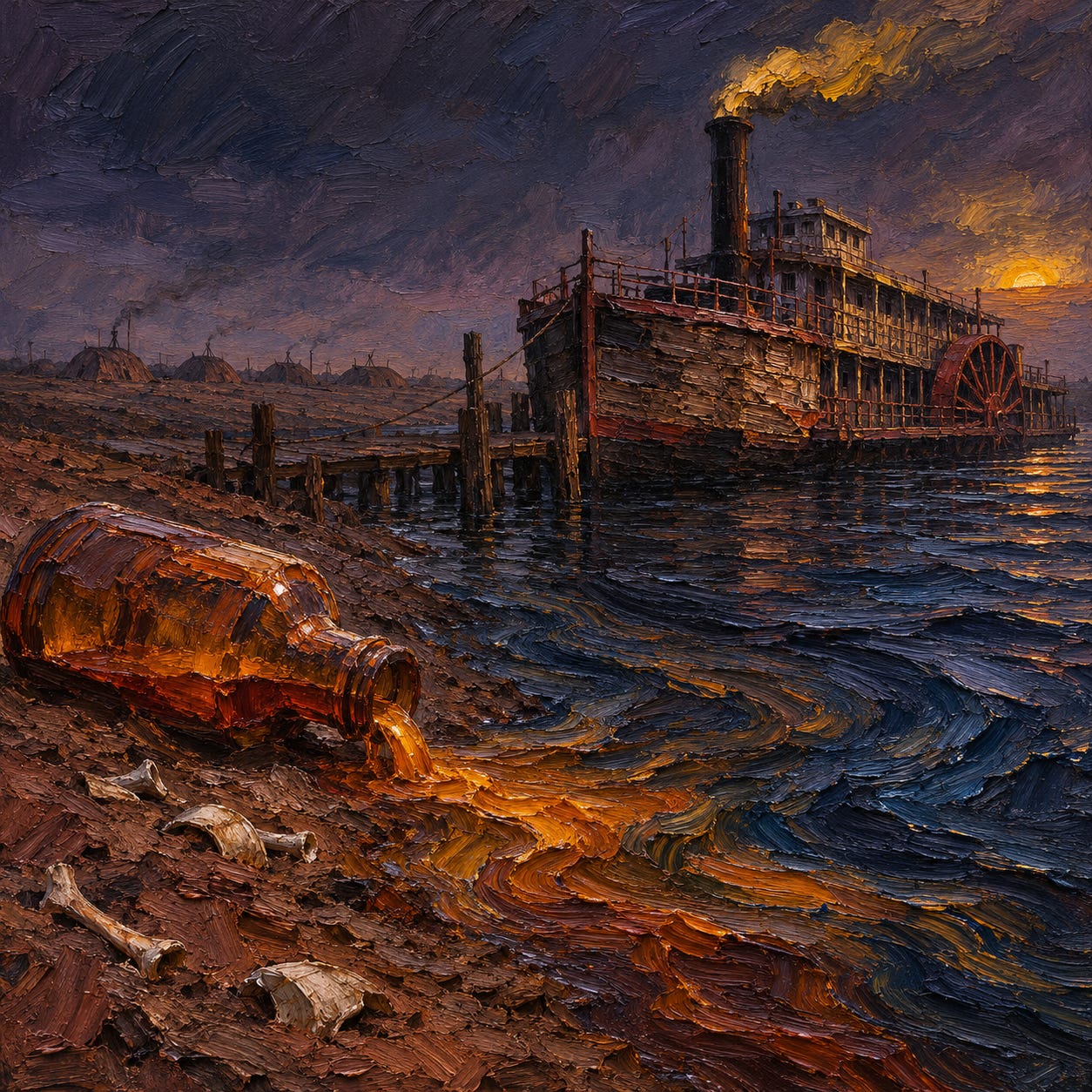
A brief note on what this essay is and what it is not. The book under examination is S.C. Gwynne’s Empire of the Summer Moon, a 2011 Pulitzer Prize finalist for General Nonfiction, widely regarded as the definitive popular history of the Comanches.¹ The essay examines a specific silence in it, and the structure that silence exemplifies. The author of a Pulitzer-finalist history working for years on nineteenth-century Native American demographic collapse is not an amateur. The primary sources discussed in this essay are available to any researcher who looks: the Indian Vaccination Act of 1832 at 4 Stat. 514, Chardon’s journal in print since 1932, J. Diane Pearson’s 2003 article in Wicazo Sa Review, Elizabeth Fenn’s Pox Americana (2001), Robert Boyd’s “Tribal Fever” in Smithsonian. A historian of Gwynne’s stature researching this period for years knows or ought to know. Silence of this specificity, from a scholar of this credential, is complicity with the official story this essay examines.
Where the essay quotes establishment sources, the historical record, or Gwynne’s own framing, it uses their vocabulary intact. Where the essay speaks in its own voice, it operates outside the pathogen-transmission framework that organizes most histories of nineteenth-century Native American population collapse. The reader will see two registers at work and should not confuse them.
The essay does not rest on Ward Churchill’s thesis that smallpox was deliberately distributed to the Mandan via infected blankets at Fort Clark in 1837. That thesis is contested, and the blanket-mediated transmission mechanism it assumes is itself part of the framework this essay examines rather than operates within. The paradigm lineage drawn on most directly is the critical vaccination history developed by Suzanne Humphries in Dissolving Illusions. The broader argument within which this essay operates is developed in the author’s earlier “What Really Killed the Native Americans?”,² which examines how germ theory narratives displace attention from the documented material causes of indigenous population collapse. The present essay examines one specific case inside that broader pattern.
Gwynne names the Mandan once:
In 1839 smallpox had swept through them again, this time brought by Kiowas from the Mandan Indians on the Missouri River. Thousands had died.³
The sentence is accurate. The Kiowas did travel to the upper Missouri in those years. Accuracy is not what is in question here.
The sentence is also the only time the Mandan appear in the body of the book. Six hundred pages of Comanche history, and the people named as the source of the 1839 catastrophe get one sentence, half a dependent clause, and no further mention. The reader is told where the sickness came from and is asked to let the matter rest there.
What the sentence does not say is what happened at the place it names. On the upper Missouri, in the summer of 1837, something killed between eighty and ninety percent of the Mandan nation. The federal Indian subagent Joshua Pilcher wrote to William Clark in February 1838 reporting the Mandan reduced from approximately 1,600 people to 31 survivors, though later scholarship places actual survivors closer to 100 to 150.⁴ Either way, the Mandan ceased to exist as an independent people. Francis Chardon’s journal at Fort Clark records the collapse in daily detail.
What the sentence also does not say is that by the summer of 1837, the United States federal-commercial apparatus had been physically acting on Indian bodies through two chemical tools for decades: a vaccination program authorized by the Indian Vaccination Act of May 5, 1832,⁵ which scraped materials of acknowledged uncertain origin into the arms of tribes the program selected, and an alcohol trade operated primarily by the American Fur Company and its competitors, which delivered chemically adulterated spirits to tribes along the fur routes. The 1832 Act was the newer of the two tools. The alcohol trade had been operating in Mandan villages for fifty years.
The Indian Vaccination Act is not in Gwynne’s book. The St. Peter steamboat is not in Gwynne’s book. Fort Clark in June 1837 is not in Gwynne’s book. The alcohol trade along the upper Missouri is not in Gwynne’s book. The word “vaccination” does not appear in the book’s six hundred pages. Neither does “inoculation.”⁶
What is in Gwynne’s book is a sentence that reports, in the vocabulary of pathogen transmission, a sickness carried by horsemen from the upper Missouri to the southern plains and the deaths of many Comanches. The sentence’s accuracy in reporting what Gwynne understood to have happened is not what is in question. What is in question is the architecture by which accurate sentences assemble into a book whose central claim about the destruction of the Plains Indians is that it was the work of “white man’s disease,”⁷ a phrase that reads as moral accusation while operating as germ-theory abstraction. In the book, the phrase names an invisible pathogen the white man carried, impersonal, airborne, not inside the field of responsibility. The phrase is also, in a sense the book does not acknowledge, literally descriptive. The white man was physically placing disease-producing substances into Indian bodies through deliberate acts with specific tools under specific federal statutes and specific commercial contracts. Gwynne’s book uses the phrase in the first sense. The essay examines what the phrase describes in the second.
Essay PDF Download (Free Subscribers)
Audio Deep Dive (Paid Subscribers Only)
Support This Work
The essays are free and will stay free. What paid subscribers get is the library that surrounds them: the full digital book catalogue, audio deep dives, archived, and embedded in each essay, and the Questions for Your Doctor, Before You Consent, and Package Insert series. Platinum Supporters also receive the digital edition of every paperback on the day it’s published.
Whichever tier suits, thank you for being here. If you’d like to become a paid subscriber, upgrade a tier, or gift a subscription to someone who might value the work, the options are below.
The Design
The vaccination of Indians as federal policy did not begin in 1832. It began with Jefferson, and Jefferson wrote about it.
Jefferson had been an advocate of smallpox inoculation since the 1760s, when he traveled to Philadelphia as a young man to be inoculated. After Edward Jenner’s cowpox technique reached America through Benjamin Waterhouse of Harvard, Jefferson received cowpox material from Waterhouse in July and August 1801 and used it over the following months to inoculate approximately two hundred members of his household at Monticello, including enslaved people and family members.⁸ During the winter of 1801 to 1802, Jefferson personally vaccinated a visiting delegation of Native American chieftains at the White House: the first recorded instance of federal vaccination applied to Native Americans.⁹ He understood vaccination not primarily as medicine but as an instrument of diplomatic and territorial policy. In his instructions to Meriwether Lewis dated June 20, 1803, drafted as the Corps of Discovery prepared to depart, Jefferson directed Lewis to “carry with you some matter of the kine-pox; inform those of them with whom you may be, of it’s efficacy as a preservative from the small-pox; & instruct & encourage them in the use of it.”¹⁰ The vaccine was framed as a gift. The gift was to establish good relations. Good relations were to prepare the ground for the acquisitions that followed the Louisiana Purchase. The kinepox Lewis carried spoiled during the journey and was never used.¹¹
The 1832 Act formalized what Jefferson had begun as a presidential improvisation. Enacted on May 5, 1832, by the 22nd Congress and signed by Andrew Jackson, the statute appropriated twelve thousand dollars to vaccinate Indian tribes and was administered by Secretary of War Lewis Cass, who had designed the bill. Its full title announced its purpose:
An Act to provide the means of extending the benefits of vaccination, as a preventive of the small-pox, to the Indian tribes, and thereby, as far as possible, to save them from the destructive ravages of that disease.¹²
The title described a humanitarian purpose. The Act’s apparatus made classifications about which Indian bodies to subject to the physical interventions the Act funded. The southeastern tribes under the Indian Removal Act of 1830 received the greatest attention, because the federal government needed the Cherokee, Choctaw, Chickasaw, Creek, and Seminole physically present at their relocation destinations for the political and economic logic of Removal to function. Tribes along the Missouri fur trade routes were approached only in the same seasons the American Fur Company was expanding its commerce along those routes. Several tribes further west were classified outside the program altogether. The Mandan, Hidatsa, and Arikara of the upper Missouri were among those placed outside, categorized by federal administrators as beyond the civilized domain and therefore beyond the Act’s scope.¹³ The Blackfeet were similarly placed. The Comanches, aloof from government and hostile to federal approaches, were almost entirely outside the program during its first decades.
The exclusion of the upper Missouri tribes from the Act had an additional commercial dimension that is paradigm-decisive. The Chouteau family, which controlled the fur trade on the Missouri through what had been the American Fur Company, actively blocked vaccination along the river because the operation interrupted hunting schedules.¹⁴ This commercial calculus only makes sense if vaccination made the hunters sick enough to be out of work for extended periods. Which the vaccination of the period did. The recorded physical response to the vaccination procedure of the 1830s was severe: fever, pustules, weakness, sometimes death. Joshua Pilcher himself, the federal Indian subagent, wrote to William Clark during the 1837 catastrophe observing that “death from any other cause, while under the influence of vaccination, would be attributed to that and no other cause.”¹⁵ Pilcher’s concern itself acknowledged that vaccination killed often enough that any proximate death would be blamed on it. Everyone in the commercial calculus understood this. The protective-vaccination narrative that overlays the historical record is contradicted by the behavior of the people who were there and who had direct economic interest in understanding what vaccination physically did. The Chouteau family did not block vaccination because they were indifferent to Indian welfare. They blocked vaccination because it would have stopped their trading partners from hunting for weeks.
By February 1833, nine months after the Act’s passage, more than seventeen thousand Indians had been subjected to the program. By 1841, the estimated total approached thirty-nine thousand.¹⁶ The materials used in those operations are the second element of the design that Gwynne’s book does not describe.
What was in the lancets that the federal contract physicians carried to Indian villages in the 1830s? The historical record on this point is not ambiguous. The materials were of variable composition, of uncertain origin, and transferred by methods that would not now be permitted in any veterinary context.
Vaccination in the 1830s meant arm-to-arm transfer.¹⁷ A vesicle on the arm of a previously vaccinated person was opened. The lymph that exuded from the vesicle was collected onto a lancet. The lancet was used to make small cuts in the arm of the next recipient, and the lymph was worked into the cuts. The recipient’s body, over the following days, developed its own vesicles, which were then used to vaccinate the next recipient. The chain of material ran, person to person, across weeks and months and continents. An alternate method dispensed with the living chain altogether: dried scabs from previously vaccinated recipients were placed in a jar, water was added, the jar was shaken, and the resulting pus was used as vaccine material for an entire town.¹⁸
What was in the material? The honest answer, provided by the medical establishment of the period itself, was that no one knew. A statement in The Lancet, quoted by M. Beddow Bayly in his 1952 work The Case Against Vaccination, put the position plainly: “no practitioner knows whether the lymph he employs is derived from smallpox, rabbit-pox, ass-pox, or mule-pox.”¹⁹ Edward Jenner himself had used horse grease rather than cowpox as his original starting material, a fact recorded in The Lancet in 1829.²⁰ Beddow Bayly summarized what vaccine lymph had been derived from across the preceding century and a half: a smallpox corpse, the ulcerated udder of a cow, or the running sores of a sick horse’s heels.²¹
This is the physical material the 1832 Act authorized federal agents to work into the arms of Indian men, women, and children across the 1830s wherever the program reached. It is the material whose recipients, over the following weeks and months, developed vesicles, fevers, and the full range of what was then called smallpox.
The Other Weapon
The 1832 Act was not the only federal-commercial tool deployed against Indian bodies in the first half of the nineteenth century. It was not even the oldest or the most widely used. The oldest, and the most consistently applied across three centuries of contact, was alcohol.
The pattern was established before the United States existed. In 1623, at Jamestown, English colonists under Captain William Tucker proposed peace with the Powhatan after the previous year’s violence. The two groups met. The colonists offered the Powhatan wine as a gesture of reconciliation. The wine had been deliberately poisoned. Approximately two hundred Powhatan died.²² This is the first documented American chemical warfare event against Indians, carried out by colonial authority as deliberate policy.
The use of alcohol as a trade weapon was explicit in the colonial correspondence of the people doing it. A 1769 British document stated the logic directly: “when the vent of liquors is allow’d amongst them, it spurs them on to an unwaried application in hunting in order to supply the trading places with furs and skins in exchange for liquors.”²³ Alcohol was openly discussed as a tool for creating physical and economic dependency, so that hunters would overwork themselves to buy more alcohol. This was not accidental trade. It was deliberate chemical weaponization documented in the correspondence of the authorities who deployed it.
After the United States was established, the federal government formalized the practice while maintaining public claims to the contrary. The historian Grant Foreman documented the operating rule: “while outlawing whisky in the Indian country when introduced by others, the government reserved to itself the use of it in negotiations with the Indians.”²⁴ The 1834 Trade and Intercourse Act banned alcohol trade with Indians by private parties. The federal government continued using alcohol as its own tool in treaty negotiations, incapacitating Indian negotiators before extracting land cessions. Soldiers on reservations received daily whiskey rations which they traded to Indians, using the military ration system as a vector for alcohol delivery even as civilian traders were punished for doing the same.
The alcohol itself was not what would be sold today under the same name. “Indian whiskey” was a specific product, formulated for the frontier Indian trade and known to be different from the whiskey sold in American cities. Standard adulterants included tobacco juice (nicotine-heavy), capsaicin from peppers (irritant), and in documented recipes substances including strychnine, creosote, fusel oil, and sulfuric acid.²⁵ Methanol contamination from poor distillation was routine. Methanol tastes similar to ethanol, breaks down in the body to formaldehyde and formic acid, and causes blindness, organ failure, and death within 24 to 72 hours of exposure. The symptoms of methanol poisoning (vomiting, weakness, skin discoloration, death without obvious external cause) overlap significantly with the symptoms attributed to various “diseases” of the era. The frontier whiskey trade delivered to Indian villages a product that was reliably poisoning its recipients, slowly through chronic exposure and acutely in cases of heavy adulteration.
Alcohol was the first and most sustained chemical tool deployed by the federal-commercial apparatus against Indian bodies. By the 1830s, when the 1832 Act added vaccination to the toolkit, alcohol had been operating for two centuries. Where the Act was selective in its application, reaching some tribes and withheld from others for ideological and commercial reasons, the alcohol trade was universal. Where vaccination required federal contract physicians and the apparatus of appropriation and delegation, alcohol required only a barrel and a trader. Where vaccination produced a predictable short-term physical response, alcohol produced a range of responses from acute intoxication through chronic organ damage through death from adulterants. The two tools operated on different schedules through different mechanisms but with a common structure: physical substances introduced into Indian bodies by federal or commercial actors, producing physical collapse that was then labeled with the vocabulary of disease.
The fur companies that controlled the Missouri trade, including Chouteau’s American Fur Company, were the primary delivery mechanism for alcohol to the upper Missouri tribes. The same companies that blocked vaccination along their trade routes were simultaneously operating the alcohol trade along those routes. The commercial calculus was coherent in both directions: vaccination temporarily incapacitated hunters and reduced fur returns; alcohol made hunters economically dependent on the trade and increased fur returns. One tool was refused, the other was aggressively deployed. The federal-commercial apparatus made selections about which chemical tools to apply to which populations based on which tool served federal and commercial interests in each case. Indian welfare was not a factor in either decision.
By the time the St. Peter left St. Louis in the spring of 1837 bound for the upper Missouri, it was carrying the standard alcohol freight that every annual American Fur Company steamboat carried. The Yellow Stone, the first steamboat up the Missouri in 1832, had carried 1,500 gallons of liquor as part of its standard cargo.²⁶ The St. Peter was doing the same annual run with the same type of freight. The alcohol was not an incidental trade item. It was a central product of the fur trade economy, and had been delivered to Mandan villages for decades.
The Demonstration
The Mandan in the summer of 1837 were a settled agricultural people, not nomadic horsemen. They lived in earth-lodge villages on the banks of the Missouri in what is now North Dakota, raised corn and beans and squash, traded with every passing party, and held a position of commercial importance on the upper river that the fur trade had amplified across the preceding two decades. Lewis and Clark had wintered with them in 1804. Prince Maximilian and Karl Bodmer had visited in 1833. George Catlin had painted them in 1832. Their population at the beginning of the decade is variously estimated between 1,500 and 2,000.²⁷
By late autumn 1837, between eighty and ninety percent of them were dead. The remnant was absorbed into the neighboring Hidatsa.
The St. Peter, chartered by Pratte, Chouteau and Company (the western branch of the former American Fur Company) and commanded by Captain Bernard Pratte Jr., left St. Louis in the spring of 1837 bound upriver with trade goods, alcohol, and passengers. The passenger list bears examination. Among them were Jacob Halsey, an American Fur Company clerk being sent to take command of Fort Union, described in the Oregon Historical Quarterly’s account of his career as a man who, “while he was a hard drinker, he was a valuable man”; Halsey’s pregnant Indian wife; Mr. Papin, another trader; several discharged fur company employees returning to St. Louis after seasons in the wilderness; multiple deckhands including a Black crewman who first showed symptoms at Fort Leavenworth around April 29; three Arikara women returning to the upper Missouri after unknown time in St. Louis; Francis Chardon’s two-year-old son Andrew Jackson Chardon, being brought upriver to join his father; and the Indian subagent Joshua Pilcher, who would disembark at Fort Kiowa before Fort Clark.²⁸ Several of the deckhands died during the voyage. By the time the boat reached Fort Clark, visible sickness was established among the passengers and crew. Pratte had been notified. He continued the commercial route.
The St. Peter arrived at Fort Clark on June 19, 1837. Chardon’s journal entry for that day reads: “arrived at the Mandans at 3 P. M., unloaded the Merchandises for the Fort - all hands a Frolicking.”²⁹ The Frolicking was a party. Alcohol from the boat was consumed. Members of the St. Peter crew and passengers mingled with the Mandan at the village through the afternoon and evening. The three Arikara women disembarked and joined their people nearby. Twenty-five days later, the first Mandan died.
What the passengers were suffering from is the question the orthodox narrative does not examine. Under germ theory, they had “smallpox,” a pathogen that moved from body to body. Under terrain paradigm, the question is what physical insult each compromised body was responding to. Halsey is the documented case: a chronic heavy drinker, by the OHQ characterization cited above, who had been previously vaccinated earlier in his life and thought himself protected. His body carried the accumulated terrain destruction of decades of heavy drinking combined with whatever residues remained from his earlier vaccination. On the crowded steamboat, in close quarters with other similarly compromised bodies, drinking throughout the voyage, Halsey’s body produced sores. The deckhands who died were probably in similar terrain: fur trade workers with chronic alcohol histories, poor nutrition, and the compromised cleansing capacity that chronic alcohol produces. The sickness on the St. Peter was not pathogen transmission from a single source. It was the predictable collapse of compromised terrains under the added acute insults of steamboat conditions and continued alcohol consumption. The passenger manifest reads, under the paradigm, as a portable catalog of terrain destruction.
At Fort Union, two hundred miles upriver from Fort Clark, Halsey’s body became the source material for Charles Larpenteur’s attempted intervention. Larpenteur, a clerk at Fort Union, scraped pus from Halsey’s open sores and used it to vaccinate approximately thirty Indian women at the fort. Within fifteen days, by the Fort Union record, the fort “stank of death at 300 yards.”³⁰ The women vaccinated with Halsey’s pus died. Halsey’s pregnant wife gave birth to a daughter and died shortly afterward. Halsey himself survived, the stronger terrain of the man with the resources for medical care and the physical reserves of years of adequate food.
What happened in the villages between June and November is documented in considerable detail, principally in the journal of Francis Chardon, the American Fur Company trader at Fort Clark, which sat on the river bank directly adjacent to the Mandan village of Mitutanka.³¹ The journal was never meant for publication. It was found in the War Department archives in 1921 by the historian Annie Heloise Abel, who edited it for publication.³² Its tone is the tone of commercial accounting. Chardon’s entry for July 14, 1837, the day the first Mandan died, reads:
One of the warmest days that we have had this summer, Weather smoky - A young Mandan died to day of the Small Pox - several others has caught it, the Indians all being out making dried meat, has saved several of them.³³
The same entry ends with the month’s rat count: 61 killed in July, 1,778 total.³³ A Mandan child was dead of the catastrophe that would end the tribe. The next line of Chardon’s journal recorded the rats.
By August 11, Chardon had stopped counting: “I Keep no a/c of the dead, as they die so fast it is impossible.”³⁴ By the end of that month: “the Mandan are all cut off except twenty-three young and old men.”³⁵ By the end of September, his own estimate was that smallpox had taken “seven eighths of the Mandans and one half of the Rees [Arikara] Nations.”³⁶ Chardon himself fell ill. His young son, Andrew Jackson Chardon, whom he had collected from the St. Peter thirty miles downstream and brought back to the fort, died during the catastrophe.³⁷
The Mandan knew where to place the blame. On July 28, a young Mandan man came into the fort with his gun cocked under his robe, hunting Chardon from room to room. The attempt failed. Chardon records it between the rats and the dead.³⁸
On July 30, 1837, Chardon recorded in his journal the dying speech of Four Bears, the second chief of the Mandan.³⁹ Four Bears (Mato-Tope) had been named head chief in 1836, just before the catastrophe. He was a renowned warrior, famous for killing a Cheyenne chief in hand-to-hand combat, painted by George Catlin in 1832 and Karl Bodmer in 1834, friend of whites throughout his life, teacher of the Mandan and Arikara languages to Prince Maximilian. His wife Brown Woman and his children had already died in the catastrophe. His own face was covered in sores. Chardon recorded Four Bears’ words, translated from Mandan:
I do not fear Death my friends. You Know it, but to die with my face rotten, that even the Wolves will shrink with horror at seeing me, and say to themselves, that is the 4 Bears the Friend of the Whites.... I have never Called a White Man a Dog, but today, I do pronounce them to be a set of Black harted Dogs, they have deceived Me, them that I always considered as Brothers, have turned out to be my worst enemies.³⁹
Four Bears died that day. The scholarly debate about whether Chardon recorded the words exactly as Four Bears spoke them is secondary to the historical fact that the dying chief of the Mandan, friend of whites for a lifetime, understood what was happening to his people as something whites had deliberately done to them. That understanding is in the record as the Mandan read what was killing them in real time.
The orthodox reading of what followed goes like this: the sick passenger carried smallpox virus; the virus was transmitted to the Mandan via droplet or contact; the virus replicated in Mandan bodies; the Mandan died.
Nothing in the documentary record supports this reading over any other. What the documentary record supports is that the St. Peter arrived with alcohol and sick passengers, that the Frolicking on June 19 brought the Mandan and the compromised arrivals into alcohol-involved physical contact, that sickness appeared in the villages some weeks later, and that within a season the people were dead. The replicating-virus mechanism is read into the record. It is not in the record.
What is in the record, and what Gwynne does not mention, is that by June 1837 the federal-commercial apparatus had been operating in the upper Missouri for decades through multiple chemical tools. Alcohol had reached the Mandan villages for fifty years through fur trade shipments. Vaccination under the 1832 Act had explicitly not reached them. The Chouteau family had blocked vaccination along the river because it would have delayed hunting, the paradigm-decisive point established above, while simultaneously operating the alcohol trade along the same routes. Federal Indian agents on the upper Missouri, including William Fulkerson at Fort Clark, corresponded with William Clark, the Indian superintendent in St. Louis, about arrangements for vaccination activity along the river. The arrangements were not completed. When the catastrophe of 1837 began, Fulkerson wrote again. Clark forwarded the letter to the War Department.
The vaccination activity that did reach the upper Missouri during the catastrophe itself was not the Jennerian cowpox of the official program and was not directed at the Mandan. At Fort Union, two hundred miles upriver from Fort Clark, traders opened cuts in the arms of approximately thirty Indian women and worked into those cuts scabs taken directly from a smallpox victim.⁴⁰ The women were then returned to their community. At Fort Clark, the Indian subagent D.D. Mitchell vaccinated two Assiniboin war parties that had come into the post.⁴¹ Joshua Pilcher, after disembarking the St. Peter, later recorded his own vaccinations. The vaccination apparatus continued operating around the Mandan throughout the catastrophe, administering raw scab material to the tribes within its reach. The Mandan were not within its reach then, as they had not been within its reach for the five preceding years.
The documented challenge to the pathogen model does not come from paradigm theorists alone. Dr. Charles Campbell, who ran a smallpox pest house in San Antonio in the early twentieth century, conducted repeated experiments attempting to transmit the sickness through direct contact. He exposed himself repeatedly to patients covered in sores. For thirty minutes at a stretch, he inhaled dust beaten from rugs in rooms recently vacated by smallpox patients. Afterward he mingled freely with family, patients, and friends without any precautions. Neither he nor anyone he subsequently contacted developed smallpox. He repeated the experiments with others, and the transmission failed each time. What Campbell did find, in every household where smallpox occurred, was bedbugs. He linked the severity of the sickness to scorbutic cachexia, the nutritional collapse Campbell associated with winter diets lacking fresh fruit, and observed that a failure of the fruit crop in any large area was always followed the succeeding winter by the sickness.⁴²
The body does not die of pathogens. The body dies of sustained insult it can no longer respond to. In the case of the Mandan in 1837, the insults were plural, compounded, and centrally chemical.
The oldest insult was alcohol. Direct European trade contact with the Mandan began in December 1738, when a French-Canadian expedition under La Vérendrye reached the Missouri villages. After 1763, trade intensified. By the 1780s, the Mandan had been subjected to forty-three years of European trade contact, with alcohol a central product of that trade from its earliest years. In 1780 to 1781 the Mandan experienced their first mass acute response, which reduced them from nine large villages to two.⁴³ Standard historical accounts label this a “smallpox epidemic” that arrived from Boston in 1775 and swept up the Great Plains. Under the terrain paradigm, the pattern is recognizable: four decades of trade-era terrain destruction (alcohol, dietary disruption, contaminated trade goods, psychological pressure) accumulated in the Mandan population until the body could no longer respond, and the collapse was labeled smallpox. Six years later, when the naturalist John James Audubon visited Fort Clark, Chardon told him that what had struck the Mandan was unlike what Europeans experienced under the same label. Audubon recorded Chardon’s statement in his own journal: “the small-pox had never been known in the civilized world, as it had been among the poor Mandans and other Indians.” The symptoms were more severe because the terrain was more compromised, not because the pathogen was different.
The 1780s catastrophe was the first iteration of the pattern that killed the Mandan again in 1837. Between the two catastrophes lay fifty-six more years of fur trade operation, alcohol delivery, and accumulating terrain destruction. The mechanism by which chronic alcohol destroys the terrain is physiologically specific. Alcohol depletes glutathione, the body’s primary molecule for neutralizing free radicals and clearing toxins. Alcohol damages the liver, the body’s primary filtration organ. Alcohol depletes thiamine and other nutrients required for cellular metabolism. The body processing alcohol produces acetaldehyde, which is more toxic than alcohol itself and which the compromised liver cannot efficiently clear. Chronic alcohol exposure thus produces a terrain in which the cleansing capacity is progressively destroyed. A body in this state cannot respond to additional insults by expelling them. The insults accumulate. The terrain collapses.
By 1837 the Mandan terrain had absorbed a century of trade-era destruction, two generations of adulterated alcohol, the earlier mass collapse of the 1780s, and the 1830s acute conditions: continued fur trade exploitation, continued alcohol delivery, dietary dependence on commercial trade. The St. Peter arrived with fresh alcohol freight and compromised passengers whose own bodies carried the residues of medical treatments then standard (mercury compounds as calomel, antimony, arsenic preparations, opiates). The Frolicking on June 19 added acute alcohol consumption to the chronic exposure and put the Mandan bodies into direct physical contact with those residues: shared cups, shared food, shared air in enclosed earth lodges with passengers whose sweat and breath and bodily fluids carried the chemical load the passengers themselves had been metabolizing for weeks. The accumulation was both chronic (a century of alcohol, dietary collapse, displacement, prior mass collapse) and acute (the June 19 Frolicking, chemical contact with the passengers’ compromised bodies, the trade goods unloaded, continued alcohol consumption through the summer). The mechanism was chemical throughout. Nothing in this account requires an infectious agent to move from one body to another. The passengers did not transmit their sickness to the Mandan. The Mandan terrain, already unable to clear its chronic load, was given new acute material to absorb and could not expel it. What the villages produced in response was a mass acute response of the kind the terrain tradition from Antoine Béchamp through Herbert Shelton has described: the body attempting to expel what it could not metabolize, failing, and collapsing.⁴⁴
The label applied to this collapse was smallpox. The label is a category in a classification system. It is not an agent, and it does not act. What acted, in the villages above Fort Clark in the summer of 1837, was an accumulation of chemical insults extended by the federal-commercial apparatus into Mandan bodies through two parallel tools: the alcohol trade that had operated against them for decades and reached acute intensity at the June 19 Frolicking, and the vaccination apparatus that was operating around them without reaching them directly.
A note on Churchill. Ward Churchill has argued that the Mandan catastrophe was deliberately produced by US Army distribution of infected blankets from a St. Louis infirmary. This essay does not engage the thesis. The mechanism it alleges carries a specific logical problem Dawn Lester and David Parker have identified: the soldiers who distributed the blankets were, by standard account, immune to smallpox, meaning their bodies carried the antibodies that had neutralized the pathogen. If the pathogen had been neutralized, they had none to transmit. If they were still carrying it, they were not immune. The narrative requires the same soldiers to be simultaneously free of the sickness and transmitters of it, a contradiction germ theory resolves only by invoking the unfalsifiable category of the asymptomatic carrier.⁴⁵ Beyond that, Fort Clark was not a military post but a civilian trading post operated by the American Fur Company. The Army was not there. The question of military intent at a non-military location is separable from the documented question of what the federal-commercial apparatus was physically doing to Indian bodies across the same period through its established chemical tools. The documented record on the second question is sufficient without the first.
The Extension
Gwynne’s book ends with Quanah Parker on the reservation, having led the last free Comanches into surrender in 1875. The last hundred pages cover the reservation years: the collapse of the buffalo economy, the boarding school system, the Dawes Act land allotments, Quanah’s accommodations, and the final transformation of the Comanches from a free people into federal wards.
What they do not describe is what happened to Comanche bodies on the reservation under the Office of Indian Affairs medical program, or what continued to happen to them through the alcohol trade that followed them onto the reservation.
The reservation system, from the 1870s onward, was the full extension of both tools’ logic. Under the 1832 Act as originally passed, federal agents had subjected classified-in Indians to the Act’s materials in their own territories where possible. On the reservations, vaccination became compulsory. It was tied to ration distribution, to boarding school enrollment, and to any interaction with the agency office. An Indian who refused vaccination could be denied rations, could have children taken for boarding school, could be arrested.⁴⁶
The vaccine materials had not substantially changed. Arm-to-arm vaccination remained standard American practice until 1898, when it was legally outlawed because the risk of transferring material from one body to another through the procedure had become too obvious to ignore.⁴⁷ Across the 1870s and 1880s, Comanche men, women, and children on the Fort Sill reservation had opened into their arms the materials of the composition Beddow Bayly described.
The alcohol tool also followed the Comanches onto the reservation. The 1834 Trade and Intercourse Act’s ban on alcohol trade with Indians was poorly enforced on the frontier; it was poorly enforced in the reservation era too. Soldiers’ whiskey rations continued to find their way to Indian hands. Private traders continued to deliver adulterated alcohol to reservation populations. The population that could not refuse vaccination also could not refuse the chemical that had been delivered to their villages for a century.
Gwynne’s book mentions none of this. The index lists the Mandan on page 112⁴⁸ and carries no entry for vaccination, for the Indian Vaccination Act, for the Office of Indian Affairs medical program, for the alcohol trade as a federal-commercial system, or for the physicians under federal contract who operated at Fort Sill across the reservation years the book otherwise describes in detail.
The pattern that produced the Mandan catastrophe in 1837 produced its lesser but cumulative versions on the reservations from the 1870s onward. The same chemical tools, under extensions of the same statutory authority, applied to the same kinds of bodies, now under conditions of compulsion that the free Comanches of Gwynne’s earlier chapters would not have tolerated for a day.
Humphries documents the broader compulsion pattern of the period. Massachusetts enacted its compulsory vaccination law in 1855. Chicago made vaccination a condition of receiving relief supplies after the Great Fire of 1871. The English law of 1853 established the model for the compulsory regimes that spread across Europe in the following decades.⁴⁹ Read against the Comanche reservation years, the chronology shows what American histories conventionally obscure: the Indians entered the federal vaccination system two decades before the first US state imposed vaccination on its own citizens.
Quanah Parker died on February 23, 1911, at the Star House at Cache, Oklahoma.⁵⁰ By that time the compulsory vaccination regime built on the Indian population was in the process of being extended, state by state, to the rest of the American public. The Supreme Court decision in Jacobson v. Massachusetts in 1905 cemented the legal framework.⁵¹ The program that had been imposed on the Comanche at Fort Sill in the 1880s was by Quanah’s death the operating template for American vaccination policy generally.
Gwynne’s book does not mention Jacobson. It does not mention the Massachusetts law. It does not mention that the reservation experience of vaccination was a prototype for what became the universal American experience of vaccination. What it mentions, on the question of why the Comanches as a people were destroyed, is “white man’s disease,” framed as an invisible agent that moved through the plains in waves and killed people who had no defense against it.
The Named Chemicals
The Mandan is one case where “smallpox” was applied to terrain collapse under extended chemical stress. The question that follows is whether it sits inside a documented pattern of direct chemical action against Indigenous populations across the long nineteenth century. The record names chemicals, perpetrators, vectors, and deaths across four colonial settings. Gwynne’s book contains none of this material.
The clearest chemically specific case on the US record is the H.L. Hall deposition of 1860. Hall was a California rancher operating in Eden and Round Valleys in Mendocino County, managing livestock for Serranus Hastings (later the founder of Hastings College of the Law). In sworn testimony before the California state investigation of the Mendocino War, Hall described a reprisal attack in which his party came upon a group of Yuki butchering horse meat they had taken from Hastings’s herds, killed ten men and one woman in the attack, and then laced the remaining meat with strychnine to kill any survivors who returned. The deposition is in the Indian War Papers held at the California State Archives.⁵² A separate deposition by settler William T. Scott, dated March 2, 1860, records Hall’s own boasts: he had driven Yuki people from their settlements and put strychnine into their baskets of soup and other food. Sworn testimony. The chemical is named. The admission is on record.
The same practice appears in contemporary reporting across California and Oregon. The Shasta Republican alleged that Samuel Lockhart mixed strychnine with flour and placed it where starving Achumawi people in the Pit River region might find it, and attributed to Lockhart boasts about earlier poisonings.⁵³ Earlier accounts attribute poison purchases and preparation to Ben Wright before the 1852 Modoc massacre, with sources variously naming arsenic or strychnine.⁵⁴ A signed September 1848 statement by Cayuse mission worker John Young reports arsenic-laced wolf bait consumed by Indigenous passers-by, and separately describes mission worker W.H. Gray warning that poison had been placed in melons intended for Indigenous consumption.⁵⁵ None of these cases was judicially pursued. Each is in the record.
The same decades produced a parallel pattern in the Australian colonies. Medical officer John Watton investigated nine Aboriginal deaths at Tarrone Station in the Port Phillip District in October 1842 after a substance supplied as flour; he recorded symptoms compatible with arsenic poisoning and noted that a station overseer had recently obtained arsenic. Nine deaths were reported: three men, three women, three children. Bodies had been burned, limiting examination. Prosecution did not proceed. At Connell’s Ford in November 1840, Thomas Connell was reported for having distributed arsenic-laced damper to Aboriginal visitors; the Aboriginal Protectorate gathered further testimony.⁵⁶ At Plough Station near Ipswich in 1844, Dr. David Ballow tested the stomach contents of a man named Docto who died after consuming biscuits reportedly supplied by convict Charles Sellers, and obtained a positive result for arsenic. The Kilcoy incident of 1842 involved mass deaths from poisoned flour or damper, with historical accounts varying between arsenic and strychnine as the compound.⁵⁷
The 1847 Whanganui case has crossed from allegation into state acknowledgment. During fighting between Crown forces and Māori, arsenic-laced flour was found by people associated with a taua led by Tōpine te Mamaku in an evacuated settler house. Settlers were subsequently reported to have boasted of a deliberate poisoning plot, with allegations that justices of the peace approved. The Crown received reports that at least two Māori had been poisoned. No investigation was conducted. The Ngāti Hāua Claims Settlement Act 2026 formally records the Crown’s acknowledgment of these reports and the lasting grievance.⁵⁸ A state has acknowledged in statutory text that reports of arsenic poisoning against Indigenous people were received and not investigated.
Indigenous oral histories of the Blackfoot nations in Canada carry parallel testimony from a later period. Yvonne Boyer, citing Maureen Lux and Treaty Seven community sources, records Piikani and Kainai accounts of government rations causing severe illness and many deaths in the early 1880s. A yellow substance in flour was identified as sulphur. Bluestone (copper sulphate) and lye were named as additives to meat. Ghost Coulee and Belly Butte appear in the remembrance.⁵⁹ These are Indigenous historical accounts carrying their own evidentiary standing in the nations that preserved them, and they identify named chemicals delivered through named vectors.
The pattern the record names, across sworn depositions in California, medical investigations in the Port Phillip District, a Crown settlement act in Aotearoa New Zealand, and oral histories on the Canadian Plains, is this. Direct chemical poisoning of Indigenous populations, using named chemicals (strychnine, arsenic, copper sulphate, sulphur, lye), delivered through named vectors (horse meat, melons, flour, damper, biscuits, government rations), was a documented practice across the century and across the English-speaking colonial world. The chemicals were named. The vectors were named. The perpetrators were sometimes named and sometimes not prosecuted. This is not inference. This is the documentary record read as it stands. The 1623 Jamestown poisoning described earlier in this essay sits at the origin of the same pattern.
Under the terrain paradigm, this pattern bears on how nineteenth-century Indigenous mass deaths are to be read. The “smallpox” label was administratively applied across the same decades, by the same colonial authorities, without case-by-case investigation of chemical causation. Mandan 1837 is one case where the label was applied to a terrain collapse under extended chemical stress. The California, Oregon, Australian, New Zealand, and Canadian cases above show that direct chemical poisoning of Indigenous populations was practiced across the same decades and the same apparatus, and that where the record was taken down soon enough, the chemicals were named rather than absorbed into a disease category. What remains unknown, for any given mass-death event conventionally called a smallpox epidemic, is whether it was terrain collapse under chronic insult, direct chemical administration, or both compounded. What is known is that the historiography has not systematically asked the question, and the “smallpox” label has not been asked to produce evidence it never carried.
What the record establishes, plainly and across continents, is this. Direct chemical poisoning of Indigenous populations was a practiced colonial technique. The chemicals were identified in sworn testimony, medical investigations, Crown acknowledgments, and Indigenous oral histories. The practice occupied the same decades and the same colonial apparatus that labeled Indigenous mass deaths “smallpox” without investigation into chemical causation. The question of what each epidemic was, chemically, has not been asked by the historians who built the category. It is not a question the category permits.
How the Official Story Was Built
A Pulitzer-finalist historian spent years researching the destruction of the Plains Indians and produced a six-hundred-page book. The book was a finalist for the 2011 Pulitzer Prize for General Nonfiction, sold hundreds of thousands of copies, and became the standard popular history of the Comanches for a generation of readers. The specific battles, dates, people, and movements the book describes are, at the level of individual sentences, verifiable. The book is not a work of fabrication. It is a work of selection, and the selection is itself a professional act.
A historian at this level does not accidentally miss the primary sources on his topic. The Indian Vaccination Act of 1832 is in the federal statute books at 4 Stat. 514. Chardon’s journal at Fort Clark has been in published scholarly editions since Annie Heloise Abel edited it in 1932. J. Diane Pearson’s “Lewis Cass and the Politics of Disease” was published in Wicazo Sa Review in 2003. Elizabeth Fenn’s Pox Americana was published in 2001 and won the Society of American Historians’ Francis Parkman Prize. Robert Boyd’s “Tribal Fever” was published in Smithsonian magazine. The Chouteau family’s blocking of vaccination along the Missouri is documented in standard fur-trade historiography. None of this is obscure. None of it is unreachable. A historian researching the destruction of the Plains Indians across the nineteenth century, for years, with the resources of a Pulitzer-tier career, cannot plausibly not know that this material exists.
The selection that governs the book, on the question of what destroyed the Plains Indians, is the selection of pathogen transmission as the load-bearing causal category. “White man’s disease” is the agent the book names. The agent operates in the book the way the book’s dates and battles do not require the author to analyze. It is given, it is present, it is not inside the field of political responsibility. The 1832 Act, the alcohol trade, Chardon’s journal entry on the Frolicking, Four Bears’ dying accusation, the Chouteau commercial blocking of vaccination, the compulsory vaccination regime on the reservations: none of these appear. The selection is not neutral. It is the choice of a professional, with the professional’s responsibility for what is chosen.
This category does two things at once, which is why historians reach for it and keep reaching for it.⁶⁰ It validates the framework within which the category itself makes sense. If germs destroyed the Indians, the germ framework is confirmed by one of the largest demographic events in recorded history, a case study taught in every biology class and invoked in every public health campaign that depends on fear of invisible pathogens. And it displaces responsibility while appearing to assign it. The phrase “white man’s disease” sounds like an accusation. A reader hears it and feels that the catastrophe is being named as the white man’s work. But the mechanism the phrase names is a pathogen, which has no intent, replicates on its own, and acts the way weather acts. The moral charge is loaded into the phrase while the physical mechanism is drained of specificity. If the Mandan died of smallpox in the germ-theory sense, their destruction becomes tragic but impersonal, a collision of immune systems rather than a collision of civilizations in which one side held the mines, the lancets, the alcohol barrels, the ration stores, the fur-company monopoly, and the statute book. Gwynne’s book performs both functions at the sentence level, and a historian of Gwynne’s credentials cannot claim not to have known that selecting the category would perform them. The category does the work the historian hired it to do.
The phrase “white man’s disease” admits three readings, each hiding the one beneath it. In Gwynne’s book and in the germ-theory frame generally, the phrase names an invisible pathogen the white man carried. First reading. The essay has shown a second reading: the white man physically introduced disease-producing material into Indian bodies through vaccination, scraping horse grease and scab water into tribal arms wherever the 1832 Act reached. A third reading goes further. The vaccination apparatus was one chemical tool among several. The alcohol apparatus was another, older, more widely deployed. Together these tools constituted a sustained federal-commercial chemical warfare against Indian populations, going back to the 1623 Powhatan wine poisoning and continuing through the Prohibition-era deliberate poisoning of industrial alcohol. The phrase “white man’s disease” names, in this reading, the whole apparatus of chemical action by which white settler-commercial society physically compromised Indian bodies over three centuries. The germ-theory reading hides the vaccination reading, which hides the full chemical-warfare reading. Each layer conceals the one beneath it. The Mandan died inside the third layer, physically acted upon by the alcohol tool while classified out of the vaccination tool, the whole process labeled smallpox by the apparatus that caused it.
This is the mechanism by which official histories are built. The historian does not lie. The historian selects a causal category whose structure removes certain kinds of events from the field of inquiry, and then describes everything else with scrupulous accuracy. The sentence on the Mandan is accurate. The sentence’s accuracy is the cover under which the omission operates. The distinction between lying and omitting at this scale is a distinction without a professional difference. A Pulitzer-finalist historian is responsible for both what is said and what is not said. The silence is the choice. The choice is the professional act. Innocence is not available at this level of expertise.
The Indian Vaccination Act is in the federal statute books at 4 Stat. 514. Chardon’s journal is in published scholarly editions.⁶¹ The Fulkerson-Clark correspondence and the Pilcher letter on the emergency vaccinations are in the Office of Indian Affairs records at the National Archives. The records of alcohol shipments on the American Fur Company steamboats are in the company archives. The 1623 Powhatan wine poisoning is documented in Smithsonian Magazine. None of this material is secret. All of it is available to any researcher who looks. What has happened is that the categories under which American history of this period is conventionally organized do not direct researchers to look. “White man’s disease” is the category. The category is complete and self-contained. It produces books like Gwynne’s.
The infrastructure the 1832 Act built did not end with the Indians. Its apparatus, routines, and practical techniques became the operating template for American vaccination policy generally, generalized through Jacobson in 1905 and the state school mandates that followed. What began in 1832 as a program whose test population could not say no because the federal government controlled their food became, over the following century, the shape of American vaccination policy itself. The alcohol apparatus did not end either. Its role as a tool of social control persisted through Prohibition’s deliberate poisoning of industrial alcohol and continues through the regulatory regimes of the present. The chemical tools the federal-commercial apparatus developed against Indian populations in the nineteenth century are the chemical tools the same apparatus now deploys against everyone.
The one place Gwynne’s book names the Mandan: In 1839 smallpox had swept through them again, this time brought by Kiowas from the Mandan Indians on the Missouri River. Thousands had died. The sentence is accurate. What it does not say:
For fifty years before 1837 the Mandan villages had been receiving shipments of alcohol adulterated with tobacco, capsaicin, methanol, and worse, delivered by fur traders working under American Fur Company contracts. For five years before 1837 the United States government had been operating a vaccination program that opened cuts in Indian arms and worked into them material drawn from smallpox corpses, cow udders, and horses’ heels, a program whose apparatus explicitly excluded the Mandan at the insistence of the same commercial interests that controlled their alcohol supply. A steamboat arrived at Fort Clark in June 1837 carrying fresh alcohol freight and sick passengers whose bodies were loaded with the medical compounds of the era. The Frolicking on the day of arrival put the Mandan into alcohol-involved physical contact with the compromised arrivals. Twenty-five days later, the first Mandan child died. At Fort Clark a trader recorded that death on the same page where he recorded the fort’s monthly rat count. The category “white man’s disease” covers all of it. The phrase reads as moral acknowledgment while doing the work of naming nothing specific.
That sentence is this essay’s first line. It is also its last.
How to Explain It to a Six-Year-Old
Imagine a very thick book about a village a long time ago. In the book, everyone in the village dies one summer. The book says a terrible sickness came through the air. The book says nobody could have known. The book is very sad about this. The book says it was nobody’s fault.
Now imagine you ask the grown-up who wrote the book what else was happening in and around the village. The grown-up might say: men who bought furs had been coming to the village for fifty years. They brought a drink that made people sick. The drink was often mixed with tobacco juice, hot peppers, and worse things. The village had been shrinking for a very long time already. Then one summer a boat came up the river. It brought more of the drink. Some of the people on the boat were sick themselves. On the day the boat arrived, there was a big party at the village. People from the boat and people from the village all drank the drink together. Twenty-five days later, the first villager died. Then more died, and more, until almost everyone was dead.
Far away, the government had been sending other men with little knives and little jars of goo to other villages. The goo came from sick animals and from the sores of sick people. The men with knives would cut people’s arms a little bit and rub the goo into the cuts. The goo-men never came to this village. The fur-buyers did not want the goo-men to come, because the goo made people too sick to hunt. The fur-buyers wanted people hunting.
And you say: “Why isn’t that in your book?” And the grown-up says: “Because my book is about the sickness that came through the air.”
That is how an official story gets built. The grown-up did not lie. Everything in the book is true. But the grown-up chose to write a book about the sickness and not about the drink, the boat, the party, the fur-buyers, or the goo. If you only read the book, you only hear about the sickness. You have to look for the other things yourself. The village is still gone. But now you know what else was happening in the village the summer everybody died.
In Print
The Unbekoming library is available in paperback, printed to order through Lulu and shipped worldwide. The shelf begins with the paradigm question underneath everything else — No Virus, the isolation problem, the collapse of virology’s foundational claims, and a disease-by-disease reappraisal — and moves through the suppressed compounds mainstream medicine set aside: The DMSO Book, Chlorine Dioxide: The Forbidden Remedy, The Iodine Book, and The Hydrogen Peroxide Book. Two more recover what’s still on the kitchen shelf: Baking Soda and The Castor Oil Book. Two more recover the minerals modern soil, water, and processing quietly stripped from the diet: The Magnesium Handbook and The Boron Book. Sitting alongside these is No Contagion, co-authored with Jamie Andrews — the case against germ theory itself, catalogued through 258 failed contagion experiments.
The critique books cover what medicine, dentistry, psychiatry, and veterinary practice have become. The Unvaccinated treats the completely unvaccinated as a comparison group across twenty chapters and five appendices. Medicalized Motherhood follows a woman through 123 documented interventions from teenage pill to postpartum discharge. Drilling for Profit treats cavities, gum disease, and crooked teeth as the dietary problem they are. What Your Vet Can’t Tell You applies the same critique to pets. Escape from Psychiatry documents the fabrication of the DSM and the specific damage of every major psychiatric drug class. The Vitamin K Injection covers what happens in the first hours of a newborn’s life.
The full shelf is at lulu.com/spotlight/unbekoming. A physical book reaches the person a Substack post never will — the skeptical relative, the friend who won’t click a link but might open a book, the visitor whose eye lands on a coffee table. Buy one to keep, and one to give away.
References
Gwynne, S. C. Empire of the Summer Moon: Quanah Parker and the Rise and Fall of the Comanches, the Most Powerful Indian Tribe in American History. New York: Scribner, 2010. Finalist for the 2011 Pulitzer Prize for General Nonfiction, per Library of Congress and Pulitzer Prize records.
Unbekoming, “What Really Killed the Native Americans? An Essay on Genocide, Germ Theory, and the Erasure of Documented History,” published March 2026.
Gwynne, Empire of the Summer Moon, p. 112, the sole occurrence of “Mandan” in the body of the work, as verified by full-text search.
Joshua Pilcher to William Clark, February 1838, cited in Robert Boyd, “Tribal Fever,” Smithsonian magazine, and in standard scholarly treatments of the Mandan population collapse. Pilcher reported the reduction from “1,600 people to thirty-one persons.” Later scholarly consensus places actual surviving Mandan at approximately 100 to 150 individuals.
Act of May 5, 1832, ch. 75, 4 Stat. 514, Pub. L. 22–75. Designed by Secretary of War Lewis Cass; signed into law by President Andrew Jackson.
Verified by full-text search of Gwynne’s Empire of the Summer Moon as supplied; zero occurrences of the terms “vaccin,” “inocul,” or “variolat” in the body of the work.
Gwynne, Empire of the Summer Moon, p. 112, naming “white man’s disease” as “the agent of destruction” responsible for the collapse of nearly every Indian population in the Americas, in the paragraph preceding the Mandan reference. The surrounding paragraph also describes the sickness as “this terrifying, invisible magic” from the Comanche perspective.
Thomas Jefferson to Benjamin Waterhouse, August and September 1801 correspondence; Jefferson to Henry Rose, October 23, 1801. Papers of Thomas Jefferson, vol. 35. Monticello Foundation documentation on Jefferson’s 1801 vaccinations at Monticello.
Monticello Foundation and Smithsonian documentation of Jefferson’s vaccination of a visiting Native American delegation at the White House during the winter of 1801 to 1802.
Jefferson to Meriwether Lewis, June 20, 1803, in Papers of Thomas Jefferson, vol. 40, p. 179. Transcription available at Founders Online, National Archives.
Meriwether Lewis to Jefferson, October 3, 1803, reporting that the kinepox material had spoiled. In Donald Jackson, ed., Letters of the Lewis and Clark Expedition with Related Documents: 1783–1854, 2nd ed., University of Illinois Press, 1978, p. 130.
Act of May 5, 1832, ch. 75, 4 Stat. 514, Pub. L. 22–75. Full statutory title.
J. Diane Pearson, “Lewis Cass and the Politics of Disease: The Indian Vaccination Act of 1832,” Wicazo Sa Review 18, no. 2 (Autumn 2003): 9–35, published by the University of Minnesota Press. North Dakota Studies, “Smallpox Among Indian Tribes,” on the exclusion of the Mandan, Hidatsa, and Arikara, classified by federal administrators as “far removed from ‘civilized man.’” Secretary Cass stated in 1832 that no surgeon would probably be sent higher up the Missouri River than the Mandan, or even the Arikara.
Robert Boyd, “Tribal Fever,” Smithsonian magazine, on the Chouteau family’s blocking of vaccination along the Missouri because it would delay Indian hunting parties from leaving for their profitable trips to the high plains. William Fulkerson’s correspondence with William Clark requesting vaccination arrangements for the upper Missouri, in the Office of Indian Affairs records at the National Archives.
Joshua Pilcher to William Clark, cited in Boyd, “Tribal Fever,” on the difficulty of distinguishing deaths from vaccination complications versus deaths from the outbreak itself.
Pearson, “Lewis Cass and the Politics of Disease”; Report of Elbert Herring, Commissioner of Indian Affairs, to Secretary of War Lewis Cass, February 1, 1833, H.R. Doc. 82, 22nd Congress, 2nd Session, reporting more than 17,000 vaccinations by that date. Pearson estimates approximately 38,745 total vaccinations by 1841.
Humphries, S., and R. Bystrianyk. Dissolving Illusions: Disease, Vaccines, and the Forgotten History. Create Space, 2013. Chapter on the methods of smallpox vaccination, including arm-to-arm transfer.
Humphries and Bystrianyk, Dissolving Illusions, same chapter, on the scab-and-water method of preparing vaccine material.
Bayly, M. Beddow. The Case Against Vaccination. London: Printed for private circulation, 1952, as quoted in Humphries and Bystrianyk, Dissolving Illusions. Bayly’s statement reproduces an earlier declaration by The Lancet whose exact date Bayly does not specify.
“Observations by Mr. Fosbroke,” The Lancet, vol. II, 1829, pp. 583–584, on Jenner’s use of horse grease rather than cowpox as his original starting material, cited in Humphries and Bystrianyk, Dissolving Illusions.
Bayly, The Case Against Vaccination, as quoted in Humphries and Bystrianyk, Dissolving Illusions.
Peter C. Mancall, “Was the 1623 Poisoning of 200 Native Americans One of the Continent’s First War Crimes?” Smithsonian magazine. On English colonist Captain William Tucker’s use of poisoned wine at the proposed peace meeting with the Powhatan following the 1622 violence.
Documents Relative to the Colonial History of the State of New York, vol. 7, p. 613, E. B. O’Callaghan, ed. (Albany: Weed, Parsons, 1868), on the 1769 British colonial document discussing alcohol as a tool for creating physical and economic dependency among Indian hunters.
Grant Foreman, quoted in historical scholarship on federal alcohol policy in Indian country, on the federal government’s practice of outlawing whisky trade by others while reserving its own use of alcohol in treaty negotiations. See also Peter Mancall, Deadly Medicine: Indians and Alcohol in Early America (Cornell University Press, 1995).
On the composition of “Indian whiskey” and frontier adulterated spirits, James Strang’s records of Irish fishermen operating out of Mackinac Island trading adulterated whiskey to Native Americans; frontier recipes documented in trade books of the period included tobacco juice, capsaicin, creosote, fusel oil, sulfuric acid, and in some recipes strychnine and prussic acid. See “This Frontier ‘Whiskey’ from the American West Came with Creepy-Crawly Side-Effects,” Tasting Table, on the broader category of frontier adulterated spirits including Tarantula Juice.
On the Yellow Stone’s 1832 cargo including 1,500 gallons of liquor, Fort Clark historic site documentation (Clio Historic Sites); North Dakota State Historical Society records on fur trade steamboat traffic.
Standard Mandan population estimates for the early 1830s, drawing on Maximilian, Catlin, and later demographic reconstructions.
On the St. Peter passenger list and crew: Jacob Halsey characterized in Oregon Historical Quarterly, vol. 25, in its account of his role in the Upper Missouri Outfit, with the words “while he was a hard drinker, he was a valuable man”; Halsey had been previously vaccinated earlier in life. On the Black deckhand who first showed symptoms at Fort Leavenworth around April 29, 1837, Wikipedia, “1837 Great Plains smallpox epidemic,” citing contemporary sources. On Joshua Pilcher’s disembarkation at Fort Kiowa, Pilcher’s letters to William Clark. On the three Arikara women passengers, True West Magazine, “Smallpox Among the Plains Indians.” On Andrew Jackson Chardon being brought upriver to his father, North Dakota Studies, “Section 2: Smallpox Among Indian Tribes.” On deckhand deaths during the voyage, bionity.com encyclopedia entry on the 1837 epidemic citing Calloway and other sources.
Chardon, F. A. Chardon’s Journal at Fort Clark, 1834–1839. Edited by Annie Heloise Abel. Pierre, SD: Department of History, State of South Dakota, 1932, entry for June 19, 1837.
On the emergency vaccinations performed by Charles Larpenteur at Fort Union using pus scraped from Jacob Halsey’s open sores, and on the Fort Union superintendent’s report that within fifteen days the fort “stank of death at 300 yards”: When In Your State, “The Steamboat That Carried Smallpox Up the Missouri River” (summarizing primary source material from Fort Union records); Wikipedia, “1837 Great Plains smallpox epidemic,” citing the Fort Union trader’s contemporary report. Halsey’s own letter from November 1837 describing the Fort Union situation is in the American Fur Company archives. Halsey’s wife, who gave birth to a daughter during the catastrophe and then died, is documented in HistoryNet and other sources.
Chardon, Chardon’s Journal at Fort Clark, entries for the summer and autumn of 1837.
On the discovery and publication of Chardon’s journal, Abel’s 1932 introduction to the volume.
Chardon, Chardon’s Journal at Fort Clark, entry for Friday, July 14, 1837. Also cited in Krystle Pelto, “Stopping the Spread: 1837 Smallpox Epidemic,” Agora: Red Deer Polytechnic Undergraduate Journal, vol. 15, no. 1 (2024); North Dakota Studies, “Section 3: Smallpox Epidemic of 1837.”
Chardon, Chardon’s Journal at Fort Clark, entry for August 11, 1837.
Chardon, Chardon’s Journal at Fort Clark, entries for late August 1837.
Chardon, Chardon’s Journal at Fort Clark, entry for late September 1837, as cited in “When Death Rode a Pale Horse: The Smallpox Epidemics of 1781–1782 and 1837–1838 in Montana and the Upper Missouri,” Distinctly Montana.
On Chardon collecting his son from the St. Peter thirty miles downstream of Fort Clark, and the subsequent death of the son during the catastrophe, North Dakota Studies, “Section 2: Smallpox Among Indian Tribes.”
Chardon, Chardon’s Journal at Fort Clark, entry for Friday, July 28, 1837, recording the attempted assassination.
On Four Bears (Mato-Tope), second chief of the Mandan, his biography, his relationships with Catlin and Bodmer, and his dying speech of July 30, 1837 as recorded in Chardon’s journal: Chardon, Chardon’s Journal at Fort Clark, entry for July 30, 1837 (Abel ed., 1932, p. 124); North Dakota Studies, “The Three Tribes”; “Speech of the Four Bears a Mandan Warrior to the Arricarees and Mandans, 30th July 1837” (primary source text widely reproduced). The question of whether Chardon’s transcription reproduces Four Bears’ exact words is discussed in Boyd, “Tribal Fever,” Smithsonian magazine; the historical fact that Chardon recorded the speech and attributed the accusation to Four Bears is uncontested.
Boyd, “Tribal Fever,” and Documents-MHA (Mandan-Hidatsa-Arikara historical documents, North Dakota Studies), on the vaccination of thirty Indian women at Fort Union using scabs taken from a smallpox victim as the vaccination material.
Citing Stearn and Stearn, The Effect of Smallpox on the Destiny of the Amerindian (1945), p. 162, on D.D. Mitchell’s vaccination of Assiniboin war parties at Fort Clark during the catastrophe.
On Dr. Charles Campbell’s smallpox transmission experiments at the San Antonio pest house, his observations regarding bedbugs in affected households, and his linkage of smallpox severity to scorbutic cachexia, as cited in Thomas S. Cowan and Sally Fallon Morell, The Contagion Myth (Skyhorse Publishing, 2020), section on smallpox and bedbugs.
On direct European trade contact with the Mandan beginning in December 1738 under La Vérendrye, and on trade intensification after 1763: Historical Marker Database, “Double Ditch Village,” on Mandan trade chronology; Northern Plains Heritage, “Traders & Artists.” On the 1780s catastrophe reducing the Mandan from nine large villages to two: North Dakota Studies, “Smallpox Among Indian Tribes”; MHA Education Department, “Tribal History.” On Chardon’s statement to Audubon in 1843, “the small-pox had never been known in the civilized world, as it had been among the poor Mandans and other Indians,” recorded in Audubon’s own journal during his visit to Fort Clark: North Dakota Studies, “Section 3: Smallpox Epidemic of 1837,” citing Audubon’s journal; also discussed in the Wikipedia entry “1837 Great Plains smallpox epidemic.” On the mechanism of chronic alcohol damage to the liver, glutathione depletion, thiamine depletion, and acetaldehyde accumulation: standard medical literature on alcohol-induced liver disease; Roger F. Butterworth, “The Role of Liver Disease in Alcohol-Induced Cognitive Defects,” Alcohol Health and Research World 19, no. 2 (1995); and general scholarship on hepatic physiology.
On the terrain-paradigm tradition of understanding acute illness as the body’s attempt to expel what it cannot metabolize: Antoine Béchamp, The Blood and Its Third Anatomical Element (1912 translation); Herbert Shelton, The Hygienic System (1935); summarized in Thomas S. Cowan, Vaccines, Autoimmunity, and the Changing Nature of Childhood Illness (Chelsea Green, 2018). The lineage runs from Béchamp’s pleomorphism and Claude Bernard’s milieu intérieur through Shelton’s work on the acute-to-chronic progression driven by suppression.
On the logical contradiction between the immune-settler and contagious-carrier narratives, Dawn Lester and David Parker, What Really Makes You Ill? Why Everything You Thought You Knew About Disease Is Wrong (2019), section on the contradictions of the immunity/carrier narrative.
Office of Indian Affairs records at the National Archives document the use of ration denial, enrollment of children in boarding schools, and other sanctions to enforce reservation-era compulsory vaccination. See also Pearson, “Lewis Cass and the Politics of Disease,” on the continuation and extension of the 1832 Act’s logic onto the reservation system.
Humphries and Bystrianyk, Dissolving Illusions, on the end of arm-to-arm vaccination practice in 1898.
Gwynne, Empire of the Summer Moon, index entry for “Mandans,” listing page 112.
Humphries and Bystrianyk, Dissolving Illusions, chapter on compulsion, timeline of compulsory vaccination laws, including Massachusetts 1855, Chicago 1871 (ration-tied vaccination after the Great Fire), and the English Vaccination Act of 1853.
Standard biographical sources on Quanah Parker, including the National Park Service and the Texas State Historical Association. Parker died of heart failure at the Star House at Cache, Oklahoma, on February 23, 1911.
Jacobson v. Massachusetts, 197 U.S. 11 (1905).
Brendan Lindsay, “Serranus Clinton Hastings in Eden and Round Valleys: White Paper” (December 14, 2021), prepared for the Hastings Legacy Review Committee, University of California Hastings College of the Law, p. 23 and transcribed depositions in Appendix D, drawing on H.L. Hall’s deposition (Military Department, Office of the Adjutant General, Indian War Papers, 1850-1880, F3753, Record 449, California State Archives, Sacramento) and William T. Scott’s deposition of March 2, 1860 (F3753, Record 471). Lindsay documents Hall’s party attacking Yuki butchering horse meat, killing ten men and one woman, then lacing the remaining meat with strychnine to poison survivors. Scott’s deposition records Hall’s own boasts that he had put strychnine in the baskets of soup and other food left in Yuki settlements he had driven people from.
Benjamin Madley, An American Genocide: The United States and the California Indian Catastrophe, 1846-1873 (Yale University Press, 2016), p. 255, citing the Shasta Republican allegations regarding Samuel Lockhart and strychnine in flour placed for Achumawi people in the Pit River region.
On the Ben Wright accounts and the 1852 Modoc massacre, Oregon Historical Society, “Ben Wright Massacre of 1852”; compare the John Beeson retelling printed in the Grant County Herald (July 24, 1873), in which arsenic purchases are attributed to Wright. Sources variously name arsenic or strychnine; the massacre itself is documented. The exact chemical, where one was prepared, is not independently established.
J.-B.-A. Brouillet, Authentic Account of the Murder of Dr. Whitman and Other Missionaries (1869), pp. 30-31, reproducing the signed September 1848 statements of John Young and Augustine Raymond, including Young’s account of arsenic-laced wolf bait consumed by Indigenous passers-by at the Whitman mission and Gray’s warning regarding poisoned melons.
University of Newcastle, Colonial Frontier Massacres Project, entries on Tarrone Station (1842) citing Dr. John Watton and Charles La Trobe; and Connell’s Ford (1840) citing Augustine Barton’s report to La Trobe and the subsequent Aboriginal Protectorate inquiry.
Lynley Wallis, “Each poor poisoned wretch: Distributing death by poison on Queensland’s colonial frontier” (2022), discussing Plough Station near Ipswich (1844) with Dr. David Ballow’s reported positive arsenic test on the stomach contents of the deceased man named Docto; and the 1842 Kilcoy Station incident, with accounts varying between arsenic and strychnine as the compound.
Ngāti Hāua Claims Settlement Act 2026, Crown acknowledgment provisions; additional Whanganui settlement historical account, paragraphs 4.69-4.71, documenting the finding of arsenic-laced flour by people associated with the taua led by Tōpine te Mamaku, settler reports of a deliberate poisoning plot, and the Crown’s receipt of reports without investigation.
Yvonne Boyer, First Nations, Métis and Inuit Health Care: The Crown’s Fiduciary Obligation (2004), p. 40, citing Maureen Lux and Treaty Seven oral histories from Piikani and Kainai sources, recording accounts of government rations causing severe illness and many deaths in the early 1880s, with named additives including a yellow substance identified as sulphur, bluestone (copper sulphate) in meat, and lye.
On the two institutional functions of the germ theory explanation for indigenous depopulation (validation of germ theory and displacement of responsibility), Dawn Lester and David Parker, What Really Makes You Ill?, chapter on smallpox and indigenous depopulation. See also Unbekoming, “What Really Killed the Native Americans?”
Chardon, Chardon’s Journal at Fort Clark, as above.
Thank you for this historical essay,🏆🙏🏼 which invites reflection on the TERRIBLE REPRESSION of Indigenous peoples.😒
There is a fundamental issue that should not be overlooked: the biological state of the human organism. Nutrition, metabolic status, the microbiota, exposure to toxic substances, and the capacity of the immune system are essential factors in understanding why some individuals become severely ill, while others develop greater resistance to infections.
The tragedy of North American Indigenous peoples cannot be analyzed solely from the perspective of viruses. Instead, one must examine the systematic introduction of adulterated alcohol, toxic substances, dietary shifts, malnutrition, pollution, and imposed living conditions—all of which compromised their health and natural defense mechanisms. These are the factors that drove their staggering mortality rates, with smallpox taking hold within a population whose biological defenses had already been severely weakened.
Furthermore, the harm caused by historical smallpox vaccination campaigns among Indigenous peoples was an absolute crime. Throughout much of the 19th century, the "arm-to-arm" technique was used, which could transmit infections—such as syphilis—if the lymph material was contaminated. There were also significant issues regarding the preservation, potential contamination, and sanitary oversight of the vaccine material. This history deserves to be investigated—both in terms of the harm caused by medical interventions of that era and the broader context of exploitation, exposure to toxins, and colonial policies that exacerbated the vulnerability of these populations. We must speak out against a tragedy of such magnitude.❤️🙏🏼
Three particularly relevant references:
1. Seth Archer (2023), *Vaccination, Dispossession, and the Indigenous Interior*. A specific study on U.S. vaccination campaigns among Indigenous peoples during the 1830s, including their political and historical context.
https://pubmed.ncbi.nlm.nih.gov/38588247/
2. NCBI – Smallpox and Vaccinia. It documents the problems associated with arm-to-arm vaccination and the accidental transmission of syphilis via contaminated material.
https://www.ncbi.nlm.nih.gov/books/NBK7294/
3. Early Smallpox Vaccine Manufacturing in the United States (2020). A historical study on vaccine manufacturing—including so-called "vaccine farms"—and the challenges inherent in early production and distribution techniques.
https://pmc.ncbi.nlm.nih.gov/articles/PMC7294234/