

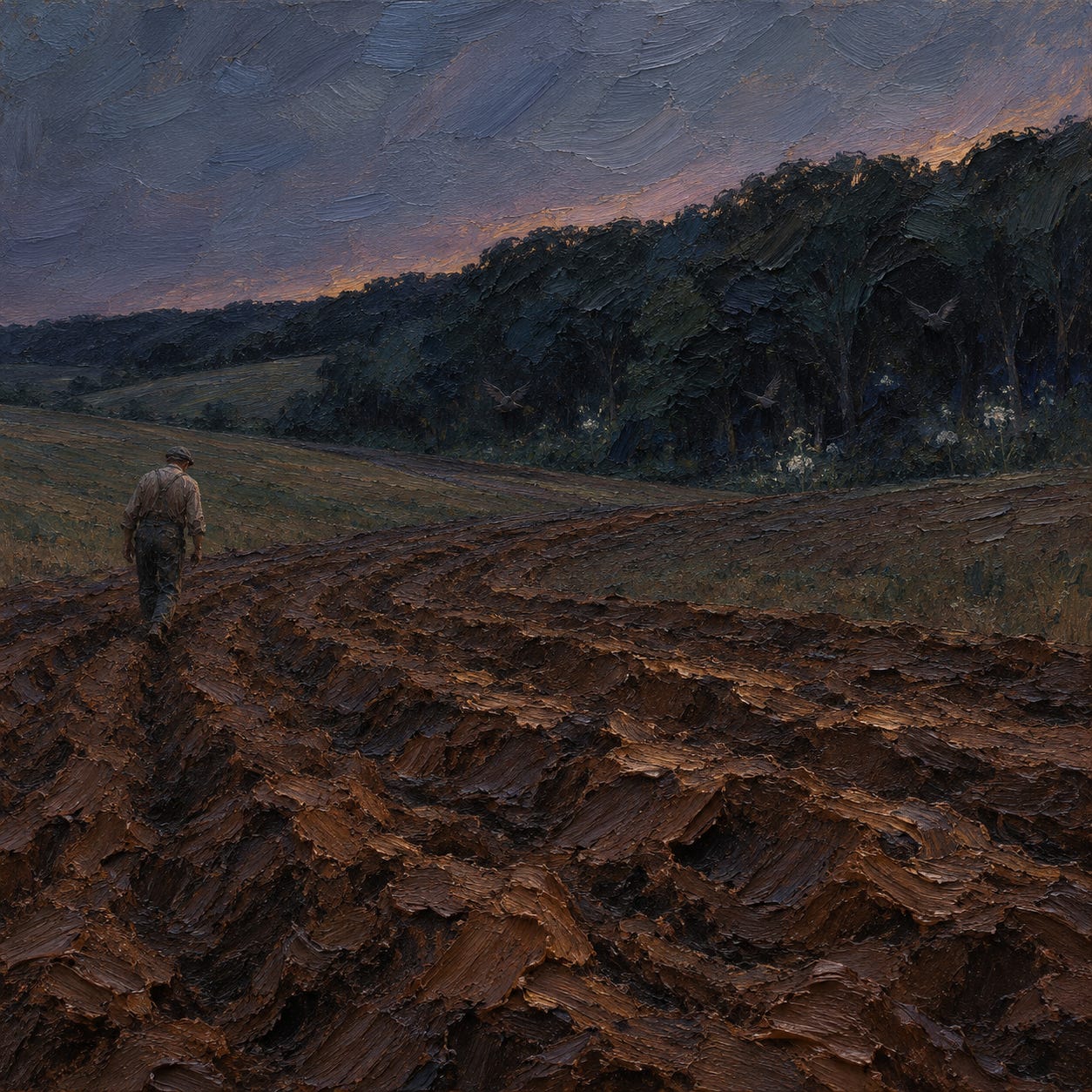
This is a guest post by Michael Bryant, and one I am very happy to publish. I interviewed Michael back in September 2024, in the piece titled “No Pandemic,” and called it at the time one of the most important interviews of that year. His writing on the fraud baked into the history of disease, the HIV/AIDS scandal as blueprint for the Covid operation, and the deliberate killing of the elderly in Spring 2020 belongs on the short shelf of essential Covid-era material. He wrote the elegy that follows when he learned of Wendell Berry’s passing at his home in Port Royal, Kentucky on August 31, 2026, aged 92.
The hook into Michael’s story is the 1998 Northeast Organic Farming Association summer conference, where Berry stepped to the microphone as keynote speaker and told the pioneers of the organic movement, on their biggest stage and directly to their faces, that USDA co-optation and corporate monoculture were already swallowing their work and that they needed to get out of the movement before the machinery closed around them. The speech became “In Distrust of Movements,” published in Orion the following year. Michael was in the rafters that day with two farmer friends, listening and wondering if they were really hearing what they were hearing. Nearly three decades later, he writes, it is hard to find a single thing Berry got wrong.
What follows traces Berry’s path from the New York literary world back to Henry County, Kentucky, where he farmed with horses, refused a computer, and across six decades produced more than two dozen books of poems, essays, novels, and short stories. Berry treated industrial agriculture, consumer society, and the two major American political parties as three wings of a single operating logic: the one that severs people from the sources of life and sells back what it took. His concerns run parallel to much that this publication examines. Health is wholeness. Connection is health. Disease and dependency are manufactured by the disconnection itself. Michael gathers the Berry quotes that shaped his own trajectory and places each one beside the moment that gave it weight. The piece closes with Berry’s four-line poem, “To Know the Dark.”
Elegy PDF Download (Free Subscribers)
Audio Deep Dive (Paid Subscribers Only)
Support This Work
The essays are free and will stay free. What paid subscribers get is the library that surrounds them: the full digital book catalogue, audio deep dives, archived, and embedded in each essay, and the Questions for Your Doctor, Before You Consent, and Package Insert series. Platinum Supporters also receive the digital edition of every paperback on the day it’s published.
Whichever tier suits, thank you for being here. If you’d like to become a paid subscriber, upgrade a tier, or gift a subscription to someone who might value the work, the options are below.
An Elegy for Wendell Berry (1934-2026): Agrarian, Decentralist, Ecologist and Man of Letters
By Michael Bryant
“Many are the lives of men unwritten, which have nevertheless as powerfully influenced civilization and progress as the more fortunate Great whose names are recorded in biography. Even the humblest person, who sets before his fellows an example of industry, sobriety, and upright honesty of purpose in life, has a present as well as a future influence upon the well-being of his country; for his life and character pass unconsciously into the lives of others, and propagate good example for all time to come.”
― Samuel Smiles, Self Help; With Illustrations of Conduct and Perseverance, 1866
While looking for an old essay of Wendell Berry’s a few weeks ago, it came to my attention that he recently passed away at the age of 92 at his home in Port Royal, Kentucky, on August 31, 2026. In honor of his passing, I wish to introduce, or reunite, readers with some of his musings and encourage everyone to explore his body of work at length. It’s always wise to be judicious when applying such terms as “legendary” or “iconic” to anyone, but in this case such accolades are entirely appropriate.
My introduction to Wendell Berry was in the late 1990s when I was living on a bio-dynamic farm in Western Massachusetts. This period was notable for, among other things, the emergence of the anti-globalization movement and the massive protests that were reverberating across the world. These protests, and the global justice movement itself, were in response to the increasing concentration of corporate power, neoliberal economic policies, and the growing influence of supranational financial institutions over all facets of community life.
For me, it was a period of profound awakening. The leading voices of this movement opened my eyes to the raw realities of the world around me, shattering the official hallucinations and controlled narratives that my conventional education had instilled in me. The writings and talks of Dr. Jane Healy, John Taylor Gatto, Kirkpatrick Sale, Eduardo Galeano, Howard Zinn, Helena Norberg-Hodge, David Korten, Chet Bowers, Edward Goldsmith, Mae-Wan-Ho, Brian Tokar, Jerry Mander, Vandana Shiva and many others did more than just speak censored truths. They painted a coherent picture of the world which made sense of the day-to-day realities I saw all around me.
Amidst that awakening, I had a gnawing sense that something was fundamentally wrong with the current state of US agriculture, though I couldn’t pinpoint exactly what it was. Berry’s detailed critique of how agribusiness dismantled local economies, destroyed topsoil, and severed the connections between people and the land brought to life the problems we face and shone a light on how we got here. As I was becoming more keenly interested in food systems and politics Berry’s work resonated with me personally, providing clarity to these issues. Suffice it to say I began to devour everything of his I could get my hands on.
Back at the farm there were many conversations about the urgent need for small-scale, chemical-free, sustainable farming and the problems facing those trying to practice it. Central to these dialogues was how big business was already swallowing up the “organic movement,” how it could be resisted, and how to remain viable until the corporate storm passed. The towering voice that informed and guided many of these talks was Wendell Berry. Virtually all of the farmers “in the trenches” respected him as a voice of reason and seemed to have a collection of his quotes close at hand for every discussion.
In August 1998 at the 24th Annual Northeast Organic Farming Association (NOFA) Summer Conference held at nearby U-MASS Amherst, Berry stepped up to the microphone as the keynote speaker. Much to the surprise of many of the attendees Berry delivered a scathing keynote speech explicitly targeting “the movement” itself by highlighting USDA co-optation and the rise of large-scale corporate organic monocultures. Rather than rallying the crowd to lobby the government he challenged the very premise of turning their agrarian way of life into a political movement. After refining and expanding that speech through conversations with his close friend Wes Jackson, Berry formally published the text as the essay, “In Distrust of Movements“, in the Summer 1999 issue of Orion Magazine.
I remember Berry’s keynote speech clearly. Standing in the rafters with two, “as down-to-earth as it gets” farmer friends, Tim the Dibbler and Sara the earth alchemist, we listened and wondered if we were really hearing what we were hearing. Was Wendell Berry really saying what he was saying? The icon of the “organic movement” was staging a radical intervention in his cutting, yet avuncular manner, by telling the very people who built the movement that they needed to “get out of it” before the corporate machinery swallowed them entirely. It seemed not everyone was ready to hear that message.
By delivering those words directly to the pioneers of the Northeast organic movement, Berry shattered the celebratory atmosphere of the conference with an uncomfortable, urgent message and proved that his ultimate loyalty lay not with any organization or political faction, but with the soil itself and the small farmers who tended it.
My already profound respect for him grew immensely that day as he refused to take the easy road of empty platitudes or indulge the crowd with fawning praise, a choice that characterized his lifelong commitment to uncompromising principles.
Standing in the rafters that day, I could not have known that those words would echo across these decades and be even more relevant today. Wendell Berry’s life was a monument to the very soil he has now returned to and his voice of clarity is needed now more than ever.
In remembrance of Wendell Berry, we take a look at the man and celebrate a life well-lived through his own words and a few musings of my own.
To fully grasp the weight of his thoughts it helps to first look at the roots that shaped them. Berry’s philosophy wasn’t merely as an academic, in fact, he famously turned away from a promising academic career early on to return home to Kentucky. The truth of the man was lived out daily on the Kentucky soil he loved, farmed, and defended for decades.
A fifth-generation native of Henry County, Kentucky, Berry completed his BA and MA at the University of Kentucky and went on to teach creative writing to wide acclaim in both the United States and Europe. Across a career that yielded over two dozen books of poems as well as numerous collections of essays, novels, and short stories, he stood among the United States’ most distinguished men of letters.
Eventually, he and his wife came home to Henry County for good, settling on a farm at Lane’s Landing near Port Royal, the small town that inspired the fictional Port William in many of his novels. The Berry Center in nearby New Castle was later established to carry forward the themes of his life’s work.
Describing himself as an agrarian, Christian, pacifist, decentralist, and ecologist, Berry’s work was rooted in a deep reverence for life, land, place, and tradition. He championed sustainable agriculture, proper husbandry of the Earth’s resources, appropriate technology, frugality, and human-scale communities with local economies. At the same time, he was a fierce critic of industrial agriculture, soil degradation, destructive mountaintop coal mining, and the foreign policy of the US government.
Before living on the farm in Western Massachusetts, I took a few extensive camping and hiking trips out West. As a kid from the Midwest, I had little idea of the sheer scale and grandeur of the mountains and wide-open spaces that defined that part of the country. Taking in the gargantuan orange sequoias, Monument Valley, the vast New Mexico skies, and the Grand Canyon was a feast for the senses, even if I couldn’t fully wrap my head around the sheer beauty and power of the landscape before me. It forever changed my perception of what we narrowly call “the environment.” Along with those idyllic sights, I also came across my first savage clear-cuts and saw firsthand the gore of immense mining operations. I couldn’t square the brutality of those devastating extractions with the quiet majesty of the land that held them. Years later, I came upon his seminal book, The Unsettling of America: Culture and Agriculture, and Berry gave precise language to my experience which helped me understand that clash of mindsets:
I conceive a strip-miner to be a model exploiter, and as a model nurturer I take the old-fashioned idea or ideal of a farmer. The exploiter is a specialist, an expert; the nurturer is not. The standard of the exploiter is efficiency; the standard of the nurturer is care. The exploiter’s goal is money, profit; the nurturer’s goal is health -- his land’s health, his own, his family’s, his community’s, his country’s. Whereas the exploiter asks of a piece of land only how much and how quickly it can be made to produce, the nurturer asks a question that is much more complex and difficult: What is its carrying capacity? (That is: How much can be taken from it without diminishing it? What can it produce dependably for an indefinite time?) The exploiter wishes to earn as much as possible by as little work as possible; the nurturer expects, certainly, to have a decent living from his work, but his characteristic wish is to work as well as possible. The competence of the exploiter is in organization; that of the nurturer is in order -- a human order, that is, that accommodates itself both to other order and to mystery. The exploiter typically serves an institution or organization; the nurturer serves land, household, community, place. The exploiter thinks in terms of numbers, quantities, “hard facts”; the nurturer in terms of character, condition, quality, kind.
I had always led a rather modest life, yet this realization solidified why frugality and simplicity were more than just personal choices. Trying to live with that mindset and “walk the walk”, rejecting the consumer culture that defines the “American way of life”, brought plenty of internal contradictions and no shortage of friction with the world around me. Once again, Berry clarified those contradictions, reminding us that total purity is impossible even when conscience is essential:
I cannot think of any American whom I know or have heard of, who is not contributing in some way to destruction. The reason is simple: to live undestructively in an economy that is overwhelmingly destructive would require of any one of us, or of any small group of us, a great deal more work than we have yet been able to do. How could we divorce ourselves completely and yet responsibly from the technologies and powers that are destroying our planet? The answer is not yet thinkable, and it will not be thinkable for some time -- even though there are now groups and families and persons everywhere in the country who have begun the labor of thinking it.
And so we are by no means divided, or readily divisible, into environmental saints and sinners. But there are legitimate distinctions that need to be made. These are distinctions of degree and of consciousness. Some people are less destructive than others, and some are more conscious of their destructiveness than others.
Once on this path there was no turning back, nor any desire to, while I witnessed the hypocrisies of a world which I had been led to believe was “normal.” Berry articulated that exact sentiment:
People who thus set their lives against destruction have necessarily confronted in themselves the absurdity that they have recognized in their society. They have first observed the tendency of modern organizations to perform in opposition to their stated purposes. They have seen governments that exploit and oppress the people they are sworn to serve and protect, medical procedures that produce ill health, schools that preserve ignorance, methods of transportation that, as Ivan Illich says, have ‘created more distances than they bridge’.
The toll that industrial society has taken on the land and its people is a defining theme across Berry’s work and life. Time and again, he explored the tension of being awake to that destruction while still living within the society that drives it, a struggle embodied by both his fictional characters and his own philosophy:
The split between what we think and what we do is profound. It is not just possible, it is altogether to be expected, that our society would produce conservationists who invest in strip-mining companies, just as it must inevitably produce asthmatic executives whose industries pollute the air and vice-presidents of pesticide corporations whose children are dying of cancer. And these people will tell you that this is the way the “real world” works. They will pride themselves on their sacrifices for “our standard of living.” They will call themselves “practical men” and “hardheaded realists.” And they will have their justifications in abundance from intellectuals, college professors, clergymen, politicians. The viciousness of a mentality that can look complacently upon disease as “part of the cost” would be obvious to any child. But this is the “realism” of millions of modern adults.
What does it actually mean to go along with this mad world of consumption and its sycophants, and where is it all heading? Berry cut straight to the delusion beneath it:
One possibility is just to tag along with the fantasists in government and industry who would have us believe that we can pursue our ideals of affluence, comfort, mobility, and leisure indefinitely. This curious faith is predicated on the notion that we will soon develop unlimited new sources of energy: domestic oil fields, shale oil, gasified coal, nuclear power, solar energy, and so on. This is fantastical cause the basic cause of the energy crisis is not scarcity; it is moral ignorance and weakness of character. We don’t know how to use energy, or what to use it for. And we cannot restrain ourselves. Our time is characterized as much by the abuse and waste of human energy as it is by the abuse and waste of fossil fuel energy. Nuclear power, if we are to believe its advocates, is presumably going to be well used by the same mentality that has egregiously devalued and misapplied man- and womanpower. If we had an unlimited supply of solar or wind power, we would use that destructively, too, for the same reasons.
Berry also possessed a profound distrust for the abstract. To him, “the environment” was never some idealized, utopian concept, it was the living world we inhabit collectively, whether we recognize it or not. Whatever we do to that world, we do to ourselves and to our brothers and sisters:
The concept of country, homeland, dwelling place becomes simplified as “the environment” -- that is, what surrounds us, we have already made a profound division between it and ourselves. We have given up the understanding -- dropped it out of our language and so out of our thought -- that we and our country create one another, depend on one another, are literally part of one another; that our land passes in and out of our bodies just as our bodies pass in and out of our land; that as we and our land are part of one another, so all who are living as neighbors here, human and plant and animal, are part of one another, and so cannot possibly flourish alone; that, therefore, our culture must be our response to our place, our culture and our place are images of each other and inseparable from each other, and so neither can be better than the other.
As industrial society severs our ties to the land and to one another, the damage shows up as concrete illnesses and pathologies in our daily lives. When we lose our sense of place and stewardship, we are left isolated, anxious, and alienated from the very things meant to sustain us. Berry traced these fractured relationships directly to an economy built to profit from this rupture:
The modern urban-industrial society is based on a series of radical disconnections between body and soul, husband and wife, marriage and community, community and the earth. At each of these points of disconnection the collaboration of corporation, government, and expert sets up a profit-making enterprise that results in the further dismemberment and impoverishment of the Creation. Together, these disconnections add up to a condition of critical ill health, which we suffer in common—not just with each other, but with all other creatures. Our economy is based upon this disease. Its aim is to separate us as far as possible from the sources of life (material, social, and spiritual), to put these sources under the control of corporations and specialized professionals, and to sell them to us at the highest profit.
Berry also spoke to the profound anomie that haunts such a society, a condition born when human beings are cut off from meaningful labor, self-reliance, and shared purpose. Even surrounded by unprecedented comfort, the modern citizen is left strangely hollow and perpetually on edge:
The fact is, however, that this is probably the most unhappy average citizen in the history of the world. He has not the power to provide himself with anything but money, and his money is inflating like a balloon and drifting away, subject to historical circumstances and the power of other people. From morning to night he does not touch anything that he has produced himself, in which he can take pride. For all his leisure and recreation, he feels bad, he looks bad, he is overweight, his health is poor. His air, water, and food are all known to contain poisons.
Certain advertisements and pictures in magazines make him suspect that he is basically unattractive. He feels that all his possessions are under threat of pillage. He does not know what he would do if he lost his job, if the economy failed, if the utility companies failed, if the police went on strike, if the truckers went on strike, if his wife left him, if his children ran away, if he should be found to be incurably ill. And for these anxieties, of course, he consults certified experts, who in turn consult certified experts about their anxieties.
It is rarely considered that this average citizen is anxious because he ought to be because he still has some gumption that he has not yet given up in deference to the experts. He ought to be anxious, because he is helpless. That he is dependent upon so many specialists, the beneficiary of so much expert help, can only mean that he is a captive, a potential victim. If he lives by the competence of so many other people, then he lives also by their indulgence; his own will and his own reasons to live are made subordinate to the mere tolerance of everybody else. He has one chance to live what he conceives to be his life: his own small specialty within a delicate, tense, everywhere-strained system of specialties.
Looking directly into the eyes of these truths may seem daunting to some; I found it liberating. It gave an honest voice to what I was witnessing every day. Who could say, even back then, that they knew many genuinely whole and healthy individuals? And who can deny that the conditions Berry described have only deteriorated in the decades since? Seeking true wholeness in a broken world invites us to reflect on how Berry understood both personal and societal health:
We are healthy, we think, if we do not feel any pain or too much pain, and if we are strong enough to do our work. If we become unhealthy, then we go to a doctor who we hope will “cure” us and restore us to health. By health, in other words, we mean merely the absence of disease. Our health professionals are interested almost exclusively in preventing disease (mainly by destroying germs) and in curing disease (mainly by surgery and by destroying germs). But the concept of health is rooted in the concept of wholeness. To be healthy is to be whole. The word health belongs to a family of words, a listing of which will suggest how far the consideration of health must carry us: heal, whole, wholesome, hale, hallow, holy. And so it is possible to give a definition to health that is positive and far more elaborate than that given to it by most medical doctors and the officers of public health.
Only by restoring the broken connections can we be healed. Connection is health. And what our society does its best to disguise from us is how ordinary, how commonly attainable, health is. We lose our health -- and create profitable diseases and dependencies -- by failing to see the direct connections between living and eating, eating and working, working and loving. In gardening, for instance, one works with the body to feed the body. The work, if it is knowledgeable, makes for excellent food. And it makes one hungry. The work thus makes eating both nourishing and joyful, not consumptive, and keeps the eater from getting fat and weak. This is health, wholeness, a source of delight. And such a solution, unlike the typical industrial solution, does not cause new problems.
What, then, are we to do about it all? Berry never claimed to hold every answer, and the remedies he offered were quite simple, requiring not grand “fixes”, but a fundamental shift in mindset. Skeptical that we could ever heal a broken world using the same logic that broke it, he urged us to start where we stand:
Many times, after I have finished a lecture on the decline of American farming and rural life, someone in the audience has asked, “What can city people do?” “Eat responsibly,” I have usually answered. Of course, I have tried to explain what I mean by that, but afterwards I have invariably felt there was more to be said than I had been able to say. Now I would like to attempt a better explanation. I begin with the proposition that eating is an agricultural act. Eating ends the annual drama of the food economy that begins with planting and birth. Most eaters, however, are no longer aware that this is true. They think of food as an agricultural product, perhaps, but they do not think of themselves as participants in agriculture. They think of themselves as “consumers.” If they think beyond that, they recognize that they are passive consumers. They buy what they want — or what they have been persuaded to want — within the limits of what they can get. They pay, mostly without protest, what they are charged. And they mostly ignore certain critical questions about the quality and the cost of what they are sold: How fresh is it? How pure or clean is it, how free of dangerous chemicals? How far was it transported, and what did transportation add to the cost? How much did manufacturing or packaging or advertising add to the cost? When the food product has been manufactured or “processed” or “precooked,” how has that affected its quality or price or nutritional value?
One of Wendell Berry’s hallmarks, and one of the things that first drew me to him, was his clear-eyed realism about what an economy meant to serve people should actually look like. Like most Americans, I grew up hearing pundits and politicians boast about how well the economy was doing and promise that Valhalla was just around the corner. Like most Americans, I looked around and wondered “Where’s that?” and waited for an economy that never seemed to turn that corner for the majority of us. Later, I came across Clifford Cobb, Ted Halstead, and Jonathan Rowe’s essay, “If the GDP Is Up, Why Is America Down?”, which explained why a climbing GDP has so little to do with the actual well-being of ordinary people. Berry cut straight to the root of that illusion, exposing the hidden costs that modern accounting refuses to count:
If economy means ‘management of a household,’ then we have a system of national accounting that bears no resemblance to the national economy whatsoever, for it is not the record of our life at home but the fever chart of our consumption. National economy--the health of which might be indicated by our net national product, derived by subtracting our real losses from our real gains--is perhaps a top secret, the existence of which even the government has not yet suspected.
“One reason for this is the geographical separation that frequently exists between losses and gains. Agricultural losses occur on the farm and in farming communities, whereas the great gains of agriculture all occur in cities, just as the profits from coal are realized mainly in cities far from where the coal is mined. Almost always the profit is realized by people who are under no pressure or obligation to realize the losses-- people, that is, who are so positioned by wealth and power that they need assign no value at all to what is lost. The cost of soil erosion is not deducted from the profit on a packaged beefsteak, just as the loss of forest, topsoil, and human homes on a Kentucky mountainside does not reduce the profit on a ton of coal.
If in the human economy, a squash in the field is worth more than a bushel of soil, that does not mean that food is more valuable than soil; it means simply that we do not know how to value the soil. In its complexity and its potential longevity, the soil exceeds our comprehension; we do not know how to place a just market value on it, and we will never learn how. Its value is inestimable; we must value it, beyond whatever price we put on it, by respecting it.
But when nothing is valued for what it is, everything is destined to be wasted. Once the values of things refer only to their future usefulness, then an infinite withdrawal of value from the living present has begun. Nothing (and nobody) can then exist that is not theoretically replaceable by something (or somebody) more valuable. The country that we (or some of us) had thought to make our home becomes instead ‘a nation rich in natural resources’; the good bounty of the land begins its mechanical metamorphosis into junk, garbage, silt, poison, and other forms of ‘waste.’
The inevitable result of such an economy is that no farm or any other usable property can safely be regarded by anyone as a home, no home is ultimately worthy of our loyalty, nothing is ultimately worth doing, and no place or task or person is worth a lifetime’s devotion. ‘Waste,’ in such an economy, must eventually include several categories of humans--the unborn, the old, ‘disinvested’ farmers, the unemployed, the ‘unemployable.’ Indeed, once our homeland, our source, is regarded as a resource, we are all sliding downward toward the ashheap or the dump.
Understanding that the system itself was destructive and rigged against ordinary people it’s no surprise that Berry refused to align with either the Democratic or Republican party, arguing that both sides serve the same destructive industrial and corporate economy. Throughout his career, Berry maintained that the imagined divide between the two parties was a manufactured distraction from the real threat to local communities and viewed both major parties as two wings of the same industrial mindset. He rarely named “Democrats” and “Republicans” directly in his essays, preferring to critique the broader “liberal” and “conservative” establishments they represent:
Come all ye conservatives and liberals who want to conserve the good things and be free, come away from the merchants of big answers, whose hands are metaled with power; from the union of anywhere and everywhere by the purchase of everything from everybody at the lowest price and the sale of anything to anybody at the highest price; from the union of work and debt, work and despair; from the wage-slavery of the helplessly well-employed. From the union of self-gratification and self-annihilation, secede into care for one another and for the good gifts of Heaven and Earth.
The standard of the partisan or the sectarian is simple: if it is done by ‘our side’ it is right; if it is done by ‘their side’ it is wrong. This is the logic of total warfare, and it is the logic of our present politics. It is the morality of a football game: the rules apply only to the keeping of the score; everything else is tactics.
When a person identifies himself with a category—whether a political party, a movement, a race, or a class—he accepts a set of readymade answers that relieve him of the necessity of thinking. He no longer has to examine the world, or his own conscience, or the lives of his neighbors; he has only to consult the dogmas of his group. The group provides him with a simplified vocabulary and a set of approved emotional responses. He can be angry, or righteous, or compassionate on demand, without the trouble of personal experience or personal risk. This is a form of moral abdication. It replaces the complex, difficult discipline of personal judgment with the easy conformity of the crowd. It makes a man a function of an organization, an instrument of a collective will.
Berry differentiated between the “individual” as an isolated unit that an organization can count and manipulate as a political tool, versus a “person” rooted in a specific place, bound by relationships to neighbors and the land, and acting out of personal conscience rather than a political identity:
That is what I hope for: a chance to live and speak as a person, not as a function of some political bunch.
Berry never used a computer, farmed using horses, and rejected automated “progress.” For this he often drew sharp criticism and was regularly tabbed a “Luddite.” Rather than shy away from this label he embraced it and used it to set the historical record straight, an account which industrial society has distorted and erased.
Berry pointed out that the 19th-century Luddites were not clumsy, backward-looking peasants afraid of gears and levers, they were highly skilled artisans and master weavers who operated the most advanced textile machinery of their era. Their protests were not against tools or technical skill, they were against the abuse of new factory machines used by unscrupulous owners to bypass fair wages, undermine craftsmanship, flood the market with shoddy goods, and hollow out entire working communities.
“The Luddites... asserted the precedence of community needs over technological innovation and monetary profit. The victory of industrialism over Luddism was overwhelming and unconditional; it was undoubtedly the most complete, significant, and lasting victory of modern times.”
For Berry, the historical Luddites were models of the exact principle he lived by on his own farm, using advanced, well-made tools that enhance human skill and sustain a local community, while rejecting tools designed to replace people and concentrate profit:
I believe that health is wholeness. For many years I have returned again and again to the work of the English agriculturist Sir Albert Howard, who said, in The Soil and Health, that “the whole problem of health in soil, plant, animal, and man [is] one great subject.” I am moreover a Luddite, in what I take to be the true and appropriate sense. I am not “against technology” so much as I am for community. When the choice is between the health of a community and technological innovation, I choose the health of the community. I would unhesitatingly destroy a machine before I would allow the machine to destroy my community. I believe that the community-in the fullest sense: a place and all its creatures-is the smallest unit of health and that to speak of the health of an isolated individual is a contradiction in terms.
All facets of Wendell Berry’s life and work, his skepticism of blind technological progress, his rejection of partisan illusions, his defense of local economies, and his insistence on human-scale living leads back to the single, living foundation that sustains us all. For Berry, stewardship was never an abstract political program it was a daily act of fidelity to the ground beneath our feet:
The soil is the great connector of lives, the source and destination of all. It is the healer and restorer and resurrector, by which disease passes into health, age into youth, death into life. Without proper care for it we can have no community, because without proper care for it we can have no life.
In remembering Wendell Berry, we celebrate far more than a prolific poet, essayist, and novelist. We celebrate a man who refused to separate his words from his work, or his ideals from the place he called home.
In his 1968 essay “A Native Hill,” Berry wrote about his decision to leave behind the New York literary world just two years into his career in favor of his home county in Kentucky:
I had made a significant change in my relation to the place: before it had been mine by coincidence or accident; now it was mine by choice. My return, which at first had been hesitant and tentative, grew wholehearted and sure. I had come back to stay. I hoped to live here the rest of my life.
It was a hope he fulfilled.
What struck me at that NOFA keynote address a lifetime ago, and has stayed with me to this day, was the moral clarity of Wendell Berry. He told his biggest fans, on their biggest stage, directly to their faces, not what they wanted to hear, but what they needed to hear. Nearly three decades later, it is hard to find a single thing he got wrong.
In an age defined by speed, distraction, and disposability, Berry asked us to slow down, pay attention, and love the particular corners of the Earth entrusted to our care. He knew that true renewal rarely begins at the center of power:
If change is to come, it will have to come from the margins.
And even while staring squarely at the worst of human folly he never surrendered to despair:
Be joyful though you have considered all the facts.
CODA
People often ask how I can spend so much time covering troubling stories without letting them weigh me down. The truth is doing so has never left me in despair, it clarifies what needs to be done. I think about my favorite Wendell Berry poem that tells us we must step directly into the shadow, bear witness, and trust that even in the darkest places, there is still life worth fighting for.
To Know the Dark
by Wendell Berry
To go in the dark with a light is to know the light.
To know the dark, go dark. Go without sight,
and find that the dark, too, blooms and sings,
and is traveled by dark feet and dark wings.
The collected essays of Wendell Berry can be found here.
His poems can be found here.
To browse complete publication catalogs, bibliographies, and available editions of his works, you can explore the Open Library Wendell Berry Page.
Unbekoming paperbacks available on Lulu
The Unbekoming library is available in paperback, printed to order through Lulu and shipped worldwide. The shelf begins with the paradigm questions underneath everything else. No Virus takes apart virology’s foundational claims and the diseases attributed to viruses, one by one. No Contagion, co-authored with Jamie Andrews, carries that into germ theory itself, catalogued through 258 failed contagion experiments. No Autoimmunity does the same for the “body attacks itself” story, with toxic injury and inflammatory repair put where that story used to be. The Genetic Deception does it for the “it’s in your genes” account that forecloses every environmental question.
From the paradigm, the shelf moves to what medicine set aside: The DMSO Book, Chlorine Dioxide: The Forbidden Remedy, The Iodine Book, The Hydrogen Peroxide Book, Colloidal Silver: The Silver That Medicine Dropped, and The Zeolite Book. Two more recover what’s still on the kitchen shelf: Baking Soda and The Castor Oil Book. Two more recover the minerals modern soil, water, and processing quietly stripped from the diet: The Magnesium Handbook and The Boron Book. And three more sit with traditional food and the oldest clinical tool of all: The Food Book — twenty books on the traditional kitchen in a single 581-page volume — The Garlic Book, and Fasting: The Oldest Medicine.
The critique books cover what medicine, dentistry, psychiatry, and veterinary practice have become. The Unvaccinated treats the completely unvaccinated as a comparison group across twenty chapters and five appendices. Medicalized Motherhood follows a woman through 123 documented interventions from teenage pill to postpartum discharge. The Vitamin K Injection covers what happens in the first hours of a newborn’s life. Breast Cancer: Before You Consent and Beyond the PSA are the two cancer books — one for women, one for men — on the screening industries and what cancer actually is. Drilling for Profit treats cavities, gum disease, and crooked teeth as the dietary problem they are. What Your Vet Can’t Tell You applies the same critique to pets. Escape from Psychiatry documents the fabrication of the DSM and the specific damage of every major psychiatric drug class. Butchered by “Healthcare” is Robert Yoho MD’s insider account of what the medical industry has become.
At the systems level, two more books on the structures underneath the health story: Extraction: The Middle Class as Colony traces the architecture of Big Medicine as an extraction stack — pharma, hospitals, insurers, medical schools, regulatory and professional bodies — and The Carbon Dollar turns the same lens on money.
The full shelf is at lulu.com/spotlight/unbekoming. A physical book reaches the person a Substack post never will — the skeptical relative, the friend who won’t click a link but might open a book, the visitor whose eye lands on a coffee table. Buy one to keep, and one to give away.
Thank you for featuring this elegy, Unbekoming. So many profound thoughts by Wendell Berry. “Nurturers” versus “exploiters”, connection leads to health, the importance of meaningful work that produces something worthwhile, being good stewards of the land and natural resources, people and community over profits and power, and soil as the great connector of lives all resonate loudly.
Incredible! Jaber Crow and Hanna Colter are two of my all-time favorite works of fiction.