

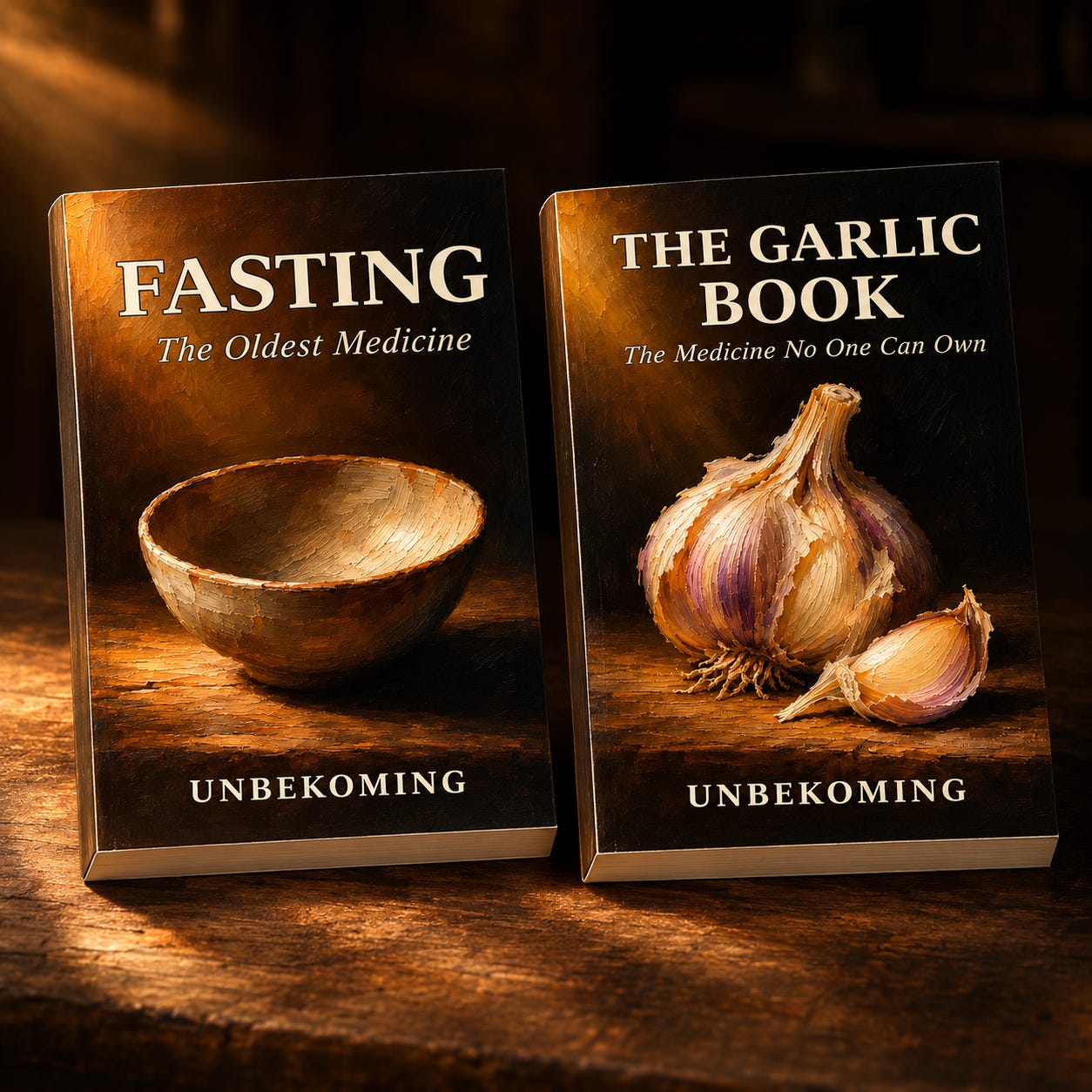
Fasting was prescribed in the Book of Leviticus. It was ritualised in every durable civilisation — Yom Kippur for more than three thousand years, Lent for two thousand, Ramadan for the fourteen centuries since Mohammed, the monastic retreats, the rites of grief and recovery. Garlic was placed in an Egyptian grave nearly six thousand years ago. The Ebers Papyrus records more than eight hundred remedies; twenty-two of them use garlic. It was prescribed by Hippocrates, classified by Galen, refined by Avicenna, catalogued by Culpeper, carried through the Arab physicians, the medieval herbals, and the plague years. These are not alternative medicines. These are two of the oldest medicines on the clinical record.
Both disappeared from Western medicine inside the same window. The last era in which Western physicians prescribed garlic as a matter of course ran from 1850 to 1945 — William Minchin treating tuberculosis at the Kells Union Hospital in Ireland; the 1901 report of more than two hundred tuberculosis patients treated with garlic at the City Hospital in Venice; the 1917 New York hospital comparison in which garlic ranked first among fifty-six treatments. That window closed in the 1940s. Fasting’s window was closing in the same decades. Herbert Shelton had supervised more than thirty thousand fasts across forty years at his Natural Hygiene centres in Texas by the time he published Fasting Can Save Your Life in 1964; his medical era insisted the heart would collapse within six days without food. Angus Barbieri went 382 days under medical supervision at Maryfield Hospital in Dundee in 1965 and the clinical assumption inverted. Neither practice came back. The prescription pad moved on.
What has not been treated at book length, until now, is the two records together — fasting’s century of suppressed clinical evidence, and garlic’s six-thousand-year chart of continuous prescription — read against the same institutional pivot that dropped them both.
Fasting: The Oldest Medicine catalogues twelve voices across more than a century who arrived at the same clinical observation independently. The Garlic Book reads six source books, the pre-1945 medical literature, and the modern trial record against each other, and reports what the evidence actually shows — including the trials that went against garlic as directly as the ones that went for it.
That is why these two books are shaped as they are. 425 pages, twenty-three chapters, four appendices for fasting. 270 pages, twenty-two chapters, two appendices for garlic. The record is the argument.
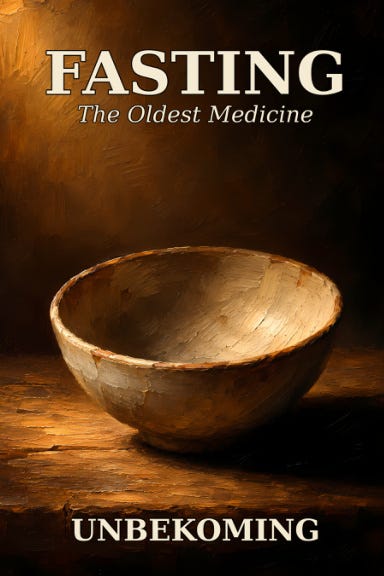
Fasting: The Oldest Medicine — paperback cover
What Fasting: The Oldest Medicine shows
The book is in five parts.
Part One, The Case for Fasting, opens with the body and what it does when food stops arriving — the switch into dismantling what should not be there and repairing what should. It then establishes that fasting is not starvation, that every durable civilisation codified it, and that the pattern of three meals a day with snacks between is approximately one hundred years old. A chapter on the century of suppression that followed closes the case.
Part Two, The Voices, is the compendium. Ten chapters move through twelve clinicians, researchers and practitioners who documented the same mechanism across more than a century — Herbert Shelton’s thirty thousand fasts in Texas; Alan Goldhamer and Toshia Myers’s twenty-five thousand water-only fasts at the TrueNorth Health Center in Santa Rosa across four decades, with no deaths on record; Edward Earle Purinton’s 1906 philosophy; Henry Bieler’s 1965 position that food is the medicine; Jason Fung, the Toronto nephrologist, read alongside the neuroscientist Andrew Huberman; August Dunning, the aerospace engineer who reconstructed the Russian dry-fasting literature into his Phoenix Protocol; Michelle Slater’s first-person account of an eleven-day dry fast under Sergey Filonov in the Altai Mountains of Siberia; and interviews with Leslie Dennis Taylor on the clinical side, with Dr Amanda King on the metabolic approach to cancer, and with Gary Moller, the New Zealand functional-nutrition consultant, on root causes. An eleventh chapter on the heart closes Part Two.
Part Three turns to cancer. One chapter. The foundation of recovery.
Part Four, The Practice, is the working manual — the protocol ladder, how to break a fast, troubleshooting, between-fast eating.
Part Five, The Argument Answered, takes the objections one by one: what your doctor said, who should not fast, and why the body still knows.
At the back: four appendices treat fasting through the terrain lens, the insulin–seed oil–fasting triangle, a full sources-and-notes apparatus, and further reading. A live index closes the book.
Who Fasting: The Oldest Medicine is for
For the existing subscriber who has been waiting for the fasting book — this is it. More than a century of clinical observation, placed in one volume for the first time.
For the new reader — start at Chapter 1. No prerequisites. The book opens with the physiology, moves through twelve voices, and closes with practice. By the end of Part One you will know what the body does when food stops. By the end of Part Five you will know why it has done it for all of human history.
For someone you love — the person who has been told their condition is chronic, incurable, managed-for-life. Twelve clinicians across a century, each working independently, each arriving at the recognition that given rest from incoming food the body knows what to do. This is the compendium.
Fasting: The Oldest Medicine on Lulu
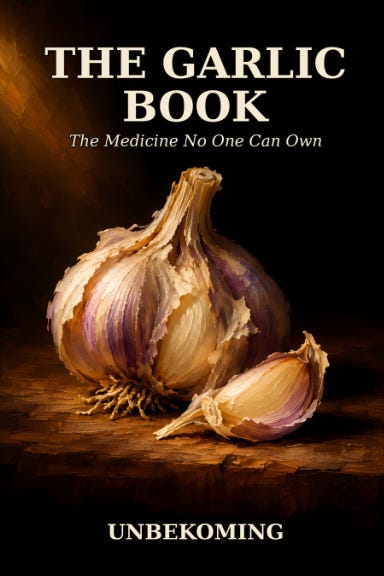
The Garlic Book — paperback cover
What The Garlic Book shows
The book is in four parts.
Part One, The Record, treats the history of garlic as evidence. From the clay garlic bulb placed in an Egyptian grave nearly six thousand years ago, through the Ebers Papyrus, through Hippocrates, Dioscorides, Pliny and Galen, the Arab physicians under Avicenna, the medieval herbals, Culpeper, and the plague years, to the last era in which Western physicians prescribed garlic as a matter of course, which ran from 1850 to 1945. It closes with the living traditions that never stopped using it, and with the folklore of charms, vampires and the evil eye.
Part Two, The Chemistry and the Evidence, sets out what is known about why a clove has no smell until it is cut, and why the order of crush, rest and heat changes the medicine. It then reads the clinical evidence against the historical record — bacteria, blood and vessels, cancer epidemiology, metals and fatigue — and names the trials that went against garlic as directly as the trials that went for it, including the 2007 Stanford trial funded by the US National Institutes of Health which found that raw garlic, garlic powder and aged garlic extract moved LDL cholesterol no more than placebo did. It then turns to onion, garlic’s closest relative, and reads the newer evidence published since 2015, before closing with the whole of the record through the terrain lens.
Part Three, Why Medicine Set It Aside, asks the question directly. One chapter contrasts the pharmaceutical model of isolating a single active compound with the folk model of combining whole plants, and reports what the garlic evidence says about which model works better. One chapter examines the economics of research on a plant that cannot be patented. One chapter — Fire Cider — tells the story of a folk preparation whose name was taken into a United States trademark by a Massachusetts company in 2012, and won back by three herbalists in 2014 who documented forty years of prior use through Rosemary Gladstar and her students into the older tradition.
Part Four, Garlic in Practice, is the working manual — the kitchen pharmacy, traditional uses by body system, a full chapter on safety and interactions, and a complaint-by-complaint practical guide. The book closes with The Trial That Was Never Run — a one-chapter reading of the whole evidential architecture.
At the back: two appendices (a traditional list of uses, and a preparation quick-reference), a full bibliography, and a live index.
Who The Garlic Book is for
For the existing subscriber who has read the Morton Walker summary and the fire cider essay and knew a book was coming — this is it.
For the new reader — start at the Preface. It names what the book will not do (invent effects garlic does not have), what it will do (read the historical record and the trial record against each other), and the rules it applies. The rest of the book follows from there.
For someone you love — the household that reaches for pharmaceutical products at every sniffle. A book that treats a clove as what it has been in every recorded civilisation: a kitchen medicine with a six-thousand-year chart.
Both Audio Deep Dives (Paid Subscribers Only)
Both Digital Editions
Platinum Supporters - immediate access
Want access now? Upgrade to Platinum Supporter to receive digital editions on paperback release day.
Standard Paid Subscribers - access in 3-6 months from date of this post
Both EPUB Editions — Platinum Supporters
An EPUB edition, readable on Kindle, Kobo, Apple Books, and any e-reader that supports the format. Platinum Supporters can download it below.
For the full paperback shelf
These two new paperbacks join the rest of the shelf. The paradigm books — No Virus, No Contagion, No Autoimmunity. The mineral books — The Boron Book, The Magnesium Handbook, The Iodine Book. The kitchen pharmacy that doctors stopped prescribing — The DMSO Book, Baking Soda, The Hydrogen Peroxide Book, Chlorine Dioxide, The Castor Oil Book, Colloidal Silver, The Zeolite Book. The books on what the diagnostic machinery is actually doing — Beyond the PSA, Before You Consent, The Genetic Deception. The political-economy books — Extraction, The Carbon Dollar. The institutional record — The Unvaccinated, Medicalized Motherhood, Escape from Psychiatry, Drilling for Profit, The Vitamin K Injection. The first Unbekoming edition of Robert Yoho MD — Butchered by ‘Healthcare’. And What Your Vet Can’t Tell You for the dogs and cats. The full shelf sits at lulu.com/spotlight/unbekoming.
Thank you
This imprint runs on attention and word of mouth. On readers reading, lending, sharing, buying second copies for people they love, pressing a book into the hand of someone who has been told their condition is permanent. It runs on nothing else. There is no publishing house underwriting this. There is no distributor placing these books in airports. There is you. Whatever you do with these two books — read them, pass them on, tell someone who needs them that there is a book — carries the whole of the project forward. Thank you.
Fasting and garlic are not inventions. They are records. That is what these two books return.
With gratitude,
Unbekoming
Support This Work
The essays are free and will stay free. What paid subscribers get is the library that surrounds them: the full digital book catalogue, audio deep dives, archived, and embedded in each essay, and the Questions for Your Doctor, Before You Consent, and Package Insert series. Platinum Supporters also receive the digital edition of every paperback on the day it’s published.
Whichever tier suits, thank you for being here. If you’d like to become a paid subscriber, upgrade a tier, or gift a subscription to someone who might value the work, the options are below.
Thank you very much for this magnificent article and for revisiting one of humanity’s oldest therapeutic practices—a practice whose biological and metabolic potential deserves far more attention.
Fasting is not merely about abstaining from food; it is about allowing the body to trigger an extraordinary series of physiological mechanisms for adaptation, regulation, and cellular maintenance.
Among its most compelling effects are:
* Activation of autophagy: This promotes the recycling of damaged cellular components and the renewal of intracellular structures.
* Improved insulin sensitivity: This can contribute to better regulation of glucose and energy metabolism.
* Metabolic flexibility: This facilitates the transition from using glucose to mobilizing and oxidizing fatty acids, as well as producing ketone bodies.
* Activation of AMPK and modulation of mTOR: These processes are involved in key signaling pathways related to energy balance, growth, and cellular maintenance.
* Mitochondrial health: This can support adaptive mechanisms and energy efficiency, including the renewal of mitochondria.
* Reduction of inflammation: Some studies show improvements in specific inflammatory and metabolic markers.
* Cardiovascular health: This can help improve blood pressure, triglyceride levels, and other cardiometabolic risk factors.
* Regulation of oxidative stress: This triggers cellular adaptive and defensive responses against oxidative stress.
* Hepatic metabolism: This can help reduce liver fat, particularly in cases where there is an excess of metabolic fat.
* Metabolic and hormonal balance: This alters the signaling of insulin, glucagon, and other hormones involved in the availability and utilization of energy.
It is particularly important, in my view, to revisit the concept that the body requires more than just nutrients to build itself and function; it also needs periods of digestive and metabolic rest to activate its own adaptive and maintenance mechanisms.
For too long, we have defined healthy eating solely in terms of what and how much we consume—forgetting that *when* we eat, and how long we allow our metabolism to rest, can also be of immense biological significance. Understanding its mechanisms opens up a fascinating perspective on prevention and metabolic health—areas involving biological processes that evolution has preserved for millions of years.
Thank you once again for sharing this knowledge and keeping it alive.
PROTEIN, FASTING, CANCER, AND LONGEVITY | VALTER LONGO, PHD
Dr. Valter Longo is the Edna M. Jones Professor of Gerontology and Biological Sciences and Director of the Longevity Institute at the University of Southern California’s Leonard Davis School of Gerontology in Los Angeles—a leading center for research on aging and age-related diseases. Dr. Longo also serves as the Director of the Longevity and Cancer Program at the IFOM Institute of Molecular Oncology in Milan, Italy.
In this episode, we explore terms that have become buzzwords in the field of protein research, including IGF-1 and mTOR. We discuss protein requirements for different age groups, the importance of muscle tissue, the benefits of protein consumption, and potential risks. We also cover the fasting-mimicking diet, both for the general population and as an adjunctive treatment for cancer. Specifically, the following topics are covered:
1) Introduction (0:00)
2) Ideal diets for longevity (2:58)
3) Key pathways in aging (9:15)
4) IGF-1 elevation (16:24)
5) Acute vs. chronic IGF-1 elevation (19:46)
6) Dangers of excessive protein consumption (25:11)
7) Impact of exercise on IGF-1 (32:52)
8) Muscle mass and longevity (38:35)
9) Study on high protein intake later in life (41:59)
10) How to get tested for IGF-1 (48:03)
11) Low IGF-1 and cognitive decline (49:54)
12) IGF-1 resistance (53:00)
13) Mendelian randomization studies (54:38)
14) Fasting-mimicking diet (59:21)
15) Fasting and cancer (1:16:03)
16) Ketogenic diet and cancer (1:27:51)
17) Conclusion (1:32:15)
https://theproof.com/protein-fasting-cancer-and-longevity-valter-longo-phd/