

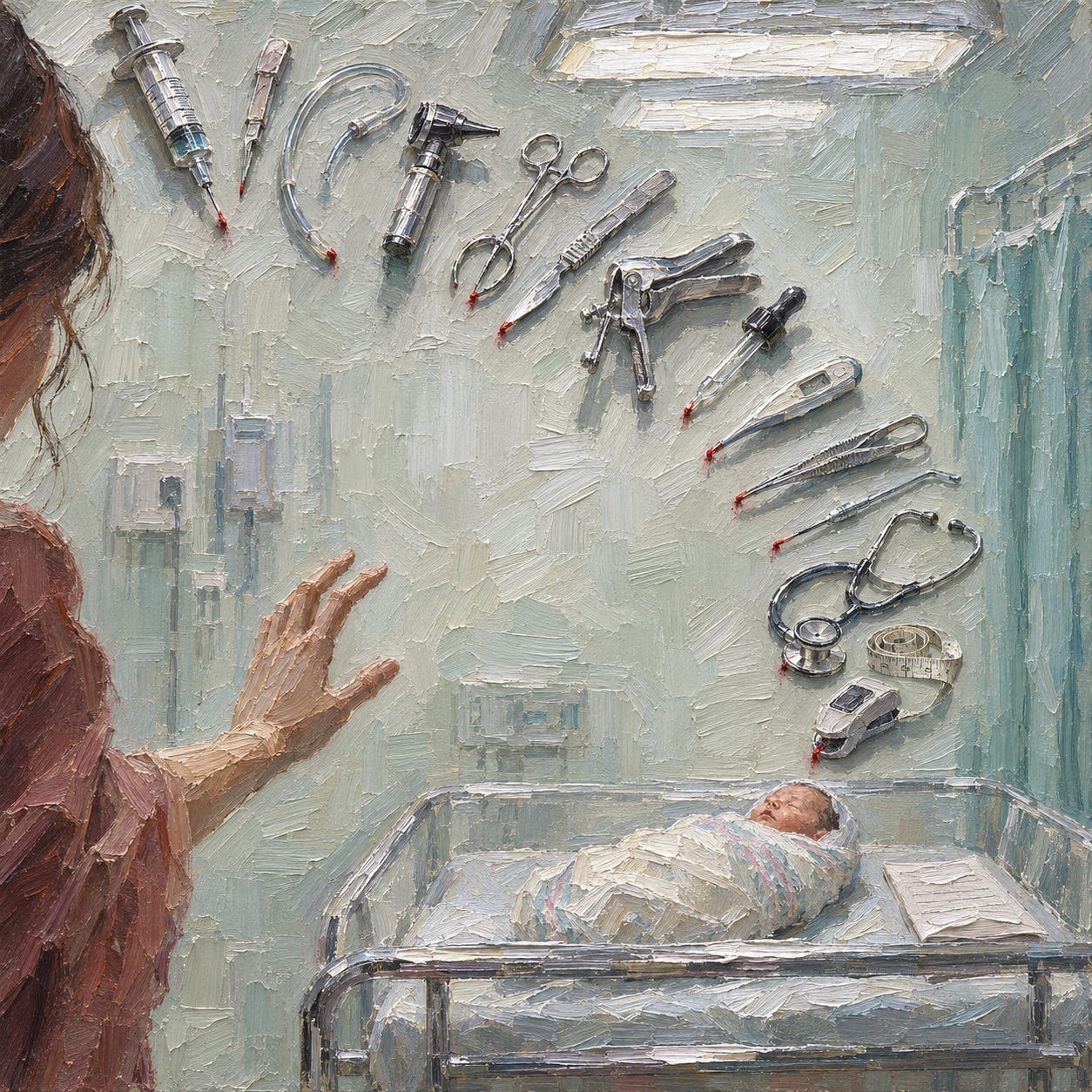
Author’s note: This essay engages with the standard American hospital birth protocol in the terms the protocol uses. Establishment vocabulary (hepatitis B, phenylketonuria, group B strep, antibody titer, immune function) appears in quotation, in reported speech, or inside the product and procedure names the hospital uses. The analytical voice operates from the terrain paradigm: the body is a self-healing organism that does not make mistakes, disease arises from toxic exposure and other identifiable insults, and interventions that bypass the skin barrier of a hours-old infant are examined accordingly. The two registers do different work. The hospital’s language describes what the hospital does. The terrain language describes what is being done to the baby.
The physiological detail of what the first-hour interventions displace, including the placental transfer mechanism, the Widström nine-stage approach to the breast, and the maternal oxytocin cascade, is traced in a prior essay in this series, “7 Interventions in 60 Minutes” (August 2026). This essay is the architectural companion: what the full forty-eight-hour protocol does, how consent is dissolved into a single admission form, and what the cascade produces beyond the hospital doors.

1. The Protocol Is Already Running
The baby cannot sign. The mother signs one form at admission, which opens the protocol. The protocol performs fourteen distinct medical procedures on the baby in the first forty-eight hours of its life. Six of them occur in the first hour. The last of the six is the hepatitis B vaccine, which delivers two hundred fifty micrograms of aluminum intramuscularly to an infant whose average weight is 3.3 kilograms. Adjusted for body weight, the newborn receives roughly eleven times the per-kilogram aluminum load the same product delivers to an adult.
No one asked the mother.
The itemized hospital bill catalogs each procedure. The consent paperwork the mother signed at admission covers two or three of them. The vaccine information sheet handed to her after the hepatitis B dose was already in the baby’s thigh is an educational document, not a consent form. Everything else happens under what the protocols call “standing orders” or “routine newborn care.” The vocabulary converts a sequence of fourteen interventions into a single administrative category, and the category removes the question of whether any individual item was wanted.
In adult medicine, each major procedure requires its own consent form: the blood transfusion, the general anesthesia, the central venous catheter, even the chest X-ray. The newborn signs nothing because the newborn cannot, and the one person who could sign on the baby’s behalf is told, repeatedly and from several directions, that refusal is dangerous eccentricity.
Essay PDF Download (Free Subscribers)
Audio Deep Dive (Paid Subscribers Only)
Support This Work
The essays are free and will stay free. What paid subscribers get is the library that surrounds them: the full digital book catalogue, audio deep dives, archived, and embedded in each essay, and the Questions for Your Doctor, Before You Consent, and Package Insert series. Platinum Supporters also receive the digital edition of every paperback on the day it’s published.
Whichever tier suits, thank you for being here. If you’d like to become a paid subscriber, upgrade a tier, or gift a subscription to someone who might value the work, the options are below.
2. The First Hour
Intervention one: the cord is cut. In most American hospitals, the umbilical cord is clamped and cut within fifteen to thirty seconds of delivery. The World Health Organization recommends waiting at least one to three minutes. The American College of Obstetricians and Gynecologists, in 2017, revised its guidance to recommend a minimum delay of thirty to sixty seconds for vigorous term infants. The practice in the room runs ahead of the guidance because the protocol was built around speed and still rewards it.
The specific loss is measurable. A full placental transfusion delivers approximately eighty to one hundred milliliters of blood to the newborn, roughly one third of its total blood volume.¹ Clamping the cord before pulsation finishes diverts that blood away from the baby. The downstream effect is reduced iron stores for the first six months of life, during exactly the window the brain is building its myelin. The hospital treats the iron shortfall it created with iron-fortified formula and iron supplementation. The documentation does not connect the two.
Intervention two: the airway is suctioned. A bulb or wall-suction catheter is run through the nose and mouth, often while the baby is still attached to the cord. Neonatal Resuscitation Program guidelines, which are the training standard for American hospital birth staff, were revised in 2015 to recommend against routine suctioning of vigorous newborns, because the procedure causes bradycardia through vagal stimulation and damages the delicate mucosal lining. The hospital kept doing it anyway. It remains on the standing-order list and in the muscle memory of the nurses who carry it out.
Intervention three: the vernix is wiped off. Vernix caseosa, the white protective coating the baby arrives wearing, has documented antimicrobial properties and provides temperature regulation. The World Health Organization recommends delaying the first bath for at least twenty-four hours. American hospitals typically wash the baby within one to two hours. The wash removes the maternal scent that orients the newborn toward the breast, drops the baby’s temperature, and spikes cortisol. A knitted or cotton hat is then placed over the baby’s head, ostensibly for thermoregulation; the mother’s chest already provides thermal regulation calibrated to the infant’s needs, and the hat covers the crown where the densest concentration of the baby’s olfactory and sensory input occurs. “Fussy baby after bath” becomes “difficulty latching” becomes “formula supplementation.” The cascade begins with a washcloth.
Intervention four: erythromycin ointment goes in the eyes. Required by law in at least thirty-two American states and recommended by the CDC in all fifty, applied to every newborn regardless of the mother’s prenatal gonorrhea screen.² The stated purpose is prevention of ophthalmia neonatorum, a severe eye inflammation the establishment attributes to maternal gonorrhea passed to the baby during delivery. The mother has already been screened and treated if positive. The ointment blurs the baby’s vision for the next twelve to twenty-four hours, interferes with the first eye contact that drives maternal bonding, and introduces a sensitizing antibiotic to the ocular mucosa. Roughly a quarter of American gonorrhea isolates are now resistant to erythromycin; the mandated drug is losing efficacy against the condition the mandate exists to prevent.³ The United Kingdom, Denmark, Sweden, and most of continental Europe have abandoned universal application. The United States has not.
Intervention five: the first injection. A syringe containing one milligram of synthetic phytonadione in a vehicle of polyoxyethylated castor oil (or, in some formulations, polysorbate 80), nine milligrams per milliliter of benzyl alcohol, and dextrose monohydrate enters the baby’s thigh.⁴ The active ingredient is dwarfed by the carrier. In the Hospira AquaMEPHYTON insert, the “inactive” ingredients outweigh the vitamin K by a factor of approximately forty to one. The manufacturer discloses that the product has not been studied for carcinogenicity, mutagenicity, or impairment of fertility. Benzyl alcohol is on the FDA’s flagged list for neonatal use because of its documented association with “gasping syndrome” at higher cumulative doses in low-birth-weight infants; the vitamin K vehicle delivers it in a single bolus to a baby whose hepatic clearance of the compound has not yet begun. The product insert lists hyperbilirubinemia and jaundice as adverse events. Jaundice is then observed in the baby in the subsequent days and recorded as “idiopathic” or “physiologic.”
Intervention six: the first vaccine. The hepatitis B vaccine, administered within hours of birth, delivers two hundred fifty micrograms of aluminum (as aluminum hydroxide in Engerix-B, or as amorphous aluminum hydroxyphosphate sulfate in Recombivax HB) to an infant whose average weight is 3.3 kilograms.⁵ Adjusted for body weight, the newborn dose delivers approximately eleven times the aluminum per kilogram that the same product delivers to an adult. The mother has already been screened for the hepatitis B surface antigen during prenatal care. If she tested negative, the baby is still receiving the dose.
The hepatitis B birth dose was folded into the universal infant vaccination strategy in November 1991. The ACIP’s own explanation at the time: selective vaccination of adults in identified high-risk groups had failed to lower incidence, because vaccinating the high-risk population “before they become infected generally has not been feasible.”⁶ Universal infant vaccination was the alternative. A vaccine for a condition the CDC classifies as transmitted primarily through sexual contact and shared intravenous drug equipment became a universal first-day pediatric injection because the adult program had collapsed and the pediatric population was easier to reach.
The injection is also the first product on a schedule the manufacturer bears no liability for injuring. The 1986 National Childhood Vaccine Injury Act removed tort liability for all vaccines on the CDC recommended pediatric schedule, and hepatitis B was folded into that schedule by the same 1991 ACIP decision that moved the dose to the day of birth. A parent whose child is injured by this product cannot sue the manufacturer; they can petition the Vaccine Injury Compensation Program, a HRSA-administered no-fault fund that has paid out over five billion dollars to injured petitioners since 1988 while the manufacturers remain structurally insulated from the cost of what their products produce.⁷
The Informed Consent Action Network, in 2019, filed a Freedom of Information Act request to the National Institutes of Health asking for the studies establishing the safety of injecting aluminum into infants. The NIH response, after a search of the Office of Intramural Research, the National Institute of Allergy and Infectious Diseases, and the Eunice Kennedy Shriver National Institute of Child Health and Human Development, was that “no records responsive to your request were located.”⁸ Not a single safety study was identified. The dose continues to be administered.
Six interventions in the first hour. The baby has lost a third of its blood volume, had its airway instrumented, been stripped of its skin barrier, had its eyes coated in an antibiotic ointment, received an injection whose carrier the manufacturer concedes has not been studied for cancer or birth defects, and received an aluminum-containing injection whose safety the NIH concedes it has no studies on.
3. The Rest of Day One
Intervention seven: pulse oximetry. Pulse oximetry screening for critical congenital heart disease was added to the Recommended Uniform Screening Panel, the national newborn screening list, in 2011. The screen itself is non-invasive. Its significance here is that it adds another observation window, another nurse arriving at the bassinet, and a false-positive rate of roughly 0.14 percent in the primary validation studies that generates downstream echocardiograms and specialist consults for a small but non-trivial population of healthy babies.
Intervention eight: the glucose check. Any baby flagged as “at risk” (induced labor, maternal gestational diabetes, “large for gestational age,” “small for gestational age,” late preterm) receives serial heel sticks to measure blood glucose. The threshold has been progressively lowered. A reading below 40 milligrams per deciliter now triggers “intervention,” which in practice means a bottle of formula. What the screen catches is the postnatal drop in blood sugar that occurs as the newborn mobilizes glycogen stores and transitions to colostrum. The screen reads a physiological transition as a pathological event and prescribes the formula that will interfere with the breastfeeding the mother was told to establish.
Intervention nine: the neonatal physical examination. A pediatrician examines the baby within twenty-four hours. This is the one procedure on the list with a defensible purpose. It is also the entry point for the next cascade. A heart murmur (physiologic, common, usually benign) triggers an echocardiogram. A hip click triggers an ultrasound. A visible bilirubin level, elevated by the vitamin K injection’s own documented effect, triggers phototherapy under lights that the baby wears foam goggles under, separated from the mother for the duration.
Intervention ten: the hearing screen. Mandated by law in all fifty states, performed before discharge. Universal newborn hearing screening carries a false-positive rate variously reported between two and ten percent, driven partly by residual amniotic fluid in the ear canal and partly by the baby being asleep or restless during the test. The screen is non-invasive. It is also another separation from the mother, another specialist, another scheduled follow-up when the first result is “refer.” A fraction of parents receive the news that their baby has “failed” a hearing test, carry that fear through the first week, and return for a repeat that is almost always normal.
4. Day Two: The Separation Protocol
Intervention eleven: the heel prick. Between twenty-four and forty-eight hours after birth, before the baby can be discharged, blood is drawn by heel stick to fill four to six circles on the Guthrie card, the specialized filter paper used for newborn metabolic screening. The screen tests for phenylketonuria, congenital hypothyroidism, galactosemia, sickle cell disease, cystic fibrosis, and depending on the state, up to thirty additional conditions. Most have no treatment. Several have treatments only effective if begun immediately; the screen is defensible for those few. For the rest, it generates an indefinite data trail. Residual blood spots are retained, in many states indefinitely, for research use that parents are not asked to consent to.⁹
The heel prick is performed on a baby who may still be bleeding from the vitamin K puncture site in the thigh. If the nurse cannot get enough blood on the first stick, she sticks again. Two to six punctures is typical. Lancets are small; babies cry hard. The baby’s cortisol rises; the mother’s cortisol rises in response; the breastfeeding dyad, already compromised by vernix removal and glucose supplementation, loses more ground.
Intervention twelve: the artificial nipple. Formula bottles and pacifiers are introduced in nearly every American hospital, often before the mother’s milk has come in. The nipple shape of a bottle teat and a pacifier is nothing like the breast. The suckling mechanics are different. Babies who are given a bottle in the first forty-eight hours have significantly higher rates of breastfeeding cessation at six weeks and at six months.¹⁰ The industry name for this effect is “nipple confusion”; the hospital treats it as a parent-education problem rather than a product-introduction problem. Enfamil and Similac samples go home in the discharge bag.
Intervention thirteen: the nursery separation. The baby is taken to the newborn nursery for observation, often overnight, “so the mother can rest.” Skin-to-skin contact in the first hours and days has documented effects on thermoregulation, blood sugar stabilization, breastfeeding initiation, and the maternal-infant hormonal cascade. Separation disrupts all of these. The mother is not resting during that separation; she is anxious, listening for a cry that may not be her baby’s. The baby, placed in a plastic bassinet under fluorescent light, cries alone until a nurse arrives with a bottle. The decision was made by the hospital workflow, not the mother. It is the first of many decisions she will discover were made for her.
Intervention fourteen: circumcision. Approximately fifty-eight to sixty percent of newborn American boys are circumcised in the hospital before discharge.¹¹ The American Academy of Pediatrics Task Force on Circumcision, in its 2012 technical report, concluded that the preventive health benefits of elective circumcision of male newborns “outweigh the risks of the procedure,” and in the same report stated that “the health benefits are not great enough to recommend routine circumcision for all male newborns.”¹² The hospital protocol operates in the gap between those two sentences: performing the procedure routinely without the recommendation that would justify the routine.
The AAP also recommends the use of analgesia when circumcision is performed. A substantial fraction are still conducted with topical EMLA cream only, which penetrates poorly, and a smaller but non-zero fraction with no analgesia at all.¹³ The baby is strapped to a plastic restraint board while the foreskin is clamped and cut away. Studies measuring infant physiologic response during circumcision document heart rate elevation, oxygen desaturation, cortisol surge, and in some cases the behavioral collapse pediatric researchers call “dissociation” and parents call “the baby went still.”
The foreskin is a specialized tissue containing between ten and twenty thousand fine-touch nerve endings.¹⁴ The removed tissue has, for several decades, been purchased by biotechnology and cosmetic firms for use in cultured skin products (Dermagraft, Apligraf) and anti-aging serums; SkinMedica’s TNS Recovery Complex, the market-leading product in the growth-factor skincare category, is derived from a donated neonatal foreskin.¹⁵ The baby bears the cost of the procedure while the industry collects the revenue from what the baby lost.
Fourteen interventions. The paperwork records the discharge of a “well newborn.”
5. The Pattern Underneath
Each intervention creates the next. Early cord clamping produces iron shortfall, which produces formula fortification. Vernix removal and nursery separation disrupt breastfeeding, which produces glucose instability, which produces supplementation. The vitamin K injection produces hyperbilirubinemia, which produces phototherapy. The hepatitis B dose, together with the vitamin K dose, delivers the aluminum and the surfactant load that the body spends the next weeks and months attempting to clear.
The cascade test that applies elsewhere in American medicine applies here without modification: does this intervention create conditions requiring further intervention? The answer, item by item down the fourteen, is yes. The newborn who arrives at discharge on day two is no longer the newborn who was handed to the mother at delivery. The infant in the car seat is a patient whose medical record already shows a sequence of billable procedures and a history of pharmaceutical exposure, and whose first pediatric appointment is already on the calendar.
Joy Garner’s Control Group Survey, conducted across forty-eight American states with a confidence level of ninety-nine percent, established that fully unvaccinated adults, with no vitamin K shot and no maternal vaccine exposure during pregnancy, have a chronic condition rate of 2.64 percent. Exposure to the vitamin K shot alone, without any later vaccines, raised that rate to 11.73 percent, a 344 percent increase over the baseline. Exposure to the vitamin K shot and to maternal vaccines during pregnancy raised the rate to 30 percent, a 1,036 percent increase.¹⁶ The vitamin K injection, framed to parents as “just a vitamin,” is a documented dose-response factor in later chronic disease.
The baseline exists. The CDC, FDA, and NIH have refused for decades to conduct the vaccinated-versus-unvaccinated comparison that would make the baseline visible. Garner’s survey, built from parents who kept their children off the schedule, assembled the baseline from the bottom up.
6. The Refusal They Punish
Parents who decline the fourteen do not experience the protocol as a menu. They experience it as resistance from a system that treats refusal as pathology.
The documented pattern of hospital response to vitamin K refusal in the United States includes NICU admission for “monitoring,” repeated heel sticks for blood tests, lectures from nurses and residents, pediatric consults called in within minutes of birth, and in several documented cases, calls to Child Protective Services and police visits to the home. The Illinois cases from 2013 to 2015, in which parents who had declined vitamin K received home visits from law enforcement after being reported by hospital staff, are a matter of public record.¹⁷
The pattern is not limited to vitamin K. In New York, hospitals routinely call Child Protective Services for parents who decline the erythromycin eye ointment, even where the gonorrhea-screened mother has tested negative and the drug itself is now failing against a quarter of American isolates. The specific intervention declined is not the point. The refusal is. The architecture produces the escalation whether the item in question is the aluminum injection, the ointment, the formula bottle, or the circumcision. What the hospital treats as deviance is the parent exercising the only legal right the admission form did not dissolve.
The pressure escalates in sequence. Doctor, nurse, charge nurse, pediatric consult, social work consult, risk management consult. Each step is framed as “concern for the baby.” The parent who began the hour believing they were making an informed choice ends it being treated as a danger to their own child. Most parents yield. The small number who do not have usually done months of preparation, know the specific product inserts, and carry printed copies of the Australian Paediatric Surveillance Unit data showing six infant deaths from what the hospital system classifies as vitamin K deficiency bleeding across five million births over twenty-five years (three of the six had received the vitamin K injection, and none of the six was a hospital-born baby whose parents had declined the dose).¹⁸ They know they are not endangering their child. They are refusing to enroll their child in a protocol that was designed around the hospital’s workflow rather than around the baby.
7. What the Protocol Will Not Investigate
A few of the fourteen produce genuine benefit for the small populations they were designed around: the PKU heel prick for the baby who has PKU, the hearing screen for the deaf baby whose language development benefits from early intervention, the physical exam for the baby with the hip dysplasia or cardiac defect that would otherwise progress. The essay has conceded these items at the point of each. What the protocol will not ask is what the fourteen produce in aggregate, applied universally, to the ninety-plus percent of babies who did not need any of them.
The vitamin K injection has not been studied against a true placebo-controlled trial in the sixty-plus years it has been administered. The hepatitis B birth dose has not been studied against an unexposed cohort. The combined aluminum load across the first forty-eight hours has not been studied for its effect on neurodevelopment at any age. The cumulative effect of fourteen interventions, in sequence, on a system that was not designed to tolerate them, has not been examined because examining it would require asking the question in the first place.
The streetlight stands over the questions the funding structure is willing to pay for. The dark field, which is everything that would reveal harm from the protocol, remains unlit. Parents are told the absence of evidence of harm is evidence of safety. The absence of evidence is evidence that no one looked.
The hospital that discharges the baby on day two does not follow up. The pediatrician who sees the baby in two weeks does not have the cumulative exposure chart. The developmental concern that emerges at eighteen months, the diagnosis labeled autism at thirty months, the recurrent ear inflammation at four years, the ADHD label at seven, the chronic inflammatory diagnosis at twenty-two, will each be treated as its own isolated event with no known cause. By then the protocol has moved on; the family has not; and the connection between the sequence that opened the child’s life and the symptoms that followed will exist only in the parents’ own memory.
8. How to Explain It to a Six-Year-Old
Imagine you are brand new. You just woke up for the very first time. You cannot talk yet. You cannot walk. You cannot say what you want or what you do not want.
A grown-up you have never met picks you up. They do fourteen things to you, one after another. They take some of your blood away. They put a tube up your nose. They scrub off the special coating on your skin. They put stinging goo in your eyes so you cannot see your mother. They give you two shots in your leg. They poke the bottom of your foot with a sharp needle, over and over, until it bleeds into a card. They put you in a plastic box in a different room from your mother. They put a plastic nipple in your mouth that does not taste like your mother. If you are a boy, they strap you down and cut part of you off.
Nobody asked you if any of this was okay. Nobody asked your mother before most of it either. They were doing it to all the babies that day. It was on the list.
When your mother asks why, they tell her it is to help you. They do not tell her that most of these things were invented a long time ago for babies who were sick, or for mothers who were sick, and that your mother is not sick and neither are you. They do not tell her that in some countries they stopped doing most of them because the babies were fine without them.
They tell her this is just what happens. And because she loves you and she is tired and the hospital is loud and the people wear white coats, she lets them do it.
The list goes on, item by item, until it is finished. And then they send you home.
In Print
The Unbekoming library is available in paperback, printed to order through Lulu and shipped worldwide. The shelf begins with the paradigm question underneath everything else — No Virus, the isolation problem, the collapse of virology’s foundational claims, and a disease-by-disease reappraisal — and moves through the suppressed compounds mainstream medicine set aside: The DMSO Book, Chlorine Dioxide: The Forbidden Remedy, The Iodine Book, and The Hydrogen Peroxide Book. Two more recover what’s still on the kitchen shelf: Baking Soda and The Castor Oil Book. Two more recover the minerals modern soil, water, and processing quietly stripped from the diet: The Magnesium Handbook and The Boron Book. Sitting alongside these is No Contagion, co-authored with Jamie Andrews — the case against germ theory itself, catalogued through 258 failed contagion experiments.
The critique books cover what medicine, dentistry, psychiatry, and veterinary practice have become. The Unvaccinated treats the completely unvaccinated as a comparison group across twenty chapters and five appendices. Medicalized Motherhood follows a woman through 123 documented interventions from teenage pill to postpartum discharge. Drilling for Profit treats cavities, gum disease, and crooked teeth as the dietary problem they are. What Your Vet Can’t Tell You applies the same critique to pets. Escape from Psychiatry documents the fabrication of the DSM and the specific damage of every major psychiatric drug class. The Vitamin K Injection covers what happens in the first hours of a newborn’s life.
The full shelf is at lulu.com/spotlight/unbekoming. A physical book reaches the person a Substack post never will — the skeptical relative, the friend who won’t click a link but might open a book, the visitor whose eye lands on a coffee table. Buy one to keep, and one to give away.
References
Hutton EK, Hassan ES. Late vs early clamping of the umbilical cord in full-term neonates: systematic review and meta-analysis of controlled trials. JAMA. 2007;297(11):1241-1252. See also Mercer JS, Erickson-Owens DA. Rethinking placental transfusion and cord clamping issues. Journal of Perinatal and Neonatal Nursing. 2012;26(3):202-217. ACOG Committee Opinion No. 684: Delayed Umbilical Cord Clamping After Birth. January 2017.
Standler RB. “Legal Obligation to Administer Prophylaxis to Eyes of Newborns in USA.” 2006 (updated subsequent years). State-by-state review of ocular prophylaxis mandates, finding at least thirty-two US states with laws requiring erythromycin or equivalent application to newborns regardless of maternal screening status. See also USPSTF Reaffirmation Recommendation Statement, JAMA 2019;321(4):394-398, and CDC STI Treatment Guidelines on neonatal gonococcal prophylaxis.
Centers for Disease Control and Prevention. Gonococcal Isolate Surveillance Project (GISP) annual reports. Erythromycin resistance in Neisseria gonorrhoeae isolates has been documented at approximately twenty to thirty percent of American surveillance samples in recent years, with regional variation. The CDC removed erythromycin from recommended gonorrhea treatment regimens on this basis, while the mandated ocular prophylaxis in newborns continues to rely on it.
Hospira (Pfizer). AquaMEPHYTON (phytonadione) Injectable Emulsion Package Insert. Current revision available via DailyMed. Formulation includes polyoxyethylated fatty acid derivatives (polyoxyl 35 castor oil), benzyl alcohol 9 mg/mL, dextrose monohydrate, and phytonadione 2 mg/mL (pediatric dose 0.5 mL = 1 mg phytonadione). Insert states: “Phytonadione injectable emulsion has not been evaluated for its carcinogenic or mutagenic potential, or its effect on fertility.”
GlaxoSmithKline. Engerix-B (Hepatitis B Vaccine, Recombinant) Package Insert. Pediatric/adolescent dose (0.5 mL) contains 250 micrograms of aluminum as aluminum hydroxide; adult dose (1.0 mL) contains 500 micrograms of aluminum as aluminum hydroxide. Merck. Recombivax HB (Hepatitis B Vaccine, Recombinant) Package Insert. Pediatric/adolescent dose (0.5 mL) contains 250 micrograms of aluminum as amorphous aluminum hydroxyphosphate sulfate.
Centers for Disease Control and Prevention. Hepatitis B Virus: A Comprehensive Strategy for Eliminating Transmission in the United States Through Universal Childhood Vaccination: Recommendations of the Immunization Practices Advisory Committee (ACIP). MMWR Recommendations and Reports. 1991;40(RR-13). Original text: “The recommended strategy for preventing these infections has been the selective vaccination of persons with identified risk factors. However, this strategy has not lowered the incidence of hepatitis B, primarily because vaccinating persons engaged in high-risk behaviors, life-styles, or occupations before they become infected generally has not been feasible.” Universal infant vaccination recommended as the alternative strategy.
National Childhood Vaccine Injury Act of 1986, Public Law 99-660. Codified at 42 U.S.C. §§ 300aa-10 et seq. The Act created the Vaccine Injury Compensation Program (VICP), administered by the Health Resources and Services Administration (HRSA), as a no-fault alternative to tort litigation for vaccines covered by the Vaccine Injury Table. Hepatitis B was added to the Table following its 1991 inclusion on the ACIP recommended schedule. HRSA VICP data indicate total compensation paid exceeds five billion US dollars since program inception, with annual compensation reports published on the HRSA website.
Informed Consent Action Network. “NIH Concedes It Has No Studies Assessing The Safety Of Injecting Aluminum Adjuvants.” Document trail including FOIA Case Number 50822 and HHS Appeal No. 19-0083-AA, final response letter dated July 19, 2019. Available at icandecide.org.
See Beleno v. Lakey (Texas, 2009), in which the Texas Department of State Health Services settled a lawsuit over indefinite retention and research use of residual newborn blood spots without parental consent; and Bearder v. State of Minnesota (2009-2011), in which the Minnesota Supreme Court held that the state’s retention and use of newborn screening samples violated the Minnesota Genetic Privacy Act.
Howard CR, et al. Randomized clinical trial of pacifier use and bottle-feeding or cupfeeding and their effect on breastfeeding. Pediatrics. 2003;111(3):511-518.
Centers for Disease Control and Prevention, National Center for Health Statistics. Trends in in-hospital newborn male circumcision, United States, 1999-2010. MMWR Morbidity and Mortality Weekly Report. 2011;60(34):1167-1168. Subsequent CDC data through the 2010s show rates in the 55-60% range, with regional variation.
American Academy of Pediatrics Task Force on Circumcision. Circumcision Policy Statement and Male Circumcision Technical Report. Pediatrics. 2012;130(3):e585-e586 (Policy Statement) and e756-e785 (Technical Report). Quoted phrases: “preventive health benefits of elective circumcision of male newborns outweigh the risks of the procedure” and “the health benefits are not great enough to recommend routine circumcision for all male newborns.”
Stang HJ, Snellman LW. Circumcision practice patterns in the United States. Pediatrics. 1998;101(6):E5.
Taylor JR, Lockwood AP, Taylor AJ. The prepuce: specialized mucosa of the penis and its loss to circumcision. British Journal of Urology. 1996;77(2):291-295.
SkinMedica (an Allergan subsidiary). TNS Recovery Complex product information. The product’s active ingredient is Human Fibroblast Conditioned Media (TNS), derived from fibroblasts originally obtained from a donated neonatal foreskin. Sourcing confirmed through SkinMedica authorized reseller technical documentation and multiple independent reviews, including industry commentary from plastic surgery providers who distribute the product.
Garner J. The Control Group Independent Health Survey Initiative Report. 2020. Cross-sectional survey of fully unvaccinated subjects across 48 American states, 99% confidence level. See also Unbekoming. “Vaccinated (60%) vs Unvaccinated (2.64%).” Lies are Unbekoming. September 29, 2024.
Documented cases of law enforcement and Child Protective Services involvement following parental refusal of the vitamin K injection, Illinois and other states, 2013-2016. Reported in Hamilton K. “Why Illinois Doctors Are Alerting the State to Parents Who Decline a Routine Shot for Their Newborns.” Chicago Tribune. February 11, 2014. See also documented accounts of New York hospital reports to CPS following parental refusal of erythromycin eye prophylaxis, collected in parent advocacy petitions and midwife practice records.
Australian Paediatric Surveillance Unit (APSU) data on vitamin K deficiency bleeding, cited and reviewed in Unbekoming. “The Unvaccinated: Proof of What We Lost.” Lies are Unbekoming. August 24, 2025.
Unbekoming. “Below the Line of Consent” and “Medicalized Motherhood.” Lies are Unbekoming. 2024-2025. Full documentation of the 123-intervention reproductive timeline.
Unbekoming. “Seven Interventions in Sixty Minutes: An Essay on What Is Done to a Newborn Before Anyone Says the Baby Is Fine.” Lies are Unbekoming. August 15, 2026. Companion essay developing the first-hour physiology and maternal cascade in detail.
Lester D, Parker D. What Really Makes You Ill? Why Everything You Thought You Knew About Disease Is Wrong. Independently published, 2019.
World Health Organization. WHO recommendations on newborn health: guidelines approved by the WHO Guidelines Review Committee. Geneva: WHO; 2017 (and 2013 recommendations on timing of first bath).
Neonatal Resuscitation Program, American Academy of Pediatrics and American Heart Association, 7th edition (2015), on the removal of routine oropharyngeal and nasopharyngeal suctioning for vigorous newborns.
Thank you very much for this excellent essay and for opening such a necessary debate regarding medical procedures during a newborn's first 48 hours of life.
I would like to particularly highlight the importance of the mother receiving complete, understandable, and evidence-based information regarding any intervention that could pose risks to her or her baby. Providing information is not the same as imposing it; no mother should feel coerced, pressured, or deprived of her ability to make free decisions—fully aware of the benefits, risks, and alternatives associated with each procedure.
However, true prevention begins long before birth. Maternal health care during pregnancy—through a nutritious and balanced diet, a healthy environment, and the avoidance of tobacco, alcohol, and other toxic exposures that could potentially harm neurological development—is fundamental to providing a child with the best possible conditions for cognitive and immunological development.
After birth, breastfeeding—whenever possible and desired—serves as another essential pillar. Proper nutrition, high-quality breast milk, and, above all, skin-to-skin contact, emotional bonding, and the love a mother conveys to her baby all contribute to the child’s well-being and development. A child’s health begins during pregnancy, is strengthened through maternal care, and is further built upon through love, nourishment, and respect from the very first day of life.
We must reject unnecessary interventions and unjustified exposure to potentially harmful substances—such as the hepatitis B vaccine—and instead embrace prevention, transparent information, informed consent, and the loving care of both mother and baby. Protecting childhood should always be our priority.
Even the head of the FDA has stated that there is no solid evidence to support the administration of the hepatitis B vaccine at birth.
https://childrenshealthdefense.org/defender/gnw-fda-chief-no-solid-evidence-supporting-hepatitis-b-vaccine-at-birth/
We need to reclaim a form of medicine that supports, informs, and protects—one that respects natural physiology and family autonomy, and intervenes only when truly necessary.
The first hour, mom's and newborns. Gotta say as an aged man, with no kids, who has an intense distrust of the medical system and an even more intense hatred of the vaccine BS.......this is mind-blowing. Thanks. I will now press into the hands of all prospective younger folk having babies.