

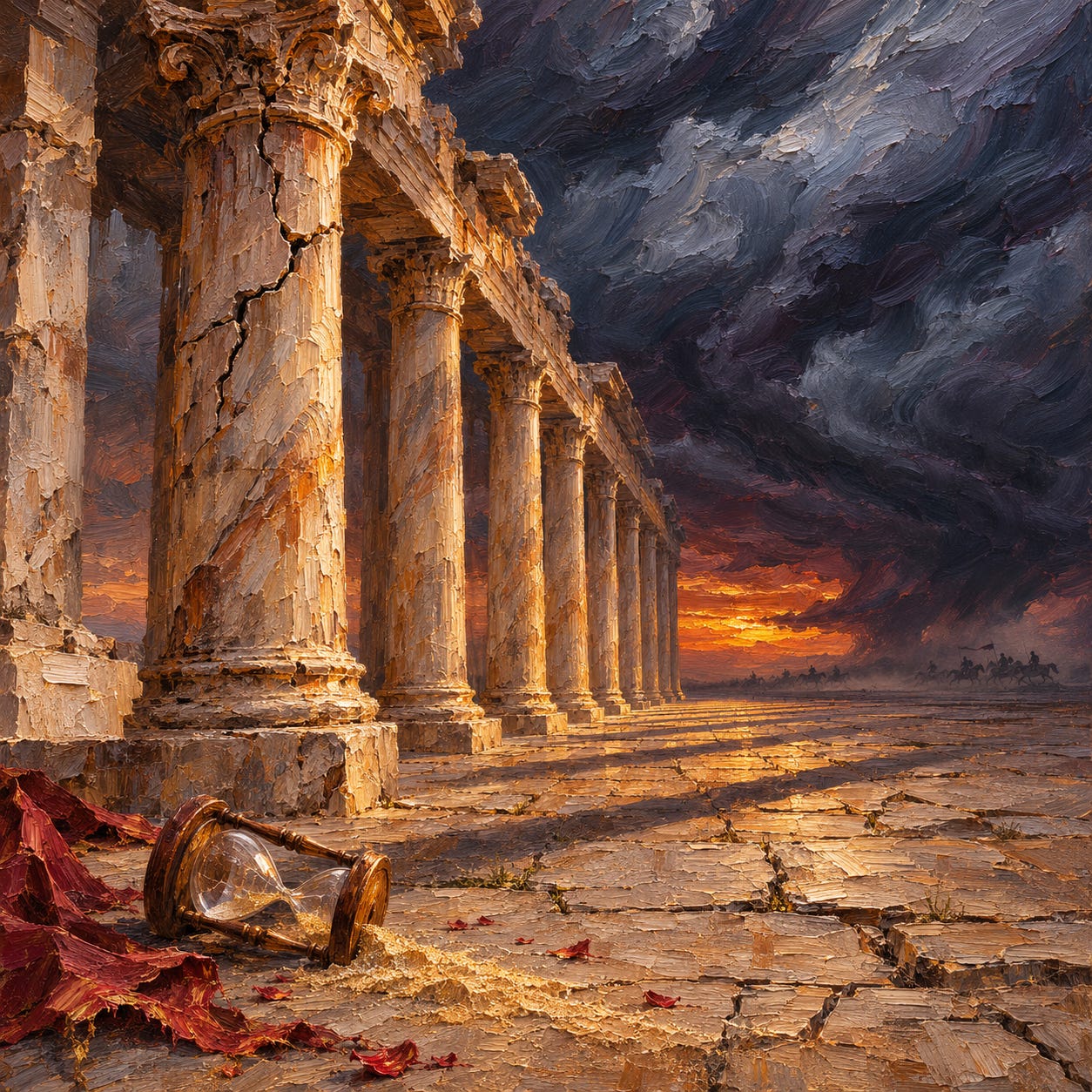
Eleven great empires across three thousand years — Assyria 247 years, Persia 208, Greece 231, the Roman Republic 233, the Roman Empire 207, the Arab Empire 246, the Mamelukes 267, the Ottomans 250, Spain 250, Romanov Russia 234, Britain 250 — ran almost identical courses from conquest to collapse, clustered around a figure of ten human generations. The clustering is not refined by hindsight. It is what the dates record. Sir John Glubb’s The Fate of Empires and Search for Survival, published by William Blackwood & Sons in 1976-77, was built on the observation that this regularity does not depend on technology, geography, religion, or political institutions. The Assyrians marching on foot with spears and the British sailing the oceans with artillery held their empires for about the same length of time. Something internal to the human material imposes a ceiling that the arrival of railways, aircraft, or parliamentary democracy has done nothing to lift.
John Bagot Glubb was born in 1897, the son of a Royal Engineers officer, and left England for Mauritius at age four. He entered the Royal Military Academy at Woolwich in September 1914, was commissioned in the Royal Engineers in April 1915, served through the First World War in France and Belgium, was wounded three times, and was awarded the Military Cross. In 1920 he volunteered for Iraq as a regular officer; in 1926 he resigned his commission to take an administrative post under the Iraq Government. From 1930 he served the Transjordan Government, and from 1939 to 1956 he commanded the famous Jordan Arab Legion, which was in reality the Jordan Army — a tenure that earned him the title Glubb Pasha. By the time of this essay he had published seventeen books, chiefly on the Middle East, and had lectured widely in Britain, the United States, and Europe. His authority on the Arab Empire specifically — a civilisation whose decline he regarded as an exact precursor of Britain’s — rests on fifty years inside the region, not on secondary reading.
The essay first appeared in two parts in Blackwood’s Magazine before the 1976-77 book edition, during a period when Britain itself was approximately ten generations past its 1700 imperial awakening and visibly running the terminal course the essay describes. The welfare state, introduced in Britain as the high-water mark of human development, had already begun exhibiting the structural strains Glubb traces in late Abbasid Baghdad. Parliamentary courtesy had lapsed into booing and shouting. London’s streets carried Cypriots, Greeks, Italians, Russians, Africans, Germans, and Indians, with original Britons increasingly hard to find. Universities had multiplied into every town. The five-day work week had been introduced. The European Economic Community was a practical attempt to recover by voluntary association what empire once imposed by conquest. Glubb was writing, in other words, from inside precisely the pattern he was documenting, and the tenth-century Baghdad historians he quoted — on degenerate officials, erotic “pop” singers with lutes, women demanding entry to the professions, agitation for female judges, and a five-day week introduced in a moment of financial stringency — could have been describing the London of the week he sat down to write.
Among the findings the full summary unpacks: the six stages through which every great nation moves — Pioneers, Conquests, Commerce, Affluence, Intellect, Decadence — and the specific mechanism by which each produces the next; the seven markers that distinguish the final age (defensiveness, pessimism, materialism, frivolity, the influx of foreigners, the welfare state, and the weakening of religion), and their nearly identical appearance in tenth-century Baghdad and twentieth-century London; and the four causes of decadence, named plainly as too long a period of wealth and power, selfishness, love of money, and the loss of a sense of duty. The first free public hospital opened in Baghdad under Harun al-Rashid between 786 and 809. Within a century, the empire that built it had fragmented into independent principalities, its capital overrun by Turkish mercenaries, its historians lamenting pop singers and female judges in words that read today like morning headlines.
Related


Reader’s Guide PDF Download & Audio Deep Dive (Paid Subscribers Only)
The rest of this Reader’s Guide — the analogy, one-minute elevator explanation, 12-point summary, Q&As, and Golden Nugget — is for paid subscribers.
Your subscription also unlocks every other Guide in the library, the Deep Dive Audio Library, my original books (new ones added monthly), and three series for the moments when a real decision is in front of you: Questions for Your Doctor, Before You Consent, and Package Inserts.