

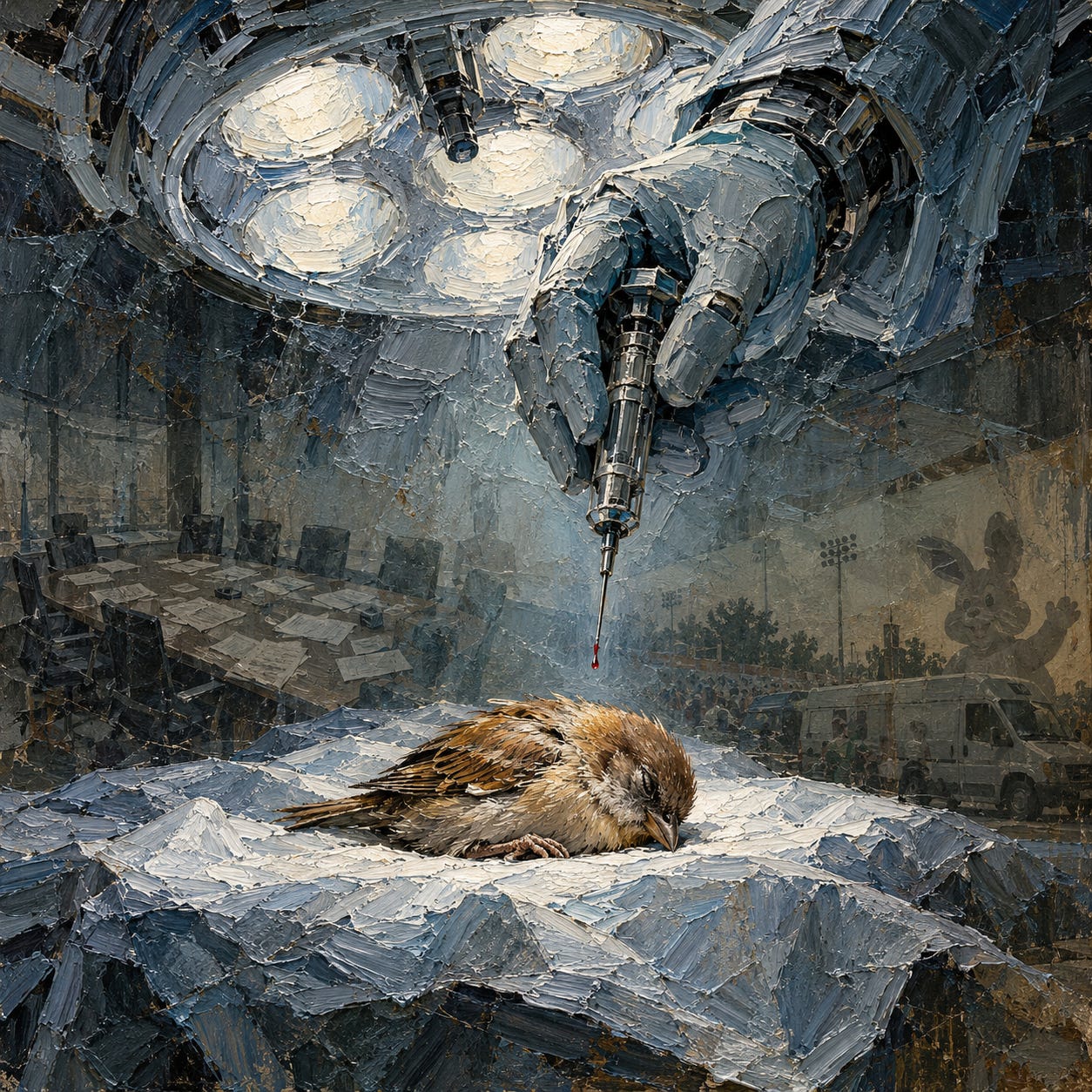
A companion essay to What Is a Fang? That essay recorded the bypass of the body. This one examines a 2025 Australian public-health paper and a 2026 American hospital program that extends its logic, and records the bypass of everything the body is attached to. The paper’s own vocabulary (barrier, hesitancy, phobia, vaccine champions, dialogue-based intervention) appears here in attribution and quotation. My analytical voice is not endorsing that vocabulary. It is reading what the vocabulary is for.

In the vocabulary of public-health policy, a barrier is anything that stands between a child and a needle. The barrier must be identified and mapped. It must then be defeated. The language is engineering language. A barrier is a problem of design.
An Australian paper¹ published in October 2025 in the Australian and New Zealand Journal of Public Health has the word barrier in its title and uses it throughout. The paper is titled Getting more kids vaccinated on time: Strategies and broader policy considerations to address caregiver-identified barriers to childhood immunisation in Australia. It was funded by the Australian government. Its senior author disclosed travel support from the vaccine manufacturer Sanofi. The strategies the paper recommends came from a seventy-minute online workshop with eleven participants from the project’s own advisory group. The paper is peer-reviewed. It describes, in detail, how to engineer around parents who are declining to have their children injected.
Essay PDF Download (Free Subscribers)
Audio Deep Dive (Paid Subscribers Only)
Support This Work
The essays are free and will stay free. What paid subscribers get is the library that surrounds them: the full digital book catalogue, audio deep dives, archived, and embedded in each essay, and the Questions for Your Doctor, Before You Consent, and Package Insert series. Platinum Supporters also receive the digital edition of every paperback on the day it’s published.
Whichever tier suits, thank you for being here. If you’d like to become a paid subscriber, upgrade a tier, or gift a subscription to someone who might value the work, the options are below.
The first barrier: a parent weighing a decision
The paper lists the most common barriers cited by parents of partially vaccinated children. In descending order: finding it difficult to get a vaccination appointment when the child’s vaccination is due (24.8 percent); not prioritising vaccination over other things (23.9 percent); not being able to afford costs associated with vaccinating the child (20.5 percent); not believing vaccines are safe for the child (17.7 percent), are effective (14.3 percent), or help protect others (14.0 percent); and not trusting information about vaccination from the child’s doctor or nurse (16.8 percent).¹
The first and third items name practical constraints. The others name a parent thinking.
“Not prioritising vaccination over other things” describes a parent weighing an appointment against the shape of a child’s day and deciding something else matters more. “Not believing vaccines are safe for the child” describes a parent assessing a product and reaching a judgment. “Not trusting information about vaccination from the child’s doctor or nurse” describes a parent noticing a pattern in what they are being told.
Each of these is thinking. The paper classifies each one as a barrier.
The classification does the work the rest of the paper is written to accomplish. If the parent’s thinking is the barrier, then the parent’s thinking is what the strategies must defeat. The paper proposes “dialogue-based interventions,” “communication training,” “vaccine champions,” and “campaigns to inform or educate the public.”¹ None of these is proposed as a response to what the parent is thinking. Each is proposed as a technique for arriving at a different thought.
In the paper’s grammar, the parent’s judgment is renamed resistance.
The second barrier: a parent noticing something
The paper devotes substantial attention to what it calls trust. Trust is not something the healthcare system has or has not earned. It is a resource to be managed and routed through particular channels.
One of the paper’s quoted immunisation policymakers tells the authors: “Vaccination is completely about trust. Vaccination is different from every other medication in that you’re asking a parent to give something to their child when, for all intents and purposes, there’s nothing actually wrong with the child. Gaining that trust again through effective communication is key for us.”¹
That quotation contains the entire argument the paper exists to deflect. A policymaker is saying out loud that the child is well, that the intervention is being proposed on a well child, and that the parent can see as much. The job of the apparatus, from that admission forward, is to get past what the parent can see.
The paper describes how trust is to be engineered. “Dialogue-based vaccination counselling training across the health sector.” Medicare-funded “longer vaccination consultations” so providers have “paid time for vaccination counselling.” Healthcare professional vaccination “champions” in facilities to mentor other staff. The National Immunisation Information Line, to be made more prominent. Communications tailored to parents who do not use “traditional written resources.”¹
None of this is responsive to the reason trust declined. The paper notes in passing that trust was damaged during the COVID-19 period, then moves on. The question of what happened during that period, and whether the parents’ changed assessment might contain accurate information about the behavior of the institutions involved, is not asked. The paper treats declining trust as a problem to be solved by the same institutions whose behavior reduced it.
In the same year the paper’s research was carried out, its senior author accepted paid travel from Sanofi, which makes vaccines. The conflict is disclosed at the paper’s end, not treated as bearing on the trust question the paper otherwise devotes itself to.
The third barrier: a child’s body
The American program examined in the next section reports that roughly a third of children vaccinated under anesthesia “wouldn’t have otherwise received the flu vaccine due to needle phobia, limited healthcare access or vaccine hesitancy.”²
The three items name different kinds of thing. “Limited healthcare access” is a practical constraint. The other two put medical labels on people: a parent’s judgment is called “vaccine hesitancy,” and a child’s refusal is called “needle phobia.”
The word phobia performs the same work the word barrier performs in the paper: it reclassifies a response as a defect. A phobia is irrational by definition and lives in the child rather than in the thing the child is responding to.
What Is a Fang? noted that the body’s flinch at the needle is accurate information about what a certain class of object is for, and that the medical system has learned to call this accurate information a phobia. The Australian paper and the American program show what the renaming is for. Once the child’s flinch is a phobia, it is a condition the clinic manages. The question of whether to administer the injection never has to engage with the question of what the child’s body is saying.
The paper proposes several methods for presenting the needle in a form the child’s recognition will not fire on. “Onsite vaccinations at community events, public places and sporting events, paired with local incentives like food or clothing (e.g. T-shirts, shawls, baby vests with logos), tailored to local needs.” Vaccine vans. For Aboriginal and Torres Strait Islander families: “vans painted by local artists”; events “framed as celebrations of health, strength and family”; “healthy foods, arts and crafts and storytelling” as part of the vaccination event. One community-member participant is quoted proposing “cartoon-like ‘deadly characters’ promoting vaccination, with whom children could identify.”¹
What gets reconsidered is the presentation. The thing being presented stays the same. The needle in a van at a sporting event, offered alongside food and clothing and a cartoon character, remains the same object the body flinches from. The child’s flinch is what the engineering must prevent.
The fourth barrier: the child’s consciousness
The Children’s Hospital of Philadelphia runs a program called Close Your Eyes, We’ll Immunize. In the 2025–2026 flu season, the program delivered 2,054 flu vaccine doses to children while they were sedated or under anesthesia for an unrelated medical procedure. The program generated over $60,000 for the hospital during the 2024–2025 season. The team hopes to expand to include COVID-19 and RSV vaccines. Similar programs are being piloted at the University of North Carolina at Chapel Hill Children’s Hospital, Seattle Children’s Hospital, and Akron Children’s Hospital.²
The program leaders report, in a May newsletter, that roughly a third of these doses would not otherwise have been given, “due to needle phobia, limited healthcare access or vaccine hesitancy.”²
These categories of refusal are resolved in one operational move. The child’s body cannot flinch. The parent, approached in a hospital corridor minutes before the child is wheeled into surgery, is in no condition to deliberate. Every barrier the Australian paper mapped is engineered around in a single procedure.
The child is asleep. The nurse enters with the syringe. The flinch does not arrive.
The program’s name is addressed to the parent as much as to the child. Close Your Eyes asks the parent to agree not to look. The vaccination occurs in the one setting where the child cannot refuse, the parent is unlikely to insist on detail, and the normal review of the vaccine’s effects will be confounded with the aftermath of the surgery. An anesthesiologist quoted in the reporting notes that side effects such as fevers or rashes “could be confused with severe reactions to anesthetic drugs.”² A pediatrician notes that both anesthesia and the vaccine increase inflammation, that detoxification is impaired under anesthesia, and that “this is a perfect storm to use a setting like the stress of anesthesia and a surgical procedure to further injure children.”²
The program excludes children with a severe allergy to the flu vaccine, children with a history of Guillain-Barré syndrome, and children undergoing bone marrow transplants.²
The exclusion list is where the operators tell on themselves. A severe allergy is an exclusion because the flu vaccine can trigger anaphylaxis. A history of Guillain-Barré syndrome (a nerve condition that can cause paralysis) is an exclusion because of the recognized possibility that flu vaccination can trigger or worsen it. The exclusion list exists because the operators know the vaccine causes serious harm in a documented subset of recipients. The program proceeds in the much larger group where no such harm has yet occurred, or has occurred and has not been attributed.
The anesthesiologist quoted in the reporting makes a related observation: “We simply cannot know how an individual child will respond to these drugs for the first time.”² He is talking about the anesthesia. The same holds for the vaccine. Both are novel to the child receiving them. The program proposes to deliver them together, in a setting designed to defeat the body’s capacity to signal that something has gone wrong, and in a reporting environment that will attribute any subsequent symptom to the surgery.
What a barrier actually is
Read the paper’s title again: Strategies and broader policy considerations to address caregiver-identified barriers to childhood immunisation in Australia.
The caregiver-identified barriers are these: a parent judging the appointment is not the day’s priority; the same parent assessing the risk and finding it not worth the benefit; the parent assessing the evidence and finding the claim unsupported; the parent noticing that the voice offering counsel is no longer trustworthy. A child’s body recognizing the needle for what it is. A child’s mind not wanting the thing the body does not want.
The strategies proposed to defeat these include stakeholder advisory groups, APEASE criteria for ranking interventions, Medicare funding mechanisms for extended counseling time, vans painted by local artists, cartoon characters for Aboriginal children, dialogue-based interventions, provider performance assessment and feedback, default appointments, and automated reminder systems.¹ The paper ranks these on acceptability, practicability, effectiveness, affordability, spillover effect, and equity.
Each strategy is engineered to defeat a particular form of refusal. Each form of refusal is a person exercising judgment. A successful intervention, in the paper’s grammar, is one that produces compliance without the judgment having been engaged.
The paper is not covert about this. Default appointments are endorsed on the grounds that they “normalise” vaccination and bring parents “back to the same providers,” producing continuity of trust by routing the parent through the same channel repeatedly.¹ Reminders are to be automated so they arrive “at any health check.” The architecture seeks the position of least resistance. The position of least resistance is where the parent is not asked.
The syringe defeats the skin, the nose, the tongue, the stomach, the liver, and the lymphatic network in a single act. What this essay has recorded is what the apparatus has been built to do on top of that. The parent’s judgment is bypassed by communication strategy. The parent’s trust is bypassed by scripted dialogue. The child’s fear is bypassed by cartoon characters and painted vans. The child’s consciousness is bypassed by anesthesia.
The fang only had to defeat the body. The system had to defeat everything the body is attached to. The method is published, peer-reviewed, government-funded, and in rollout. The authors did not disguise what they were describing. They assumed we would not read it as what it is.
How to Explain It to a Six-Year-Old
Imagine a grown-up really wants you to eat a certain candy. You do not want the candy. You say no.
The grown-up thinks for a while and comes back. This time the candy is inside your favorite toy. You push the toy away.
The grown-up thinks some more. Now they are dressed as your favorite cartoon character, singing a song about the candy. You still say no.
The grown-up thinks some more. Then they wait until you fall asleep. And they put the candy in your mouth while you are sleeping.
Every time you said no, the grown-up did not ask why. They did not wonder if maybe you were right about the candy. Your no was treated as a puzzle to solve. In the end, the puzzle got solved by waiting until you could not say anything at all.
In Print
The Unbekoming library is available in paperback, printed to order through Lulu and shipped worldwide. The shelf begins with the paradigm question underneath everything else — No Virus, the isolation problem, the collapse of virology’s foundational claims, and a disease-by-disease reappraisal — and moves through the suppressed compounds mainstream medicine set aside: The DMSO Book, Chlorine Dioxide: The Forbidden Remedy, The Iodine Book, and The Hydrogen Peroxide Book. Two more recover what’s still on the kitchen shelf: Baking Soda and The Castor Oil Book. Two more recover the minerals modern soil, water, and processing quietly stripped from the diet: The Magnesium Handbook and The Boron Book. Sitting alongside these is No Contagion, co-authored with Jamie Andrews — the case against germ theory itself, catalogued through 258 failed contagion experiments.
The critique books cover what medicine, dentistry, psychiatry, and veterinary practice have become. The Unvaccinated treats the completely unvaccinated as a comparison group across twenty chapters and five appendices. Medicalized Motherhood follows a woman through 123 documented interventions from teenage pill to postpartum discharge. Drilling for Profit treats cavities, gum disease, and crooked teeth as the dietary problem they are. What Your Vet Can’t Tell You applies the same critique to pets. Escape from Psychiatry documents the fabrication of the DSM and the specific damage of every major psychiatric drug class. The Vitamin K Injection covers what happens in the first hours of a newborn’s life.
The full shelf is at lulu.com/spotlight/unbekoming. A physical book reaches the person a Substack post never will — the skeptical relative, the friend who won’t click a link but might open a book, the visitor whose eye lands on a coffee table. Buy one to keep, and one to give away.
References
Bolsewicz KT, Steffens MS, Dalton L, Kaufman J, Christou-Ergos M, Sabahelzain M, Beard F, Danchin M, Leask J. Getting more kids vaccinated on time: Strategies and broader policy considerations to address caregiver-identified barriers to childhood immunisation in Australia. Aust NZ J Public Health. 2025;49(5):100274. https://doi.org/10.1016/j.anzjph.2025.100274
Burdick S. ‘Stunningly Irresponsible’: Hospitals Push Parents to Vaccinate Kids While They’re Knocked Out for Surgery. The Defender. October 21, 2026. https://childrenshealthdefense.org/defender/hospitals-push-parents-vaccinate-kids-sedated-surgery-chop-initiative/
I am getting flashbacks to that nudge-language of 'Vaccine hesitant' from good ole CV19 propaganda. Anyone who didn't take the proscribed was 'hesitant'. No I am not vaccine hesitant, I am vaccine aware..aware of the BS!! Ahaha!
People think we’ve made so much progress. It was just a period of silence while they reloaded.