

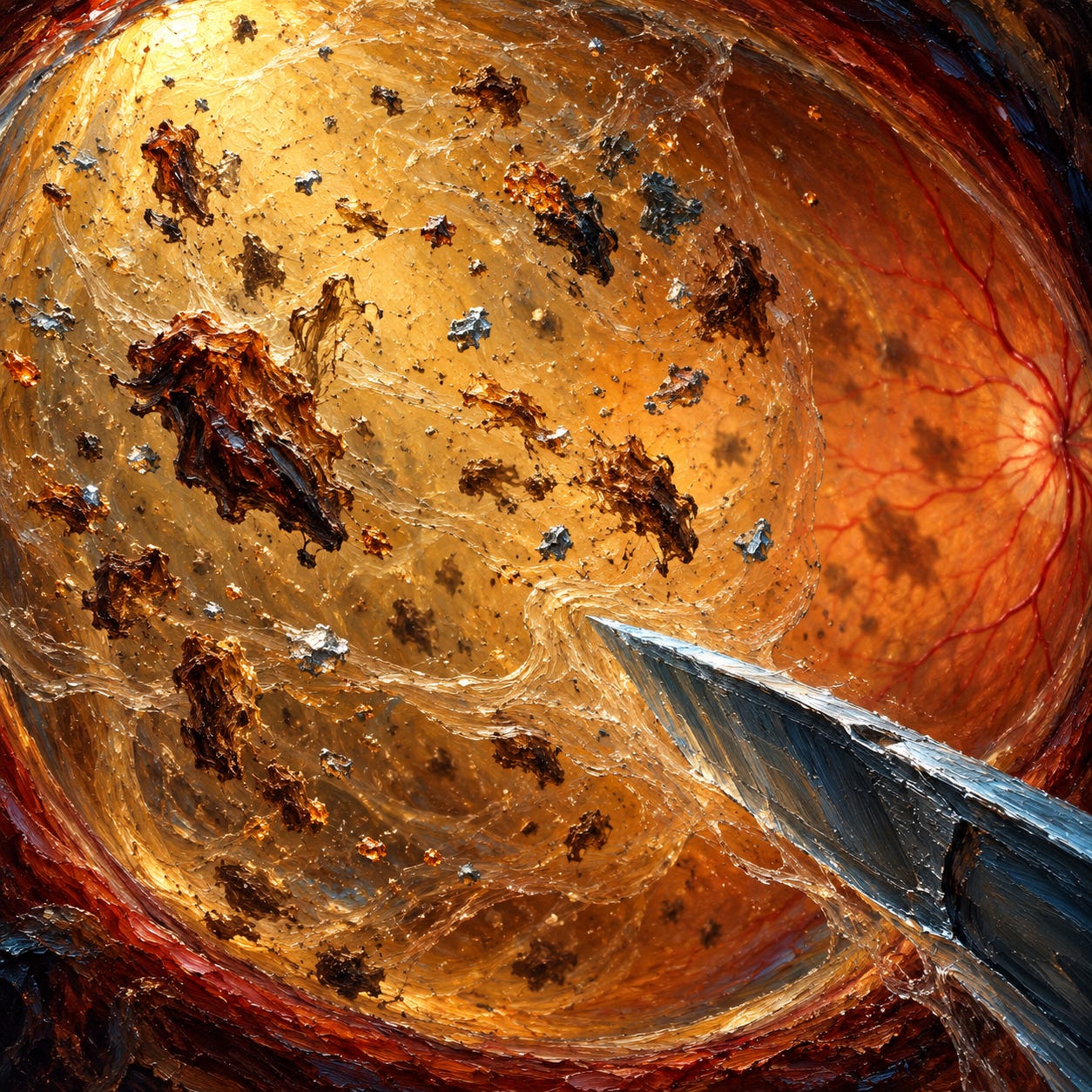
This essay is the second in a three-part sequence that began with a March 2025 conversation between Dr. Andrew Kaufman and Matt from Cultivate Elevate on eye health. The first essay, The Permanent UV Block They Install in Your Eye, took up what cataract surgery does to the eye-pineal pathway. The second, Your Glasses Are Making Your Eyes Worse, took up the three mechanisms by which corrective lenses drive progressive refractive deterioration. This one takes up floaters, the drifting shapes that most people learn to ignore until the day they start to multiply. The essay works in two registers. Where mainstream ophthalmology has documented what it can see about floaters, its findings and its admissions are reported in their own vocabulary, with attribution. Where the essay speaks in its own voice, the frame is terrain. The central question is why the medical profession, having admitted it does not know what causes floaters, offers either observation or the surgical removal of the vitreous as its only interventions, when a terrain reading of the same evidence yields a coherent mechanism and a reversal pathway.

The Offer
A patient presents with drifting shapes in the field of vision. The complaint is not vague. The patient can describe the shapes, when they appeared, how they move, how they have multiplied. The specialist listens, examines, and then explains that there is nothing much to be done. If the patient persists, if the floaters are interfering with reading or driving or quality of life, the specialist offers a surgical intervention called vitrectomy. The procedure removes the vitreous humour from the eye, the gel-like substance that fills the body of the eye between the lens and the retina. The gel is cut away and extracted. The space is replaced with a saline solution, with a gas bubble, or with silicone oil. The floaters go, because the gel that was holding them is gone.
What the specialist does not say, because the medical literature does not permit the specialist to say, is why the floaters were there in the first place. The medical term for the ordinary floater is idiopathic vitreous opacity. Idiopathic is the Latin shrug. It means the cause is unknown. The patient is being offered the surgical removal of a healthy anatomical structure as the response to a condition the surgeon cannot explain.
The strangeness of the offer is the opening the terrain argument needs. The mainstream has not identified a cause, has not identified a mechanism, and does not claim to have identified either. Whatever account fills the vacuum is not displacing an established mainstream account. It is proposing a mechanism where none has been offered. What follows is such an account.
Essay PDF Download (Free Subscribers)
Audio Deep Dive (Paid Subscribers Only)
Support This Work
The essays are free and will stay free. What paid subscribers get is the library that surrounds them: the full digital book catalogue, audio deep dives, archived, and embedded in each essay, and the Questions for Your Doctor, Before You Consent, and Package Insert series. Platinum Supporters also receive the digital edition of every paperback on the day it’s published.
Whichever tier suits, thank you for being here. If you’d like to become a paid subscriber, upgrade a tier, or gift a subscription to someone who might value the work, the options are below.
What a Floater Actually Is
A floater, in physical terms, is a particle or clump of material suspended in the vitreous humour. When light passes through the vitreous on its way to the retina, the particle casts a shadow. The shadow is what the person sees. The particle moves as the eye moves, which is why floaters appear to drift and settle rather than hold their position. The shape of the particle determines the shape of the shadow: the stringy ones, the disc-shaped ones, the clumps that look like small clouds.
The mainstream account identifies two possible physical origins. The first is syneresis, the age-related breakdown of the vitreous gel into more liquid consistency, during which collagen fibrils that had been held in suspension clump together and become visible. The second is posterior vitreous detachment, in which the vitreous pulls away from the retina and the tissue debris released at the detachment interface becomes suspended in the gel. Both accounts describe what the particle is physically. Neither accounts for why it is there in a particular patient at a particular time, or why some eyes develop many and others few, or why the condition has become so common in general populations in industrial countries.
The two mainstream origin stories also do not fully account for the particles patients describe seeing. Syneresis and posterior vitreous detachment produce visible collagen clumps and tissue debris. They do not, on their own account, produce the small dark specks, the dot patterns, or the particulate matter that patients frequently report. The gap between what the mainstream mechanism predicts and what patients actually see is one of the places the mainstream account fails on its own terms.
Meir Schneider, who built a practice around natural vision restoration, identifies the physical substance of floaters as bits of collagen drifting in the vitreous humour and casting shadows on the retina.¹ His account overlaps with the mainstream syneresis story on the physical level but departs from it on the question of mechanism. Schneider treats floaters as debris the body has produced in response to something, which the body can also, in response to appropriate intervention, clear. The mainstream, having identified the material as collagen, treats the question as closed. The question of why collagen is clumping in the vitreous in the first place does not get asked.
A century before Schneider, William Horatio Bates was already locating the cause of floaters outside the eye. In his 1920 clinical account, Bates described floating specks as linked to the condition of the body rather than the eye alone, appearing especially during attacks of what he called biliousness and most often in the myopic.² The vocabulary is dated. The direction of inference is not. Bates was reading the eye as a report on the systemic condition behind it, and the floater as one of the places where systemic disturbance became visible. The modern terrain framework reaches the same conclusion from a different starting point.
The Nested Mechanism
The terrain account begins with what the body is doing when it accumulates heavy metals. In the industrial environment, humans absorb metals through food (agricultural residues, farmed fish, cookware leaching), through water (pipe residues, treatment chemicals, wells contaminated by mining and industrial discharge), through air (coal plant emissions, vehicle exhaust, industrial particulates), and through direct deposition (amalgam dental fillings, aluminum from antiperspirants and vaccines, mercury from skin creams and some pharmaceuticals, lead from lipsticks and from old paint). The body stores what it cannot immediately clear. The storage sites include the liver, the kidneys, the brain, the bones, the fat tissue, and the connective tissue throughout the body.
The eye is downstream of all of these. The retina is one of the most densely vascular tissues in the body and receives the metal burden that circulates through the blood. The vitreous is the opposite case. It is an avascular gel, meaning it has no blood supply of its own. What arrives in it, through the retinal vessels or through diffusion from the surrounding structures, remains there, because the vitreous has no circulation to carry it away. The combination is unfortunate for the eye. The retina delivers; the vitreous accumulates.
The second layer of the mechanism is what metals do to the tissue around them. Heavy metals are redox-active in the biochemical environment of living tissue, meaning they shift between oxidation states and generate free radicals as they do so. Free radicals attack the lipid membranes of cells, the proteins that make up tissue structure, and the collagen fibrils that give the vitreous its organisation. The result is oxidative damage: peroxidised lipids, fragmented proteins, and oxidised collagen. These are physical products. They are fragments of what the tissue used to be. They remain suspended in the vitreous because the vitreous has no clearing mechanism.
The two layers together describe the floater as a dual phenomenon. The metal particles themselves are visible as small dark specks and dot patterns. The oxidised collagen and lipid fragments are visible as the stringy and disc-shaped forms the mainstream syneresis account identifies. Both arise from the same underlying process. Both increase as the terrain insult accumulates. Both respond to the same interventions.
This mechanism is not speculation drawn from first principles alone. Each step is documented in mainstream biochemistry. That heavy metals cause oxidative damage is standard. That oxidative damage produces lipid peroxidation products and fragmented proteins in tissue is standard. That these fragments are physical particulate matter is standard. That the vitreous accumulates what enters it, lacking the clearing mechanisms other tissues have, follows directly from its anatomy. The only step requiring inference is that this process is what floaters are. Given the mainstream admission that the cause is unknown and the nested mechanism’s consistency with each biochemical step, the inference is well-supported.
The Pattern of Who Gets Them
The terrain reading predicts that floaters will be more common in populations with higher cumulative toxic burden, more common in populations with lower antioxidant capacity, more common with increasing age (because the burden is cumulative), and more common in people with other visible markers of terrain disturbance such as cataracts, chronic inflammation, or neurological symptoms. The clinical pattern reported by terrain-oriented practitioners is consistent with these predictions. The specific comparative data that would settle the question across populations has not been assembled, because mainstream researchers do not study the question.
The mainstream reads the age distribution as evidence that floaters are an age-related phenomenon. The terrain reading identifies the same data as evidence that floaters are a cumulative-burden phenomenon. Age correlates with both, which is why the mainstream reading looks superficially explanatory, but the age correlation is a correlation with duration of exposure rather than with age itself. A person who has avoided the toxic exposures of industrial life, who has maintained strong antioxidant status through diet, and who has not accumulated heavy metals is observed, clinically, to develop floaters at substantially lower rates than peers in the general population. The question of whether this clinical observation holds at the population level is unanswered, because the population study has not been performed.
A floater is a report on the terrain that produced it. The report is accurate. The question the mainstream does not ask is what the terrain is reporting on.
What Vitrectomy Actually Costs
The vitrectomy offer, named in the opening, deserves closer examination. The procedure is aggressive. It is performed under local or general anesthesia. It carries a documented risk of retinal detachment in the months following the operation. It carries a high likelihood of accelerated cataract formation in the operated eye, with the majority of patients requiring subsequent cataract surgery as a direct consequence. It carries risks of endophthalmitis, of macular edema, of elevated intraocular pressure, and of a range of other complications documented in the surgical literature.
The clinical culture that produces this offer is the one Essay Two identified. Ophthalmology perfects an intervention it never tries to understand. The clouded lens is removed. The clouded lens is not asked why it clouded. The refractive error is corrected. The refractive error is not asked why it developed. The vitreous is cut out. The vitreous is not asked why the floaters are there. In each case the response is mechanical. In each case the response addresses the symptom and participates in producing more of the conditions that will require further intervention.
The vitrectomy patient leaves the operation with less vitreous and a probable future cataract. The floaters are reduced because the gel that was holding them is gone. The question of what the floaters were, and what their presence was indicating, is not asked. The vitreous that was performing structural work in the eye is replaced with saline. The eye continues under conditions less favourable than those under which it was floating.
The alternative to vitrectomy that the specialist does not raise is the one the terrain reading predicts should work: addressing the accumulation and the oxidative stress that produced the floaters in the first place.
The Reversal Pathway
If floaters are the result of heavy metal accumulation and oxidative damage in the vitreous, then addressing the accumulation and the oxidative stress should reduce them. The mainstream has not studied this because the mainstream does not read floaters this way. The practitioners who do read floaters this way report that the predicted reduction is what happens in patients who undertake the work.
The pathway has four elements. The first is reducing ongoing exposure. Identifying the metal sources (amalgam fillings, aluminum cookware, antiperspirants, medications, certain cosmetics, certain foods, certain water supplies) and removing or replacing them stops the inflow. Without this step, downstream detoxification work is undermined by continuing input.
The second is supporting the body’s clearing capacity. The pathways by which heavy metals leave the body are hepatic (through the bile and stool), renal (through the urine), and dermal (through sweat). Each depends on the terrain being able to perform the work. The companion essay Cataract identified the four converging terrain insults that produce the clouded lens: toxic light and EMF exposure, nutritional and metabolic acidification, pharmaceutical drugs, and oxidative stress.³ The same four forces produce the floater. Addressing them, through dietary correction, drug review, hydration and movement, and light hygiene, supports the body’s capacity to shed what has accumulated.
The third is targeted mobilisation. Practitioners who do this work use a range of substances documented to bind and mobilise stored metals: chlorella and cilantro among the plant chelators, zeolite and modified citrus pectin among the structural binders, selenium and glutathione among the sulfur-pathway supporters. The clinical literature on each is uneven and the appropriate protocol depends on the specifics of the person’s terrain. The principle is that stored metals can be moved, and that moving them reduces the burden on the tissues where they have been residing.
The fourth is restoring antioxidant capacity. The oxidative damage layer of the floater mechanism is driven by the body’s inability to neutralise the free radicals generated by the stored metals. Rebuilding antioxidant capacity through dietary nutrient density, through reduced oxidative insults (screens, EMF, pharmaceutical drugs, processed food), and through the whole-foods matrix that supports the body’s own production of glutathione and the other endogenous antioxidants, closes the loop. The free radicals are neutralised before they produce the oxidised fragments. The vitreous ceases to receive the input that was feeding the floater.
Schneider also reports an additional intervention specific to the eye itself. He describes rapidly shifting the eyes back and forth across the floating spots in bright light as a technique that helps to dissipate them, on the theory that the rapid eye movement causes the vitreous fluid to swish and break up the clumps.¹ The empirical claim, that targeted eye movement in bright light reduces floaters, is reported by his patients. The specific biomechanical explanation he offers is uncertain, but the clinical observation falsifies the mainstream claim that floaters are fixed structural features requiring either observation or surgery. If they can be reduced by eye movement, they are not fixed. If they are not fixed, the mainstream account that treats them as such is wrong on its own terms.
The reversal pathway is slow. It depends on the specifics of the person’s terrain, the duration and extent of the accumulation, and the sustained attention they bring to the work. It does not guarantee reduction in every case. It is not what ophthalmology offers. It does not involve removing the vitreous. It addresses what produced the floaters rather than what the floaters look like.
The Pattern Across the Three Essays
The three essays in this sequence, together with the earlier companion piece Cataract, document a single pattern repeating across different conditions. The clouded lens is removed and a UV-blocking implant installed. The refractive error is corrected and the prescription climbs. The vitreous is cut out and the cataract follows. Each condition is a terrain report. Each response is mechanical. Each intervention generates the next intervention.
The eye travels through a sequence of procedures each of which answers the symptom of the previous one. The ophthalmologist is paid at each step. The patient’s eye reaches old age having been operated on three or four times, each operation producing new conditions the next operation will address. At no point in the sequence does anyone ask what the terrain was doing when it produced the first condition, because asking that question would redirect the patient out of the sequence altogether.
The alternative Bates set down in 1920 and Schneider carried forward is simple to state and difficult to practise. The eye is a living organ in a terrain. The conditions that develop in it are reports on the terrain. The terrain can be addressed. The reports can diminish. This is not what ophthalmology offers because ophthalmology is organised around removal and compensation rather than around understanding and reversal.
The floater, in this reading, is not a mystery. It is a report. The mystery is why the profession that admits it does not know what the report is reporting on offers to remove the organ delivering the report rather than ask what the report is about.
How to Explain It to a Six-Year-Old
Imagine your house has a small pile of dust that keeps forming in one corner. You don’t know where the dust is coming from. You just know it keeps appearing.
The man who comes to help says he doesn’t know where the dust is coming from either. But he can take the whole corner of the house away. Just cut it out and replace it with something plain. The dust won’t be there anymore, because the corner won’t be there anymore.
Or, you could try to find out where the dust is coming from. Maybe it’s a crack in the wall letting in dirt. Maybe it’s old wood breaking down. Maybe it’s something tracking in from outside. If you fix the cause, the dust stops forming on its own, and you don’t have to cut out any part of your house.
The dust is the floaters. The corner is your vitreous. The man is the eye surgeon.
The man cuts out the corner. The dust is never asked where it came from.
References
Schneider, Meir. Vision for Life: Ten Steps to Natural Eyesight Improvement. North Atlantic Books, 2012. For the identification of floaters as collagen fragments in the vitreous and for the targeted eye-movement intervention.
Bates, William Horatio. Perfect Sight Without Glasses, 1920. The edition referenced here is the 2005 Sterling Publishers edition. For Bates’s description of floating specks as linked to the condition of the body rather than the eye alone.
Cowan, Thomas S. “Cataract: An Essay on Light, Poison, and the Wisdom of Opacity.” Unbekoming, February 2026. The earlier companion essay examining the four converging terrain insults that produce the clouded lens and apply equally to the floater: toxic light and EMF exposure, nutritional and metabolic acidification, pharmaceutical drugs, and oxidative stress.
Thank you very much for sharing this interesting article. I would like to add some research that I consider particularly relevant, as it explores both potential interventions targeting the mechanisms of vitreous degeneration and available ophthalmological treatments.
——1. FLIES clinical trial (2021): antioxidants and vitreous protection.
A randomized, double-blind study involving 61 patients over a six-month period. It investigated a combination of lysine, vitamin C, grape seed extract, zinc, and *Citrus aurantium*. The treatment group showed improvements in visual discomfort and a reduction in the area of vitreous opacities.
Full study:
https://pmc.ncbi.nlm.nih.gov/articles/PMC8525826/
——2. Plant-derived proteolytic enzymes (2022).
A trial involving 224 patients examined a combination of bromelain, papain, and ficin over a three-month period. Improvements in vitreous opacities were reported; however, these results require confirmation through higher-quality, independent studies.
Full study: https://pmc.ncbi.nlm.nih.gov/articles/PMC8525826/
——3. 2024 review on the treatment of vitreous opacities ("floaters").
This review analyzes vitreous degeneration and therapeutic alternatives—including YAG laser vitreolysis and vitrectomy—along with their respective benefits, limitations, and risks.
https://pubmed.ncbi.nlm.nih.gov/39046174/
——4. American Academy of Ophthalmology clinical guidelines (2025).
An update to the recommendations regarding posterior vitreous detachment, retinal tears, and the prevention of complications that could compromise vision. https://pubmed.ncbi.nlm.nih.gov/39918519/
——5. National Eye Institute. An accessible explanation of how aggregates within the vitreous humor cast shadows on the retina, and when these "floaters" require an ophthalmological evaluation. https://www.nei.nih.gov/eye-health-information/eye-conditions-and-diseases/floaters
——6. 2026 clinical update on posterior vitreous detachment.
A review of the mechanisms of degeneration, diagnosis, follow-up, and therapeutic options. It also notes that clinical evidence regarding antioxidant supplements remains limited.
https://www.ncbi.nlm.nih.gov/books/NBK563273/
Regarding zeolite, chlorella, and heavy-metal detoxification protocols, there is research on their potential utility in specific cases of exposure to toxic substances; however, clinical trials are required to demonstrate that they can eliminate "floaters" or restore the transparency of the vitreous humor.
Furthermore, I believe it is essential to focus on a healthy diet. A diet rich in fruits, vegetables, polyphenols, carotenoids, vitamin C, and other micronutrients provides compounds that contribute to antioxidant defense mechanisms and cellular protection. A varied, minimally processed, and nutritionally balanced plant-based diet can support overall eye health, although it has not yet been shown to specifically prevent or reverse "floaters."
Further research is needed into the role of oxidative stress, glycation, and alterations to the extracellular matrix—specifically the collagen and hyaluronic acid present in the vitreous humor. The key lies in distinguishing between biochemical plausibility and clinical efficacy. The most promising lines of research are not necessarily those that claim to eliminate toxins, but rather those that demonstrate a genuine ability to modify the structure of the affected tissue—always bearing in mind that prevention is better than cure.
Thank you once again for sharing this information and for fostering new avenues of research.
I took a 6 week heal your vision naturally course with Dr. Ainhoa de Federico and it was a game changer. We are self healing, miraculous, eternal beings and when you see that, it changes everything. Matt is getting hammered by many eye doctors and for good reason. The they don't want us to know just how powerful we are! Love Matt and Andy and Ainhoa, and YOU! Keep on keepin' on, the truth is coming out fast!