

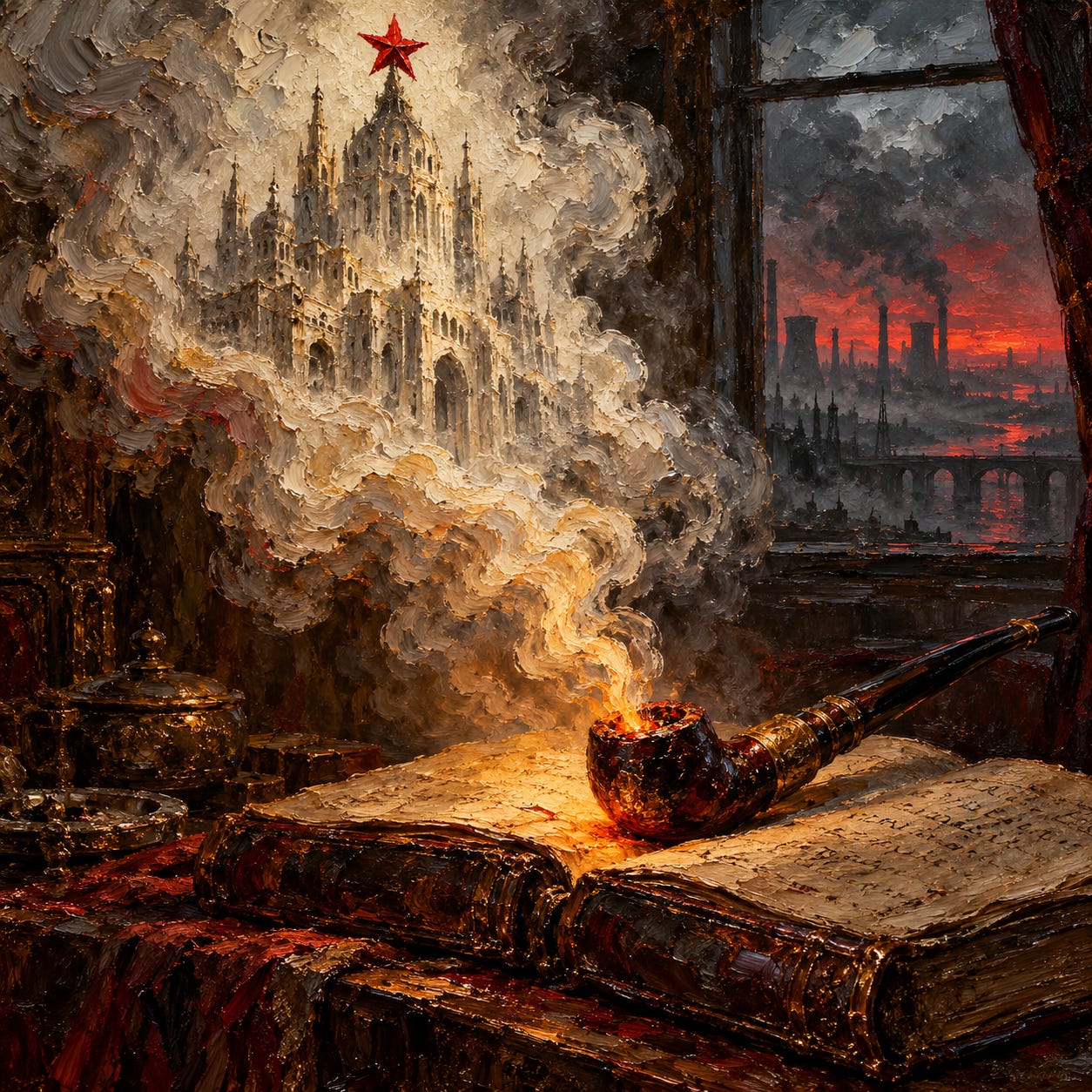
Communism succeeded not because its doctrine was more true than its rivals but because it was better armed. Positivism, Saint-Simonism, Comte’s Religion of Humanity, Rousseau’s civil religion — all attempted the same project, a secular religion to fill the vacancy Christianity had left, with comparable ambition and in some cases superior craft. All failed. The Bolsheviks succeeded because in October 1917 a party seized state power, and thereafter had the police, the army, the international organisation, and the diplomatic weight of a great power to deploy in the doctrine’s diffusion. The diffusion followed the Revolution; the Revolution did not follow the diffusion. This is the central structural claim of The Opium of the Intellectuals, published in Paris in 1955 by Raymond Aron: that the postwar French intelligentsia’s tolerance of Soviet crimes was not an intellectual position but a religious one, and that the religion was successful because of state power rather than theoretical merit.
Aron was trained at the École Normale Supérieure, formed in German philosophy, and intimately familiar with the Sartrean milieu at St-Germain-des-Prés from which the book’s chief targets emerged. He knew his adversaries as colleagues and former friends. His other works — Peace & War: A Theory of International Relations, the two-volume Main Currents in Sociological Thought covering Montesquieu, Comte, Marx, Tocqueville, Durkheim, Pareto, and Weber, In Defense of Decadent Europe, Politics and History — established him as the serious liberal counterweight to the French Left’s dominance of mid-century intellectual life. He was marginalised within that life for exactly that reason. The École Normale produced him and the École Normale largely refused him; the honour of being the single lucid man in a room of brilliant ones is not one that produces warmth from those who share the room. He wrote from that position without self-pity and without concession.
France in 1955 was a country in which the Communist Party commanded roughly a quarter of the vote, the Fourth Republic staggered from one unstable government to the next, Indo-China had just been lost at Dien Bien Phu, and the dominant philosophical fashions were Marxism and Existentialism. Sartre and Merleau-Ponty voted for the Communist Party without believing in Communism, and the pattern spread through the Parisian intellectual class — Simone de Beauvoir’s Les Mandarins had just won the Prix Goncourt, flesh-and-blood mandarins were making the pilgrimage to Moscow and Peking. The book appeared on the eve of the Twentieth Party Congress and Khrushchev’s Secret Speech — before the official admission that Stalin had executed hundreds of thousands of innocent Communists through terror and forced confessions, before the Polish and Hungarian revolts, before the collapse of the Mausoleum cult. What the fellow-travellers were defending at the moment Aron was writing was a régime whose horrors would within eighteen months be acknowledged by its own General Secretary. Aron was asking why intelligent people had refused to see what was in front of them, and his answer was that they had replaced seeing with believing.
The book sits on the political-economy and institutional-capture shelf alongside Sowell, Quigley, Knuth, Haxey, Illich, and Gatto — a diagnosis of how an educated class comes to serve a doctrine against the evidence of its own experience. The full summary unpacks three interlocking myths that gave the pattern its structure: the Left as a permanent front of virtue, the Revolution as the shortcut past the compromises of politics, and the Proletariat as the class elected by history to redeem humanity. It traces the detailed anatomy of Communism as a secular religion, with Party replacing Church, interpretive scholasticism replacing theology, and the classless society replacing the Kingdom of God. And it works through Aron’s distinction between the militant, the sympathiser, the churchman, and the faithful — four types the surface labels never distinguish, which combine in every possible way and together explain why no one in the Communist orbit wholly believes the doctrine yet no one openly departs from it. Aron closes with the image of the French intelligentsia murmuring to one another, “What’s the point of it all, if it isn’t universal?” The question is the disease, and the willingness to accept the concrete work of an unglamorous nation as work worth doing would be the beginning of the cure.
Related


Support This Work
The essays are free and will stay free. What paid subscribers get is the library that surrounds them: the full digital book catalogue, audio deep dives, archived, and embedded in each essay, and the Questions for Your Doctor, Before You Consent, and Package Insert series. Platinum Supporters also receive the digital edition of every paperback on the day it’s published.
Whichever tier suits, thank you for being here. If you’d like to become a paid subscriber, upgrade a tier, or gift a subscription to someone who might value the work, the options are below.