

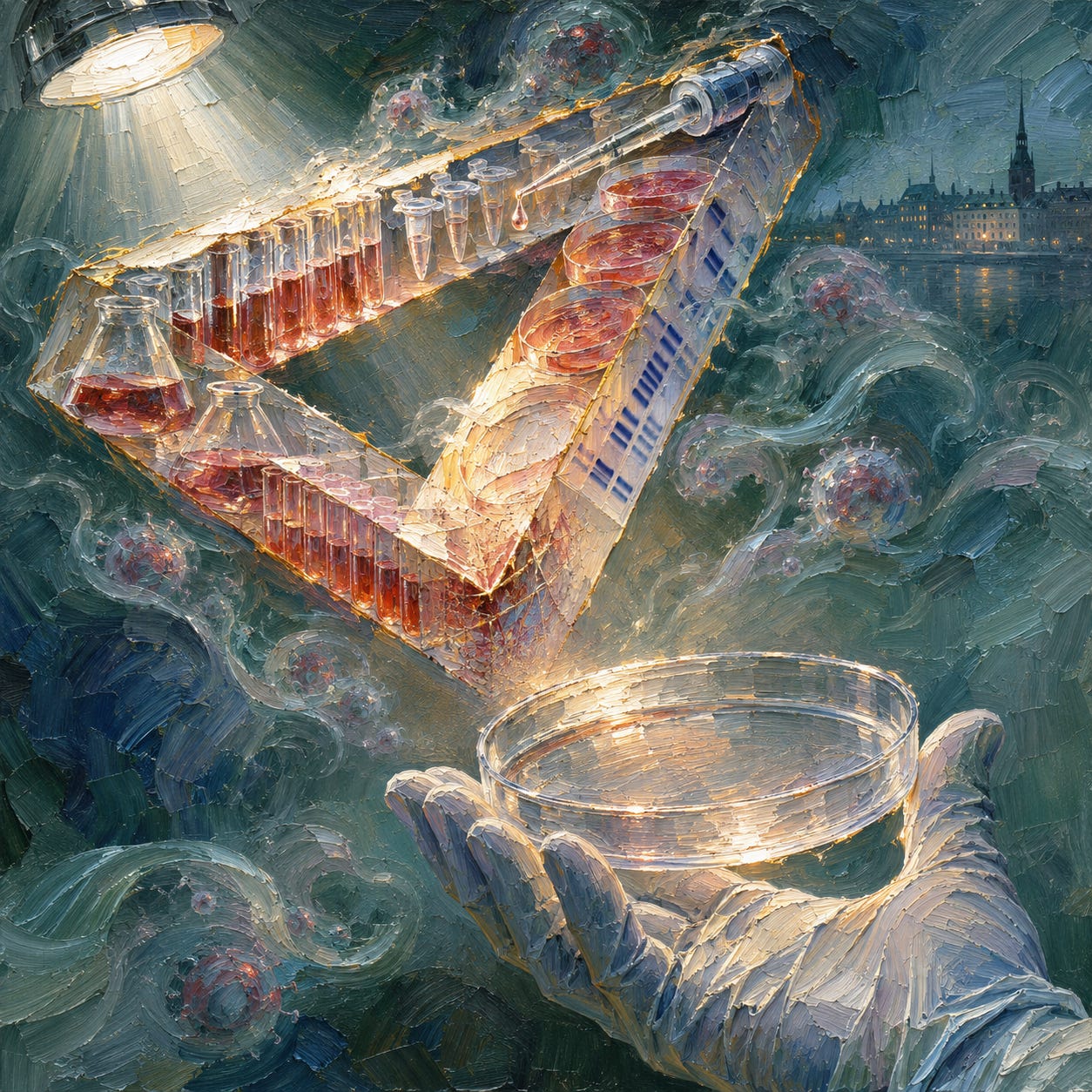
Every other category of nanoparticle in a biological sample can be isolated, visualised, and characterised with current separation and imaging methods — vesicles, exosomes, mitochondrial fragments, bacteriophages. What virology calls viral particles are the exception. After more than a century of research, no homogeneous, intact particle of the kind virology posits has been purified directly from blood, sputum, or tissue taken from a sick patient. That empty hand is the observation Magnus Burling and Fredrik Elwinger place at the centre of The Virus Puzzle — a 246-page examination of virology on its own terms, published in Swedish as Virusgåtan and now released in English. The book joins a growing library of serious challenges to the foundations of the field — Stefan Lanka’s work, the Baileys’ The Final Pandemic, Tom Cowan’s The Contagion Myth, Daniel Roytas’s Can You Catch a Cold? — and the field needs every one of them. The fraud sits deep. The institutions defending it are well-resourced and their public reach is near-total. Another axe at the roots is welcome.
Burling is a Swedish physician, MD, and a specialist in family medicine with more than twenty years of clinical experience. Elwinger holds a doctorate in physical chemistry and has spent more than twenty years in research and development within the life sciences. Neither is an academic virologist — and that is the point. The book’s angle of attack comes from methodological ground adjacent to the field: a clinician who has worked downstream of virology’s diagnostic chain for two decades, and a credentialed chemist who understands purification, chromatography, sequencing, and biochemical characterisation at a working R&D level. The English edition carries no author bios, which has struck more than one reader as a strange omission; Burling has since confirmed, in correspondence with this reviewer, that the oversight will be corrected in a future update. What the book delivers in place of a bio page is sustained, document-level engagement with virology’s own methods. Burling has described the COVID period as the moment he saw, step by step, how much of the field rests on an assumption — that small invisible particles are transmitted and cause disease — and how rarely that assumption has been scrutinised at its foundation. The book is that scrutiny.
The method is to walk virology’s own workflow from patient sample to published genome and ask, at every step, what was observed, what was inferred, and where circular reasoning was permitted to substitute for evidence. Patient material is combined with cell cultures, bovine serum, and antibiotics. Cellular breakdown appears in the culture. The breakdown is called cytopathic effect and interpreted as viral action. Sequencing is performed on the resulting mixture; fragments are assembled into a consensus sequence; the sequence is interpreted as a viral genome; the genome is tested for identity using PCR primers derived from that same sequence. Each step is treated as confirmation of the one before. Burling and Elwinger push through the chain methodically. Their decisive move — and the step they describe as taking the critique further than earlier work — is the argument that the fundamental error of interpretation, treating observations made in a mixture of particles as if they belonged to one hypothetical entity, does not merely weaken the evidence. It renders the conclusions scientifically invalid for what they were used to establish.
Chapter 10, “How Viruses Come Into Existence,” carries the book’s most unsettling claim. What is called a virus arises through two interacting pathways, both inside the laboratory. The first is spontaneous. Cell lines standard in virology — HeLa, Vero, 293, CHO — are genetically unstable, cancer-derived, and carry active retrotransposons. Under culture stress they produce virus-like particles on their own. The second pathway is directed. Cello, Paul, and Wimmer published the chemical synthesis of poliovirus from a nucleotide sequence in Science in 2002, with no natural sample involved. The constructed RNA infected cells and produced particles indistinguishable from “natural” poliovirus. XMRV — the alleged xenotropic murine leukemia virus-related virus once presumed to cause prostate cancer and the condition labelled chronic fatigue syndrome — is now documented as a laboratory recombination artifact that never existed in nature. Reverse genetics routinely builds what virology calls infectious constructs from assembled fragments, removes large portions of what is called the viral genome, and still produces replication-competent particles. The building blocks are already inside the cell-culture system and the researcher’s workflow. The authors’ conclusion: no external infectious agent needs to be assumed to explain what the laboratory produces.
The structure holds together, at first glance, because every method appears to confirm every other. Cytopathic effect confirms virus because PCR detected it. PCR confirms virus because cytopathic effect was observed. Serology, hemagglutination, and neutralisation tests validate one another in the same way. No link in the chain is anchored to a defined, homogeneous population of the particles virology claims to be identifying, purified from a patient. Burling and Elwinger invoke the Penrose triangle as the image: a structure that appears coherent until the relationships are followed carefully, at which point the whole is revealed as an impossible construction. Language had to be adjusted for the appearance to hold. “Isolation” came to mean mixing patient material with cell cultures rather than separating a particle from its surroundings. “Validation” came to mean one interpretation-dependent test confirming another. These linguistic shifts are not neutral. They create the impression that virology’s methodological requirements have been met while the particle itself remains unseen in purified form.
“Virology is not even at the starting line” is the authors’ closing verdict, and the sentence lands with the weight of what precedes it. Every influenza season should yield hundreds of purified particle samples from patients around the world, each with corresponding biochemical and structural characteristics, each capable of reproducing the symptoms attributed to them. The field has produced fragments, cross-reactions, and cell-culture artifacts instead. The Virus Puzzle is accessible — the Foreword notes it could in principle be summarised on one page — and backed by two technical appendices on polio and the hepatitides for readers who want to follow the critique down to the specific sequencing decisions and SDS-PAGE interpretations. What the book contributes to the growing terrain-aligned canon is a disciplined outsider examination that does not ask the reader to accept the full terrain paradigm upfront. It asks virology to meet its own stated scientific standards. It demonstrates that virology does not. That is enough. More books of this kind, from more angles, keep arriving. The foundations crack from every strike. This is one more.
Where to buy: The Virus Puzzle is available on Amazon in Kindle, paperback, and hardcover editions — amazon.com/dp/B0HQZTBCB8.
Further viewing: The authors have published a short video distilling one of the book’s central arguments — the “heterogeneous fractions” problem at the root of historical virus identification — youtube.com/shorts/8Px8osCb2d0.
Related


Support This Work
The essays are free and will stay free. What paid subscribers get is the library that surrounds them: the full digital book catalogue, audio deep dives, archived, and embedded in each essay, and the Questions for Your Doctor, Before You Consent, and Package Insert series. Platinum Supporters also receive the digital edition of every paperback on the day it’s published.
Whichever tier suits, thank you for being here. If you’d like to become a paid subscriber, upgrade a tier, or gift a subscription to someone who might value the work, the options are below.
Thank you for sharing this interesting reflection. I believe that science, in particular, needs a review of its own methods and a willingness to question its beliefs when new evidence emerges.👍🙏
I find the distinction between what is actually observed in the laboratory and how those observations are interpreted to be particularly relevant. The quality of controls, sample contamination, cell cultures, and the limitations of molecular techniques all warrant rigorous scientific debate.
I also consider it essential to broaden our perspective and not reduce health merely to the presence or absence of a microorganism. The state of the biological terrain, the gut microbiota, the integrity of mucous membranes, metabolism, inflammation, and the body’s immune capacity are all crucial elements for understanding why some people develop diseases while others do not, or why the progression of a disease varies so significantly between individuals.
Throughout the COVID-19 scandal, the CDC has employed a barrage of medical fraud to strip people of their civil liberties and advance new experiments involving mRNA "vaccines" on humans. This medical fraud begins with unreliable PCR tests, intentionally calibrated with a high cycle threshold (Ct value) that amplifies non-infectious viral RNA, resulting in a false-positive diagnosis up to 97 percent of the time. Most laboratories worldwide used Ct values above 28. The ideal cycle count is 17; therefore, any value above this number could trigger a false positive.
The public health crisis will pass, but the economic and social "collateral damage" inflicted upon humanity by a corrupt elite—exacerbated by extreme measures justified by fraudulent PCR testing—will remain. Humanity was subjected to mass unemployment, poverty, death, and despair—all stemming from a financial establishment and a form of "philanthropy" that masquerades as virtue while ultimately leading to profound evil. Even the inventor of PCR, Kary Mullis—who won the Nobel Prize in Chemistry—vehemently opposed the use of PCR for diagnosing diseases, as it is a process designed to produce a large quantity of something from a very small amount. It allows you to take a minuscule quantity of any substance and make it measurable. RNA fragments can remain present in our bodies for weeks. Kary Mullis previously criticized Fauci, calling him a liar. He also strongly questioned Fauci’s grasp of science, while pointing out that the PCR test is not suitable as a diagnostic tool in the way it is being used for COVID-19.
Great review! Regarding the missing author biographies, you actually stumbled upon a classic Swedish cultural quirk.
In Sweden, there is a strong tradition—both in non-fiction and academia—of keeping the author's persona strictly in the background. For example, when writing a university thesis in Sweden, you are generally discouraged from including a foreword or acknowledgements thanking people who supported you; the focus is expected to be 100% on the subject matter itself, letting the text stand on its own merits.
In the Anglo-American tradition, establishing credentials upfront is essential for credibility, whereas in Sweden, highlighting your own titles and background can sometimes be viewed as boastful. It’s quite amusing to see these two traditions collide in translation, though I agree that for an international audience, adding their bios in the next update is definitely the right move!